Kinematics: displacement, velocity and acceleration
A particle moving along a straight line has a position s, a velocity v and an acceleration a, all depending on the time t. Velocity is the rate of change of displacement and acceleration is the rate of change of velocity, so differentiation takes you from s to v to a, and integration takes you back. This chapter uses calculus alone, with no special motion formulas: it finds when a particle is at rest, when its velocity is greatest, how far it really travels as opposed to how far it ends up from where it began, and when two particles meet. Always check the sign of v before you add up a distance.
Your outcome tracker0 / 6
Let's go! Tick an outcome once you can pass its exam check. Saved on this device.
Chapter 16
Figure 1 · s = t³ − 6t² + 9t for 0 ≤ t ≤ 5: the particle moves forward until t = 1, comes back until t = 3 and then moves forward again; the two turning points are where v = 0
r = 1y = sin θcos θ
1 outcomes · 1 page · every step shown ✦
s, v, a
Velocity is the rate of change of displacement and acceleration is the rate of change of velocity. Going back, integrate and use the starting values to find each constant. No special motion formulas are needed.
At rest
At rest means v = 0. The greatest or least velocity has a = 0. Time starts at 0, so reject a negative root.
Distance
Split the journey at every v = 0, take each piece as a positive length and add. Distance is not displacement.
By the end of this chapter
Find the velocity and acceleration from a displacement function by differentiating, including terms in t1 and ekt, and state each answer with its unit.
Find displacement and velocity from an acceleration or velocity function by integrating, using a starting position, a starting velocity or a given point to fix each constant of integration.
Find when a particle is at rest (v=0), where it is and what its acceleration is then, its greatest or least velocity, and the time interval when its velocity is increasing or exceeds a given value.
Tell distance from displacement and speed from velocity, find the distance travelled by splitting at every turning point, and find the distance in the nth second as against the first n seconds.
Sketch and read a velocity-time graph: the gradient is the acceleration and the area is the displacement, including a journey that ends with a constant deceleration to rest.
Find when two particles meet, compare their speeds there, and show that a particle never reaches the fixed point O by using the discriminant.
✶
Start here
Maths In Real Life
Three journeys: a train between two stations, a jogger on a straight path and a car slowing for a red light. The pictures come first; the working in each solution comes from the same numbers.
ABtrackside view
Maths In Real Life 1
An MRT train between two stations
A train driver plans the run between two stations as three stages: speeding up, a steady cruise and braking. The distance the train covers is the area under its velocity-time graph.
Not in G2 (G3 Additional Maths only): An MRT train leaves one station and stops at the next on a straight section of track. Its velocity v m s⁻¹ at time t s is drawn as straight line segments joining, in order, the points (0,0), (20,20), (75,20), (100,0). The train speeds up, travels at a steady speed and then brakes to a stop.
(a)Find the acceleration of the train in each of the three stages.
(b)Find the distance between the two stations.
(c)Find the average speed of the train for the whole journey.
Show full solutionHide solution
Colour keythe answer with its unit
(a)
a=20−020−0=1
The acceleration is the gradient of the v-t graph between t=0 and t=20.
a=75−2020−20=0
The acceleration is the gradient of the v-t graph between t=20 and t=75.
a=100−750−20=−54
The acceleration is the gradient of the v-t graph between t=75 and t=100 (negative: slowing down).
(b)
s=20+20×20=200
The area under the graph from t=0 to t=20 is a trapezium (or triangle): the displacement in that stage, ∫vdt.
s=220+20×55=1100
The area under the graph from t=20 to t=75 is a trapezium (or triangle): the displacement in that stage, ∫vdt.
s=220+0×25=250
The area under the graph from t=75 to t=100 is a trapezium (or triangle): the displacement in that stage, ∫vdt.
d=200+1100+250=1550
The graph never goes below the axis, so the distance is the whole area.
(c)
s=20+20×20=200
The area under the graph from t=0 to t=20 is a trapezium (or triangle): the displacement in that stage, ∫vdt.
s=220+20×55=1100
The area under the graph from t=20 to t=75 is a trapezium (or triangle): the displacement in that stage, ∫vdt.
s=220+0×25=250
The area under the graph from t=75 to t=100 is a trapezium (or triangle): the displacement in that stage, ∫vdt.
d=200+1100+250=1550
The graph never goes below the axis, so the distance is the whole area.
average speed=1001550=231
Average speed is distance divided by time taken.
Answer
(a)1 m s⁻² for 0<t<20; 0 m s⁻² for 20<t<75; −0.8 m s⁻² for 75<t<100
(b)1550 m
(c)15.5 m s⁻¹
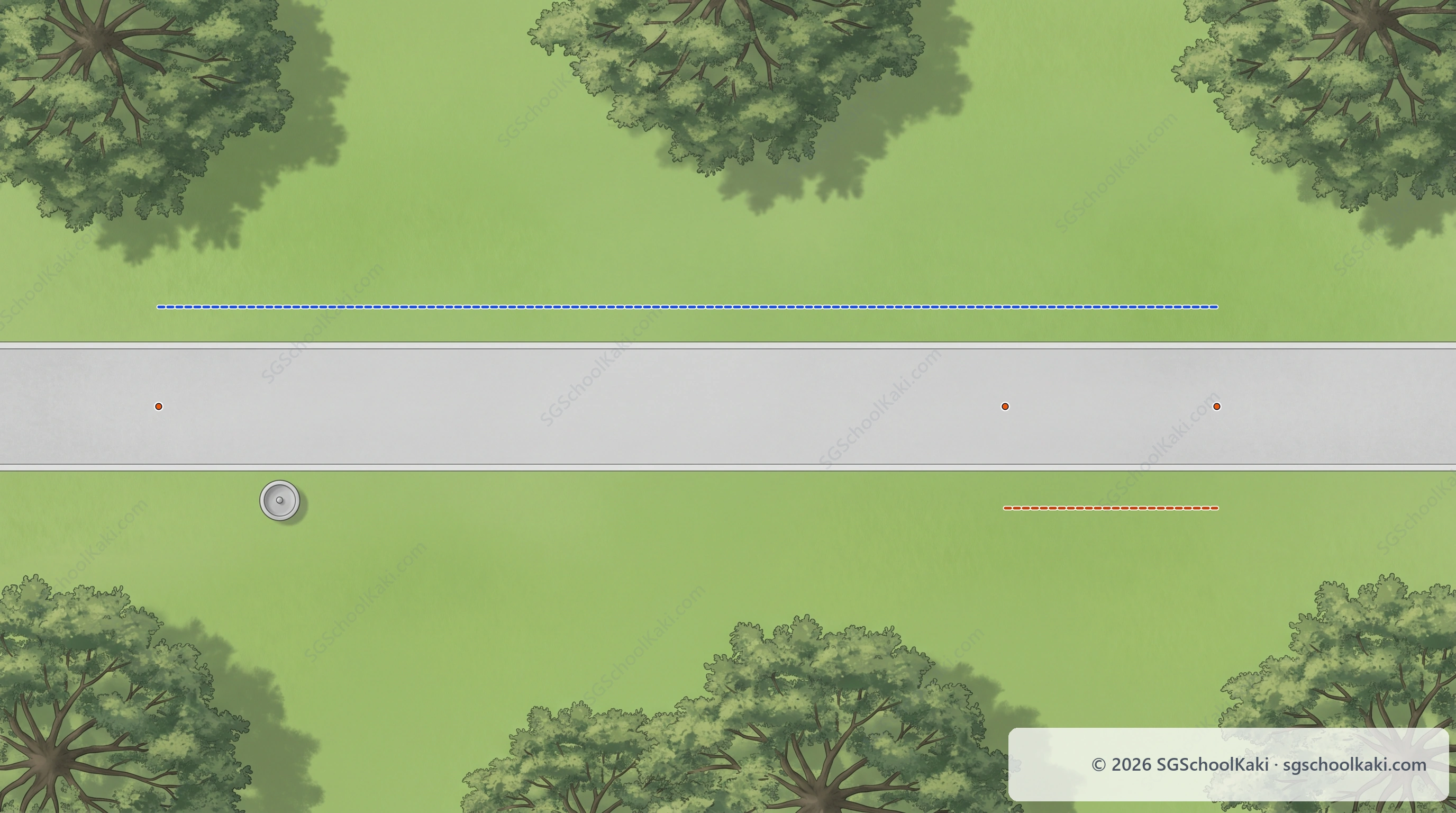
OAB200 m40 mplan view
Maths In Real Life 2
A jogger on a straight park connector
On a straight path a runner who turns round covers more ground than the final distance from the start suggests: the displacement counts only where she ends up, while the distance counts every metre she ran.
Not in G2 (G3 Additional Maths only): A jogger runs along a straight park connector that starts at a marker post O. Her displacement from O is s metres at time t minutes, where s=10t3−90t2+240t for 0≤t≤5.
(a)Find the times when the jogger is at rest, and her displacement from O at each of those times.
(b)Find her displacement from O between t=0 and t=5, the total distance she runs in that time and her average speed.
Show full solutionHide solution
Colour keythe answer with its unit
(a)
dtds=30t2−180t+240
The velocity is v=dtds, the rate of change of displacement. Differentiate each term: multiply by the power, then lower the power by 1.
30t2−180t+240=0
A particle at rest has velocity 0, so set v=0.
30(t−4)(t−2)=0
Factorise, so that each bracket can be set to 0 on its own.
t=2 or t=4
Each bracket (and each factor containing t) equal to 0 gives a time.
s=10×(2)3−90×(2)2+240×(2)=200
Substitute t=2 into the expression for s.
s=10×(4)3−90×(4)2+240×(4)=160
Substitute t=4 into the expression for s.
(b)
dtds=30t2−180t+240
The velocity is v=dtds, the rate of change of displacement. Differentiate each term: multiply by the power, then lower the power by 1.
30t2−180t+240=0
A particle at rest has velocity 0, so set v=0.
30(t−4)(t−2)=0
Factorise, so that each bracket can be set to 0 on its own.
t=2 or t=4
Each bracket (and each factor containing t) equal to 0 gives a time.
Only the times strictly between t=0 and t=5 matter: the particle changes direction at t=2 and t=4.
s=10×(0)3−90×(0)2+240×(0)=0
Substitute t=0 into the expression for s.
s=10×(2)3−90×(2)2+240×(2)=200
Substitute t=2 into the expression for s.
s=10×(4)3−90×(4)2+240×(4)=160
Substitute t=4 into the expression for s.
s=10×(5)3−90×(5)2+240×(5)=200
Substitute t=5 into the expression for s.
200−0=200
Displacement is the change in position: the position at t=5 minus the position at t=0, with its sign.
d=∣200∣+∣−40∣+∣40∣=200+40+40=280
Distance is the total length of the path: take the size of each stage between turning points, each a positive length, and add them.
average speed=5280=56
Average speed uses distance, not displacement, divided by the time taken.
Answer
(a)t=2 or t=4 min; s=200 m when t=2; s=160 m when t=4
(b)200 m (in the positive direction); 280 m; 56 m min⁻¹
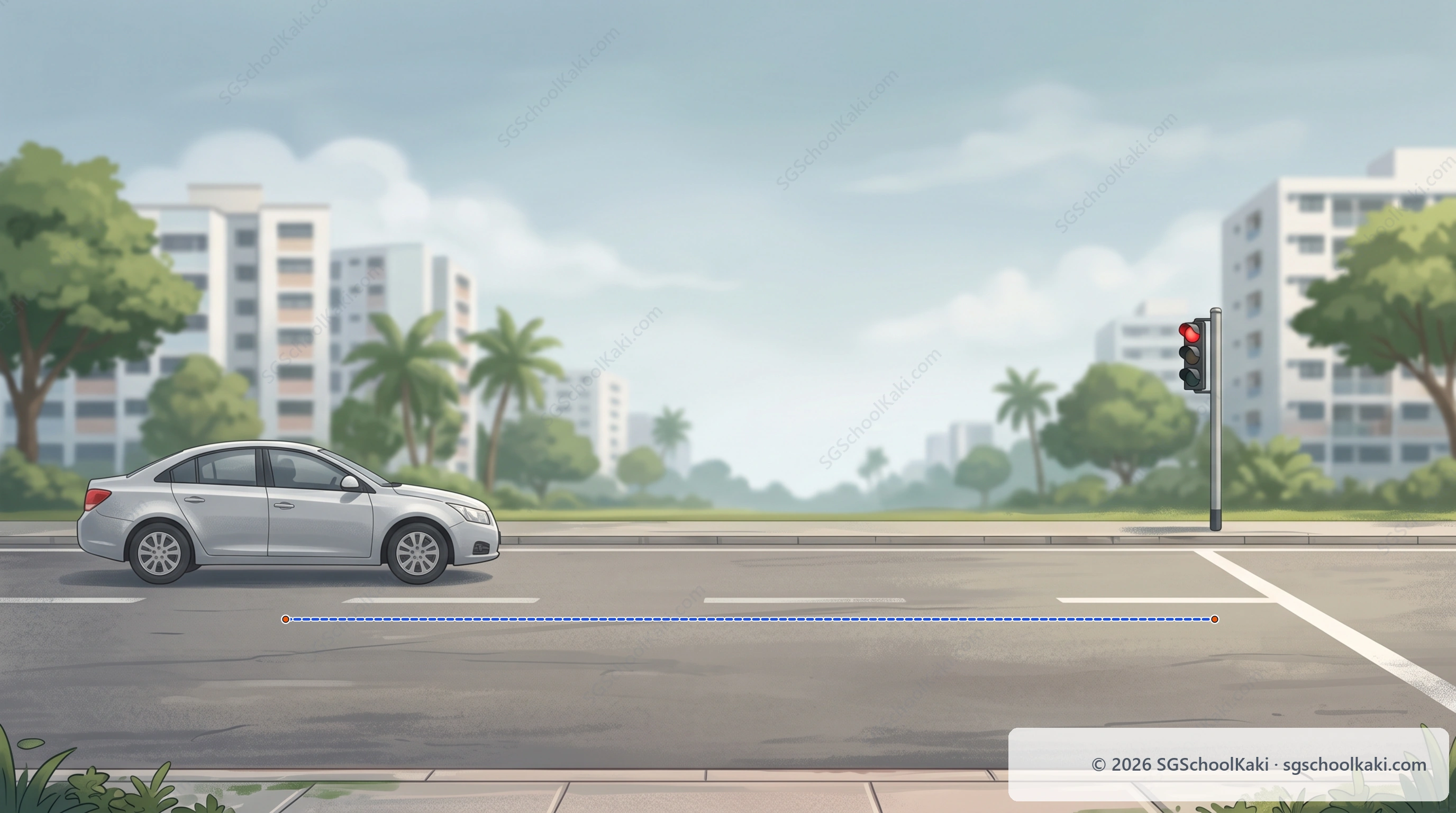
PLroadside view
Maths In Real Life 3
A car slowing for a red light
A driver who sees a red light lifts off the accelerator and brakes smoothly, so the car slows quickly at first and then more gently. An exponential model captures this: the velocity falls by the same fraction in equal times.
Not in G2 (G3 Additional Maths only): A car slows down for a red traffic light on a straight road. Let s metres be the distance of the car from the point P where the driver starts to brake, at time t seconds after braking begins. A model for the motion is s=60−60e−4t for t≥0.
(a)Find the velocity of the car at the instant braking begins, when t=0.
(b)Find the velocity and the acceleration of the car when t=3, giving each value exactly and to three significant figures.
(c)Find the distance the car has travelled from P when t=3, giving the value exactly and to three significant figures.
Show full solutionHide solution
Colour keythe answer with its unit
(a)
dtds=15e−4t
The velocity is v=dtds, the rate of change of displacement. For an exponential term, the coefficient of t in the index multiplies the whole term and the index stays the same. A constant term differentiates to 0.
v=15×e−4(0)=15
Put t=0 into the expression for v, then evaluate.
(b)
dtds=15e−4t
The velocity is v=dtds, the rate of change of displacement. For an exponential term, the coefficient of t in the index multiplies the whole term and the index stays the same. A constant term differentiates to 0.
v=15×e−4(3)=e4315
Put t=3 into the expression for v, then evaluate.
dtdv=−415e−4t
The acceleration is a=dtdv, the rate of change of velocity. For an exponential term, the coefficient of t in the index multiplies the whole term and the index stays the same.
a=−415×e−4(3)=−4e4315
Put t=3 into the expression for a, then evaluate.
(c)
s=60−60×e−4(3)=−e4360+60
Put t=3 into the expression for s, then evaluate.
Answer
(a)15 m s⁻¹ when t=0
(b)15e−0.75≈7.09 m s⁻¹ (3 s.f.) when t=3; −3.75e−0.75≈−1.77 m s⁻² (3 s.f.) when t=3
(c)60−60e−0.75≈31.7 m (3 s.f.) when t=3
01
Supports K341-C1-18
From displacement to velocity and acceleration
Not in G2 (G3 Additional Maths only): kinematics, the study of straight-line motion by calculus, is G3 Additional Maths only. Everything in this chapter uses differentiation and integration, and no special motion formulas are needed.
Revision. You differentiated powers of t and exponentials ekt in Chapter 11. That is all this section needs: a rate of change is a derivative.
A particle moves along a straight line through a fixed point O. Its displacements is its position measured from O, in metres: positive on one side of O, negative on the other. The time t is in seconds and starts at t=0. The velocityv is how fast s is changing, and the accelerationa is how fast v is changing.
The Core Idea
Differentiate once for velocity, twice for acceleration.
v=dtds,a=dtdv=dt2d2s Velocity is in m s⁻¹ and acceleration is in m s⁻². A negative v means the particle is moving in the negative direction.
Example 1.1
Velocity and acceleration from a displacement function
A particle moves along a straight line. Its displacement from a fixed point O is s metres at time t seconds, where s=2t3−12t2+18t+4 for t≥0. Find expressions for the velocity v and the acceleration a of the particle at time t.
Show solutionHide solution
Colour keythe answer with its unit
dtds=6t2−24t+18
The velocity is v=dtds, the rate of change of displacement. Differentiate each term: multiply by the power, then lower the power by 1. A constant term differentiates to 0.
dtdv=12t−24
The acceleration is a=dtdv, the rate of change of velocity. Differentiate each term: multiply by the power, then lower the power by 1. A constant term differentiates to 0.
Answer
v=6t2−24t+18 (m s⁻¹, for t≥0); a=12t−24 (m s⁻², for t≥0)
SGSchoolKaki Tip
Differentiate first, then substitute. Putting a value of t into s gives the position at that moment, which is just a number, and a number differentiates to 0. Find the expressions for v and a first, then put in the time.
Example 1.2
Velocity and acceleration at a given time
A particle moves along a straight line. Its displacement from a fixed point O is s metres at time t seconds, where s=3t3−29t2+20t for t≥0. Find the velocity and the acceleration of the particle when t=6.
Show solutionHide solution
Colour keythe answer with its unit
dtds=t2−9t+20
The velocity is v=dtds, the rate of change of displacement. Differentiate each term: multiply by the power, then lower the power by 1.
v=(6)2−9×(6)+20=2
Put t=6 into the expression for v, then evaluate.
dtdv=2t−9
The acceleration is a=dtdv, the rate of change of velocity. Differentiate each term: multiply by the power, then lower the power by 1. A constant term differentiates to 0.
a=2×(6)−9=3
Put t=6 into the expression for a, then evaluate.
Answer
2 m s⁻¹ when t=6; 3 m s⁻² when t=6
The sign of an answer carries meaning. If v is negative the particle is moving towards the negative side of O, and if a is negative the velocity is decreasing. Give each value with its unit.
The table shows how each kind of term behaves. A term such as tk is first written as kt−1, so the power rule applies.
From s to v to a, term by term
Term in the displacement s
Velocity v (the derivative of s)
Acceleration a (the derivative of v)
ktn
nktn−1
n(n−1)ktn−2
tk, written kt−1
−t2k
t32k
Aept
pAept
p2Aept
a constant c
0
0
Example 1.3
A displacement with a reciprocal term
A particle moves along a straight line. Its displacement from a fixed point O is s metres at time t seconds, where s=t2+t8 for t>0. Find expressions for the velocity and the acceleration at time t, and find the velocity when t=2.
Show solutionHide solution
Colour keythe answer with its unit
dtds=2t−t28
The velocity is v=dtds, the rate of change of displacement. Differentiate each term: multiply by the power, then lower the power by 1.
dtdv=2+t316
The acceleration is a=dtdv, the rate of change of velocity. Differentiate each term: multiply by the power, then lower the power by 1.
v=2×(2)−(2)28=2
Put t=2 into the expression for v, then evaluate.
Answer
v=2t−t28 (m s⁻¹, for t>0); a=2+t316 (m s⁻², for t>0); 2 m s⁻¹ when t=2
Think About It
Can a particle have acceleration 0 and still be moving? Test it with s=5t+7.
Show the full workingHide the working
v=dtds=5
Differentiate the displacement: v is the rate of change of s.
a=dtdv=0
Differentiate the velocity: a constant velocity has rate of change 0.
Answer
Yes. Here a=0 for every t, but v=5 m s⁻¹ all the time, so the particle keeps moving at a steady 5 m s⁻¹. An acceleration of 0 says only that the velocity is not changing; it does not say that the velocity is 0.
A particle that slows down smoothly often has a displacement with a term e−kt. Differentiating multiplies by the coefficient of t in the index each time, so v and a are again multiples of e−kt. The value at a given time is then not a whole number, so give it exactly and to three significant figures.
Example 1.4
A braking motion with an exponential displacement
A toy car is pushed along a straight track and slows down. Its displacement from the starting point is s metres at time t seconds, where s=40−40e−2t for t≥0. Find expressions for the velocity and the acceleration at time t, and find the velocity when t=2, giving the exact value and the value to three significant figures.
Show solutionHide solution
Colour keythe answer with its unit
dtds=20e−2t
The velocity is v=dtds, the rate of change of displacement. For an exponential term, the coefficient of t in the index multiplies the whole term and the index stays the same. A constant term differentiates to 0.
dtdv=−10e−2t
The acceleration is a=dtdv, the rate of change of velocity. For an exponential term, the coefficient of t in the index multiplies the whole term and the index stays the same.
v=20×e−2(2)=20e−1
Put t=2 into the expression for v, then evaluate.
Answer
v=20e−2t (m s⁻¹, for t≥0); a=−10e−2t (m s⁻², for t≥0); 20e−1≈7.36 m s⁻¹ (3 s.f.) when t=2
Do not lose the sign of the index. In s=A−Ae−kt the derivative of e−kt is −ke−kt, so the two minus signs make v positive, while a is negative: the particle moves forward and is slowing down.
Example 1.5
Initial velocity and acceleration with an exponential term
A particle moves along a straight line. Its displacement from a fixed point O is s metres at time t seconds, where s=5t+3e−2t for t≥0. Find the velocity and the acceleration at the instant the motion starts, when t=0.
Show solutionHide solution
Colour keythe answer with its unit
dtds=5−6e−2t
The velocity is v=dtds, the rate of change of displacement. Differentiate each term: multiply by the power, then lower the power by 1. For an exponential term, the coefficient of t in the index multiplies the whole term and the index stays the same.
v=5−6×e−2×(0)=−1
Put t=0 into the expression for v, then evaluate.
dtdv=12e−2t
The acceleration is a=dtdv, the rate of change of velocity. For an exponential term, the coefficient of t in the index multiplies the whole term and the index stays the same. A constant term differentiates to 0.
From acceleration and velocity back to displacement
Not in G2 (G3 Additional Maths only): Kinematics is G3 Additional Maths only (syllabus item C1-18), so everything in this chapter is not examined at G2.
Differentiation takes a displacement s to a velocity v and then to an acceleration a. Integration runs the same chain backwards: from an acceleration to a velocity, and from a velocity to a displacement. Every integration brings a constant of integration, so you need a starting value, such as the velocity or the position at one particular time, to find it. Nothing else is needed: there is no separate formula to learn, because even a constant acceleration is simply the function a= a number, integrated like any other function.
The Core Idea
Integrate to go back, and use a starting value to find each constant.
Velocity from acceleration: v=∫adt. Displacement from velocity: s=∫vdt. Each indefinite integral brings one constant c. A question with an acceleration needs two integrations, each with its own constant, found one after the other: use the starting velocity for the first constant and the starting position for the second. The time of the starting value is usually t=0, but it can be any time the question gives.
Revision. From Chapter 14. ∫xndx=n+1xn+1+c for n=−1, ∫ekxdx=k1ekx+c, and a constant of integration is found by substituting a point on the curve.
Example 2.1
Displacement from velocity with a starting position
A particle moves in a straight line. Its velocity is v=3t2−33t+54 m s⁻¹ at time t seconds, and its displacement from a fixed point O is 2 m when t=0. Find an expression for the displacement s metres in terms of t, the acceleration, and the displacement when t=3.
Show solutionHide solution
Colour keya value substituted or a piece of the journeythe answer with its unit
∫3t2dt=2+13t2+1
Add 1 to the power, then divide by the new power. The constant multiplier stays in front.
=t3
Simplify.
∫−33tdt=1+1−33t1+1
Add 1 to the power, then divide by the new power. The constant multiplier stays in front.
=−233t2
Simplify.
∫54dt=54t
The integral of a constant k is kt.
s=t3−233t2+54t+c
Add the integrals of the terms and write one constant of integration c at the end.
c=2
At t=0 every term of the integral is 0, so c is the starting value of s.
s=t3−233t2+54t+2
Put the constant back.
dtdv=6t−33
The acceleration is a=dtdv, the rate of change of velocity. Differentiate each term: multiply by the power, then lower the power by 1. A constant term differentiates to 0.
s=(3)3−233×(3)2+54×(3)+2=285
Put t=3 into the expression for s, then evaluate.
Answer
s=t3−233t2+54t+2 (m, for t≥0); a=6t−33 (m s⁻², for t≥0); 42.5 m when t=3
SGSchoolKaki Tip
Put the starting values in straight away. After integrating, substitute the given time and displacement to find c before you do anything else with s; a constant you forget to find makes every later value wrong. Check by differentiating: your s must give back the velocity you were given.
Example 2.2
Two integrations with two starting values
A particle moves in a straight line. Its acceleration is a=−6t+18 m s⁻² at time t seconds. When t=0 its velocity is −6 m s⁻¹ and its displacement from a fixed point O is 4 m. Find expressions for the velocity v and the displacement s in terms of t.
Show solutionHide solution
Colour keya value substituted or a piece of the journeythe answer with its unit
∫−6tdt=1+1−6t1+1
Add 1 to the power, then divide by the new power. The constant multiplier stays in front.
=−3t2
Simplify.
∫18dt=18t
The integral of a constant k is kt.
v=−3t2+18t+c
Add the integrals of the terms and write one constant of integration c at the end.
c=−6
At t=0 every term of the integral is 0, so c is the starting value of v.
v=−3t2+18t−6
Put the constant back.
∫−3t2dt=2+1−3t2+1
Add 1 to the power, then divide by the new power. The constant multiplier stays in front.
=−t3
Simplify.
∫18tdt=1+118t1+1
Add 1 to the power, then divide by the new power. The constant multiplier stays in front.
=9t2
Simplify.
∫−6dt=−6t
The integral of a constant k is kt.
s=−t3+9t2−6t+c
Add the integrals of the terms and write one constant of integration c at the end.
c=4
At t=0 every term of the integral is 0, so c is the starting value of s.
s=−t3+9t2−6t+4
Put the constant back.
Answer
v=−3t2+18t−6 (m s⁻¹, for t≥0); s=−t3+9t2−6t+4 (m, for t≥0)
Two integrations, two constants. The first constant belongs to v and is found from the starting velocity; the second belongs to s and is found from the starting position. Do not use the starting position for the first constant, and never leave c in the velocity when you integrate it again.
Example 2.3
A constant deceleration found by integration
A particle moves in a straight line. Its acceleration is −3 m s⁻² at every time t≥0 seconds. When t=0 its velocity is 12 m s⁻¹ and its displacement from a fixed point O is 0 m. Find expressions for v and s in terms of t, and the velocity when t=2.
Show solutionHide solution
Colour keya value substituted or a piece of the journeythe answer with its unit
v=−3t+c
The integral of a constant k is kt.
c=12
At t=0 every term of the integral is 0, so c is the starting value of v.
v=−3t+12
Put the constant back.
∫−3tdt=1+1−3t1+1
Add 1 to the power, then divide by the new power. The constant multiplier stays in front.
=−23t2
Simplify.
∫12dt=12t
The integral of a constant k is kt.
s=−23t2+12t+c
Add the integrals of the terms and write one constant of integration c at the end.
c=0
At t=0 every term of the integral is 0, so c is the starting value of s.
s=−23t2+12t
Put the constant back.
v=−3×(2)+12=6
Put t=2 into the expression for v, then evaluate.
Answer
v=−3t+12 (m s⁻¹, for t≥0); s=−23t2+12t (m, for t≥0); 6 m s⁻¹ when t=2
Think About It
Why does a velocity v=4t+1 give many displacement functions, and what picks one of them? The particle is 7 m from O when t=0.
Show the full workingHide the working
s=∫(4t+1)dt=2t2+t+c
Integrating gives an arbitrary constant c: any constant has derivative 0, so it does not change the velocity.
s=2t2+t+3
Choose c to be a second value: this is a different displacement function.
dtds=4t+1
Differentiate it: the constant disappears and the velocity is the same as before.
7=0+c
A starting position fixes c: put t=0 and the given displacement into s=2t2+t+c.
c=7
Only one value of c fits the starting position.
Answer
Every value of c gives dtds=4t+1, because the derivative of a constant is 0, so the velocity alone cannot say where the particle is. A starting value such as s=7 when t=0 gives c=7 and picks exactly one displacement function.
Example 2.4
Integrating a velocity with an exponential term
A particle moves in a straight line. Its velocity is v=6e−2t m s⁻¹ at time t seconds, and its displacement from a fixed point O is 1 m when t=0. Find an expression for s in terms of t and the displacement when t=1, giving the exact value and the value to 3 significant figures.
Show solutionHide solution
Colour keythe answer with its unit
s=−3e−2t+c
The integral of eax+b is a1eax+b: divide by the coefficient of x, which is −2. The constant multiplier stays in front.
1=−3+c
Use the given value: s=1 when t=0.
c=4
Solve for c.
s=4−3e−2t
Put the constant back.
s=4−3×e−2×(1)=−3e−2+4
Put t=1 into the expression for s, then evaluate.
Answer
s=4−3e−2t (m, for t≥0); 4−3e−2≈3.59 m (3 s.f.) when t=1
SGSchoolKaki Tip
A velocity of the form v=ke−at, with a>0, never reaches 0. The factor e−at is always positive, so the particle is never at rest, and its displacement keeps changing in one direction towards a limit. Keep e exact in the answer and give a decimal only to the accuracy the question asks for.
Example 2.5
A starting value given at a time other than t = 0
A particle moves in a straight line. Its velocity is v=3t2−8t+4 m s⁻¹ at time t seconds. The displacement of the particle from a fixed point O is 5 m when t=2. Find an expression for the displacement s metres in terms of t, and an expression for the acceleration.
Show solutionHide solution
Colour keya value substituted or a piece of the journeythe answer with its unit
∫3t2dt=2+13t2+1
Add 1 to the power, then divide by the new power. The constant multiplier stays in front.
=t3
Simplify.
∫−8tdt=1+1−8t1+1
Add 1 to the power, then divide by the new power. The constant multiplier stays in front.
=−4t2
Simplify.
∫4dt=4t
The integral of a constant k is kt.
s=t3−4t2+4t+c
Add the integrals of the terms and write one constant of integration c at the end.
5=(2)3−4×(2)2+4×(2)+c
Use the given value: s=5 when t=2.
c=5
Solve for c.
s=t3−4t2+4t+5
Put the constant back.
dtdv=6t−8
The acceleration is a=dtdv, the rate of change of velocity. Differentiate each term: multiply by the power, then lower the power by 1. A constant term differentiates to 0.
Answer
s=t3−4t2+4t+5 (m, for t≥0); a=6t−8 (m s⁻², for t≥0)
Links To
The rules for integrating powers and exponentials, and finding c from a point, are in Chapter 14. Chapter 14: Integration
03
Supports K341-C1-18
At rest, greatest velocity and increasing velocity
Not in G2 (G3 Additional Maths only): finding when a particle is at rest, its greatest velocity and when its velocity is increasing are G3 Additional Maths only.
A particle is at rest at an instant when its velocity is 0. To find these instants, differentiate to get v, put v=0 and solve for t. Time starts at t=0, so a negative root is rejected, with the reason stated.
The Core Idea
At rest means v=0.
v=0⟺dtds=0 Solve for t, keep only t≥0, then put each time into s for the position and into a for the acceleration there. At rest does not mean a=0.
Example 3.1
When is the particle at rest?
A particle moves along a straight line. Its displacement from a fixed point O is s metres at time t seconds, where s=2t3−27t2+84t+80 for t≥0. Find the times when the particle is at rest, its displacement from O at each of these times and its acceleration at each of these times.
Show solutionHide solution
Colour keythe answer with its unit
dtds=6t2−54t+84
The velocity is v=dtds, the rate of change of displacement. Differentiate each term: multiply by the power, then lower the power by 1. A constant term differentiates to 0.
6t2−54t+84=0
A particle at rest has velocity 0, so set v=0.
6(t−7)(t−2)=0
Factorise, so that each bracket can be set to 0 on its own.
t=2 or t=7
Each bracket (and each factor containing t) equal to 0 gives a time.
s=2×(2)3−27×(2)2+84×(2)+80=156
Substitute t=2 into the expression for s.
s=2×(7)3−27×(7)2+84×(7)+80=31
Substitute t=7 into the expression for s.
dtdv=12t−54
The acceleration is a=dtdv, the rate of change of velocity. Differentiate each term: multiply by the power, then lower the power by 1. A constant term differentiates to 0.
a=12×(2)−54=−30
Substitute t=2 into a.
a=12×(7)−54=30
Substitute t=7 into a.
the path of the particle on a line through O: each arc is one stage of the motion, with an arrow for the direction of travel; the dots are the start and the times when v=0
Answer
t=2 or t=7 s; s=156 m when t=2; s=31 m when t=7; a=−30 m s⁻² when t=2; a=30 m s⁻² when t=7
SGSchoolKaki Tip
The position at a rest time is a turning point of the path. The particle stops there and changes direction, so the rest positions are the furthest points it reaches before turning back. (This holds whenever v changes sign at the rest time, as it does in every Example here. If v has a repeated root the particle pauses and then carries on the same way.)
Example 3.2
A rest time that is not allowed
A particle moves along a straight line. Its displacement from a fixed point O is s metres at time t seconds, where s=t3−3t2−9t+7 for t≥0. Find the time when the particle is at rest and its displacement from O at that time.
Show solutionHide solution
Colour keythe answer with its unit
dtds=3t2−6t−9
The velocity is v=dtds, the rate of change of displacement. Differentiate each term: multiply by the power, then lower the power by 1. A constant term differentiates to 0.
3t2−6t−9=0
A particle at rest has velocity 0, so set v=0.
3(t−3)(t+1)=0
Factorise, so that each bracket can be set to 0 on its own.
t=−1 or t=3
Each bracket (and each factor containing t) equal to 0 gives a time.
Time cannot be negative, so we reject t=−1: the particle is at rest when t=3.
s=(3)3−3×(3)2−9×(3)+7=−20
Substitute t=3 into the expression for s.
the path of the particle on a line through O: each arc is one stage of the motion, with an arrow for the direction of travel; the dots are the start and the times when v=0
Answer
t=3 s; s=−20 m when t=3
Think About It
At the instant when v=0 the particle is at rest. Is a also 0 at that instant? Test it with s=t3−6t2+9t.
Show the full workingHide the working
dtds=3t2−12t+9=3(t−3)(t−1)
Differentiate, then factorise so that the times when v=0 can be read off.
3(t−3)(t−1)=0⟺t=1 or t=3
Each bracket equal to 0 gives a time at rest.
dtdv=6t−12
Differentiate the velocity to get the acceleration.
a=6×(1)−12=−6
Put t=1 into a: this is the acceleration at the first rest time.
a=6×(3)−12=6
Put t=3 into a: this is the acceleration at the second rest time.
Answer
No. At t=1 the acceleration is −6 m s⁻² and at t=3 it is 6 m s⁻². The particle is only at rest for an instant: the velocity is changing sign, so the particle turns round.
The signs of v and a together describe the motion. Speeding up means v and a have the same sign; slowing down means they have opposite signs.
What the signs of v and a tell you
Signs
What the particle does
Picture
v>0 and a>0
Moving in the positive direction and speeding up.
equal time steps: the gaps grow
v>0 and a<0
Moving in the positive direction and slowing down.
equal time steps: the gaps shrink
v<0 and a<0
Moving in the negative direction and speeding up.
moving left: the gaps grow
v<0 and a>0
Moving in the negative direction and slowing down.
moving left: the gaps shrink
v=0 and a=0
At rest for an instant, then turning round.
out to the turning time, then back
The Core Idea
The velocity is greatest or least where a=0.
a=dtdv=0then test withdtda If dtda<0 the velocity has its greatest value there; if dtda>0 it has its least value. Put the time into v to find the value.
Example 3.3
Greatest velocity and when it occurs
A particle moves along a straight line. Its displacement from a fixed point O is s metres at time t seconds, where s=−t3+6t2+t for t≥0. Find expressions for the velocity and the acceleration, the time when the velocity is greatest and the greatest velocity.
Show solutionHide solution
Colour keythe answer with its unit
dtds=−3t2+12t+1
The velocity is v=dtds, the rate of change of displacement. Differentiate each term: multiply by the power, then lower the power by 1.
dtdv=−6t+12
The acceleration is a=dtdv, the rate of change of velocity. Differentiate each term: multiply by the power, then lower the power by 1. A constant term differentiates to 0.
a=−6t+12=0
The velocity has a greatest or least value when its rate of change, the acceleration, is 0.
−6t+12=0
Factorise, so that each bracket can be set to 0 on its own.
t=2
Solve.
dtda=−6
Differentiate the acceleration once more to test the stationary value of v.
dtda=−6<0
When t=2, a negative rate of change of acceleration means the velocity has a maximum.
v=−3×(2)2+12×(2)+1=13
Put t=2 into the expression for v, then evaluate.
Answer
v=−3t2+12t+1, a=−6t+12; t=2 s: the velocity is greatest; 13 m s⁻¹: greatest velocity, at t=2
a=0 does not mean the particle is at rest. At the greatest or least velocity the acceleration is 0 but the velocity is not. Set v=0 to find when the particle is at rest, and set a=0 to find when the velocity is greatest or least.
Example 3.4
Least velocity and when it occurs
A particle moves along a straight line. Its displacement from a fixed point O is s metres at time t seconds, where s=2t3−12t2+30t for t≥0. Find expressions for the velocity and the acceleration, the time when the velocity is least and the least velocity.
Show solutionHide solution
Colour keythe answer with its unit
dtds=6t2−24t+30
The velocity is v=dtds, the rate of change of displacement. Differentiate each term: multiply by the power, then lower the power by 1.
dtdv=12t−24
The acceleration is a=dtdv, the rate of change of velocity. Differentiate each term: multiply by the power, then lower the power by 1. A constant term differentiates to 0.
a=12t−24=0
The velocity has a greatest or least value when its rate of change, the acceleration, is 0.
12t−24=0
Factorise, so that each bracket can be set to 0 on its own.
t=2
Solve.
dtda=12
Differentiate the acceleration once more to test the stationary value of v.
dtda=12>0
When t=2, a positive rate of change of acceleration means the velocity has a minimum.
v=6×(2)2−24×(2)+30=6
Put t=2 into the expression for v, then evaluate.
Answer
v=6t2−24t+30, a=12t−24; t=2 s: the velocity is least; 6 m s⁻¹: least velocity, at t=2
The velocity is increasing exactly when its rate of change is positive, that is when a>0. This is an inequality in t, and the answer is a range of times with t≥0.
Example 3.5
When is the velocity increasing?
A particle moves along a straight line. Its displacement from a fixed point O is s metres at time t seconds, where s=t3−9t2+15t for t≥0. Find an expression for the acceleration, and the values of t for which the velocity is increasing.
Show solutionHide solution
Colour keythe answer with its unit
dtds=3t2−18t+15
The velocity is v=dtds, the rate of change of displacement. Differentiate each term: multiply by the power, then lower the power by 1.
dtdv=6t−18
The acceleration is a=dtdv, the rate of change of velocity. Differentiate each term: multiply by the power, then lower the power by 1. A constant term differentiates to 0.
6t−18>0
The velocity is increasing exactly when its rate of change, the acceleration, is positive.
t>3
Solve the inequality for t; divide by the coefficient of t, reversing the inequality when it is negative.
Answer
v=3t2−18t+15, a=6t−18; t>3 (s): the velocity is increasing
Velocity increasing is not the same as speeding up. If v is negative and a is positive, the velocity is increasing towards 0, but the particle is slowing down. Speed depends on the size of v; the velocity increases when a>0.
A condition such as v>c is a quadratic inequality in t when s is a cubic. Write it as a quadratic compared with 0, factorise, find the two critical times, and use the shape of the graph to decide where the quadratic has the required sign.
Example 3.6
A condition on the velocity
A particle moves along a straight line. Its displacement from a fixed point O is s metres at time t seconds, where s=2t3−39t2+216t for t≥0. Find the values of t for which the velocity is greater than 36 m s⁻¹.
Show solutionHide solution
Colour keythe answer with its unit
dtds=6t2−78t+216
The velocity is v=dtds, the rate of change of displacement. Differentiate each term: multiply by the power, then lower the power by 1.
6t2−78t+216>36
Write the condition on the velocity as an inequality in t.
6t2−78t+180>0
Move everything to one side.
6(t−10)(t−3)>0
Factorise.
The quadratic is 0 when t=3 or t=10, and its sign can change only at these two values.
Setting each factor to 0 gives the values where the sign can change.
Sketch the quadratic: the graph of y=6t2−78t+180 is a ∪-shaped curve (positive coefficient of t2), so it is above the t-axis outside the roots.