








SILE Approved Overseas Law Schools 2026:
The Complete List for Singapore Bar Admission
Every university recognised under the Legal Profession (Qualified Persons) Rules for admission to practise law in Singapore.
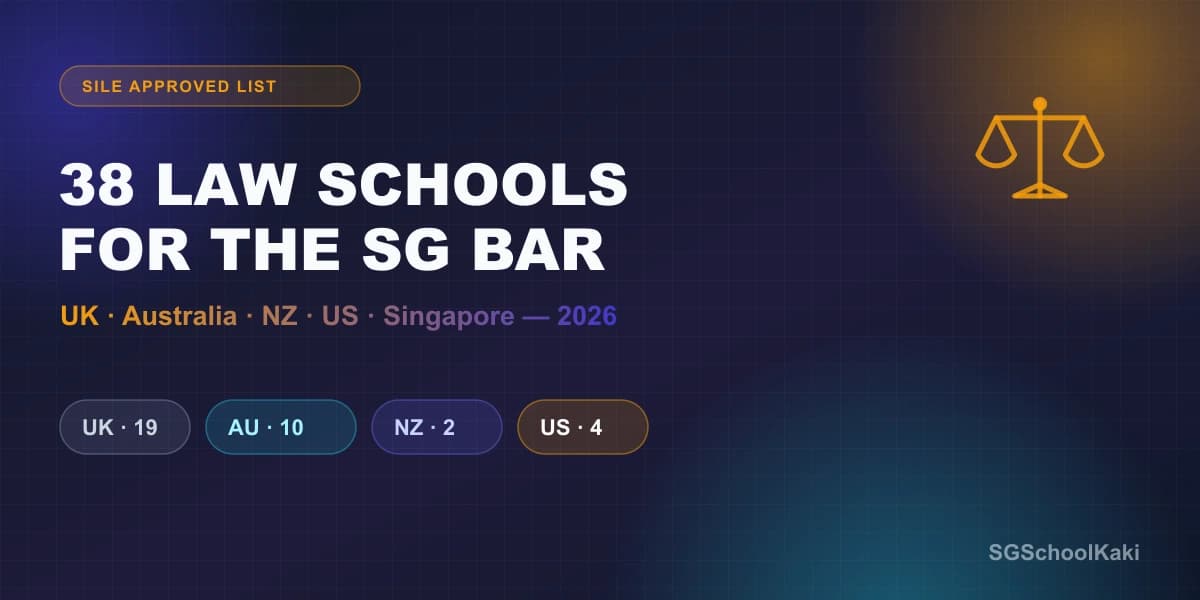
38 universities are currently recognised for admission to the Singapore Bar under the Legal Profession (Qualified Persons) Rules[1]: 35 overseas (19 in the UK, 10 in Australia, 2 in New Zealand, 4 in the US) plus Singapore's own 3 (NUS, SMU, SUSS)[2].
A degree from one of these institutions only makes you a “qualified person.”You still need to pass the Bar Examinations and complete practice training before you can be admitted — covered in the “Beyond the University List” section below.
Quick Navigation
At a Glance
 United Kingdom— 19 universities
All 19 require at least lower second-class honours (2:2) or the equivalent. But only the 11 First Schedule universities are open to students admitted today. The 8 Second Scheduleuniversities are a closed, legacy route — only candidates who were admitted to their law degree before 1 October 2015 still qualify under it[1].
| Institution | Schedule | Approved Degree | Minimum Requirement | Status |
|---|---|---|---|---|
| University of Birmingham | First Schedule | LL.B (Honours) | Lower second-class honours or equivalent Degree conferred on/after 1 Jan 1997 | Open to new entrants |
| University of Bristol | First Schedule | LL.B (Single Honours) | Lower second-class honours or equivalent Degree conferred on/after 1 Jan 1997 | Open to new entrants |
| University of Cambridge | First Schedule | B.A. Law | Lower second-class honours or equivalent Degree conferred on/after 1 Jan 1997 | Open to new entrants |
| University of Durham | First Schedule | LL.B (Honours) | Lower second-class honours or equivalent Degree conferred on/after 1 Jan 1997 | Open to new entrants |
| King's College London | First Schedule | LL.B (Honours) | Lower second-class honours or equivalent Degree conferred on/after 1 Jan 1997 | Open to new entrants |
| London School of Economics and Political Science (LSE) | First Schedule | LL.B (Honours) | Lower second-class honours or equivalent Degree conferred on/after 1 Jan 1997 | Open to new entrants |
| Queen Mary University of London | First Schedule | LL.B (Honours) | Lower second-class honours or equivalent Degree conferred on/after 1 Jan 1997 | Open to new entrants |
| University College London | First Schedule | LL.B (Honours) | Lower second-class honours or equivalent Degree conferred on/after 1 Jan 1997 | Open to new entrants |
| University of Nottingham | First Schedule | LL.B (Honours) | Lower second-class honours or equivalent Degree conferred on/after 1 Jan 1997 | Open to new entrants |
| University of Oxford | First Schedule | B.A. (Honours) Jurisprudence | Lower second-class honours or equivalent Degree conferred on/after 1 Jan 1997 | Open to new entrants |
| University of Warwick | First Schedule | LL.B (Honours) | Lower second-class honours or equivalent Degree conferred on/after 1 Jan 1997 | Open to new entrants |
| University of Exeter | Second Schedule | LL.B (Honours) | Lower second-class honours or equivalent Only if admitted before 1 Oct 2015; degree conferred 1997–2025 | Legacy (closed) |
| University of Leeds | Second Schedule | LL.B (Honours) | Lower second-class honours or equivalent Only if admitted before 1 Oct 2015; degree conferred 1997–2025 | Legacy (closed) |
| University of Leicester | Second Schedule | LL.B (Honours) | Lower second-class honours or equivalent Only if admitted before 1 Oct 2015; degree conferred 1997–2025 | Legacy (closed) |
| University of Liverpool | Second Schedule | LL.B (Honours) | Lower second-class honours or equivalent Only if admitted before 1 Oct 2015; degree conferred 1997–2025 | Legacy (closed) |
| School of Oriental and African Studies, University of London | Second Schedule | LL.B (Honours) | Lower second-class honours or equivalent Only if admitted before 1 Oct 2015; degree conferred 1997–2025 | Legacy (closed) |
| University of Manchester | Second Schedule | LL.B (Honours) | Lower second-class honours or equivalent Only if admitted before 1 Oct 2015; degree conferred 1997–2025 | Legacy (closed) |
| University of Sheffield | Second Schedule | LL.B (Honours) | Lower second-class honours or equivalent Only if admitted before 1 Oct 2015; degree conferred 1997–2025 | Legacy (closed) |
| University of Southampton | Second Schedule | LL.B (Honours) | Lower second-class honours or equivalent Only if admitted before 1 Oct 2015; degree conferred 1997–2025 | Legacy (closed) |
 Australia— 10 universities
Australian universities use a relative cohort ranking instead of a fixed grade: you must have finished in the highest 70% by academic performanceof your graduating batch. All 10 are currently open to new students — there is no admission cut-off date like the UK Second Schedule[1].
| Institution | Schedule | Approved Degree | Minimum Requirement | Status |
|---|---|---|---|---|
| Monash University | First Schedule | LL.B / LL.B (Hons) / J.D. | Highest 70% by academic performance of the graduating batch LL.B commenced on/after 1 Jan 1994; J.D. conferred on/after 1 Dec 2017 | Open to new entrants |
| University of Melbourne | First Schedule | LL.B / LL.B (Hons) / J.D. | Highest 70% by academic performance of the graduating batch LL.B commenced on/after 1 Jan 1994; J.D. conferred on/after 1 Dec 2017 | Open to new entrants |
| University of New South Wales | First Schedule | LL.B / J.D. | Highest 70% by academic performance of the graduating batch LL.B commenced on/after 1 Jan 1994; J.D. conferred on/after 1 Dec 2017 | Open to new entrants |
| University of Sydney | First Schedule | LL.B / LL.B (Hons) / J.D. | Highest 70% by academic performance of the graduating batch LL.B commenced on/after 1 Jan 1994; J.D. conferred on/after 1 Dec 2017 | Open to new entrants |
| Australian National University | Third Schedule | LL.B / LL.B (Hons) / J.D. | Highest 70% by academic performance of the graduating batch LL.B conferred on/after 28 Jul 2003; J.D. conferred on/after 1 Dec 2017 | Open to new entrants |
| Flinders University | Third Schedule | LL.B / LL.B (Hons) / J.D. | Highest 70% by academic performance of the graduating batch LL.B conferred on/after 28 Jul 2003; J.D. conferred on/after 1 Dec 2017 | Open to new entrants |
| University of Queensland | Third Schedule | LL.B / LL.B (Hons) / J.D. | Highest 70% by academic performance of the graduating batch LL.B conferred on/after 28 Jul 2003; J.D. conferred on/after 1 Dec 2017 | Open to new entrants |
| University of Western Australia | Third Schedule | LL.B / LL.B (Hons) / J.D. | Highest 70% by academic performance of the graduating batch LL.B conferred on/after 28 Jul 2003; J.D. conferred on/after 1 Dec 2017 | Open to new entrants |
| University of Tasmania | Fourth Schedule | LL.B / LL.B (Hons) / J.D. | Highest 70% by academic performance of the graduating batch LL.B conferred on/after 1 Aug 2005; J.D. conferred on/after 1 Dec 2017 | Open to new entrants |
| Murdoch University | Fourth Schedule | LL.B / LL.B (Hons) / J.D. | Highest 70% by academic performance of the graduating batch LL.B conferred on/after 1 Aug 2005; J.D. conferred on/after 1 Dec 2017 | Open to new entrants |
 New Zealand— 2 universities
Only two New Zealand universities are on the list, both requiring the same highest-70%-of-batch ranking as Australia[1].
| Institution | Schedule | Approved Degree | Minimum Requirement | Status |
|---|---|---|---|---|
| University of Auckland | First Schedule | LL.B / LL.B (Hons) | Highest 70% by academic performance of the graduating batch Degree commenced on/after 1 Jan 1994 | Open to new entrants |
| Victoria University of Wellington | First Schedule | LL.B / LL.B (Hons) | Highest 70% by academic performance of the graduating batch Degree commenced on/after 1 Jan 1994 | Open to new entrants |
 United States— 4 universities
Only Juris Doctor (J.D.)graduates from these 4 universities qualify — a US undergraduate law degree does not exist in the same form, so the J.D. is the applicable qualification. The same highest-70% cohort ranking applies[1].
| Institution | Schedule | Approved Degree | Minimum Requirement | Status |
|---|---|---|---|---|
| Harvard University | Fifth Schedule | Doctor of Jurisprudence (J.D.) | Highest 70% by academic performance of the graduating batch J.D. conferred on/after 1 Jan 2004 | Open to new entrants |
| Columbia University | Fifth Schedule | Doctor of Jurisprudence (J.D.) | Highest 70% by academic performance of the graduating batch J.D. conferred on/after 1 Jan 2004 | Open to new entrants |
| New York University | Fifth Schedule | Doctor of Jurisprudence (J.D.) | Highest 70% by academic performance of the graduating batch J.D. conferred on/after 1 Jan 2004 | Open to new entrants |
| University of Michigan | Fifth Schedule | Doctor of Jurisprudence (J.D.) | Highest 70% by academic performance of the graduating batch J.D. conferred on/after 1 Jan 2004 | Open to new entrants |
 Singapore— 3 local universities
Graduates of Singapore's own law schools follow a separate “local graduate” qualified-person route with university-specific thresholds — SMU and SUSS use a GPA cut-off rather than a UK-style degree class[2].
| Institution | Approved Degree | Minimum Requirement |
|---|---|---|
| National University of Singapore | LL.B (Honours) | Passed the final examination and attained at least lower second-class honours |
| National University of Singapore | Doctor of Jurisprudence (J.D.) | Passed the final examination and attained at least a Merit |
| Singapore Management University | LL.B / J.D. | Passed the final examination and attained a grade point average of at least 3.00 |
| Singapore University of Social Sciences | LL.B / J.D. | Passed the final examination and attained a grade point average of at least 3.50 |
Beyond the University List: What Else Is Required
1. Be a “Qualified Person” [3]
Citizen or PR of Singapore, an approved law degree from a scheduled university (the tables above), and the correct degree classification or cohort ranking.
2. Complete 6 Months of Legal Training or Relevant Legal Practice [3]
After passing your final law examinations, overseas graduates must also complete 6 months of relevant legal training, or have been engaged in relevant legal practice or work, before qualifying as a “qualified person.”
3. Pass Part A of the Bar Examinations [4]
A conversion examination required only for graduates of overseas scheduled universities (not Singapore local graduates), testing Singapore-specific law subjects before you can proceed to Part B.
4. Complete the Part B Course & Examinations [5]
Six compulsory modules (Ethics & Professional Responsibility, Corporate & Commercial Practice, Dispute Resolution Practice, Private Client Practice, Contemporary Legal Knowledge & Practice, Professional Skills), examined over 8 days, open-book. Must be passed within 4 consecutive sessions.
5. Complete a 12-Month Practice Training Period [6]
Completed within a continuous 16-month window — under a practice training contract at a Singapore law practice, an in-house qualifying entity (max 3 months), or public service.
6. Meet the Legal Profession Act admission criteria [7]
At least 21 years old, of good character, and having satisfactorily completed the courses and examinations the SILE Board of Directors prescribes.
Cite This Page
SGSchoolKaki. (2026). SILE Approved Overseas Law Schools 2026: The Complete List for Singapore Bar Admission. Retrieved 2026-09-17, from https://sgschoolkaki.com/blog/sile-approved-overseas-law-schools-2026
Frequently Asked Questions
How many overseas law schools are approved for Singapore Bar admission?
35 overseas universities (19 UK, 10 Australia, 2 New Zealand, 4 US) plus 3 Singapore local universities (NUS, SMU, SUSS) — 38 in total, per the SILE schedules current as of 9 October 2025.
Can I practise law in Singapore with a UK law degree?
Only from one of the 19 scheduled UK universities with at least lower second-class honours. 8 of the 19 (Exeter, Leeds, Leicester, Liverpool, SOAS, Manchester, Sheffield, Southampton) are a closed legacy route — you needed to have been admitted before 1 October 2015. The other 11 remain open.
What GPA or class of degree do I need from a US or Australian law school?
There is no fixed GPA. You need to rank in the highest 70% of your graduating batch by academic performance — a relative, cohort-based bar rather than an absolute grade.
Is an approved degree enough to be admitted to the Singapore Bar?
No. It only makes you a “qualified person.” You still need to pass Part A (overseas graduates only), complete the Part B Course & Examinations, and finish a 12-month Practice Training Period within a continuous 16-month window before applying for admission.
Continue Your Research
SMC Recognised Overseas Medical Schools 2026
The medical equivalent of this list — 120 SMC-approved universities
NUS Law A-Level Cut-Off 2026
What A-Level grades you need for NUS Law
NUS vs NTU vs SMU Comparison 2026
How Singapore's autonomous universities compare
Singapore University Scholarships 2026 Guide
Funding pathways for local and overseas study
Private Universities Singapore 2026
Overseas-linked private degree options in Singapore
Singapore University IGP 2026/2027
Indicative Grade Profiles for JC applicants
Official Sources
- [1]SILE — Qualified Person (Overseas Scheduled Universities): UK, Australia, New Zealand & USA tables — page states “Last Updated: 9 October 2025”
- [2]SILE — Qualified Person (Local Universities): NUS, SMU, SUSS
- [3]SILE — Qualified Person overview (for overseas graduates)
- [4]SILE — Part A of the Singapore Bar Examinations
- [5]SILE — Part B Course & Examinations (overseas graduates)
- [6]SILE — Practice Training Period (overseas graduates)
- [7]Ministry of Law — Admission to the Bar: Admission Requirements
- [8]Singapore Statutes Online — Legal Profession (Qualified Persons) Rules (underlying legislation) — the legal instrument that SILE's tables above reproduce
Important Disclaimer
This article is provided for general reference and informational purposes only. The official and legally binding list of approved universities is governed by the Legal Profession (Qualified Persons) Rules, as administered by the Ministry of Law and published by the Singapore Institute of Legal Education (SILE).
Always verify with the official source before making any decisions:
Singapore Institute of Legal Education — Qualified Person (Overseas Scheduled Universities)Liability Notice: SGSchoolKaki, its authors, and affiliates do not assume any responsibility or liability for any errors, omissions, or outcomes arising from the use of this information. Bar admission is a serious legal and career matter. For official guidance, consult SILE or the Ministry of Law directly, or seek professional legal advice.
SGSchoolKaki Education Team
Ex-MOE Teachers, Private Tutors & Education Data Analysts with 15+ Years Combined Experience
Reviewed by: KW Phoon
Founder, BEng(Hons) in Computing Engineering
Data-Driven Education Platform