Chapter 12 · Additional Maths · Applications of differentiation
Stationary points, rates of change and optimisation
A derivative is a gradient, and a gradient tells you where a curve climbs, falls or turns. This chapter puts the rules of chapter 11 to work: the sign of f'(x) shows where a function increases or decreases, f'(x) = 0 finds the stationary points, the second derivative test sorts maxima from minima, tangents and normals follow from the gradient at a point, connected rates link quantities that change together, and maximum and minimum problems find the best value of a real quantity.
Your outcome tracker0 / 6
Let's go! Tick an outcome once you can pass its exam check. Saved on this device.
Chapter 12
Figure 1 · a cubic with a horizontal tangent at its maximum (-1, 2): where the gradient is 0 the curve turns (y = x^3 - 3x)
r = 1y = sin θcos θ
4 outcomes · 1 page · every step shown ✦
Stationary points
Set f'(x) = 0 and solve, then find the y-value. Decide the nature: f'' > 0 minimum, f'' < 0 maximum; if f'' = 0 the test is inconclusive, so check the sign of f' either side.
Rates of change
dtdy=dxdy×dtdx: link the rate you want to the rate you are given through a bridge variable. A decreasing quantity has a negative rate.
Optimisation
Form a function of ONE variable using the constraint, differentiate, set it to 0, then prove the nature with f'' and answer in context with the range of x and the units.
By the end of this chapter
Use the sign of f'(x) to find where a function is increasing or decreasing, and show that a function is always increasing or always decreasing.
Find the stationary points of a curve and decide whether each is a maximum, a minimum or a stationary point of inflexion, by the sign of f' either side or by the second derivative test.
Use the second derivative to say whether a gradient is increasing or decreasing, and know when the second derivative test is inconclusive.
Find the equations of tangents and normals, tangents with a given gradient, and the intercepts and area they cut off.
Solve connected rates of change with dy/dt = dy/dx × dx/dt, taking care with signs and with the reciprocal rate.
Form a one-variable function from a word problem, find its stationary value, and prove it is a maximum or minimum.
✶
Start here
Maths In Real Life
Three situations where a stationary point, a rate or a best value decides what can be built. The pictures come first; the working in each solution comes from the same numbers.
y=32x3−12x2+36x+180 mPQlevel at Plevel at Q
Maths In Real Life 1
A cycle path over a gentle rise
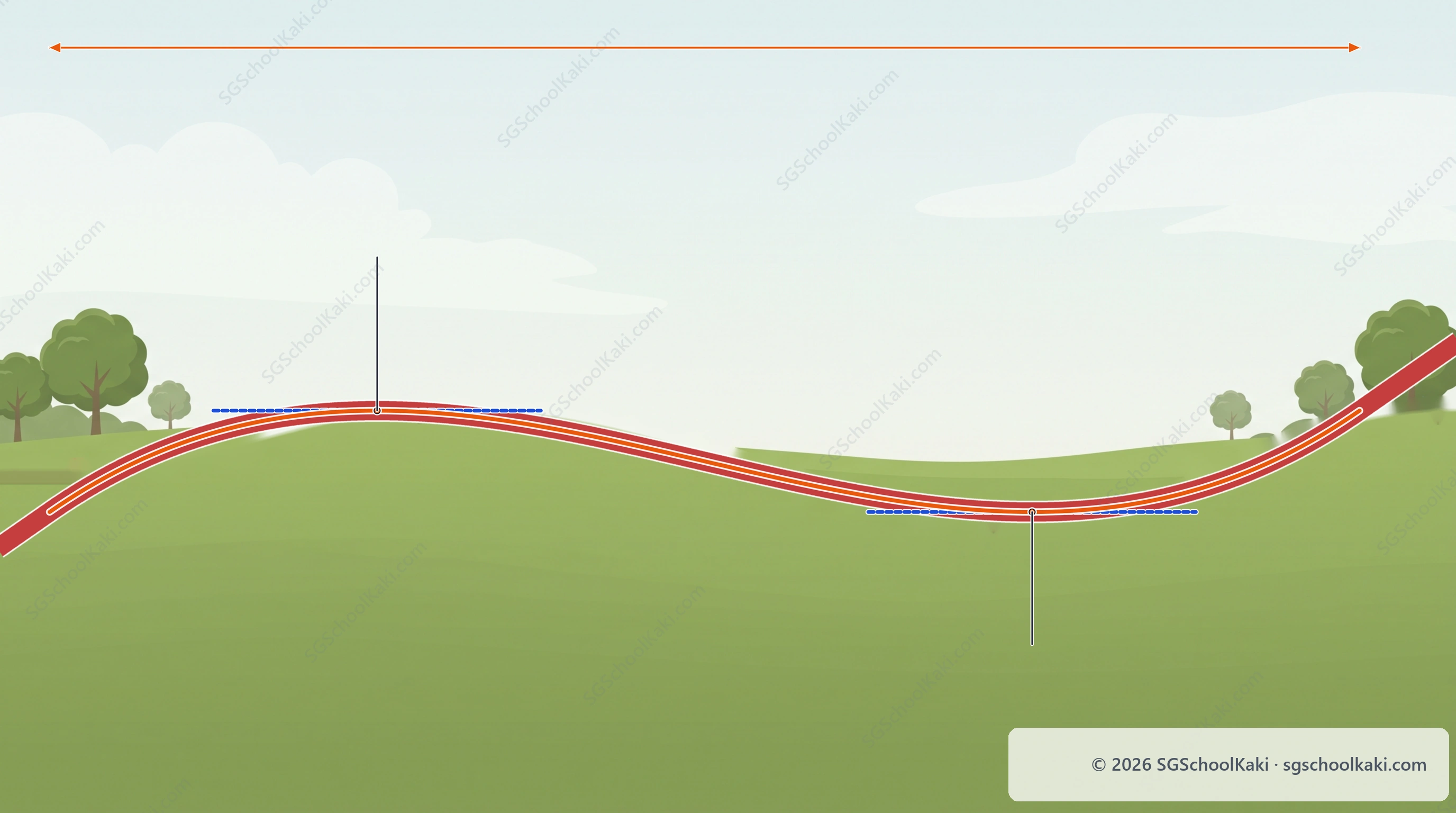
A park-connector path is built over a low rise: it climbs to a crest, dips to a trough and climbs again. At the crest and at the trough the path is level for an instant, so the gradient there is 0. Finding those stationary points tells the designer where a cyclist can coast and where to brake.
A park-connector cycle path is 80 m long. At a distance of x tens of metres from its start, the surface of the path is y metres above the car park, where y=32x3−83x2+89x+1, for 0≤x≤8.
(a)Locate the stationary points of the path, giving each one as a pair of coordinates, and decide the nature of each. Say which is the crest and which is the trough.
(b)Between which values of x is a cyclist riding uphill, and between which downhill?
(c)Find dxdy where x=4 and explain what its sign and size tell the cyclist.
Show full solutionHide solution
Colour keyderivative, y-value or intermediate resultfinal result
(a)
dxd(321x3)=323x2
Multiply the coefficient 321 by the power 3 to get 323, then lower the power to 2.
dxd(−83x2)=−43x
Multiply the coefficient −83 by the power 2 to get −43, then lower the power to 1.
dxd(89x)=89
The power is 1: multiply 89 by 1, and x0 is 1.
dxd(1)=0
The derivative of a constant is 0.
dxdy=323x2−43x+89
Add the derivatives of the terms.
323x2−43x+89=0
At a stationary point the gradient is 0: set the derivative equal to 0.
3(x−6)(x−2)=0⟺x=2 or x=6
Solve the factors: each factor can be zero.
y=32(2)3−83×(2)2+89×(2)+1=2
Put x=2 into the curve to find the y-coordinate.
y=32(6)3−83×(6)2+89×(6)+1=1
Put x=6 into the curve to find the y-coordinate.
Differentiate the first derivative once more.
dxd(323x2)=163x
Multiply by the power and lower the power by 1.
dxd(−43x)=−43
Multiply by the power and lower the power by 1.
dxd(89)=0
Power rule again; a constant term gives 0.
dx2d2y=163x−43
Add the results.
y′′(2)=163×(2)−43=−83
Put x=2 into the second derivative: positive means a minimum, negative a maximum.
y′′(6)=163×(6)−43=83
Put x=6 into the second derivative: positive means a minimum, negative a maximum.
A maximum is the highest point of the path around it: the path stops climbing and starts to fall, so it is a crest. A minimum is the lowest point around it: the path stops falling and starts to climb, so it is a trough.
(b)
dxd(321x3)=323x2
Multiply the coefficient 321 by the power 3 to get 323, then lower the power to 2.
dxd(−83x2)=−43x
Multiply the coefficient −83 by the power 2 to get −43, then lower the power to 1.
dxd(89x)=89
The power is 1: multiply 89 by 1, and x0 is 1.
dxd(1)=0
The derivative of a constant is 0.
dxdy=323x2−43x+89
Add the derivatives of the terms.
323x2−43x+89=0
The path is level for an instant where its gradient is 0: set the derivative equal to 0.
323(x−6)(x−2)=0⟺x=2 or x=6
Each factor can be zero.
The path runs from x=0 to x=8. The level points split it into 3 stretches: test the sign of the gradient once inside each. Uphill means a positive gradient, downhill a negative gradient.
323×(1)2−43×(1)+89=3215
Test the stretch from x=0 to x=2 at its middle. The result is positive.
323×(4)2−43×(4)+89=−83
Test the stretch from x=2 to x=6 at its middle. The result is negative.
323×(7)2−43×(7)+89=3215
Test the stretch from x=6 to x=8 at its middle. The result is positive.
The sign of the gradient was found in each stretch above: downhill is where it is negative.
(c)
dxd(321x3)=323x2
Multiply the coefficient 321 by the power 3 to get 323, then lower the power to 2.
dxd(−83x2)=−43x
Multiply the coefficient −83 by the power 2 to get −43, then lower the power to 1.
dxd(89x)=89
The power is 1: multiply 89 by 1, and x0 is 1.
dxd(1)=0
The derivative of a constant is 0.
dxdy=323x2−43x+89
Add the derivatives of the terms.
y′(4)=323×(4)2−43×(4)+89=−83
Put x=4 into the derivative.
The height y is in metres but x is in tens of metres, so dxdy is metres of height gained per ten metres along the path.
83=0.375
Write the size of the gradient as a decimal.
100.375=0.0375
Divide by the 10 m in one unit of x to get metres of height per metre along the path.
Answer
(a)(2,2) and (6,1); (2,2) is a maximum point; (6,1) is a minimum point; (2,2) is the crest and (6,1) is the trough
(b) uphill for 0≤x<2 and 6<x≤8; downhill for 2<x<6
(c)y′(4)=−0.375 metres per ten metres; the gradient is negative, so the path falls: the cyclist is riding downhill; the path drops 0.375 m for every 10 m along it, that is 0.0375 m for every metre
Orplan view
Maths In Real Life 2
The ripple on the reservoir
A ripple spreads in a circle, so its area grows with the square of its radius. The area grows faster and faster even when the radius grows at a steady speed, and the chain rule shows exactly how much faster.
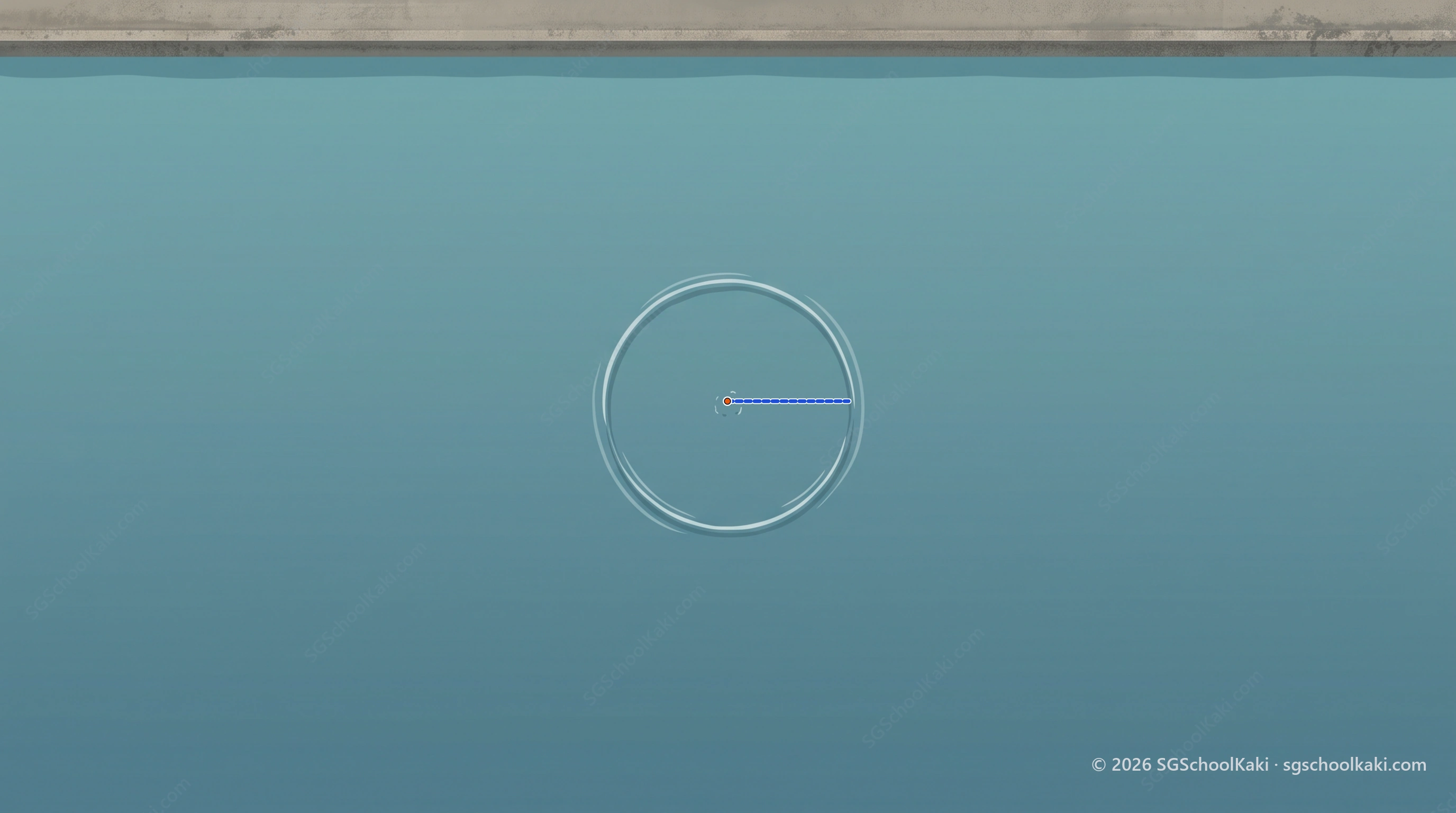
A stone dropped into the Marina Reservoir makes a circular ripple. For the first few seconds the radius r cm of the ripple grows at a constant rate of 25 cm every second. The area of the ripple is A=πr2 cm2.
(a)Find the rate at which the area of the ripple is increasing at the instant when r=10.
(b)As the ripple fades it slows down. At the instant when r=50 the area is growing at 1000π cm2 each second. Find the rate at which the radius is increasing at that instant.
Show full solutionHide solution
Colour keyfinal result
(a)
drdA=2πr
Differentiate A with respect to r.
dtdA=drdA×dtdr
Chain rule: the rate we want is the rate we can find times the rate we are given.
=2×π×(10)×25=500π
Put r=10 and the given rate 25 in.
(b)
drdA=2πr
Differentiate A with respect to r first: it is the bridge between the two rates.
Chain rule turned round: dtdr=dtdA÷drdA, the given rate divided by the bridge.
dtdr=2×π×(50)1000π=10
Put r=50 into the bridge.
Answer
(a) the rate of change of A is 500π cm2 per second
(b) the rate of change of r is 10 cm per second
xxhplan view
Maths In Real Life 3
Fencing a garden plot
Fencing is sold by the metre, so a plot of a fixed area should be enclosed with as little fence as possible. A long thin plot and a short wide plot of the same area need different lengths of fence: calculus finds the shape that needs the least.
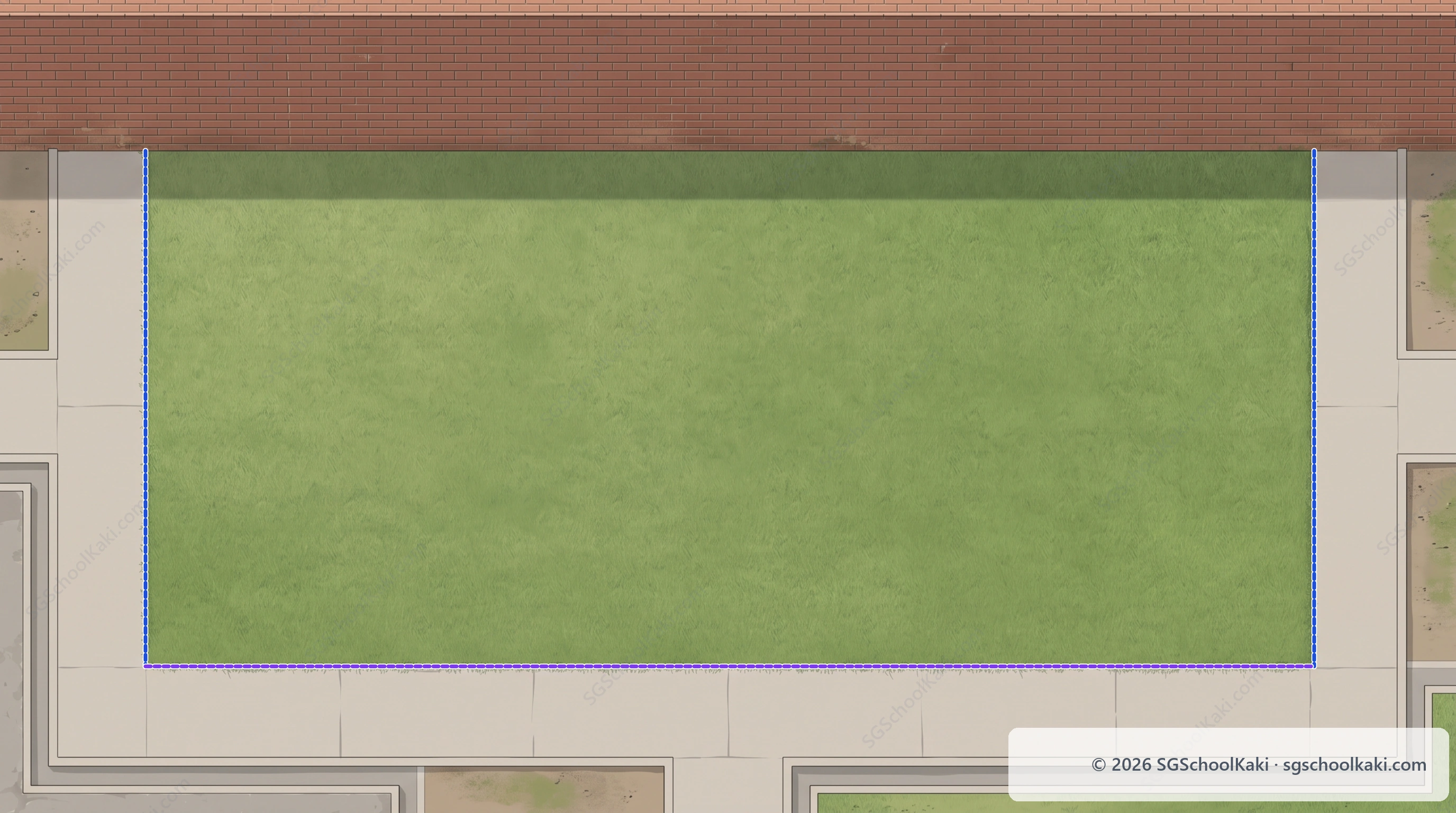
A school garden is a rectangular plot of area 800 m2 against a plain wall. It is fenced on the three sides that are not the wall. The two sides at right angles to the wall are x m long and the side parallel to the wall is h m long.
(a)Express the length L m of fencing in terms of x only, find the value of x that makes the length least, show that this value gives a minimum, find the least length of fencing and the length of the side parallel to the wall.
Show full solutionHide solution
Colour keyderivative, y-value or intermediate resultfinal result
(a)
hx−800=0
Write the constraint so that every term is on the left.
h=x800
Make the other variable the subject of the constraint (it is linear).
L=2x+x800
Substitute it into the quantity to be made largest or smallest, so that only x remains.
=2x+800x−1
Expand and write every term as a power of x.
Both x and h are lengths, so x>0 and h=x800>0: the range of x is x>0.
L=2x+800x−1
Write every root and reciprocal as a power of x: a root has a fractional index and x in the denominator has a negative index.
dxd(2x)=2
The power is 1: multiply 2 by 1, and x0 is 1.
dxd(800x−1)=−800x−2
Multiply the coefficient 800 by the power −1 to get −800, then lower the power to −2.
dxdL=2−800x−2
Add the derivatives of the terms.
dxdL=2−x2800
Write the negative and fractional powers as fractions and roots again.
2−x2800=0
At a stationary value the gradient is 0: set the derivative equal to 0.
2(x−20)(x+20)=0⟺x=−20 or x=20
A fraction is 0 only where its top is 0; solve the factors.
Reject x=−20: it lies outside the allowed range x>0.
dx2d2L=1600x−3
Differentiate the first derivative once more.
=(20)31600=51
Put x=20 in: positive, so the stationary value is a minimum.
L=2×(20)+(20)800=80
Put x=20 into the function to find the least value.
h=(20)800=40
Put x=20 into the expression for h.
Answer
(a)L=2x+x800, for x>0; x=20 m; L is a minimum at x=20; L=80 m; h=40 m
01
Supports K341-C1-07
Increasing and decreasing functions
Walk along a curve from left to right. Where the path climbs, the curve is increasing: y gets larger as x gets larger. Where the path falls, the curve is decreasing. The gradient tells you which: it is positive on a climb and negative on a fall.
The Core Idea
The sign of the derivative decides.
A function y=f(x) is increasing where dxdy>0 and decreasing where dxdy<0. The changeover happens where dxdy=0 (or where the function is not defined), so solve dxdy=0 first, then test the sign of dxdy in each interval between the solutions.
What the sign of the gradient tells you
Sign of the gradient
What the curve does
Picture
dxdy>0
The curve rises as x increases: it is increasing.
tangent slopes up
dxdy<0
The curve falls as x increases: it is decreasing.
tangent slopes down
dxdy=0
The tangent is level: the curve may turn here (a stationary point).
tangent is level
The method has three moves. Differentiate, solvedxdy=0 for the boundary values of x, then test one value of x in each interval. The test values are worked out from the boundaries: a value below the smallest one, a value halfway between two neighbours, and a value above the largest one.
Example 1.1
A cubic: two boundary values, three intervals
A curve has equation y=x3−3x2−9x+2. Find dxdy and hence the ranges of values of x for which y is increasing and for which it is decreasing.
Show solutionHide solution
Colour keyderivative, y-value or intermediate resultfinal result
dxd(x3)=3x2
The coefficient is 1: bring the power 3 down and lower the power to 2.
dxd(−3x2)=−6x
Multiply the coefficient −3 by the power 2 to get −6, then lower the power to 1.
dxd(−9x)=−9
The power is 1: multiply −9 by 1, and x0 is 1.
dxd(2)=0
The derivative of a constant is 0.
dxdy=3x2−6x−9
Add the derivatives of the terms.
3x2−6x−9=0
A function is neither increasing nor decreasing where its gradient is 0: set the derivative equal to 0.
3(x−3)(x+1)=0⟺x=−1 or x=3
Each factor can be zero.
These values split the number line into intervals. Test the sign of the derivative once in each interval.
3×(−2)2−6×(−2)−9=15
Test a value to the left of the first root. The result is positive.
3×(1)2−6×(1)−9=−12
Test a value between these two roots. The result is negative.
3×(4)2−6×(4)−9=15
Test a value to the right of the last root. The result is positive.
Answer
dxdy=3x2−6x−9; increasing for x<−1 and x>3; decreasing for −1<x<3
SGSchoolKaki Tip
Never test a boundary value itself: the gradient is 0 there, so the sign test tells you nothing. Test inside each interval, and use a value that is easy to calculate with.
Example 1.2
A negative leading coefficient: the picture flips
A curve has equation y=−x3+3x2+24x−5. Find dxdy and hence the ranges of values of x for which y is increasing and for which it is decreasing.
Show solutionHide solution
Colour keyderivative, y-value or intermediate resultfinal result
dxd(−x3)=−3x2
Multiply the coefficient −1 by the power 3 to get −3, then lower the power to 2.
dxd(3x2)=6x
Multiply the coefficient 3 by the power 2 to get 6, then lower the power to 1.
dxd(24x)=24
The power is 1: multiply 24 by 1, and x0 is 1.
dxd(−5)=0
The derivative of a constant is 0.
dxdy=−3x2+6x+24
Add the derivatives of the terms.
−3x2+6x+24=0
A function is neither increasing nor decreasing where its gradient is 0: set the derivative equal to 0.
−3(x−4)(x+2)=0⟺x=−2 or x=4
Each factor can be zero.
These values split the number line into intervals. Test the sign of the derivative once in each interval.
−3×(−3)2+6×(−3)+24=−21
Test a value to the left of the first root. The result is negative.
−3×(1)2+6×(1)+24=27
Test a value between these two roots. The result is positive.
−3×(5)2+6×(5)+24=−21
Test a value to the right of the last root. The result is negative.
Answer
dxdy=−3x2+6x+24; increasing for −2<x<4; decreasing for x<−2 and x>4
A cubic with a negative x3 term starts high on the left and ends low on the right, so the order of the intervals is decreasing, increasing, decreasing, the reverse of the pattern in the previous Example. The sign test shows it every time, so you never have to remember the pattern.
Think About It
A student says: “y=x3 has dxdy=3x2, which is 0 at x=0, so y must stop increasing there.” Is the student right?
Show the full workingHide the working
dxdy=3x2
Power rule on x3.
3(−1)2=3
The gradient at a value to the left of x=0.
3(1)2=3
The gradient at a value to the right of x=0.
The gradient is positive on both sides of x=0 and is only 0 at the single point x=0.
Answer
The student is wrong: dxdy>0 on both sides of x=0, so y=x3 is increasing for every x; the curve only flattens for an instant.
When the derivative is a quadratic, finding where it is negative or positive is exactly the quadratic inequality of Chapter 2. Factorise, mark the boundary values on a number line, and read off the intervals. The same working answers “for what values of x is f decreasing?” in one step.
Example 1.3
Decreasing as a quadratic inequality
Given that f(x)=2x3−9x2−24x+1, find the set of values of x for which f is decreasing. Illustrate the solution on a number line.
Show solutionHide solution
Colour keycommon factor taken outderivative, y-value or intermediate resultfinal result
dxd(2x3)=6x2
Multiply the coefficient 2 by the power 3 to get 6, then lower the power to 2.
dxd(−9x2)=−18x
Multiply the coefficient −9 by the power 2 to get −18, then lower the power to 1.
dxd(−24x)=−24
The power is 1: multiply −24 by 1, and x0 is 1.
dxd(1)=0
The derivative of a constant is 0.
f′(x)=6x2−18x−24
Add the derivatives of the terms.
A function is decreasing where its gradient is negative. So find the values of x for which the derivative is negative: a quadratic inequality.
Decreasing means the gradient is negative.
f′(x)=6x2−18x−24
The derivative found above.
6x2−18x−24<0
The condition for the function to be decreasing: the gradient < 0.
x2−3x−4<0
Divide by a positive common factor: the sign stays.
Step 1: find where the quadratic equals zero (the boundary points).
(x+1)(x−4)=0
Factorise the quadratic.
x=−1orx=4
Each factor equal to zero gives one solution.
Step 2: sketch the parabola y=x2−3x−4. It opens upwards (its x2 term is positive) and meets the horizontal axis at the two roots. Between the roots it is below the axis; outside them it is above it.
The sketch shows which parts are above (positive) or below (negative) the axis.
We need the quadratic less than zero, so take the part below the axis: between the roots.
Step 3: write the solution as an inequality (never as a pair of equalities): −1<x<4.
The answer is a range of values, not just the boundary values.
the values of x for which the gradient is negative, so the function is decreasing
Answer
f is decreasing for −1<x<4
Example 1.4
A quartic: three boundary values, four intervals
A curve has equation y=x4−8x2+3. Find the ranges of values of x for which y is increasing and for which it is decreasing.
Show solutionHide solution
Colour keyderivative, y-value or intermediate resultfinal result
dxd(x4)=4x3
The coefficient is 1: bring the power 4 down and lower the power to 3.
dxd(−8x2)=−16x
Multiply the coefficient −8 by the power 2 to get −16, then lower the power to 1.
dxd(3)=0
The derivative of a constant is 0.
dxdy=4x3−16x
Add the derivatives of the terms.
4x3−16x=0
A function is neither increasing nor decreasing where its gradient is 0: set the derivative equal to 0.
4x(x−2)(x+2)=0⟺x=−2 or x=0 or x=2
Each factor can be zero.
These values split the number line into intervals. Test the sign of the derivative once in each interval.
4×(−3)3−16×(−3)=−60
Test a value to the left of the first root. The result is negative.
4×(−1)3−16×(−1)=12
Test a value between these two roots. The result is positive.
4×(1)3−16×(1)=−12
Test a value between these two roots. The result is negative.
4×(3)3−16×(3)=60
Test a value to the right of the last root. The result is positive.
Answer
increasing for −2<x<0 and x>2; decreasing for x<−2 and 0<x<2
A boundary value does not always mark a change. If the derivative has a squared (even-power) factor such as (x−1)2, it touches 0 but does not change sign, so the function carries on in the same direction. The next Example shows it.
Example 1.5
A repeated root: the direction does not change
A curve has equation y=x3−3x2+3x+5. Find the ranges of values of x for which y is increasing and for which it is decreasing.
Show solutionHide solution
Colour keyderivative, y-value or intermediate resultfinal result
dxd(x3)=3x2
The coefficient is 1: bring the power 3 down and lower the power to 2.
dxd(−3x2)=−6x
Multiply the coefficient −3 by the power 2 to get −6, then lower the power to 1.
dxd(3x)=3
The power is 1: multiply 3 by 1, and x0 is 1.
dxd(5)=0
The derivative of a constant is 0.
dxdy=3x2−6x+3
Add the derivatives of the terms.
3x2−6x+3=0
A function is neither increasing nor decreasing where its gradient is 0: set the derivative equal to 0.
3(x−1)2=0⟺x=1
Each factor can be zero.
These values split the number line into intervals. Test the sign of the derivative once in each interval.
3×(0)2−6×(0)+3=3
Test a value to the left of the first root. The result is positive.
3×(2)2−6×(2)+3=3
Test a value to the right of the last root. The result is positive.
Answer
increasing for all real x; never decreasing
To show that a function is always increasing, you do not need any intervals. Show that f′(x) is positive for everyx. A quadratic derivative is easiest to handle by completing the square: a square is never negative, so adding a positive constant keeps it above 0.
Example 1.6
Show that a function is always increasing
Given that f(x)=x3+3x2+5x−2, show that f is an increasing function for all real values of x.
Show solutionHide solution
Colour keyderivative, y-value or intermediate resultfinal result
dxd(x3)=3x2
The coefficient is 1: bring the power 3 down and lower the power to 2.
dxd(3x2)=6x
Multiply the coefficient 3 by the power 2 to get 6, then lower the power to 1.
dxd(5x)=5
The power is 1: multiply 5 by 1, and x0 is 1.
dxd(−2)=0
The derivative of a constant is 0.
f′(x)=3x2+6x+5
Add the derivatives of the terms.
f′(x)=3(x+1)2+2
Complete the square on the derivative: halve the coefficient of x inside the bracket and subtract the extra constant.
A square is never negative, so the positive multiple of it is at least 0 for every real x.
f′(x)≥2>0
Adding the constant keeps the derivative strictly above 0.
Answer
f′(x)>0 for all real x, so f(x) is always increasing
The derivative of the derivative, dx2d2y, tells you whether the gradient itself is increasing or decreasing. That is a different question from whether y is increasing: a curve can be falling while its gradient is increasing (the fall is getting gentler).
Example 1.7
Is the gradient increasing or decreasing?
A curve has equation y=x4−6x2. Find dx2d2y and its value when x=2. State whether the gradient is rising or falling as x increases through that point.
Show solutionHide solution
Colour keyderivative, y-value or intermediate resultfinal result
dxd(x4)=4x3
The coefficient is 1: bring the power 4 down and lower the power to 3.
dxd(−6x2)=−12x
Multiply the coefficient −6 by the power 2 to get −12, then lower the power to 1.
dxdy=4x3−12x
Add the derivatives of the terms.
Differentiate the first derivative once more.
dxd(4x3)=12x2
Multiply by the power and lower the power by 1.
dxd(−12x)=−12
Multiply by the power and lower the power by 1.
dx2d2y=12x2−12
Add the results.
dx2d2y=12×(2)2−12=36
Put x=2 into the second derivative.
The value is positive, so the gradient is increasing as x increases through that point.
Answer
dx2d2y=12x2−12; dx2d2y=36, so the gradient is increasing
A stationary point is a point on a curve where the gradient is 0 and the tangent is horizontal. To find the stationary points, solve dxdy=0 for x, then put each x back into the curve (never into the derivative) to get the y-coordinate.
The Core Idea
Three kinds of stationary point.
A stationary point is a maximum if the gradient changes from positive to negative, a minimum if it changes from negative to positive, and a stationary point of inflexion if the gradient has the same sign on both sides. The nature is found from the sign of dxdy either side (or from dx2d2y, in the next section).
Nature of a stationary point from the sign of the gradient
Gradient just before
Gradient just after
Nature
Picture
Positive (rising)
Negative (falling)
Maximum
maximum
Negative (falling)
Positive (rising)
Minimum
minimum
Positive (rising)
Positive (rising)
Stationary point of inflexion
rises through
Negative (falling)
Negative (falling)
Stationary point of inflexion
falls through
Example 2.1
A cubic: a maximum and a minimum
Find dxdy, then locate the stationary points of the curve y=2x3−9x2+12x−1, giving each one as a pair of coordinates, and decide the nature of each.
Show solutionHide solution
Colour keyderivative, y-value or intermediate resultfinal result
dxd(2x3)=6x2
Multiply the coefficient 2 by the power 3 to get 6, then lower the power to 2.
dxd(−9x2)=−18x
Multiply the coefficient −9 by the power 2 to get −18, then lower the power to 1.
dxd(12x)=12
The power is 1: multiply 12 by 1, and x0 is 1.
dxd(−1)=0
The derivative of a constant is 0.
dxdy=6x2−18x+12
Add the derivatives of the terms.
6x2−18x+12=0
At a stationary point the gradient is 0: set the derivative equal to 0.
6(x−2)(x−1)=0⟺x=1 or x=2
Solve the factors: each factor can be zero.
y=2×(1)3−9×(1)2+12×(1)−1=4
Put x=1 into the curve to find the y-coordinate.
y=2×(2)3−9×(2)2+12×(2)−1=3
Put x=2 into the curve to find the y-coordinate.
6×(0)2−18×(0)+12=12
Test a value just to the left of the stationary point. The result is positive.
6×(23)2−18×(23)+12=−23
Test a value just to the right of the stationary point. The result is negative.
6×(23)2−18×(23)+12=−23
Test a value just to the left of the stationary point. The result is negative.
6×(3)2−18×(3)+12=12
Test a value just to the right of the stationary point. The result is positive.
the curve with its stationary points marked; each dashed line is the horizontal tangent there, where the gradient is 0. Here y=2x3−9x2+12x−1.
Answer
dxdy=6x2−18x+12; (1,4) and (2,3); (1,4) is a maximum point; (2,3) is a minimum point
SGSchoolKaki Tip
The question says “coordinates”, so every answer is a pair(x,y). Finding x and stopping is the most common way to lose the last mark.
Example 2.2
A quartic with a stationary point of inflexion
Locate the stationary points of the curve y=x4−4x3+10, giving each one as a pair of coordinates, and decide whether each is a maximum, a minimum or a point of inflexion.
Show solutionHide solution
Colour keyderivative, y-value or intermediate resultfinal result
dxd(x4)=4x3
The coefficient is 1: bring the power 4 down and lower the power to 3.
dxd(−4x3)=−12x2
Multiply the coefficient −4 by the power 3 to get −12, then lower the power to 2.
dxd(10)=0
The derivative of a constant is 0.
dxdy=4x3−12x2
Add the derivatives of the terms.
4x3−12x2=0
At a stationary point the gradient is 0: set the derivative equal to 0.
4x2(x−3)=0⟺x=0 or x=3
Solve the factors: each factor can be zero.
y=(0)4−4×(0)3+10=10
Put x=0 into the curve to find the y-coordinate.
y=(3)4−4×(3)3+10=−17
Put x=3 into the curve to find the y-coordinate.
4×(−1)3−12×(−1)2=−16
Test a value just to the left of the stationary point. The result is negative.
4×(23)3−12×(23)2=−227
Test a value just to the right of the stationary point. The result is negative.
4×(23)3−12×(23)2=−227
Test a value just to the left of the stationary point. The result is negative.
4×(4)3−12×(4)2=64
Test a value just to the right of the stationary point. The result is positive.
the curve with its stationary points marked; each dashed line is the horizontal tangent there, where the gradient is 0. Here y=x4−4x3+10.
Answer
(0,10) and (3,−17); (0,10) is a stationary point of inflexion; (3,−17) is a minimum point
A double root of dxdy=0 does not mean a minimum. When the derivative has a squared (even-power) factor such as x2, the gradient touches 0 without changing sign, so the point is a stationary point of inflexion. Always do the sign test.
Example 2.3
Only one stationary point, and it is an inflexion
Locate the stationary points of the curve y=x3−9x2+27x−20, giving each one as a pair of coordinates, and decide whether each is a maximum, a minimum or a point of inflexion.
Show solutionHide solution
Colour keyderivative, y-value or intermediate resultfinal result
dxd(x3)=3x2
The coefficient is 1: bring the power 3 down and lower the power to 2.
dxd(−9x2)=−18x
Multiply the coefficient −9 by the power 2 to get −18, then lower the power to 1.
dxd(27x)=27
The power is 1: multiply 27 by 1, and x0 is 1.
dxd(−20)=0
The derivative of a constant is 0.
dxdy=3x2−18x+27
Add the derivatives of the terms.
3x2−18x+27=0
At a stationary point the gradient is 0: set the derivative equal to 0.
3(x−3)2=0⟺x=3
Solve the factors: each factor can be zero.
y=(3)3−9×(3)2+27×(3)−20=7
Put x=3 into the curve to find the y-coordinate.
3×(2)2−18×(2)+27=3
Test a value just to the left of the stationary point. The result is positive.
3×(4)2−18×(4)+27=3
Test a value just to the right of the stationary point. The result is positive.
Answer
(3,7); (3,7) is a stationary point of inflexion
Think About It
How many stationary points can a cubic curve have?
Show the full workingHide the working
dxdy=ax2+bx+c
The derivative of a cubic is a quadratic.
A quadratic has two real roots when its discriminant is positive, one when it is zero and none when it is negative.
Each real root of the derivative is a stationary point, so the three cases give two, one or none.
Answer
A cubic has two stationary points, one stationary point (an inflexion), or none.
Example 2.4
A curve with no stationary point
A curve has equation y=x3+2x2+4x−7. Find dxdy and explain why the curve has no stationary point.
Show solutionHide solution
Colour keyderivative, y-value or intermediate resultfinal result
dxd(x3)=3x2
The coefficient is 1: bring the power 3 down and lower the power to 2.
dxd(2x2)=4x
Multiply the coefficient 2 by the power 2 to get 4, then lower the power to 1.
dxd(4x)=4
The power is 1: multiply 4 by 1, and x0 is 1.
dxd(−7)=0
The derivative of a constant is 0.
dxdy=3x2+4x+4
Add the derivatives of the terms.
3x2+4x+4=0
A stationary point needs a gradient of 0: set the derivative equal to 0.
b2−4ac=42−4(3)(4)=−32
Test whether this quadratic has a real solution with the discriminant.
The discriminant is negative, so dxdy=0 has no real solution.
Answer
dxdy=3x2+4x+4; the curve has no stationary points: the gradient is never 0
Example 2.5
A root function: the domain is x > 0
A curve has equation y=x23−3x, for x>0. Find dxdy, the coordinates of the stationary point, and its nature.
Show solutionHide solution
Colour keyderivative, y-value or intermediate resultfinal result
y=x23−3x
Write every root and reciprocal as a power of x: a root has a fractional index and x in the denominator has a negative index.
dxd(x23)=23x21
The coefficient is 1: bring the power 23 down and lower the power to 21.
dxd(−3x)=−3
The power is 1: multiply −3 by 1, and x0 is 1.
dxdy=23x21−3
Add the derivatives of the terms.
=23x−3
Write the negative and fractional powers as fractions and roots again.
23x−3=0
At a stationary point the gradient is 0: set the derivative equal to 0.
3(x−2)=0⟺x=4
Solve the factors: each factor can be zero.
y=(4)23−3×(4)=−4
Put x=4 into the curve to find the y-coordinate.
Differentiate the first derivative once more.
dxd(23x21)=43x−21
Multiply by the power and lower the power by 1.
dxd(−3)=0
Power rule again; a constant term gives 0.
dx2d2y=43x−21
Add the results.
=4x3
Write the powers as fractions and roots again.
dx2d2y=4×(4)3=83
Put x=4 into the second derivative: positive means a minimum, negative a maximum.
Answer
dxdy=23x−3; (4,−4); (4,−4) is a minimum point
When the curve is a product or a quotient, differentiate with the rule of Chapter 11, then factorise the derivative before setting it equal to 0. A factorised derivative gives the stationary x-values at once and makes the sign test quick.
Example 2.6
A product: factorise the derivative
A curve has equation y=x(x−3)2. Find dxdy, then locate the stationary points, giving each one as a pair of coordinates, and decide their nature.
Show solutionHide solution
Colour keycommon factor taken outderivative, y-value or intermediate resultfinal result
Differentiate the first factor and the second factor separately.
dxd(x)=1
Power rule on each term.
dxd((x−3)2)=2x−6
Chain rule: outside derivative with the bracket kept, times the derivative of the bracket.
dxdy=(x−3)2+x(2x−6)
Product rule: derivative of the first times the second, plus the first times the derivative of the second.
=3x2−12x+9
Expand the brackets and collect like terms.
=3(x−3)(x−1)
Take out the common factor.
3(x−3)(x−1)=0⟺x=1 or x=3
At a stationary point the gradient is 0: set the derivative equal to 0; each factor can be zero.
y=(1)×((1)−3)2=4
Put x=1 into the curve to find the y-coordinate.
y=(3)×((3)−3)2=0
Put x=3 into the curve to find the y-coordinate.
3×((0)−3)×((0)−1)=9
Test a value just to the left of the stationary point. The result is positive.
3×((2)−3)×((2)−1)=−3
Test a value just to the right of the stationary point. The result is negative.
3×((2)−3)×((2)−1)=−3
Test a value just to the left of the stationary point. The result is negative.
3×((4)−3)×((4)−1)=9
Test a value just to the right of the stationary point. The result is positive.
the curve with its stationary points marked; each dashed line is the horizontal tangent there, where the gradient is 0. Here y=x3−6x2+9x.
Answer
dxdy=3(x−3)(x−1); (1,4) and (3,0); (1,4) is a maximum point; (3,0) is a minimum point
Example 2.7
A quotient: a pole sits between the test values
A curve has equation y=x−1x2. Find dxdy, then locate the stationary points, giving each one as a pair of coordinates, and decide their nature.
Show solutionHide solution
Colour keycommon factor taken outderivative, y-value or intermediate resultfinal result
Differentiate the top and the bottom separately.
dxd(x2)=2x
Power rule on each term.
dxd(x−1)=1
Power rule on each term.
dxdy=(x−1)22x(x−1)−x2
Quotient rule: (derivative of the top times the bottom) minus (the top times the derivative of the bottom), over the bottom squared.
=(x−1)2x2−2x
Expand the top and collect like terms.
=(x−1)2x(x−2)
Factorise the top so that any common factor shows.
(x−1)2x(x−2)=0
At a stationary point the gradient is 0: set the derivative equal to 0.
x(x−2)=0⟺x=0 or x=2
Solve the factors (a fraction is 0 only where its top is 0).
y=(0)−1(0)2=0
Put x=0 into the curve to find the y-coordinate.
y=(2)−1(2)2=4
Put x=2 into the curve to find the y-coordinate.
((−1)−1)2(−1)×((−1)−2)=43
Test a value just to the left of the stationary point. The result is positive.
((21)−1)2(21)×((21)−2)=−3
Test a value just to the right of the stationary point. The result is negative.
((23)−1)2(23)×((23)−2)=−3
Test a value just to the left of the stationary point. The result is negative.
((3)−1)2(3)×((3)−2)=43
Test a value just to the right of the stationary point. The result is positive.
Answer
dxdy=(x−1)2x(x−2); (0,0) and (2,4); (0,0) is a maximum point; (2,4) is a minimum point
A quotient is not defined where its denominator is 0. A test value must never sit across that gap from the stationary point it is meant to test: choose the test values on each side of the stationary point but between it and the neighbouring root or break in the curve.
Beyond the Syllabus · Good to Know
A curve can also change from bending one way to bending the other way at a point where the gradient is not0. That is a non-stationary point of inflexion: on y=x3+x the origin is one, with gradient 1. In this chapter only stationary points of inflexion are tested.