
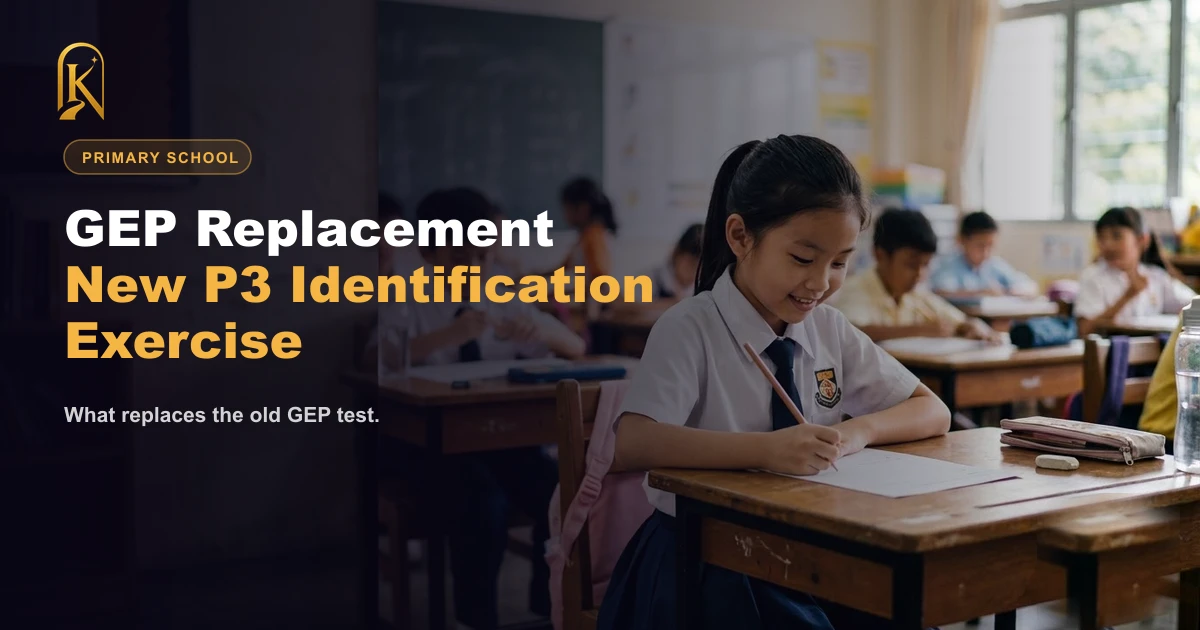





Singapore's new Primary 3 identification exercise is a standardised one-stage process that replaces the former two-stage Gifted Education Programme (GEP) screening and selection. The first cohort sits the refreshed exercise as Primary 3 students in August 2026, with results used alongside school-based information — teacher observations, students' work — to identify children who may benefit from high-ability learning provisions in their own schools.
Source: MOE — "Learning Together with Different Strengths and Needs" (3 Mar 2026)
Sources: MOE — "Learning Together with Different Strengths and Needs" (3 Mar 2026) ; MOE — Gifted Education Programme
What Is Changing
The old GEP identification process had two Primary 3 stages: a screening exercise, then a selection exercise for shortlisted pupils. The new approach removes the second stage — one standardised identification exercise, supplemented by school-based information . It shifts from a single high-stakes selection point to a broader picture of a child's strengths over time.
One stage, not two
The Gifted Education Programme, in its current form, stops admitting new Primary 4 students from 2027. Existing GEP classes continue until 2028, when the final batch completes Primary 6. This is a gradual wind-down, not an overnight change — children already in GEP classes are not affected.
Sources: MOE — "Learning Together with Different Strengths and Needs" (3 Mar 2026) ; MOE — Gifted Education Programme
Old GEP vs New Identification Exercise
Here is how the two approaches compare, based on what MOE has confirmed so far:
| Feature | Old two-stage GEP | New identification exercise |
|---|---|---|
| Stages | Two: screening, then selection | One standardised identification exercise + school-based information |
| When (Primary 3) | Screening around August; selection later in the year | One standardised exercise in Primary 3 — first cohort August 2026 |
| Subjects / domains | Screening: English + Maths. Selection: English, Maths, General Ability (per 2024 school notifications) | Not officially published for the new exercise (see below) |
| What happens after | Successful pupils joined GEP in Primary 4, generally transferring to one of nine GEP schools | Identified pupils access school-based provisions and, where suitable, centre-based advanced modules while staying in their own primary schools |
Sources: MOE — GEP overview ; MOE — "Learning Together with Different Strengths and Needs" (3 Mar 2026)
What Does the New Exercise Test?
MOE's press release confirms the structure and timing of the new identification exercise, but the official pages we reviewed do not publish detailed papers, test specifications or the subject breakdown. The following are therefore not verified from an official MOE source:
- Whether the new exercise assesses English and Mathematics specifically.
- Whether it includes Science, General Ability or another reasoning paper.
- Whether it is explicitly aptitude/reasoning-based versus mastery of the Primary 1–3 syllabus.
- The duration, number of papers and question formats.
Parents should be cautious about treating tuition-provider claims, social-media posts or unofficial “prep” sites as confirmed test details. MOE-aligned coverage of the refreshed approach has emphasised identifying potential rather than drilled performance, so framing the exercise as something to be “prepped for” runs against the intent of the change. MOE does note that the post-identification advanced modules may be offered in English, Mathematics or Science — but those are learning domains for the provision after identification, not confirmed test subjects.
Sources: MOE — "Learning Together with Different Strengths and Needs" (3 Mar 2026) ; MOE — Gifted Education Programme
What Happens After Identification (2027 Provisions)
Identified pupils remain in their own primary schools and access school-based high-ability learning provisions. Where suitable, centre-based advanced modules— offered in domains such as English, Mathematics or Science — run at 15 host primary schools (for example Palm View Primary and Yew Tee Primary) from 2027.
Source: MOE — "Learning Together with Different Strengths and Needs" (3 Mar 2026)
What P2–P4 Parents Should Know Now
- There is no official test specification to “prepare” for — MOE's design emphasises identifying potential, not drilled performance.
- The change reduces the old single high-stakes selection point by adding school-based information alongside the standardised exercise.
- Watch only official MOE channels and your child's school for details — treat unofficial “GEP prep” claims with caution.
Source: MOE — "Learning Together with Different Strengths and Needs" (3 Mar 2026)
Key Dates Timeline
| Date | What happens |
|---|---|
| 3 Mar 2026 | MOE announces the refreshed approach (“Learning Together with Different Strengths and Needs”) |
| August 2026 | First Primary 3 cohort sits the new one-stage identification exercise |
| From 2027 | GEP stops admitting new Primary 4 students; school-based high-ability provisions + centre-based advanced modules roll out at 15 host schools |
| Until 2028 | Existing GEP classes continue (final batch completes Primary 6) |
Sources: MOE — "Learning Together with Different Strengths and Needs" (3 Mar 2026) ; MOE — Gifted Education Programme
Frequently Asked Questions
What replaced the old GEP test?
A single standardised Primary 3 identification exercise, supplemented by school-based information, instead of the old two-stage screening + selection process.
When does the first cohort sit it?
Primary 3 students in August 2026.
What subjects does it test?
MOE has not published the subjects or format for the new exercise. Be wary of unofficial tuition-provider or social-media claims that describe test content — none of that has been confirmed by MOE.
Does my child still transfer to a GEP school if identified?
No. The new model keeps identified pupils in their own primary schools, with school-based provisions and, where suitable, centre-based advanced modules — rather than transferring to a separate GEP school.
How should I prepare my child?
There is no official specification to prepare for. MOE's approach looks at a child's potential and strengths over time, not drilled test performance.
Related Resources
GEP Discontinued: Advanced Modules from 2027
The full story on why GEP is winding down and what the new advanced modules replace it with.
2026 P6 Math Syllabus Changes
What's changing in the PSLE Math syllabus for Primary 6 pupils this year.
The bottom line
The refreshed identification exercise moves Singapore away from a single high-stakes GEP selection toward broader, school-based high-ability provision. For P2–P4 parents, the practical takeaway is to rely on official MOE and school communications and ignore unofficial “prep” hype — MOE has not published the test's contents.
Note on completeness: Structure and timing are from MOE's 3 March 2026 press release and GEP pages. Detailed test subjects, format and the exact host-school count were included only where an official MOE source confirms them; anything unconfirmed is flagged “not verified” rather than stated.
Sources
- 1.MOE — "Learning Together with Different Strengths and Needs" (3 Mar 2026). moe.gov.sg
- 2.MOE — Gifted Education Programme. moe.gov.sg
- 3.MOE — GEP overview. moe.gov.sg
Cite this page: SGSchoolKaki Education Team, “GEP Replacement Singapore: New P3 Identification Exercise,” SGSchoolKaki, 26 Sept 2026, https://sgschoolkaki.com/blog/gep-replacement-p3-identification-test-2026.