





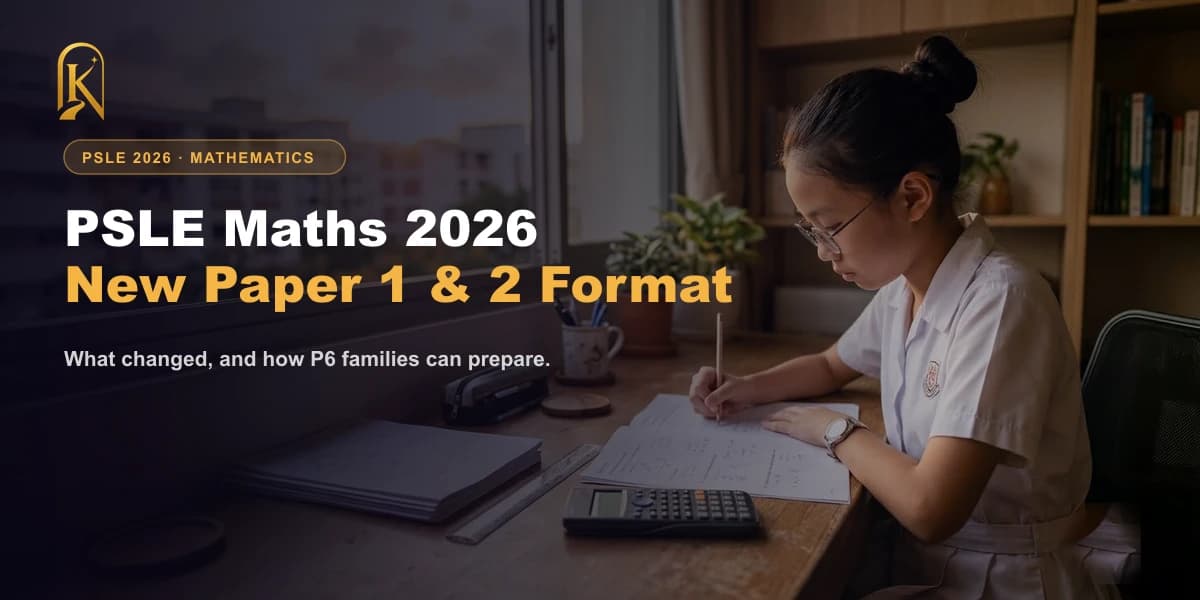
The PSLE Mathematics 2026 exam format is revised. Paper 1 now has 18 multiple-choice questions and 12 short-answer questions; Paper 2 has five short-answer questions and 10 structured or long-answer questions. The two papers now carry equal weight — 50 marks each — for 100 marks in total.
For P6 families, the most important step is simple: start practising complete papers using the new timing and question structure. Paper 1 is now 1 hour 10 minutes and Paper 2 is 1 hour 20 minutes, so pupils need to work accurately without a calculator in Paper 1 and show clear methods in Paper 2.
Source: SEAB — PSLE Formats Examined in 2026
Sources: SEAB — 2026 PSLE Mathematics (0008) syllabus ; SEAB — PSLE page
The 2026 Format At A Glance
SEAB lists PSLE Mathematics (subject code 0008) as a revised examination format for 2026. The examination is two written papers made up of three booklets.
| Feature | Paper 1 | Paper 2 |
|---|---|---|
| Booklets | Booklet A + Booklet B | One booklet |
| Question types | Multiple-choice + short-answer | Short-answer + structured/long-answer |
| Number of questions | 30 | 15 |
| Total marks | 50 marks | 50 marks |
| Duration | 1 hour 10 minutes | 1 hour 20 minutes |
| Calculator | Not allowed | Allowed |
Source: SEAB — 2026 PSLE Mathematics (0008) syllabus
Overall: 45 questions, 100 marks, 2 hours 30 minutes. Both papers are scheduled on the same day with a break in between.
What Is In Paper 1 and Paper 2?
What is in Paper 1?
Paper 1 has two booklets and no calculator is allowed anywhere in it.
Booklet A — 18 MCQs (26 marks): 10 one-mark MCQs (10 marks) — straightforward questions assessing basic concepts and skills — plus 8 two-mark MCQs (16 marks). Each MCQ has four options with exactly one correct answer.
Booklet B — 12 short-answer questions (24 marks): each question is worth 2 marks and may have one or two parts. For a two-part question, one mark is awarded for each correct part. For a one-part question, 2 marks are given for the correct answer, or 1 mark for the correct method if the final answer is wrong.
What is in Paper 2?
Paper 2 is one booklet, 1 hour 20 minutes, 50 marks, and a calculator is allowed.
- 5 short-answer questions × 2 marks = 10 marks.
- 10 structured/long-answer questions worth 3, 4 or 5 marks each = 40 marks.
Pupils must show their method of solution clearly for structured and long-answer questions; a correct final answer without the required working may not earn full marks.
Source: SEAB — 2026 PSLE Mathematics (0008) syllabus
Together, Booklets A and B make Paper 1 worth 50 marks — so Paper 1 is not a warm-up. It needs three habits: fast, accurate selection for one-mark MCQs; careful reading for two-mark MCQs; and clear written working for the short-answer questions.
The Key Shift: Equal 50/50 Papers
The headline change for 2026 is that Paper 1 and Paper 2 now carry the same 50 marks each, with Paper 1 running 1 hour 10 minutes and Paper 2 running 1 hour 20 minutes. Families should not treat Paper 1 as a light section: a weak Paper 1 can affect the final Mathematics Achievement Level (AL) just as much as a weak Paper 2.
Does this change the PSLE scoring system? No. The Mathematics result is still reported as an Achievement Level (AL1–AL8, AL1 highest). The revised format does not create a separate grade for Paper 1 or Paper 2 — the marks from both papers form the single Mathematics result. The practical implication: prepare for both papers, not just the structured problem sums.
Source: SEAB — 2026 PSLE Mathematics (0008) syllabus
When Is PSLE Mathematics 2026?
The 2026 written PSLE examinations run from 24 September 2026 to 30 September 2026. Both Mathematics papers are sat on the same day with a break between them; pupils should use that break to reset rather than re-discuss Paper 1.
Source: SEAB — PSLE page
What This Means For P6 Preparation
- Practise Paper 1 without a calculator. Paper 1 is entirely calculator-free — drill fractions, decimals, percentages, ratios and multi-step arithmetic by hand. Aim for controlled speed across 30 questions in 70 minutes: read carefully, estimate, eliminate unsuitable MCQ options, and confirm the option answers the exact question.
- Treat two-mark MCQs with more care. They carry twice the marks of a one-mark MCQ. Write quick working where space allows, check units, and test an option against the question before committing.
- Write complete short answers. In Booklet B every question is worth 2 marks; show working so a one-part question can still earn a method mark if the final answer slips. Give the answer in the unit provided.
- Rehearse the shorter Paper 2. Fifteen questions in 80 minutes — identify each question's demand, write organised working, label units, sanity-check the answer, and move on when a question runs long.
- Practise with the actual approved calculator. Only allowed in Paper 2, and only an SEAB-approved model in silent mode with no prohibited storage/wireless features. Practise deciding the operation and judging whether results make sense — not pressing buttons for every step.
Source: SEAB — 2026 PSLE Mathematics (0008) syllabus
The 2026 changes are about structure and balance, not new maths. Once your child practises full papers under the new timing — calculator-free in Paper 1, method-clear in Paper 2 — the revised format becomes familiar rather than daunting.
Note on completeness: The 2026 format above is taken directly from SEAB's official 2026 PSLE Mathematics (0008) syllabus. SEAB no longer publishes the prior-year (2025) format page, so this article does not restate specific pre-2026 figures for comparison; it describes only the confirmed 2026 structure. This article covers exam mechanics, not syllabus/topic content.
Frequently Asked Questions
Is PSLE Maths Paper 1 longer in 2026?
Yes. In the 2026 PSLE Maths format, Paper 1 runs 1 hour 10 minutes and is worth 50 marks, with 30 questions across two booklets. Paper 2 runs 1 hour 20 minutes, also worth 50 marks.
How many MCQs are in PSLE Maths 2026?
There are 18 multiple-choice questions in Paper 1 Booklet A — 10 worth one mark each and 8 worth two marks each. The other 12 Paper 1 questions are short-answer questions in Booklet B.
Can pupils use a calculator in PSLE Maths 2026?
A calculator is not allowed anywhere in Paper 1. It is allowed only in Paper 2, and it must be an SEAB-approved model in silent mode without prohibited storage or wireless features.
How are the marks split between Paper 1 and Paper 2 in 2026?
Equally — 50 marks each, for 100 marks in total. This equal weighting is the biggest change: Paper 1 now matters as much as Paper 2 for the Mathematics AL.
When is the PSLE Maths 2026 exam?
The 2026 PSLE written examinations run from 24 September to 30 September 2026, with both Mathematics papers on the same day. Confirm your child's exact paper date and reporting time on the school's official PSLE timetable.
Related Resources
PSLE Score Calculator
Work out your child's projected Achievement Level and secondary school options.
PSLE Question Bank
Practise real PSLE Maths questions by topic, with fully worked solutions.
The bottom line
The 2026 changes are about structure and balance, not new maths. Once your child practises full papers under the new timing — calculator-free in Paper 1, method-clear in Paper 2 — the revised format becomes familiar rather than daunting.
Sources
- 1.SEAB — PSLE Formats Examined in 2026. seab.gov.sg
- 2.SEAB — 2026 PSLE Mathematics (0008) syllabus (PDF). isomer-user-content.by.gov.sg
- 3.SEAB — PSLE page (exam window). seab.gov.sg
Cite this page: SGSchoolKaki Education Team, “PSLE Maths 2026 Singapore: New Exam Format,” SGSchoolKaki, 12 Aug 2026, https://sgschoolkaki.com/blog/psle-math-2026-new-exam-format-paper-1-paper-2.