
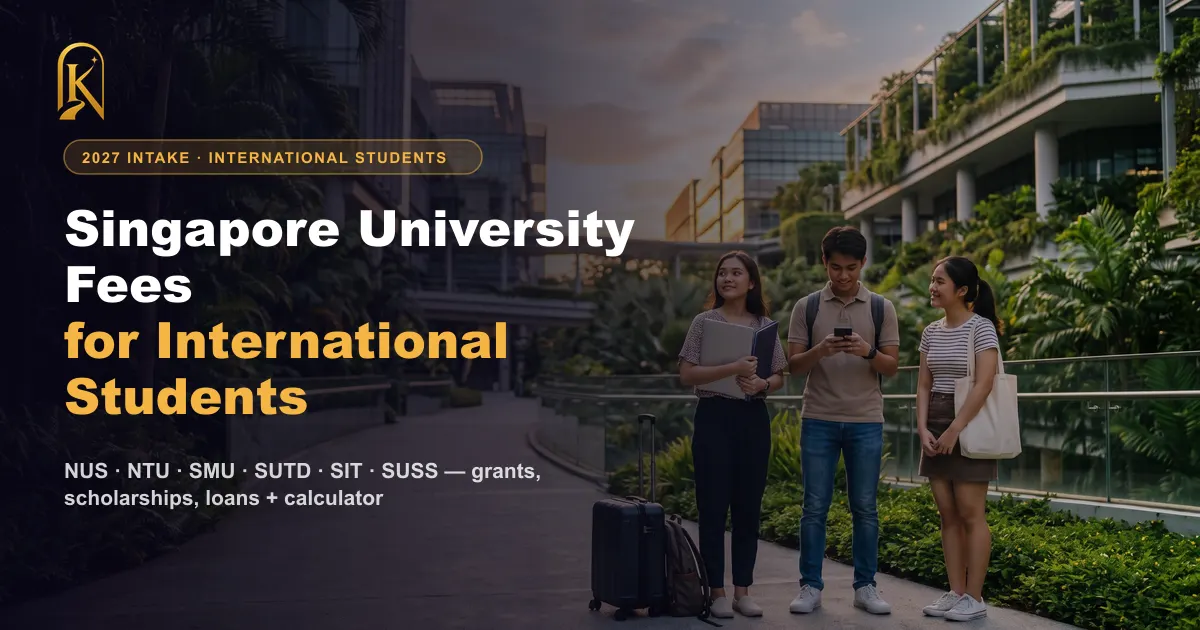

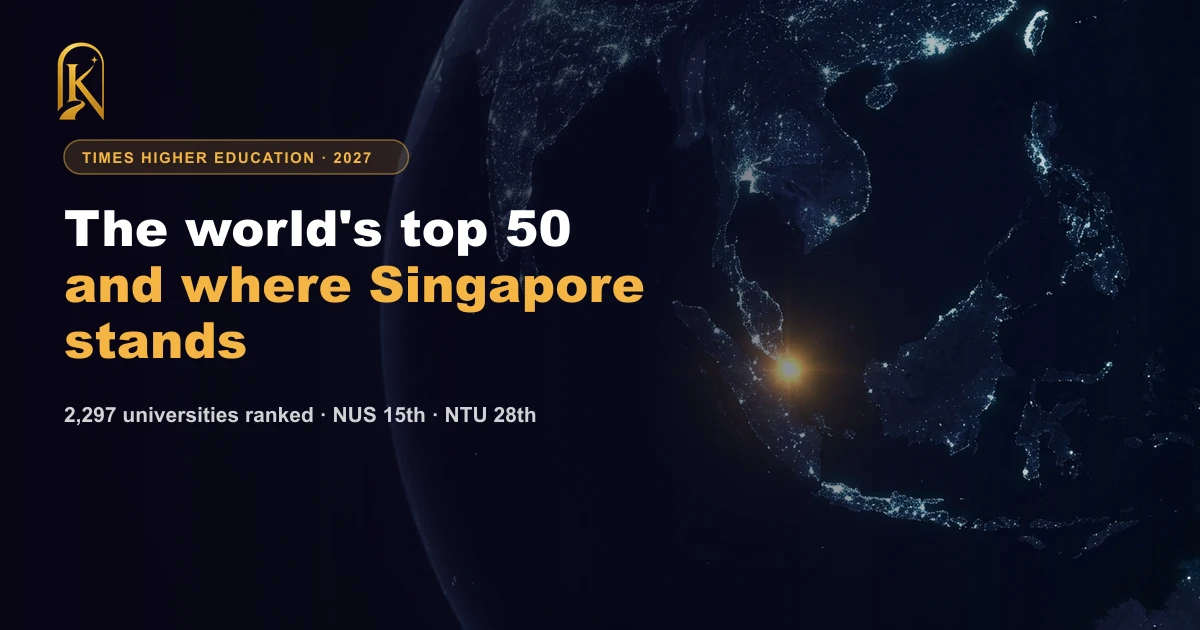
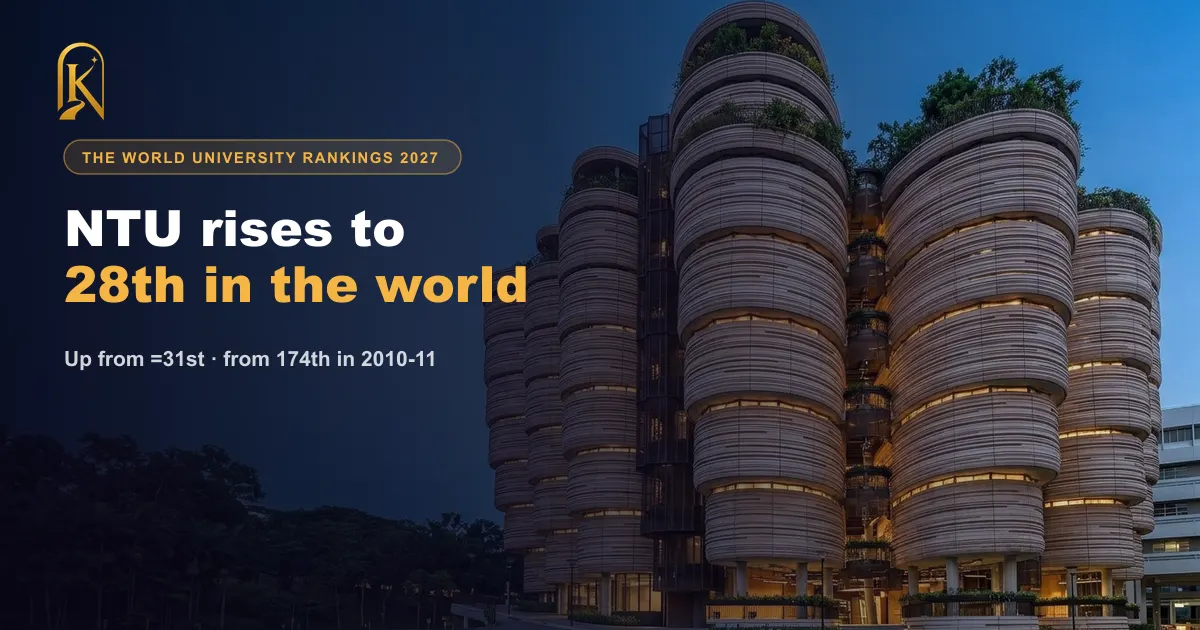
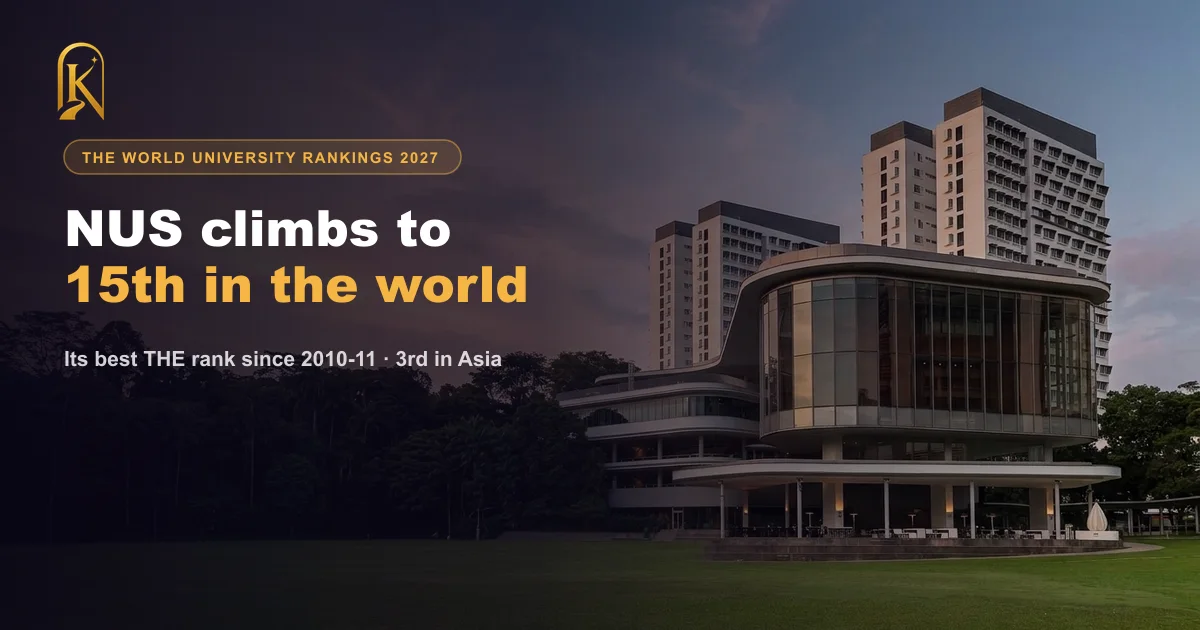



With the MOE Tuition Grant, most international degrees cost S$18,050 to S$31,600 a year in tuition at NUS, NTU, SMU and SUTD, in exchange for a 3-year work bond in Singapore. Without it, the same course can cost nearly double. Use our fee calculator to price your own course, loan and currency.
Preparing for the 2027 intake? The fees below are the latest published (AY2026/27) official fees. AY2027/28 fees for the 2027 intake are not yet published; check the official page before you accept your offer. Fees for new cohorts have risen year on year, so budget a buffer.
We checked every figure on this page against the official university, MOE, MOM, ICA and bank pages on 5 October 2026. Fees are for the AY2026/27 intake, in Singapore dollars, and include 9% GST for international students as the universities publish them. Figures we could not confirm are left out and listed in the note on completeness.
Sources: NUS Registrar: undergraduate tuition (AY2026/27 new intake) ; MOE: Tuition Grant overview ; OCBC: Higher Education Student Loan ; MOM: work pass exemption for foreign students
Annual Tuition: With the Grant vs Without
This is the table most families want first. Every university publishes three international rates: ASEAN student with the Tuition Grant, other international student with the Grant, and the non-subsidised rate you pay if you do not take the Grant. Compulsory miscellaneous fees and living costs are extra and covered further down.
| University and course | ASEANwith Grant · S$/yr | Other ISwith Grant · S$/yr | No Grantno bond · S$/yr | Grant savesASEAN · other IS |
|---|---|---|---|---|
| NUSComputing | S$18,050 | S$21,400 | S$39,700 | S$21,650·S$18,300 |
| NUSBusiness | S$21,150 | S$22,200 | S$33,400 | S$12,250·S$11,200 |
| NTUMost programmeslab-based no-Grant rate | S$18,050 | S$21,400 | S$40,600 | S$22,550·S$19,200 |
| NTUAccountancy / Business | S$20,700 | S$21,800 | S$45,600 | S$24,900·S$23,800 |
| SMUBusiness, Accountancy, Computing and more | S$25,150 | S$26,200 | S$47,700 | S$22,550·S$21,500 |
| SMULaw | S$27,750 | S$30,450 | S$56,150 | S$28,400·S$25,700 |
| SUTDAll degrees | S$30,200 | S$31,600 | S$62,076 | S$31,876·S$30,476 |
| SITStandard-rate programmesper credit x 60 (estimate) | S$19,489 | S$22,301 | S$34,531 | S$15,042·S$12,230 |
| SITBusiness / health-rate programmesper credit x 60 (estimate) | S$21,844 | S$24,525 | S$39,208 | S$17,364·S$14,683 |
| SUSSMost programmes4-year total / 4 (estimate) | S$17,100 | S$19,200 | S$33,742 | S$16,642·S$14,542 |
| SUSSAccountancy4-year total / 4 (estimate) | S$18,250 | S$20,500 | S$34,539 | S$16,289·S$14,039 |
Lowest ASEAN fee with the Grant, and the biggest ASEAN saving from taking the Grant. SIT and SUSS yearly figures are estimates (per-credit rate × credits, or 4-year total ÷ 4).
Sources: NUS Registrar: undergraduate tuition (AY2026/27 new intake) ; NTU: tuition fees, programme offer in 2026 ; SMU: tuition fees and Tuition Grant (AY2026/27 freshmen) ; SUTD: tuition fees (AY2026) ; SIT: undergraduate tuition fees AY2026 (PDF) ; SUSS: full-time undergraduate tuition fees AY2026
SIT bills per credit and SUSS publishes a four-year total, so their yearly figures are our arithmetic (shown in the Basis column), not a published bill. NTU publishes a lab-based and a non-lab no-Grant rate (S$40,600 and S$36,350 for most programmes); the row above uses the lab-based one. The ASEAN list varies slightly by university: NTU includes Timor-Leste, while SMU’s list does not.
How to read “with the Grant”
The Grant is not an automatic right for international students. MOE says the award is competitive and based on merit, and SMU and SUTD both say a limited number of Grants are available to international students. SMU offers a Tier C Grant only. If you are not offered one, or choose not to take it, the non-subsidised column is your fee.
Sources: MOE: Tuition Grant overview ; SMU: tuition fees and Tuition Grant (AY2026/27 freshmen) ; SUTD: tuition fees (AY2026)
The Tuition Grant and Its 3-Year Bond, Explained
The Tuition Grant (TG) is a government subsidy for full-time diploma and undergraduate courses at publicly funded institutions. There are three tiers, A, B and C, with Tier A the highest and reserved for Singapore citizens. Citizens get the Grant automatically. International students must apply when they enrol in an eligible course. You are not eligible if you have already received a TG, subsidy, sponsorship or scholarship from the Singapore Government for a qualification at the same level or higher. Part-time courses, advanced and specialist diplomas and any course at a private education institution are excluded.
Sources: MOE: Tuition Grant overview ; MOE: Tuition Grant application process
What the bond requires
The obligation
- Work for a Singapore entity, on a valid work pass, for 3 years upon graduation.
- You may work at one company or at different ones.
- Only full-time employment is considered.
- Bond service must begin immediately after graduation, and you must update your employment status within 3 months.
What counts as a Singapore entity
Not only the civil service. MOE lists a company incorporated in Singapore, a partnership or sole proprietorship, a Singapore government agency, a registered education institution, a registered non-profit, and a foreign company with a substantial connection to Singapore under Singapore law. Self-employment counts if you run an ACRA-registered company.
Some overseas roles can count with prior MOE approval: an overseas subsidiary or joint venture more than 50% owned by a Singapore entity, an overseas representative office on a Singapore payroll, or a secondment on a Singapore payroll.
Sources: MOE: types of employment that count towards the bond ; MOE: Tuition Grant overview
Deferment: studying further
You can ask MOE to defer the bond to pursue further studies, but you need approval before you start. The process can take up to 2 months, so MOE advises applying early. To extend a deferment, apply at least 8 weeks before it ends. A second deferment is possible only if you have already served at least 18 months of the bond, and the application goes in at least 8 weeks before it starts.
Source: MOE: bond deferment to pursue further studies
Breaking the bond: liquidated damages
If you do not complete the bond, you pay liquidated damages (LD): the total Tuition Grant received, plus any GST subsidy, plus 10% interest a year, compounded at the end of each academic year. MOE lists the triggers as withdrawing from the course, being terminated from it, changing to a course without taking the Grant for the new one, buying out the bond, or failing to serve it after graduation.
Two practical points from MOE’s freshmen FAQ. If you buy out the bond while still studying, you pay the LD in one lump sum within 30 days and pay non-subsidised fees for the rest of the course. And the FAQ says you will pay LD “for your outstanding bond period”, so service already given counts for something, but MOE does not publish the exact pro-rating arithmetic. For a real number, use MOE’s estimator at go.gov.sg/grantsense.
Sources: MOE: liquidated damages ; MOE: Tuition Grant freshmen briefing FAQ (PDF)
Worked example (estimate): NUS Computing, other international student
- No-Grant fee S$39,700 minus Grant fee S$21,400 = about S$18,300 of Grant a year, S$73,200 over 4 years.
- We assume each year’s Grant compounds at 10% at the end of that academic year and every later one, so the first year compounds 4 times and the last year once.
- Broken right after graduation, that gives roughly S$93,400. For an ASEAN student the same course gives roughly S$110,500.
- Rule of thumb from the same formula: every S$1,000 of yearly Grant over 4 years becomes about S$5,110 of LD.
- This estimate leaves out the GST subsidy and assumes no pro-rating, so the real figure will differ.
Sureties
You nominate two sureties to sign the Tuition Grant Agreement. MOE says a surety assumes responsibility for ensuring you fulfil your obligations, and its FAQ says that if LD is payable on withdrawal, you and your sureties are liable. NTU states sureties must be aged 21 to 64. Choose people who understand they could be asked to pay.
Sources: MOE: Tuition Grant application process ; MOE: Tuition Grant freshmen briefing FAQ (PDF) ; NTU: Tuition Grants
Declining the Grant: full fee, no bond
The official wording at three universities is clear. SMU: those who are not eligible or choose not to apply pay the non-subsidised fees and “do not need to serve out the 3-year work obligation”. NTU asks applicants to say whether they accept the offer with or without the Grant before the July closing date and says those who do not apply or do not complete signing are liable for the full non-subsidised fees. SUTD says that without a Grant you pay non-subsidised fees. NUS adds a warning: international students who reject the Grant, or are admitted without it, are not eligible for its financial aid schemes, including the MOE Tuition Fee Loan, HESL and scholarships.
Sources: SMU: tuition fees and Tuition Grant (AY2026/27 freshmen) ; NTU: tuition fees ; SUTD: tuition fees (AY2026) ; NUS: financial aid for full-time undergraduates
The bond is not a government-jobs rule. It is 3 years of full-time work for any Singapore entity, and MOE’s own outcome data suggests most graduates meet it.
That data point: in a February 2024 parliamentary reply, MOE said about 2,900 international Tuition Grant students graduate each year, and more than 8 in 10 were employed in Singapore within 3 years, with the majority of the rest granted deferment for further studies (figures cover 2017 to 2023). A 2019 reply, now dated, said about 4% of international Grant students over the previous three years had defaulted on the bond, and that MOE would act to prevent defaulters who do not pay from working or residing in Singapore. In January 2025 MOE also said scholarships for international students are under 1% of its budget, and scholarships plus Tuition Grants together under 2%.
Sources: MOE parliamentary reply, 28 Feb 2024: employment of international Tuition Grant holders ; MOE parliamentary reply, 5 Aug 2019: Tuition Grant bond defaulters ; MOE parliamentary reply, 8 Jan 2025: scholarships and Tuition Grants for international students
ASEAN and Other Scholarships
The ASEAN Undergraduate Scholarship (AUS) is a same-named scheme run separately by NUS, NTU, SMU, SUTD, SIT and SUSS. The package is identical on all six pages: subsidised tuition after the Grant, S$5,800 a year for living, S$3,000 a year for accommodation and a one-time S$1,750 computer allowance. One point trips up many families: “no bond” is only half true. The scholarship has no bond of its own, but you must take the Tuition Grant, which carries the 3-year bond. Selection is merit-based and none of the pages publish grade cut-offs or acceptance rates.
ASEAN Undergraduate Scholarship (NUS, NTU, SMU, SUTD, SIT, SUSS each run their own)
- Open to
- ASEAN citizens, excluding Singapore (SUTD and NTU pages also mention permanent residents)
- Tuition
- 100% of subsidised tuition after the Tuition Grant (SIT page says "subsidised tuition fees"; SUTD up to 4 years)
- Allowances
- S$5,800 living + S$3,000 accommodation a year; S$1,750 computer once
- Bond
- No bond on the scholarship, but you must take the Tuition Grant and its 3-year bond
- Keep it by
- Minimum GPA each term (3.5 at NUS, NTU, SUTD, SIT; 3.0/4.0 at SMU; 3.8 at SUSS, scale not stated)
NUS International Undergraduate Scholarship
- Open to
- Citizens of all countries except Singapore
- Tuition
- 100% of subsidised tuition after the Tuition Grant
- Allowances
- S$5,800 living + S$5,000 accommodation a year; S$1,750 computer once
- Bond
- No bond on the scholarship; 3-year Tuition Grant bond (MOH bond for Dentistry 5 years, Medicine 6 years)
- Keep it by
- GPA 3.5 or equivalent
NTU Nanyang Global Scholarship
- Open to
- All nationalities
- Tuition
- Full subsidised tuition after the Tuition Grant
- Allowances
- S$6,500 living a year; up to S$2,000 a year for NTU hostel residents; S$2,000 computer once; travel grant up to S$8,000 for an overseas programme
- Bond
- No bond apart from the 3-year Tuition Grant bond
- Keep it by
- CGPA 3.5/5.0 each semester
NUS ABS - Goh Keng Swee Scholarship
- Open to
- Citizens of 15 listed economies (not SC/PR), excluding Dentistry, Medicine and Music
- Tuition
- 100% of subsidised tuition after the Tuition Grant
- Allowances
- S$6,000 living + S$5,000 accommodation a year; S$1,750 computer; S$200 settling-in; S$400 incoming + S$800 return travel
- Bond
- No bond on the scholarship; 3-year Tuition Grant bond
- Keep it by
- GPA 3.5
SMU Lee Kong Chian Scholars’ Programme
- Open to
- First-year SMU undergraduates of any nationality; up to 60 scholarships
- Tuition
- Waiver of subsidised tuition for Semesters 1 and 2, up to 4 years
- Allowances
- S$5,000 a year; Global Opportunities grant S$16,000; S$1,800 computer once
- Bond
- Bond-free; non-Singaporeans must take the Tuition Grant (3 years of work in Singapore)
- Keep it by
- Not stated on the page
Science & Technology scholarships (NUS, NTU, SMU)
- Open to
- Asian citizens excluding Singapore (SMU: India, China, Hong Kong, Macau, Taiwan; NUS and NTU: Computing, Engineering, Science with exclusions)
- Tuition
- 100% of subsidised tuition after the Tuition Grant (NTU also covers compulsory misc fees)
- Allowances
- S$6,000 living a year; lowest double-room hostel rate; S$1,750 computer; S$200 settling-in; travel allowances
- Bond
- SIX-year bond with a Singapore-registered company (not 3), and the Tuition Grant is required
- Keep it by
- GPA 3.5 (NUS), CGPA 3.5/5.0 (NTU), CGPA 3.4/4.0 (SMU)
OCBC Regional Undergraduate Scholarship
- Open to
- Check OCBC; the only statement we verified is a 7 August 2023 press release
- Tuition
- "Up to S$75,000 annually" covering tuition, allowances, accommodation, airfare and exchange (2023 statement)
- Allowances
- Included in the S$75,000 ceiling (2023 statement)
- Bond
- Serve OCBC in your home country for the same duration as the scholarship (2023 statement)
- Keep it by
- Current terms not checked
Scholarship pages print no academic year on their benefit text, so every row means “the current published page, read on 5 October 2026”. Do not compare grade requirements across scales: NTU, SUTD use 3.5 out of 5.0, SMU’s AUS uses 3.0 out of 4.0, SMU’s Science & Technology scholarship 3.4 out of 4.0, and SUSS states 3.8 without naming a scale. Benefits are fixed allowances, not guaranteed to cover your real hostel bill.
Sources: NUS ASEAN Undergraduate Scholarship ; NUS International Undergraduate Scholarship ; NTU Nanyang Global Scholarship ; NUS ABS - Goh Keng Swee Scholarship ; SMU Lee Kong Chian Scholars’ Programme ; NUS Science & Technology Undergraduate Scholarship ; OCBC press release, 7 August 2023
Six-year bond warning
The Science & Technology scholarships at NUS, NTU and SMU carry a six-year bond with a Singapore-registered company, on top of needing the Tuition Grant. Any source that says three years for these scholarships is wrong. The ASEAN and international scholarships above are the ones with no bond of their own.
Dates worth knowing, with caveats
- NUS and NTU award these scholarships through admission, so there is usually no separate form. NUS interviews run January to July with outcomes by mid-July; NTU interviews run March to May.
- NUS’s international-qualification application window for AY2027/28 is printed as 16 December 2026 to 17 February 2027, but the page labels every window “[Closed]”, which is plainly stale. Treat the dates as indicative and re-check.
- We could not find 2027-intake scholarship deadlines for SMU, SUTD, SIT or SUSS, and we do not guess them.
Source: NUS: important admission dates
If your results are not enough for a scholarship
There are fewer safety nets for internationals than for citizens, so plan around these.
- Take the Tuition Grant. Subsidised fees need it, and NUS financial aid is closed to students without it.
- NUS financial aid for internationals is thin: per capita income up to S$1,875, a living allowance loan of up to S$4,100 a year, donated bursaries from S$1,500, a Student Assistance Loan of up to S$4,000 and a Work Study Assistance Scheme. NUS also lists an overseas exchange loan of up to S$3,000 a semester for needy students.
- HESL covers up to 45% of subsidised tuition regardless of neediness at NUS (see the loans section below).
- NTU bursaries: NTU says a limited number of donated bursaries are available to PR and international students paying subsidised fees. It publishes no international amount we could verify.
- Donor scholarships by nationality exist at SMU (Philippines, Thailand) and SUTD (Regent Group for ASEAN nations). Amounts are not on the list pages.
- Malaysia’s JPA: its main national scholarship page states there is no sponsorship in Singapore for 2026.
Sources: NUS: financial aid for full-time undergraduates ; JPA Malaysia: Program Penajaan Nasional (PPN) ; NTU bursaries
Also, MOE’s “ASEAN Scholarship” is a secondary-school scheme (Secondary 3 to Pre-University 2), not a university one. Our full Singapore university scholarships guide covers the Singaporean-facing awards in more depth.
Loans: HESL and Bank Options
The Higher Education Student Loan (HESL) replaces the old Tuition Fee Loan, Study Loan and Overseas Student Programme Loan. New applications for the old schemes closed in May 2026, and the HESL portal opened on 29 July 2026. Our HESL guide covers the scheme for Singaporeans. Here is what applies to international students.
| Term | International students |
|---|---|
| Who can borrow | Full-time international undergraduates on MOE-subsidised programmes, i.e. paying the subsidised fee with the Tuition Grant |
| Tuition loan | Up to 45% of the subsidised international tuition fee, not means-tested (citizens 90%, PRs 65%) |
| Living allowance loan | Up to S$4,100 per academic year, means-tested (gross monthly household per capita income up to S$1,875) |
| If a scholarship already covers tuition | Only the living allowance loan; no tuition (base provision) loan |
| Not available to internationals | 10% Balance Fee Coverage and the Overseas Student Programme loan of up to S$12,000 (citizens only) |
| Interest while studying | 0%, interest-free during the course of study; interest starts on graduation or on leaving the institution |
| Rate after that | 3-month compounded SORA + 1.5 percentage points, revised half-yearly (1 Apr and 1 Oct); 2.6% a year in OCBC’s table for both 1 Apr to 30 Sep 2026 and 1 Oct 2026 to 31 Mar 2027 |
| Late payment | 3-month SORA + 4.5 percentage points |
| Repayment | Maximum 10 years; lump sum, partial payments or equal monthly instalments of at least S$100 |
| Leave without graduating | The whole outstanding loan becomes due immediately (the bank can set up a monthly plan) |
| Guarantor | Aged 21 to 60, not an undischarged bankrupt; for international students the guarantor can be any nationality (NTU page) |
| Banks | NTU names DBS and OCBC; OCBC lists NUS, NTU, SMU and NIE as eligible universities |
Sources: StudentLoanSG (MOE): HESL FAQ ; NTU: Higher Education Student Loan (HESL) ; OCBC: Higher Education Student Loan ; OCBC: government education loan interest rates ; SUTD: Higher Education Student Loan (HESL) ; MOE: Higher Education Student Loan
Two cautions. First, the “up to 90% of subsidised tuition fees” you will see on MOE pages is the citizen figure; MOE’s StudentLoanSG FAQ sets the international rate at up to 45%. Second, HESL is only for students on MOE-subsidised programmes, so an international student must take the Tuition Grant to borrow (NUS also says students who reject the Grant cannot use HESL). The interest rate shown is a snapshot; check the bank’s table before signing.
Worked repayment examples (estimates)
Assumptions: standard amortisation at 2.6% a year, interest starting at graduation, equal payments for the number of years shown. Bank start dates and the floating rate will change the real figures.
| Borrow S$10,000 over | Monthly | Quarterly | Yearly | Total interest (monthly plan) |
|---|---|---|---|---|
| 5 years | S$177.91 | S$534.82 | S$2,158.67 | S$675 |
| 7 years | S$130.34 | S$391.78 | S$1,580.95 | S$948 |
| 10 years | S$94.73 | S$284.71 | S$1,148.50 | S$1,367 |
At 2.6%, a 10-year plan costs about S$95 a month for every S$10,000 borrowed. That is below the S$100 monthly minimum, so a very small balance would be repaid faster than the term you choose.
Example: NUS Computing, other international student, borrowing the maximum
45% of S$85,600 of subsidised tuition over 4 years is S$38,520, plus S$4,100 x 4 = S$16,400 of living allowance loan (if means-tested eligible). Principal: S$54,920.
Over 10 years at 2.6%: about S$520.23 a month, S$1,563.65 a quarter or S$6,308 a year, with roughly S$7,508 of total interest on the monthly plan. All estimates.
Commercial bank loans
Private education loans are harder for internationals. The OCBC Education Loan page lists a rate from 4.5% a year (effective rate 5.17%), a 2.5% processing fee, up to 10 times monthly income or S$150,000, up to 8 years, and combined annual income of at least S$24,000. The main borrower must be a Singapore citizen or PR aged 17 or older, and a joint borrower who is a citizen or PR aged 21 or older is required if the main borrower is under 21 or studies overseas. In practice an international family needs a Singaporean or PR relative willing to borrow. The page is undated, so confirm current terms with the bank.
Source: OCBC: Education Loan
University by University
Official sources publish no course-popularity ranking, so we do not claim one. For each university we list the most expensive programmes (flagged) plus the standard-rate programmes most families will price. “Full course” multiplies the published fee by the normal duration and is an estimate: fees are cohort-based, so a later intake can pay more. Tuition only; misc fees and living costs follow in the next sections.
 NUS
NUS
NUS fees are cohort-based and payable in two equal instalments at the start of each semester. The AY2026/27 intake pays more than last year’s: other-international Computing with the Grant moved from S$20,000 (AY2025/26 intake) to S$21,400, up 7.0%. Expect new cohorts to keep rising, so budget a buffer for the 2027 intake. Beyond the table, Music is the third-most expensive programme at S$40,100 (ASEAN) and S$56,850 (other), with a no-Grant fee of S$147,850; we have not verified its duration, so it is left out of the full-course column. NUS international misc fees are S$272.50 a semester for lab-based programmes and S$255 for non-lab ones.
| Programme | Years | Per semester: ASEAN / other | Per year: ASEAN / other | No Grant, per year | Full course (est.): ASEAN / other |
|---|---|---|---|---|---|
| Medicine (MBBS)Priciest | 5 | S$37,375 / S$43,900 | S$74,750 / S$87,800 | S$190,150 | S$373,750 / S$439,000 |
| Dentistry (BDS)Priciest | 4 | S$37,050 / S$42,275 | S$74,100 / S$84,550 | S$190,150 | S$296,400 / S$338,200 |
| Law (LLB) | 4 | S$13,875 / S$15,225 | S$27,750 / S$30,450 | S$44,450 | S$111,000 / S$121,800 |
| Business | 4 | S$10,575 / S$11,100 | S$21,150 / S$22,200 | S$33,400 | S$84,600 / S$88,800 |
| Computing | 4 | S$9,025 / S$10,700 | S$18,050 / S$21,400 | S$39,700 | S$72,200 / S$85,600 |
| Design & Engineering | 4 | S$9,025 / S$10,700 | S$18,050 / S$21,400 | S$39,700 | S$72,200 / S$85,600 |
| Humanities and Sciences | 4 | S$9,025 / S$10,700 | S$18,050 / S$21,400 | S$36,650 | S$72,200 / S$85,600 |
| Medicine (Nursing) | 4 | S$9,900 / S$11,250 | S$19,800 / S$22,500 | S$38,750 | S$79,200 / S$90,000 |
Sources: NUS Registrar: undergraduate tuition (AY2026/27 new intake) ; NUS Registrar: miscellaneous fees ; NUS Registrar: continuation and graduation requirements (durations)
Durations: Business 4 years (MOE CourseFinder), Law 4, Dentistry 4 and Medicine 5 (NUS Registrar). Computing, Design & Engineering and Humanities and Sciences assume 8 semesters from NUS’s 160-unit rule, and Nursing is an editable assumption; confirm your major. Medicine and Dentistry scholarship recipients also carry a Ministry of Health service bond, which NUS states as 6 years for Medicine and 5 for Dentistry.
NTU
NTU says the annual tuition fee is fixed at the 2026 rate for the duration of the degree. Most programmes cost S$18,050 (ASEAN) or S$21,400 (other); the Nanyang Business School group costs S$20,700 or S$21,800. The Renaissance Engineering Programme (4.5 years, dual degree) and Medicine (5 years) are the priciest, and NTU’s table lists no non-subsidised rate for either. NTU’s grant covers “the normal duration of a degree programme, usually three or four years”.
| Programme | Years | Per semester (est.): ASEAN / other | Per year: ASEAN / other | No Grant, per year | Full course (est.): ASEAN / other |
|---|---|---|---|---|---|
| Medicine (LKCMedicine MBBS)Priciest | 5 | S$40,425 / S$45,625 | S$80,850 / S$91,250 | not published | S$404,250 / S$456,250 |
| Renaissance Engineering ProgrammePriciest | 4.5 | S$15,500 / S$16,000 | S$31,000 / S$32,000 | not published | S$139,500 / S$144,000 |
| Accountancy / Business (Nanyang Business School programmes)Priciest | 4 | S$10,350 / S$10,900 | S$20,700 / S$21,800 | S$45,600 | S$82,800 / S$87,200 |
| Most programmes, lab-based (e.g. engineering, computing, sciences) | 4 | S$9,025 / S$10,700 | S$18,050 / S$21,400 | S$40,600 | S$72,200 / S$85,600 |
| Most programmes, non-lab (e.g. humanities, social sciences) | 4 | S$9,025 / S$10,700 | S$18,050 / S$21,400 | S$36,350 | S$72,200 / S$85,600 |
Sources: NTU: tuition fees, programme offer in 2026 ; NTU: AY2026 miscellaneous fees (PDF) ; NTU: Tuition Grants
NTU’s AY2026 misc fees for international students are S$455 (business, humanities, social sciences, communication), S$490 (computing, engineering, sciences) and S$505 (Medicine) “inclusive of GST”, but the PDF does not state whether that is per semester or per year. We therefore show it as a yearly amount and let the calculator double it; check NTU’s fee statement. The page also says all Grant application updates and signing must be completed by 18 October 2026, but ties that date to the AY2027-28 cohort label, so check which intake it applies to.
SMU
SMU uses one fee band for every degree except Law, which is simple to plan around. Fees are fixed for the normal four-year duration, though each new cohort’s fees are revised annually. International students can apply for a Tier C Tuition Grant only, and SMU describes places as limited and merit-based. An optional Special Term (Term 3) costs S$2,515 (ASEAN) or S$2,620 (other) per course with the Grant, S$3,045 per Law course for other students. Misc fees for international students are S$367 a year (Student Activities S$80, Insurance S$268, IT S$19).
| Programme | Years | Per term (est.): ASEAN / other | Per year: ASEAN / other | No Grant, per year | Full course (est.): ASEAN / other |
|---|---|---|---|---|---|
| Law (LLB)Priciest | 4 | S$13,875 / S$15,225 | S$27,750 / S$30,450 | S$56,150 | S$111,000 / S$121,800 |
| Accountancy, Business, Economics, Computing, IS, Social Sciences (one fee band) | 4 | S$12,575 / S$13,100 | S$25,150 / S$26,200 | S$47,700 | S$100,600 / S$104,800 |
Source: SMU: tuition fees and Tuition Grant (AY2026/27 freshmen)
SUTD
SUTD charges one flat fee for all degrees, quoted per term: S$15,100 (ASEAN) or S$15,800 (other) with the Grant, S$31,038 without. Students pay for 8 academic terms, which is the normal duration, so the per-year figures are the published S$30,200 and S$31,600. The fee has crept up by cohort: other-international was S$30,650 for AY2024, S$31,400 for AY2025 and S$31,600 for AY2026. SUTD stresses that international Grants are limited and competitive; the fallback is the non-subsidised S$62,076 a year. Compulsory misc fees are S$232 a term plus a one-time S$10.
| Programme | Years | Per term: ASEAN / other | Per year: ASEAN / other | No Grant, per year | Full course (est.): ASEAN / other |
|---|---|---|---|---|---|
| All SUTD degrees (one flat fee) | 4 | S$15,100 / S$15,800 | S$30,200 / S$31,600 | S$62,076 | S$120,800 / S$126,400 |
Source: SUTD: tuition fees (AY2026)
SIT
SIT bills per credit, with rates set by programme group, so the full-course figure is exact (credits x rate) but the yearly and per-trimester figures are estimates that assume 60 credits a year. The standard group covers most engineering and ICT degrees; SIT-DigiPen carries the highest rate among the 180- and 240-credit programmes. The Culinary Institute of America degrees have the highest per-credit rate (S$552.63 for other internationals) but only 132 credits, so we leave them out of the table.
| Programme | Years | Per trimester (est.): ASEAN / other | Per year: ASEAN / other | No Grant, per year | Full course (est.): ASEAN / other |
|---|---|---|---|---|---|
| SIT-DigiPen (Computer Science, interactive media and game development)Priciest | 4 | S$8,567 / S$9,614 | S$25,702 / S$28,841 | S$42,575 | S$102,809 / S$115,366 |
| SIT-TUM (Chemical Engineering, Electronics and Data Engineering)Priciest | 4 | S$8,262 / S$9,265 | S$24,787 / S$27,795 | S$40,875 | S$99,146 / S$111,180 |
| Business / health rate, 240 credits (BIBIT, physiotherapy, occupational therapy and similar)Priciest | 4 | S$7,281 / S$8,175 | S$21,844 / S$24,525 | S$39,208 | S$87,374 / S$98,100 |
| Joint degrees with Newcastle / Glasgow, 180 credits | 3 | S$8,262 / S$9,265 | S$24,787 / S$27,795 | S$40,875 | S$74,360 / S$83,385 |
| Standard rate, 240 credits (e.g. Civil Engineering, EEE) | 4 | S$6,496 / S$7,434 | S$19,489 / S$22,301 | S$34,531 | S$77,957 / S$89,206 |
| Business / health rate, 180 credits (Accountancy, Aviation, Hospitality, Nursing) | 3 | S$7,281 / S$8,175 | S$21,844 / S$24,525 | S$39,208 | S$65,531 / S$73,575 |
| Standard rate, 180 credits (e.g. Computer Engineering, Aircraft Systems) | 3 | S$6,496 / S$7,434 | S$19,489 / S$22,301 | S$34,531 | S$58,468 / S$66,904 |
Sources: SIT: undergraduate tuition fees AY2026 (PDF) ; SIT: undergraduate tuition fees page (miscellaneous fees)
Credit totals come from SIT’s PDF; the 3-year and 4-year durations follow from 180 and 240 credits but SIT’s duration page was not available to us. Misc fees are S$121.70 a trimester including GST, charged every trimester (S$365.10 a year). SIT’s joint degrees range from 120 to 240 credits; the 180-credit joint row is one example.
SUSS
SUSS offers twelve full-time undergraduate programmes to international students on a Student’s Pass: Accountancy, Chinese Studies, Early Childhood Education, Human Resource Management, Public Safety and Security, Business Analytics, Finance, ICT, Marketing, Psychology, Supply Chain Management and Social Work. It publishes four-year totals: S$68,400 (ASEAN) or S$76,800 (other) with the Grant for most programmes, and S$73,000 or S$82,000 for Accountancy; without the Grant, S$134,966 and S$138,157. Fees are per course (a typical 5-credit-unit course is S$1,854 for ASEAN students with the Grant) and are reviewed annually. Misc fees are S$530 a year, before prevailing GST.
| Programme | Years | Per semester (est.): ASEAN / other | Per year: ASEAN / other | No Grant, per year | Full course (est.): ASEAN / other |
|---|---|---|---|---|---|
| AccountancyPriciest | 4 | S$9,125 / S$10,250 | S$18,250 / S$20,500 | S$34,539 | S$73,000 / S$82,000 |
| Most programmes (Business Analytics, Finance, ICT, Marketing, Psychology, Social Work and more) | 4 | S$8,550 / S$9,600 | S$17,100 / S$19,200 | S$33,742 | S$68,400 / S$76,800 |
Sources: SUSS: full-time undergraduate tuition fees AY2026 ; SUSS: international full-time undergraduate students
SUSS does not publish a per-semester fee, so the per-semester column is our estimate. There is no on-campus accommodation at present, and the admission process includes an ICA medical examination with TB and HIV tests.
Living Costs: What the Universities Publish
Living costs are where official data is thinnest. Only NUS, SMU and SUSS publish a usable estimate. We found no undergraduate estimate for NTU or SIT, and SUTD’s estimates page is headed AY2025, so we do not present those as current.
| University | What is published | Our low / mid / high a year (estimate) |
|---|---|---|
| NUS | Meals S$2,600, personal S$2,200, transport S$800 and a total of S$6,000 a year excluding accommodation; on-campus accommodation S$4,000 to S$10,290 a year; excludes vacation. No academic year printed. | S$10,000 / S$13,145 / S$16,290 |
| SMU | Monthly: accommodation S$250 to S$800, utilities S$40 to S$100, transport S$200, telecom S$50, personal S$100 to S$300, food S$300 to S$450, books S$200 a term. Says the average student stays within S$2,000 a month. Undated page. | S$11,680 / S$17,440 / S$23,200 |
| SUSS | S$500 to S$2,000+ a month (FAQ); no on-campus housing. | S$6,000 / S$15,000 / S$24,000 |
| SUTD | AY2025 page, per term: hostel S$1,710, meals S$1,680, books and personal S$1,350, transport S$324. Verified AY2026 Freshmore double-room hostel fee: S$5,517.30 for the 8 Sep 2026 to 21 Aug 2027 contract. | Not modelled (reference only in the calculator) |
| NTU, SIT | No official undergraduate estimate found. NTU’s only published figures are for graduate students and are not shown here. | Not available (NUS reference only in the calculator) |
Sources: NUS living costs ; SMU: living in Singapore ; SUSS: international students ; SUTD: financial estimates (AY2025) ; SUTD: Freshmore housing payment AY2026
Our low, mid and high figures are simple arithmetic on those published ranges (ends and midpoint), not a university forecast. Rents and phone plans in the private market are not covered by any of these pages. SUTD’s Freshmore hostel payment also has separate application (S$27.25) and acceptance (S$200) fees listed on its undergraduate housing page.
Part-Time Work: What It Can and Cannot Pay
MOM’s rules for international students at NUS, NTU, SMU, SUTD, SIT and SUSS are short. You may work up to 16 hours a week during term and there is no weekly limit during vacation, provided you hold a valid Student’s Pass and are aged 14 or older. Exchange students are not allowed to work. The part-time work rules sit on a valid pass, so confirm your own pass conditions.
Source: MOM: work pass exemption for foreign students
Estimates. The S$10 and S$15 hourly rates and the 26 working weeks are our assumptions, not published wages. Singapore’s Local Qualifying Salary of S$10.50 an hour (from 1 July 2026) is a work-pass quota benchmark for employers, not a minimum wage for students, so we do not use it as a floor.
Source: MOM: Local Qualifying Salary
Can part-time work pay the tuition? Honestly, no. The best case above, 16 hours at S$15 for 26 weeks, is S$6,240 a year. Against S$21,400 of NUS Computing tuition for an other international student, that is about 29%. At S$10 an hour it is 19%. What it can do is offset part of living costs. Vacation work has no weekly cap, so four extra weeks at 40 hours and S$10 an hour (our assumption) would add S$1,600. Remember that heavy work hours compete with the grades many scholarships require you to keep.
Take the Bond or Pay More? A Decision Table
The real decision is rarely “can we afford it” but “which obligation do we prefer”: a cash cost now, or a work commitment later. Here is how the options compare, using only what the official pages state.
| Route | What you pay | What you owe | Watch out for |
|---|---|---|---|
| Tuition Grant and bond | Subsidised fee, for example NUS Computing other IS S$21,400 a year | 3 years of full-time work for a Singapore entity, starting right after graduation | LD if broken: grant + any GST subsidy + 10% a year compounded. Two sureties. |
| Decline the Grant: full fee | Non-subsidised fee, for example NUS Computing S$39,700 a year | No bond (official wording at SMU, NTU, SUTD) | NUS: no financial aid, HESL or scholarships. NTU Medicine and REP list no non-subsidised rate. SUTD fallback is S$62,076 a year. |
| ASEAN or international scholarship | Tuition after the Grant plus allowances are covered | No bond on the scholarship, but the Tuition Grant bond still applies | Grade floor each term; merit-based; a single university’s package |
| Science & Technology scholarship | Tuition after the Grant, living allowance, hostel | SIX-year bond with a Singapore-registered company | Longer commitment than the Grant alone |
| MOH-bonded Medicine or Dentistry scholarship | Scholarship as listed by NUS | MOH service bond: 6 years Medicine, 5 years Dentistry (NUS pages) | We did not verify how the MOH bond and the Tuition Grant bond interact; ask NUS |
| OCBC Regional Undergraduate Scholarship | Up to S$75,000 a year per a 2023 press release | Serve OCBC in your home country for the scholarship’s duration (2023) | Current terms not verified |
| Home-country sponsorship | Varies | Varies | Malaysia’s JPA PPN: no sponsorship in Singapore for 2026 |
Sources: MOE: liquidated damages ; SMU: tuition fees and Tuition Grant (AY2026/27 freshmen) ; NUS: financial aid for full-time undergraduates ; NUS ASEAN Undergraduate Scholarship ; OCBC press release, 7 August 2023 ; JPA Malaysia: Program Penajaan Nasional (PPN)
Bond now, or cash now
Both routes are legitimate. Pick the one your family can actually live with.
You save about S$18,300 a year on NUS Computing as an other-international student (S$73,200 over four years, estimate). In return you plan to work in Singapore for 3 years straight after graduation, at any Singapore entity.
You keep your freedom to work anywhere after graduating, but you fund the non-subsidised fee, and at NUS you also lose access to its financial aid, HESL and scholarships. Check your exact programme’s no-Grant rate first.
Fee Calculator: Your Course, Loan and Currency
University fees calculator
Free · NUS, NTU, SMU, SUTD, SIT and SUSS · 12 currencies
- Tuition with or without the Tuition Grant
- Living costs from university estimates
- ASEAN scholarship or any other award
- Part-time earnings within the 16-hour limit
- Optional HESL loan with monthly repayments
- Per semester, per year and full course
Example: NUS Computing
S$21,400
a year tuition, other international + Grant
Price your own courseEstimates only. Not financial or immigration advice. Fees are cohort-based and can change for later intakes; confirm every figure with your university and MOE before you commit.
What a Year Costs in Your Currency
A mid-case year here means: the flagship programme’s tuition with the Tuition Grant, plus compulsory misc fees, plus the mid living-cost estimate from the living-costs table. No scholarship and no part-time income. Converted at preset rates as of 5 October 2026. Living costs for NTU, SUTD and SIT are the NUS reference, not their own published figures.
ASEAN students (ASEAN Grant rate)
| Programme | SGD |  MYR MYR |  THB THB |  IDR IDR |  VND VND |  PHP PHP | MMK |
|---|---|---|---|---|---|---|---|
| NUS Computing | S$31,740 | MYR 101,251 | THB 833,810 | IDR 443.788.680 | VND 643.560.240 | PHP 1,553,356 | MMK 52,045,030 |
| NTU most programmes (lab) | S$31,685 | MYR 101,075 | THB 832,365 | IDR 443.019.670 | VND 642.445.060 | PHP 1,550,664 | MMK 51,954,845 |
| SMU standard band | S$42,957 | MYR 137,033 | THB 1,128,480 | IDR 600.624.774 | VND 870.996.132 | PHP 2,102,316 | MMK 70,437,882 |
| SUTD | S$43,809 | MYR 139,751 | THB 1,150,862 | IDR 612.537.438 | VND 888.271.284 | PHP 2,144,012 | MMK 71,834,932 |
| SIT standard rate | S$32,999 | MYR 105,268 | THB 866,892 | IDR 461.396.213 | VND 669.093.807 | PHP 1,614,986 | MMK 54,109,942 |
| SUSS most programmes | S$32,630 | MYR 104,090 | THB 857,190 | IDR 456.232.660 | VND 661.605.880 | PHP 1,596,912 | MMK 53,504,390 |
Other international students (other-IS Grant rate)
| Programme | SGD |  CNY CNY | INR |  USD USD |
|---|---|---|---|---|
| NUS Computing | S$35,090 | CNY 183,521 | INR 26,34,206 | USD 27,370 |
| NTU most programmes (lab) | S$35,035 | CNY 183,233 | INR 26,30,077 | USD 27,327 |
| SMU standard band | S$44,007 | CNY 230,157 | INR 33,03,605 | USD 34,325 |
| SUTD | S$45,209 | CNY 236,443 | INR 33,93,840 | USD 35,263 |
| SIT standard rate | S$35,812 | CNY 187,294 | INR 26,88,369 | USD 27,933 |
| SUSS most programmes | S$34,730 | CNY 181,638 | INR 26,07,181 | USD 27,089 |
Sources: MAS reference rates for 5 Oct 2026, via allratestoday.com (secondary) ; Wise mid-market SGD to MMK ; Wise mid-market SGD to KHR ; Wise mid-market SGD to LAK ; Brunei Darussalam Central Bank: Brunei dollar pegged to Singapore dollar at par
Rates move daily and are approximate. The Myanmar kyat, Cambodian riel and Lao kip rates come from a single mid-market source and the kyat can differ in the parallel market, so check today’s rate for those. The calculator covers BND (at par), KHR and LAK too. Our SGD exchange rate guide looks at the other direction, Singaporeans paying overseas fees.
Timeline and Checklist
This timeline is built around the 2027-intake application cycle (applying in 2026-27 for entry in 2027). Only dates we could verify are shown. Everything else is marked as not published.
Dates we could verify
- NUS international-qualification applications for AY2027/28: 16 Dec 2026 to 17 Feb 2027 as printed (page labelled “[Closed]” in error; re-check).
- NUS and NTU scholarship interviews: NUS January to July, outcomes by mid-July; NTU March to May.
- NTU Tuition Grant updates and signing: complete by 18 Oct 2026 (intake label ambiguous; check).
- HESL portal opened 29 Jul 2026; old Tuition Fee Loan and Study Loan stopped taking new applications in May 2026.
- SMU, SUTD, SIT, SUSS scholarship deadlines: not published on the pages we checked.
Student’s Pass costs (estimates)
- Processing fee S$45, non-refundable (ICA application page for institutes of higher learning).
- Issuance fee S$60 and, where applicable, multiple-journey visa S$30 (ICA).
- Total about S$135 with the visa, S$105 without (our arithmetic).
- The pass is digital-only since 27 Feb 2023. A medical examination is part of the process; ICA says it “may be required” and SUSS lists TB and HIV tests.
- Timing windows for applying differ between ICA and NTU pages, so follow your university’s instructions.
Sources: ICA: apply for a Student’s Pass (institutes of higher learning) ; ICA: collect your Student’s Pass ; NUS: important admission dates ; NTU: Tuition Grants
Checklist
- Price your course in the calculator for both the Grant and no-Grant routes.
- Decide whether your family prefers the bond or the cash cost, and tell the university which you choose before its closing date.
- If taking the Grant, identify two sureties aged 21 to 64 who understand the liability, and sign the agreement in the university’s window.
- Apply for your scholarship together with your admission application where the university says so.
- If borrowing, line up a guarantor aged 21 to 60 and check the bank’s current rate.
- Budget for the Student’s Pass fees and the medical examination.
- Keep a note of the bond start date: service must begin immediately after graduation and status updates are due within 3 months.
Frequently Asked Questions
11 questions families ask us
Tap a question to open it
01How much will university fees for international students in Singapore cost if I am preparing for the 2027 intake?
AY2027/28 fees for the 2027 intake are not yet published, so check the official page before you accept your offer. On the latest published fees (AY2026/27) with the MOE Tuition Grant, a typical NUS or NTU degree costs an ASEAN student about S$18,050 a year and other international students about S$21,400 (tuition only, GST included). Without the grant the same NUS Computing degree is S$39,700 a year. SMU is S$25,150 to S$30,450 with the grant, SUTD S$30,200 to S$31,600. Medicine and Dentistry cost far more.
02Are the 2027 intake fees published yet?
Not yet. The fees on this page are the latest published (AY2026/27) official fees. AY2027/28 fees for the 2027 intake have not been published; check each university’s official fee page before you accept your offer. Fees for new cohorts have risen year on year (for example NUS Computing with the Grant for other international students moved from S$20,000 to S$21,400), so budget a buffer.
03What is the Tuition Grant bond for international students?
International students who accept the MOE Tuition Grant must work for a Singapore entity, on a valid work pass, for 3 years after graduation, at one company or several. It is not limited to government jobs. Breaking the bond means paying liquidated damages: the total grant received, any GST subsidy, plus 10% a year compounded at the end of each academic year.
04Can I decline the Tuition Grant and avoid the bond?
Yes, according to SMU, NTU and SUTD, which say students who do not apply for or sign the grant pay non-subsidised fees and do not serve the 3-year work obligation. The cost is much higher: NUS Computing is S$39,700 a year instead of S$21,400 for most international students. NUS also says students who reject the grant cannot use its financial aid schemes, including HESL and scholarships.
05Does the ASEAN Undergraduate Scholarship have a bond?
The scholarship itself carries no bond, but recipients must take the MOE Tuition Grant, which carries the 3-year work bond. The package on all six university pages is subsidised tuition after the grant, S$5,800 a year for living costs, S$3,000 a year for accommodation and a one-time S$1,750 computer allowance.
06Can international students get a loan for Singapore university fees?
Yes, through the Higher Education Student Loan (HESL), but only on an MOE-subsidised programme, which for international students means taking the Tuition Grant. You can borrow up to 45% of the subsidised tuition fee, plus a means-tested living allowance loan of up to S$4,100 a year. It is interest-free while studying, then 3-month SORA plus 1.5 percentage points (2.6% a year in the OCBC table for 1 April 2026 to 31 March 2027), repaid over up to 10 years with a S$100 monthly minimum. Leave without graduating and the whole balance falls due at once.
07How many hours can an international student work part-time in Singapore?
Up to 16 hours a week during term, with no weekly limit in vacation, if you hold a valid Student’s Pass at NUS, NTU, SMU, SUTD, SIT or SUSS. Exchange students are not allowed to work. At S$10 an hour for 16 hours over 26 term weeks, that is about S$4,160 a year (our assumption, not a minimum wage), enough to offset part of living costs but not tuition.
08What are the Student’s Pass fees?
ICA’s pages show an S$60 issuance fee and a S$30 multiple-journey visa fee where applicable. A non-refundable S$45 processing fee is stated on ICA’s application page for institutes of higher learning. That adds up to about S$135, or S$105 without the visa (our arithmetic).
09Does Malaysia’s JPA sponsor undergraduates in Singapore in 2026?
Not through its main national scheme. JPA’s Program Penajaan Nasional page states: “Bagi tahun 2026: Tiada penajaan di Singapura” (for 2026, no sponsorship in Singapore).
10Is the MOE ASEAN Scholarship a university scholarship?
No. MOE’s ASEAN Scholarship is a secondary-school scheme (Secondary 3 to Pre-University 2). Its Vietnam page shows the 2026 round closed on 9 March 2026. University-level ASEAN scholarships are run separately by each university.
11How much would the bond cost me if I broke it?
MOE’s formula is the grant received plus any GST subsidy plus 10% a year, compounded at the end of each academic year. Our estimate for an other-international NUS Computing student (about S$18,300 of grant a year over 4 years) is roughly S$93,400 if broken right after graduation. It excludes the GST subsidy and assumes no reduction for service already completed, so use MOE’s own estimator for a real figure.
Related reading
- Singapore university scholarships 2026 guide
- HESL student loan scheme 2026
- SGD exchange rate and overseas tuition cost
- NUS vs NTU vs SMU for 2027
Compare Singapore universities side by side
Browse every Singapore university on SGSchoolKaki to see programmes, courses and graduate outcomes before you decide.
Explore Singapore universitiesNote on completeness: as of 5 October 2026, the official pages we read did not publish, or we could not confirm, the following. We have not estimated them.
- MOE’s Tuition Grant tier amounts, the exact pro-rating of liquidated damages and bond buy-out amounts.
- A formal MOE statement that the Grant can be declined (the universities state it themselves).
- Scholarship application deadlines for SMU, SUTD, SIT and SUSS; amounts and bonds for SMU donor awards and most SUTD awards; SUSS international scholarship figures.
- Undergraduate living-cost estimates for NTU and SIT; NTU and SIT hostel rates; private rents.
- The unit (per semester or per year) of NTU’s misc fee; SIT’s official programme durations and credits per trimester; SUSS per-semester fees.
- Course-popularity rankings and acceptance rates for any university or scholarship.
- Whether AY2026/27 benefit levels differ from the AY2027/28 intake you are preparing for; no AY2027/28 fees are published yet.
- Any HESL repayment start deadline, and non-OCBC bank loan terms.
Sources
- 1.NUS Registrar: undergraduate tuition (AY2026/27 new intake) nus.edu.sg
- 2.NUS Registrar: miscellaneous fees nus.edu.sg
- 3.NTU: tuition fees, programme offer in 2026 ntu.edu.sg
- 4.NTU: AY2026 miscellaneous fees (PDF) ntu.edu.sg
- 5.SMU: tuition fees and Tuition Grant (AY2026/27 freshmen) admissions.smu.edu.sg
- 6.SUTD: tuition fees (AY2026) sutd.edu.sg
- 7.SIT: undergraduate tuition fees AY2026 (PDF) singaporetech.edu.sg
- 8.SIT: undergraduate tuition fees page (miscellaneous fees) singaporetech.edu.sg
- 9.SUSS: full-time undergraduate tuition fees AY2026 suss.edu.sg
- 10.MOE: Tuition Grant overview moe.gov.sg
- 11.MOE: Tuition Grant application process moe.gov.sg
- 12.MOE: types of employment that count towards the bond moe.gov.sg
- 13.MOE: liquidated damages moe.gov.sg
- 14.MOE: bond deferment to pursue further studies moe.gov.sg
- 15.MOE: Tuition Grant freshmen briefing FAQ (PDF) file.go.gov.sg
- 16.MOE parliamentary reply, 28 Feb 2024: employment of international Tuition Grant holders moe.gov.sg
- 17.MOE parliamentary reply, 5 Aug 2019: Tuition Grant bond defaulters moe.gov.sg
- 18.MOE parliamentary reply, 8 Jan 2025: scholarships and Tuition Grants for international students moe.gov.sg
- 19.MOE: Higher Education Student Loan moe.gov.sg
- 20.NTU: Higher Education Student Loan (HESL) ntu.edu.sg
- 21.SUTD: Higher Education Student Loan (HESL) sutd.edu.sg
- 22.OCBC: Higher Education Student Loan ocbc.com
- 23.OCBC: government education loan interest rates ocbc.com
- 24.OCBC: Education Loan ocbc.com
- 25.NUS: financial aid for full-time undergraduates nus.edu.sg
- 26.NUS: important admission dates nus.edu.sg
- 27.NTU: Tuition Grants ntu.edu.sg
- 28.JPA Malaysia: Program Penajaan Nasional (PPN) penajaan.jpa.gov.my
- 29.NUS ASEAN Undergraduate Scholarship nus.edu.sg
- 30.NUS International Undergraduate Scholarship nus.edu.sg
- 31.NTU Nanyang Global Scholarship ntu.edu.sg
- 32.NUS ABS - Goh Keng Swee Scholarship nus.edu.sg
- 33.SMU Lee Kong Chian Scholars’ Programme admissions.smu.edu.sg
- 34.NUS Science & Technology Undergraduate Scholarship nus.edu.sg
- 35.OCBC press release, 7 August 2023 ocbc.com
- 36.MOM: work pass exemption for foreign students mom.gov.sg
- 37.ICA: apply for a Student’s Pass (institutes of higher learning) ica.gov.sg
- 38.ICA: collect your Student’s Pass ica.gov.sg
- 39.MAS reference rates for 5 Oct 2026, via allratestoday.com (secondary) allratestoday.com
- 40.Wise mid-market SGD to MMK wise.com
- 41.Wise mid-market SGD to KHR wise.com
- 42.Wise mid-market SGD to LAK wise.com
- 43.Brunei Darussalam Central Bank: Brunei dollar pegged to Singapore dollar at par bdcb.gov.bn
Cite this page: SGSchoolKaki Education Team, “Singapore University Fees for International Students: Your 2027 Intake Guide to Tuition Grant, Scholarships, Loans and Real Costs,” SGSchoolKaki, 6 Oct 2026, https://sgschoolkaki.com/blog/singapore-university-fees-international-students-2027.