Chapter 17 · Additional Maths · Proofs in plane geometry
Proofs in plane geometry
A proof is a short chain of statements, and every statement has a reason you can name. This chapter shows you how to set one out, how to choose between congruent and similar triangles, and how to use two theorems that are new in Additional Maths: the midpoint theorem and the tangent-chord (alternate segment) theorem. You will also use the circle properties you already know, but only after you have checked the condition that goes with each one.
Your outcome tracker0 / 6
Let's go! Tick an outcome once you can pass its exam check. Saved on this device.
Chapter 17
Figure 1 · the tangent-chord theorem: the angle between the tangent and the chord equals the angle in the opposite segment
r = 1y = sin θcos θ
1 outcomes · 1 page · every step shown ✦
Reasons win marks
Every line of a proof ends with its reason. Name the angles with three letters and say which theorem: alternate angles, same segment, angle in a semicircle.
Check the condition
A circle theorem needs its condition: the centre for the double angle, a diameter for the right angle, four points on a circle for the cyclic quadrilateral. No condition, no theorem.
Match the vertices
Write congruent and similar triangles with the vertices in matching order, so △ABC∼△ADE tells you which side matches which.
By the end of this chapter
Set out a proof as Given, Reasons and Conclusion, naming the property that justifies each step, including angle facts about parallel lines, triangles and isosceles triangles.
Prove triangles congruent (SSS, SAS, ASA or AAS, RHS) or similar (AA, sides in proportion, or two sides in proportion with the included angle), writing the vertices in matching order, and use the result to prove equal lengths, parallel lines, and products of lengths.
State and use the midpoint theorem and its converse, including ratios of lengths along a chord.
Use the circle angle properties and the tangent-chord theorem, checking the condition of each (centre, same segment, diameter, cyclic) before using it.
Prove that a quadrilateral is a parallelogram or rhombus, that four points lie on a circle, that a line bisects an angle or that two lines are parallel, and combine a geometry proof with a little trigonometry or coordinate geometry of a circle.
✶
Start here
Maths In Real Life
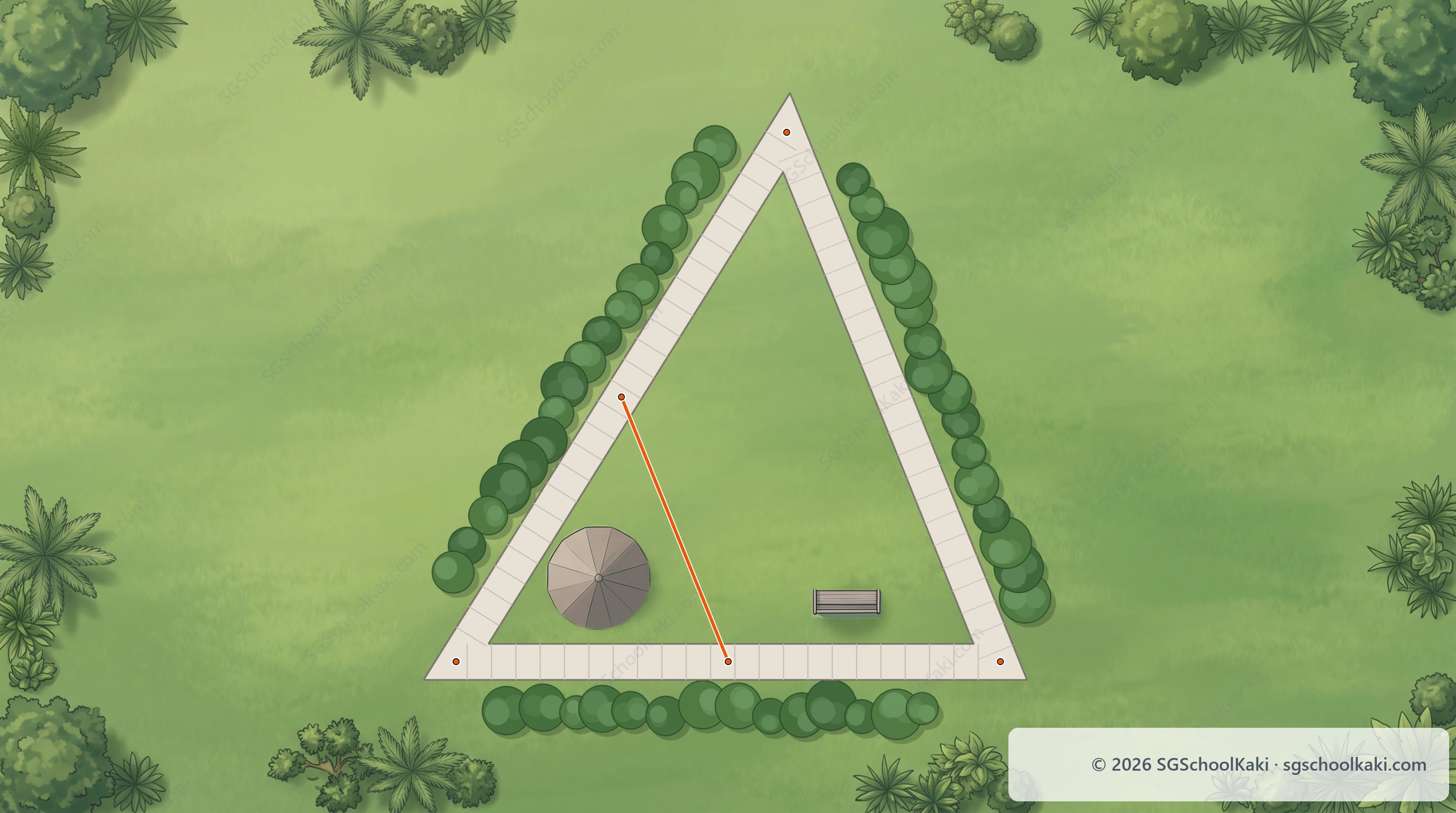
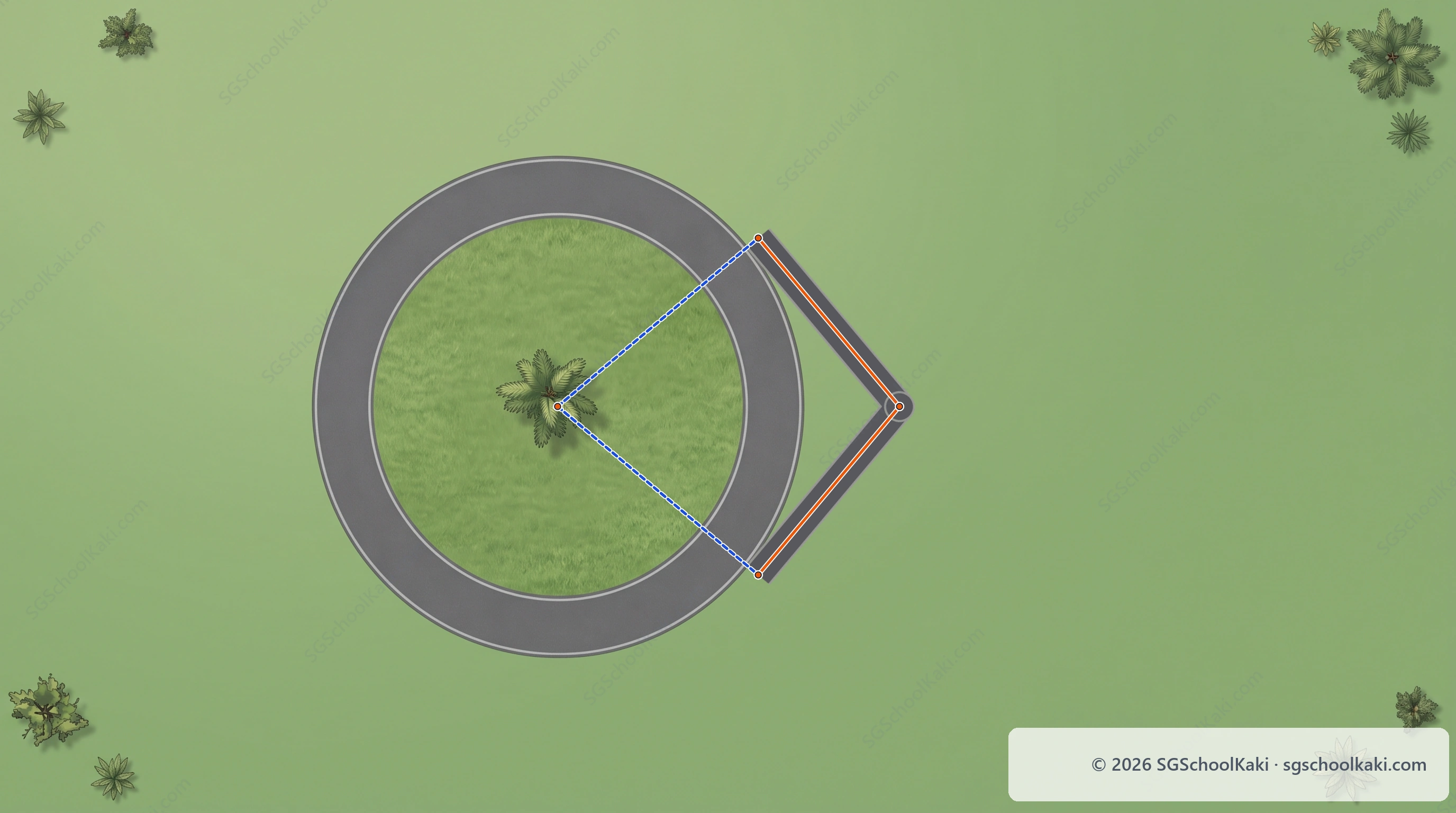
Two real places where a proof pays off: a triangular park whose paths join the midpoints of the sides, and a roundabout with two straight roads touching it. The pictures come first; every angle in each solution is checked on the same figure.
ABCDEDE
Maths In Real Life 1
Paths across a triangular park
In a triangle, the line joining the midpoints of two sides is parallel to the third side and half as long. A straight path that joins the middle of two park edges is therefore parallel to the third edge.
Not in G2 (G3 Additional Maths only): A triangular park ABC has a path DE joining D, the midpoint of the edge AB, to E, the midpoint of the edge AC. The corner ∠ABC=68∘.
(a)Prove that the path DE is parallel to the edge BC.
(b)Find ∠ADE.
(c)Write down the ratio of the length of the path DE to the length of the edge BC.
Show full solutionHide solution
(a)
Given: D is the midpoint of AB
Given: E is the midpoint of AC
DE∥BC (midpoint theorem)
Midpoint theorem in triangle ABC.
(b)
Given: D is the midpoint of AB
Given: E is the midpoint of AC
DE∥BC from part (a).
Given: ∠ABC=68∘
∠ADE=∠ABC (corresponding angles, parallel lines), so ∠ADE=68∘.
DE∥BC: corresponding angles.
(c)
Given: D is the midpoint of AB
Given: E is the midpoint of AC
DE=21BC (midpoint theorem)
The midpoint theorem gives half the length.
So DE:BC=1:2.
Half the length means a ratio of 1:2.
Answer
(a)DE∥BC(shown)
(b)∠ADE=68∘
(c)1:2
OABPOAOBPAPB
Maths In Real Life 2
Two roads that touch a roundabout
A road that just touches a circular roundabout, without entering it, is a tangent to the circle. The two roads that leave a junction and touch the roundabout have the same length from the junction to the point of contact.
Not in G2 (G3 Additional Maths only): A circular roundabout has centre O, and A and B are on its edge. Two straight roads meet at the junction P, and each touches the roundabout at one point: the road PA touches it at A and the road PB touches it at B. A road is perpendicular to the radius at its point of contact: ∠OAP=90∘ and ∠OBP=90∘. The angle at the centre is ∠AOB=80∘.
(a)Prove that the two roads PA and PB have the same length.
(b)Find the angle ∠APB between the two roads.
Show full solutionHide solution
Colour keythe angle or statement you were asked for
(a)
The road PA touches the roundabout at A, so it is perpendicular to the radius OA: ∠OAP=90∘.
A road that touches the circle is a tangent: it meets the radius at a right angle.
The road PB touches the roundabout at B, so ∠OBP=90∘.
The same fact for the second road.
OA=OB (radii of the roundabout).
A and B are on the edge of the roundabout.
OP=OP (common side).
OP belongs to both triangles.
Each triangle has a right angle, the common hypotenuse OP and OA=OB, so △OAP≡△OBP (RHS).
RHS: a right angle, the hypotenuse and one other side.
The matching sides are equal, so PA=PB.
PA matches PB in the congruent triangles.
(b)
Given: ∠OAP=90∘
Given: ∠OBP=90∘
∠OAP+∠OBP=180∘, and these are opposite angles of OAPB, so O, A, P, B lie on a circle.
∠AOB+∠APB=180∘ (opposite angles of a cyclic quadrilateral). So ∠APB is:
180∘−80∘=100∘
Opposite angles of the cyclic quadrilateral OAPB.
Answer
(a)PA=PB(shown)
(b)∠APB=100∘
01
Supports K341-G3-01
Writing a proof: lines, triangles and reasons
Not in G2 (G3 Additional Maths only): writing proofs in plane geometry is G3 Additional Maths only. Everything in this section is a fact from earlier years; the new skill is writing it as a proof with a reason for every step.
A proof is a short chain of statements. Each statement is either given in the question or follows from earlier ones, and beside each you write its reason: the name of the property that makes it true. A reader should be able to check every line without looking at the figure.
Revision.Parallel lines: corresponding angles are equal, alternate angles are equal and co-interior angles add up to 180∘. Triangles: the angles add up to 180∘, an exterior angle equals the sum of the two interior opposite angles, and the base angles of an isosceles triangle are equal. Straight lines: angles on a line add up to 180∘, angles at a point add up to 360∘ and vertically opposite angles are equal. Parallelogram: both pairs of opposite sides are parallel, and its diagonals bisect each other.
The Core Idea
Write a proof as Given, Reasons, Conclusion.
State what you are given. Then write each step as a claim with its reason in brackets, and finish by stating the conclusion the question asked for. A step with no reason earns no mark, and a reason must name the property, not the picture: say alternate angles, not “they look equal”.
SGSchoolKaki Tip
Name every angle with three letters. Write ∠PRU, not “angle R”, because several angles meet at R. The middle letter is the vertex. A reason such as “alternate angles” then points at two named angles, and the reader can check it.
In the first Example every line of the solution has the same layout: a claim, the reason in brackets, and what it tells you. The first answer uses alternate angles; the second uses corresponding angles and then a straight line.
Example 1.1
Parallel lines and a transversal
PQ and US are parallel lines. A straight line VX cuts them at P and R, with V, P, R, X in that order along it. Q and S are on the same side of VX, and U is on the other side. ∠QPR=52∘. Find x, the size of ∠PRU, and y, the size of ∠PRS.
Show solutionHide solution
Colour keythe angle or statement you were asked for
Given: PQ∥US
The stem says the lines are parallel, so the angle rules for parallel lines may be used.
Given: ∠QPR=52∘
∠PRU=∠QPR (alternate angles, parallel lines), so ∠PRU=52∘.
∠PRU and ∠QPR are on opposite sides of the transversal, between the parallel lines.
∠SRX=∠QPR (corresponding angles, parallel lines), so ∠SRX=52∘.
∠SRX sits at R exactly where ∠QPR sits at P.
∠SRX+∠PRS=180∘ (angles on a straight line add up to 180∘). So ∠PRS is:
180∘−52∘=128∘
P, R and X are on one straight line, so the two angles fill a half-turn.
Answer
∠PRU=52∘; ∠PRS=128∘
Which pair of angles you name decides the reason. The table shows the three pairs that parallel lines make with a transversal; the marked angles are the pair in each row.
The three angle pairs made by parallel lines
Pair of angles
What the pair satisfies
Picture
Corresponding angles: same position at the two crossings
equal
corresponding pair
Alternate angles: opposite sides of the transversal, between the lines
equal
alternate pair
Co-interior angles: same side of the transversal, between the lines
add up to 180∘
co-interior pair
Think About It
A line cuts two lines at P and R. The alternate angles it makes measure 52∘ and 61∘. A student writes “the two lines are parallel, because the angles look about the same”. Is the conclusion proved?
Show the full workingHide the working
Parallel lines make equal alternate angles, so look at whether the two angles are equal.
61∘−52∘=9∘
The difference of the two alternate angles: it is not zero, so they are not equal.
Answer
No. The alternate angles differ by 9∘, so they are not equal and the lines are not parallel. “Looks about the same” is never a reason: a proof needs a property that is true, and each step must name it.
The exterior angle theorem is not a new fact: it is proved from two facts you already know, the angle sum of a triangle and angles on a straight line. The next Example uses it and then proves it.
Example 1.2
Angle sum and the exterior angle
In triangle ABC, ∠CAB=48∘ and ∠ABC=64∘. The side AB is extended to D. (a) Find x, the size of ∠ACB. (b) Prove that the exterior angle ∠CBD equals ∠CAB+∠ACB.
Show solutionHide solution
Colour keythe angle or statement you were asked for
Given: ∠CAB=48∘
Given: ∠ABC=64∘
∠CAB+∠ABC+∠ACB=180∘ (angle sum of a triangle). So ∠ACB is:
180∘−48∘−64∘=68∘
The three angles of triangle ABC add up to a half-turn.
∠ABC+∠CBD=180∘ (angles on a straight line add up to 180∘). So ∠CBD is:
180∘−64∘=116∘
A, B and D are on one straight line, so the angles at B on that line add up to 180∘.
∠CAB+∠ABC+∠ACB=180∘ (angle sum of a triangle)
The same angle sum as in (a), now used as a statement, not as a calculation.
Both ∠CBD and ∠CAB+∠ACB equal 180∘−∠ABC, so ∠CBD=∠CAB+∠ACB.
Subtracting ∠ABC from 180∘ on both lines gives the same angle: that is the exterior angle theorem.
Answer
∠ACB=68∘; ∠CBD=∠CAB+∠ACB(shown)
Isosceles triangles give a standard deduction: equal sides give equal base angles, and equal base angles can then be carried to another triangle by parallel lines.
Example 1.3
An isosceles triangle cut by a parallel line
In triangle ABC, CA=CB and ∠CAB=70∘. The point D lies on CA and the point E lies on CB so that DE is parallel to AB. (a) Prove that ∠CDE=∠CED. (b) Find x, the size of ∠ADE.
Show solutionHide solution
Colour keythe angle or statement you were asked for
Given: CA=CB
Given: DE∥AB
Given: ∠CAB=70∘
∠CBA=∠CAB (base angles of an isosceles triangle), so ∠CBA=70∘.
CA=CB, so the base angles at A and B are equal.
∠CDE=∠CAB (corresponding angles, parallel lines), so ∠CDE=70∘.
DE∥AB and the line CA crosses both: ∠CDE and ∠CAB are in matching positions.
∠CED=∠CBA (corresponding angles, parallel lines), so ∠CED=70∘.
The line CB crosses the same parallel lines: ∠CED matches ∠CBA.
∠CDE=∠CAB=∠CBA=∠CED, so ∠CDE=∠CED.
Both angles are equal to the same base angle, so they are equal to each other.
∠CDE+∠ADE=180∘ (angles on a straight line add up to 180∘). So ∠ADE is:
180∘−70∘=110∘
A, D and C are on one straight line, so the angles at D on it add up to 180∘.
Answer
∠CDE=∠CED(shown); ∠ADE=110∘
When a line bisects an angle, the two halves are equal. That equality is part of what you are given, so its reason is written as “given” and you may use it at once.
Example 1.4
An angle bisector
In triangle ABC, AD is the bisector of ∠BAC and D lies on BC. ∠BAD=40∘ and ∠ABD=56∘. (a) Find x, the size of ∠ADB. (b) Show that ∠ADC=∠DAC+∠ABD.
Show solutionHide solution
Colour keythe angle or statement you were asked for
Given: ∠BAD=40∘
Given: ∠ABD=56∘
∠BAD+∠ABD+∠ADB=180∘ (angle sum of a triangle). So ∠ADB is:
180∘−40∘−56∘=84∘
The three angles of triangle ABD add up to a half-turn.
Given: ∠BAD=∠DAC
AD bisects ∠BAC, so it splits the angle into two equal angles: this is the information given.
∠ADB+∠ADC=180∘ (angles on a straight line add up to 180∘). So ∠ADC is:
180∘−84∘=96∘
B, D and C are on one straight line, so the angles at D add up to 180∘.
∠ADC=∠BAD+∠ABD (exterior angle of a triangle)
∠ADC is the exterior angle of triangle ABD at D, so it equals the two interior opposite angles.
Replace ∠BAD by the equal angle ∠DAC (given): ∠ADC=∠DAC+∠ABD. So ∠DAC is:
96∘−56∘=40∘
The bisector lets one half of the angle stand in for the other; the difference below is the angle DAC, equal to ∠BAD.
Answer
∠ADB=84∘; ∠ADC=∠DAC+∠ABD(shown)
When two lines cross, four angles meet at one point. Say which angles each reason links: vertically opposite angles share no arm, and angles on a line share the arm between them.
Example 1.5
Lines that cross
The straight lines AB and CD meet at X, with X between A and B and between C and D. ∠AXC=70∘. Find x, the size of ∠BXD, y, the size of ∠CXB, and z, the size of ∠DXA.
Show solutionHide solution
Colour keythe angle or statement you were asked for
Given: ∠AXC=70∘
∠BXD=∠AXC (vertically opposite angles are equal), so ∠BXD=70∘.
XB is opposite XA and XD is opposite XC, so the angles are vertically opposite.
∠AXC+∠CXB=180∘ (angles on a straight line add up to 180∘). So ∠CXB is:
180∘−70∘=110∘
A, X and B are on one straight line.
∠AXC+∠CXB+∠BXD+∠DXA=360∘ (angles at a point add up to 360∘). So ∠DXA is:
360∘−70∘−110∘−70∘=110∘
The four angles fill the whole turn at X; the first three are already found.
Answer
∠BXD=70∘; ∠CXB=110∘; ∠DXA=110∘
02
Supports K341-G3-01
Congruent and similar triangles
Not in G2 (G3 Additional Maths only): proofs in plane geometry are G3 Additional Maths only. You already know congruent and similar triangles from Mathematics, and here you use them as reasons inside a proof.
Revision. Two triangles are congruent when one fits exactly on the other, and similar when they have the same shape but not always the same size. In both, the corresponding angles are equal.
A proof that uses triangles has a fixed pattern. First you state three facts about the two triangles, then you name the test, then you read off the new fact you wanted, such as a pair of equal angles, a pair of equal sides, or a pair of parallel lines. The facts you are given decide which test you use. The table lists every test you may quote.
Which test proves which relation
Test
What you must know
Conclusion
three pairs of equal sides
SSS
All three sides of one triangle equal the three sides of the other.
Congruent
two sides and the angle between them
SAS
Two sides and the included angle (the angle between them).
Congruent
two angles and a side
ASA or AAS
Two angles and a corresponding side: the side between the two angles (ASA) or a side opposite one of them (AAS). The third angle follows from the angle sum.
Congruent
right angle, hypotenuse, one side
RHS
A right angle, the hypotenuse and one other side.
Congruent
two pairs of equal angles
AA
Two pairs of equal angles (the third pair then follows).
Similar
three pairs of sides in the same ratio
Three sides in proportion
All three sides of one triangle are the same multiple of the matching sides of the other: ABDE=BCEF=CAFD.
Similar
two sides in the same ratio and the angle between them
Two sides in proportion, included angle equal
Two pairs of sides in the same ratio, ABDE=ACDF, and the included angles equal.
Similar
the same two sides and angle fit two triangles
SSA is not a test
Two sides and an angle that is not between them. This does not fix the triangle: the same facts fit two different triangles.
No conclusion
The Core Idea
Choose the test from what you are given, then write the vertices in matching order.
Write △ABC≡△DEF only when A matches D, B matches E and C matches F. The letters tell the reader which sides and angles are equal. After the test, the phrase corresponding parts of congruent triangles (or of similar triangles) gives every other fact.
Example 2.1
Congruent triangles by SSS
The triangle ABC is isosceles with CA=CB, and M is the midpoint of AB, so AM=BM. The angle ∠CAB=64∘. Prove that triangles AMC and BMC are congruent and that CM bisects ∠ACB, then find ∠ACB.
Show solutionHide solution
Colour keythe angle or statement you were asked for
Given: CA=CB
Given: AM=BM
CM=CM (common side)
CM is a side of both triangles.
△AMC≡△BMC (SSS)
Three pairs of equal sides, matched in the order A→B, M→M, C→C.
∠ACM=∠BCM (corresponding parts of congruent triangles)
Matching angles of congruent triangles are equal, so CM splits the angle at C into two equal parts.
∠CBA=∠CAB (base angles of an isosceles triangle), so ∠CBA=64∘.
∠CAB+∠CBA+∠ACB=180∘ (angle sum of a triangle). So ∠ACB is:
180∘−64∘−64∘=52∘
Subtract the known angles from 180∘.
Answer
△AMC≡△BMC and ∠ACM=∠BCM, so CM bisects ∠ACB(shown); ∠ACB=52∘
Vertex order is part of the statement. △AMC≡△BMC says A matches B. Writing △AMC≡△MBC would claim that A matches M, which is false even though the same two triangles are meant.
Example 2.2
Congruent triangles by SAS and parallel lines
The straight lines AB and CD cross at X. X is the midpoint of AB and also the midpoint of CD. The angle ∠AXC=80∘. Prove that AC is parallel to BD and find ∠CXB.
Show solutionHide solution
Colour keythe angle or statement you were asked for
Given: XA=XB
Given: XC=XD
∠BXD=∠AXC (vertically opposite angles are equal), so ∠BXD=80∘.
The angle between the equal sides of one triangle matches the angle between the equal sides of the other.
△AXC≡△BXD (SAS)
Two sides and the included angle: the equal angle sits between the two equal sides.
∠CAX=∠DBX (corresponding parts of congruent triangles)
∠CAX=∠DBX, and these are alternate angles on the transversal AB, so AC∥BD (equal alternate angles).
Equal alternate angles are what make two lines parallel.
∠AXC+∠CXB=180∘ (angles on a straight line add up to 180∘). So ∠CXB is:
180∘−80∘=100∘
A, X, B are on a straight line.
Answer
AC∥BD(shown); ∠CXB=100∘
Think About It
In triangle ABC the side AB=8, the side BC=5 and the angle ∠BAC=30∘. The side BC is not between the given angle and the other given side. Is the triangle ABC the only triangle with these facts?
Show the full workingHide the working
Put A at the origin and draw AB along the x-axis. The point C lies on the ray from A that makes 30∘ with AB, and it is 5 units from B.
Two sides and a non-included angle: the arrangement called SSA, which is not a test.
AC=8cos30∘+52−(8sin30∘)2=3+43
The circle of radius 5 about B cuts the ray at a first point.
AC=8cos30∘−52−(8sin30∘)2=−3+43
...and at a second point, because the square root can take either sign.
Answer
No. The circle cuts the ray twice, so there are two triangles, with AC=3+43 and AC=−3+43, and both have AB=8, BC=5 and ∠BAC=30∘. Two sides and an angle that is not between them do not make a congruence test, so never write SSA as a reason.
Example 2.3
Similar triangles by AA
In triangle ABC the points D and E lie on AB and AC so that DE∥BC. The angles are ∠BAC=60∘ and ∠ABC=70∘. Prove that triangles ADE and ABC are similar and that AD×BC=AB×DE, then find ∠AED.
Show solutionHide solution
Colour keythe angle or statement you were asked for
Given: DE∥BC
∠ADE=∠ABC (corresponding angles, parallel lines), so ∠ADE=70∘.
DE∥BC with transversal AB: corresponding angles.
∠DAE=∠BAC (common angle), so ∠DAE=60∘.
Both angles are at A between the same two rays.
△ADE∼△ABC (AA: two pairs of equal angles)
Two pairs of equal angles. The vertices are in matching order: A→A, D→B, E→C.
ABAD=BCDE (corresponding sides of similar triangles), so AD×BC=AB×DE.
Cross-multiply the equal ratios.
∠ACB+∠BAC+∠ABC=180∘ (angle sum of a triangle). So ∠ACB is:
180∘−60∘−70∘=50∘
Subtract the known angles from 180∘.
∠ACB=∠AED (corresponding parts of similar triangles), so ∠AED=50∘.
E matches C in the similar triangles.
Answer
△ADE∼△ABC and AD×BC=AB×DE(shown); ∠AED=50∘
SGSchoolKaki Tip
To prove a product of lengths, find similar triangles. Write the equal ratio first, with the lengths of one triangle on top and the matching lengths of the other below, then cross-multiply. The product AD×BC=AB×DE is the same fact as the ratio ABAD=BCDE.
Example 2.4
Similar triangles in a different position
Triangles ABC and DEF are drawn apart. ∠BAC=∠EDF=50∘ and ∠ABC=∠DEF=70∘. Prove that the triangles are similar, and find ∠DFE.
Show solutionHide solution
Colour keythe angle or statement you were asked for
Given: ∠BAC=∠EDF
Given: ∠ABC=∠DEF
△ABC∼△DEF (AA: two pairs of equal angles)
A→D, B→E, C→F: write the matching letters in the same order.
∠ACB+∠BAC+∠ABC=180∘ (angle sum of a triangle). So ∠ACB is:
180∘−50∘−70∘=60∘
Subtract the known angles from 180∘.
∠ACB=∠DFE (corresponding parts of similar triangles), so ∠DFE=60∘.
F matches C.
Answer
△ABC∼△DEF(shown); ∠DFE=60∘
Lengths scale by the ratio, areas by its square. If triangle DEF is similar to triangle ABC with every length multiplied by k, then the area of DEF is k2 times the area of ABC. A ratio of 23 between lengths gives a ratio of 49 between areas. You use this fact to state a result, not inside a proof of similarity.
Example 2.5
Similar triangles from a trapezium
The straight lines AB and CD cross at X, and AC is parallel to BD, so ACBD is a trapezium whose diagonals are AB and CD. The angle ∠AXC=80∘. Prove that triangles XAC and XBD are similar and that XA×XD=XB×XC, then find ∠CXB.
Show solutionHide solution
Colour keythe angle or statement you were asked for
Given: AC∥BD
∠CAX=∠DBX (alternate angles, parallel lines)
AC∥BD with transversal AB: alternate angles.
∠BXD=∠AXC (vertically opposite angles are equal), so ∠BXD=80∘.
The lines AB and CD cross at X.
△XAC∼△XBD (AA: two pairs of equal angles)
X→X, A→B, C→D.
XBXA=XDXC (corresponding sides of similar triangles), so XA×XD=XB×XC.
Cross-multiply the equal ratios.
∠AXC+∠CXB=180∘ (angles on a straight line add up to 180∘). So ∠CXB is:
180∘−80∘=100∘
A, X, B are on a straight line.
Answer
△XAC∼△XBD and XA×XD=XB×XC(shown); ∠CXB=100∘
Locked · Chapter 17
You've read the free 26%. Unlock the rest of Chapter 17.
Still to read in this chapter:
The midpoint theorem
Circle angle properties
Tangent-chord theorem
Quadrilaterals and circles
Formula panel
Exercise
$9one-time · all 17 chapters · no subscription
Worked examples, formulas and exam checks. The whole A-Math syllabus.
ONE PRICE17chapters
Premium members get all 17 chapters included.
Notes version 1.0 · Last updated 3 Nov 2026 · Chapter 17 of 17