A definite integral measures signed area: it adds up thin strips between a curve and an axis. This chapter shows how to evaluate a definite integral, how to turn it into the area of a region bounded by a curve and a line or an axis, and what changes when the region lies below the x-axis, straddles it, or is described by strips running sideways to the y-axis. It ends by using a known area to find an unknown constant. Always sketch the region first, then decide which pieces are above and below the axis.
Your outcome tracker0 / 6
Let's go! Tick an outcome once you can pass its exam check. Saved on this device.
Chapter 15
Figure 1 · y = x(x - 2)(x - 4) from x = 0 to x = 4: the blue piece above the axis and the orange piece below it have equal areas, so the integral over the whole interval is 0, but the area enclosed is 8
r = 1y = sin θcos θ
4 outcomes · 1 page · every step shown ✦
Integral = signed area
A definite integral is F(b) - F(a), with no constant. Above the axis it is the area; below the axis it comes out negative.
Sketch, then split
Find where the curve meets the axis, split there, and add the pieces as positive areas. A single integral over a crossing can cancel to zero.
Curve and line
Area = integral of (upper - lower) between the intersections, or a geometric shape minus an integral. Two curves are not examined.
By the end of this chapter
Evaluate a definite integral as F(b)−F(a) and use the rules for equal limits, swapped limits and splitting at an interior value, including integrals given only by their values.
Find the area between a curve, the x-axis and two vertical lines when the curve is above the axis, leaving exact answers for exponential, logarithmic, reciprocal and root functions.
Find the area of a region below the x-axis by taking the modulus, and of a curve that crosses the axis by finding the zeros, splitting and adding the positive areas (G3 only).
Find the area of a region bounded by a curve and a straight line, or by a curve, its tangent and an axis, by combining an integral with the area of a rectangle or triangle.
Use horizontal strips: make x the subject, integrate with respect to y, and take the modulus for a region to the left of the y-axis.
Use a given integral or area to find an unknown constant, an upper limit or a coordinate, rejecting any root that cannot be used.
✶
Start here
Maths In Real Life
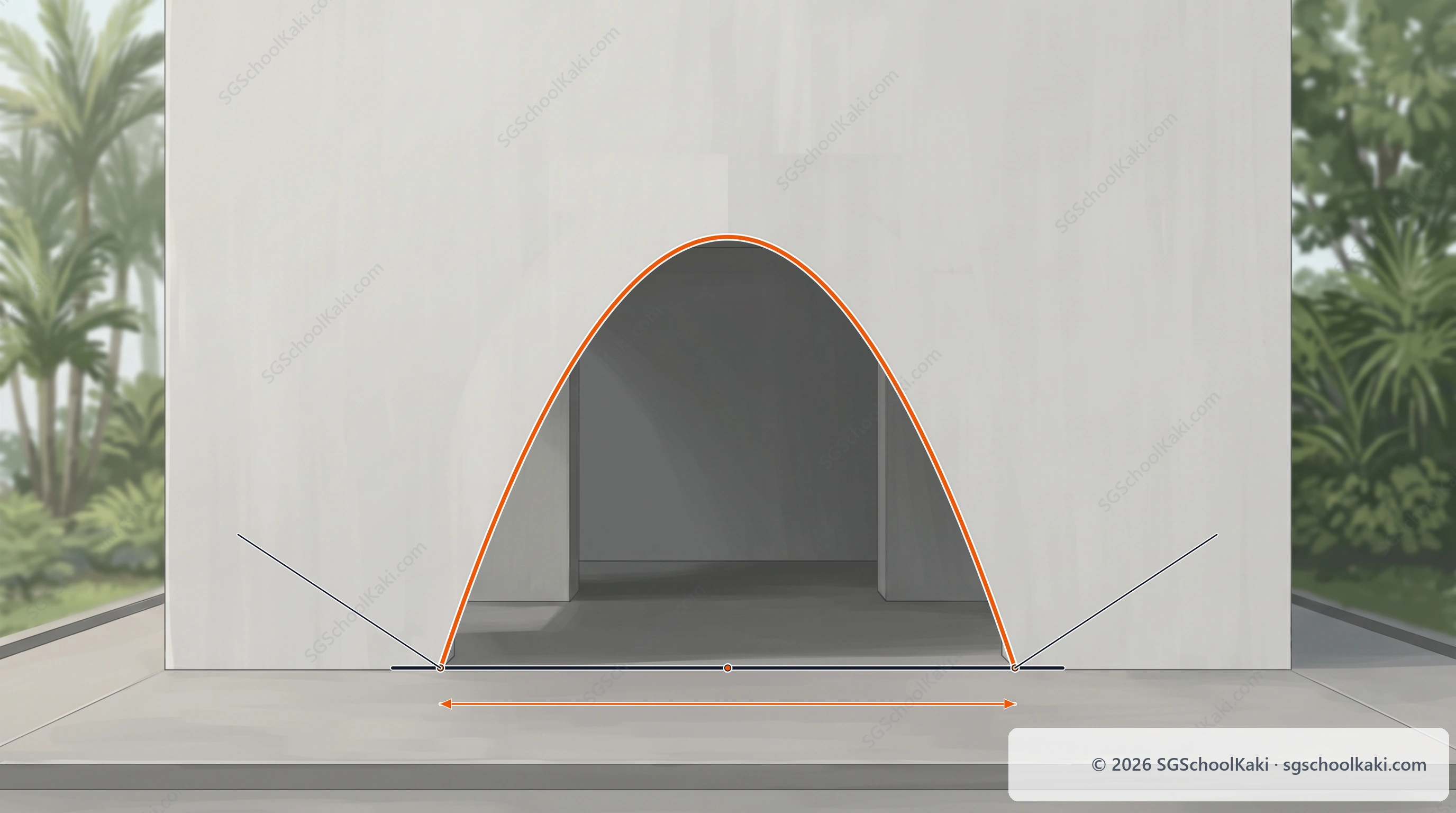
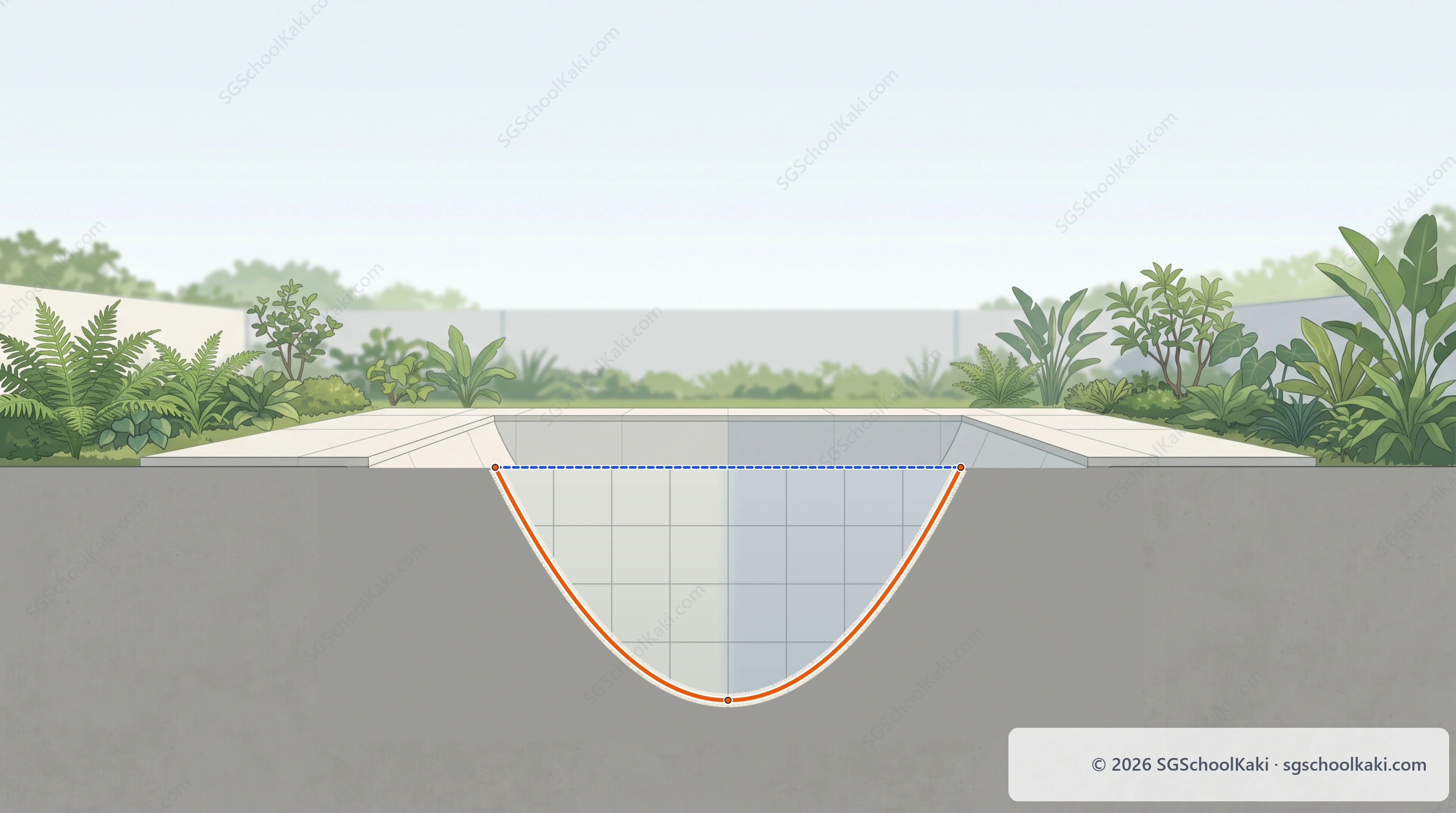
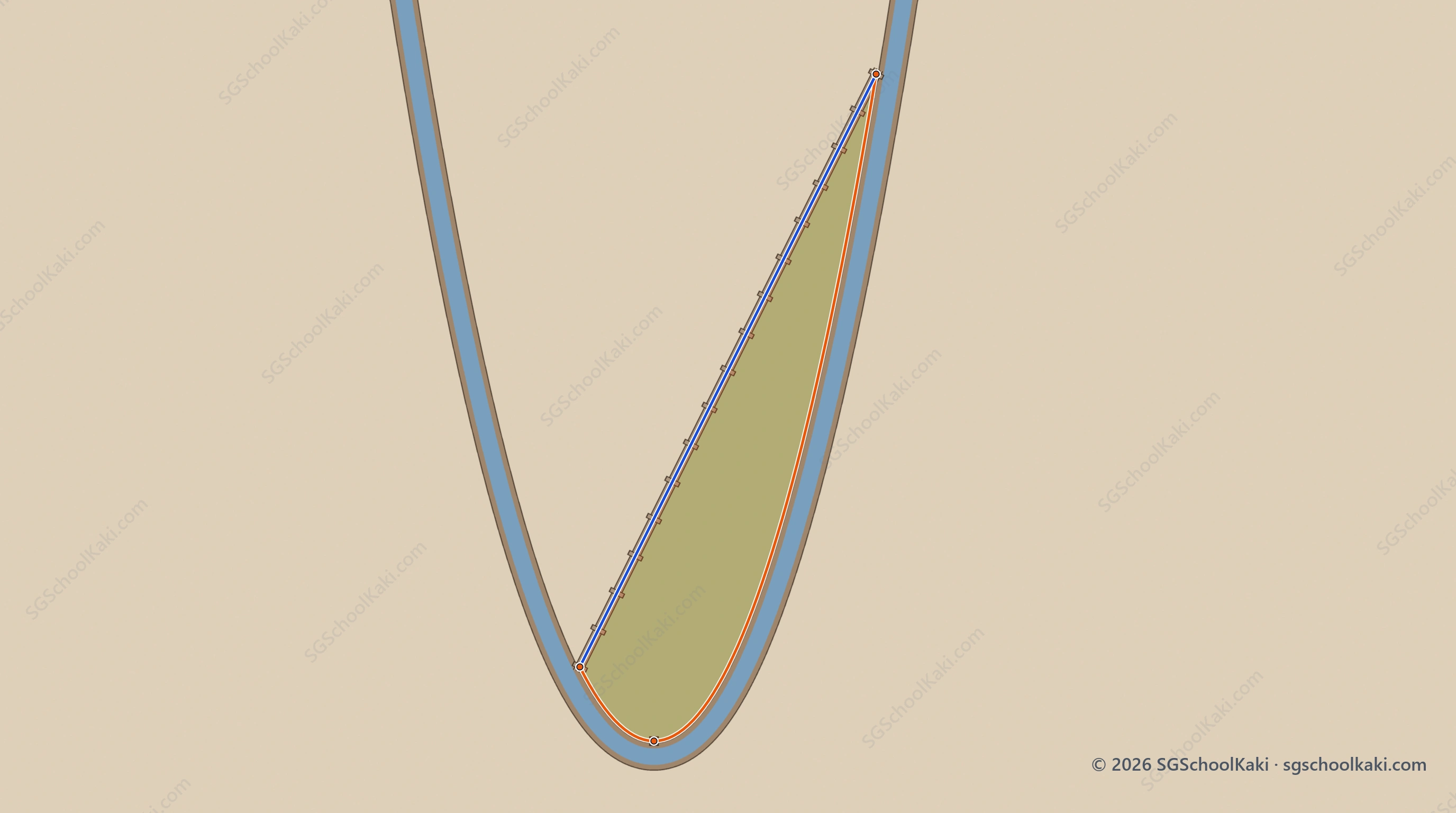
Three places where an area matters: the opening of a covered walkway, the end cross-section of a plunge pool, and a lawn between a fence and a stream. The pictures come first; the working in each solution comes from the same numbers.
y=29−2x26 m widex=−3x=3Oground
Maths In Real Life 1
The opening of a covered walkway
Covered walkways in housing estates often end in a curved arch. The area of the opening tells the builder how much of the end wall has to be cut out or covered.
The end of a covered walkway is an arch. Take the ground as the x-axis and the middle of the opening on the ground as the origin, with x and y in metres. The top edge of the arch is the curve y=−2x2+29 for −3≤x≤3.
(a)Find the area of the opening of the arch.
Show full solutionHide solution
Colour keythe evaluated area or value
(a)
2−3+3=0
The middle of the piece is a safe test value: it cannot be a root.
−2(0)2+29=29
The curve's height at the test value: positive, so this piece lies above the x-axis.
∫−33(−2x2+29)dx=[−6x3+29x]−33
Integrate with the usual rules but leave out c: it cancels in a definite integral.
=(−6(3)3+29×(3))−(−6(−3)3+29×(−3))
Substitute the upper limit 3, then the lower limit −3, and subtract (upper minus lower).
=18
Evaluate.
The curve is above the axis, so the area is the integral itself.
Answer
(a)18 m²
y=4x2−2x(0,0)(8,0)(4,−4)water surface6 m wide(into the page)end view
Maths In Real Life 2
The cross-section and the volume of a plunge pool
A pool is a prism: every cross-section along its width is the same. The area of one end face, found by integration, times the width gives the volume of water it holds, and the curved floor lies below the water surface, so the integral is negative and the area is its modulus.
Not in G2 (G3 Additional Maths only): this uses a region below the x-axis (or left of the y-axis). The end of a plunge pool is shaped like the region between the water surface, the x-axis, and a curved floor with equation y=4x2−2x for 0≤x≤8, where x and y are measured in metres and the floor is below the water surface. The pool is 6 metres wide, with the same end all the way across.
(a)Find the area of the end of the pool, in square metres.
(b)Hence find the volume of water the pool holds when it is full to the surface, in cubic metres.
Show full solutionHide solution
Colour keythe evaluated area or value
(a)
20+8=4
The middle of the piece is a safe test value: it cannot be a root.
4(4)2−2×(4)=−4
The curve's height at the test value: negative, so this piece lies below the x-axis.
∫08(4x2−2x)dx=[12x3−x2]08
Integrate with the usual rules but leave out c: it cancels in a definite integral.
=(12(8)3−(8)2)−(12(0)3−(0)2)
Substitute the upper limit 8, then the lower limit 0, and subtract (upper minus lower).
=−364
Evaluate.
−364=364
An area is never negative: take the modulus of the negative integral.
(b)
Every cross-section along the width of the pool is the same, so the volume is the cross-section area times the width.
A prism: volume = (area of the end face) × (length).
V=364×6
Use the area from the first part.
=128
Multiply.
Answer
(a)21.3 m² (3 s.f.), exactly 364
(b)V=128 m³
ABOfencestream bankplan view
Maths In Real Life 3
A lawn between a fence and a stream
A park keeper has to order turf for a lawn with one straight edge and one curved edge. Turf is sold by the square metre, so the area has to be found before the order.
A lawn in a park lies between a straight fence and a curved stream bank, seen from above. Take the corner post O as the origin, with x and y in metres. The stream bank is the curve y=2x2 and the fence is the line y=2x+6. They meet at the points A and B.
(a)Find the coordinates of A and B, and the area of the lawn.
Show full solutionHide solution
Colour keythe evaluated area or value
(a)
2x2=2x+6
Where the line meets the curve the two y-values are equal.
2x2−2x−6=0
Collect every term on one side.
x=−2 or x=6
Solve (factorise) to get the x-coordinate of each point.
2−2+6=2
Test value: the middle of the two intersections.
2(2)2−(2×(2)+6)=−8
Curve height minus line height: negative, so the line is the upper boundary here.
∫−26(−2x2+2x+6)dx=[−6x3+x2+6x]−26
Integrate (upper − lower) =−2x2+2x+6, with no constant.
=(−6(6)3+(6)2+6×(6))−(−6(−2)3+(−2)2+6×(−2))
Substitute the upper limit 6, then the lower limit −2, and subtract (upper minus lower).
=3128
Evaluate.
Answer
(a)(−2,2), (6,18) (x and y in metres); 42.7 m² (3 s.f.), exactly 3128
01
Supports K341-C1-15
Definite integrals and their rules
Revision. In Chapter 14 you reversed differentiation: ∫xndx=n+1xn+1+c. A definite integral uses the same reversing, but it runs between two limits, so it gives a number, not a formula.
The symbol ∫abf(x)dx is read “the integral of f(x) from a to b”: a is the lower limit and b is the upper limit. To evaluate it, find an antiderivative F(x), substitute the upper limit, substitute the lower limit and subtract.
The Core Idea
A definite integral is F(b)−F(a).
∫abf(x)dx=[F(x)]ab=F(b)−F(a) No constant c is needed: it would appear in both brackets and cancel. Always write the upper limit first, then subtract the lower limit.
Example 1.1
Evaluating a definite integral
Evaluate ∫13(3x2−4x+5)dx.
Show solutionHide solution
Colour keythe evaluated area or value
∫13(3x2−4x+5)dx=[x3−2x2+5x]13
Integrate with the usual rules but leave out the constant c: it cancels in a definite integral.
=((3)3−2×(3)2+5×(3))−((1)3−2×(1)2+5×(1))
Substitute the upper limit 3, then the lower limit 1, and subtract (upper minus lower).
=20
Evaluate.
Answer
20
SGSchoolKaki Tip
Write []ab before you substitute. The square bracket with the limits keeps the two substitutions in the right order, and it is where the method marks are earned.
Roots and reciprocals are rewritten in index form first, exactly as in Chapter 14: x21=x−2 and x=x1/2. Then every term is integrated by adding 1 to the power and dividing by the new power.
Example 1.2
Powers, roots and reciprocals
Evaluate ∫14(3x+x22)dx.
Show solutionHide solution
Colour keythe evaluated area or value
∫14(3x+x22)dx=[2x23−x2]14
Integrate with the usual rules but leave out the constant c: it cancels in a definite integral.
=(2×(4)23−(4)2)−(2×(1)23−(1)2)
Substitute the upper limit 4, then the lower limit 1, and subtract (upper minus lower).
=231
Evaluate.
Answer
231
Not in G2 (G3 Additional Maths only): an integrand with eax or a logarithm is G3 Additional Maths only. The limit lnn is chosen so that elnn=n, and the answer comes out as a whole number.
Example 1.3
An exponential with an exact limit
Evaluate ∫0ln(2)4e2xdx.
Show solutionHide solution
Colour keythe evaluated area or value
∫0ln24e2xdx=[2e2x]0ln2
Integrate with the usual rules but leave out the constant c: it cancels in a definite integral.
=(2×e2×(ln(2)))−(2×e2×(0))
Substitute the upper limit ln(2), then the lower limit 0, and subtract (upper minus lower).
=6
Evaluate.
Answer
6
Keep the order: upper limit first, then subtract the lower limit. Putting them the other way round gives the right size with the wrong sign, and the answer is then a negative area.
A definite integral also obeys three rules. They let you work out new integrals from ones you are told, without knowing the function at all. The table shows each rule as a picture of areas.
Three rules for definite integrals, drawn on the same grid
Rule
In symbols
Picture
Join two integrals that share an end
∫acf(x)dx=∫abf(x)dx+∫bcf(x)dx
the piece from a=1 to b=3the piece from b=3 to c=5
Swap the limits
∫baf(x)dx=−∫abf(x)dx
from a=1 to b=5: this area. From b to a: minus this area
Take a constant multiple out
∫abkf(x)dx=k∫abf(x)dx
the area under the curve ftwice as tall, so twice the area
When both limits are equal the integral is 0, because there is no width. A constant multiplier comes outside the integral, and a constant term is integrated on its own: ∫abkdx=k(b−a).
Example 1.4
Adding and reversing given integrals
It is given that ∫13f(x)dx=5 and ∫36f(x)dx=−2. Find the value of (i) ∫16f(x)dx, (ii) ∫63f(x)dx, (iii) ∫13(3f(x)+2)dx.
Show solutionHide solution
Colour keythe evaluated area or value
The limits run on from a to b to c, so the integrals add: ∫16f(x)dx=∫13f(x)dx+∫36f(x)dx.
Splitting a definite integral at a value between the limits.
5+(−2)=3
Substitute the two given values and add.
Swapping the limits changes the sign: ∫63f(x)dx=−∫36f(x)dx.
Reversing the limits reverses the sign.
−(−2)=2
Substitute the given value.
Split the integral: ∫13(3f(x)+2)dx=3∫13f(x)dx+∫132dx.
A constant multiple comes outside the integral; the other term is integrated on its own.
3×5+2×(3−1)=19
The integral of a constant k from a to b is k(b−a).
Answer
3; 2; 19
The same rules work when the given values are letters. Nothing changes except that the answers are expressions in p and q instead of numbers.
Example 1.5
Integrals in terms of p and q
It is given that ∫24f(x)dx=p and ∫47f(x)dx=q. Find the value of (i) ∫27f(x)dx, (ii) ∫74f(x)dx, (iii) ∫24(4f(x)−3)dx.
Show solutionHide solution
Colour keythe evaluated area or value
The limits run on from a to b to c, so the integrals add: ∫27f(x)dx=∫24f(x)dx+∫47f(x)dx.
Splitting a definite integral at a value between the limits.
p+q
Substitute the two given values and add.
Swapping the limits changes the sign: ∫74f(x)dx=−∫47f(x)dx.
Reversing the limits reverses the sign.
−q
Substitute the given value.
Split the integral: ∫24(4f(x)−3)dx=4∫24f(x)dx−∫243dx.
A constant multiple comes outside the integral; the other term is integrated on its own.
4×p−3×(4−2)=4p−6
The integral of a constant k from a to b is k(b−a).
Answer
p+q; −q; 4p−6
Think About It
A student integrates 6x2+2 but keeps the constant, so F(x)=2x3+2x+c, and then works out ∫13(6x2+2)dx as F(3)−F(1). Does the constant c change the answer?
Show the full workingHide the working
(60+c)−(4+c)
Put the upper limit into F, then the lower limit, keeping c in both brackets.
=60+c−4−c
Remove the brackets: the second c now has a minus sign.
=56
The +c and the −c cancel, so only the difference of the two values is left.
Answer
No. The constant appears in both brackets, once with + and once with −, so it cancels. The value is 56 whatever c is, which is why a definite integral needs no constant.
Not in G2 (G3 Additional Maths only): a fraction whose integral is a logarithm (x+11 integrates to ln∣x+1∣) is G3 Additional Maths only.
A fraction with a linear bottom cannot be integrated as it stands. Divide the top by the bottom to rewrite it as a polynomial plus a fraction with a constant top, DN=Q+DR; the polynomial is integrated by the usual rule and the fraction gives a logarithm.
Example 1.6
Prove an identity, then integrate the fraction
Express x+1x2+3x+5 in the form Q(x)+x+1R, where Q(x) is a polynomial and R is a constant. Hence evaluate ∫02x+1x2+3x+5dx.
Show solutionHide solution
Colour keythe evaluated area or value
(x+2)(x+1)+3=x2+3x+2+3=x2+3x+5
Multiply out the quotient by the divisor, then add the remainder: the result is the numerator.
x+1x2+3x+5=x+2+x+13
Divide the whole identity by the denominator (it is not zero on the interval).
∫02(x+2+x+13)dx=[2x2+2x+3ln(∣x+1∣)]02
Integrate each term of the rewritten form x+2+x+13: the fraction gives a logarithm.
Substitute the upper limit 2, then the lower limit 0, and subtract (upper minus lower).
=3ln(3)+6
Evaluate.
Answer
x+1x2+3x+5=x+2+x+13; 3ln(3)+6
Links To
The antiderivative rules used here, and the first look at limits, are in Chapter 14: Integration
02
Supports K341-C1-14 · K341-C1-16
Area under a curve above the x-axis
Cut the region under a curve into very thin vertical strips. Each strip is almost a rectangle of height y and tiny width dx, so its area is about ydx. Adding all the strips from x=a to x=b is exactly what the integral does.
The Core Idea
Area under a curve = definite integral.
Area=∫abydx=F(b)−F(a)when y≥0 for a≤x≤b The region sits between the curve and the x-axis, from x=a to x=b. Sketch the curve first and check that it lies above the axis between the limits.
Example 2.1
Area under a parabola
Find the area between the curve y=x2+1 and the x-axis, from x=1 to x=3.
Show solutionHide solution
Colour keythe evaluated area or value
21+3=2
The middle of the piece is a safe test value: it cannot be a root.
(2)2+1=5
The curve's height at the test value: positive, so this piece lies above the x-axis.
∫13(x2+1)dx=[3x3+x]13
Integrate with the usual rules but leave out c: it cancels in a definite integral.
=(3(3)3+(3))−(3(1)3+(1))
Substitute the upper limit 3, then the lower limit 1, and subtract (upper minus lower).
=332
Evaluate.
The curve is above the axis, so the area is the integral itself.
the region whose area is found is shaded; the part above the x-axis is blue
Answer
332 square units
SGSchoolKaki Tip
The answer is in square units. An area is a length times a length, so write square units (or the squared unit of the question). A negative area, or one that is far larger than the picture, means a slip in the limits or the signs.
Example 2.2
A reciprocal-square curve
Find the area between the curve y=x212 and the x-axis, from x=1 to x=4.
Show solutionHide solution
Colour keythe evaluated area or value
21+4=25
The middle of the piece is a safe test value: it cannot be a root.
(25)212=2548
The curve's height at the test value: positive, so this piece lies above the x-axis.
∫14x212dx=[−x12]14
Integrate with the usual rules but leave out c: it cancels in a definite integral.
=(−(4)12)−(−(1)12)
Substitute the upper limit 4, then the lower limit 1, and subtract (upper minus lower).
=9
Evaluate.
The curve is above the axis, so the area is the integral itself.
the region whose area is found is shaded; the part above the x-axis is blue
Answer
9 square units
The limits must not include a value where the curve is undefined. The curve y=x2k does not exist at x=0, so an area under it must start and stop on the same side of 0.
Example 2.3
A square-root curve
Find the area between the curve y=3x and the x-axis, from x=1 to x=4.
Show solutionHide solution
Colour keythe evaluated area or value
21+4=25
The middle of the piece is a safe test value: it cannot be a root.
3×(25)=2310
The curve's height at the test value: positive, so this piece lies above the x-axis.
∫143xdx=[2x23]14
Integrate with the usual rules but leave out c: it cancels in a definite integral.
=(2×(4)23)−(2×(1)23)
Substitute the upper limit 4, then the lower limit 1, and subtract (upper minus lower).
=14
Evaluate.
The curve is above the axis, so the area is the integral itself.
the region whose area is found is shaded; the part above the x-axis is blue
Answer
14 square units
Not in G2 (G3 Additional Maths only): the exponential eax and the logarithm from x1 are G3 Additional Maths only. These two Examples give exact answers, because the limit is lnn.
Example 2.4
An exponential area, exact
Find the area between the curve y=ex+1 and the x-axis, from x=0 to x=ln(3).
Show solutionHide solution
Colour keythe evaluated area or value
20+ln(3)=ln(3)
The middle of the piece is a safe test value: it cannot be a root.
eln(3)+1=1+3
The curve's height at the test value: positive, so this piece lies above the x-axis.
∫0ln3(ex+1)dx=[ex+x]0ln3
Integrate with the usual rules but leave out c: it cancels in a definite integral.
=((ln(3))+eln(3))−((0)+e0)
Substitute the upper limit ln(3), then the lower limit 0, and subtract (upper minus lower).
=ln(3)+2
Evaluate.
The curve is above the axis, so the area is the integral itself.
the region whose area is found is shaded; the part above the x-axis is blue
Answer
ln(3)+2 square units
Think About It
The curve y=x2+1 is stretched upwards so that every height is multiplied by 2, giving y=2x2+2. What happens to the area between the curve, the x-axis and the lines x=1 and x=3?
Show the full workingHide the working
A1=∫13(x2+1)dx=[3x3+x]13=332
The original area: integrate x2+1 between the limits and substitute.
A2=∫13(2x2+2)dx=[32x3+2x]13=364
The new area: integrate 2x2+2 between the same limits.
A1A2=332364=2
Divide the new area by the old area.
Answer
The area is multiplied by 2, from 332 to 364. A constant multiplier comes outside the integral, so stretching every height by a factor multiplies the area by the same factor.
Example 2.5
An area that is a logarithm
Find the area between the curve y=x3 and the x-axis, from x=1 to x=2.
Show solutionHide solution
Colour keythe evaluated area or value
21+2=23
The middle of the piece is a safe test value: it cannot be a root.
(23)3=2
The curve's height at the test value: positive, so this piece lies above the x-axis.
∫12x3dx=[3ln(∣x∣)]12
Integrate with the usual rules but leave out c: it cancels in a definite integral.
=(3×ln(2))−(3×ln(1))
Substitute the upper limit 2, then the lower limit 1, and subtract (upper minus lower).
=ln(8)
Evaluate.
The curve is above the axis, so the area is the integral itself.
the region whose area is found is shaded; the part above the x-axis is blue
Answer
ln(8) square units
When a question says sketch, the picture is part of the answer. Mark where the curve meets the axes, check that it lies above the x-axis between the limits, and shade the region. The sketch also protects you from integrating over a stretch where the curve dips below the axis.
Example 2.6
Sketch first, then integrate
Sketch the curve y=(−x+5)(x+1) for 0≤x≤4, and find the area between the curve and the x-axis, from x=0 to x=4.
Show solutionHide solution
Colour keythe evaluated area or value
20+4=2
The middle of the piece is a safe test value: it cannot be a root.
(−(2)+5)×((2)+1)=9
The curve's height at the test value: positive, so this piece lies above the x-axis.
∫04(−x2+4x+5)dx=[−3x3+2x2+5x]04
Integrate with the usual rules but leave out c: it cancels in a definite integral.
=(−3(4)3+2×(4)2+5×(4))−(−3(0)3+2×(0)2+5×(0))
Substitute the upper limit 4, then the lower limit 0, and subtract (upper minus lower).
=392
Evaluate.
The curve is above the axis, so the area is the integral itself.
the region whose area is found is shaded; the part above the x-axis is blue
Answer
392 square units
Links To
The rules for the antiderivative, including negative and fractional powers, are in Chapter 14: Integration
Locked · Chapter 15
You've read the free 24%. Unlock the rest of Chapter 15.
Still to read in this chapter:
Curve and line
Below the axis
Horizontal strips
Unknown constants
Formula panel
Exercise
$9one-time · all 17 chapters · no subscription
Worked examples, formulas and exam checks. The whole A-Math syllabus.
ONE PRICE17chapters
Premium members get all 17 chapters included.
Notes version 1.0 · Last updated 3 Nov 2026 · Chapter 15 of 17