Differentiation rules: power, chain, product and quotient
The derivative tells you how steeply a curve climbs at any point. This chapter builds the rules that find it fast: the power rule for any rational index, the chain rule for a bracket raised to a power, and the product and quotient rules for functions multiplied or divided. You will also meet the second derivative and use f'(a) as the gradient of a tangent. Derivatives of sin, cos, tan, e^x and ln x use the same rules and come in chapter 13.
Your outcome tracker0 / 8
Let's go! Tick an outcome once you can pass its exam check. Saved on this device.
Chapter 11
Figure 1 · a tangent line touching a curve: the gradient of the curve at that point is the gradient of the line (y = x^3 - 3x at the origin)
r = 1y = sin θcos θ
6 outcomes · 1 page · every step shown ✦
Power rule
Multiply by the power, then lower the power by 1. Write roots and reciprocals as powers first: x=x21, x21=x−2. A constant term differentiates to 0.
Chain rule
dxdf(g(x))=f′(g(x))×g′(x): outside derivative, bracket kept, then times the derivative of the bracket. For (ax+b)n the answer is na(ax+b)n−1.
Product and quotient
(uv)′=u′v+uv′ and (vu)′=v2u′v−uv′. Mind the minus sign and the order in the quotient rule; a one-term denominator is easier as a negative power.
By the end of this chapter
Read dy/dx and f'(x) as the gradient of the tangent at a point and as a rate of change, and use the notation dy/dx, f'(x), d²y/dx² and f''(x).
Differentiate any sum of powers of x, including negative and fractional indices, after rewriting roots and reciprocals in index form.
Differentiate a power of a bracket, k(ax + b)^n and k(g(x))^n, with the chain rule.
Differentiate products and quotients, choose the efficient method, and simplify or factorise the answer.
Find and interpret the second derivative, and show that a relation between y, dy/dx and d²y/dx² holds.
Use the gradient at a point to find the equation of a tangent and a normal, a point with a given gradient, or an unknown constant.
✶
Start here
Maths In Real Life
Two situations where a gradient or a rate of change decides what can be built or booked. The pictures come first; the working in each solution comes from the same numbers.
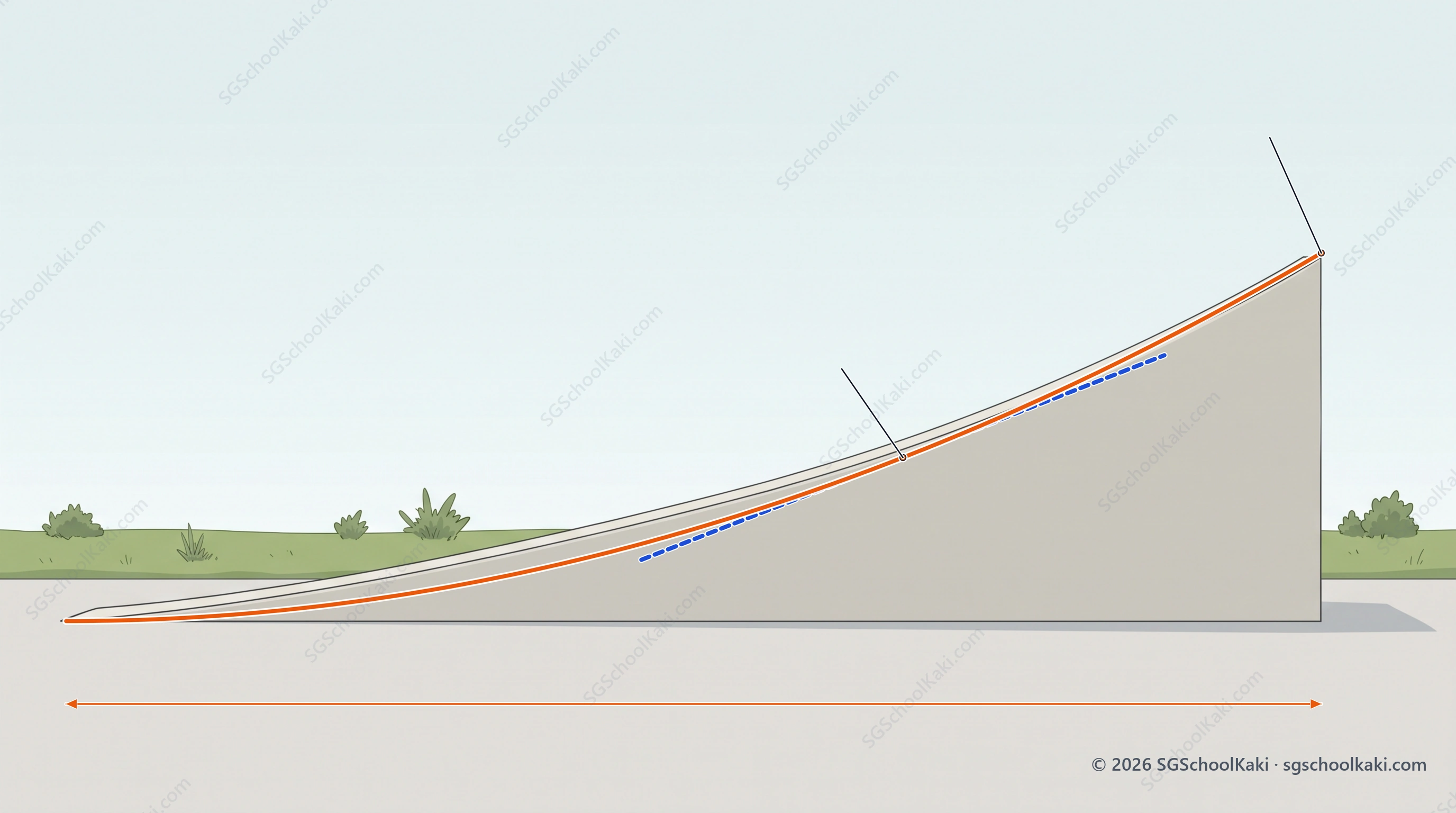
y=160x212 mPTtangent at Pvertical scale exaggerated
Maths In Real Life 1
A curved access ramp
A ramp that is curved instead of straight is gentle at the start and steeper towards the top. Because its steepness changes from place to place, the gradient at one point has to be found by differentiating.
A community centre is building a curved access ramp. At a horizontal distance of x metres from the start of the ramp, the surface of the ramp is y metres above the ground, where y=160x2, from the start of the ramp up to x=12.
(a)The designer wants the gradient to be at most 101. Find the value of x at which the gradient of the ramp first reaches this limit, and the height of the ramp there.
(b)Find the gradient of the ramp at its top end, where x=12. Does the top end of the ramp meet the designer's limit? Give a reason.
Show full solutionHide solution
Colour keyderivative of a term or factorfinal derivative
(a)
dxdy=801x
Multiply by the power, then lower the power by 1.
80x=101
The gradient is given, so set the derivative equal to it.
80x−101=0
Move every term to the left.
80x−8=0⟺x=8
A fraction is zero only when its top is zero, so x−8=0.
y=160(8)2=52
Put x=8 into the curve.
(b)
dxdy=801x
Multiply by the power, then lower the power by 1.
m=80(12)=203
Put x=12 into the derivative to get the gradient of the tangent there.
Compare with the designer's limit: 203=0.15 and 101=0.1, so 203>101. The top end of the ramp is steeper than the limit allows, so this section does not meet the designer's rule.
Answer
(a)x=8 m, where the ramp is 0.4 m high (y=52)
(b)m=203. This is more than 101, so the top end does not meet the designer's limit.
x passengersside view
Maths In Real Life 2
The cost per head of a chartered coach
A coach company charges one fixed fee for the vehicle and driver, however many people ride, plus a smaller charge for each passenger. Dividing the total by the number of passengers gives the cost per head, so the more people book, the less each one pays. A quotient shows exactly how quickly that falls.
A class hires a coach for a trip. When x passengers book, the cost per head, y dollars, is modelled by y=x12x+360, for x>0. The top of the fraction is the total cost of the trip in dollars: a fixed charge for the coach plus a charge for each passenger.
(a)Use the quotient rule to find dxdy. Check your answer by writing y as a sum of powers of x and differentiating again.
(b)Find the rate at which the cost per head is changing when 20 passengers have booked. Give your answer in dollars per passenger.
Show full solutionHide solution
Colour keyderivative of a term or factorfinal derivative
(a)
Differentiate the top and the bottom separately.
dxd(12x+360)=12
Power rule on each term.
dxd(x)=1
Power rule on each term.
dxdy=x212x−(12x+360)
Quotient rule: (derivative of the top times the bottom) minus (the top times the derivative of the bottom), over the bottom squared.
=x2−360
Expand the top and collect like terms. The top is a single number, so nothing cancels with the bottom.
Check by a second route: divide first, so that the quotient becomes a sum of powers of x.
y=12+360x−1
Write every root and reciprocal as a power of x: a root has a fractional index and x in the denominator has a negative index.
dxd(12)=0
The derivative of a constant is 0.
dxd(360x−1)=−360x−2
Multiply the coefficient 360 by the power −1 to get −360, then lower the power to −2.
dxdy=−360x−2
Add the derivatives of the terms.
=−x2360
Write the negative and fractional powers as fractions and roots again.
The two routes give the same derivative.
(b)
y=12+360x−1
Write every root and reciprocal as a power of x: a root has a fractional index and x in the denominator has a negative index.
dxd(12)=0
The derivative of a constant is 0.
dxd(360x−1)=−360x−2
Multiply the coefficient 360 by the power −1 to get −360, then lower the power to −2.
dxdy=−360x−2
Add the derivatives of the terms.
=−x2360
Write the negative and fractional powers as fractions and roots again.
m=−(20)2360=−109
Put x=20 into the derivative. The gradient dxdy there is the rate of change of y with respect to x.
Answer
(a)dxdy=−x2360
(b)m=−0.9 dollars per extra passenger: the cost per head is falling
01
Supports K341-C1-01 · K341-C1-02 · K341-C1-03
The derivative as the gradient of a tangent
A straight line has the same steepness everywhere, but a curve does not: it is steep in one place and nearly flat in another. The gradient of a curve at a point means the gradient of the tangent there, the straight line that just touches the curve at that point and runs in the same direction. This section shows where that idea comes from and what the notation means. The next sections build quick rules for finding the gradient.
P is a fixed point on the curve. The dashed chords from P to Q and then to R lean closer and closer to the solid tangent at P as the second point moves towards P.
Here is the idea behind the tangent. Join P to a second point on the curve by a chord, and work out the gradient of that chord. Now slide the second point along the curve towards P. The chord swings round and its gradient settles down to one value, and that value is the gradient of the tangent at P. Doing this with algebra for a general point gives the derivative. You are not asked to carry out this limit process in the exam; you only need to know that the derivative is the gradient of the tangent.
Think About It
The curve is y=x2 and P is the point where x=1. Let Q be the point of the curve where x=1+h, with h a small positive number. What is the gradient of the chord PQ, and what happens to it as h gets smaller?
Show the full workingHide the working
m=h(1+h)2−1
The rise is the difference of the two y-values and the run is h.
=h2h+h2=2+h
Expand the bracket, then divide the top and the bottom by h, which is not zero.
As h gets smaller, 2+h gets closer and closer to 2, so the chords settle onto a line of gradient 2.
Answer
The chord gradient is 2+h, which approaches 2: the gradient of the tangent to y=x2 at x=1.
The Core Idea
The derivative is the gradient of the tangent.
For a curve y=f(x) the derivative is written dxdy or f′(x). Its value at x=a is the gradient of the tangent at the point where x=a, written f′(a). Because the gradient says how fast y changes as x increases, it is also the rate of change of y with respect to x, measured in units of y per unit of x.
For the next few Examples you need one rule before it is explained properly in the next section: to differentiate a term axn, multiply by the power and lower the power by 1, so axn becomes anxn−1. A number on its own has derivative 0, and the terms of a sum are differentiated one at a time.
SGSchoolKaki Tip
Always keep the two ideas apart. f′(x) is a function of x, the general gradient formula. f′(a) is a number, the gradient at one particular point. You find the formula first, then put in the value of x.
Example 1.1
The derivative, then the gradient at a point
A curve has equation y=x2+3x. Find dxdy and the gradient of the curve at the point where x=2.
Show solutionHide solution
Colour keyderivative of a term or factorfinal derivative
dxd(x2)=2x
The coefficient is 1: bring the power 2 down and lower the power to 1.
dxd(3x)=3
The power is 1: multiply 3 by 1, and x0 is 1.
dxdy=2x+3
Add the derivatives of the terms.
m=2×(2)+3=7
Put x=2 into the derivative to get the gradient of the tangent there.
Answer
dxdy=2x+3; m=7
Example 1.2
Function notation: f'(x) and f'(a)
Given that f(x)=x3−3x2, find f′(x) and the value of f′(−1).
Show solutionHide solution
Colour keyderivative of a term or factorfinal derivative
dxd(x3)=3x2
The coefficient is 1: bring the power 3 down and lower the power to 2.
dxd(−3x2)=−6x
Multiply the coefficient −3 by the power 2 to get −6, then lower the power to 1.
f′(x)=3x2−6x
Add the derivatives of the terms.
m=3×(−1)2−6×(−1)=9
Put x=−1 into the derivative to get the gradient of the tangent there.
Answer
f′(x)=3x2−6x; m=9
f′(−1) means put x=−1 into the derivative f′(x). It does not mean the derivative of f(−1): that is a single number, and the derivative of a number is 0. Differentiate first, substitute second.
Example 1.3
The gradient as a rate of change
The curve y=5x2−2x describes how a quantity y changes as x changes. Find dxdy, and the rate of change of y with respect to x when x=3.
Show solutionHide solution
Colour keyderivative of a term or factorfinal derivative
dxd(5x2)=10x
Multiply the coefficient 5 by the power 2 to get 10, then lower the power to 1.
dxd(−2x)=−2
The power is 1: multiply −2 by 1, and x0 is 1.
dxdy=10x−2
Add the derivatives of the terms.
m=10×(3)−2=28
Put x=3 into the derivative. The gradient dxdy there is the rate of change of y with respect to x.
Answer
dxdy=10x−2; m=28 units of y per unit of x
Example 1.4
Working backwards: where is the gradient given?
Find the coordinates of the point on the curve y=x2−6x+5 at which the gradient of the curve is 2.
Show solutionHide solution
Colour keyderivative of a term or factorfinal derivative
dxd(x2)=2x
The coefficient is 1: bring the power 2 down and lower the power to 1.
dxd(−6x)=−6
The power is 1: multiply −6 by 1, and x0 is 1.
dxd(5)=0
The derivative of a constant is 0.
dxdy=2x−6
Add the derivatives of the terms.
2x−6=2
The gradient is given, so set the derivative equal to it.
2x−8=0
Move every term to the left.
2(x−4)=0⟺x=4
Each factor can be zero.
y=(4)2−6×(4)+5=−3
Put x=4 into the curve.
Answer
(4,−3)
Differentiating the derivative gives the second derivative. It is written dx2d2y or f′′(x): the derivative of dxdy. It tells you how the gradient itself is changing. This chapter only computes it and reads it as the rate at which the gradient changes.
dx2d2y is a single symbol for the second derivative. It is not (dxdy)2, which would mean the first derivative multiplied by itself.
Example 1.5
dy/dx and d2y/dx2 of the same function
Given that y=x5−4x2, find dxdy and dx2d2y.
Show solutionHide solution
Colour keyderivative of a term or factorfinal derivative
dxd(x5)=5x4
The coefficient is 1: bring the power 5 down and lower the power to 4.
dxd(−4x2)=−8x
Multiply the coefficient −4 by the power 2 to get −8, then lower the power to 1.
Almost every function in this chapter is built from powers of x. One rule handles them all, and it works for whole-number, negative and fractional indices alike.
The Core Idea
Multiply by the power, then lower the power by 1.
For any rational number n: dxd(xn)=nxn−1. A constant multiple stays in front, dxd(kxn)=knxn−1, and a sum or difference is differentiated term by term. A term that is just a number differentiates to 0. When n is a fraction with an even denominator (such as 21), x must be positive; when n is negative, x is not 0.
The rule needs every term written as a number times a power of x. A root is a power with a fractional index and a reciprocal is a power with a negative index, so rewrite first, then differentiate, and write the answer back as a fraction or a root at the end.
Rewrite first, then differentiate
Form given
Index form
Derivative
x31
x−3
−3x−4, that is −x43
x
x21
21x−21, that is 2x1
3x
x31
31x−32
x25
5x−2
−10x−3, that is −x310
A number added or taken away: what happens to the gradient
Function
Gradient at x = 1
Picture
y=x2
2
tangent where x=1
y=x2+2
2: unchanged by the +2
moved up, same steepness
y=x2−1
2: unchanged by the −1
moved down, same steepness
Moving a graph up or down does not change how steep it is, which is why a constant term differentiates to 0.
Example 2.1
A polynomial with a constant term
Find dxdy when y=4x3−5x2+7x−9.
Show solutionHide solution
Colour keyderivative of a term or factorfinal derivative
dxd(4x3)=12x2
Multiply the coefficient 4 by the power 3 to get 12, then lower the power to 2.
dxd(−5x2)=−10x
Multiply the coefficient −5 by the power 2 to get −10, then lower the power to 1.
dxd(7x)=7
The power is 1: multiply 7 by 1, and x0 is 1.
dxd(−9)=0
The derivative of a constant is 0.
dxdy=12x2−10x+7
Add the derivatives of the terms.
Answer
dxdy=12x2−10x+7
Example 2.2
A reciprocal term: a negative index
Differentiate y=x2+x3 with respect to x.
Show solutionHide solution
Colour keyderivative of a term or factorfinal derivative
y=x2+3x−1
Write every root and reciprocal as a power of x: a root has a fractional index and x in the denominator has a negative index.
dxd(x2)=2x
The coefficient is 1: bring the power 2 down and lower the power to 1.
dxd(3x−1)=−3x−2
Multiply the coefficient 3 by the power −1 to get −3, then lower the power to −2.
dxdy=2x−3x−2
Add the derivatives of the terms.
=2x−x23
Write the negative and fractional powers as fractions and roots again.
Answer
dxdy=2x−x23
Think About It
What does the power rule give for n=0, and does that agree with the rule that a constant has derivative 0?
Show the full workingHide the working
Since x0=1, the function x0 is a constant.
Any non-zero number to the power 0 is 1.
dxd(x0)=0×x−1=0
The power rule with n=0: the factor 0 in front kills the whole term.
Answer
The rule gives 0, so it agrees with the fact that a constant has derivative 0.
Example 2.3
A square root term: a fractional index
Find dxdy when y=−6x+x2, for x>0.
Show solutionHide solution
Colour keyderivative of a term or factorfinal derivative
y=x2−6x21
Write every root and reciprocal as a power of x: a root has a fractional index and x in the denominator has a negative index.
dxd(x2)=2x
The coefficient is 1: bring the power 2 down and lower the power to 1.
dxd(−6x21)=−3x−21
Multiply the coefficient −6 by the power 21 to get −3, then lower the power to −21.
dxdy=2x−3x−21
Add the derivatives of the terms.
=2x−x3
Write the negative and fractional powers as fractions and roots again.
Answer
dxdy=2x−x3
A fraction with a single term underneath is not a quotient problem. Split it into separate fractions, one for each term on top, and every piece becomes a number times a power of x.
Example 2.4
A fraction split into terms
Find dxdy when y=x2x2+5. Split the fraction into terms first.
Show solutionHide solution
Colour keyderivative of a term or factorfinal derivative
y=1+5x−2
Write every root and reciprocal as a power of x: a root has a fractional index and x in the denominator has a negative index.
dxd(1)=0
The derivative of a constant is 0.
dxd(5x−2)=−10x−3
Multiply the coefficient 5 by the power −2 to get −10, then lower the power to −3.
dxdy=−10x−3
Add the derivatives of the terms.
=−x310
Write the negative and fractional powers as fractions and roots again.
Answer
dxdy=−x310
Example 2.5
A constant taken out of the denominator
Differentiate y=4x21 with respect to x.
Show solutionHide solution
Colour keyfinal derivative
y=41x−2
Write every root and reciprocal as a power of x: a root has a fractional index and x in the denominator has a negative index.
dxdy=−21x−3
Multiply by the power, then lower the power by 1.
=−2x31
Write the negative and fractional powers as fractions and roots again.
Answer
dxdy=−2x31
SGSchoolKaki Tip
A number in the denominator of a fraction is a constant multiplier. 4x21 is 41 times x−2, so the 41 stays in front and only x−2 is differentiated.
A power of a bracket that holds only a multiple of x must be expanded before the power rule is used on it. (2x)3 is 23x3=8x3, not 2x3: the number inside the bracket is cubed too. The derivative of (2x)3 is therefore 24x2, not 6x2.
Example 2.6
Expanding a bracket of a single term
Find dxdy when y=8x3+x.
Show solutionHide solution
Colour keyderivative of a term or factorfinal derivative
dxd(8x3)=24x2
Multiply the coefficient 8 by the power 3 to get 24, then lower the power to 2.
dxd(x)=1
The power is 1, so the term is x and its gradient is 1.
dxdy=24x2+1
Add the derivatives of the terms.
Answer
dxdy=24x2+1
Example 2.7
An unknown constant from a given gradient
The gradient of the curve y=kx3−4x, where k is a constant, is 20 at the point where x=2. Find the value of k.
Show solutionHide solution
Colour keyderivative of a term or factorfinal derivative
dxd(kx3)=3kx2
Power rule on the term; the unknown k is a constant multiplier.
dxd(−4x)=−4
Power rule on the term; the unknown k is a constant multiplier.
dxdy=3kx2−4
Add the derivatives of the terms.
3×(2)2×k−4=20
The gradient at x=2 is given, so substitute x=2 and set the result equal to 20.
k=2
Solve the linear equation for k.
Answer
k=2
03
Supports K341-C1-06
The chain rule: powers of a bracket
The power rule needs a bare x. A power of a bracket, such as (2x+5)4, is different: the bracket is a function of x in its own right. You could multiply it out, but that is slow and a single slip ruins the answer. The chain rule differentiates it directly.
The Core Idea
Outside derivative, bracket kept, times the derivative of the bracket.
dxdf(g(x))=f′(g(x))×g′(x). For a power of a bracket, bring the power down, lower it by 1 and keep the bracket, then multiply by the derivative of what is inside. For a linear bracket this gives dxd(ax+b)n=na(ax+b)n−1. Write k(ax+b)n with its constant multiple in front: the answer is kna(ax+b)n−1.
Think About It
Why is there an extra factor from the inside of the bracket? Check the rule on (2x+5)2 by expanding it first.
Show the full workingHide the working
(2x+5)2=4x2+20x+25
Expand the bracket so the power rule can be used on each term.
dxd(4x2+20x+25)=8x+20=4(2x+5)
Power rule term by term, then take out the common factor 4.
The chain rule gives 2×2(2x+5)1=4(2x+5). The first 2 is the power and the second 2 is the derivative of the bracket 2x+5.
Answer
Expanding and the chain rule both give 4(2x+5), so the factor 2 from the inside of the bracket really is needed.
Example 3.1
A power of a linear bracket
Differentiate y=(2x+5)4 with respect to x.
Show solutionHide solution
Colour keyinside function or factor brought inderivative of a term or factorfinal derivative
dxdy=4(2x+5)3×2
Outside: bring the power down and multiply it into the coefficient, which gives 4, and lower the power to 3, keeping the bracket. Inside: multiply by the derivative of the bracket.
=8(2x+5)3
Multiply the numbers together.
Answer
dxdy=8(2x+5)3
Do not forget the derivative of the bracket. The derivative of (3x−1)5 is 15(3x−1)4, not 5(3x−1)4: the missing factor is the 3 from inside. Do not change the bracket either: the new power goes on the whole bracket, so (3x−1)5 never becomes 5(3x)4.
Example 3.2
A negative index: the reciprocal of a bracket
Find dxdy when y=(4x−1)23.
Show solutionHide solution
Colour keyinside function or factor brought inderivative of a term or factorfinal derivative
dxdy=−6(4x−1)−3×4
Outside: bring the power down and multiply it into the coefficient, which gives −6, and lower the power to −3, keeping the bracket. Inside: multiply by the derivative of the bracket.
=−(4x−1)324
Multiply the numbers together.
Answer
dxdy=−(4x−1)324
Example 3.3
The square root of a linear bracket
Differentiate y=3x+7 with respect to x, for values of x where the root exists.
Show solutionHide solution
Colour keyinside function or factor brought inderivative of a term or factorfinal derivative
dxdy=21(3x+7)−21×3
Outside: bring the power down and multiply it into the coefficient, which gives 21, and lower the power to −21, keeping the bracket. Inside: multiply by the derivative of the bracket.
=23x+73
Multiply the numbers together.
Answer
dxdy=23x+73
The bracket does not have to be linear. For (x2−3x)6 the derivative of the bracket is 2x−3, and it multiplies the front, so the result is a product. Taking out the common factor leaves a tidy answer.
Example 3.4
A quadratic bracket, answer factorised
Differentiate y=(x2−3x)6 with respect to x. Give your answer in factorised form.
Show solutionHide solution
Colour keyinside function or factor brought inderivative of a term or factorfinal derivative
dxdy=6(x2−3x)5×(2x−3)
Outside: bring the power down and multiply it into the coefficient, which gives 6, and lower the power to 5, keeping the bracket. Inside: multiply by the derivative of the bracket.
=6x5(x−3)5(2x−3)
Multiply the numbers together.
Answer
dxdy=6x5(x−3)5(2x−3)
Example 3.5
The reciprocal square root of a quadratic
Find dxdy when y=x2+41.
Show solutionHide solution
Colour keyinside function or factor brought inderivative of a term or factorfinal derivative
dxdy=−21(x2+4)−23×2x
Outside: bring the power down and multiply it into the coefficient, which gives −21, and lower the power to −23, keeping the bracket. Inside: multiply by the derivative of the bracket.
=−(x2+4)23x
Multiply the numbers together.
Answer
dxdy=−(x2+4)23x
SGSchoolKaki Tip
Before using the chain rule, ask: is this a power of something that is not just x? If so, the something is the bracket. A root g is the bracket g to the power 21, and g1 is g−1.
Example 3.6
A constant multiple of a bracket power
Find dxdy when y=2(4−x)5.
Show solutionHide solution
Colour keyinside function or factor brought inderivative of a term or factorfinal derivative
dxdy=10(4−x)4×(−1)
Outside: bring the power down and multiply it into the coefficient, which gives 10, and lower the power to 4, keeping the bracket. Inside: multiply by the derivative of the bracket.