Differentiation turns a function into its gradient; integration goes back. Given a gradient, a rate of change or a derivative you just found, integration recovers the curve or the quantity, with one constant c that a single known point fixes. This chapter builds the integrals of powers of x (including the one exception, x1, which gives a natural logarithm), of linear brackets raised to a power, and of the exponential, sine, cosine and sec2 functions of a linear bracket, shows how to rewrite a function before integrating it, and ends with evaluating a definite integral. Angles are in radians throughout.
Your outcome tracker0 / 9
Let's go! Tick an outcome once you can pass its exam check. Saved on this device.
Chapter 14
Figure 1 · the family of curves y = ½x² + c: every curve has gradient x, and the point (1, 3) picks out one of them (c = 2½): integrating a gradient always leaves a constant
r = 1y = sin θcos θ
3 outcomes · 1 page · every step shown ✦
Reverse the derivative
Add 1 to the power, divide by the new power, and always add + c. Check by differentiating: you must get the original function back.
Brackets and the exception
For (ax+b)n divide by the coefficient of x as well. The power −1 breaks the rule: x1 gives ln∣x∣ and ax+b1 gives a1ln∣ax+b∣ (not in G2).
Rewrite first
Roots and fractions become powers of x; brackets are multiplied out; tan² = sec² − 1, cos² = ½(1 + cos 2x). Never integrate a product or a quotient directly.
By the end of this chapter
Use integration as the reverse of differentiation and write the constant of integration; find a curve from its gradient and a point, or from its second derivative and two conditions.
Integrate xn for any rational n, including roots and reciprocal powers rewritten in index form, with constant multiples, sums and differences.
Integrate (ax+b)n by reversing the chain rule: divide by a and by the new power.
Integrate x1 and ax+b1 to natural logarithms, and eax+b, sin(ax+b), cos(ax+b) and sec2(ax+b) (G3 only).
Rewrite before integrating: expand brackets, use index laws, tan2x=sec2x−1, the double angle for cos2x and sin2x, and partial fractions.
Answer 'hence' questions by differentiating first, and find a quantity from its rate of change; evaluate a definite integral as the difference of F between its limits.
✶
Start here
Maths In Real Life
Three situations where a rate of change decides how much has collected: a tank filling, a cup of tea cooling and a pulsing pump. The pictures come first; the working in each solution comes from the same numbers.
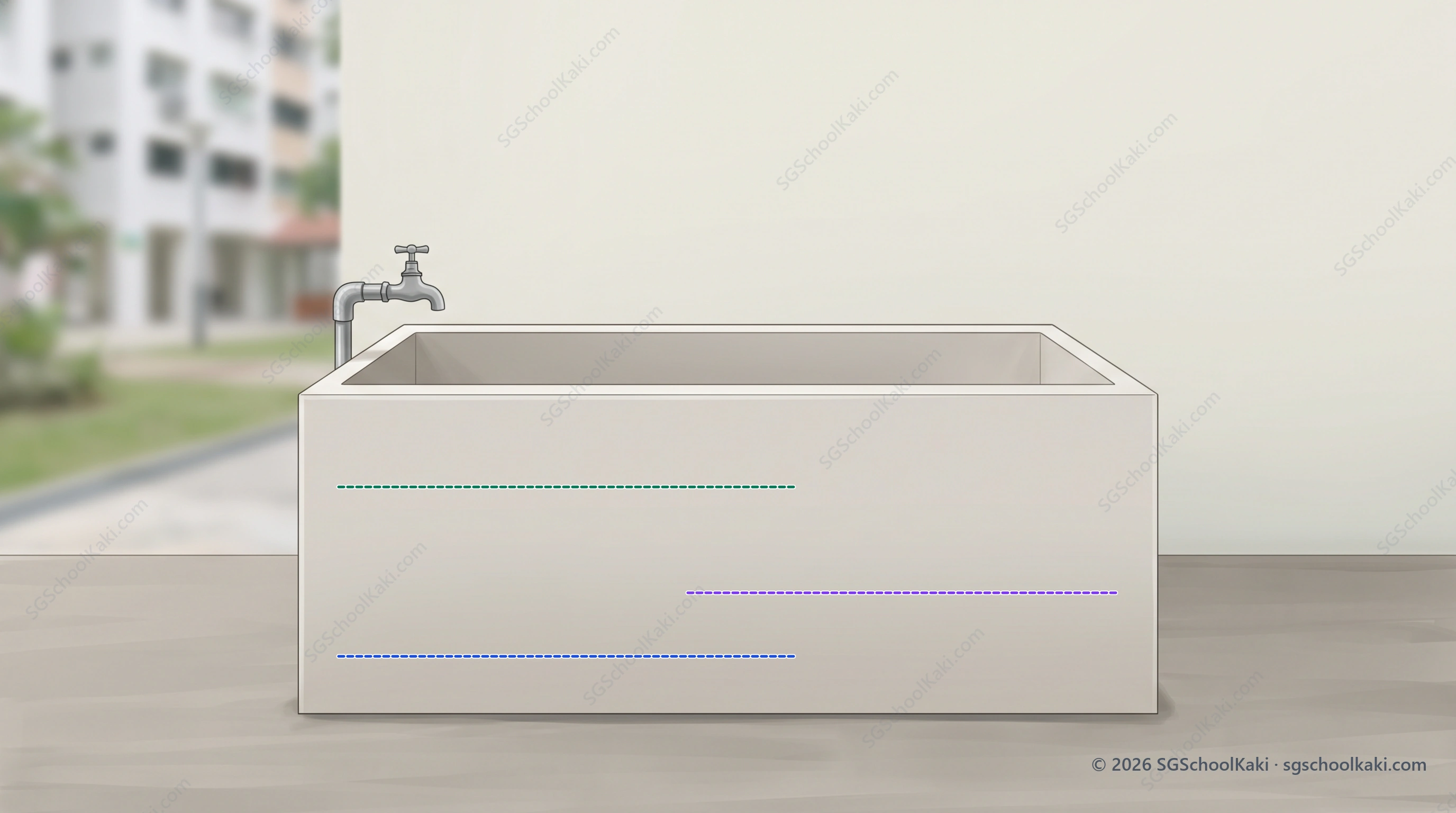
50 litres at t=0110 litres at t=2210 litres at t=4front view
Maths In Real Life 1
A tank filling from a tap
A tap does not always run at a steady speed. If you know how fast the volume is changing at every moment, integrating that rate gives the volume in the tank at any time.
Water flows from a tap into a plain open tank with straight vertical sides. The volume of water in the tank is V litres at time t minutes after the tap is opened, and dtdV=10t+20, measured in litres per minute. The tank holds 50 litres of water when t=0.
(a)Find V in terms of t, and the volume of water in the tank when t=4.
(b)Find the volume of water added to the tank between t=2 and t=4.
Show full solutionHide solution
Colour keythe rule applied to a termthe antiderivative or final result
(a)
V=∫(10t+20)dt
A rate of change is a derivative, so reverse it: V is the integral of dtdV=10t+20.
∫10tdt=1+110t1+1
Add 1 to the power, then divide by the new power. The constant multiplier stays in front.
=5t2
Simplify.
∫20dt=20t
The integral of a constant k is kt.
V=5t2+20t+c
Add the integrals of the terms and write one constant of integration c at the end.
V=5t2+20t+c
The integral with its constant c.
50=5×(0)2+20×(0)+c
Use the starting value: V=50 when t=0.
c=50
Solve for c.
V=5t2+20t+50
Put the constant back.
V=5×(4)2+20×(4)+50
Substitute t=4.
=210
Evaluate.
(b)
∫24(10t+20)dt=[5t2+20t]24
Integrate with the usual rules but leave out the constant c: it cancels in a definite integral.
=(5×(4)2+20×(4))−(5×(2)2+20×(2))
Substitute the upper limit 4, then the lower limit 2, and subtract (upper minus lower).
=100
Evaluate.
Answer
(a)V=5t2+20t+50; V=210 litres
(b)100 litres
80 °C at pouringfront view
Maths In Real Life 2
A cup of tea cooling
A hot drink loses heat fastest at the start and more and more slowly as it nears the temperature of the room. The rate of cooling is known, and integrating it recovers the temperature itself, with the starting temperature fixing the constant.
Not in G2 (G3 Additional Maths only): this uses the exponential eax+b. A cup of tea is poured at time t=0, when its temperature is 80 °C. At t minutes after pouring, the temperature T °C is changing at a rate of dtdT=−25e−20t, measured in °C per minute.
(a)Find T in terms of t, and hence the temperature of the tea 20 minutes after it is poured. Give the exact value and then the value to 1 decimal place.
Show full solutionHide solution
Colour keythe antiderivative or final result
(a)
T=∫−25e−20tdt
A rate of change is a derivative, so reverse it: T is the integral of dtdT=−25e−20t.
=50e−20t+c
The integral of eax+b is a1eax+b: divide by the coefficient of x, which is −201. The constant multiplier stays in front.
T=50e−20t+c
The integral with its constant c.
80=50×e−20(0)+c
Use the starting value: T=80 when t=0.
c=30
Solve for c.
T=30+50e−20t
Put the constant back.
T=30+50×e−20(20)
Substitute t=20.
=50e−1+30
Evaluate.
≈48.4
Round at the very end, to 1 decimal place.
Answer
(a)T=30+50e−20t,t≥0; T=50e−1+30≈48.4 °C (1 d.p.): the tea has cooled but is still hotter than the temperature it is heading towards
after 3 minafter 6 minfront view
Maths In Real Life 3
A pulsing garden pump
A small pump delivers water in pulses: the flow rises to a peak and falls back to zero. The flow rate is known, so integrating it gives the volume delivered, and a definite integral gives the volume delivered over a whole pulse.
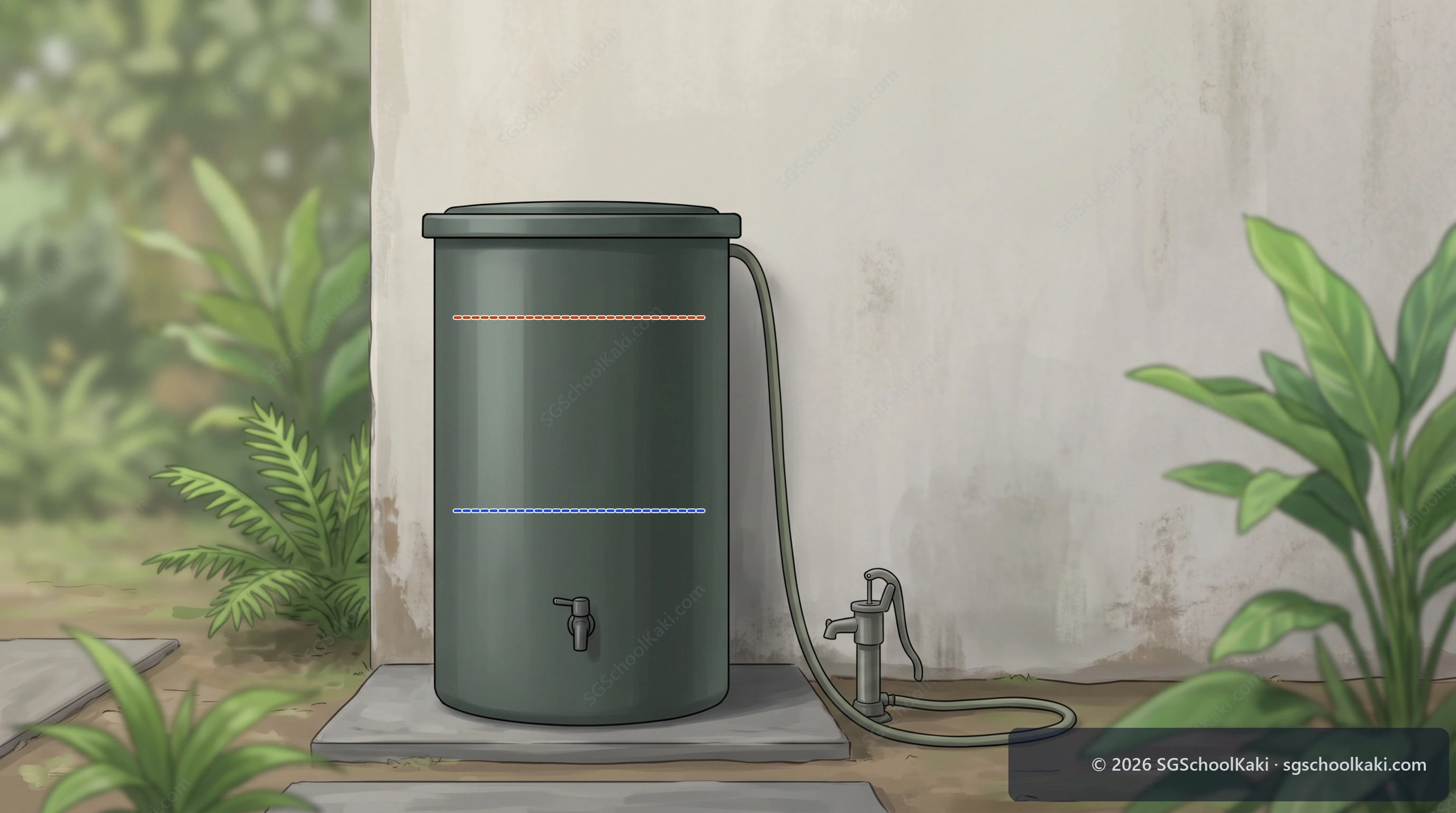
Not in G2 (G3 Additional Maths only): this uses sin, cos or sec2 of a linear bracket. A hand pump fills an empty water butt. For 0≤t≤6, where t is the time in minutes after the pump starts, the pump delivers water at a rate of dtdV=6sin(6πt), measured in litres per minute, where the angle in the sine is in radians and V litres is the volume in the butt.
(a)Find V in terms of t, and the volume in the butt after 3 minutes. Give the exact value and then the value to 1 decimal place.
(b)Evaluate ∫066sin(6πx)dx to find the volume the pump delivers in the whole pulse of 6 minutes. Give the exact value and then the value to 1 decimal place.
Show full solutionHide solution
Colour keythe antiderivative or final result
(a)
V=∫6sin(6πt)dt
A rate of change is a derivative, so reverse it: V is the integral of dtdV=6sin(6πt).
=−π36cos(6πt)+c
The integral of sin(ax+b) is −a1cos(ax+b): the sign changes and you divide by a, here the coefficient of x is 6π. The constant multiplier stays in front.
V=−π36cos(6πt)+c
The integral with its constant c.
0=−π36×cos(6π×(0))+c
Use the starting value: V=0 when t=0.
c=π36
Solve for c.
V=−π36cos(6πt)+π36
Put the constant back.
V=−π36×cos(6π×(3))+π36
Substitute t=3.
=π36
Evaluate.
≈11.5
Round at the very end, to 1 decimal place.
(b)
∫066sin(6πt)dt=[−π36cos(6πt)]06
Integrate with the usual rules but leave out the constant c: it cancels in a definite integral.
=−π36×cos(6π×(6))−−π36×cos(6π×(0))
Substitute the upper limit 6, then the lower limit 0, and subtract (upper minus lower).
=π72
Evaluate.
≈22.9
Round at the very end, to 1 decimal place.
Answer
(a)V=−π36cos(6πt)+π36,0≤t≤6; V=π36≈11.5 litres (1 d.p.): the pump is still running, so the butt fills further
(b)π72≈22.9 litres (1 d.p.): the whole pulse delivers twice the volume of its first half
01
Supports K341-C1-11
Integration as the reverse of differentiation
Revision. In Chapter 11 you differentiated a power of x: bring the power down in front and take 1 off the power, so dxd(x4)=4x3. This chapter runs that machine backwards.
Differentiation takes a curve and gives its gradient function. Integration goes the other way: given a gradient function, it finds the curve (or any quantity) it came from. Because several curves have the same gradient function, the answer always carries an unknown constant. Writing ∫…dx means “find a function whose derivative is what is inside”.
The Core Idea
Integration undoes differentiation.
∫xndx=n+1xn+1+c Add 1 to the power, then divide by the new power. The +c is the constant of integration: write it once, at the end of every indefinite integral. A constant multiplier stays in front, and a sum is integrated term by term.
Example 1.1
Undoing one power of x
Find ∫8x3dx.
Show solutionHide solution
Colour keythe rule applied to a termthe antiderivative or final result
∫8x3dx=3+18x3+1+c
Add 1 to the power, then divide by the new power. The constant multiplier stays in front.
=2x4+c
Simplify.
Answer
2x4+c
SGSchoolKaki Tip
Check by differentiating. Differentiate your answer: you must get the original function back, and the +c disappears because the derivative of a constant is 0.
A sum is integrated one term at a time. A plain number is a constant term: the integral of a constant k is kx, because dxd(kx)=k.
Example 1.2
A sum with a constant term
Find ∫(6x2−4x+5)dx.
Show solutionHide solution
Colour keythe rule applied to a termthe antiderivative or final result
∫6x2dx=2+16x2+1
Add 1 to the power, then divide by the new power. The constant multiplier stays in front.
=2x3
Simplify.
∫−4xdx=1+1−4x1+1
Add 1 to the power, then divide by the new power. The constant multiplier stays in front.
=−2x2
Simplify.
∫5dx=5x
The integral of a constant k is kx.
∫(6x2−4x+5)dx=2x3−2x2+5x+c
Add the integrals of the terms and write one constant of integration c at the end.
Answer
2x3−2x2+5x+c
Think About It
One student integrates 6x2 and writes 2x3. A second student writes 2x3+7. Both differentiate their answer and get 6x2. Can both be right?
Show the full workingHide the working
y=2x3+7
The second student's answer.
dxdy=6x2+0=6x2
Differentiate: the constant term disappears, so it cannot change the gradient.
Answer
Yes. Both answers have the gradient 6x2, because a constant has gradient 0. Every function 2x3+c has that gradient, which is why +c is written.
Fractions and negative numbers behave exactly as they do in differentiation: divide by the new power, and keep the sign and the multiplier.
Example 1.3
Fractional coefficients
Find ∫(−4x2+3x)dx.
Show solutionHide solution
Colour keythe rule applied to a termthe antiderivative or final result
∫−4x2dx=2+1−4x2+1
Add 1 to the power, then divide by the new power. The constant multiplier stays in front.
=−34x3
Simplify.
∫3xdx=1+131x1+1
Add 1 to the power, then divide by the new power. The constant multiplier stays in front.
=6x2
Simplify.
∫(−4x2+3x)dx=−34x3+6x2+c
Add the integrals of the terms and write one constant of integration c at the end.
Answer
−34x3+6x2+c
Many curves share one gradient function: they are the same shape, shifted up or down by different values of c. The table shows this, and shows how one given point picks out the single curve you want.
One gradient, many curves, and one point that chooses
Information
What it gives
Picture
dxdy=x and no point
y=2x2+c: one curve for every value of c. Three of them are drawn.
c=−2,0,2
dxdy=x and the point (1,3)
Put x=1, y=3 into y=2x2+c: 3=21+c, so c=25 and only one curve is left.
the curve through (1,3)
Example 1.4
One gradient, many curves, one point
A curve passes through the point (2,3) and dxdy=6x−5. Find the equation of the curve.
Show solutionHide solution
Colour keythe rule applied to a termthe antiderivative or final result
y=∫(6x−5)dx
The gradient function is the derivative, so y is its integral: reverse the differentiation of dxdy=6x−5.
∫6xdx=1+16x1+1
Add 1 to the power, then divide by the new power. The constant multiplier stays in front.
=3x2
Simplify.
∫−5dx=−5x
The integral of a constant k is kx.
y=3x2−5x+c
Add the integrals of the terms and write one constant of integration c at the end.
The rule ∫xndx=n+1xn+1+c works for any rational power n, positive, negative or fractional, except one special value that is met later (a G3 topic). The skill is rewriting the function as a sum of powers of x first.
The Core Idea
Rewrite in index form, then integrate.
A root is a fractional power: x=x1/2. A power on the bottom of a fraction is a negative power: xn1=x−n. Write every term as xn, then add 1 to the power and divide by the new power.
Rewriting a term before integrating
Term
In index form
Integral (without + c)
x21
x−2
−x1
x
x21
32x23
x1
x−21
2x
x32
x32
53x35
Example 2.1
A power on the bottom of a fraction
Find ∫(2x+x34)dx.
Show solutionHide solution
Colour keythe rule applied to a termthe antiderivative or final result
∫(2x+x34)dx=∫2x+4x−3dx
Write each term as a power first: a power on the bottom of a fraction is a negative power (1/xn=x−n).
∫2xdx=1+12x1+1
Add 1 to the power, then divide by the new power. The constant multiplier stays in front.
=x2
Simplify.
∫x34dx=−3+14x−3+1
Add 1 to the power, then divide by the new power. The constant multiplier stays in front.
=−x22
Simplify.
∫(2x+x34)dx=x2−x22+c
Add the integrals of the terms and write one constant of integration c at the end.
Answer
x2−x22+c
Dividing by the new power can give a negative number. The integral of x−2 is −1x−1, which is −x1: keep the minus sign, and never write the power −1 as a positive number.
Example 2.2
A square root
Find ∫(6x+x)dx.
Show solutionHide solution
Colour keythe rule applied to a termthe antiderivative or final result
∫(6x+x)dx=∫x+6x21dx
Write each term as a power first: a root is a fractional power (x=x1/2).
∫xdx=1+1x1+1
Add 1 to the power, then divide by the new power.
=2x2
Simplify.
∫6xdx=21+16x21+1
Add 1 to the power, then divide by the new power. The constant multiplier stays in front.
=4x23
Simplify.
∫(6x+x)dx=2x2+4x23+c
Add the integrals of the terms and write one constant of integration c at the end.
Answer
2x2+4x23+c
Example 2.3
The reciprocal of a root
Find ∫(x2+x3)dx.
Show solutionHide solution
Colour keythe rule applied to a termthe antiderivative or final result
∫(x2+x3)dx=∫x2+3x−21dx
Write each term as a power first: a root is a fractional power (x=x1/2) and a power on the bottom of a fraction is a negative power (1/xn=x−n).
∫x2dx=2+1x2+1
Add 1 to the power, then divide by the new power.
=3x3
Simplify.
∫x3dx=−21+13x−21+1
Add 1 to the power, then divide by the new power. The constant multiplier stays in front.
=6x
Simplify.
∫(x2+x3)dx=3x3+6x+c
Add the integrals of the terms and write one constant of integration c at the end.
Answer
3x3+6x+c
Think About It
A student integrates x and writes x23, without dividing by the new power. Differentiate the student's answer. Is it x?
Show the full workingHide the working
y=x23
The student's answer.
dxdy=23x
Bring the power down in front: the multiplier appears, so the result is not the original function.
Answer
No. The derivative is 23x, which is 23 times too big. Dividing by the new power 23 gives 32x23, whose derivative is x.
Some functions are not yet a sum of powers. A fraction with a single term on the bottom is split over that term, and brackets are multiplied out first. Neither a quotient nor a product of two factors can be integrated as it stands.
Example 2.4
A fraction split over a power of x
Find ∫x43x2+2dx.
Show solutionHide solution
Colour keythe rule applied to a termthe antiderivative or final result
∫x43x2+2dx=∫(x23+x42)dx
Expand the brackets (or split the fraction) so that every term is a power of x.
∫x42dx=−4+12x−4+1
Add 1 to the power, then divide by the new power. The constant multiplier stays in front.
=−3x32
Simplify.
∫x23dx=−2+13x−2+1
Add 1 to the power, then divide by the new power. The constant multiplier stays in front.
=−x3
Simplify.
∫(x23+x42)dx=−3x32−x3+c
Add the integrals of the terms and write one constant of integration c at the end.
Answer
−3x32−x3+c
Example 2.5
Brackets multiplied out first
Find ∫(x−2)(x+3)dx.
Show solutionHide solution
Colour keythe rule applied to a termthe antiderivative or final result
∫(x−2)(x+3)dx=∫(x2+x−6)dx
Expand the brackets (or split the fraction) so that every term is a power of x.
∫x2dx=2+1x2+1
Add 1 to the power, then divide by the new power.
=3x3
Simplify.
∫xdx=1+1x1+1
Add 1 to the power, then divide by the new power.
=2x2
Simplify.
∫−6dx=−6x
The integral of a constant k is kx.
∫(x2+x−6)dx=3x3+2x2−6x+c
Add the integrals of the terms and write one constant of integration c at the end.
Answer
3x3+2x2−6x+c
SGSchoolKaki Tip
Never integrate a product factor by factor: the integral of (x−2)(x+3) is not the integral of (x−2) times the integral of (x+3). Multiply out and integrate the sum.
Example 2.6
Two fractional and negative powers together
Find ∫(9x32−x21)dx.
Show solutionHide solution
Colour keythe rule applied to a termthe antiderivative or final result
∫(9x32−x21)dx=∫−x−2+9x32dx
Write each term as a power first: a root is a fractional power (x=x1/2) and a power on the bottom of a fraction is a negative power (1/xn=x−n).
∫−x21dx=−2+1−x−2+1
Add 1 to the power, then divide by the new power.
=x1
Simplify.
∫9x32dx=32+19x32+1
Add 1 to the power, then divide by the new power. The constant multiplier stays in front.
=527x35
Simplify.
∫(9x32−x21)dx=x1+527x35+c
Add the integrals of the terms and write one constant of integration c at the end.
Answer
x1+527x35+c
03
Supports K341-C1-13
Integrating (ax+b) to a power
A bracket (ax+b) raised to a power looks like xn, but it is the chain rule that has been used on the way down: differentiating (ax+b)n+1 brings out the extra factor a. To undo it, divide by a as well.
The Core Idea
Divide by the new power and by a.
∫(ax+b)ndx=a(n+1)(ax+b)n+1+c The bracket must be linear: ax+b with a number in front of x. Divide by the new power AND by the coefficient a of x.
What to divide by
Integrand
What to divide by
Integral (without + c)
(4x+1)2
Divide by 3 (the new power) and by 4 (the coefficient of x).
316x3+4x2+x
(3x−1)−2
Divide by −1 (the new power) and by 3 (the coefficient of x).
−9x−31
(−3x+1)3
Divide by 4 (the new power) and by −3 (the coefficient of x).
−427x4+9x3−29x2+x
Example 3.1
A positive power of a bracket
Find ∫(2x+1)3dx.
Show solutionHide solution
Colour keythe rule applied to a termthe antiderivative or final result
∫(2x+1)3dx=2(3+1)(2x+1)3+1+c
Add 1 to the power and divide by the new power; the bracket is linear, so also divide by the coefficient 2 of x.
=8(2x+1)4+c
Simplify.
Answer
8(2x+1)4+c
Example 3.2
The root of a bracket
Find ∫2x+7dx.
Show solutionHide solution
Colour keythe rule applied to a termthe antiderivative or final result
∫2x+7dx=∫(2x+7)21dx
Write each term as a power first: a root is a fractional power (x=x1/2).
=2(21+1)(2x+7)21+1+c
Add 1 to the power and divide by the new power; the bracket is linear, so also divide by the coefficient 2 of x.
=3(2x+7)23+c
Simplify.
Answer
3(2x+7)23+c
Think About It
A student integrates (4x+3)2 and writes 3(4x+3)3. Differentiate the answer to test it.
Show the full workingHide the working
y=3(4x+3)3
The student's answer: only the new power was divided by.
dxdy=4(4x+3)2
Differentiate with the chain rule: the factor from inside the bracket appears in front.
Answer
No. The derivative is 4(4x+3)2, which is 4 times too big. Dividing by 4 as well gives 12(4x+3)3, whose derivative is (4x+3)2.
Example 3.3
A negative power of a bracket
Find ∫(2x+1)38dx.
Show solutionHide solution
Colour keythe rule applied to a termthe antiderivative or final result
∫(2x+1)38dx=∫8(2x+1)−3dx
Write each term as a power first: a power on the bottom of a fraction is a negative power (1/xn=x−n).
=2(−3+1)8(2x+1)−3+1+c
Add 1 to the power and divide by the new power; the bracket is linear, so also divide by the coefficient 2 of x. The constant multiplier stays in front.
=−(2x+1)22+c
Simplify.
Answer
−(2x+1)22+c
SGSchoolKaki Tip
In this chapter's first part the power is never −1. A bracket to the power −1 is the exception that gives a logarithm (a G3 topic); a bracket to the power −2 or −3 is an ordinary power.
Example 3.4
A negative coefficient of x inside the bracket
Find ∫(−2x+5)4dx.
Show solutionHide solution
Colour keythe rule applied to a termthe antiderivative or final result
∫(5−2x)4dx=−2(4+1)(5−2x)4+1+c
Add 1 to the power and divide by the new power; the bracket is linear, so also divide by the coefficient −2 of x.
=−10(5−2x)5+c
Simplify.
Answer
−10(5−2x)5+c
When the coefficient of x inside the bracket is negative, the minus sign comes with the division: dividing by −2 makes the result negative. It is not lost.
Example 3.5
A bracket added to a plain power of x
Find ∫(3x2+10(2x−1)4)dx.
Show solutionHide solution
Colour keythe rule applied to a termthe antiderivative or final result
∫10(2x−1)4dx=2(4+1)10(2x−1)4+1
Add 1 to the power and divide by the new power; the bracket is linear, so also divide by the coefficient 2 of x. The constant multiplier stays in front.
=(2x−1)5
Simplify.
∫3x2dx=2+13x2+1
Add 1 to the power, then divide by the new power. The constant multiplier stays in front.
=x3
Simplify.
∫(3x2+10(2x−1)4)dx=(2x−1)5+x3+c
Add the integrals of the terms and write one constant of integration c at the end.
Integrating eax+b, sin(ax+b), cos(ax+b) and sec2(ax+b)
Not in G2 (G3 Additional Maths only): Every rule in this section is for G3 Additional Maths. The G2 syllabus integrates only powers of x and of (ax+b), so eax+b, sin(ax+b), cos(ax+b) and sec2(ax+b) are not examined at G2.
In Chapter 13 you differentiated eax+b, sin(ax+b), cos(ax+b) and tan(ax+b), and each time the coefficient a of x came down in front. Integration goes the other way, so the coefficient has to be divided out. That one idea, divide by a, gives all four rules, and the only extra care is the sign: ∫sinxdx is −cosx, and a negative a brings its own minus sign.
The Core Idea
Reverse the chain rule: keep the function, then divide by the coefficient of x.
∫eax+bdx=a1eax+b+c. ∫sin(ax+b)dx=−a1cos(ax+b)+c and ∫cos(ax+b)dx=a1sin(ax+b)+c. ∫sec2(ax+b)dx=a1tan(ax+b)+c. Here a=0 and x is in radians. Check any answer by differentiating it: you must get the integrand back.
Revision. From Chapter 13. dxd(eax+b)=aeax+b, dxdsin(ax+b)=acos(ax+b), dxdcos(ax+b)=−asin(ax+b) and dxdtan(ax+b)=asec2(ax+b). Integration reverses each of these.
Example 4.1
ex with sinx or cosx
Find ∫(4ex+cos(x))dx, where x is in radians.
Show solutionHide solution
Colour keythe antiderivative or final result
∫4exdx=4ex
The integral of ex is ex. The constant multiplier stays in front.
∫cos(x)dx=sin(x)
The integral of cosx is sinx (x in radians).
∫(4ex+cos(x))dx=4ex+sin(x)+c
Add the integrals of the terms and write one constant of integration c at the end.
Answer
4ex+sin(x)+c
SGSchoolKaki Tip
ex is the only function that integrates to itself. ∫exdx=ex+c, with no divisor, because a=1. Watch the sign of the trigonometric ones: ∫sinxdx=−cosx+c but ∫cosxdx=+sinx+c.
Example 4.2
eax+b with a positive a
Find ∫6e3x−1dx.
Show solutionHide solution
Colour keythe antiderivative or final result
∫6e3x−1dx=2e3x−1+c
The integral of eax+b is a1eax+b: divide by the coefficient of x, which is 3. The constant multiplier stays in front.
Answer
2e3x−1+c
Example 4.3
eb−ax: the negative coefficient keeps its sign
Find ∫3e1−2xdx.
Show solutionHide solution
Colour keythe antiderivative or final result
∫3e1−2xdx=−23e−2x+1+c
The integral of eax+b is a1eax+b: divide by the coefficient of x, which is −2. The constant multiplier stays in front.
Answer
−23e−2x+1+c
Divide by a together with its sign. The coefficient of x in e1−2x is −2, so ∫e1−2xdx=−21e1−2x+c, never +21e1−2x. A negative coefficient is the most common lost sign in this chapter.
Example 4.4
sin and cos of a linear argument
Find ∫(6sin(3x)−4cos(2x+1))dx, where x is in radians.
Show solutionHide solution
Colour keythe antiderivative or final result
∫−4cos(2x+1)dx=−2sin(2x+1)
The integral of cos(ax+b) is a1sin(ax+b): divide by a, here the coefficient of x is 2. The constant multiplier stays in front.
∫6sin(3x)dx=−2cos(3x)
The integral of sin(ax+b) is −a1cos(ax+b): the sign changes and you divide by a, here the coefficient of x is 3. The constant multiplier stays in front.
∫(6sin(3x)−4cos(2x+1))dx=−2sin(2x+1)−2cos(3x)+c
Add the integrals of the terms and write one constant of integration c at the end.
Answer
−2sin(2x+1)−2cos(3x)+c
The four rules at a glance, with the check by differentiating
Function
Integral (add + c)
Check: differentiate the integral
eax+b
a1eax+b
a1×aeax+b=eax+b
sin(ax+b)
−a1cos(ax+b)
−a1×(−asin(ax+b))=sin(ax+b)
cos(ax+b)
a1sin(ax+b)
a1×acos(ax+b)=cos(ax+b)
sec2(ax+b)
a1tan(ax+b)
a1×asec2(ax+b)=sec2(ax+b)
Example 4.5
sec2 of a linear argument: the reverse of dxdtan(ax)
Find ∫(x+6sec2(3x))dx, where x is in radians.
Show solutionHide solution
Colour keythe rule applied to a termthe antiderivative or final result
∫xdx=1+1x1+1
Add 1 to the power, then divide by the new power.
=2x2
Simplify.
∫6sec2(3x)dx=2tan(3x)
The integral of sec2(ax+b) is a1tan(ax+b): divide by a, here the coefficient of x is 3. The constant multiplier stays in front.
∫(x+6sec2(3x))dx=2x2+2tan(3x)+c
Add the integrals of the terms and write one constant of integration c at the end.
Answer
2x2+2tan(3x)+c
SGSchoolKaki Tip
sec2 is only the answer to differentiating tan. Because dxdtan(ax)=asec2(ax) (Chapter 13), the integral of sec2(ax) is a1tan(ax). There is no rule that integrates tanx itself in this chapter, so a bare tan in an integrand never appears.
Example 4.6
A fractional coefficient: x over 2 and x over 3
Find ∫(e3x+sin(2x))dx, where x is in radians.
Show solutionHide solution
Colour keythe antiderivative or final result
∫e3xdx=3e3x
The integral of eax+b is a1eax+b: divide by the coefficient of x, which is 31.
∫sin(2x)dx=−2cos(2x)
The integral of sin(ax+b) is −a1cos(ax+b): the sign changes and you divide by a, here the coefficient of x is 21.
∫(e3x+sin(2x))dx=3e3x−2cos(2x)+c
Add the integrals of the terms and write one constant of integration c at the end.
Answer
3e3x−2cos(2x)+c
SGSchoolKaki Tip
Dividing by a fraction is multiplying by its reciprocal. The coefficient of x in sin2x is 21, so the divisor 21 turns into a multiplier of 2 in front: ∫sin2xdx=−2cos2x+c.
Think About It
A student writes ∫e−3x+2dx=3e−3x+2+c. Test the answer by differentiating it: does it give back e−3x+2?
Show the full workingHide the working
y=31e−3x+2
The student's answer, without its constant.
dxdy=31×(−3)e−3x+2=−e−3x+2
Differentiate: the factor −3 from the power comes down in front, and it is negative.
y=−31e−3x+2
Now keep the sign that comes with the coefficient of x.
dxdy=−31×(−3)e−3x+2=e−3x+2
The two negatives multiply to a positive, so the integrand comes back.
Answer
The student's answer differentiates to −e−3x+2, the opposite of what was wanted. The coefficient of x is −3, so the divisor is −3, not 3: ∫e−3x+2dx=−31e−3x+2+c, and this does differentiate back to e−3x+2.