- 1What is the Polytechnic Early Admissions Exercise (EAE) in 2026?
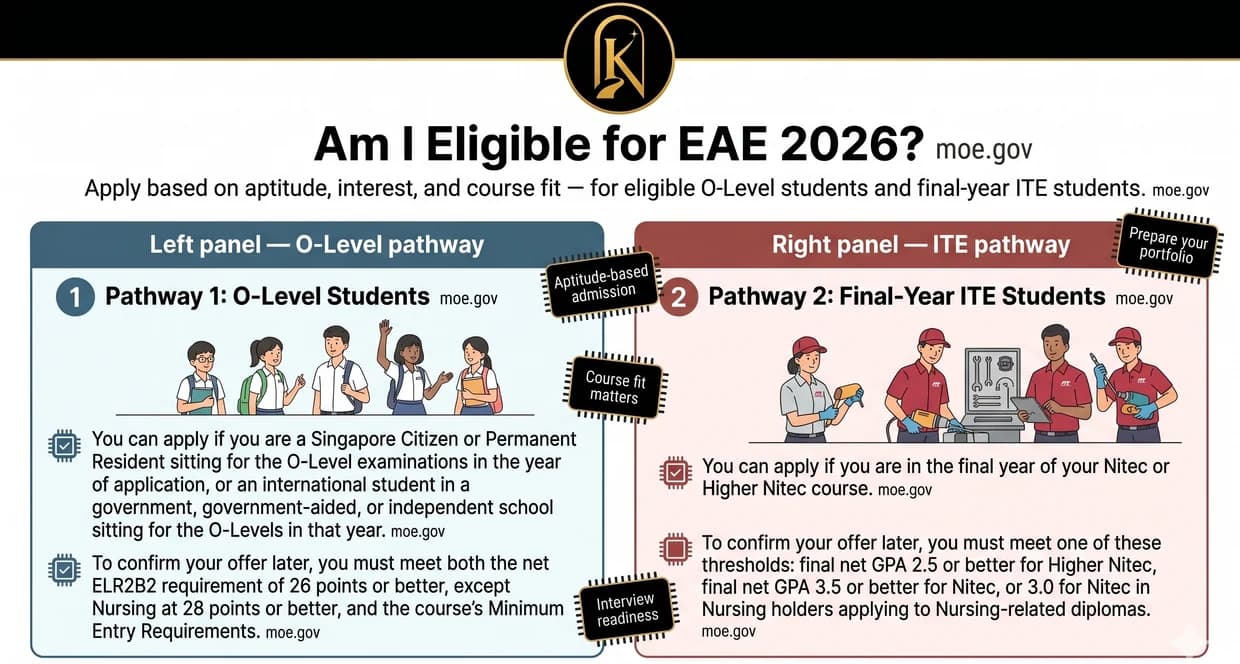
- EAE is an aptitude-based admissions exercise that lets graduating O-Level, ITE (Nitec / Higher Nitec) and working-adult applicants apply for and receive conditional offers from the 5 Singapore polytechnics BEFORE their final O-Level results or GPA are released. In 2026, O-Level applications open on Thursday 25 June and close on Wednesday 1 July.
- 2When does Polytechnic EAE open in 2026?
- For final-year ITE students: Thursday 11 June to Wednesday 17 June 2026. For O-Level students: Thursday 25 June to Wednesday 1 July 2026. For working adults: Monday 1 June to Sunday 28 June 2026. Selection (interviews, aptitude tests, portfolio review) runs from 6 July to 1 September 2026. Conditional offers are released between 8 and 11 September 2026.
- 3Who is eligible for Polytechnic EAE 2026?
- Three groups: (1) Graduating O-Level students projected to score net ELR2B2 of 26 points or better (28 for Nursing); (2) Final-year ITE students with projected net GPA of 3.5+ (Nitec) or 2.5+ (Higher Nitec — raised from 2.0 starting AY2027); (3) Working adults with two or more years of relevant work experience. Singapore Citizens, PRs and International Students at MOE-affiliated schools may apply.
- 4How many courses can I apply for through EAE?
- Each applicant may apply for up to 3 diploma courses across the 5 polytechnics. You submit one 600-character write-up per course explaining your aptitude and interest for that specific diploma.
- 5What is the 600-character EAE write-up and how do I write it?
- The 600-character write-up is your personal statement for each course you apply to. It should answer: Why this course? What evidence (achievements, projects, experiences) shows your aptitude? What is your future vision? Counting includes spaces. See our /eae/write-up-guide for a 5-part framework and 3 worked examples.
- 6What happens if I accept an EAE conditional offer but fail to meet the requirements?
- The conditional offer is automatically revoked if your final O-Level ELR2B2 is worse than 26 (28 for Nursing) or your final ITE GPA falls below the minimum (3.5 Nitec / 2.5 Higher Nitec; the Nitec-in-Nursing route to the Nursing diploma needs 3.0). You then proceed to the Joint Admissions Exercise (JAE) like other O-Level holders. Always have a JAE backup plan.
- 7EAE vs JAE — which should I choose in 2026?
- EAE rewards aptitude, portfolio and interview performance — strong for students with clear passion, projects or talent in a specific field. JAE is purely score-based — strong for high O-Level scorers without a strong portfolio. Most students apply via EAE first (no downside) then proceed to JAE if they don't get a firm offer. See our /blog/eae-vs-jae-2026 comparison.
- 8Can I withdraw from an EAE offer if I want to do JAE instead?
- You can decline an EAE offer during the acceptance window (8–11 September 2026 for O-Level / ITE). Once accepted, the offer is binding once you meet the conditional requirements — you cannot then take a JAE place at a different course. Decide carefully before accepting.
- 9Do I need a portfolio for every EAE course?
- No. Portfolio requirements vary by course. Design, media, animation and architecture courses typically require a portfolio. Engineering, IT and business courses focus on aptitude tests and interviews. Always check each poly's course-specific guidance in the central EAE portal at eae.polytechnic.edu.sg.
- 10When do I find out if I got an EAE offer?
- Conditional offers for O-Level and ITE applicants are released between Tuesday 8 September and Friday 11 September 2026. Working adults receive offers between 8 September and 16 October 2026. Check the central EAE portal on the day — polytechnics also email the result.
- 11Is there a lower GPA threshold for Nitec-in-Nursing graduates applying to the Diploma in Nursing?
- Yes. Per MOE: Nitec in Nursing holders only need a final net GPA of 3.0 (instead of the standard Nitec 3.5) to apply for the Diploma in Nursing or the Diploma in Health Sciences (Nursing). This carve-out recognises relevant prior healthcare training. It does NOT apply to other diploma courses, and it does NOT apply to Higher Nitec holders (whose Nursing-diploma bar is separately set by the polytechnic admitting them).
- 12Where do I submit my EAE application — at each polytechnic's website?
- No. All EAE applications are submitted through the SINGLE central portal at eae.polytechnic.edu.sg, regardless of which polytechnic(s) you are applying to. You select up to 3 courses across any combination of SP, NP, NYP, TP and RP within one application. The polytechnic websites only provide reference guides and course information — they do not accept EAE applications directly.
- 13Can I apply to the same course at two different polytechnics via EAE?
- Yes. Each of your up to 3 course choices is independent and can be at different polytechnics. You might apply to Diploma in Mass Communication at NP, Diploma in Animation at NYP, and Diploma in Communication Design at TP in the same exercise. Each choice requires its own 600-character write-up.
- 14If I receive an EAE conditional offer, do I still need to submit JAE applications in January?
- It depends on whether you have accepted the EAE offer. If you accept, and you subsequently meet the Minimum Entry Requirements (MERs) after O-Level results, your placement is secured — you do not need to participate in JAE. If you do NOT accept the EAE offer, or if your offer is revoked (because you missed MERs), you proceed to JAE normally.