

The medal table by school
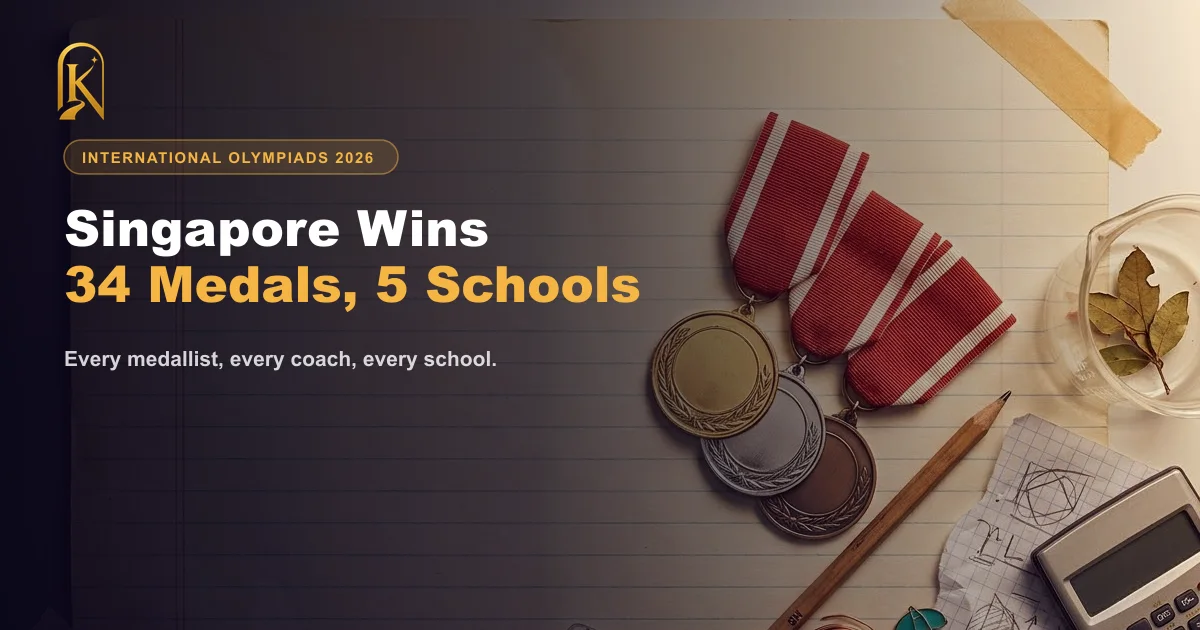
Singapore has 147 secondary schools and 19 junior colleges. In 2026, every single olympiad medal came from five of them. Here is the tally, computed from MOE’s named lists.
| School | Gold | Silver | Bronze | Total | IYPT team | Events |
|---|---|---|---|---|---|---|
| Raffles Institution | 8 | 2 | 5 | 15 | 2 | 8 |
| NUS HighNUS High School of Mathematics and Science | 4 | 6 | 2 | 12 | 2 | 7 |
| Hwa Chong Institution | — | 5 | — | 5 | 1 | 5 |
| Dunman High School | 1 | — | — | 1 | — | 1 |
| Eunoia Junior College | — | — | 1 | 1 | — | 1 |
| Singapore total | 13 | 13 | 8 | 34 | 5 | 8 |
“Total” counts individual medals only. The five IYPT team members are listed separately because MOE awards IYPT as a single team championship, not as individual medals. “Events” = how many of the eight competitions the school appeared in. Source: MOE press release, 2 September 2026.
Three things this table says out loud
- 1.Raffles owns gold and breadth. Raffles took 8 of Singapore’s 13 golds, and was the only school to appear in all 8 events. NUS High took more silver than anyone (6) and turned up in 7 of the 8.
- 2.Hwa Chong won 5 medals — every one silver. Across five different competitions. At this level the gap between silver and gold can be one problem part.
- 3.The tail is very short. Dunman High and Eunoia JC contributed one medal each; nobody else contributed anything. Two schools account for 27 of the 34 individual medals.
Every competition, side by side
Eight events, four continents, six weeks. Where MOE published a national placing it is shown; where it did not, the cell reads “not stated” rather than an estimate.
| Competition | Host & dates | Field | SG placing | G | S | B |
|---|---|---|---|---|---|---|
| IBO37th International Biology Olympiad | Vilnius, Lithuania12–19 July 2026 | 302 participants · 78 countries/territories | Joint 5th | 3 | 1 | — |
| IChO58th International Chemistry Olympiad | Tashkent, Uzbekistan10–19 July 2026 | 363 participants · 92 countries/territories | 7th | 3 | — | 1 |
| iGeo22nd International Geography Olympiad | Istanbul, Türkiye11–17 August 2026 | 184 participants · 48 teams | 4th | 2 | 1 | 1 |
| IMO67th International Mathematical Olympiad | Shanghai, China10–21 July 2026 | 666 participants · 117 countries/territories | 4th | 3 | 2 | 1 |
| IOAI3rd International Olympiad in Artificial Intelligence | Astana, Kazakhstan2–8 August 2026 | 440 participants · 95 countries | not stated | 1 | 3 | 3 |
| IOI38th International Olympiad in Informatics | Tashkent, Uzbekistan9–16 August 2026 | 375 participants · 97 countries/territories | not stated | — | 2 | 2 |
| IPhO56th International Physics Olympiad | Bucaramanga, Colombia4–12 July 2026 | 400+ students · 90+ countries/territories | not stated | 1 | 4 | — |
| IYPT39th International Young Physicists' Tournament | Zurich, Switzerland5–12 July 2026 | 35 competing countries | Overall Champion | — | — | — |
| Total — 7 medal events + 1 team championship | 13 | 13 | 8 | |||
What actually happened in each category
A medal count tells you the score. It does not tell you which result was hard, which one was strange, or which one your child could realistically aim at. Here is the read on all eight, with every named student.
Three of the four medals were gold
Three of Singapore’s four biology medals were gold — a 75% gold rate that only Chemistry matched, and that no other team on this page beat. And look at what the practical actually contained: plant computational biology. Biology at this level is no longer a memory subject — it is a data subject. If your child loves bio because it means avoiding maths, this exam paper is the polite correction.
What the paper actually tested
Four practical tasks spanning molecular biology and biochemistry, animal physiology, animal morphology and systematics, and plant computational biology — plus a theory paper covering biosystematics, cell and molecular biology, ecology, ethology, genetics and evolution, and plant and animal anatomy and physiology.
Singapore medallists
- Raphael Ho Jun WeiGoldNUS High School of Mathematics and Science
- Ron Lim Shao LeongGoldRaffles Institution
- Teo Wei JeenGoldNUS High School of Mathematics and Science
- Wong Yit Terng EthanSilverNUS High School of Mathematics and Science
A school teacher, not a professor, led this one
Three golds and a bronze, 7th of 92 countries. But the detail worth pausing on is in the coaching line: the chemistry team was led in part by Mr Lim Ting Liang of Raffles Institution — a serving school teacher standing alongside two NUS chemists. Most olympiad training here runs on university faculty. Chemistry shows what happens when a classroom teacher owns the pipeline: three of the four medals went to Raffles.
What the paper actually tested
An experimental component requiring students to synthesise compounds, perform quantitative analysis and determine the identity of an unknown substance; a theoretical component across biochemistry, physical, inorganic and organic chemistry.
Singapore medallists
- Aloysius YongGoldRaffles Institution
- Chin Hao Ching DylanGoldRaffles Institution
- Kieran Chai Kai RenGoldNUS High School of Mathematics and Science
- Wu JiakaiBronzeRaffles Institution
The quiet outlier — and the best-kept secret on this page
Singapore placed 4th in the world in Geography — higher than it placed in Chemistry. This is the only humanities-side olympiad on the list, and the one most parents have never heard of. It is also the one that cannot be crammed: the fieldwork paper drops students into a foreign city and asks them to collect and interpret real data on the spot. Dunman High’s single medal of the entire year is a gold, and it is here.
What the paper actually tested
Three components: a written response test on physical, human and regional geography; a fieldwork test requiring students to observe and collect real-world data and apply mapping skills on unfamiliar ground; and a multimedia test.
Singapore medallists
- Ryann Win KhaingGoldRaffles Institution
- Teng Tse Yuan MarcusGoldDunman High School
- Aw Jun KaiSilverRaffles Institution
- Lee Yi Ning MeganBronzeRaffles Institution
The hardest result here — and a loop closing
117 countries. 666 contestants. This is the deepest, oldest and most brutally competitive field in the set, and Singapore finished 4th in the world with six medals — three gold, two silver, one bronze. Now read the coaching line again: Dr Lim Jeck. In 2012, as a 17-year-old from NUS High, Lim Jeck scored a perfect 42/42 and ranked first of 548 contestants at the IMO — the first perfect score by a Singaporean. Fourteen years later he is on the other side of the table, coaching. That is what a working pipeline looks like: the medallist becomes the teacher.
What the paper actually tested
Six problems across two days, assessing ingenuity and rigorous mathematical reasoning.
Singapore medallists
- Brian Xiao BoyangGoldRaffles Institution
- Wang YiGoldRaffles Institution
- Yang YihanGoldRaffles Institution
- Gao Yuxiang, LucasSilverHwa Chong Institution
- Gao ZixiangSilverNUS High School of Mathematics and Science
- Akash ThiagarajanBronzeNUS High School of Mathematics and Science
The newest olympiad has the widest door — and Singapore hosts it next
Seven medals — Singapore’s single biggest haul of 2026 came from a competition that did not exist four years ago. In only its third edition, IOAI drew 440 competitors from 95 countries. Two things follow. First, this is the one event where a school outside the usual big three broke through: Eunoia Junior College’s Tan Choon Yong took a bronze — the only 2026 medal won outside Raffles, NUS High, Hwa Chong and Dunman High. Newer olympiads have shallower national squads, so the door is genuinely wider. Second: Singapore hosts the 4th IOAI in 2027. If your child is in Sec 3 or Sec 4 now and codes, that is the most actionable line in the whole press release.
What the paper actually tested
An Individual Contest requiring students to understand core AI concepts and their theoretical underpinnings, and to demonstrate the practical skills needed to implement AI methods in code.
Singapore medallists
- Wang Enrun MatthiasGoldRaffles Institution
- Ernest Tan Jia TengSilverNUS High School of Mathematics and Science
- Kishan BalamuruganSilverNUS High School of Mathematics and Science
- Miao RuichenSilverHwa Chong Institution
- Austin Liu Zi RuiBronzeRaffles Institution
- Swaagat Bikash SaikiaBronzeRaffles Institution
- Tan Choon YongBronzeEunoia Junior College
The only event without a gold — and why that is fine
Two silvers, two bronzes, no gold. IOI is the one competition where Singapore did not reach the top tier in 2026, and that is worth saying plainly rather than burying. Competitive programming at IOI level rewards countries running year-round, near-professional training squads. Still, four medals from four medallists is no small return, and Hwa Chong took both silvers — the school’s strongest showing in any single event this year.
What the paper actually tested
Two days of designing and implementing efficient algorithms and data structures to solve computational problems.
Singapore medallists
- Derrick LukiminSilverHwa Chong Institution
- Tay Yi XiangSilverHwa Chong Institution
- Gu SimiaoBronzeRaffles Institution
- Jayden Hoo Dun JieBronzeNUS High School of Mathematics and Science
NUS High owns physics — and Singapore imports elite coaching
One gold, four silvers, and three of the five medals — including the gold — went to NUS High. Two five-hour papers back to back make this as much an endurance test as a physics test. The coaching line is the most internationally striking of the year, too: alongside two NUS physicists sits Mr Clemens Sebastian Dittmer of the Max Planck Institute for Gravitational Physics. Singapore does not only train its physicists locally — it goes and recruits gravitational-wave researchers to help.
What the paper actually tested
An experimental and a theoretical component, each lasting five hours. The experimental test required measurements on concrete physical phenomena; the theoretical test focused on modelling and solving complex problems.
Singapore medallists
- Ruhan Tasneem ShafaGoldNUS High School of Mathematics and Science
- Chandranshu NandaSilverNUS High School of Mathematics and Science
- Lan Shuheng JerrySilverRaffles Institution
- Liang JingzhangSilverNUS High School of Mathematics and Science
- Ng Chern YiSilverHwa Chong Institution
The best result of the year is the one everybody will scroll past
Singapore did not place at IYPT. Singapore won it — Overall Champion out of 35 countries. Note the format, because it is unlike everything else here: no multiple choice, no marking scheme. Seventeen open-ended problems, presented and then defended live under cross-examination by international jurors. It is the closest thing to a research viva a 17-year-old can experience. Then look at the five names: two from NUS High, two from Raffles, one from Hwa Chong. The one event Singapore outright won was won by a mixed-school team.
What the paper actually tested
17 open-ended inquiry problems. Students presented, defended and critiqued solutions before an international panel of jurors.
Championship team
- Cai XinzeChampionNUS High School of Mathematics and Science
- Chan Ee KinChampionRaffles Institution
- Kieran Ho JianmingChampionNUS High School of Mathematics and Science
- Zhong JingyaoChampionRaffles Institution
- Zhu YijunChampionHwa Chong Institution
The 28 names nobody puts in a headline
MOE’s release does something most medal stories don’t: it names every team leader and coach. 39 students, 28 named adults — and those are only the ones who travelled. Reproduced here in full, because they earned it.
- Dr Beverly GohNational Institute of Education
- Ms Lim Le XuanSingapore Institute of Biology
- Ms Ranjani PandaSingapore Institute of Biology
- Dr Wang Liang WeiA*STAR
- Ms Xu RuipingMinistry of Education
- Mr Lim Ting LiangRaffles Institution
- Dr Tan Wee BoonNational University of Singapore
- Mr Teng Guan FooMinistry of Education
- Dr Zhang ShengNational University of Singapore
- Ms Rebecca LeeMinistry of Education
- Ms Wendy AngMinistry of Education
- Dr Lee Chan LyeNUS High School of Mathematics and Science
- Dr Lim JeckUniversity of Oxford
- Dr Sia Jia Min, CharmaineNational University of Singapore
- Assistant Professor Chuanxia ZhengNanyang Technological University
- Mr Ong Chin AnnNanyang Technological University
- Mr Yuen Wen JunMinistry of Education
- Mr Jonathan Irvin GunawanTeam Coach
- Mr Seah Zuo ShengMinistry of Education
- Dr Steven HalimNational University of Singapore
- Mr Clemens Sebastian DittmerMax Planck Institute for Gravitational Physics
- Dr Nidhi SharmaNational University of Singapore
- Mr Oh Jin ShengMinistry of Education
- Mr Sim Hui XiangNational University of Singapore
- Dr Chang Sheh LitSingapore Polytechnic
- Ms Claudia Tan Li ChingMinistry of Education
- Mr Sze Guan KhengRaffles Institution
- Mr Zed Lim Li XinIYPT Coach
Read that list again
Three serving school teachers — Mr Lim Ting Liang and Mr Sze Guan Kheng of Raffles Institution, and Dr Lee Chan Lye of NUS High. Eight MOE officers. Six academics from NUS, two from NTU, one from NIE. A researcher from A*STAR. Two from the Singapore Institute of Biology. One from Singapore Polytechnic. Two from abroad: the University of Oxford, and the Max Planck Institute for Gravitational Physics. And two listed simply as the team’s own coaches.
Behind them, nine partner organisations: AI Singapore · DSO National Laboratories · Geography Teachers’ Association of Singapore · Institute of Physics, Singapore · Nanyang Technological University · National Institute of Education, NTU · National University of Singapore · Singapore Institute of Biology · Singapore Mathematical Society. That is not a school programme. That is a country deciding this matters, and putting its universities, its research institutes and its schoolteachers in the same room.
To every teacher, coach and student on this page
From KW Phoon, Founder of SGSchoolKaki
To every teacher, coach and team leader named above —
Thank you — you are the part of this story that never makes the headline.
Nobody sees the Saturday mornings, the school holidays you gave up, or the years spent building a training programme that only pays off long after the student has left your classroom.
Your sacrifice has come back: 13 gold, a world championship in Zurich, and fourth in the world in mathematics out of 117 countries — that is your work made visible, and today your job is fulfilled.
And to all 39 of you who competed: you made Singapore proud, far from home, in an unfamiliar room, with a clock running and nobody to ask.
Keep that feeling, keep it up, and next year go and shine again.
KW Phoon
Founder, SGSchoolKaki · BEng(Hons), Computing Engineering
Medals vs. cut-off points: what our own rankings show
We publish two ranking tables: secondary schools by 2025 PSLE cut-off point and junior colleges by L1R5. Laying the medal table over them produces one genuinely surprising row.
| School | Olympiad 2026 | IP cut-off (2025) | Our IP rank | Best L1R5 | Our JC rank |
|---|---|---|---|---|---|
| Raffles Institution | 15 medals + IYPT champion | 4 – 6 | Joint 1st of 16 | 3 | Joint 1st of 19 |
| NUS HighSpecialised Independent School — admits by its own selection process and awards its own six-year diploma, so it appears in neither ranking. | 12 medals + IYPT champion | none | not ranked | none | not ranked |
| Hwa Chong Institution | 5 medals + IYPT champion | 4(D) – 6(M) | Joint 1st of 16 | 3 | Joint 1st of 19 |
| Dunman High School | 1 gold | 4(D) – 8(M) | 3rd of 16 | 6 | Joint 3rd of 19 |
| Eunoia Junior CollegeJunior college only — no secondary arm, so no PSLE cut-off point. | 1 bronze | none | not ranked | 5 | Joint 2nd of 19 |
IP cut-off = 2025 PSLE score range for the non-affiliated Integrated Programme intake (lower is better), ranked against all 16 IP schools in our table. Best L1R5 = the strongest 2026 JC admission cut-off across that college’s courses, ranked against 19 JCs. Both figures come from SGSchoolKaki’s own tables; medal counts are MOE’s.
The school that won 12 individual olympiad medals in 2026 does not appear in either of our ranking tables — because it has no cut-off point to rank.
Next year, continue to shine
and to everyone thinking of trying
Whether you came home with a gold or came home with nothing but the experience, you trained, you turned up, and you carried Singapore's name into the room. Next year, continue to shine. continue to shine
To the 39 who made it: you already know you can do hard things. To everyone who trained and didn’t make the team this year — you are closer than you think, and almost nobody medals on their first attempt. Talk to your subject teacher: school-level olympiad rounds usually start in Sec 2–Sec 3, and national squads are nominated from there. The widest open door right now is AI and informatics — IOAI is only three years old, and Singapore hosts it in 2027. Keep going.
The best thing you can do is make the training possible and keep the pressure off the result — every one of these 39 students had someone driving them to weekend sessions for years. Use our cut-off tables for eligibility, then judge a school on the programme it actually runs for your child’s strengths, not on a medal count.
Frequently asked questions
How many medals did Singapore win at the 2026 international olympiads?
Singapore won 13 gold medals, 13 silver medals and 8 bronze medals — 34 individual medals in total — plus the Overall Champion title at the 39th International Young Physicists’ Tournament. In all, 39 students were named across eight competitions held between 4 July and 17 August 2026.
Which Singapore schools won olympiad medals in 2026?
Only five: Raffles Institution (15 individual medals), NUS High School of Mathematics and Science (12), Hwa Chong Institution (5), Dunman High School (1 gold) and Eunoia Junior College (1 bronze). Raffles, NUS High and Hwa Chong also supplied all five members of the IYPT championship team.
Which school won the most olympiad medals in Singapore in 2026?
Raffles Institution, with 15 individual medals including 8 of Singapore’s 13 golds, plus two members of the IYPT championship team — and it was the only school to appear in all eight competitions. NUS High was second with 12 individual medals and led on silver with 6, appearing in seven of the eight events (all except the Geography Olympiad).
What was Singapore’s best result of 2026?
Winning the 39th International Young Physicists’ Tournament outright, as Overall Champion out of 35 competing countries, in Zurich. On the individual olympiads, Singapore’s strongest placings were 4th of 117 countries at the International Mathematical Olympiad and 4th of 48 teams at the International Geography Olympiad.
Does a school’s PSLE cut-off point predict olympiad medals?
Not reliably. NUS High School of Mathematics and Science won 12 individual medals and has no PSLE cut-off point at all — it is a Specialised Independent School with its own admissions. Olympiad medals track where a school has built a long-running training programme and found the coaches to run it, which is a different thing from where the highest-scoring intake happens to apply.
Where can my child try out for an olympiad team?
National selection runs through school-nominated training programmes coordinated by MOE with partner bodies — the Singapore Mathematical Society, Institute of Physics Singapore, Singapore Institute of Biology, AI Singapore, the Geography Teachers’ Association of Singapore and the universities. Speak to your child’s subject HOD; entry usually begins with school-level olympiad rounds in Sec 2 to Sec 3.
Is Singapore hosting any olympiad in 2027?
Yes. MOE confirmed that Singapore will host the 4th International Olympiad in Artificial Intelligence in 2027.
Keep reading
Sources
- [1]Ministry of Education, Singapore. “Singapore Students Win 13 Gold Medals, 13 Silver Medals, 8 Bronze Medals and 1 Team Championship in this Year’s International Olympiads and International Young Physicists’ Tournament”, press release, 2 September 2026. Every student name, medal, school, coach, host city, date, field size and national placing on this page is transcribed from this release.
- [2]SGSchoolKaki, Secondary School Rankings 2026 and Junior College Rankings 2026, built from MOE’s published 2025 PSLE score ranges and 2026 JC admission cut-off points.
- [3]Dr Lim Jeck’s 2012 result — a perfect score of 42, ranked 1st of 548 contestants at the 53rd IMO in Mar del Plata, Argentina, while a student at NUS High School of Mathematics and Science — is a matter of contemporary public record. His 2026 role as an IMO team leader is from source 1.
- [4]Official competition websites — IBOIChOiGeoIMOIOAIIOIIPhOIYPT. Each is also linked from its abbreviation in the competition table above. Note: MOE’s footnote cites igeo2026.org for the Geography Olympiad, but that host site is no longer reachable, so we link the permanent IGU iGeo site instead.
A note on accuracy. Every medal count on this page is computed from the named lists rather than typed by hand, and the totals reconcile exactly with MOE’s headline: 13 gold, 13 silver, 8 bronze and 1 team championship across 39 students. If you spot an error in a name or a school, tell us and we will fix it the same day.