A quadratic function is the first curve you can fully understand from its equation alone. By the end of this chapter you can read its shape and turning point, rewrite it by completing the square, sketch it, decide when it stays above or below the x-axis, and use it to model a real situation.
Your outcome tracker0 / 8
Let's go! Tick an outcome once you can pass its exam check. Saved on this device.
Chapter 1
Figure 1 · the parabola at a glance
r = 1y = sin θcos θ
3 outcomes · 1 page · every step shown ✦
The shape
The sign of a decides it: a > 0 opens upward (a minimum), a < 0 opens downward (a maximum). The turning point sits on the axis of symmetry.
Completing the square
Rewrite ax2+bx+c as a(x−h)2+k. Half the coefficient of x goes inside the bracket, and (h,k) is the turning point.
Always positive or negative
Always positive needs a>0 and D<0. Translate the exam wording into conditions on a and the discriminant first.
By the end of this chapter
Tell whether a quadratic has a maximum or a minimum, and read off its turning point and axis of symmetry.
Complete the square for monic, non-monic and negative-leading quadratics, and use it to find extreme values and to solve equations.
Find a turning point from the midpoint of the roots, and sketch a quadratic from its factorised or completed-square form.
Decide when a quadratic is always positive or always negative, find the range of a constant k, and prove such statements.
Build and use a quadratic model: maximum height, time to land, break-even prices, and rejecting answers that do not fit the story.
✶
Start here
Maths In Real Life
Three real situations, one parabola each. The pictures are drawn first, then the graph is placed on top by script, so each equation matches its problem exactly.
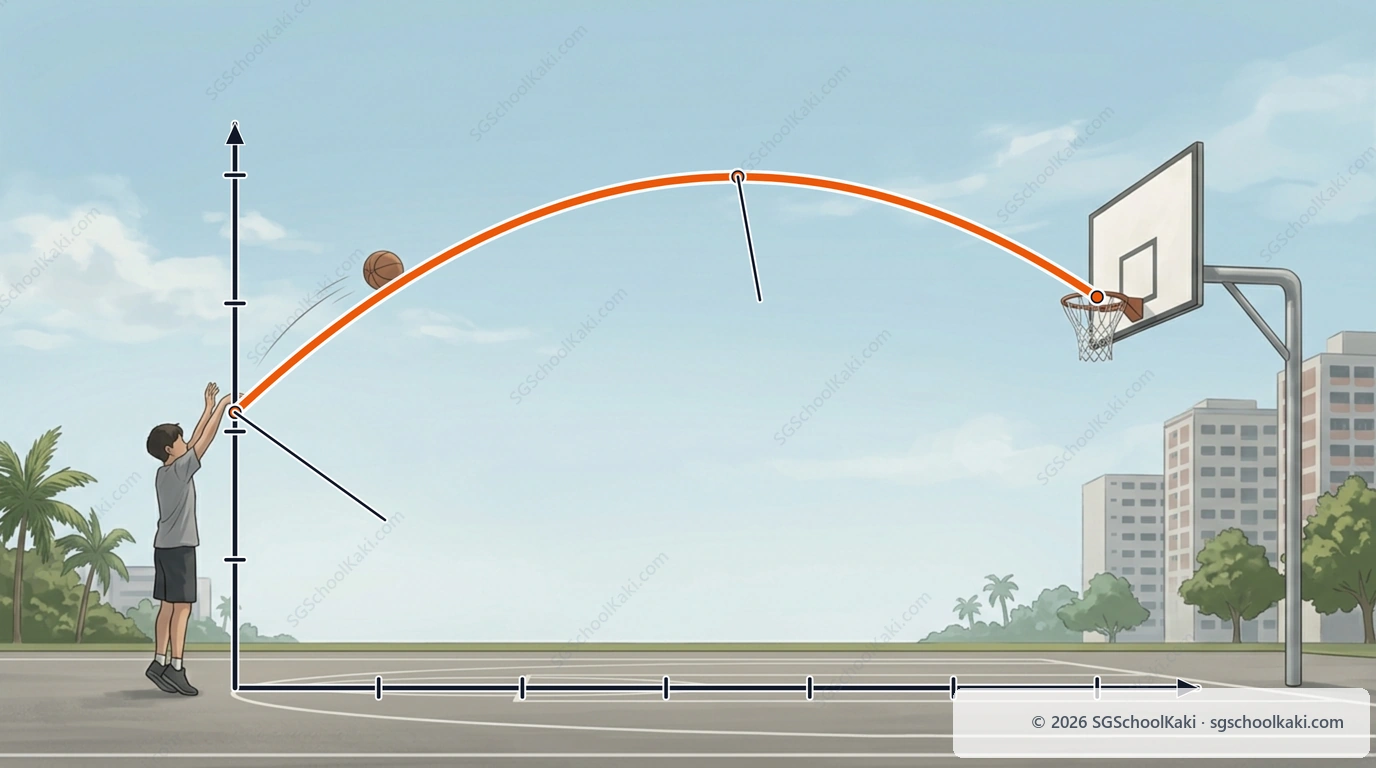
A basketball in flight follows a parabola because gravity pulls it down at a steady rate while it keeps moving forward at a steady speed.
A teenager takes a jump shot at an HDB estate court. Let x be the horizontal distance in metres from the point where the ball leaves the hands, and h the height of the ball above the ground in metres. The path is h=−0.15x2+1.05x+2.15. The rim of the hoop is 3.05 m above the ground.
(a)Find the height at which the ball leaves the shooter's hands.
(b)The hoop is 6 m away horizontally. Show that the ball passes through the rim.
(c)Find the greatest height of the ball and how far from the shooter it occurs.
(d)The ball is at rim height twice. Find both horizontal distances.
Show full solutionHide solution
Colour keyterm added and subtractedfactor taken outbracket being completedfinal form
(a)
h(0)=(−0.15)(0)2+1.05(0)+2.15=2.15
Substitute x=0 into the model.
(b)
h(6)=(−0.15)(6)2+1.05(6)+2.15=3.05
Substitute x=6 into the model.
(c)
h=−0.15x2+1.05x+2.15
Here a=−0.15, so take a out of the x2 and x terms first.
h=−0.15[x2−7x]+2.15
Factorise the first two terms. The coefficient of x is now −7.
h=−0.15[x2−7x+3.52−3.52]+2.15
Add and subtract the square of half of −7, which is 3.52.
h=−0.15(x−3.5)2−(−0.15)×3.52+2.15
When the subtracted square leaves the bracket it is multiplied by a.
h=−0.15(x−3.5)2+3.9875
Simplify: 2.15−(−0.15)×3.52=3.9875.
(x−3.5)2≥0
A real number squared is never negative.
−0.15(x−3.5)2≤0
Multiplying by −0.15<0 REVERSES the inequality.
−0.15(x−3.5)2+3.9875≤3.9875
Add the constant to both sides.
So h≤3.9875 for every real x: the maximum value of h is 3.9875 m.
(x−3.5)2=0
The extreme value happens when the squared bracket is zero.
x−3.5=0
x=3.5
The greatest height is 3.9875 m, reached when x=3.5 m.
(d)
−0.15x2+1.05x+2.15=3.05
The h model set equal to the target value.
0.15x2−1.05x+0.9=0
Rearrange to =0 and, if you like, multiply by −1 so the x2 coefficient is positive.
The quadratic formula (given on the formula page).
x=0.31.05±0.5625
So x=1 or x=6.
Both roots are exact, so no rounding is needed.
The height is 3.05 m when x=1 m and when x=6 m.
Answer
(a)h=2.15 m when x=0
(b)h=3.05 m when x=6
(c) greatest height 3.9875 m, when x=3.5 m
(d)x=1 m and x=6 m
12345678123Ox (m)y (m)y=−0.2x2+1.6x(4,3.2)(8,0)
Maths In Real Life 2
The fountain jet
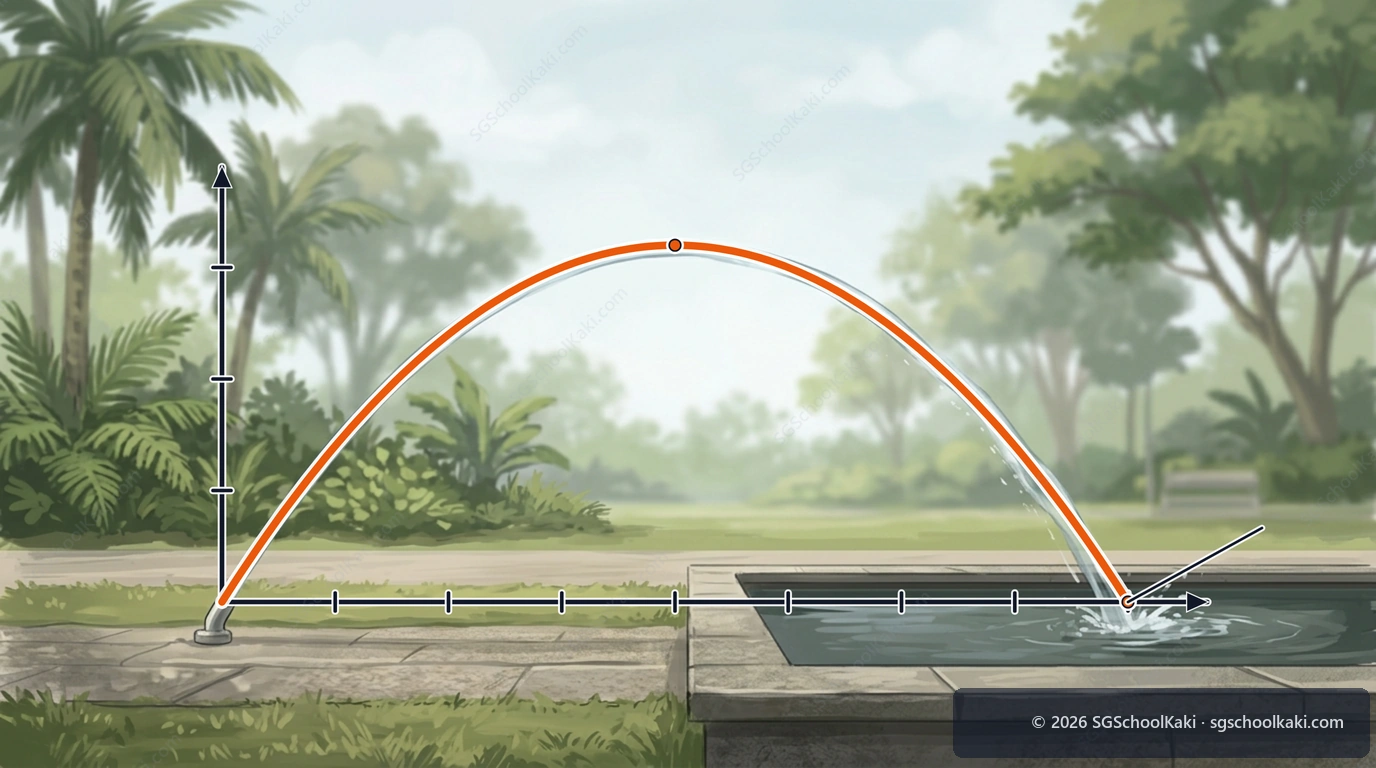
Water leaves a nozzle with the same horizontal speed all the way, and gravity bends its path into a parabola. Fountain designers choose the nozzle angle so the jet lands where they want.
A jet of water leaves a nozzle at O and returns to the height of the nozzle at a point 8 m away. Its greatest height is 3.2 m. Take the x-axis through the nozzle, with x the horizontal distance from O in metres and y the height above the nozzle in metres.
(a)Find an equation for the path of the jet in the form y=ax(x−8).
(b)Find the height of the jet when it is 2 m from the nozzle horizontally.
(c)At what horizontal distances from the nozzle is the jet 3 m high?
Show full solutionHide solution
(a)
The curve passes through (0,0) and (8,0), so y=ax(x−8).
Use the roots to write the factorised form.
x=20+8=4
The highest point is on the axis of symmetry, half-way between the roots.
3.2=a(4)(4−8)
The highest point is (4,3.2): substitute it.
3.2=−16a
a=−0.2
Solve for a (it is negative, as expected for a maximum).
So y=−0.2x(x−8)=−0.2x2+1.6x.
(b)
y(2)=(−0.2)(2)2+1.6(2)=2.4
Substitute x=2 into the model.
(c)
−0.2x2+1.6x=3
The y model set equal to the target value.
0.2x2−1.6x+3=0
Rearrange to =0 and, if you like, multiply by −1 so the x2 coefficient is positive.
x=2a−b±b2−4ac=2(0.2)−(−1.6)±(−1.6)2−4(0.2)(3)
The quadratic formula (given on the formula page).
x=0.41.6±0.16
So x=3 or x=5.
Both roots are exact, so no rounding is needed.
The height is 3 m when x=3 m and when x=5 m.
Answer
(a)y=−0.2x2+1.6x
(b)y=2.4 m when x=2
(c)x=3 m and x=5 m
x mx my mwall2x+y=36A=xy
Maths In Real Life 3
The community garden
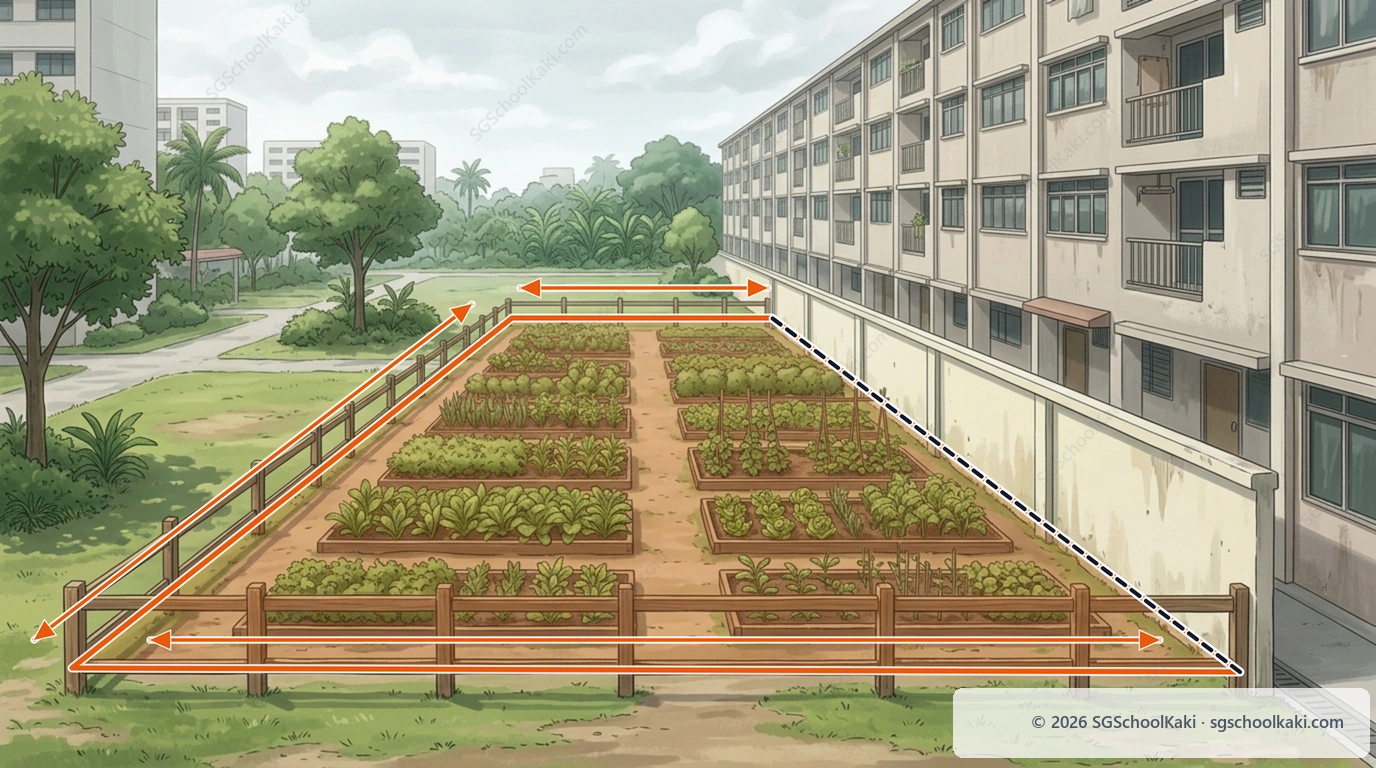
Using an existing wall as one side saves fencing. This is a classic maximum-area situation: a perimeter-style quadratic whose turning point gives the best plot.
A rectangular community garden is built against the long wall of an HDB block. Fencing is needed on the other three sides only: two sides of length x m at right angles to the wall, and one side of length y m parallel to it. There is 36 m of fencing in total.
(a)Show that the area of the garden is A=−2x2+36x square metres.
(b)Find the greatest possible area and the dimensions of the garden that give it.
(c)The wall is only 14 m long, so y≤14. Find the greatest area that is now possible.
Show full solutionHide solution
Colour keyterm added and subtractedfactor taken outbracket being completedfinal form
(a)
2x+y=36
All the fencing is used on the three sides.
y=36−2x
Make y the subject.
A=xy
Area = length × width.
A=x(36−2x)=−2x2+36x
Substitute y=36−2x.
(b)
A=−2x2+36x
Here a=−2, so take a out of the x2 and x terms first.
A=−2[x2−18x]
Factorise the first two terms. The coefficient of x is now −18.
A=−2[x2−18x+92−92]
Add and subtract the square of half of −18, which is 92.
A=−2(x−9)2−(−2)×92
When the subtracted square leaves the bracket it is multiplied by a.
A=−2(x−9)2+162
Simplify: 0−(−2)×92=162.
(x−9)2≥0
A real number squared is never negative.
−2(x−9)2≤0
Multiplying by −2<0 REVERSES the inequality.
−2(x−9)2+162≤162
Add the constant to both sides.
So A≤162 for every allowed x (0<x<18): the maximum value of A is 162 m².
(x−9)2=0
The extreme value happens when the squared bracket is zero.
x−9=0
x=9
(c)
y≤14⇒36−2x≤14⇒x≥11
The wall limits y, which forces x to be at least this big.
The best x from part (b) is 9, which is less than 11, so it is not allowed. The area A=−2(x−9)2+162 falls as x increases beyond 9, so the best allowed value is the smallest allowed x=11.
A maximum can be missed when the allowed values are restricted.
A=11(36−2(11))=154
Substitute x=11: then y=14.
Answer
(a)A=−2x2+36x
(b)A=−2(x−9)2+162; maximum value 162 m²; x=9; dimensions: 9 m by 18 m
(c) greatest area 154 m², with x=11 m and y=14 m
01
Supports K341-A1-01
Meet the quadratic: shape, turning point and axis
Revision. Functions are sorted by degree (the highest power of x): constant 0, linear 1, quadratic 2, cubic 3. Here f(x)=ax2+bx+c with a=0.
The graph of every quadratic is a parabola: one smooth bowl with exactly one turning point. Two things describe it at a glance: which way it opens, and where it turns.
The Core Idea
The sign of a decides the shape.
If a>0 the bowl opens upward and the turning point is the lowest point (a minimum). If a<0 it opens downward and the turning point is the highest point (a maximum). Keep asking yourself two questions on every problem: which way does it open, and where does it turn?
Case table 1: the sign of a decides everything about the shape
Sign of a
Picture
Turning point
Extreme value
Range of f
a>0
a>0
a minimum point: the lowest point of the curve
minimum value k
f(x)≥k
a<0
a<0
a maximum point: the highest point of the curve
maximum value k
f(x)≤k
a=1>0: opens upward, so the turning point is a minimuma=−1<0: opens downward, so the turning point is a maximum
The vertical line through the turning point is the axis of symmetry. Fold the page along it and the two halves of the curve land exactly on each other. That mirror idea will do a lot of work later in this chapter.
SGSchoolKaki Tip
Read the shape from the coefficient of x2 only, wherever that term is written. In y=5−3x−2x2 the value of a is −2, not 5.
Think About It
A parabola opens upward. Could it ever have a highest point? Why or why not?
Show the full workingHide the working
Take an upward parabola, say f(x)=x2−2x+3 (here a=1>0). Its arms keep climbing, so try bigger and bigger values of x.
Test the claim with numbers.
f(10)=102−2(10)+3=83
A big x gives a big f(x).
f(100)=1002−2(100)+3=9803
Bigger again, with no limit.
A highest point would have to beat every value, but f(x) keeps growing. So an upward parabola has no highest point: only a lowest point, its turning point.
Answer
No highest point. An upward parabola has only a lowest point (its turning point).
Example 1.1
Reading a vertex form
A graph has equation y=2(x−3)2+1.
(i)Does the graph have a maximum or a minimum point?
(ii)Write down the coordinates of the turning point and the equation of the axis of symmetry.
Show solutionHide solution
Colour keycondition on a
(i)
Compare y=2(x−3)2+1 with y=a(x−h)2+k: a=2, h=3, k=1.
Vertex form: the turning point is (h,k).
a=2>0, so the graph opens upward and its turning point is a minimum point.
The sign of a decides the shape.
(ii)
Turning point (3,1) and axis of symmetry x=3.
h is the number that makes the bracket zero; k is added outside.
Answer
(i) minimum point (a>0)
(ii) turning point (3,1), axis x=3
Example 1.2
Negative and fractional a
A graph has equation y=−21(x+4)2+6. State whether it has a maximum or minimum point, the turning point, and the greatest or least value of y.
(i)Maximum or minimum point?
(ii)Turning point and axis of symmetry.
(iii)The greatest or least value of y.
Show solutionHide solution
Colour keycondition on a
(i)
Compare y=−21(x+4)2+6 with y=a(x−h)2+k: a=−21, h=−4, k=6.
Vertex form: the turning point is (h,k).
a=−21<0, so the graph opens downward and its turning point is a maximum point.
The sign of a decides the shape.
(ii)
Turning point (−4,6) and axis of symmetry x=−4.
h is the number that makes the bracket zero; k is added outside.
(iii)
The maximum value is k=6, reached at x=−4, so y≤6 for every real x.
Answer
(i) maximum point (a<0)
(ii) turning point (−4,6), axis x=−4
(iii) maximum value 6 at x=−4
Example 1.3
Terms written out of order
The graph of y=5−3x−2x2 is drawn. Without plotting it, say whether its turning point is a maximum or a minimum, and where the graph crosses the y-axis.
Show solutionHide solution
Colour keycondition on a
Put the terms in descending powers: y=−2x2−3x+5.
Standard order: ax2+bx+c.
The coefficient of x2 is a=−2 (watch the sign: it belongs to the x2 term, wherever that term is written).
a<0, so the graph opens downward: a maximum point.
At x=0: y=c=5, so the graph crosses the y-axis at (0,5).
Put x=0 for the y-intercept.
Answer
a=−2, so a maximum point; y-intercept (0,5)
Example 1.4
Does it ever touch the x-axis?
How many times does the graph of y=21(x−5)2+2 meet the x-axis? Explain without solving an equation.
Show solutionHide solution
Compare y=21(x−5)2+2 with y=a(x−h)2+k: a=21, h=5, k=2.
Vertex form: the turning point is (h,k).
The graph opens upward and its lowest point has y=2, which is above the x-axis, so the curve stays on that side. It never meets the x-axis: 0 intercepts.
Answer
0 x-intercepts
Example 1.5
Using the mirror line
The points A(1,5) and B(7,5) both lie on a parabola.
(i)Find the equation of the axis of symmetry.
(ii)The point C(−1,2) also lies on the parabola. Find the coordinates of its mirror image in the axis of symmetry.
Show solutionHide solution
(i)
A and B are at the same height, so they are mirror images of each other in the axis of symmetry.
Equal heights on a parabola mean a symmetric pair.
x=21+7=4
The axis passes half-way between A and B.
(ii)
C is 5 units to the left of the axis, so its mirror image is 5 units on the other side, at the same height.
Mirror images are the same distance from the axis.
x=2(4)−(−1)=9
New x = twice the axis value minus the old x.
The mirror image of C is (9,2).
Answer
(i)x=4
(ii)(9,2)
02
Supports K341-A1-01
Completing the square
In expanded form ax2+bx+c the turning point is hidden. Completing the square rewrites the quadratic as a(x−h)2+k, which shows the turning point (h,k) at once. The idea comes from expanding a bracket: (x+4)2=x2+8x+16. Half of the coefficient of x (8÷2=4) goes inside the bracket. Watch the sign: the bracket (x+4) means h=−4.
The Core Idea
Half the coefficient of x goes inside the bracket.
For a monic quadratic, x2+bx=(x+2b)2−(2b)2: add the square of half of b so a perfect square appears, and take it away again so nothing has changed. If a=1, take a out of the x2 and x terms first. At the end h=−2ab.
SGSchoolKaki Tip
Always expand your answer to check it. If 2(x−2)2−5 does not expand back to the quadratic you started with, a slip is hiding in the line above.
Think About It
How can I check that 2(x−2)2−5 is the same function as 2x2−8x+3?
Show the full workingHide the working
Expand the bracket and collect the terms. If you get back the original, the two forms are the same function.
Always check by expanding.
2(x−2)2−5=2(x2−4x+4)−5=2x2−8x+8−5=2x2−8x+3
Square the bracket, multiply by 2, then combine the constants.
That is exactly 2x2−8x+3, so the two forms are the same function.
Answer
Expand: 2(x−2)2−5=2x2−8x+3, which is the original function.
Example 2.1
Monic, positive b
The function f(x)=x2+8x+3 is defined for all real x.
(i)Express f(x) in the form (x−h)2+k.
(ii)Hence write down the minimum value of f(x) and the value of x at which it occurs.
Show solutionHide solution
Colour keyterm added and subtractedbracket being completedfinal form
(i)
f(x)=x2+8x+3
Coefficient of x is 8; half of it is 4.
f(x)=x2+8x+42−42+3
Add and subtract (2b)2=42.
f(x)=(x+4)2−42+3
The first three terms are a perfect square.
f(x)=(x+4)2−13
Simplify the constants: 3−16=−13.
(ii)
(x+4)2≥0
A real number squared is never negative.
(x+4)2−13≥−13
Add the constant to both sides.
So f(x)≥−13 for every real x: the minimum value of f(x) is −13.
(x+4)2=0
The extreme value happens when the squared bracket is zero.
x+4=0
x=−4
Answer
(i)f(x)=(x+4)2−13
(ii) minimum value −13; x=−4
Example 2.2
Monic, fractions appear
Express f(x)=x2−5x+1 in the form (x−h)2+k. Hence state the minimum value of f(x) and where it occurs.
Show solutionHide solution
Colour keyterm added and subtractedbracket being completedfinal form
f(x)=x2−5x+1
Coefficient of x is −5; half of it is −25.
f(x)=x2−5x+(25)2−(25)2+1
Add and subtract (2b)2=(25)2.
f(x)=(x−25)2−(25)2+1
The first three terms are a perfect square.
f(x)=(x−25)2−421
Simplify the constants: 1−425=−421.
(x−25)2≥0
A real number squared is never negative.
(x−25)2−421≥−421
Add the constant to both sides.
So f(x)≥−421 for every real x: the minimum value of f(x) is −421.
(x−25)2=0
The extreme value happens when the squared bracket is zero.
x−25=0
x=25
Answer
f(x)=(x−25)2−421; minimum value −421; x=25
Example 2.3
Non-monic: take out a first
Write f(x)=3x2+12x+5 in the form a(x−h)2+k, and hence state the coordinates of the turning point and the equation of the axis of symmetry.
Show solutionHide solution
Colour keyterm added and subtractedfactor taken outbracket being completedfinal form
f(x)=3x2+12x+5
Here a=3, so take a out of the x2 and x terms first.
f(x)=3[x2+4x]+5
Factorise the first two terms. The coefficient of x is now 4.
f(x)=3[x2+4x+22−22]+5
Add and subtract the square of half of 4, which is 22.
f(x)=3(x+2)2−3×22+5
When the subtracted square leaves the bracket it is multiplied by a.
f(x)=3(x+2)2−7
Simplify: 5−3×22=−7.
Compare with y=a(x−h)2+k: here h=−2 and k=−7, so the turning point (h,k) is (−2,−7) and the axis of symmetry is x=−2.
Rewrite (x+2) as (x−(−2)) to read h with its sign.
Answer
f(x)=3(x+2)2−7; turning point (−2,−7), a minimum point; axis x=−2
Example 2.4
Negative leading coefficient
Express f(x)=−x2+6x+1 in the form a(x−h)2+k. Hence find the maximum value of f(x) and the value of x at which it occurs.
Show solutionHide solution
Colour keyterm added and subtractedfactor taken outbracket being completedfinal form
f(x)=−x2+6x+1
Here a=−1, so take a out of the x2 and x terms first.
f(x)=−[x2−6x]+1
Factorise the first two terms. The coefficient of x is now −6.
f(x)=−[x2−6x+32−32]+1
Add and subtract the square of half of −6, which is 32.
f(x)=−(x−3)2−(−1)×32+1
When the subtracted square leaves the bracket it is multiplied by a.
f(x)=−(x−3)2+10
Simplify: 1−(−1)×32=10.
(x−3)2≥0
A real number squared is never negative.
−(x−3)2≤0
Multiplying by −1<0 REVERSES the inequality.
−(x−3)2+10≤10
Add the constant to both sides.
So f(x)≤10 for every real x: the maximum value of f(x) is 10.
(x−3)2=0
The extreme value happens when the squared bracket is zero.
x−3=0
x=3
Answer
f(x)=−(x−3)2+10; maximum value 10; x=3
Example 2.5
Hence solve
Express f(x)=2x2−8x+3 in the form a(x−h)2+k. Hence solve f(x)=0, leaving your answers in surd form.
(i)Complete the square.
(ii)Solve f(x)=0.
Show solutionHide solution
Colour keyterm added and subtractedfactor taken outbracket being completedfinal form
(i)
f(x)=2x2−8x+3
Here a=2, so take a out of the x2 and x terms first.
f(x)=2[x2−4x]+3
Factorise the first two terms. The coefficient of x is now −4.
f(x)=2[x2−4x+22−22]+3
Add and subtract the square of half of −4, which is 22.
f(x)=2(x−2)2−2×22+3
When the subtracted square leaves the bracket it is multiplied by a.
The function is f(x)=−4x2+12x+7. Find the maximum value of f(x), the value of x where it occurs, and the values of x for which f(x)=0.
Show solutionHide solution
Colour keyterm added and subtractedfactor taken outbracket being completedfinal form
f(x)=−4x2+12x+7
Here a=−4, so take a out of the x2 and x terms first.
f(x)=−4[x2−3x]+7
Factorise the first two terms. The coefficient of x is now −3.
f(x)=−4[x2−3x+(23)2−(23)2]+7
Add and subtract the square of half of −3, which is (23)2.
f(x)=−4(x−23)2−(−4)×(23)2+7
When the subtracted square leaves the bracket it is multiplied by a.
f(x)=−4(x−23)2+16
Simplify: 7−(−4)×(23)2=16.
(x−23)2≥0
A real number squared is never negative.
−4(x−23)2≤0
Multiplying by −4<0 REVERSES the inequality.
−4(x−23)2+16≤16
Add the constant to both sides.
So f(x)≤16 for every real x: the maximum value of f(x) is 16.
(x−23)2=0
The extreme value happens when the squared bracket is zero.
x−23=0
x=23
−4(x−23)2+16=0
Set f(x)=0 and use the completed square.
−4(x−23)2=−16
Move the constant across.
(x−23)2=4
Divide both sides by −4.
x−23=±2
Take the square root. Do not forget the ±.
x=23±2
x=−21orx=27
Split the ± into two answers.
So x=−21,x=27.
Answer
f(x)=−4(x−23)2+16; maximum value 16; x=23; x=−21,x=27
Example 2.7
A fractional a and the range
Write f(x)=21x2−2x+5 in completed-square form and state the range of f.
Show solutionHide solution
Colour keyterm added and subtractedfactor taken outbracket being completedfinal form
f(x)=21x2−2x+5
Here a=21, so take a out of the x2 and x terms first.
f(x)=21[x2−4x]+5
Factorise the first two terms. The coefficient of x is now −4.
f(x)=21[x2−4x+22−22]+5
Add and subtract the square of half of −4, which is 22.
f(x)=21(x−2)2−21×22+5
When the subtracted square leaves the bracket it is multiplied by a.
f(x)=21(x−2)2+3
Simplify: 5−21×22=3.
The minimum value is 3 and the graph goes on without limit in the other direction, so the range is f(x)≥3.
Answer
f(x)=21(x−2)2+3; f(x)≥3
Example 2.8
When the square cannot help
Use completing the square to solve x2+4x+9=0 if possible; if there is no real solution, say why.
Show solutionHide solution
Colour keyterm added and subtractedbracket being completedfinal form
f(x)=x2+4x+9
Coefficient of x is 4; half of it is 2.
f(x)=x2+4x+22−22+9
Add and subtract (2b)2=22.
f(x)=(x+2)2−22+9
The first three terms are a perfect square.
f(x)=(x+2)2+5
Simplify the constants: 9−4=5.
(x+2)2+5=0
Set f(x)=0 and use the completed square.
(x+2)2=−5
Move the constant across.
A square cannot equal the negative number −5, so the equation has no real solution.
Answer
f(x)=(x+2)2+5; no real solution
Example 2.9
A reverse question
The function f(x)=x2+px+q has a minimum value of 4 when x=3. Find the values of p and q.
Show solutionHide solution
The turning point is (3,4), so f(x) can be written in the form a(x−h)2+k with h=3, k=4 and a=1.
Vertex form: turning point (h,k).
f(x)=(x−3)2+4
f(x)=x2−6x+9+4
Expand the bracket.
f(x)=x2−6x+13
Collect the constant terms.
Compare with f(x)=x2+px+q: p=−6 and q=13.
Match the coefficients.
Answer
p=−6,q=13
03
Supports K341-A1-01
A shortcut: the turning point from the roots
When a quadratic is already factorised, or factorises easily, you do not need to complete the square. A parabola is symmetrical, so if it meets the x-axis at two points, the turning point sits exactly half-way between them.
The Core Idea
Axis of symmetry: x=2p+q.
If y=a(x−p)(x−q), the curve crosses the x-axis at p and q. The axis is the midpoint of the roots. Put that x-value back into the equation to get the y-coordinate of the turning point.
SGSchoolKaki Tip
Use this shortcut only when the roots are easy to find. If the quadratic will not factorise, go back to completing the square: it always works.
Think About It
A parabola crosses the x-axis at x=−3 and x=9. Where must its turning point be? Can you also say how high or low it is?
Show the full workingHide the working
x=2−3+9=3
The turning point is half-way between the roots.
That fixes the axis, but not the height. Compare two curves with the same roots, y=(x+3)(x−9) and y=2(x+3)(x−9). Put x=3 into each.
y=(3+3)(3−9)=−36
First curve, a=1.
y=2(3+3)(3−9)=−72
Second curve, a=2: different height.
Same roots and same axis, different turning points. So the height needs more information, such as a or one more point.
Answer
The turning point is at x=3; its height cannot be found from the roots alone (it depends on a).
Example 3.1
Already factorised
Find the equation of the axis of symmetry and the coordinates of the turning point of the curve y=(x−1)(x−7), without completing the square.
Show solutionHide solution
Colour keycondition on a
y=(x−1)(x−7)
Factorised form: the roots can be read off.
Put y=0: (x−1)(x−7)=0, so x=1 or x=7.
These are the x-intercepts.
x=21+7=4
The axis of symmetry is half-way between the intercepts.
y=(4−1)(4−7)=−9
Put the axis value back into the equation to get the y-coordinate.
Turning point: (4,−9), a minimum point because a>0.
Answer
axis x=4; turning point (4,−9) (min)
Example 3.2
Negative a
The curve has equation y=−2(x+4)(x−6). Find its turning point and say whether it is a maximum or a minimum.
Show solutionHide solution
Colour keycondition on a
y=−2(x+4)(x−6)
Factorised form: the roots can be read off.
Put y=0: −2(x+4)(x−6)=0, so x=−4 or x=6.
These are the x-intercepts.
x=2−4+6=1
The axis of symmetry is half-way between the intercepts.
y=−2(1−(−4))(1−6)=50
Put the axis value back into the equation to get the y-coordinate.
Turning point: (1,50), a maximum point because a<0.
Answer
axis x=1; turning point (1,50) (max)
Example 3.3
Factorise first
The function is f(x)=x2−3x−10. By factorising, find the axis of symmetry and the least value of f(x).
Show solutionHide solution
Colour keycondition on a
y=x2−3x−10
To use symmetry we need the x-intercepts, so factorise first.
y=(x+2)(x−5)
Factorise: find two numbers with sum b/a and product c/a.
Put y=0: (x+2)(x−5)=0, so x=−2 or x=5.
These are the x-intercepts.
x=2−2+5=23
The axis of symmetry is half-way between the intercepts.
y=(23−(−2))(23−5)=−449
Put the axis value back into the equation to get the y-coordinate.
Turning point: (23,−449), a minimum point because a>0.
Since a>0 the turning point is a minimum: the minimum value is −449, at x=23.
Answer
axis x=23; turning point (23,−449) (min); minimum value −449 at x=23
Example 3.4
From the roots to the equation
A curve y=x2+bx+c crosses the x-axis at x=2 and x=8. Find b and c, and hence the least value of y.
(i)Find b and c.
(ii)Find the least value of y.
Show solutionHide solution
Colour keycondition on a
(i)
y=(x−2)(x−8)
y=x2−10x+16
Expand: the sum of the roots goes with −x, the product is the constant.
(ii)
y=(x−2)(x−8)
Factorised form: the roots can be read off.
Put y=0: (x−2)(x−8)=0, so x=2 or x=8.
These are the x-intercepts.
x=22+8=5
The axis of symmetry is half-way between the intercepts.
y=(5−2)(5−8)=−9
Put the axis value back into the equation to get the y-coordinate.
Turning point: (5,−9), a minimum point because a>0.
Since a>0 the turning point is a minimum: the minimum value is −9, at x=5.
Answer
(i)y=x2−10x+16, so b=−10 and c=16
(ii) axis x=5; turning point (5,−9) (min); minimum value −9 at x=5
Locked · Chapter 1
You've read the free 33%. Unlock the rest of Chapter 1.
Still to read in this chapter:
Sketching
Extreme values and bounds
Always positive or negative
Proving
Quadratic models
Formula panel
Exercise
$9one-time · all 17 chapters · no subscription
Worked examples, formulas and exam checks. The whole A-Math syllabus.
ONE PRICE17chapters
Premium members get all 17 chapters included.
Notes version 1.0 · Last updated 3 Nov 2026 · Chapter 1 of 17