









SGSchoolKaki
Loading...
Chapter 2 · Additional Maths · A2 Equations and inequalities

Equations and inequalities

Two ideas run through this chapter: substitute one equation into another to get a quadratic, and read a quadratic's discriminant or sign to decide what happens. By the end you can solve a line against a curve, say whether a line meets, touches or misses a curve, find an unknown constant from the nature of the roots, and solve and build quadratic inequalities.

Your outcome tracker0 / 7
Let's go! Tick an outcome once you can pass its exam check. Saved on this device.
Chapter
2
Figure 1 · a line meets a parabola
Graph of y = x² − 2x − 3 and y = x + 1Graph of y = x² − 2x − 3 and the straight line y = x + 1. They meet at two points.xy12456−4246810O(−1, 0)(4, 5)curve: y = x2 − 2x − 3line: y = x + 1
3 outcomes · 1 page · every step shown ✦
Substitute

With one linear equation, make a letter the subject, put it into the other equation, and solve the quadratic that is left. Answers are pairs.

The discriminant

D=b2−4ac\textcolor{#010102}{D} = b^2 - 4ac: positive means two roots, zero means two equal (repeated) roots, negative means none. For a line and a curve it counts the meeting points.

Quadratic inequalities

Roots first, sketch second. Positive x2x^2 term: '>0> 0' is outside the roots, '<0< 0' is between them. Write the answer as a range.

By the end of this chapter
  • Solve simultaneous equations by substitution when one equation is linear, give the answers as pairs, and check them in both equations.
  • Use the discriminant to decide whether a quadratic equation has two different, two equal or no real roots, and link each case to the graph.
  • Decide whether a line meets, touches or misses a curve, find the unknown constant for a tangent, and prove that a line always meets a curve.
  • Solve quadratic inequalities, write the answer as a range, and show it on a number line.
  • Work backwards from a given solution set to the inequality, and spot answers that do not fit a real situation.
✶
Start here

Maths In Real Life

Three real situations, one parabola each. The pictures are drawn first, then the graph is placed on top by script, so each equation matches its problem exactly.

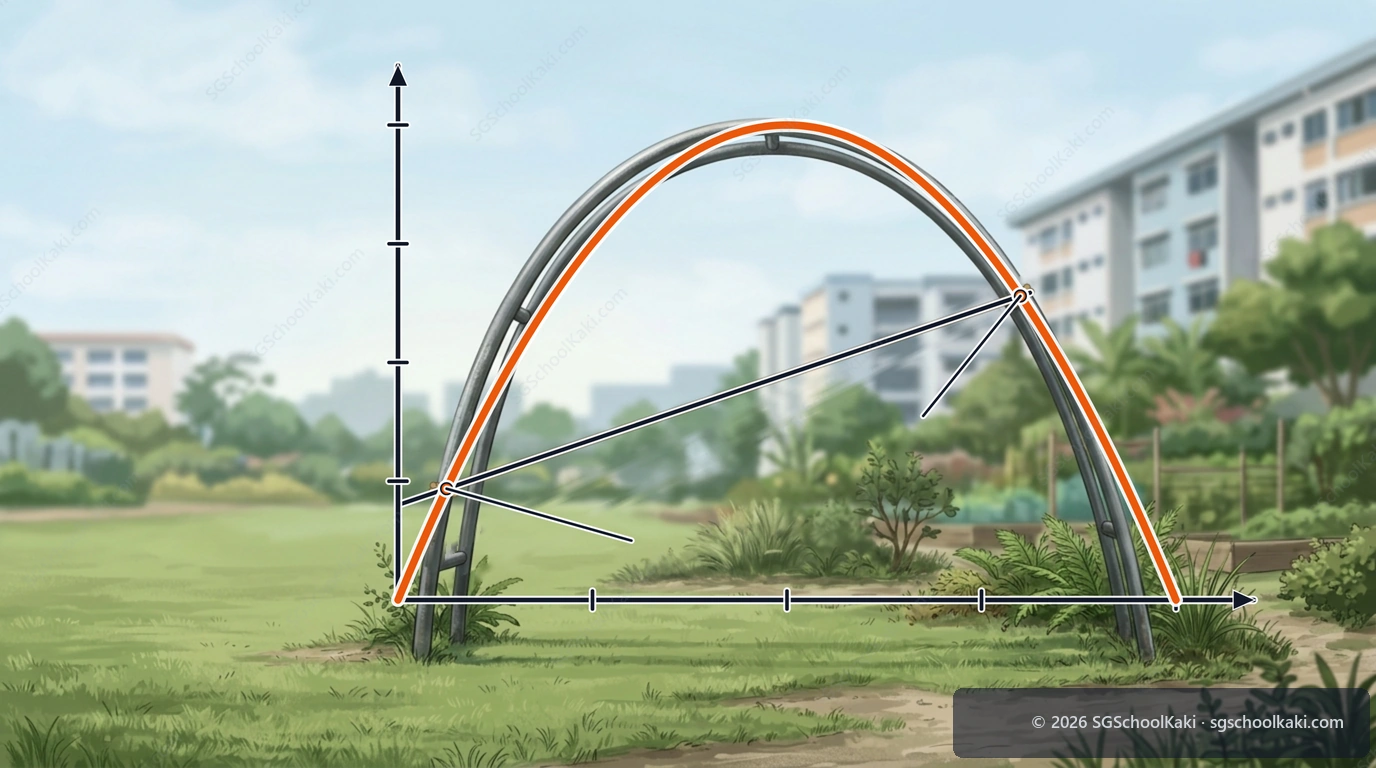
A double-tube metal garden arch on a lawn in a Singapore community garden with a taut rope across it; the arch curve, the axes, the rope with its equation and the two points where the rope meets the arch are drawn over the picture1122334411223344OOx (m)x\text{ (m)}y (m)y\text{ (m)}y=−x2+4xy = -x^2 + 4x(0.25, 0.9375)(0.25,\ 0.9375)(3.2, 2.56)(3.2,\ 2.56)y=0.55x+0.8y = 0.55x + 0.8
Maths In Real Life 1

The garden arch and the rope

A rope pulled tight between two points is a straight line, and an arch is a curve. Where the two cross is where the rope meets the arch, and finding it means solving a line and a curve together.

A garden arch is modelled by y=−x2+4xy = -x^2 + 4x, where xx and yy are in metres. A taut straight rope lies along the line y=0.55x+0.8y = 0.55x + 0.8.

  • (a)Find the coordinates of the two points where the rope meets the arch.
  • (b)A second straight rope lies along y=0.55x+3y = 0.55x + 3. Show that it does not meet the arch.
Show full solutionHide solution
Colour keyfactorexpression substitutedfinal resultdiscriminant D
(a)
One equation is linear, so use substitution: rearrange it to make one letter the subject, then put that into the other equation. This leaves one equation with one unknown.
y=0.55x+0.8\displaystyle y = 0.55x + 0.8
Make yy the subject of the linear equation (the easier letter to isolate).
(0.55x+0.8)=−x2+4x\displaystyle \textcolor{#010105}{\left(0.55x + 0.8\right)} = -x^{2} + 4x
Replace every yy in the curve by the bracket.
x2−3.45x+0.8=0\displaystyle x^{2} - 3.45x + 0.8 = 0
Bring every term to one side and collect like terms.
Multiply every term by 2020 to clear the decimals.
20x2−69x+16=0\displaystyle 20x^{2} - 69x + 16 = 0
(4x−1)(5x−16)=0\displaystyle \textcolor{#010104}{(4x - 1)(5x - 16)} = 0
Factorise the quadratic.
x=0.25orx=3.2\displaystyle x = \textcolor{#010106}{0.25} \quad\text{or}\quad x = \textcolor{#010106}{3.2}
Each factor equal to zero gives one solution.
Put each value of xx back into y=0.55x+0.8y = 0.55x + 0.8 to find yy.
y  =0.55(0.25)+0.8=0.9375\displaystyle y\;= 0.55(0.25) + 0.8 = 0.9375
When x=0.25x = 0.25.
y  =0.55(3.2)+0.8=2.56\displaystyle y\;= 0.55(3.2) + 0.8 = 2.56
When x=3.2x = 3.2.
Check every pair in both original equations.
At (0.25, 0.9375)(0.25,\ 0.9375): equation 1 gives 0.55(0.25)+0.8=0.93750.55(0.25) + 0.8 = 0.9375; equation 2 gives −(0.25)2+4(0.25)=0.9375- (0.25)^{2} + 4(0.25) = 0.9375. Both hold.
At (3.2, 2.56)(3.2,\ 2.56): equation 1 gives 0.55(3.2)+0.8=2.560.55(3.2) + 0.8 = 2.56; equation 2 gives −(3.2)2+4(3.2)=2.56- (3.2)^{2} + 4(3.2) = 2.56. Both hold.
The solution is (0.25, 0.9375)(0.25,\ 0.9375) or (3.2, 2.56)(3.2,\ 2.56).
(b)
To see how the line and the curve meet, substitute the line into the curve. The result is a quadratic in xx, and its discriminant tells you how many points they share.
−x2+4x=0.55x+3\displaystyle -x^{2} + 4x = 0.55x + 3
Both sides equal yy, so set them equal.
−x2+3.45x−3=0\displaystyle -x^2 + 3.45x - 3 = 0
Expand and collect: a quadratic in xx.
Compare with ax2+bx+c=0ax^2 + bx + c = 0: a=−1a = -1, b=3.45b = 3.45, c=−3c = -3.
D  =(3.45)2−4(−1)(−3)=−0.0975\displaystyle \textcolor{#010102}{D}\;= (3.45)^2 - 4(-1)(-3) = -0.0975
Use D=b2−4ac\textcolor{#010102}{D} = b^2 - 4ac on the quadratic you just formed.
D<0\textcolor{#010102}{D} < 0, so the line misses the curve entirely.
Answer
(a) (0.25, 0.9375)(0.25,\ 0.9375) or (3.2, 2.56)(3.2,\ 2.56)
(b) D=−0.0975\textcolor{#010102}{D} = -0.0975: the line misses the curve entirely
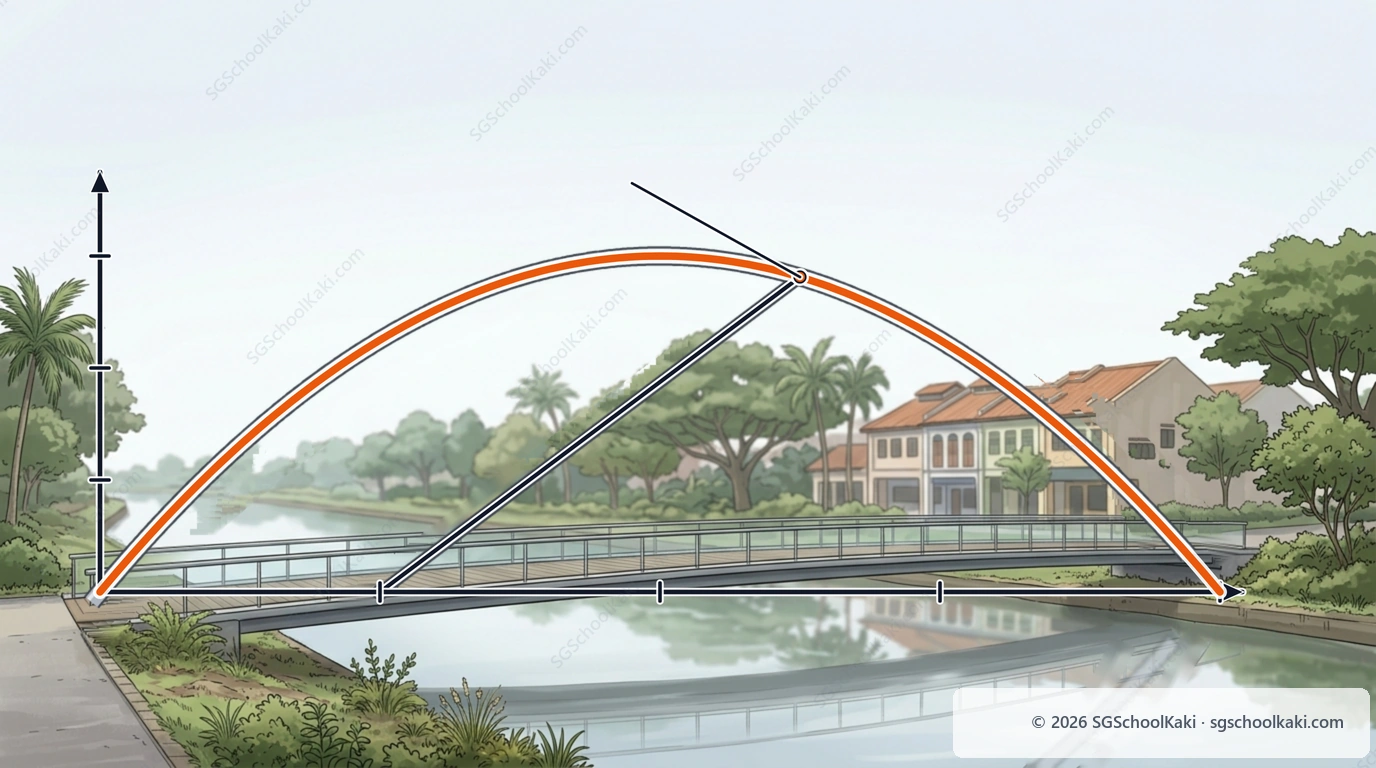
A pedestrian footbridge arch over a canal in Singapore, 20 m long and 6 m high, with a straight steel strut from the deck up to the arch; the arch curve, the axes with equal scales on both, the strut with its equation and the point where it meets the arch are drawn over the picture55101015152020224466OOx (m)x\text{ (m)}y (m)y\text{ (m)}y=−0.06x2+1.2xy = -0.06x^2 + 1.2x(12.5, 5.625)(12.5,\ 5.625)y=0.75x−3.75y = 0.75x - 3.75
Maths In Real Life 2

The footbridge strut

A straight strut from the deck to the arch is a line, and the arch is a curve. Where the strut meets the arch is a point they share, so it is found by solving the two equations together. The other solution of the equations lies outside the bridge.

The arch of a footbridge is modelled by y=−0.06x2+1.2xy = -0.06x^2 + 1.2x, where xx and yy are in metres: xx is measured along the deck from the left foot and yy is the height above the deck. A straight steel strut runs from the deck up to the arch along the line 3x−4y=153x - 4y = 15.

  • (a)Find the coordinates of the point where the strut meets the arch.
Show full solutionHide solution
Colour keyfactorexpression substitutedfinal result
(a)
One equation is linear, so use substitution: rearrange it to make one letter the subject, then put that into the other equation. This leaves one equation with one unknown.
y=0.75x−3.75\displaystyle y = 0.75x - 3.75
Make yy the subject of the linear equation (the easier letter to isolate).
(0.75x−3.75)=−3x250+6x5\displaystyle \textcolor{#010105}{\left(0.75x - 3.75\right)} = -\frac{3x^{2}}{50} + \frac{6x}{5}
Replace every yy in the curve by the bracket.
0.06x2−0.45x−3.75=0\displaystyle 0.06x^{2} - 0.45x - 3.75 = 0
Bring every term to one side and collect like terms.
Multiply every term by 100100 to clear the decimals.
6x2−45x−375=0\displaystyle 6x^{2} - 45x - 375 = 0
Divide every term by 33 to make the numbers smaller.
2x2−15x−125=0\displaystyle 2x^{2} - 15x - 125 = 0
(x+5)(2x−25)=0\displaystyle \textcolor{#010104}{(x + 5)(2x - 25)} = 0
Factorise the quadratic.
x=−5orx=12.5\displaystyle x = \textcolor{#010106}{-5} \quad\text{or}\quad x = \textcolor{#010106}{12.5}
Each factor equal to zero gives one solution.
Put each value of xx back into y=0.75x−3.75y = 0.75x - 3.75 to find yy.
y  =0.75(−5)−3.75=−7.5\displaystyle y\;= 0.75(-5) - 3.75 = -7.5
When x=−5x = -5.
y  =0.75(12.5)−3.75=5.625\displaystyle y\;= 0.75(12.5) - 3.75 = 5.625
When x=12.5x = 12.5.
Check every pair in both original equations.
At (−5, −7.5)(-5,\ -7.5): equation 1 gives 3(−5)−4(−7.5)=153(-5) - 4(-7.5) = 15; equation 2 gives −0.06(−5)2+1.2(−5)=−7.5-0.06(-5)^{2} + 1.2(-5) = -7.5. Both hold.
At (12.5, 5.625)(12.5,\ 5.625): equation 1 gives 3(12.5)−4(5.625)=153(12.5) - 4(5.625) = 15; equation 2 gives −0.06(12.5)2+1.2(12.5)=5.625-0.06(12.5)^{2} + 1.2(12.5) = 5.625. Both hold.
The point (−5, −7.5)(-5,\ -7.5) is below the deck and beyond the left foot of the bridge, so reject it.
Read the story: the algebra can give an answer that does not fit it.
The solution is (12.5, 5.625)(12.5,\ 5.625).
Answer
(a) (12.5, 5.625)(12.5,\ 5.625)
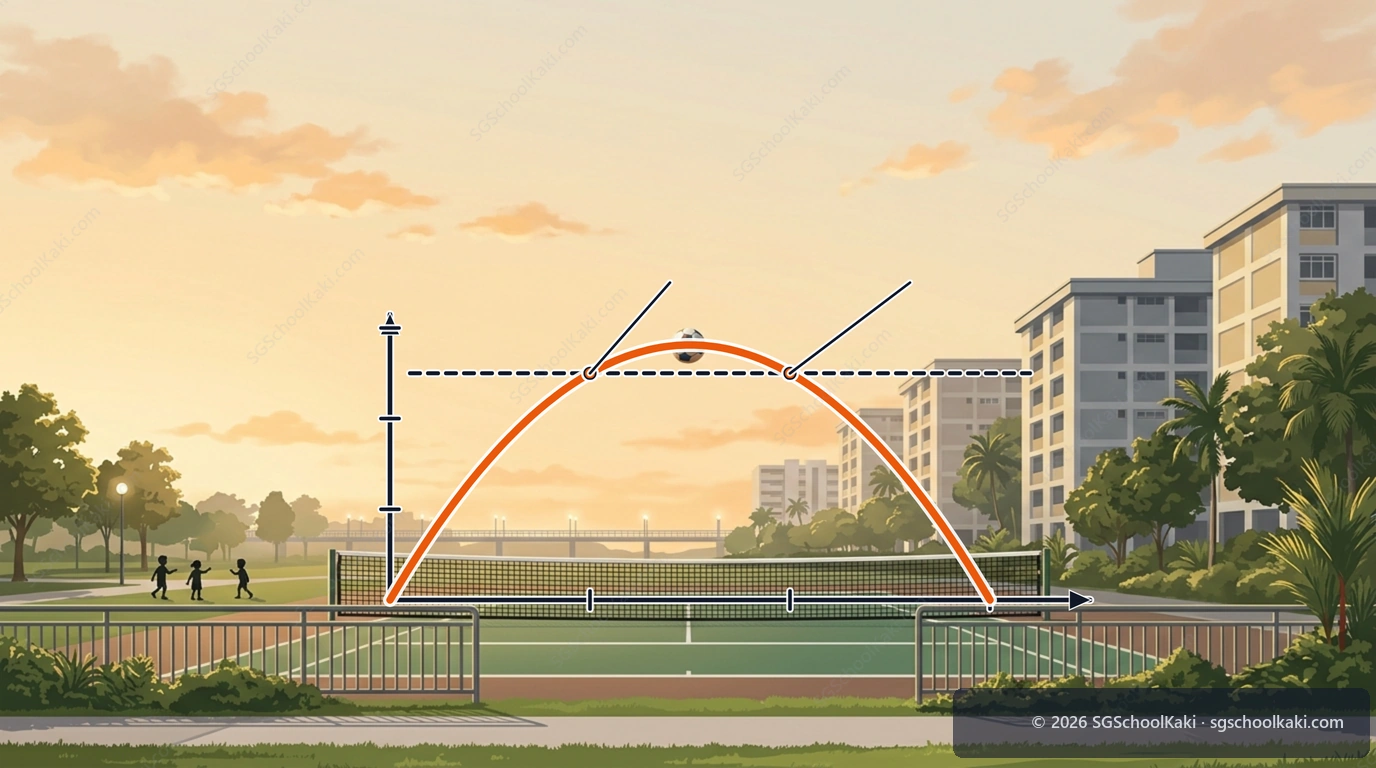
A football at the top of its flight above a ball court with a net in an HDB estate; the graph shows height against time, not position on the court: the curve, the axes, the dashed 10 m level with its label and the two times it is reached are drawn over the picture11223344881212OOt (s)t\text{ (s)}h (m)h\text{ (m)}h=−5t2+15th = -5t^2 + 15t(1, 10)(1,\ 10)(2, 10)(2,\ 10)h=10h = 10
Maths In Real Life 3

The ball in flight

A ball in flight follows a parabola. The ball is higher than a given level exactly when the parabola is above the horizontal line at that level, which is a quadratic inequality.

A football is kicked, and tt seconds later its height above the ground is h=−5t2+15th = -5t^2 + 15t metres. The graph shows height against time, not position on the court.

  • (a)Find the range of values of tt for which the ball is higher than 1010 m.
  • (b)For how long is the ball higher than 1010 m?
Show full solutionHide solution
Colour keyfactorfinal result
(a)
A quadratic inequality is solved with zero on one side. Expand any brackets and move every term across first.
−5t2+15t−10>0\displaystyle -5t^{2} + 15t - 10 > 0
Subtract the right-hand side from both sides: the sign stays the same.
The t2t^2 term is negative. Multiply every term by −1-1 to make it positive, and reverse the inequality sign.
Multiplying or dividing by a negative number reverses the sign.
5t2−15t+10<0\displaystyle 5t^{2} - 15t + 10 < 0
t2−3t+2<0\displaystyle t^{2} - 3t + 2 < 0
Divide by a positive common factor: the sign stays.
Step 1: find where the quadratic equals zero (the boundary points).
(t−1)(t−2)=0\displaystyle \textcolor{#010104}{(t - 1)(t - 2)} = 0
Factorise the quadratic.
t=1ort=2\displaystyle t = \textcolor{#010106}{1} \quad\text{or}\quad t = \textcolor{#010106}{2}
Each factor equal to zero gives one solution.
Step 2: sketch the parabola y=t2−3t+2y = t^{2} - 3t + 2. It opens upwards (its t2t^2 term is positive) and meets the horizontal axis at the two roots. Between the roots it is below the axis; outside them it is above it.
The sketch shows which parts are above (positive) or below (negative) the axis.
We need the quadratic less than zero, so take the part below the axis: between the roots.
Step 3: write the solution as an inequality (never as a pair of equalities): 1<t<2\textcolor{#010106}{1 < t < 2}.
The answer is a range of values, not just the boundary values.
Take a value just outside the solution: one less than the end-point 11, so t=1−1=0t = 1 - 1 = 0.
Check with test values. t=1.5t = 1.5 gives −5(1.5)2+15(1.5)=11.25-5(1.5)^{2} + 15(1.5) = 11.25 against 1010, and 11.25>1011.25 > 10 is true; t=0t = 0 gives −5(0)2+15(0)=0-5(0)^{2} + 15(0) = 0 against 1010, and 0>100 > 10 is false. The test values agree with the answer.
A quick substitution catches a reversed sign.
(b)
The ball is higher than 1010 m from t=1t = 1 to t=2t = 2 seconds.
Take the two end-points of the range.
T  =2−1=1\displaystyle T\;= 2 - 1 = 1
Answer
(a) 1<t<21 < t < 2
(b) 11 second
01
Supports K341-A2-02

Substitution: a line meets a curve

Revision. A linear equation such as 2x+y=72x + y = 7 can be rearranged to make one letter the subject, here y=7−2xy = 7 - 2x. Solving a quadratic by factorising or by the formula comes from chapter 1.

Two equations in two unknowns have solutions that satisfy both at once. On a graph, each equation is a line or a curve, and a solution is a point where they meet. This section handles the case that the exam names: one equation is linear, the other is not. The method is always the same: substitution.

The Core Idea

Substitute the linear equation into the other one.

Make one letter the subject of the linear equation, replace that letter in the other equation, and you are left with a quadratic in one letter. Solve it, then use the linear equation again to find the other letter. Finish by checking both pairs in both equations.

Graph of y = x² − 3x + 1 and y = −2x + 7Graph of y = x² − 3x + 1 and the straight line y = −2x + 7. They meet at two points.xy−4−3−212345−2246810121416O(−2, 11)(3, 1)curve: y = x2 − 3x + 1line: y = −2x + 7
A line cutting a parabola: two solutions, two points of intersection
Graph of y = x² − 4x + 7 and y = 2x − 2Graph of y = x² − 4x + 7 and the straight line y = 2x − 2. The line touches the curve at one point.xy−2−12345−424681012O(3, 4)curve: y = x2 − 4x + 7line: y = 2x − 2
A line touching a parabola: one repeated solution
SGSchoolKaki Tip

Write the answers as pairs. A solution of two equations in xx and yy is a pair of values, so every xx must be matched with its own yy. Two xx-values and two yy-values written separately do not say which goes with which.

Think About It
Could a straight line meet a parabola at three different points? Test it with the line y=2x+3y = 2x + 3 and the parabola y=x2y = x^2.
Show the full workingHide the working
Substitute y=x2y = x^2 into the line: the two expressions for yy must be equal.
Equal yy means the same point of both graphs.
x2=2x+3\displaystyle x^2 = 2x + 3
One equation, one unknown.
x2−2x−3=0\displaystyle x^2 - 2x - 3 = 0
A quadratic in xx.
(x−3)(x+1)=0\displaystyle (x - 3)(x + 1) = 0
It factorises into two brackets.
A quadratic has at most two roots, so there are at most two values of xx, and the line meets the parabola at most twice.
Answer
No. After substitution you always get a quadratic, which has at most two roots, so a line meets a parabola at most twice.
Example 1.1

A line meets a parabola

Solve the simultaneous equations 2x+y=72x + y = 7 and y=x2−3x+1y = x^{2} - 3x + 1.

Show solutionHide solution
Colour keyfactorexpression substitutedfinal result
One equation is linear, so use substitution: rearrange it to make one letter the subject, then put that into the other equation. This leaves one equation with one unknown.
y=7−2x\displaystyle y = 7 - 2x
Make yy the subject of the linear equation (the easier letter to isolate).
(7−2x)=x2−3x+1\displaystyle \textcolor{#010105}{\left(7 - 2x\right)} = x^{2} - 3x + 1
Replace every yy in the curve by the bracket.
x2−x−6=0\displaystyle x^{2} - x - 6 = 0
Bring every term to one side and collect like terms.
(x+2)(x−3)=0\displaystyle \textcolor{#010104}{(x + 2)(x - 3)} = 0
Factorise the quadratic.
x=−2orx=3\displaystyle x = \textcolor{#010106}{-2} \quad\text{or}\quad x = \textcolor{#010106}{3}
Each factor equal to zero gives one solution.
Put each value of xx back into y=7−2xy = 7 - 2x to find yy.
y  =7−2(−2)=11\displaystyle y\;= 7 - 2(-2) = 11
When x=−2x = -2.
y  =7−2(3)=1\displaystyle y\;= 7 - 2(3) = 1
When x=3x = 3.
Check every pair in both original equations.
At (−2, 11)(-2,\ 11): equation 1 gives 2(−2)+11=72(-2) + 11 = 7; equation 2 gives (−2)2−3(−2)+1=11(-2)^{2} - 3(-2) + 1 = 11. Both hold.
At (3, 1)(3,\ 1): equation 1 gives 2(3)+1=72(3) + 1 = 7; equation 2 gives 32−3(3)+1=13^{2} - 3(3) + 1 = 1. Both hold.
The solution is x=−2, y=11x = -2,\ y = 11 or x=3, y=1x = 3,\ y = 1.
Graph of y = x² − 3x + 1 and y = −2x + 7Graph of y = x² − 3x + 1 and the straight line y = −2x + 7. They meet at two points.xy−4−3−21234546810121416O(−2, 11)(3, 1)curve: y = x2 − 3x + 1line: y = −2x + 7
Answer
x=−2, y=11x = -2,\ y = 11 or x=3, y=1x = 3,\ y = 1
Example 1.2

A line meets a circle

Find the coordinates of the points where the line x+2y=7x + 2y = 7 meets the circle x2+y2=13x^{2} + y^{2} = 13.

Show solutionHide solution
Colour keyfactorexpression substitutedfinal result
One equation is linear, so use substitution: rearrange it to make one letter the subject, then put that into the other equation. This leaves one equation with one unknown.
x=7−2y\displaystyle x = 7 - 2y
Make xx the subject of the linear equation (the easier letter to isolate).
(7−2y)2+y2=13\displaystyle \textcolor{#010105}{\left(7 - 2y\right)}^{2} + y^{2} = 13
Replace every xx in the curve by the bracket.
5y2−28y+49=13\displaystyle 5y^{2} - 28y + 49 = 13
Expand the brackets carefully.
5y2−28y+36=0\displaystyle 5y^{2} - 28y + 36 = 0
Bring every term to one side and collect like terms.
(y−2)(5y−18)=0\displaystyle \textcolor{#010104}{(y - 2)(5y - 18)} = 0
Factorise the quadratic.
y=2ory=185\displaystyle y = \textcolor{#010106}{2} \quad\text{or}\quad y = \textcolor{#010106}{\frac{18}{5}}
Each factor equal to zero gives one solution.
Put each value of yy back into x=7−2yx = 7 - 2y to find xx.
x  =7−2(2)=3\displaystyle x\;= 7 - 2(2) = 3
When y=2y = 2.
x  =7−2(185)=−15\displaystyle x\;= 7 - 2 \left(\frac{18}{5}\right) = - \frac{1}{5}
When y=185y = \frac{18}{5}.
Check every pair in both original equations.
At (3, 2)(3,\ 2): equation 1 gives 3+2(2)=73 + 2(2) = 7; equation 2 gives 32+22=133^{2} + 2^{2} = 13. Both hold.
At (−15, 185)(- \frac{1}{5},\ \frac{18}{5}): equation 1 gives (−15)+2(185)=7\left(-\frac{1}{5}\right) + 2 \left(\frac{18}{5}\right) = 7; equation 2 gives (−15)2+(185)2=13\left(-\frac{1}{5}\right)^{2} + \left(\frac{18}{5}\right)^{2} = 13. Both hold.
The solution is (3, 2)(3,\ 2) or (−15, 185)(- \frac{1}{5},\ \frac{18}{5}).
Answer
(3, 2)(3,\ 2) or (−15, 185)(- \frac{1}{5},\ \frac{18}{5})
Example 1.3

A line meets a hyperbola

Solve x−y=1x - y = 1 and xy=6xy = 6, and give your answers as coordinates.

Show solutionHide solution
Colour keyfactorexpression substitutedfinal result
One equation is linear, so use substitution: rearrange it to make one letter the subject, then put that into the other equation. This leaves one equation with one unknown.
y=x−1\displaystyle y = x - 1
Make yy the subject of the linear equation (the easier letter to isolate).
x(x−1)=6\displaystyle x \textcolor{#010105}{\left(x - 1\right)} = 6
Replace every yy in the curve by the bracket.
x2−x=6\displaystyle x^{2} - x = 6
Expand the brackets carefully.
x2−x−6=0\displaystyle x^{2} - x - 6 = 0
Bring every term to one side and collect like terms.
(x+2)(x−3)=0\displaystyle \textcolor{#010104}{(x + 2)(x - 3)} = 0
Factorise the quadratic.
x=−2orx=3\displaystyle x = \textcolor{#010106}{-2} \quad\text{or}\quad x = \textcolor{#010106}{3}
Each factor equal to zero gives one solution.
Put each value of xx back into y=x−1y = x - 1 to find yy.
y  =(−2)−1=−3\displaystyle y\;= (-2) - 1 = -3
When x=−2x = -2.
y  =3−1=2\displaystyle y\;= 3 - 1 = 2
When x=3x = 3.
Check every pair in both original equations.
At (−2, −3)(-2,\ -3): equation 1 gives (−2)−(−3)=1(-2) - (-3) = 1; equation 2 gives (−2)(−3)=6(-2) (-3) = 6. Both hold.
At (3, 2)(3,\ 2): equation 1 gives 3−2=13 - 2 = 1; equation 2 gives 3(2)=63(2) = 6. Both hold.
The solution is (−2, −3)(-2,\ -3) or (3, 2)(3,\ 2).
Answer
(−2, −3)(-2,\ -3) or (3, 2)(3,\ 2)
Example 1.4

Both letters have a coefficient

Solve 3x+2y=63x + 2y = 6 and y=x2+2y = x^{2} + 2.

Show solutionHide solution
Colour keyfactorexpression substitutedfinal result
One equation is linear, so use substitution: rearrange it to make one letter the subject, then put that into the other equation. This leaves one equation with one unknown.
y=3−3x2\displaystyle y = 3 - \frac{3x}{2}
Make yy the subject of the linear equation (the easier letter to isolate).
(3−3x2)=x2+2\displaystyle \textcolor{#010105}{\left(3 - \frac{3x}{2}\right)} = x^{2} + 2
Replace every yy in the curve by the bracket.
−x2−3x2+1=0\displaystyle -x^{2} - \frac{3x}{2} + 1 = 0
Bring every term to one side and collect like terms.
Multiply every term by 22 to clear the fractions.
−2x2−3x+2=0\displaystyle -2x^{2} - 3x + 2 = 0
Multiply every term by −1-1 so the squared term is positive.
2x2+3x−2=0\displaystyle 2x^{2} + 3x - 2 = 0
(x+2)(2x−1)=0\displaystyle \textcolor{#010104}{(x + 2)(2x - 1)} = 0
Factorise the quadratic.
x=−2orx=12\displaystyle x = \textcolor{#010106}{-2} \quad\text{or}\quad x = \textcolor{#010106}{\frac{1}{2}}
Each factor equal to zero gives one solution.
Put each value of xx back into y=3−3x2y = 3 - \frac{3x}{2} to find yy.
y  =3−3(−2)2=6\displaystyle y\;= 3 - \frac{3(-2)}{2} = 6
When x=−2x = -2.
y  =3−3(12)2=94\displaystyle y\;= 3 - \frac{3 \left(\frac{1}{2}\right)}{2} = \frac{9}{4}
When x=12x = \frac{1}{2}.
Check every pair in both original equations.
At (−2, 6)(-2,\ 6): equation 1 gives 3(−2)+2(6)=63(-2) + 2(6) = 6; equation 2 gives (−2)2+2=6(-2)^{2} + 2 = 6. Both hold.
At (12, 94)(\frac{1}{2},\ \frac{9}{4}): equation 1 gives 3(12)+2(94)=63 \left(\frac{1}{2}\right) + 2 \left(\frac{9}{4}\right) = 6; equation 2 gives (12)2+2=94\left(\frac{1}{2}\right)^{2} + 2 = \frac{9}{4}. Both hold.
The solution is x=−2, y=6x = -2,\ y = 6 or x=12, y=94x = \frac{1}{2},\ y = \frac{9}{4}.
Graph of y = x² + 2 and y = −1.5x + 3Graph of y = x² + 2 and the straight line y = −1.5x + 3. They meet at two points.xy−4−3−2−1146810O(−2, 6)(0.5, 2.25)curve: y = x2 + 2line: y = −1.5x + 3
Answer
x=−2, y=6x = -2,\ y = 6 or x=12, y=94x = \frac{1}{2},\ y = \frac{9}{4}
Example 1.5

Only one solution

Solve 2x−y=22x - y = 2 and y=x2−4x+7y = x^{2} - 4x + 7. What does your answer tell you about the line and the curve?

Show solutionHide solution
Colour keyfactorexpression substituted
One equation is linear, so use substitution: rearrange it to make one letter the subject, then put that into the other equation. This leaves one equation with one unknown.
y=2x−2\displaystyle y = 2x - 2
Make yy the subject of the linear equation (the easier letter to isolate).
(2x−2)=x2−4x+7\displaystyle \textcolor{#010105}{\left(2x - 2\right)} = x^{2} - 4x + 7
Replace every yy in the curve by the bracket.
x2−6x+9=0\displaystyle x^{2} - 6x + 9 = 0
Bring every term to one side and collect like terms.
(x−3)2=0\displaystyle \textcolor{#010104}{(x - 3)^2} = 0
Factorise the quadratic.
The bracket is squared, so there is one repeated solution, x=3x = 3.
Two equal roots.
Put each value of xx back into y=2x−2y = 2x - 2 to find yy.
y  =2(3)−2=4\displaystyle y\;= 2(3) - 2 = 4
When x=3x = 3.
Check every pair in both original equations.
At (3, 4)(3,\ 4): equation 1 gives 2(3)−4=22(3) - 4 = 2; equation 2 gives 32−4(3)+7=43^{2} - 4(3) + 7 = 4. Both hold.
The solution is x=3, y=4x = 3,\ y = 4 only (the line touches the curve at one point).
Graph of y = x² − 4x + 7 and y = 2x − 2Graph of y = x² − 4x + 7 and the straight line y = 2x − 2. The line touches the curve at one point.xy−22345−4246810O(3, 4)curve: y = x2 − 4x + 7line: y = 2x − 2
Answer
x=3, y=4x = 3,\ y = 4 only (the line touches the curve at one point)
Example 1.6

No solution at all

Show that the simultaneous equations x−y=3x - y = 3 and y=x2+1y = x^{2} + 1 have no real solution.

Show solutionHide solution
Colour keyexpression substituteddiscriminant D
One equation is linear, so use substitution: rearrange it to make one letter the subject, then put that into the other equation. This leaves one equation with one unknown.
y=x−3\displaystyle y = x - 3
Make yy the subject of the linear equation (the easier letter to isolate).
(x−3)=x2+1\displaystyle \textcolor{#010105}{\left(x - 3\right)} = x^{2} + 1
Replace every yy in the curve by the bracket.
x2−x+4=0\displaystyle x^{2} - x + 4 = 0
Bring every term to one side and collect like terms.
D  =(−1)2−4(1)(4)=−15\displaystyle \textcolor{#010102}{D}\;= (-1)^2 - 4(1)(4) = -15
The discriminant decides whether any real solution exists.
D<0\textcolor{#010102}{D} < 0, so there are no real solutions.
So the equations have no real solutions: the two graphs never meet.
Graph of y = x² + 1 and y = x − 3Graph of y = x² + 1 and the straight line y = x − 3. They do not meet.xy−3−212−6−4468Ocurve: y = x2 + 1line: y = x − 3
Answer
no real solutions (the two graphs never meet)
Example 1.7

From a story to equations

The length of a rectangular vegetable bed is 33 m more than its width, and its area is 4040 m2^2. Let the length be xx m and the width yy m.

  • (i)Write two equations in xx and yy.
  • (ii)Solve your equations to find the length and the width.
Show solutionHide solution
Colour keyfactorexpression substitutedfinal result
(i)
The length is 33 m more than the width, so x=y+3x = y + 3, which gives x−y=3x - y = 3.
Turn each sentence into one equation.
The area is length times width, so xy=40xy = 40.
(ii)
One equation is linear, so use substitution: rearrange it to make one letter the subject, then put that into the other equation. This leaves one equation with one unknown.
y=x−3\displaystyle y = x - 3
Make yy the subject of the linear equation (the easier letter to isolate).
x(x−3)=40\displaystyle x \textcolor{#010105}{\left(x - 3\right)} = 40
Replace every yy in the curve by the bracket.
x2−3x=40\displaystyle x^{2} - 3x = 40
Expand the brackets carefully.
x2−3x−40=0\displaystyle x^{2} - 3x - 40 = 0
Bring every term to one side and collect like terms.
(x+5)(x−8)=0\displaystyle \textcolor{#010104}{(x + 5)(x - 8)} = 0
Factorise the quadratic.
x=−5orx=8\displaystyle x = \textcolor{#010106}{-5} \quad\text{or}\quad x = \textcolor{#010106}{8}
Each factor equal to zero gives one solution.
Put each value of xx back into y=x−3y = x - 3 to find yy.
y  =(−5)−3=−8\displaystyle y\;= (-5) - 3 = -8
When x=−5x = -5.
y  =8−3=5\displaystyle y\;= 8 - 3 = 5
When x=8x = 8.
Check every pair in both original equations.
At (−5, −8)(-5,\ -8): equation 1 gives (−5)−(−8)=3(-5) - (-8) = 3; equation 2 gives (−5)(−8)=40(-5) (-8) = 40. Both hold.
At (8, 5)(8,\ 5): equation 1 gives 8−5=38 - 5 = 3; equation 2 gives 8(5)=408(5) = 40. Both hold.
A length cannot be negative, so reject (−5, −8)(-5,\ -8).
Read the story: the algebra can give an answer that does not fit it.
The solution is x=8, y=5x = 8,\ y = 5.
Answer
(i) x−y=3x - y = 3 and xy=40xy = 40
(ii) x=8, y=5x = 8,\ y = 5
02
Supports K341-A2-01

The discriminant and the nature of the roots

Revision. The quadratic formula x=−b±b2−4ac2ax = \dfrac{-b \pm \sqrt{b^2 - 4ac}}{2a} is on the exam formula page. The part under the square root decides everything in this section.

Look at the quadratic formula again. Everything depends on the number under the square root, b2−4acb^2 - 4ac. Give it a name: the discriminant, D\textcolor{#010102}{D}. If D\textcolor{#010102}{D} is positive the root exists and the ±\pm gives two different answers. If D\textcolor{#010102}{D} is zero the ±\pm changes nothing and the two answers coincide. If D\textcolor{#010102}{D} is negative there is no real square root, so no real roots. You can read the nature of the roots without solving anything.

The Core Idea

D = b² − 4ac tells you the nature of the roots.

For ax2+bx+c=0ax^2 + bx + c = 0 (with a≠0a \ne 0): D>0\textcolor{#010102}{D} > 0 means two distinct real roots, D=0\textcolor{#010102}{D} = 0 means two equal real roots (a repeated root), D<0\textcolor{#010102}{D} < 0 means no real roots. This is not on the formula page. Memorise it.

Case table 1: the discriminant, the roots and the picture
DiscriminantRoots of ax2+bx+c=0ax^2 + bx + c = 0a>0\textcolor{#010101}{a > 0}a<0\textcolor{#010101}{a < 0}
D>0\textcolor{#010102}{D} > 0two different real roots: the graph cuts the xx-axis twice
Upward parabola cutting the x-axis at two pointsUpward parabola cutting the x-axis at two points
D>0\textcolor{#010102}{D} > 0
Downward parabola cutting the x-axis at two pointsDownward parabola cutting the x-axis at two points
D>0\textcolor{#010102}{D} > 0
D=0\textcolor{#010102}{D} = 0two equal real roots: the graph touches the xx-axis once
Upward parabola touching the x-axis at its minimum pointUpward parabola touching the x-axis at its minimum point
D=0\textcolor{#010102}{D} = 0
Downward parabola touching the x-axis at its maximum pointDownward parabola touching the x-axis at its maximum point
D=0\textcolor{#010102}{D} = 0
D<0\textcolor{#010102}{D} < 0no real roots: the graph misses the xx-axis
Upward parabola entirely above the x-axisUpward parabola entirely above the x-axis
D<0\textcolor{#010102}{D} < 0
Downward parabola entirely below the x-axisDownward parabola entirely below the x-axis
D<0\textcolor{#010102}{D} < 0
SGSchoolKaki Tip

Square bb before you subtract, and bracket a negative bb: b2b^2 is never negative. In x2−5x+2=0x^2 - 5x + 2 = 0 the value is (−5)2=25(-5)^2 = 25, not −25-25.

Think About It
When D=0\textcolor{#010102}{D} = 0 we say 'two equal roots' rather than 'one root'. Why? Test it with x2−6x+9=0x^2 - 6x + 9 = 0.
Show the full workingHide the working
Colour keydiscriminant D
Here a=1a = 1, b=−6b = -6, c=9c = 9. First check that D=0\textcolor{#010102}{D} = 0.
Work out b2−4acb^2 - 4ac.
D  =(−6)2−4(1)(9)=36−36=0\displaystyle \textcolor{#010102}{D}\;= (-6)^2 - 4(1)(9) = 36 - 36 = 0
x2−6x+9=(x−3)(x−3)=(x−3)2\displaystyle x^2 - 6x + 9 = (x - 3)(x - 3) = (x - 3)^2
The two brackets are identical.
Each bracket gives the same root, x=3x = 3. It is one value, counted twice: a repeated root. That is why the graph just touches the axis.
Answer
The quadratic factorises into two identical brackets, so the same root appears twice (a repeated root).
Example 2.1

Two different roots

Without solving, state the nature of the roots of 3x2−7x+2=03x^2 - 7x + 2 = 0.

Show solutionHide solution
Colour keydiscriminant D
For ax2+bx+c=0ax^2 + bx + c = 0 the discriminant is D=b2−4ac\textcolor{#010102}{D} = b^2 - 4ac. Here a=3a = 3, b=−7b = -7, c=2c = 2.
D  =(−7)2−4(3)(2)=49−24=25\displaystyle \textcolor{#010102}{D}\;= (-7)^2 - 4(3)(2) = 49 - 24 = 25
Square bb first, then subtract 4ac4ac (watch the sign of cc).
D>0\textcolor{#010102}{D} > 0, so the equation has two distinct real roots.
D>0\textcolor{#010102}{D}>0: two distinct roots. D=0\textcolor{#010102}{D}=0: two equal (repeated) roots. D<0\textcolor{#010102}{D}<0: no real roots.
Answer
D=25\textcolor{#010102}{D} = 25: two distinct real roots
Example 2.2

Equal roots

Show that the equation 4x2−12x+9=04x^2 - 12x + 9 = 0 has two equal roots, and find the repeated root.

Show solutionHide solution
Colour keyfactordiscriminant D
For ax2+bx+c=0ax^2 + bx + c = 0 the discriminant is D=b2−4ac\textcolor{#010102}{D} = b^2 - 4ac. Here a=4a = 4, b=−12b = -12, c=9c = 9.
D  =(−12)2−4(4)(9)=144−144=0\displaystyle \textcolor{#010102}{D}\;= (-12)^2 - 4(4)(9) = 144 - 144 = 0
Square bb first, then subtract 4ac4ac (watch the sign of cc).
D=0\textcolor{#010102}{D} = 0, so the equation has two equal real roots.
D>0\textcolor{#010102}{D}>0: two distinct roots. D=0\textcolor{#010102}{D}=0: two equal (repeated) roots. D<0\textcolor{#010102}{D}<0: no real roots.
(2x−3)2=0\displaystyle \textcolor{#010104}{(2x - 3)^2} = 0
Factorise the quadratic.
The bracket is squared, so there is one repeated solution, x=32x = \frac{3}{2}.
Two equal roots.
Answer
D=0\textcolor{#010102}{D} = 0: two equal real roots; x=32x = \frac{3}{2} (repeated)
Example 2.3

No real roots, and the picture

The curve y=2x2−3x+5y = 2x^2 - 3x + 5 is drawn. Use the discriminant to say whether it meets the xx-axis, and describe its position.

  • (i)Does the curve meet the xx-axis?
  • (ii)Describe where the curve lies.
Show solutionHide solution
Colour keycondition on adiscriminant D
(i)
For ax2+bx+c=0ax^2 + bx + c = 0 the discriminant is D=b2−4ac\textcolor{#010102}{D} = b^2 - 4ac. Here a=2a = 2, b=−3b = -3, c=5c = 5.
D  =(−3)2−4(2)(5)=9−40=−31\displaystyle \textcolor{#010102}{D}\;= (-3)^2 - 4(2)(5) = 9 - 40 = -31
Square bb first, then subtract 4ac4ac (watch the sign of cc).
D<0\textcolor{#010102}{D} < 0, so the equation has no real roots.
D>0\textcolor{#010102}{D}>0: two distinct roots. D=0\textcolor{#010102}{D}=0: two equal (repeated) roots. D<0\textcolor{#010102}{D}<0: no real roots.
(ii)
From above, D=−31\textcolor{#010102}{D} = -31.
With a>0\textcolor{#010101}{a > 0} the graph opens upwards. Since D<0\textcolor{#010102}{D} < 0, it stays entirely above the xx-axis.
Graph of y = 2x² − 3x + 5Graph of y = 2x² − 3x + 5. It opens upward with its minimum point at (0.75, 3.875); the dashed line is the axis of symmetry x = 0.75.xy−4−3−22345−42O(0.75, 3.875)(0, 5)x = 0.75y = 2x2 − 3x + 5minimum point (0.75, 3.875)
Answer
(i) D=−31\textcolor{#010102}{D} = -31: no real roots
(ii) opens upwards and stays entirely above the xx-axis
Example 2.4

How many times does it cross the axis?

How many times does the graph of y=−2x2+5x+1y = -2x^2 + 5x + 1 meet the xx-axis?

Show solutionHide solution
Colour keydiscriminant D
For ax2+bx+c=0ax^2 + bx + c = 0 the discriminant is D=b2−4ac\textcolor{#010102}{D} = b^2 - 4ac. Here a=−2a = -2, b=5b = 5, c=1c = 1.
D  =52−4(−2)(1)=25+8=33\displaystyle \textcolor{#010102}{D}\;= 5^2 - 4(-2)(1) = 25 + 8 = 33
Square bb first, then subtract 4ac4ac (watch the sign of cc).
The number of times the graph meets the xx-axis equals the number of real roots. Here D>0\textcolor{#010102}{D} > 0, so the graph cuts the xx-axis at two points.
Answer
2
Example 2.5

Rearrange first

Show that the equation 2x2=4x−52x^2 = 4x - 5 has no real roots.

Show solutionHide solution
Colour keydiscriminant D
The discriminant is defined for an equation written as ax2+bx+c=0ax^2 + bx + c = 0. Bring every term to one side first.
Zero on one side.
2x2−(4x−5)=0⇒2x2−4x+5=0\displaystyle 2x^2 - (4x - 5) = 0 \quad\Rightarrow\quad 2x^2 - 4x + 5 = 0
For ax2+bx+c=0ax^2 + bx + c = 0 the discriminant is D=b2−4ac\textcolor{#010102}{D} = b^2 - 4ac. Here a=2a = 2, b=−4b = -4, c=5c = 5.
D  =(−4)2−4(2)(5)=16−40=−24\displaystyle \textcolor{#010102}{D}\;= (-4)^2 - 4(2)(5) = 16 - 40 = -24
Square bb first, then subtract 4ac4ac (watch the sign of cc).
D<0\textcolor{#010102}{D} < 0, so the equation has no real roots.
D>0\textcolor{#010102}{D}>0: two distinct roots. D=0\textcolor{#010102}{D}=0: two equal (repeated) roots. D<0\textcolor{#010102}{D}<0: no real roots.
Answer
D=−24\textcolor{#010102}{D} = -24: no real roots
Example 2.6

Working backwards from the roots

The equation x2+px+q=0x^2 + px + q = 0 has roots 22 and −5-5.

  • (i)Find the values of pp and qq.
  • (ii)Hence find the nature of the roots of qx2+px+1=0q x^2 + p x + 1 = 0.
Show solutionHide solution
Colour keydiscriminant D
(i)
Roots x=2x = 2 and x=−5x = -5 mean the factors are (x−2)(x - 2) and (x−(−5))(x - (-5)).
A root rr gives the factor (x−r)(x - r).
(x−2)(x+5)=x2+5x−2x−10=x2+3x−10\displaystyle (x - 2)(x + 5) = x^2 + 5x - 2x - 10 = x^2 + 3x - 10
Expand, collect, then compare with x2+px+qx^2 + px + q.
Compare with x2+px+qx^2 + px + q: p=3p = 3 and q=−10q = -10.
(ii)
For ax2+bx+c=0ax^2 + bx + c = 0 the discriminant is D=b2−4ac\textcolor{#010102}{D} = b^2 - 4ac. Here a=−10a = -10, b=3b = 3, c=1c = 1.
D  =32−4(−10)(1)=9+40=49\displaystyle \textcolor{#010102}{D}\;= 3^2 - 4(-10)(1) = 9 + 40 = 49
Square bb first, then subtract 4ac4ac (watch the sign of cc).
D>0\textcolor{#010102}{D} > 0, so the equation has two distinct real roots.
D>0\textcolor{#010102}{D}>0: two distinct roots. D=0\textcolor{#010102}{D}=0: two equal (repeated) roots. D<0\textcolor{#010102}{D}<0: no real roots.
Answer
(i) p=3p = 3, q=−10q = -10
(ii) D=49\textcolor{#010102}{D} = 49: two distinct real roots
Example 2.7

Use the calculator to check

Find the discriminant of 5x2−6x+2=05x^2 - 6x + 2 = 0 and decide how many real roots there are. Check with your calculator.

Show solutionHide solution
Colour keydiscriminant D
For ax2+bx+c=0ax^2 + bx + c = 0 the discriminant is D=b2−4ac\textcolor{#010102}{D} = b^2 - 4ac. Here a=5a = 5, b=−6b = -6, c=2c = 2.
D  =(−6)2−4(5)(2)=36−40=−4\displaystyle \textcolor{#010102}{D}\;= (-6)^2 - 4(5)(2) = 36 - 40 = -4
Square bb first, then subtract 4ac4ac (watch the sign of cc).
D<0\textcolor{#010102}{D} < 0, so the equation has no real roots.
D>0\textcolor{#010102}{D}>0: two distinct roots. D=0\textcolor{#010102}{D}=0: two equal (repeated) roots. D<0\textcolor{#010102}{D}<0: no real roots.
Calculator check: in equation-solver mode enter a=5a = 5, b=−6b = -6, c=2c = 2. It reports no real roots (a non-real answer). Use it to check your answer, but the exam still needs the written working.
Answer
D=−4\textcolor{#010102}{D} = -4: no real roots; the calculator reports a non-real answer
SGSchoolKaki Tip

Quadratic equation mode on your calculator is a check, not an answer. It confirms the number of real roots, but the exam still wants the working: write D\textcolor{#010102}{D}, the substitution, and the conclusion. If it shows a non-real answer, that is the calculator's way of saying D<0\textcolor{#010102}{D} < 0.

SGSchoolKaki Tip

Always validate. Substitute a root back into the equation, expand your answer again, and compare with the calculator. A thirty-second check catches most sign slips before the examiner does.

Locked · Chapter 2

You've read the free 29%. Unlock the rest of Chapter 2.

Still to read in this chapter:

  • Finding a constant
  • Line and curve
  • Rules of inequalities
  • Quadratic inequalities
  • Build the inequality
  • Formula panel
  • Exercise

$9 one-time · all 17 chapters · no subscription

Worked examples, formulas and exam checks.
The whole A-Math syllabus.

Premium members get all 17 chapters included.

Notes version 1.0 · Last updated 3 Nov 2026 · Chapter 2 of 17