Chapter 6 · Additional Maths · A6 Exponential and logarithmic functions · Not in G2
Exponential and logarithmic functions
Some quantities do not grow by adding the same amount each time: they grow by multiplying. A bank balance, a bacteria colony and a cup of cooling kopi all follow an exponential rule, and a logarithm is the tool that digs the time out of it. By the end of this chapter you can sketch the graphs, use the laws of logarithms, change base, solve exponential and logarithmic equations, and build and read growth and decay models.
Your outcome tracker0 / 8
Let's go! Tick an outcome once you can pass its exam check. Saved on this device.
Chapter 6
Figure 1 · an exponential and its mirror image, a logarithm
r = 1y = sin θcos θ
3 outcomes · 1 page · every step shown ✦
Index form or log form
logax=y means ay=x. The log is the power; the base stays the base.
Laws of logs
A log turns multiplying into adding, dividing into subtracting, and a power into a multiplier. Same base on every log.
Check every root
A log needs a positive argument. Solve first, then test each answer in the ORIGINAL equation.
By the end of this chapter
State the shape, intercept and asymptote of y=ax and y=logax for a>1 and 0<a<1, and sketch transformed graphs asymptote first.
Switch between index form and log form, use the laws of logarithms and the change-of-base formula, and express one log in terms of others.
Solve exponential equations by matching bases, taking logs or substituting u=ax, and find the least whole number n that satisfies an exponential inequality.
Solve logarithmic equations, reject every answer that makes a log argument non-positive, and use the reciprocal rule and substitutions.
Use exponential and logarithmic models for growth, decay and cooling: values, times, constants and the limiting value.
✶
Start here
Maths In Real Life
Three situations where a quantity is multiplied again and again. The pictures come first; the maths drawn on them is generated from the same numbers that the solutions use.
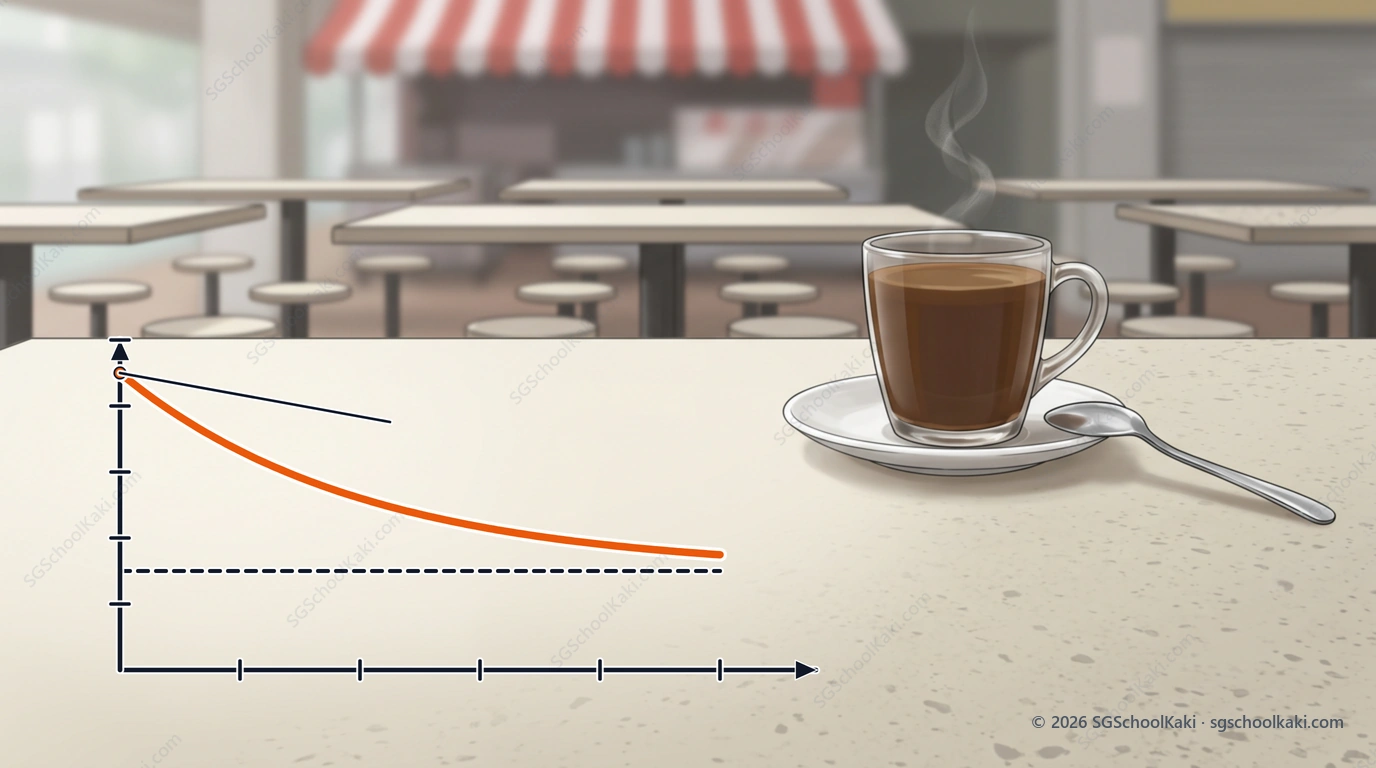
A hot drink does not cool at a steady rate: it loses heat fastest at the start and more slowly as it nears the temperature of the room. That slowing-down is the signature of an exponential model with a limiting value.
A cup of kopi is served in a food court where the room temperature stays at 30∘C. The temperature T of the kopi, in ∘C, t minutes after it is served, is modelled by T=30+60e−0.05t.
(a)Find the temperature of the kopi when it is served.
(b)Find the temperature after 10 minutes, correct to 3 significant figures.
(c)How long does the kopi take to cool to 50∘C? Give your answer in minutes, correct to 3 significant figures.
(d)What value does the temperature approach as t becomes very large? Explain why it never goes below this value.
Show full solutionHide solution
Colour keyfinal answer
(a)
T(0)=30+60e0
Put t=0: e0=1.
T(0)=90
(b)
T(10)=30+60e−0.05×10
Put t=10 into the model.
T(10)≈66.4
Calculator, then round to 3 significant figures.
(c)
30+60e−0.05t=50⟺e−0.05t=31
Move the constant across, then divide by the number in front.
e−0.05t=31⟺−0.05t=ln31
Take ln of both sides.
−0.05t=ln31⟺t=−0.05ln31
Divide by the coefficient of t, which is negative.
≈22.0
Calculator, then round to 3 significant figures.
(d)
As t becomes very large, e−0.05t gets closer and closer to 0 (it is one over a huge power of e), so 60e−0.05t is almost 0.
Think of e−y as 1÷ey.
So T gets closer and closer to 30 but never reaches it: the limiting value is 30 and the graph has the horizontal asymptote T=30.
Why it never goes below 30: e−0.05t>0 for every t, so 60e−0.05t>0 and T>30 always.
A power of e is never zero or negative.
Answer
(a)T(0)=90 °C
(b)T(10)≈66.4 °C
(c)t≈22.0 minutes
(d)T approaches 30 °C (the line T=30 is an asymptote); since e−0.05t>0, T>30 always
204060801005101520OrL (dB)L=10lgr(100,20)
Maths In Real Life 2
How loud is the hawker centre?
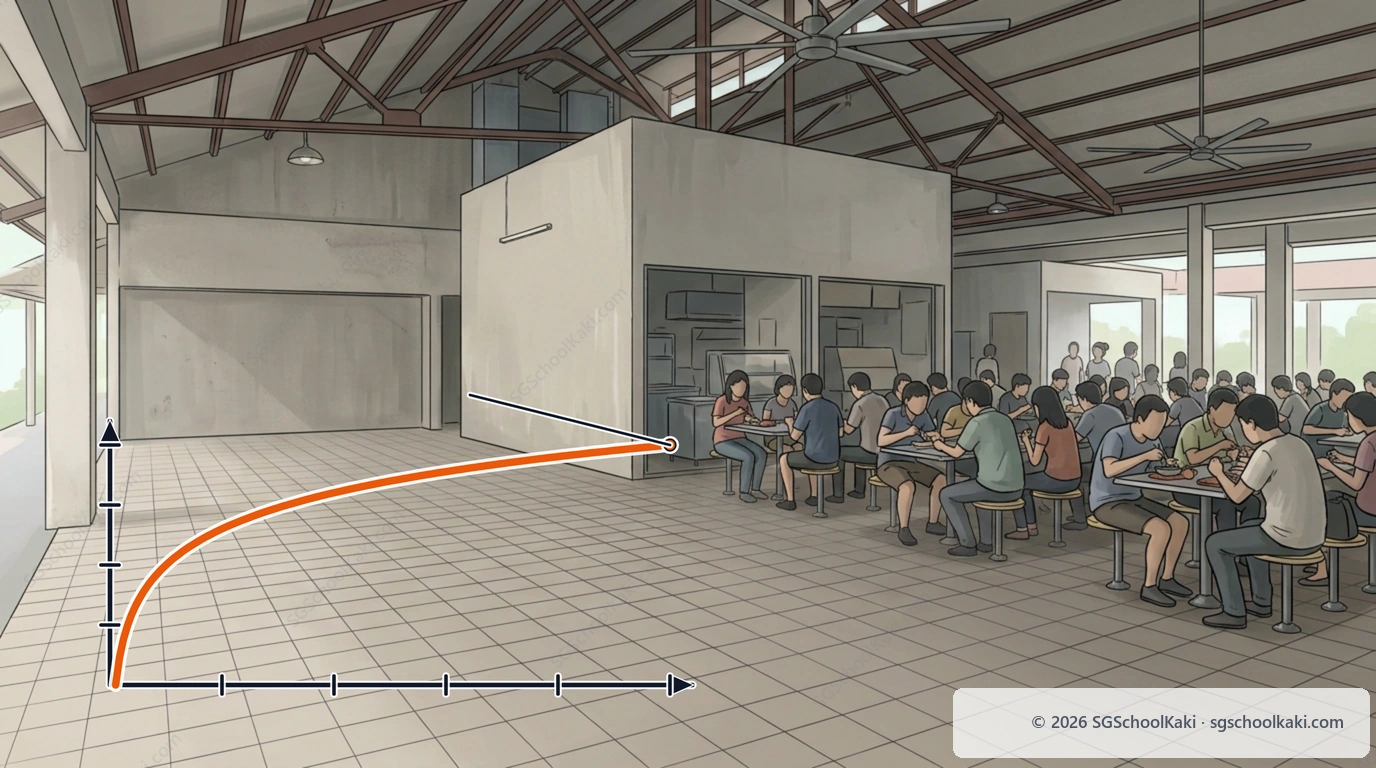
Sound is measured on a scale where adding the same number of decibels means multiplying the intensity. A logarithm is exactly the tool that turns multiplying into adding, which is why the decibel scale uses one.
The sound level L, in decibels (dB), of a sound is L=10lgr, where r is the intensity of the sound as a multiple of the quietest sound a person can hear.
(a)Show that a sound 100 times as intense as the quietest sound has a level of 20 dB.
(b)When the intensity of a sound is multiplied by 2, by how many decibels does its level rise? Give your answer correct to 3 significant figures.
(c)A food court measures 75 dB. Find the intensity r, giving your answer in the form a×10n with a correct to 3 significant figures.
Show full solutionHide solution
Colour keyfinal answer
(a)
L(100)=10lg100=10×2=20
Put r=100: lg100 is the power of ten that gives 100.
(b)
Let d be the rise in L when r becomes 2r: d=L(2r)−L(r).
d=10lg(2r)−10lgr=10(lg2+lgr)−10lgr=10lg2
Product law: lg(kr)=lgk+lgr. The lgr terms cancel.
d≈3.01
Calculator, then round to 3 significant figures.
(c)
10lgr=75⟺lgr=7.5
Divide both sides by 10.
lgr=7.5⟺r=107.5
Index form: base ten to the power of the log.
≈3.16×10⁷
Calculator, then round to 3 significant figures.
Answer
(a)L(100)=20
(b) the level rises by 10lg2≈3.01 dB
(c)r=107.5≈3.16×10⁷
24650010001500OtVV=1500×0.8t(0,1500)(3,768)V=500
Maths In Real Life 3
The e-scooter that loses value
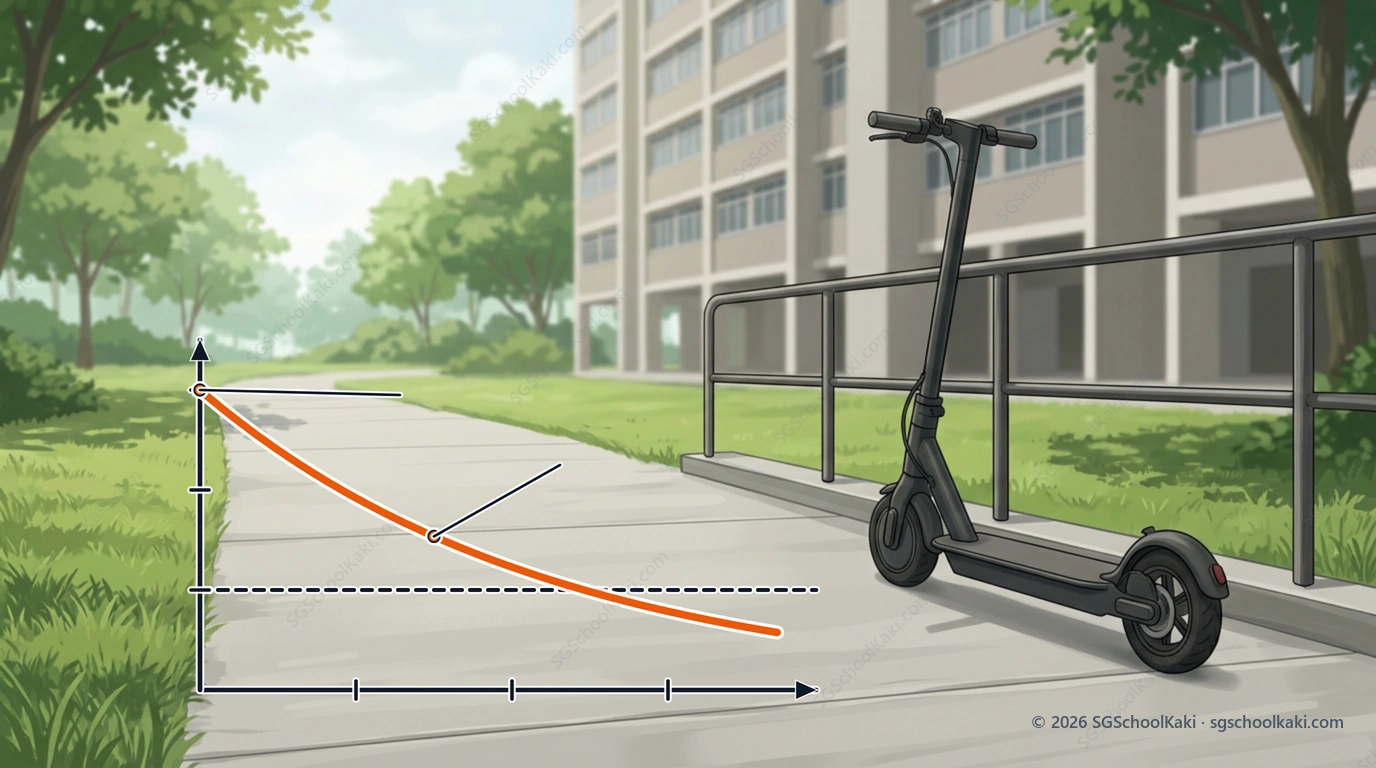
A second-hand e-scooter loses a fixed fraction of its value each year, not a fixed amount. That makes its value an exponential decay: big drops early, small drops later, and a value that never quite reaches zero.
An e-scooter is bought for $1500. Its value, V dollars, when it is t years old is modelled by V=1500×0.8t.
(a)Find the value of the e-scooter when it is 3 years old.
(b)The owner plans to sell it as soon as its value is below $500. After how many whole years should it be sold?
(c)State the value the model approaches in the long run, and say why.
Show full solutionHide solution
Colour keyroot or value foundfinal answer
(a)
V(3)=1500×0.83
Put t=3 into the model.
V(3)≈768
Calculator, then round to 3 significant figures.
(b)
1500×0.8n<500⟺0.8n<31
Divide both sides by the number in front.
0.8n<31⟺lg(0.8n)<lg31
Take logs of both sides. Log is an increasing function, so the inequality keeps its direction.
lg(0.8n)<lg31⟺nlg0.8<lg31
Power law: bring n down.
nlg0.8<lg31⟺n>lg0.8lg31
lg0.8 is negative, so dividing by it reverses the inequality.
lg0.8lg31≈4.923
Calculator. Keep one extra significant figure so the whole number is safe.
n>4.923⇒n≥5
n is a whole number, so the least value is the next whole number up.
So the least whole number is n=5.
1500×0.85≈492<500 and 1500×0.84≈614>500
Check the whole number and its neighbour, each value to 3 s.f.
(c)
Because 0.8<1, each step multiplies by a number smaller than one, so 0.8t gets closer and closer to 0 as t grows.
A decay factor below one shrinks every step.
So V approaches 0 but never reaches it: the limiting value is 0.
Answer
(a)V(3)≈768
(b)n=5 (the least whole number)
(c)V approaches 0
01
Supports K341-A6-01
Exponential functions: y=ax and its graph
An exponential function has the unknown in the index: y=ax. Compare x2, where the unknown is the base, with 2x, where it is the power. The base a is a fixed number with a>0 and a=1. If a were 1 the function would be the constant 1, and a negative a would give no real value for a power such as (−2)1/2. With a>0, ax is positive for every real x, so the graph lives entirely above the x-axis.
Revision. Index laws you need here: am×an=am+n, am÷an=am−n, (am)n=amn, a0=1 and a−n=an1.
The Core Idea
y=ax with a>0, a=1 is always positive.
The x-axis is an asymptote: the curve gets as close as you like to it, but never touches it.
Case table 1: the graph of y=ax
Base a
Shape
Passes through
Asymptote
Graph
a>1
rises from left to right (growth)
(0,1) and (1,a)
y=0, the x-axis, on the left
a=2
0<a<1
falls from left to right (decay)
(0,1) and (1,a)
y=0, the x-axis, on the right
a=21
One special base appears everywhere in science: the number e≈2.718. It is the base for which the graph of y=ex has gradient exactly 1 at the point (0,1). On a calculator it is the second function of the ln key. Write it as e, upright, to tell it from a variable.
Example 1.1
Describe the graph of y=ax
State whether the graph of y=3x rises or falls, where it crosses the y-axis, and the equation of its asymptote.
Show solutionHide solution
Colour keyfinal answer
The base 3 is greater than 1, so the graph rises (growth), and 3x is positive for every x.
Base above 1: growth. Base between 0 and 1: decay.
30=1
Every graph y=ax passes through (0,1).
31=3
And through (1,a): at x=1 the y-value is the base itself.
The x-axis, y=0, is the horizontal asymptote: the curve gets as close as you like to it but never touches it.
Answer
increasing; passes through (0,1) and (1,3); asymptote y=0; y>0 for every x
Example 1.2
Reading a kax graph
Compare the graph of y=−3×2x with the graph of y=2x. Give the y-intercept, the asymptote and the part of the plane the curve lies in.
Show solutionHide solution
Colour keyfinal answer
The factor −3 multiplies every y-value of y=2x. It does not move the asymptote: 2x is still never 0, so y=0 is still the asymptote.
A factor stretches the graph, or flips it when negative.
y=−3×20=−3
y-intercept: put x=0.
Because k<0 the graph is the mirror image in the x-axis: it stays below the x-axis.
The graph is decreasing: the base 2 is greater than 1 and the negative k turns it upside down.
Answer
y-intercept (0,−3); asymptote y=0; below the x-axis; decreasing
Example 1.3
Powers and logs on a calculator
Use your calculator to find each value correct to 3 significant figures.
(i)e2.5
(ii)ln7
(iii)lg0.05
Show solutionHide solution
Colour keyfinal answer
(i)
e2.5≈12.2
Use the ex key (the second function of ln). Round to 3 significant figures.
(ii)
ln7≈1.95
Use the ln key. Round to 3 significant figures.
(iii)
lg0.05≈−1.30
Use the log key; it means base ten. Round to 3 significant figures.
Answer
(i)e2.5≈12.2
(ii)ln7≈1.95
(iii)lg0.05≈−1.30
SGSchoolKaki Tip
Calculator keys: ln is base e, log (written lg in this chapter) is base 10. Use brackets round every exponent, such as e(−1.5).
Think About It
Why is a not allowed to be 1 in y=ax? What would the graph look like, and why would it be useless for a logarithm to work with?
Show the full workingHide the working
If a=1 then 1x=1 for every x, so the graph is the horizontal line y=1.
One output for every input.
Every x gives the same y, so you could never work backwards from a y-value to a unique x. A log works backwards from a power, and that needs different inputs to give different outputs.
Answer
1x=1 for every x, so the graph is a flat line: one output for every input, so there is no way back and no logarithm.
Beyond the Syllabus · Good to Know
Where does e come from? Put $1 in a bank paying 100% a year. If the interest is added once, you have $2. Added in n equal parts, each of rate n1, the balance is (1+n1)n times the deposit. For n=100 that is about $2.70, and as n grows without limit the amount creeps up towards e≈2.718. You will not be asked to prove this; only e and ln as inverses are examined.
02
Supports K341-A6-01
Logarithms: the undo button for powers
Ask yourself: to what power must 2 be raised to give 32? The answer is 5, and we write log232=5. A logarithm is that power. In symbols, logax=y means ay=x. The base stays the base, the log is the index, and the number sits alone on the other side.
The Core Idea
logax=y⟺ay=x
Read it both ways: log form for asking 'what power?', index form for working things out.
For logax to make sense we need a>0 and a=1 (the same rule as for ax) and x>0: no power of a positive base is ever zero or negative. Two bases have their own names: lgx means log10x and lnx means logex.
Example 2.1
Evaluate a logarithm
Find the value of log232.
Show solutionHide solution
Colour keyrewritten as a log, a power or one logfinal answer
Let y=log232. A logarithm is an index: log232=y means that the base 2 to the power y is 32.
The base stays the base; the log is the power.
log232=y⟺2y=32
Switch to index form.
32=25
Write the number as a power of the base.
2y=25
Same base on both sides, so the powers are equal.
y=5
Answer
log232=5
Example 2.2
Index form and log form
Rewrite each statement in the other form.
(i)34=81 in log form
(ii)lg0.001=−3 in index form
Show solutionHide solution
Colour keyrewritten as a log, a power or one log
(i)
34=81⟺log381=4
The power becomes the log; the base stays the base.
(ii)
lg0.001=−3⟺10−3=0.001
Base to the power of the log gives the number.
Answer
(i)log381=4
(ii)10−3=0.001
Example 2.3
Find the number, or find the base
Solve each equation.
(i)log3x=−2
(ii)logx64=6
Show solutionHide solution
Colour keyrewritten as a log, a power or one logfinal answercondition on the base or domainanswer rejected
(i)
log3x=−2⟺x=3−2
Index form: the base to the power of the log is the number.
x=3−2=91
Work out the power.
(ii)
A base must be positive and not equal to one, so x>0 and x=1.
Say this first: it decides which answers survive.
logx64=6⟺x6=64
Index form: the base to the power of the log is the number.
x6=64⇒x=2 or x=−2
An even power: both signs of the root work.
A base cannot be negative, so we reject x=−2.
Check each answer against the condition written first.
Answer
(i)x=91
(ii)x=2 (x=−2 is rejected because a base must be positive)
Example 2.4
Where does a log exist?
State the values of x for which y=ln(x−2) is defined, and the equation of the vertical asymptote of its graph.
Show solutionHide solution
A log only exists for a positive argument, so the bracket must be greater than zero.
Zero and negative numbers have no log.
x−2>0⟺x>2
Solve the inequality.
So x>2, and the line x=2 is the vertical asymptote: the graph gets as close as you like to it but never reaches it.
Answer
x>2; asymptote x=2
Case table 2: the graph of y=logax
Base a
Shape
Passes through
Asymptote
Graph
a>1
rises from left to right, slowly
(1,0) and (a,1)
x=0, the y-axis, downwards
a=2
0<a<1
falls from left to right
(1,0) and (a,1)
x=0, the y-axis, upwards
a=21
The two graphs are mirror images in the line y=x.Example 2.5
The mirror pair
On one diagram, sketch y=3x and y=log3x, and describe how the two graphs are related.
Show solutionHide solution
The two equations y=3x and y=log3x are linked: x=3y means y=log3x, so the log graph is the exponential graph with the roles of x and y swapped.
A log is the power: the base stays the base.
Swapping x and y reflects every point in the line y=x. So (0,1) on y=3x matches (1,0) on y=log3x, and the asymptote y=0 matches the asymptote x=0.
A mirror in y=x swaps the two coordinates.
Answer
the graphs of y=3x and y=log3x are mirror images in the line y=x; the asymptotes y=0 and x=0 swap too
A negative number has no log. log2(−8) asks 'what power of 2 gives −8?', and no power of 2 is negative. When your algebra produces a log of a negative number, that answer has to go.
Think About It
Why does every graph y=logax pass through (1,0), whatever the base a?
Show the full workingHide the working
loga1=y means ay=1. The only power that makes any base equal to 1 is the power 0.
Zero power gives one.
So y=0 for every base, and the graph always passes through (1,0).
Answer
a0=1 for every base a, so loga1=0: the graph passes through (1,0).
Links To
The reflection idea in this section uses the same graph-sketching habit as the parabola work in Chapter 1: Quadratic functions
03
Supports K341-A6-01
The laws of logarithms
A log is a power, so the laws of logs are the index laws in disguise. Multiplying two numbers adds their powers of a base, so a log of a product is a sum of logs. Dividing subtracts the powers. Raising to a power multiplies the power. These laws let you replace hard arithmetic with easy arithmetic.
Table: the laws of logarithms (same base a on every log; x>0 and y>0)
Law
In symbols
In words
Product
loga(xy)=logax+logay
multiplying inside becomes adding outside
Quotient
loga(yx)=logax−logay
dividing inside becomes subtracting outside
Power
loga(xk)=klogax
a power inside becomes a multiplier outside
Special values
loga1=0logaa=1
any base to the power 0 is 1; to the power 1 is itself
The Core Idea
loga(xy)=logax+logay
Quotient and power follow the same pattern: logayx=logax−logay and logaxk=klogax. Also loga1=0 and logaa=1.
The laws only work when every log has the same base and the rule is written exactly. In particular loga(x+y) is not logax+logay: for example lg(100+10)=lg110≈2.04, but lg100+lg10=2+1=3. And the power law moves a power off the ARGUMENT only: (lgx)2 is not 2lgx.
Example 3.1
Add logs of the same base
Without a calculator, evaluate log64+log69.
Show solutionHide solution
Colour keyrewritten as a log, a power or one logfinal answer
log64+log69=log6(4×9)
Add logs by multiplying the arguments; subtract by dividing.
log64+log69=log636
Work out the argument.
log64+log69=log6(62)
Write the number as a power of the base.
log64+log69=2
A log undoes its own power.
Answer
log64+log69=2
Example 3.2
Coefficients and the power law
Without a calculator, evaluate 2log36−log34.
Show solutionHide solution
Colour keyrewritten as a log, a power or one logfinal answer
2log36−log34=log3(62)−log34
Bring each coefficient inside as a power: mlogax=loga(xm).
2log36−log34=log3(462)
Add logs by multiplying the arguments; subtract by dividing.
2log36−log34=log39
Work out the argument.
2log36−log34=log3(32)
Write the number as a power of the base.
2log36−log34=2
A log undoes its own power.
Answer
2log36−log34=2
Example 3.3
Write as a single logarithm
Given that x, y and z are positive, write 2log3x+log3y−log3z as a single logarithm.
Show solutionHide solution
Colour keyrewritten as a log, a power or one logfinal answer
2log3x+log3y−log3z=log3(x2)+log3y−log3z
Bring each coefficient inside as a power.
2log3x+log3y−log3z=log3(x2y)−log3z
Add logs by multiplying the arguments; subtract by dividing.
2log3x+log3y−log3z=log3(zx2y)
One log, positive powers only.
Answer
2log3x+log3y−log3z=log3(zx2y)
Example 3.4
Split a single logarithm
Given that x, y and z are positive, express log2(z2x3y) in terms of log2x, log2y and log2z.
Show solutionHide solution
Colour keyrewritten as a log, a power or one logfinal answer
log2(z2x3y)=log2(x3y)−log2(z2)
Split: a quotient becomes a difference.
log2(z2x3y)=log2(x3)+log2y−log2(z2)
Split every product into a sum of logs.
log2(z2x3y)=3log2x+log2y−2log2z
Bring each power down to the front; the number is a plain value.
Answer
log2(z2x3y)=3log2x+log2y−2log2z
SGSchoolKaki Tip
To see which law to use, look at the arguments. Several logs added or subtracted with the same base: combine them. One log of a product, quotient or power: split it.
Think About It
Use the definition of a logarithm to show why loga(xy)=logax+logay.
Show the full workingHide the working
Let logax=p and logay=q. In index form, x=ap and y=aq.
Turn the logs into powers.
Then xy=ap×aq=ap+q, by the index law for multiplying powers of the same base.
Same base: add the powers.
Back in log form, xy=ap+q means loga(xy)=p+q=logax+logay.
Answer
With x=ap and y=aq: xy=ap+q, so loga(xy)=p+q=logax+logay.
Links To
Powers with fractional indices are surds in disguise: a1/2=a. The simplifying skills of Chapter 3: Surds
Locked · Chapter 6
You've read the free 28%. Unlock the rest of Chapter 6.
Still to read in this chapter:
Change of base
Exponential equations
Logarithmic equations
Sketching and solving by graph
Growth, decay and models
Formula panel
Exercise
$9one-time · all 17 chapters · no subscription
Worked examples, formulas and exam checks. The whole A-Math syllabus.
ONE PRICE17chapters
Premium members get all 17 chapters included.
Notes version 1.0 · Last updated 3 Nov 2026 · Chapter 6 of 17