Coordinate geometry turns pictures into numbers you can check. By the end of this chapter you can work with gradients, midpoints and equations of lines, find the area of a figure from its vertices, prove facts about triangles and quadrilaterals, and handle circles, tangents and chords.
Your outcome tracker0 / 7
Let's go! Tick an outcome once you can pass its exam check. Saved on this device.
Chapter 7
Figure 1 · a circle with a tangent and a chord
r = 1y = sin θcos θ
4 outcomes · 1 page · every step shown ✦
Gradients tell the story
Equal gradients mean parallel; gradients that multiply to −1 mean perpendicular. Watch for vertical and horizontal lines, where the rule needs care.
Areas from coordinates
List the vertices in order, repeat the first, and take 21∣S1−S2∣. The bars are modulus signs, so the answer is never negative.
Circles in two forms
(x−a)2+(y−b)2=r2 shows the centre and radius; the general form needs completing the square or g and f to read them.
By the end of this chapter
Use gradients to decide when lines are parallel or perpendicular, to show that points are collinear and to find unknown coordinates.
Find midpoints, points that divide a segment in a ratio, the fourth vertex of a parallelogram and perpendicular bisectors.
Write the equation of a line from two points or from a point and a direction, find where lines meet, and use the angle of inclination.
Find the area of a rectilinear figure with the coordinate method and use lengths and gradients to prove what kind of triangle or quadrilateral it is.
Write and read the equation of a circle in both forms, and solve problems on points, lines, chords, tangents and normals of a circle.
✶
Start here
Maths In Real Life
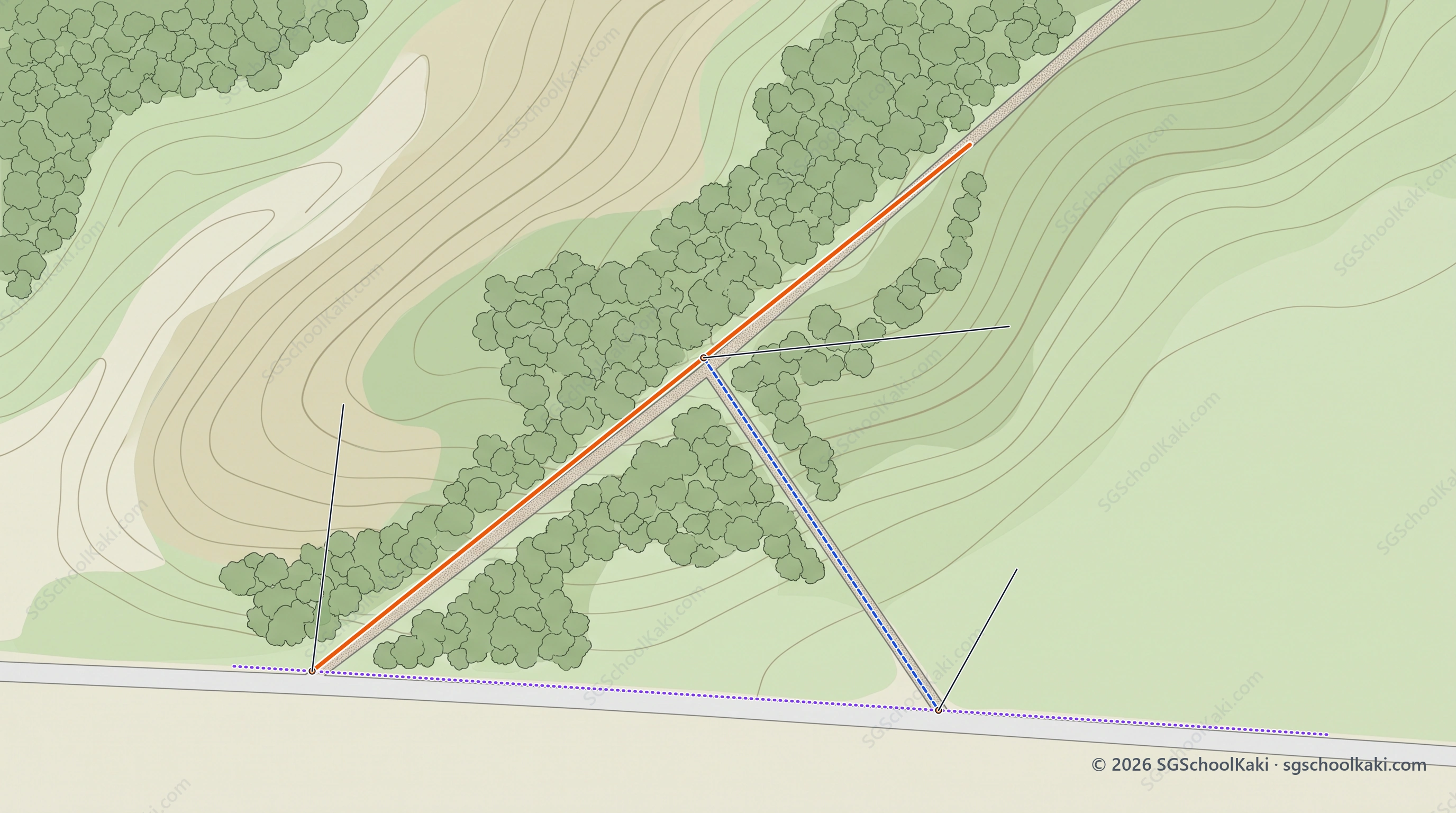
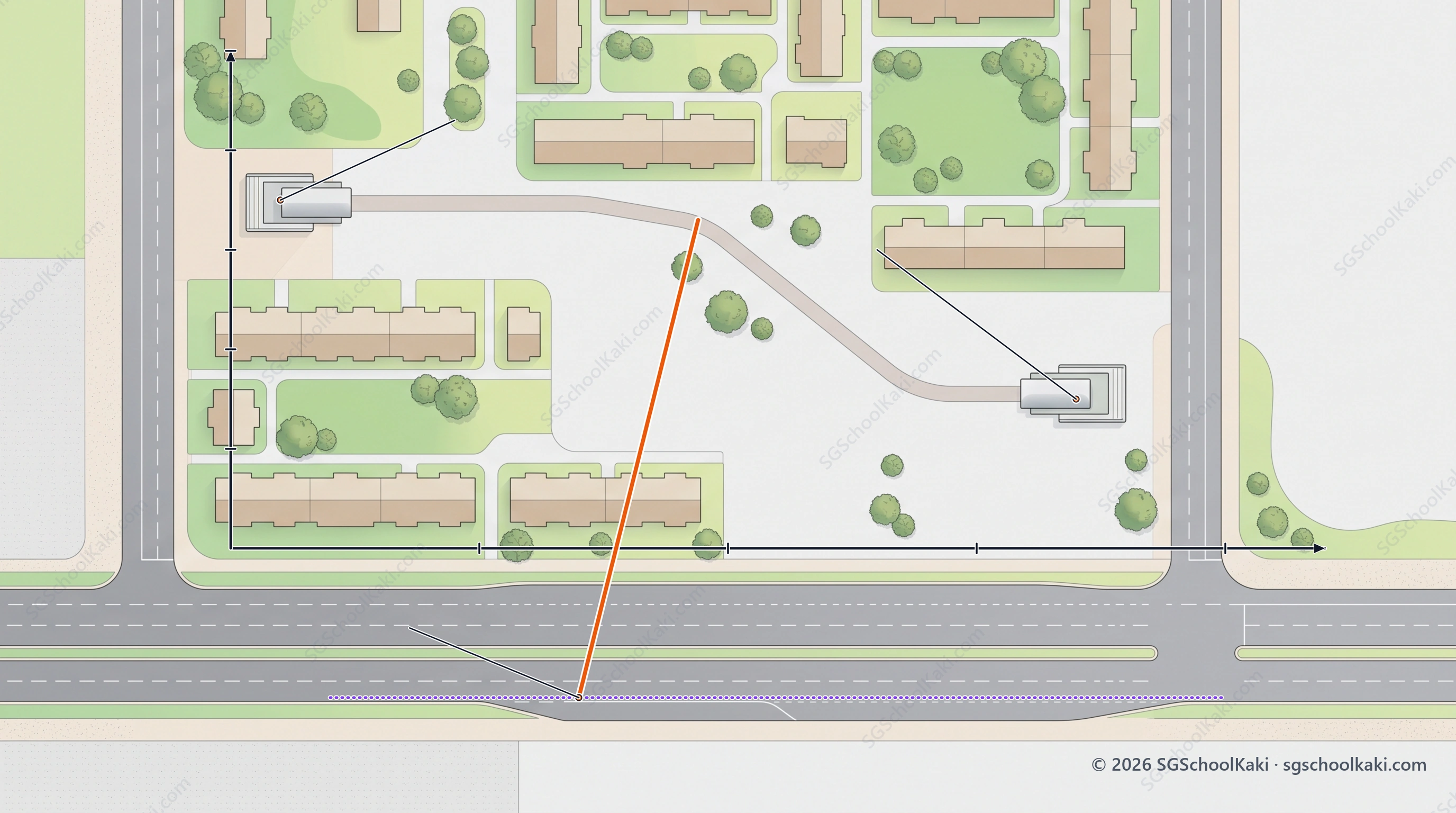
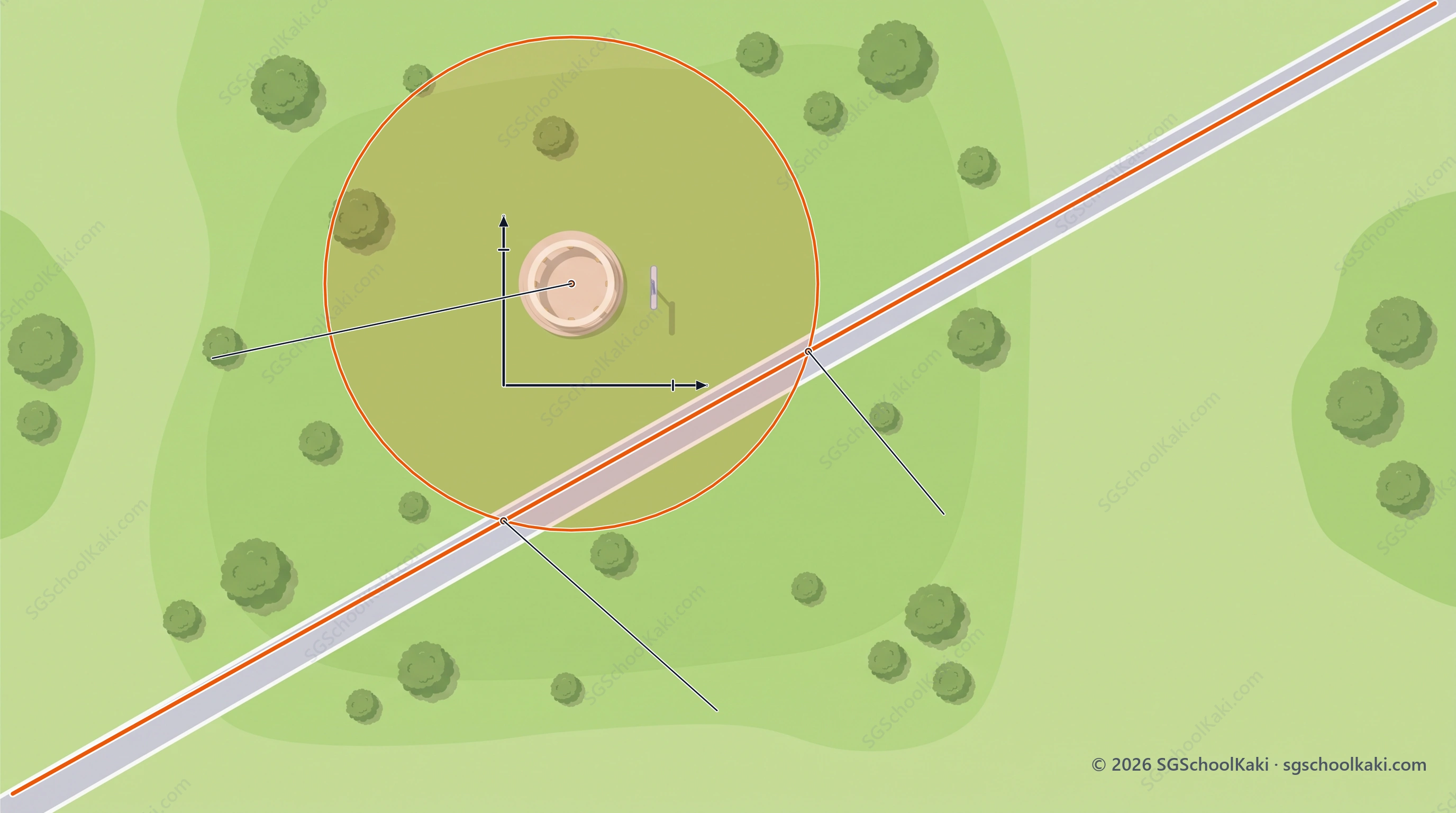
Three situations where a straight line or a circle appears on a map. The pictures come first; the lines, points and circle drawn over them come from the same numbers as the solutions.
Maps of paths and roads are drawn on grids, so a straight trail can be described by one equation, and where two paths meet can be found by calculation instead of measuring.
On a plan of a nature reserve, each grid square stands for ten metres. A straight trail starts at A(1,1) and passes through J(6,5). A road runs along the line x+16y−17=0, passing through A. A side trail leaves the trail at J and heads towards the road in the direction with gradient −23 on the plan.
(a)Find the equation of the trail in the form y=mx+c.
(b)Find the angle that the trail makes with the x-axis of the plan (its angle of inclination), correct to 1 decimal place.
(c)Find the equation of the side trail in the form y=mx+c.
(d)Find the coordinates of the point T where the side trail meets the road.
Show full solutionHide solution
Colour keygradientmidpoint, centre or other key resultfinal result
(a)
m=6−15−1=54
Gradient = change in y divided by change in x (rise over run).
y−1=54(x−1)
Point-slope form: y−y1=m(x−x1).
y=54x−54+1
Expand the bracket.
y=54x+51
Collect the constants.
(b)
Since tanθ=m, θ=tan−1(54)=38.7∘ (1 d.p.).
The gradient is positive, so the line leans up to the right and θ is acute.
(c)
The line goes through the point above and has the given gradient.
y−5=(−23)(x−6)
Point-slope form: y−y1=m(x−x1).
y=−23x+9+5
Expand the bracket.
y=−23x+14
Collect the constants.
(d)
3x+2y−28=0⟺y=−23x+14
Make y the subject of the first equation.
x+16y−17=0⟺y=−161x+1617
Make y the subject of the second equation.
At the point where the lines meet, both equations give the same y, so set the two right-hand sides equal.
−23x+14=−161x+1617
Equal y values: one equation in x only.
−23x+14=−161x+1617
Collect the x terms on the left and the numbers on the right, then divide.
−1623x=−16207
x=9
y=(−23)×9+14=21
Put x back into either equation to find y.
The lines meet at (9,21).
Answer
(a)y=54x+51
(b)θ=38.7∘ (1 d.p.)
(c)y=−23x+14
(d)(9,21)
5101520246810Oxyy=4x−31A(1,7)B(17,3)P(7,−3)y=−3
Maths In Real Life 2
A bus stop the same distance from two exits
A new bus stop is often placed so that walkers from two nearby exits have the same distance to cover. Every point equally far from two places lies on one straight line: the perpendicular bisector of the line joining them.
On a plan, two MRT exits are at A(1,7) and B(17,3). A main road runs along the line y=−3. A new bus stop P on the road is to be exactly the same distance from A and from B.
(a)Express the perpendicular bisector of AB in the form y=mx+c.
(b)Find the coordinates of P.
Show full solutionHide solution
Colour keygradientmidpoint, centre or other key resultfinal result
(a)
The perpendicular bisector of AB passes through the midpoint of AB and is perpendicular to AB.
xM=21+17=218=9
Midpoint: the average of the two x-coordinates.
yM=27+3=210=5
And the average of the two y-coordinates.
So the midpoint is M=(9,5).
m1=17−13−7=16−4=−41
Gradient = change in y divided by change in x (rise over run).
m2=4
Gradient of the bisector: negative reciprocal of the gradient of AB.
y−5=4(x−9)
Point-slope form through the midpoint.
y=4x−36+5
Expand the bracket.
y=4x−31
Collect the constants.
(b)
4x−y−31=0⟺y=4x−31
Make y the subject of the first equation.
y+3=0⟺y=−3
Make y the subject of the second equation.
At the point where the lines meet, both equations give the same y, so set the two right-hand sides equal.
4x−31=−3
Equal y values: one equation in x only.
4x−31=−3
Collect the x terms on the left and the numbers on the right, then divide.
4x=28
x=7
y=4×7−31=−3
Put x back into either equation to find y.
The lines meet at (7,−3).
Answer
(a)y=4x−31
(b)(7,−3)
54Oxyy=95x−4C(2,3)P(0,−4)Q(9,1)r=53
Maths In Real Life 3
How much of a path has Wi-Fi?
In a simple model, the signal of a hotspot reaches the same distance in every direction, so its coverage is drawn as a circle. A straight path through that circle is a chord, and its length tells you how much of the path is covered.
On a plan of a park, each grid square stands for ten metres. A Wi-Fi hotspot is at C(2,3) and its signal reaches a distance of 53 units in every direction. A straight path has equation y=95x−4.
(a)Write down the equation of the circle that marks the edge of the signal, in the form (x−a)2+(y−b)2=r2.
(b)The path enters the covered region at P and leaves it at Q. Find the coordinates of P and Q, and the length of the path inside the covered region, in units and in metres (to the nearest metre).
Show full solutionHide solution
Colour keymidpoint, centre or other key result
(a)
A circle with centre (a,b) and radius r has equation (x−a)2+(y−b)2=r2.
r2=(53)2=53
Square the radius.
(x−2)2+(y−3)2=53
Put the centre and r2 into (x−a)2+(y−b)2=r2.
(b)
Where the line meets the circle, the point satisfies both equations. Replace y in the circle equation by the expression for y from the line, to get an equation in x only.
(x−2)2+(95x−4−3)2=53
Put mx+c in place of y.
(x−2)2+(95x−4−3)2=53⟺x2−9x=0
Expand both brackets, take r2 across, and divide by any common factor.
x2−9x=0
Factorise and use the zero-product rule.
x(x−9)=0
x=0 or x=9
y=95×0−4=−4
Put x=0 into the equation of the line.
y=95×9−4=1
Put x=9 into the equation of the line.
The line meets the circle at (0,−4) and (9,1).
PQ=(9−0)2+(1−(−4))2=81+25=106
Distance formula between the two points of the chord.
Answer
(a)(x−2)2+(y−3)2=53
(b)(0,−4) and (9,1); chord length =106; In metres: 106×10≈103 m.
01
Supports K341-G2-01
Gradients, parallel and perpendicular lines
Coordinate geometry puts a picture into numbers. A point is a pair of coordinates, a line is an equation, and questions about parallel lines, right angles and distances become arithmetic that you can check. Everything starts with the gradient, which says how steeply a line climbs.
Revision. The gradient of the line through (x1,y1) and (x2,y2) is m=x2−x1y2−y1: the rise divided by the run. A positive gradient climbs to the right, a negative gradient falls to the right, a horizontal line has gradient 0 and a vertical line has no gradient at all. The y-intercept is where the line crosses the y-axis.
Four kinds of gradient
Gradient
What the line does
Picture
m>0
climbs from left to right
rises
m<0
falls from left to right
falls
m=0
is horizontal (equation y=c)
flat
undefined
is vertical (equation x=c)
upright
Two lines are parallel when they climb at the same rate, so parallel lines have equal gradients. Two lines are perpendicular when they meet at a right angle, and then the gradients are linked by a surprisingly neat rule.
The Core Idea
Perpendicular gradients multiply to −1.
If neither line is vertical, then m1m2=−1 exactly when the lines are perpendicular. To find the gradient of a perpendicular line, flip the gradient upside down and change its sign. For example, 32 becomes −23, and −4 becomes 41.
Think About It
Why do perpendicular gradients multiply to −1? Start with a line of gradient ab (run a, rise b) and turn it through a right angle.
Show the full workingHide the working
A line with run a and rise b has gradient ab. Turning the picture a quarter turn anticlockwise sends the run a to a rise of a and the rise b to a run of −b (the line now leans the other way).
A quarter turn swaps the two lengths and changes one sign.
ab×−ba=−abab=−1
The new gradient is rise over run: a over −b.
So the product of the two gradients is −1, whatever a and b are (as long as neither is zero).
Answer
The new gradient is −ba, and ab×−ba=−1.
SGSchoolKaki Tip
To see whether a gradient answer is believable, picture the line. If it falls to the right the gradient must be negative; if it is nearly flat the gradient must be small.
Example 1.1
Gradient from two points
The points A(−3,5) and B(2,−5) lie on a straight line. Find the gradient of AB.
Show solutionHide solution
Colour keygradient
m1=2−(−3)−5−5=5−10=−2
Gradient = change in y divided by change in x (rise over run).
Answer
m=−2
Example 1.2
A perpendicular gradient
The points A(1,2) and B(5,5) lie on line l. Find the gradient of l and the gradient of a line perpendicular to l.
Show solutionHide solution
Colour keygradientfinal result
m1=5−15−2=43
Gradient = change in y divided by change in x (rise over run).
m2=−34
Perpendicular lines have gradients with product −1: flip the fraction and change the sign.
m1m2=43⋅(−34)=−1
Check: the product of the two gradients is −1.
Answer
m=43; m2=−34
Example 1.3
Vertical and horizontal lines
The line through A(3,−1) and B(3,6) is l. Find the gradient of l, and the gradient of a line perpendicular to l if there is one.
Show solutionHide solution
The points A and B have the same x-coordinate, so AB is a vertical line: it has no gradient (the run is 0) and its equation is x=3.
Dividing by a run of zero is impossible, so we say the gradient is undefined.
A line perpendicular to a vertical line is horizontal, so its gradient is 0 (equation y=c).
Vertical and horizontal lines are perpendicular, although m1m2=−1 cannot be used: one gradient is undefined.
Answer
gradient undefined (vertical line x=3); gradient 0 (a horizontal line)
The rule m1m2=−1 needs both gradients to exist. A vertical line has no gradient, so a vertical line and a horizontal line are perpendicular even though the rule cannot be used. Spot these cases first, and do not divide by zero.
Example 1.4
Parallel, perpendicular or neither?
Is line AB parallel to line CD, perpendicular to it, or neither? A(1,2), B(3,6), C(0,3) and D(4,1).
Show solutionHide solution
Colour keygradientfinal result
m1=3−16−2=24=2
Gradient = change in y divided by change in x (rise over run).
m2=4−01−3=4−2=−21
Gradient = change in y divided by change in x (rise over run).
m1m2=2⋅(−21)=−1
Product −1: the lines are perpendicular.
The product of the gradients is −1, so the lines are perpendicular.
Answer
perpendicular
Example 1.5
Lines given by equations
Line l1 has equation 2x+3y−6=0 and line l2 has equation 3x−2y+5=0. Decide whether the lines are parallel, perpendicular or neither.
Show solutionHide solution
Colour keyfinal result
2x+3y−6=0⟺y=−32x+2
Make y the subject of line l1, then read the gradient off the coefficient of x.
The coefficient of x in l1 is −32, so its gradient is −32.
3x−2y+5=0⟺y=23x+25
Make y the subject of line l2, then read the gradient off the coefficient of x.
The coefficient of x in l2 is 23, so its gradient is 23.
The line through P(1,2) and Q(5,k) is parallel to a line of gradient 23. Find the value of k.
Show solutionHide solution
Colour keyfinal result
The gradient of the line through the two points is x2−x1y2−y1. For the line to be parallel to a line of gradient 23 it must equal 23.
5−1k−2=23
Gradient with the unknown k = the required gradient.
k−2=23(5−1)
Multiply both sides by the denominator.
k−2=6
Work out the right-hand side.
k=8
Collect the terms in k and solve.
Answer
k=8
Example 1.7
A missing coordinate: perpendicular lines
The line through P(2,3) and Q(k,5) is perpendicular to a line of gradient 23. Find the value of k.
Show solutionHide solution
Colour keyfinal result
The gradient of the line through the two points is x2−x1y2−y1. A line perpendicular to a line of gradient 23 has gradient −32 (the product is −1).
k−25−3=−32
Gradient with the unknown k = the required gradient.
5−3=(−32)(k−2)
Multiply both sides by the denominator.
32k=−32⟺k=−1
Collect the terms in k and solve.
Answer
k=−1
Three points are collinear when they lie on one straight line. Because the gradient is the same everywhere on a line, three points A, B, C are collinear exactly when the gradient of AB equals the gradient of BC (the two segments share the point B). This test needs the segments not to be vertical: points with the same x-coordinate are collinear on the line x=c.
Example 1.8
Showing three points are collinear
Show that the points A(1,2), B(3,6) and C(5,10) are collinear, or show that they are not.
Show solutionHide solution
Colour keygradient
m1=3−16−2=24=2
Gradient = change in y divided by change in x (rise over run).
m2=5−310−6=24=2
Gradient = change in y divided by change in x (rise over run).
m1=m2=2
Equal gradients, and the segments share the point B.
The gradients of AB and BC are equal and the two segments share the point B, so A, B and C lie on one straight line: they are collinear.
Answer
collinear
Example 1.9
Finding the coordinate that makes points collinear
The points A(1,2), B(3,6) and C(7,k) are collinear. Find the value of k.
Show solutionHide solution
Colour keygradientfinal result
m1=3−16−2=24=2
Gradient = change in y divided by change in x (rise over run).
Points are collinear when the gradient of BC equals the gradient of AB, so write BC's gradient with k and set it equal to 2.
7−3k−6=2
Gradient of BC = gradient of AB.
k−6=2(7−3)
Multiply both sides by the denominator.
k−6=8
Work out the right-hand side.
k=14
Collect the terms in k and solve.
Answer
k=14
02
Supports K341-G2-02
Midpoints, ratios and parallelograms
The midpoint of a segment is the point exactly halfway along it. Its coordinates are the averages of the end-point coordinates. The same idea of shared halves explains a useful fact about parallelograms: their diagonals cut each other in half.
The Core Idea
The midpoint is the average, coordinate by coordinate.
The midpoint of A(x1,y1) and B(x2,y2) is (2x1+x2,2y1+y2). If the midpoint and one end are known, use the same two averages the other way round to find the other end.
Example 2.1
Midpoint of a segment
Find the midpoint of the line segment joining A(−3,2) and B(5,6).
Show solutionHide solution
Colour keymidpoint, centre or other key result
xM=2−3+5=22=1
Midpoint: the average of the two x-coordinates.
yM=22+6=28=4
And the average of the two y-coordinates.
The midpoint of AB is M=(1,4).
Answer
M=(1,4)
Example 2.2
Finding the other end of a segment
M(5,8) is the midpoint of AB and A is the point (1,2). Find the coordinates of B.
Show solutionHide solution
Colour keymidpoint, centre or other key result
The midpoint is the average of the end-points, so each coordinate of M is halfway between the matching coordinates of A and B. Write B=(p,q).
21+p=5⟺p=5×2−1
Set the average equal to the x-coordinate of M and solve for p.
p=10−1=9
22+q=8⟺q=8×2−2
The same for the y-coordinates.
q=16−2=14
So B=(9,14).
Answer
B=(9,14)
Think About It
In a parallelogram ABCD the diagonals AC and BD bisect each other. Why does that let us find D when A, B and C are known?
Show the full workingHide the working
Both diagonals have the same midpoint M. So M can be found from A and C, and then D is the point whose midpoint with B is M.
A shared midpoint is a shared pair of averages.
Answer
Because M is the midpoint of AC and of BD, find M from A and C, then use it to find D from B.
Example 2.3
The fourth vertex of a parallelogram
ABCD is a parallelogram with A(0,0), B(4,1) and C(6,5). Find the coordinates of D.
Show solutionHide solution
Colour keymidpoint, centre or other key result
The diagonals of a parallelogram bisect each other, so AC and BD have the same midpoint.
xM=20+6=26=3
Midpoint: the average of the two x-coordinates.
yM=20+5=25=25
And the average of the two y-coordinates.
The midpoint of AC is M=(3,25), and it is also the midpoint of BD. Write D=(p,q).
24+p=3⟺p=6−4
Midpoint of BD has the same x-coordinate as M.
p=2
21+q=25⟺q=5−1
And the same for the y-coordinates.
q=4
So D=(2,4).
Answer
D=(2,4)
Sometimes a point splits a segment in a given ratio, say AR:RB=m:n. Draw a right-angled triangle on AB: the smaller triangle on AR is similar to it, so the run and the rise are both shared in the ratio m:(m+n). The same idea of similar triangles can extend a line to meet an axis.
Example 2.4
A point dividing a segment in a ratio
The point R lies on the line segment AB, where A is (1,2) and B is (9,10), and AR:RB=3:1. Find the coordinates of R.
Show solutionHide solution
Colour keymidpoint, centre or other key result
AR:RB=3:1, so R is 3 parts out of 4 along the way from A to B. Similar triangles show that the horizontal and the vertical distances are shared in the same ratio.
Draw a right-angled triangle on AB; the smaller triangle on AR is similar to it.
xR=1+43×(9−1)=1+43×8=7
Start at A and move the fraction m+nm of the run.
yR=2+43×(10−2)=2+43×8=8
The same fraction of the rise.
So R=(7,8).
Answer
R=(7,8)
Example 2.5
Extending a line to an axis
The line through A(2,3) and B(4,7) meets the y-axis at C. Use similar triangles to find the coordinates of C.
Show solutionHide solution
Colour keygradientmidpoint, centre or other key result
Let the line AB meet the y-axis at C. A, B and C lie on one straight line, so as you move along it the x-coordinate and the y-coordinate change in the same proportion (similar triangles). Let f be the fraction of the way from A to B at which the x-coordinate reaches 0.
Use the run from A to the y-axis and the run from A to B.
f=4−20−2=2−2=−1
The fraction of the way from A to B at which the x-coordinate reaches 0.
yC=3+(−1)×(7−3)=3+(−1)×4=−1
Move the same fraction of the rise from A.
So the line meets the y-axis at C=(0,−1).
Answer
C=(0,−1)
SGSchoolKaki Tip
A parallelogram problem can be checked at the end: opposite sides must have equal gradients, and the two diagonals must give the same midpoint.
03
Supports K341-G2-01 · K341-G2-02
Equations of lines, bisectors and intersections
Revision. A horizontal line has equation y=c and a vertical line has equation x=c. A line through (x1,y1) with gradient m has equation y−y1=m(x−x1), which can be tidied to y=mx+c. Two lines meet where both equations are true at once, so solve them as simultaneous equations.
To find the equation of a straight line you need a gradient and a point. When two points are given, the gradient comes from them. When the line is described as parallel or perpendicular to another, the gradient comes from that line. In every case, finish with the point-slope form y−y1=m(x−x1) and tidy it up.
Example 3.1
Equation of the line through two points
Find the equation of the line through A(1,2) and B(4,8), in the form y=mx+c and in the form ax+by+c=0 with whole-number coefficients.
Show solutionHide solution
Colour keygradientfinal result
m=4−18−2=36=2
Gradient = change in y divided by change in x (rise over run).
y−2=2(x−1)
Point-slope form: y−y1=m(x−x1).
y=2x−2+2
Expand the bracket.
y=2x
Collect the constants.
y=2x⟺2x−y=0
Move every term to the left and clear fractions: whole-number coefficients, x term positive.
Answer
y=2x; 2x−y=0
Example 3.2
A point and a gradient
A line passes through A(1,2) and has gradient −23. Find its equation in the form y=mx+c.
Show solutionHide solution
Colour keyfinal result
The line goes through the point above and has the given gradient.
y−2=(−23)(x−1)
Point-slope form: y−y1=m(x−x1).
y=−23x+23+2
Expand the bracket.
y=−23x+27
Collect the constants.
Answer
y=−23x+27
Example 3.3
A parallel line
Find the equation of the line through A(3,2) that is parallel to the line 2x+3y−6=0. Give your answer in the form y=mx+c.
Show solutionHide solution
Colour keyfinal result
2x+3y−6=0⟺y=−32x+2
Make y the subject to read the gradient.
So the given line has gradient −32.
A parallel line has the same gradient.
y−2=(−32)(x−3)
Point-slope form: y−y1=m(x−x1).
y=−32x+2+2
Expand the bracket.
y=−32x+4
Collect the constants.
Answer
y=−32x+4
Example 3.4
A perpendicular line
The line l passes through C(0,0) and D(2,4). Find the equation of the line through A(3,2) that is perpendicular to l. Give your answer in the form y=mx+c.
Show solutionHide solution
Colour keygradientfinal result
m1=2−04−0=24=2
Gradient = change in y divided by change in x (rise over run).
m2=−21
Perpendicular: flip the gradient and change its sign.
y−2=(−21)(x−3)
Point-slope form: y−y1=m(x−x1).
y=−21x+23+2
Expand the bracket.
y=−21x+27
Collect the constants.
Answer
y=−21x+27
The Core Idea
The perpendicular bisector passes through the midpoint at a right angle.
The perpendicular bisector of AB is the line through the midpoint of AB with gradient −mAB1. Every point on it is the same distance from A and from B.
Example 3.5
The perpendicular bisector of a segment
A is the point (1,2) and B is the point (5,8). Express the perpendicular bisector of AB in the form y=mx+c.
Show solutionHide solution
Colour keygradientmidpoint, centre or other key resultfinal result
The perpendicular bisector of AB passes through the midpoint of AB and is perpendicular to AB.
xM=21+5=26=3
Midpoint: the average of the two x-coordinates.
yM=22+8=210=5
And the average of the two y-coordinates.
So the midpoint is M=(3,5).
m1=5−18−2=46=23
Gradient = change in y divided by change in x (rise over run).
m2=−32
Gradient of the bisector: negative reciprocal of the gradient of AB.
y−5=(−32)(x−3)
Point-slope form through the midpoint.
y=−32x+2+5
Expand the bracket.
y=−32x+7
Collect the constants.
Answer
y=−32x+7
Example 3.6
Where two lines meet
The line l1 has equation 2x−y+1=0 and the line l2 has equation x+2y−7=0. Find the coordinates of the point where they meet.
Show solutionHide solution
Colour keymidpoint, centre or other key result
2x−y+1=0⟺y=2x+1
Make y the subject of the first equation.
x+2y−7=0⟺y=−21x+27
Make y the subject of the second equation.
At the point where the lines meet, both equations give the same y, so set the two right-hand sides equal.
2x+1=−21x+27
Equal y values: one equation in x only.
2x+1=−21x+27
Collect the x terms on the left and the numbers on the right, then divide.
25x=25
x=1
y=2×1+1=3
Put x back into either equation to find y.
The lines meet at (1,3).
Answer
(1,3)
The angle of inclinationθ of a line is the angle it makes with the positive x-axis, measured anticlockwise. It is linked to the gradient by m=tanθ. A line that climbs has an acute angle of inclination; a line that falls has an obtuse one.
Example 3.7
From an angle to a gradient
A line through A(1,2) has an angle of inclination of 56∘. Find its gradient correct to 2 decimal places, and its equation in the form y=mx+c.
Show solutionHide solution
The gradient is the tangent of the angle of inclination: m=tan56∘=1.48 (2 d.p.).
The angle is measured anticlockwise from the positive x-axis.
y−2=1.48(x−1)⟺y=1.48x+0.52
Point-slope form with this gradient, then make y the subject.
Answer
y=1.48x+0.52
Example 3.8
From a gradient to an angle
A line has gradient 2. Find its angle of inclination, correct to 1 decimal place.
Show solutionHide solution
Since tanθ=m, θ=tan−1(2)=63.4∘ (1 d.p.).
The gradient is positive, so the line leans up to the right and θ is acute.
Answer
θ=63.4∘ (1 d.p.)
SGSchoolKaki Tip
A negative gradient always gives an obtuse angle of inclination. Use the positive value tan−1∣m∣ in your calculator, then subtract it from 180∘.
Locked · Chapter 7
You've read the free 26%. Unlock the rest of Chapter 7.
Still to read in this chapter:
Area from coordinates
Triangles and quadrilaterals
The equation of a circle
Lines, tangents and chords
Formula panel
Exercise
$9one-time · all 17 chapters · no subscription
Worked examples, formulas and exam checks. The whole A-Math syllabus.
ONE PRICE17chapters
Premium members get all 17 chapters included.
Notes version 1.0 · Last updated 3 Nov 2026 · Chapter 7 of 17