SGSchoolKaki
Loading...

Not in G2 · G3 Additional Maths only

Chapter 5 · Additional Maths · A5 Binomial expansions

Binomial expansions

Multiplying a bracket by itself again and again is slow, and one slip spoils everything. The binomial theorem writes down every term of (a+b)n(a + b)^n at once, from Pascal's triangle for small powers or from binomial coefficients for any positive whole number nn. By the end you can expand a bracket, pick out one term or one coefficient, find unknown constants, and use the first few terms to estimate a number. This chapter is not in the G2 syllabus: it is for the G3 Additional Mathematics course only.

Your outcome tracker0 / 7
Let's go! Tick an outcome once you can pass its exam check. Saved on this device.
Chapter
5
Figure 1 · Pascal's triangle, rows 0 to 6: row 4 is highlighted
Pascal's triangle, rows 0 to 6Pascal's triangle: row 0: 1; row 1: 1, 1; row 2: 1, 2, 1; row 3: 1, 3, 3, 1; row 4: 1, 4, 6, 4, 1; row 5: 1, 5, 10, 10, 5, 1; row 6: 1, 6, 15, 20, 15, 6, 1.row 01row 111row 2121row 31331row 414641row 515101051row 61615201561
3 outcomes · 1 page · every step shown ✦
Read the triangle

Row nn gives the coefficients of (a+b)n(a + b)^n. Each inner number is the sum of the two above it; the power of aa falls while the power of bb rises.

Use the theorem

(nr)=n!r! (n−r)!\binom{n}{r} = \dfrac{n!}{r!\,(n-r)!} is the number in front of an−rbra^{n-r}b^r. Put brackets round each term before you raise it to a power, so its sign and its coefficient are powered too.

Pick one term

The term with brb^r is the (r+1)(r+1)th term. Set the power of xx equal to what you want, solve for rr, and work out only that term.

By the end of this chapter
  • Write out Pascal's triangle and use a row of it to expand (a+b)n(a + b)^n for small nn, including a related expansion deduced from one you already have.
  • Evaluate n!n! and (nr)\binom{n}{r} by the formula and on a calculator, and know what a calculator cannot do.
  • Expand a bracket with the binomial theorem when the terms have coefficients, a negative second term or a fractional second term, in ascending or descending powers.
  • Use the general term to find a particular term, the coefficient of a power of xx, the term independent of xx or an unknown constant.
  • Find coefficients in a product or in a compound bracket, solve for an unknown index or constant, and use the first few terms to estimate a number and comment on its accuracy.
✶
Start here

Maths In Real Life

Two situations where a binomial expansion does real work. The pictures come first; the maths drawn over them is generated from the same numbers that the solutions use.

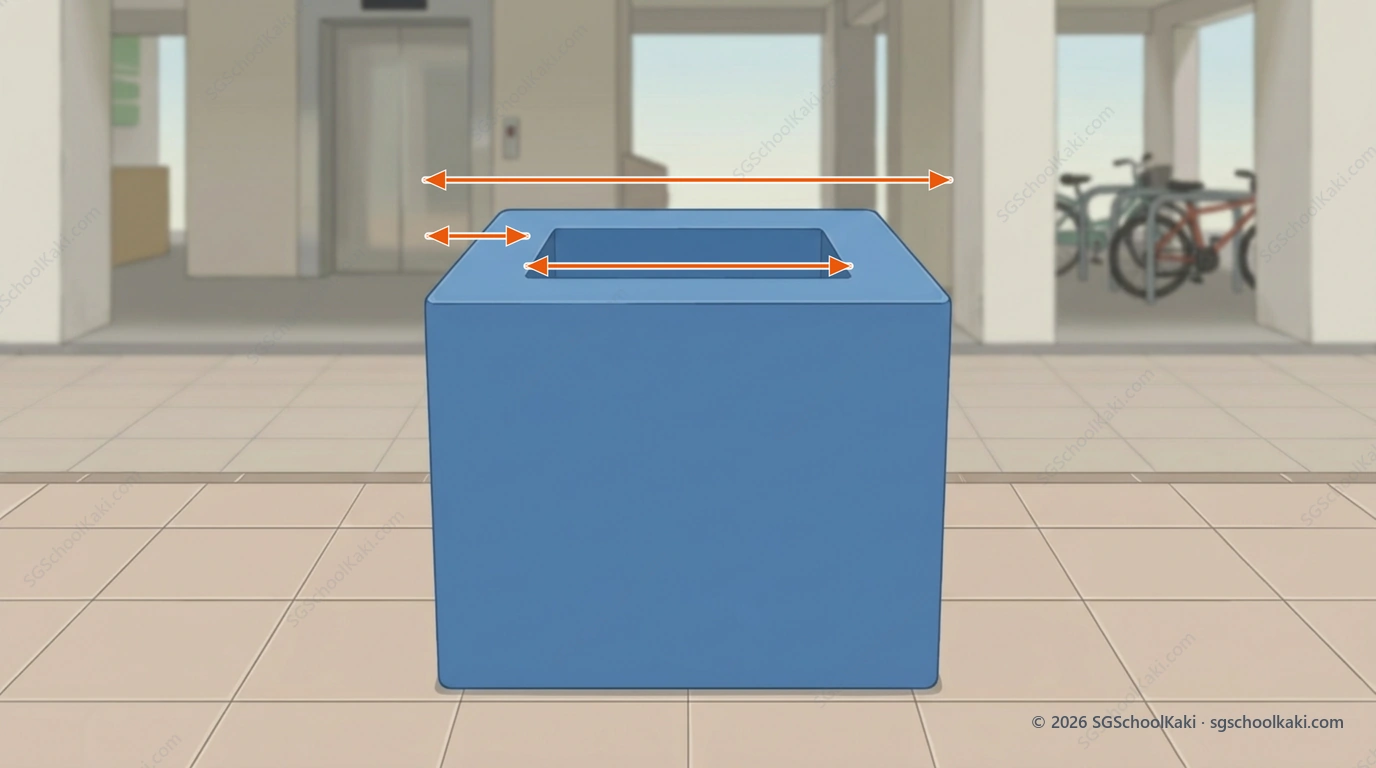
A cube-shaped plastic recycling bin, open at the top, with thick walls, standing on a void-deck floor; the outside edge is marked (x + 2) cm, the wall thickness 1 cm and the inside edge x cm(x+2) cm(x + 2)\text{ cm}1 cm1\text{ cm}x cmx\text{ cm}
Maths In Real Life 1

The recycling bin

A cube-shaped plastic recycling bin stands in the void deck of an HDB block. It is open at the top. Its walls and its floor are all 11 cm thick, so the outside is a cube of edge (x+2)(x + 2) cm, while the hollow inside is xx cm by xx cm and (x+1)(x + 1) cm deep. Expanding the cube of the outside edge is the first step to finding how much plastic the bin contains.

The inside of the bin is xx cm by xx cm by (x+1)(x + 1) cm deep, and the outside is a cube of edge (x+2)(x + 2) cm. Volumes are in cubic centimetres.

  • (a)Use the binomial theorem to expand (x+2)3(x + 2)^3, the volume of the outside cube, in descending powers of xx.
  • (b)The hollow inside has volume x2(x+1)x^2(x + 1). Find an expression for the volume of plastic in the bin.
  • (c)Find the volume of plastic when x=30x = 30.
Show full solutionHide solution
Colour keybinomial coefficientfirst term and its powersecond term and its powerfinal result
(a)
(x+2)3  =(30)x3+(31)x2(2)+(32)x(2)2+(33)(2)3\displaystyle (x + 2)^3\;= \textcolor{#010103}{\binom{3}{0}}\textcolor{#010104}{x^3} + \textcolor{#010103}{\binom{3}{1}}\textcolor{#010104}{x^2}\textcolor{#010105}{(2)} + \textcolor{#010103}{\binom{3}{2}}\textcolor{#010104}{x}\textcolor{#010105}{(2)^2} + \textcolor{#010103}{\binom{3}{3}}\textcolor{#010105}{(2)^3}
(nr)\binom{n}{r} for every rr from 00 to nn: the first term's power falls, the second term's power rises.
(x+2)3  =x3+3x2(2)+3x(2)2+(2)3\displaystyle \phantom{(x + 2)^3}\;= \textcolor{#010104}{x^3} + \textcolor{#010103}{3}\textcolor{#010104}{x^2}\textcolor{#010105}{(2)} + \textcolor{#010103}{3}\textcolor{#010104}{x}\textcolor{#010105}{(2)^2} + \textcolor{#010105}{(2)^3}
Work out each binomial coefficient.
(x+2)3  =x3+3x2(2)+3x(4)+8\displaystyle \phantom{(x + 2)^3}\;= \textcolor{#010104}{x^3} + \textcolor{#010103}{3}\textcolor{#010104}{x^2}\textcolor{#010105}{(2)} + \textcolor{#010103}{3}\textcolor{#010104}{x}\textcolor{#010105}{(4)} + \textcolor{#010105}{8}
Work out each power.
(x+2)3  =x3+6x2+12x+8\displaystyle \phantom{(x + 2)^3}\;= \textcolor{#010106}{x^3 + 6x^2 + 12x + 8}
Multiply out each term and tidy the signs. This is already in descending powers of xx.
(b)
W  =(x+2)3−x2(x+1)\displaystyle W\;= (x + 2)^3 - x^2(x + 1)
Plastic = outside volume minus hollow volume.
W  =x3+6x2+12x+8−x3−x2\displaystyle \phantom{W}\;= x^3 + 6x^2 + 12x + 8 - x^3 - x^2
Put in the expansion from part (a); the hollow is x2×x+x2×1x^2 \times x + x^2 \times 1.
W  =5x2+12x+8\displaystyle \phantom{W}\;= 5x^2 + 12x + 8
The x3x^3 terms cancel and the x2x^2 terms combine.
(c)
W  =5(30)2+12(30)+8\displaystyle W\;= 5(30)^2 + 12(30) + 8
Put x=30x = 30 into each term.
W  =4500+360+8\displaystyle \phantom{W}\;= 4500 + 360 + 8
Powers first, then the multiplications.
W  =4868\displaystyle \phantom{W}\;= 4868
Add up.
Answer
(a) (x+2)3=x3+6x2+12x+8(x + 2)^3 = x^3 + 6x^2 + 12x + 8
(b) W=5x2+12x+8W = 5x^2 + 12x + 8
(c) W=4868W = 4868 cubic centimetres
A glass jar of coins on a study desk next to a window of an HDB flat, with the amount banked, the yearly rate and the number of years marked$2500\$25000.5% a year0.5\%\text{ a year}8 years8\text{ years}
Maths In Real Life 2

The savings jar

Mei Ling empties her coin jar, counts $2500 and pays it into a savings plan that adds 0.5%0.5\% every year. She wants to know what it will be worth in a few years. The rate is small, so the first few terms of a binomial expansion already give an excellent estimate.

Each $1 in the plan grows to (1+x)n(1 + x)^{n} dollars after nn years, where xx is the yearly rate as a decimal. Take n=8n = 8.

  • (a)Expand (1+x)8(1 + x)^{ 8 } in ascending powers of xx as far as the term in x2x^2.
  • (b)Use x=0.005x = 0.005 to estimate (1+x)8(1 + x)^{ 8 }, the growth of each dollar, to 44 decimal places. Then find the estimated value of $2500 after 88 years.
  • (c)Compare your estimate with the value of (1.005)8(1.005)^{ 8 } from a calculator, find the error, and comment on how accurate the estimate is.
Show full solutionHide solution
Colour keybinomial coefficientsecond term and its powerfinal result
(a)
The power of xx goes up as rr goes up, so the 33 lowest-power terms come from r=0,1,2r = 0, 1, 2. The rest are not needed.
T1  =(80)\displaystyle T_{1}\;= \textcolor{#010103}{\binom{8}{0}}
Put r=0r = 0 into the general term.
T1  =1\displaystyle \phantom{T_{1}}\;= \textcolor{#010106}{1}
Work out the binomial coefficient and the powers.
T2  =(81)x\displaystyle T_{2}\;= \textcolor{#010103}{\binom{8}{1}}\textcolor{#010105}{x}
Put r=1r = 1 into the general term.
T2  =8x\displaystyle \phantom{T_{2}}\;= \textcolor{#010106}{8x}
Work out the binomial coefficient and the powers.
T3  =(82)x2\displaystyle T_{3}\;= \textcolor{#010103}{\binom{8}{2}}\textcolor{#010105}{x^2}
Put r=2r = 2 into the general term.
T3  =28x2\displaystyle \phantom{T_{3}}\;= \textcolor{#010106}{28x^2}
Work out the binomial coefficient and the powers.
Put the 33 terms together: 1+8x+28x2+⋯\textcolor{#010106}{1 + 8x + 28x^2} + \cdots.
The dots stand for the higher powers we did not need.
(b)
(1.005)8  =(1+0.005)8\displaystyle \left(1.005\right)^{8}\;= \left(1 + 0.005\right)^{8}
Write 1.0051.005 as 11 plus a small number, 0.0050.005.
Keep the first 33 terms only: 0.0050.005 is small, so its higher powers are tiny. The estimate is the sum of those terms.
1+8(0.005)+28(0.005)2=1+0.04+0.0007=1.0407\displaystyle 1 + \textcolor{#010105}{8(0.005)} + \textcolor{#010105}{28(0.005)^2} = 1 + 0.04 + 0.0007 = \textcolor{#010106}{1.0407}
Powers first, then the multiplications, then add up.
So (1.005)8≈1.0407\left(1.005\right)^{8} \approx 1.0407.
2500×1.0407=2601.75\displaystyle 2500 \times 1.0407 = \textcolor{#010106}{2601.75}
Multiply the starting amount by the estimated growth factor 1.04071.0407.
(c)
A calculator gives (1.005)8≈1.040707\left(1.005\right)^{8} \approx 1.040707 (to 66 decimal places). Compare it with your estimate 1.04071.0407, the answer correct to 44 decimal places.
1.040707−1.0407=0.000007\displaystyle 1.040707 - 1.0407 = \textcolor{#010106}{0.000007}
The difference between the two values: the estimate 1.04071.0407 is below the calculator value.
For the money: the estimate gives about $2601.75 and the calculator value gives about $2601.77.
56×(0.005)3=56×0.000000125=0.000007\displaystyle 56 \times (0.005)^{3} = 56 \times 0.000000125 = \textcolor{#010106}{0.000007}
The first term left out: the binomial coefficient is 5656, times 0.0050.005 to the power 33.
The estimate and the calculator value both round to 1.04071.0407 (to 44 decimal places), so the estimate is correct to 44 decimal places. This was expected: the first term left out is only 0.0000070.000007, smaller than half a unit of the last place, 0.000050.00005, and the later terms are smaller still, because each one has another factor of 0.0050.005.
Compare the two rounded values first; the size of the next term explains the result.
Answer
(a) (1+x)8=1+8x+28x2+⋯(1 + x)^8 = 1 + 8x + 28x^2 + \cdots
(b) (1.005)8≈1.0407\left(1.005\right)^{8} \approx 1.0407; about $2601.75
(c) the estimate 1.04071.0407 is about 0.0000070.000007 below the calculator value; the money is about $2601.75 by the estimate against $2601.77 by calculator; the first term left out is only 0.0000070.000007; the estimate is correct to 44 decimal places, since it and the calculator value both round to 1.04071.0407
01
Supports K341-A5-01

Pascal's triangle and small powers

Multiplying out (a+b)2(a + b)^2 gives a2+2ab+b2a^2 + 2ab + b^2. Do the same for (a+b)5(a + b)^5 and you must multiply five brackets together, which is slow and easy to get wrong. The numbers in front of the terms follow a pattern, and that pattern is called Pascal's triangle.

Start with a single 11 at the top. Every new row begins and ends with 11, and every number in between is the sum of the two numbers above it. Rows are counted from 00, so row nn goes with the power nn: row 22 is 1,2,11, 2, 1 (look at a2+2ab+b2a^2 + 2ab + b^2) and row 33 is 1,3,3,11, 3, 3, 1.

Pascal's triangle, rows 0 to 6Pascal's triangle: row 0: 1; row 1: 1, 1; row 2: 1, 2, 1; row 3: 1, 3, 3, 1; row 4: 1, 4, 6, 4, 1; row 5: 1, 5, 10, 10, 5, 1; row 6: 1, 6, 15, 20, 15, 6, 1.row 01row 111row 2121row 31331row 414641row 515101051row 61615201561
Rows 00 to 66. Row 33 is highlighted: 1,3,3,11, 3, 3, 1 are the coefficients of (a+b)3(a + b)^3.
The Core Idea

Row nn of Pascal's triangle gives the coefficients of (a+b)n(a + b)^n.

In every term the power of aa falls from nn to 00 while the power of bb rises from 00 to nn. The two powers in a term always add up to nn, and there are n+1n + 1 terms.

Here is the whole method for (x+5)3(x + 5)^3. Row 33 is 1,3,3,11, 3, 3, 1. Write each term as coefficient ×\times (first term to a falling power) ×\times (second term to a rising power), then work out the product.

Case table 1: building (x+5)3(x + 5)^3 term by term from row 33
rCoefficientFirst term, falling powerSecond term, rising powerThe term
0011x3x^311x3x^3
1133x2x^2(5)(5)15x215x^2
2233xx(5)2(5)^275x75x
331111(5)3(5)^3125125
Example 1.1

Build a row of the triangle

Write down row 55 of Pascal's triangle.

Show solutionHide solution
Row 00 is just 11. Every row starts and ends with 11, and every number in between is the sum of the two numbers above it.
The two numbers above sit just left and right of the gap.
Row 22 comes from row 11 (1,11, 1): 11, 1+1=21 + 1 = 2, 11.
Add each neighbouring pair of the row above.
Row 33 comes from row 22 (1,2,11, 2, 1): 11, 1+2=31 + 2 = 3, 2+1=32 + 1 = 3, 11.
Row 44 comes from row 33 (1,3,3,11, 3, 3, 1): 11, 1+3=41 + 3 = 4, 3+3=63 + 3 = 6, 3+1=43 + 1 = 4, 11.
Row 55 comes from row 44 (1,4,6,4,11, 4, 6, 4, 1): 11, 1+4=51 + 4 = 5, 4+6=104 + 6 = 10, 6+4=106 + 4 = 10, 4+1=54 + 1 = 5, 11.
Pascal's triangle, rows 0 to 5Pascal's triangle: row 0: 1; row 1: 1, 1; row 2: 1, 2, 1; row 3: 1, 3, 3, 1; row 4: 1, 4, 6, 4, 1; row 5: 1, 5, 10, 10, 5, 1.row 01row 111row 2121row 31331row 414641row 515101051
Answer
row 55: 1,5,10,10,5,11, 5, 10, 10, 5, 1
Example 1.2

Expand with a positive number

Use Pascal's triangle to expand (x+2)4(x + 2)^4.

Show solutionHide solution
Colour keybinomial coefficientfirst term and its powersecond term and its powerfinal result
Row 33 of Pascal's triangle is 1,3,3,11, 3, 3, 1, so row 44 is 11, 1+3=41 + 3 = 4, 3+3=63 + 3 = 6, 3+1=43 + 1 = 4, 11: that is 1,4,6,4,11, 4, 6, 4, 1.
Each inner number is the sum of the two above it.
In (x+2)4(x + 2)^4 the power of the first term falls from 44 to 00 while the power of the second term rises from 00 to 44; the row gives the coefficients in order.
(x+2)4  =x4+4x3(2)+6x2(2)2+4x(2)3+(2)4\displaystyle (x + 2)^4\;= \textcolor{#010104}{x^4} + \textcolor{#010103}{4}\textcolor{#010104}{x^3}\textcolor{#010105}{(2)} + \textcolor{#010103}{6}\textcolor{#010104}{x^2}\textcolor{#010105}{(2)^2} + \textcolor{#010103}{4}\textcolor{#010104}{x}\textcolor{#010105}{(2)^3} + \textcolor{#010105}{(2)^4}
Coefficient, then the first term to a falling power, then the second term to a rising power.
(x+2)4  =x4+4x3(2)+6x2(4)+4x(8)+16\displaystyle \phantom{(x + 2)^4}\;= \textcolor{#010104}{x^4} + \textcolor{#010103}{4}\textcolor{#010104}{x^3}\textcolor{#010105}{(2)} + \textcolor{#010103}{6}\textcolor{#010104}{x^2}\textcolor{#010105}{(4)} + \textcolor{#010103}{4}\textcolor{#010104}{x}\textcolor{#010105}{(8)} + \textcolor{#010105}{16}
Work out each power.
(x+2)4  =x4+8x3+24x2+32x+16\displaystyle \phantom{(x + 2)^4}\;= \textcolor{#010106}{x^4 + 8x^3 + 24x^2 + 32x + 16}
Multiply out each term and tidy the signs.
Answer
(x+2)4=x4+8x3+24x2+32x+16(x + 2)^4 = x^4 + 8x^3 + 24x^2 + 32x + 16
Example 1.3

A negative second term

Use Pascal's triangle to expand (x−2)5(x - 2)^5. Look at the sign of the second term before you start.

Show solutionHide solution
Colour keybinomial coefficientfirst term and its powersecond term and its powerfinal result
Row 44 of Pascal's triangle is 1,4,6,4,11, 4, 6, 4, 1, so row 55 is 11, 1+4=51 + 4 = 5, 4+6=104 + 6 = 10, 6+4=106 + 4 = 10, 4+1=54 + 1 = 5, 11: that is 1,5,10,10,5,11, 5, 10, 10, 5, 1.
Each inner number is the sum of the two above it.
In (x−2)5(x - 2)^5 the power of the first term falls from 55 to 00 while the power of the second term rises from 00 to 55; the row gives the coefficients in order.
(x−2)5  =x5+5x4(−2)+10x3(−2)2+10x2(−2)3+5x(−2)4+(−2)5\displaystyle (x - 2)^5\;= \textcolor{#010104}{x^5} + \textcolor{#010103}{5}\textcolor{#010104}{x^4}\textcolor{#010105}{(-2)} + \textcolor{#010103}{10}\textcolor{#010104}{x^3}\textcolor{#010105}{(-2)^2} + \textcolor{#010103}{10}\textcolor{#010104}{x^2}\textcolor{#010105}{(-2)^3} + \textcolor{#010103}{5}\textcolor{#010104}{x}\textcolor{#010105}{(-2)^4} + \textcolor{#010105}{(-2)^5}
Coefficient, then the first term to a falling power, then the second term to a rising power.
(x−2)5  =x5+5x4(−2)+10x3(4)+10x2(−8)+5x(16)−32\displaystyle \phantom{(x - 2)^5}\;= \textcolor{#010104}{x^5} + \textcolor{#010103}{5}\textcolor{#010104}{x^4}\textcolor{#010105}{(-2)} + \textcolor{#010103}{10}\textcolor{#010104}{x^3}\textcolor{#010105}{(4)} + \textcolor{#010103}{10}\textcolor{#010104}{x^2}\textcolor{#010105}{(-8)} + \textcolor{#010103}{5}\textcolor{#010104}{x}\textcolor{#010105}{(16)} - \textcolor{#010105}{32}
Work out each power. Keep the minus sign of the second term inside its bracket.
(x−2)5  =x5−10x4+40x3−80x2+80x−32\displaystyle \phantom{(x - 2)^5}\;= \textcolor{#010106}{x^5 - 10x^4 + 40x^3 - 80x^2 + 80x - 32}
Multiply out each term and tidy the signs.
Answer
(x−2)5=x5−10x4+40x3−80x2+80x−32(x - 2)^5 = x^5 - 10x^4 + 40x^3 - 80x^2 + 80x - 32
Example 1.4

A coefficient on the first term

Use Pascal's triangle to expand (2x+1)4(2x + 1)^4.

Show solutionHide solution
Colour keybinomial coefficientfirst term and its powerfinal result
Row 33 of Pascal's triangle is 1,3,3,11, 3, 3, 1, so row 44 is 11, 1+3=41 + 3 = 4, 3+3=63 + 3 = 6, 3+1=43 + 1 = 4, 11: that is 1,4,6,4,11, 4, 6, 4, 1.
Each inner number is the sum of the two above it.
In (2x+1)4(2x + 1)^4 the power of the first term falls from 44 to 00 while the power of the second term rises from 00 to 44; the row gives the coefficients in order.
(2x+1)4  =(2x)4+4(2x)3+6(2x)2+4(2x)+1\displaystyle (2x + 1)^4\;= \textcolor{#010104}{(2x)^4} + \textcolor{#010103}{4}\textcolor{#010104}{(2x)^3} + \textcolor{#010103}{6}\textcolor{#010104}{(2x)^2} + \textcolor{#010103}{4}\textcolor{#010104}{(2x)} + \textcolor{#010103}{1}
Coefficient, then the first term to a falling power, then the second term to a rising power.
(2x+1)4  =16x4+4(8x3)+6(4x2)+4(2x)+1\displaystyle \phantom{(2x + 1)^4}\;= \textcolor{#010104}{16x^4} + \textcolor{#010103}{4}\textcolor{#010104}{(8x^3)} + \textcolor{#010103}{6}\textcolor{#010104}{(4x^2)} + \textcolor{#010103}{4}\textcolor{#010104}{(2x)} + \textcolor{#010103}{1}
Work out each power.
(2x+1)4  =16x4+32x3+24x2+8x+1\displaystyle \phantom{(2x + 1)^4}\;= \textcolor{#010106}{16x^4 + 32x^3 + 24x^2 + 8x + 1}
Multiply out each term and tidy the signs.
Answer
(2x+1)4=16x4+32x3+24x2+8x+1(2x + 1)^4 = 16x^4 + 32x^3 + 24x^2 + 8x + 1
Example 1.5

Deduce a related expansion

  • (i)Use Pascal's triangle to expand (1+x)4(1 + x)^{ 4 }.
  • (ii)Hence expand (1+3y)4(1 + 3y)^4 in ascending powers of yy.
Show solutionHide solution
Colour keysecond term and its powerfinal result
(i)
Row 33 of Pascal's triangle is 1,3,3,11, 3, 3, 1, so row 44 is 11, 1+3=41 + 3 = 4, 3+3=63 + 3 = 6, 3+1=43 + 1 = 4, 11: that is 1,4,6,4,11, 4, 6, 4, 1.
Each inner number is the sum of the two above it.
In (1+x)4(1 + x)^4 the power of the first term falls from 44 to 00 while the power of the second term rises from 00 to 44; the row gives the coefficients in order.
(1+x)4  =1+4x+6x2+4x3+x4\displaystyle (1 + x)^4\;= \textcolor{#010106}{1 + 4x + 6x^2 + 4x^3 + x^4}
Coefficient, then the first term to a falling power, then the second term to a rising power.
(ii)
(1+x)4  =1+4x+6x2+4x3+x4\displaystyle (1 + x)^4\;= 1 + 4x + 6x^2 + 4x^3 + x^4
The expansion we already have.
The result is true for every value of xx, so we may replace xx by 3y3y on both sides. Put brackets round the replacement so its sign and coefficient are powered too.
(1+(3y))4  =1+4(3y)+6(3y)2+4(3y)3+(3y)4\displaystyle \left(1 + (3y)\right)^4\;= 1 + \textcolor{#010105}{4(3y)} + \textcolor{#010105}{6(3y)^2} + \textcolor{#010105}{4(3y)^3} + \textcolor{#010105}{(3y)^4}
Every xx becomes the bracket.
(1+(3y))4  =1+12y+54y2+108y3+81y4\displaystyle \phantom{\left(1 + (3y)\right)^4}\;= \textcolor{#010106}{1 + 12y + 54y^2 + 108y^3 + 81y^4}
Work out each power and tidy the signs.
Answer
(i) (1+x)4=1+4x+6x2+4x3+x4(1 + x)^4 = 1 + 4x + 6x^2 + 4x^3 + x^4
(ii) (1+3y)4=1+12y+54y2+108y3+81y4(1 + 3y)^4 = 1 + 12y + 54y^2 + 108y^3 + 81y^4

Pascal's triangle is quick up to about row 66 or 77. After that it is easier to find a single coefficient from a formula, which is the next section.

Rows are counted from 00. The row for (a+b)4(a + b)^4 is the one with 55 numbers, row 44 (not the fourth row you see). A quick check: (a+b)n(a + b)^n always has n+1n + 1 terms.
Think About It
Every row of Pascal's triangle starts and ends with 11. Why? Think about how the terms a4a^4 and b4b^4 arise when you expand (a+b)4(a + b)^4.
Show the full workingHide the working
To get a4a^4 you must pick the aa from all four brackets, and there is exactly one way to do that. The same holds for b4b^4: pick bb every time.
A coefficient counts the ways to make a term. One way each means the first and the last coefficients of every row are 11.
Answer
Because ana^n and bnb^n can each be made in only one way.
SGSchoolKaki Tip

Check before you simplify: the powers in every term should add up to nn, and the coefficients should be the row you read off.

02
Supports K341-A5-02

Factorials and binomial coefficients

A factorial is a product of whole numbers counting down: n!=n×(n−1)×(n−2)×⋯×2×1n! = n \times (n-1) \times (n-2) \times \cdots \times 2 \times 1. So 5!=5×4×3×2×1=1205! = 5 \times 4 \times 3 \times 2 \times 1 = 120. We also agree that 0!=10! = 1; the first Think About It box in this section explains why.

The number in front of a term is a binomial coefficient, written (nr)\binom{n}{r} and read 'n choose r'. It is the number in row nn of Pascal's triangle at position rr, counting from r=0r = 0 on the left.

The Core Idea

(nr)=n!r! (n−r)!\binom{n}{r} = \dfrac{n!}{r!\,(n-r)!}

Cancel (n−r)!(n-r)! to get the quicker form n(n−1)⋯(n−r+1)r!\dfrac{n(n-1)\cdots(n-r+1)}{r!}: rr factors on the top and r!r! on the bottom. The ends are always (n0)=(nn)=1\binom{n}{0} = \binom{n}{n} = 1.

Two small cases are worth knowing by heart: (n1)=n\binom{n}{1} = n and (n2)=n(n−1)2\binom{n}{2} = \dfrac{n(n-1)}{2}. For (n3)\binom{n}{3} you need n(n−1)(n−2)6\dfrac{n(n-1)(n-2)}{6}.

Example 2.1

Evaluate a factorial

Evaluate 6!6!.

Show solutionHide solution
Colour keyfinal result
n!n! means nn times every whole number below it, down to 11.
So n!=n(n−1)(n−2)⋯1n! = n(n-1)(n-2)\cdots 1.
6!  =6×5×4×3×2×1=720\displaystyle 6!\;= 6 \times 5 \times 4 \times 3 \times 2 \times 1 = \textcolor{#010106}{720}
Multiply from the left: each answer is the product so far.
Answer
6!=7206! = 720
Example 2.2

Evaluate a binomial coefficient

Use the formula to evaluate (83)\binom{8}{3}.

Show solutionHide solution
Colour keyfinal result
(83)  =8!3! (8−3)!\displaystyle \binom{8}{3}\;= \dfrac{8!}{3!\,(8-3)!}
Put nn and rr into the coefficient formula.
(83)  =8!3! 5!\displaystyle \phantom{\binom{8}{3}}\;= \dfrac{8!}{3!\,5!}
Work out n−rn - r first: 8−3=58-3 = 5.
(83)  =8×7×63×2×1\displaystyle \phantom{\binom{8}{3}}\;= \dfrac{8 \times 7 \times 6}{3 \times 2 \times 1}
Cancel 5!5! from the top and the bottom: only the first 33 factors of 8!8! stay.
(83)  =3366=56\displaystyle \phantom{\binom{8}{3}}\;= \dfrac{336}{6} = \textcolor{#010106}{56}
Multiply the top, multiply the bottom, divide.
Answer
(83)=56\binom{8}{3} = 56
Example 2.3

Cancel a factorial ratio

Without a calculator, simplify 9!6!\dfrac{ 9! }{ 6! }.

Show solutionHide solution
Colour keyfinal result
9!6!  =9×8×7×6!6!=9×8×7=504\displaystyle \dfrac{9!}{6!}\;= \dfrac{9 \times 8 \times 7 \times 6!}{6!} = 9 \times 8 \times 7 = \textcolor{#010106}{504}
Write 9!9! as the product down to 77, then times 6!6!, which cancels.
Answer
9!6!=504\dfrac{9!}{6!} = 504
Example 2.4

A whole row of coefficients

Find (60),(61),…,(66)\binom{6}{0}, \binom{6}{1}, \ldots, \binom{6}{6} and compare them with row 66 of Pascal's triangle.

Show solutionHide solution
Use the formula for each rr from 00 to 66: (60)=1\binom{6}{0} = 1, (61)=6\binom{6}{1} = 6, (62)=15\binom{6}{2} = 15, (63)=20\binom{6}{3} = 20, (64)=15\binom{6}{4} = 15, (65)=6\binom{6}{5} = 6, (66)=1\binom{6}{6} = 1.
These are exactly the numbers in row 66 of Pascal's triangle: 1,6,15,20,15,6,11, 6, 15, 20, 15, 6, 1.
Row nn of the triangle lists (n0),(n1),…\binom{n}{0}, \binom{n}{1}, \ldots in order.
Answer
1,6,15,20,15,6,11, 6, 15, 20, 15, 6, 1
Example 2.5

Use the calculator key

Evaluate (154)\binom{15}{4} on your calculator, then check it by cancelling.

Show solutionHide solution
On a scientific calculator, enter 1515, press the nCr key, then enter 44 and press equals. The display shows 13651365.
Order matters: nn first, then nCr, then rr.
Check with the short form: 15×14×13×124×3×2×1=3276024=1365\dfrac{15 \times 14 \times 13 \times 12}{4 \times 3 \times 2 \times 1} = \dfrac{32760}{24} = 1365.
Answer
13651365
Example 2.6

Brackets with a factorial

Work out (7−3)!(7 - 3)! and also 7−3!7 - 3!, then explain the difference between the two answers.

Show solutionHide solution
(7−3)!  =4!=24\displaystyle (7-3)!\;= 4! = 24
Brackets first: 7−3=47-3 = 4, then the factorial.
7−3!  =7−3×2×1=7−6=1\displaystyle 7-3!\;= 7 - 3 \times 2 \times 1 = 7 - 6 = 1
Without brackets only the 33 gets the factorial.
Answer
(7−3)!=24(7-3)! = 24 but 7−3!=17-3! = 1: the factorial applies only to the number next to it unless brackets say otherwise
Be careful with the calculator. Type the brackets: (7−3)!(7-3)! is 2424, but 7−3!7 - 3! is 11 because only the 33 gets the factorial. Most scientific calculators also show an error for n!n! once nn reaches 7070.
Think About It
The coefficient of x5x^5 in (1+x)5(1 + x)^5 is 11. If the formula for (50)\binom{5}{0} is to give 11, what must 0!0! equal?
Show the full workingHide the working
(50)  =5!0! (5−0)!\displaystyle \binom{5}{0}\;= \dfrac{5!}{0!\,(5-0)!}
The formula with r=0r = 0.
(50)  =5!0! 5!=10!\displaystyle \phantom{\binom{5}{0}}\;= \dfrac{5!}{0!\,5!} = \dfrac{1}{0!}
The 5!5! cancels and leaves 11 over 0!0!.
The answer must be 11 because the coefficient is 11, so 10!=1\dfrac{1}{0!} = 1. That only works if 0!=10! = 1. This is why we define 0!=10! = 1.
Answer
0!=10! = 1, so that (n0)=1\binom{n}{0} = 1 works.
Think About It
Your calculator can give (703)\binom{70}{3} but shows an error for 70!70!. Why does one work and not the other?
Show the full workingHide the working
A scientific calculator stops at numbers just under 1010010^{100}. Here 69!≈1.71×109869! \approx 1.71 \times 10^{98} fits, but 70!≈1.20×1010070! \approx 1.20 \times 10^{100} does not.
The calculator does not work out (703)\binom{70}{3} by building 70!70! first; it cancels as it goes. By hand: 70×69×683×2×1=3284406=54740\dfrac{70 \times 69 \times 68}{3 \times 2 \times 1} = \dfrac{328440}{6} = 54740.
So for large nn use the short form: it keeps the numbers small, and it is also quicker by hand.
Answer
70!70! is bigger than the calculator can show, but (703)=54740\binom{70}{3} = 54740 stays small if you cancel.
Beyond the Syllabus · Good to Know

The coefficients are symmetric: (nr)=(nn−r)\binom{n}{r} = \binom{n}{n-r}, which is why every row of Pascal's triangle reads the same from both ends. For example (107)=(103)=120\binom{10}{7} = \binom{10}{3} = 120, so you may swap to the smaller rr to save effort. Another is Pascal's rule, binomnr=binomn−1r−1+binomn−1r\\binom{n}{r} = \\binom{n-1}{r-1} + \\binom{n-1}{r}, which is the sum-of-the-two-above rule written with coefficients. These are not required: you only need the triangle's building rule from section 1. This is never examined, so use it only if it helps.

SGSchoolKaki Tip

For (nr)\binom{n}{r} with a large nn, cancel before you multiply. Put the smaller of rr and n−rn - r on the bottom and write only that many factors on top.

03
Supports K341-A5-01

The binomial theorem

Pascal's triangle gets long, but the idea behind it works for any positive whole number nn. The coefficient in front of an−rbra^{n-r}b^r is the binomial coefficient (nr)\binom{n}{r} from the last section.

The Core Idea

(a+b)n=(n0)an+(n1)an−1b\displaystyle (a + b)^n = \binom{n}{0}a^n + \binom{n}{1}a^{n-1}b+(n2)an−2b2+⋯\displaystyle + \binom{n}{2}a^{n-2}b^2 + \cdots+(nr)an−rbr+⋯+bn\displaystyle + \binom{n}{r}a^{n-r}b^r + \cdots + b^n

This is the binomial theorem, for nn a positive whole number. It is on the exam formula page, so you do not have to memorise it, but you must be fluent with it.

To use it, put brackets round aa and bb exactly as they appear, with their coefficients and signs, and then raise each bracket to its power. The bracket does the work for you: (2x)3(2x)^3 is 8x38x^3, and (−3)2(-3)^2 is 99.

Case table 2: building (2x−1)4(2x - 1)^4 term by term with the theorem
rCoefficientFirst term, falling powerSecond term, rising powerThe term
00(40)=1\binom{4}{0} = 1(2x)4(2x)^41116x416x^4
11(41)=4\binom{4}{1} = 4(2x)3(2x)^3(−1)(-1)−32x3-32x^3
22(42)=6\binom{4}{2} = 6(2x)2(2x)^2(−1)2(-1)^224x224x^2
33(43)=4\binom{4}{3} = 4(2x)(2x)(−1)3(-1)^3−8x-8x
44(44)=1\binom{4}{4} = 111(−1)4(-1)^411
Example 3.1

The simplest case: a=1a = 1

Use the binomial theorem to expand (1+x)5(1 + x)^5.

Show solutionHide solution
Colour keybinomial coefficientsecond term and its powerfinal result
(1+x)5  =(50)+(51)x+(52)x2+(53)x3+(54)x4+(55)x5\displaystyle (1 + x)^5\;= \textcolor{#010103}{\binom{5}{0}} + \textcolor{#010103}{\binom{5}{1}}\textcolor{#010105}{x} + \textcolor{#010103}{\binom{5}{2}}\textcolor{#010105}{x^2} + \textcolor{#010103}{\binom{5}{3}}\textcolor{#010105}{x^3} + \textcolor{#010103}{\binom{5}{4}}\textcolor{#010105}{x^4} + \textcolor{#010103}{\binom{5}{5}}\textcolor{#010105}{x^5}
(nr)\binom{n}{r} for every rr from 00 to nn: the first term's power falls, the second term's power rises.
(1+x)5  =1+5x+10x2+10x3+5x4+x5\displaystyle \phantom{(1 + x)^5}\;= \textcolor{#010106}{1 + 5x + 10x^2 + 10x^3 + 5x^4 + x^5}
Work out each binomial coefficient.
Answer
(1+x)5=1+5x+10x2+10x3+5x4+x5(1 + x)^5 = 1 + 5x + 10x^2 + 10x^3 + 5x^4 + x^5
Example 3.2

A coefficient on the first term

Use the binomial theorem to expand (2x+3)4(2x + 3)^4.

Show solutionHide solution
Colour keybinomial coefficientfirst term and its powersecond term and its powerfinal result
(2x+3)4  =(40)(2x)4+(41)(2x)3(3)+(42)(2x)2(3)2+(43)(2x)(3)3+(44)(3)4\displaystyle (2x + 3)^4\;= \textcolor{#010103}{\binom{4}{0}}\textcolor{#010104}{(2x)^4} + \textcolor{#010103}{\binom{4}{1}}\textcolor{#010104}{(2x)^3}\textcolor{#010105}{(3)} + \textcolor{#010103}{\binom{4}{2}}\textcolor{#010104}{(2x)^2}\textcolor{#010105}{(3)^2} + \textcolor{#010103}{\binom{4}{3}}\textcolor{#010104}{(2x)}\textcolor{#010105}{(3)^3} + \textcolor{#010103}{\binom{4}{4}}\textcolor{#010105}{(3)^4}
(nr)\binom{n}{r} for every rr from 00 to nn: the first term's power falls, the second term's power rises.
(2x+3)4  =(2x)4+4(2x)3(3)+6(2x)2(3)2+4(2x)(3)3+(3)4\displaystyle \phantom{(2x + 3)^4}\;= \textcolor{#010104}{(2x)^4} + \textcolor{#010103}{4}\textcolor{#010104}{(2x)^3}\textcolor{#010105}{(3)} + \textcolor{#010103}{6}\textcolor{#010104}{(2x)^2}\textcolor{#010105}{(3)^2} + \textcolor{#010103}{4}\textcolor{#010104}{(2x)}\textcolor{#010105}{(3)^3} + \textcolor{#010105}{(3)^4}
Work out each binomial coefficient.
(2x+3)4  =16x4+4(8x3)(3)+6(4x2)(9)+4(2x)(27)+81\displaystyle \phantom{(2x + 3)^4}\;= \textcolor{#010104}{16x^4} + \textcolor{#010103}{4}\textcolor{#010104}{(8x^3)}\textcolor{#010105}{(3)} + \textcolor{#010103}{6}\textcolor{#010104}{(4x^2)}\textcolor{#010105}{(9)} + \textcolor{#010103}{4}\textcolor{#010104}{(2x)}\textcolor{#010105}{(27)} + \textcolor{#010105}{81}
Work out each power.
(2x+3)4  =16x4+96x3+216x2+216x+81\displaystyle \phantom{(2x + 3)^4}\;= \textcolor{#010106}{16x^4 + 96x^3 + 216x^2 + 216x + 81}
Multiply out each term and tidy the signs.
Answer
(2x+3)4=16x4+96x3+216x2+216x+81(2x + 3)^4 = 16x^4 + 96x^3 + 216x^2 + 216x + 81
Example 3.3

A negative second term

Expand (3x−2)5(3x - 2)^5. Put the minus sign inside the bracket for the second term.

Show solutionHide solution
Colour keybinomial coefficientfirst term and its powersecond term and its powerfinal result
(3x−2)5  =(50)(3x)5+(51)(3x)4(−2)+(52)(3x)3(−2)2+(53)(3x)2(−2)3+(54)(3x)(−2)4+(55)(−2)5\displaystyle (3x - 2)^5\;= \textcolor{#010103}{\binom{5}{0}}\textcolor{#010104}{(3x)^5} + \textcolor{#010103}{\binom{5}{1}}\textcolor{#010104}{(3x)^4}\textcolor{#010105}{(-2)} + \textcolor{#010103}{\binom{5}{2}}\textcolor{#010104}{(3x)^3}\textcolor{#010105}{(-2)^2} + \textcolor{#010103}{\binom{5}{3}}\textcolor{#010104}{(3x)^2}\textcolor{#010105}{(-2)^3} + \textcolor{#010103}{\binom{5}{4}}\textcolor{#010104}{(3x)}\textcolor{#010105}{(-2)^4} + \textcolor{#010103}{\binom{5}{5}}\textcolor{#010105}{(-2)^5}
(nr)\binom{n}{r} for every rr from 00 to nn: the first term's power falls, the second term's power rises.
(3x−2)5  =(3x)5+5(3x)4(−2)+10(3x)3(−2)2+10(3x)2(−2)3+5(3x)(−2)4+(−2)5\displaystyle \phantom{(3x - 2)^5}\;= \textcolor{#010104}{(3x)^5} + \textcolor{#010103}{5}\textcolor{#010104}{(3x)^4}\textcolor{#010105}{(-2)} + \textcolor{#010103}{10}\textcolor{#010104}{(3x)^3}\textcolor{#010105}{(-2)^2} + \textcolor{#010103}{10}\textcolor{#010104}{(3x)^2}\textcolor{#010105}{(-2)^3} + \textcolor{#010103}{5}\textcolor{#010104}{(3x)}\textcolor{#010105}{(-2)^4} + \textcolor{#010105}{(-2)^5}
Work out each binomial coefficient.
(3x−2)5  =243x5+5(81x4)(−2)+10(27x3)(4)+10(9x2)(−8)+5(3x)(16)−32\displaystyle \phantom{(3x - 2)^5}\;= \textcolor{#010104}{243x^5} + \textcolor{#010103}{5}\textcolor{#010104}{(81x^4)}\textcolor{#010105}{(-2)} + \textcolor{#010103}{10}\textcolor{#010104}{(27x^3)}\textcolor{#010105}{(4)} + \textcolor{#010103}{10}\textcolor{#010104}{(9x^2)}\textcolor{#010105}{(-8)} + \textcolor{#010103}{5}\textcolor{#010104}{(3x)}\textcolor{#010105}{(16)} - \textcolor{#010105}{32}
Work out each power. Keep the minus sign of the second term inside its bracket.
(3x−2)5  =243x5−810x4+1080x3−720x2+240x−32\displaystyle \phantom{(3x - 2)^5}\;= \textcolor{#010106}{243x^5 - 810x^4 + 1080x^3 - 720x^2 + 240x - 32}
Multiply out each term and tidy the signs.
Answer
(3x−2)5=243x5−810x4+1080x3−720x2+240x−32(3x - 2)^5 = 243x^5 - 810x^4 + 1080x^3 - 720x^2 + 240x - 32
Example 3.4

A fractional second term

Expand (x2−1x)4\left(x^2 - \dfrac{1}{x}\right)^4 and simplify each term.

Show solutionHide solution
Colour keybinomial coefficientfirst term and its powersecond term and its powerfinal result
(x2−1x)4  =(40)(x2)4+(41)(x2)3(−1x)+(42)(x2)2(−1x)2+(43)(x2)(−1x)3+(44)(−1x)4\displaystyle \left(x^2 - \dfrac{1}{x}\right)^4\;= \textcolor{#010103}{\binom{4}{0}}\textcolor{#010104}{(x^2)^4} + \textcolor{#010103}{\binom{4}{1}}\textcolor{#010104}{(x^2)^3}\textcolor{#010105}{\left(-\dfrac{1}{x}\right)} + \textcolor{#010103}{\binom{4}{2}}\textcolor{#010104}{(x^2)^2}\textcolor{#010105}{\left(-\dfrac{1}{x}\right)^2} + \textcolor{#010103}{\binom{4}{3}}\textcolor{#010104}{(x^2)}\textcolor{#010105}{\left(-\dfrac{1}{x}\right)^3} + \textcolor{#010103}{\binom{4}{4}}\textcolor{#010105}{\left(-\dfrac{1}{x}\right)^4}
(nr)\binom{n}{r} for every rr from 00 to nn: the first term's power falls, the second term's power rises.
(x2−1x)4  =(x2)4+4(x2)3(−1x)+6(x2)2(−1x)2+4(x2)(−1x)3+(−1x)4\displaystyle \phantom{\left(x^2 - \dfrac{1}{x}\right)^4}\;= \textcolor{#010104}{(x^2)^4} + \textcolor{#010103}{4}\textcolor{#010104}{(x^2)^3}\textcolor{#010105}{\left(-\dfrac{1}{x}\right)} + \textcolor{#010103}{6}\textcolor{#010104}{(x^2)^2}\textcolor{#010105}{\left(-\dfrac{1}{x}\right)^2} + \textcolor{#010103}{4}\textcolor{#010104}{(x^2)}\textcolor{#010105}{\left(-\dfrac{1}{x}\right)^3} + \textcolor{#010105}{\left(-\dfrac{1}{x}\right)^4}
Work out each binomial coefficient.
(x2−1x)4  =x8+4x6(−1x)+6x4(1x2)+4x2(−1x3)+1x4\displaystyle \phantom{\left(x^2 - \dfrac{1}{x}\right)^4}\;= \textcolor{#010104}{x^8} + \textcolor{#010103}{4}\textcolor{#010104}{x^6}\textcolor{#010105}{\left(-\dfrac{1}{x}\right)} + \textcolor{#010103}{6}\textcolor{#010104}{x^4}\textcolor{#010105}{\left(\dfrac{1}{x^2}\right)} + \textcolor{#010103}{4}\textcolor{#010104}{x^2}\textcolor{#010105}{\left(-\dfrac{1}{x^3}\right)} + \textcolor{#010105}{\dfrac{1}{x^4}}
Work out each power. Keep the minus sign of the second term inside its bracket.
(x2−1x)4  =x8−4x5+6x2−4x+1x4\displaystyle \phantom{\left(x^2 - \dfrac{1}{x}\right)^4}\;= \textcolor{#010106}{x^8 - 4x^5 + 6x^2 - \dfrac{4}{x} + \dfrac{1}{x^4}}
Multiply out each term and tidy the signs.
Answer
(x2−1x)4=x8−4x5+6x2−4x+1x4\left(x^2 - \dfrac{1}{x}\right)^4 = x^8 - 4x^5 + 6x^2 - \dfrac{4}{x} + \dfrac{1}{x^4}
Example 3.5

Ascending powers

Expand (3−2x)4(3 - 2x)^4 in ascending powers of xx.

Show solutionHide solution
Colour keybinomial coefficientfirst term and its powersecond term and its powerfinal result
(3−2x)4  =(40)(3)4+(41)(3)3(−2x)+(42)(3)2(−2x)2+(43)(3)(−2x)3+(44)(−2x)4\displaystyle (3 - 2x)^4\;= \textcolor{#010103}{\binom{4}{0}}\textcolor{#010104}{(3)^4} + \textcolor{#010103}{\binom{4}{1}}\textcolor{#010104}{(3)^3}\textcolor{#010105}{(-2x)} + \textcolor{#010103}{\binom{4}{2}}\textcolor{#010104}{(3)^2}\textcolor{#010105}{(-2x)^2} + \textcolor{#010103}{\binom{4}{3}}\textcolor{#010104}{(3)}\textcolor{#010105}{(-2x)^3} + \textcolor{#010103}{\binom{4}{4}}\textcolor{#010105}{(-2x)^4}
(nr)\binom{n}{r} for every rr from 00 to nn: the first term's power falls, the second term's power rises.
(3−2x)4  =(3)4+4(3)3(−2x)+6(3)2(−2x)2+4(3)(−2x)3+(−2x)4\displaystyle \phantom{(3 - 2x)^4}\;= \textcolor{#010104}{(3)^4} + \textcolor{#010103}{4}\textcolor{#010104}{(3)^3}\textcolor{#010105}{(-2x)} + \textcolor{#010103}{6}\textcolor{#010104}{(3)^2}\textcolor{#010105}{(-2x)^2} + \textcolor{#010103}{4}\textcolor{#010104}{(3)}\textcolor{#010105}{(-2x)^3} + \textcolor{#010105}{(-2x)^4}
Work out each binomial coefficient.
(3−2x)4  =81+4(27)(−2x)+6(9)(4x2)+4(3)(−8x3)+16x4\displaystyle \phantom{(3 - 2x)^4}\;= \textcolor{#010104}{81} + \textcolor{#010103}{4}\textcolor{#010104}{(27)}\textcolor{#010105}{(-2x)} + \textcolor{#010103}{6}\textcolor{#010104}{(9)}\textcolor{#010105}{(4x^2)} + \textcolor{#010103}{4}\textcolor{#010104}{(3)}\textcolor{#010105}{(-8x^3)} + \textcolor{#010105}{16x^4}
Work out each power. Keep the minus sign of the second term inside its bracket.
(3−2x)4  =81−216x+216x2−96x3+16x4\displaystyle \phantom{(3 - 2x)^4}\;= \textcolor{#010106}{81 - 216x + 216x^2 - 96x^3 + 16x^4}
Multiply out each term and tidy the signs. This is already in ascending powers of xx.
Answer
(3−2x)4=81−216x+216x2−96x3+16x4(3 - 2x)^4 = 81 - 216x + 216x^2 - 96x^3 + 16x^4
Example 3.6

Descending powers from a constant first term

Expand (2+x)5(2 + x)^5 in descending powers of xx.

Show solutionHide solution
Colour keybinomial coefficientfirst term and its powersecond term and its powerfinal result
(2+x)5  =(50)(2)5+(51)(2)4x+(52)(2)3x2+(53)(2)2x3+(54)(2)x4+(55)x5\displaystyle (2 + x)^5\;= \textcolor{#010103}{\binom{5}{0}}\textcolor{#010104}{(2)^5} + \textcolor{#010103}{\binom{5}{1}}\textcolor{#010104}{(2)^4}\textcolor{#010105}{x} + \textcolor{#010103}{\binom{5}{2}}\textcolor{#010104}{(2)^3}\textcolor{#010105}{x^2} + \textcolor{#010103}{\binom{5}{3}}\textcolor{#010104}{(2)^2}\textcolor{#010105}{x^3} + \textcolor{#010103}{\binom{5}{4}}\textcolor{#010104}{(2)}\textcolor{#010105}{x^4} + \textcolor{#010103}{\binom{5}{5}}\textcolor{#010105}{x^5}
(nr)\binom{n}{r} for every rr from 00 to nn: the first term's power falls, the second term's power rises.
(2+x)5  =(2)5+5(2)4x+10(2)3x2+10(2)2x3+5(2)x4+x5\displaystyle \phantom{(2 + x)^5}\;= \textcolor{#010104}{(2)^5} + \textcolor{#010103}{5}\textcolor{#010104}{(2)^4}\textcolor{#010105}{x} + \textcolor{#010103}{10}\textcolor{#010104}{(2)^3}\textcolor{#010105}{x^2} + \textcolor{#010103}{10}\textcolor{#010104}{(2)^2}\textcolor{#010105}{x^3} + \textcolor{#010103}{5}\textcolor{#010104}{(2)}\textcolor{#010105}{x^4} + \textcolor{#010105}{x^5}
Work out each binomial coefficient.
(2+x)5  =32+5(16)x+10(8)x2+10(4)x3+5(2)x4+x5\displaystyle \phantom{(2 + x)^5}\;= \textcolor{#010104}{32} + \textcolor{#010103}{5}\textcolor{#010104}{(16)}\textcolor{#010105}{x} + \textcolor{#010103}{10}\textcolor{#010104}{(8)}\textcolor{#010105}{x^2} + \textcolor{#010103}{10}\textcolor{#010104}{(4)}\textcolor{#010105}{x^3} + \textcolor{#010103}{5}\textcolor{#010104}{(2)}\textcolor{#010105}{x^4} + \textcolor{#010105}{x^5}
Work out each power.
(2+x)5  =32+80x+80x2+40x3+10x4+x5\displaystyle \phantom{(2 + x)^5}\;= \textcolor{#010106}{32 + 80x + 80x^2 + 40x^3 + 10x^4 + x^5}
Multiply out each term and tidy the signs.
(2+x)5  =x5+10x4+40x3+80x2+80x+32\displaystyle \phantom{(2 + x)^5}\;= \textcolor{#010106}{x^5 + 10x^4 + 40x^3 + 80x^2 + 80x + 32}
The question asks for descending powers of xx, so write the terms in the opposite order.
Answer
(2+x)5=x5+10x4+40x3+80x2+80x+32(2 + x)^5 = x^5 + 10x^4 + 40x^3 + 80x^2 + 80x + 32
The commonest slip is to forget that the power applies to the whole term. (2x)3=8x3(2x)^3 = 8x^3, not 2x32x^3, and (−3)2=9(-3)^2 = 9, not −9-9. Write the brackets first and work them out second.
Think About It
When the second term is negative, the signs in the expansion alternate: plus, minus, plus, minus. Show why, using (x−2)3(x - 2)^3 as the example.
Show the full workingHide the working
The second term is −2-2, and it is raised to the power rr in the (r+1)(r+1)th term. So the sign of that term is the sign of (−2)r(-2)^r.
(−2)0=1(-2)^0 = 1, (−2)1=−2(-2)^1 = -2, (−2)2=4(-2)^2 = 4 and (−2)3=−8(-2)^3 = -8: even powers are positive and odd powers are negative, so the signs of the terms alternate.
This is why (x−2)3=x3−6x2+12x−8(x - 2)^3 = x^3 - 6x^2 + 12x - 8 has signs +,−,+,−+, -, +, -.
Answer
Because (−b)r(-b)^r is positive for even rr and negative for odd rr.
SGSchoolKaki Tip

If the question says 'ascending powers of xx', the lowest power of xx comes first. When the first bracket term has a power of xx the natural order is descending, so you may need to write the terms in reverse.

Locked · Chapter 5

You've read the free 30%. Unlock the rest of Chapter 5.

Still to read in this chapter:

  • The general term
  • Selected terms and products
  • Unknown n and constants
  • Estimates, hence and checking
  • Formula panel
  • Exercise

$9 one-time · all 17 chapters · no subscription

Worked examples, formulas and exam checks.
The whole A-Math syllabus.

Premium members get all 17 chapters included.

Notes version 1.0 · Last updated 3 Nov 2026 · Chapter 5 of 17