A surd is an exact square root such as 2. Its decimal never ends and never repeats, so we keep it as a root instead of rounding it. By the end of this chapter you can simplify surds, expand and rationalise with them, find unknown constants by comparing parts, solve equations that contain them, and give exact answers in geometry.
Your outcome tracker0 / 7
Let's go! Tick an outcome once you can pass its exam check. Saved on this device.
Chapter 3
Figure 1 · a 30-60-90 triangle
r = 1y = sin θcos θ
2 outcomes · 1 page · every step shown ✦
The laws
Roots split over multiplication and division, never over addition. Take out the largest perfect square to reach simplest form.
The conjugate
To rationalise p+qr multiply top and bottom by p−qr. The bottom becomes the whole number p2−q2r.
Test every root
Isolate the root, square the whole side, solve, then test each answer in the original. A negative right-hand side is a rejected answer.
By the end of this chapter
Tell a surd from a rational number, and place a surd between two whole numbers.
Use the laws of surds to simplify roots, then collect like surds into simplest form.
Expand brackets that contain surds, including the squares and the difference of two squares.
Rationalise a denominator with one term or with two terms using the conjugate, and find constants by comparing rational and irrational parts.
Solve equations with surds in the coefficients or with the unknown under a root, reject answers that fail the test, and give exact lengths and areas.
✶
Start here
Maths In Real Life
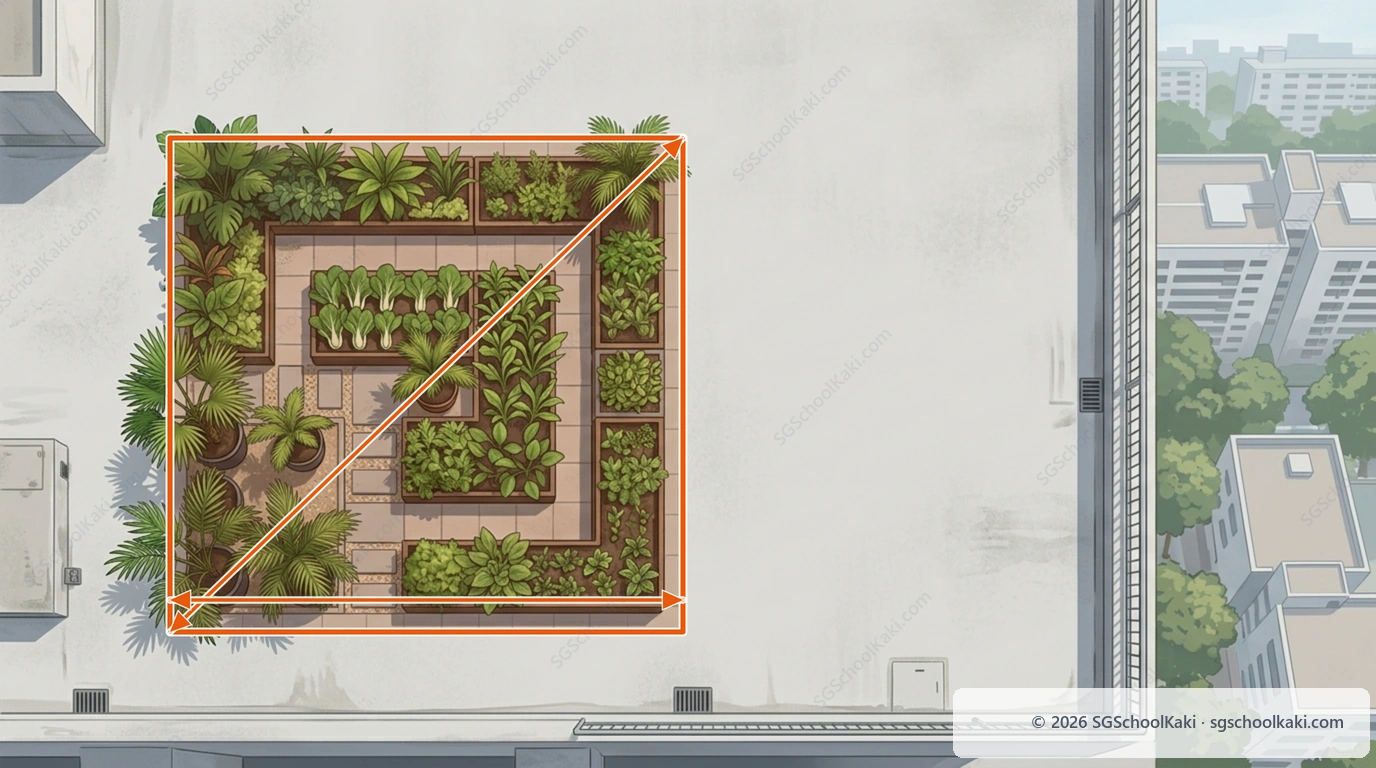
Surds are the topic of exact answers, so one real situation is enough to show why they matter: lengths that come from squares and diagonals are rarely tidy decimals. Pure topics such as this one have fewer real-life uses than curves do, so there is one problem here with four parts. The picture comes first, then the maths is drawn on top by script.
ds50 m2
Maths In Real Life 1
The rooftop garden
Planners of rooftop gardens often lay a square plot and run a path along its diagonal. A square's diagonal is always its side times 2, so the path is a surd unless the side is itself a multiple of 2.
A rooftop garden at an HDB block is a square plot of area 50 square metres. Let the side of the plot be s metres. A straight path of length d metres runs from one corner to the opposite corner.
(a)Find the length of one side of the plot in the form ab metres.
(b)Find the exact length of the path.
(c)A fence goes round the whole plot. Find its length in the form ab metres.
(d)Fencing costs $12 per metre. Find the exact cost of the fence, and its cost to the nearest cent.
Show full solutionHide solution
Colour keyperfect-square factor taken outfinal form or accepted answer
(a)
50=25×2=52
50 has the perfect-square factor 25.
(b)
The diagonal splits the square into two right-angled triangles whose other sides are both the side of the square.
(52)2+(52)2=50+50=100
Pythagoras: each square of a side is the area.
100=10
Take the root and simplify.
(c)
4×52=202
A square has four equal sides.
(d)
12×202=2402
Cost in dollars = price per metre times length in metres. Keep the surd exact.
For a price in dollars, use a calculator: 2402=339.41 to 2 decimal places, so the cost is about $339.41.
Round only at the very end.
Answer
(a)52 m
(b)10 m
(c)202 m
(d) $2402 exactly, which is $339.41 to the nearest cent
01
Supports K341-A3-01
What is a surd? Rational and irrational numbers
Revision. A rational number can be written as a fraction of two whole numbers, such as 43, −5, 0.2 or 49 (which is just 7). Its decimal either stops or repeats.
Take 2. No fraction multiplied by itself gives exactly 2, and its decimal 1.41421… never stops and never repeats. A number like this is irrational. When an irrational number is the root of a rational number, it is called a surd.
The Core Idea
A surd is an irrational root, so we leave it as a root.
n is a surd exactly when n is not the square of a rational number. 12 is a surd. 16 is not, because it is just 4. All the surds in this chapter are square roots.
Case table 1: a root is a surd only when the number under it is not a perfect square
Number
Simplest form
Rational or surd?
Where it sits
16
4
rational (not a surd)
20
25
surd
36
6
rational (not a surd)
50
52
surd
100
10
rational (not a surd)
The diagonal of a unit square has length 2. A compass arc carries it onto the number line.Surds sit between whole numbers: 2, 5 and 8 (which is 22) on one line.
SGSchoolKaki Tip
A calculator shows 2 as 1.414213562, but that is a rounded copy. In this chapter the exact surd is the answer. Decimals are for checking only.
Think About It
Can two surds multiply to give a rational number? Can they add to give one? Try 2×8 first.
Show the full workingHide the working
Colour keyfinal form or accepted answer
2×8=16=4
Multiply under one root.
The product is rational, even though both numbers are irrational.
(3+2)+(3−2)=6
The surd parts cancel.
The sum is rational too: the two surds were opposites.
Answer
Yes to both. A product or a sum of surds can be rational, so never assume that a calculation with surds stays irrational.
Example 1.1
Surd or rational?
Decide which of these numbers are surds, and give a reason for each: 12, 49, 0.16, 20, 7.
Show solutionHide solution
12: there is no whole number or fraction that squares to 12, so its decimal never ends and never repeats. It is irrational, so it is a surd.
An irrational root of a rational number.
49: the number under the root is a perfect square, so 49=7. It is rational, not a surd.
Rational means it can be written as a fraction.
0.16: the number under the root is the square of a fraction, so 0.16=0.4. It is rational, not a surd.
Rational means it can be written as a fraction.
20: there is no whole number or fraction that squares to 20, so its decimal never ends and never repeats. It is irrational, so it is a surd.
An irrational root of a rational number.
7: there is no whole number or fraction that squares to 7, so its decimal never ends and never repeats. It is irrational, so it is a surd.
An irrational root of a rational number.
Answer
Surds: 12, 20, 7. Rational: 49, 0.16.
Example 1.2
Between which whole numbers?
Between which two consecutive whole numbers does each of these lie? 10, 40, 90.
Show solutionHide solution
32=9 and 42=16, and 9<10<16, so 3<10<4.
Find the two perfect squares either side.
62=36 and 72=49, and 36<40<49, so 6<40<7.
Find the two perfect squares either side.
92=81 and 102=100, and 81<90<100, so 9<90<10.
Find the two perfect squares either side.
Answer
3<10<4; 6<40<7; 9<90<10
Example 1.3
Rational or irrational?
Say whether each of these numbers is rational or irrational, and show how you know: 2×8; 2+5; (7)2; 2×3.
Show solutionHide solution
2×8=16=4
Multiply under one root, then simplify.
4 is a rational number.
2+5 is already in simplest form: a whole number plus a surd.
2+5 is irrational: a rational number plus a surd is never rational (if it were, taking away the rational part would make the surd rational).
(7)2=7
A root multiplied by itself gives the number underneath.
7 is a rational number.
2×3=6
Multiply under one root, then simplify.
6 is irrational: it is a non-zero multiple of the surd 6.
Surds follow two laws that let you tidy any root. A root of a product splits into a product of roots, and a root of a quotient splits into a quotient of roots. Together with (a)2=a they are all you need to simplify.
The Core Idea
Roots split over multiplication and division, never over addition.
For a non-negative a and b we have a×b=ab, and ba=ba when b is positive. Reading the first law backwards is how you simplify.
Case table 2: the laws of surds, with numbers
Law
In symbols
With numbers
Product
a×b=ab
3×12=36=6
Quotient
ba=ba
250=25=5
Square
(a)2=a
(7)2=7
Not allowed
a+b=a+b
9+16=5 but 9+16=7
Watch out.9+16 is 25=5, not9+16=7. Never split a root over a sum or a difference.
Simplest form and like surds
A surd is in simplest form when the number under the root has no perfect-square factor except 1. To get there, take out the largest perfect square factor (4, 9, 16, 25, 36, and so on). Surds with the same number under the root are like surds, and only like surds can be added or subtracted, exactly as 2x+5x gives 7x.
The Core Idea
Simplify every surd first, then collect the like surds.
Write each number under a root as a perfect square times something smaller, take the root of the perfect square out, then add or subtract the like surds.
SGSchoolKaki Tip
If you pull out a smaller square than the largest, nothing is lost: 72 becomes 218, and you simply keep going until no square factor is left.
Think About It
A student says that 9+16 is the same as 9+16, which is 7. Find the mistake.
Show the full workingHide the working
Colour keyfinal form or accepted answer
9+16=25=5
Add first, then take the root.
9+16=3+4=7
The student's total.
The two totals are different, so splitting 9+16 over the plus sign is false.
Answer
A root cannot be split over an addition. Only products and quotients split: the correct value of 9+16 is 5.
Write 72 in the form ab, where a and b are integers and b is as small as possible.
Show solutionHide solution
Colour keyperfect-square factor taken outfinal form or accepted answer
72=36×2
Look for the largest perfect square that divides 72. It is 36, because 72=36×2.
72=36×2
Split the root: xy=x×y.
72=62
The root of the perfect square comes out: 36=6.
Answer
62
Example 2.2
A coefficient in front
Simplify 332.
Show solutionHide solution
Colour keyperfect-square factor taken outfinal form or accepted answer
332=316×2
Look for the largest perfect square that divides 32. It is 16, because 32=16×2.
332=316×2
Split the root: xy=x×y.
332=3×42
The root of the perfect square comes out: 16=4.
332=122
Multiply the numbers outside the root.
Answer
122
Example 2.3
Add and subtract like surds
Simplify 12+27−3.
Show solutionHide solution
Colour keyperfect-square factor taken outlike surds collected, or parts matchedfinal form or accepted answer
12+27−3=4×3+9×3−3
Split each number under a root into a perfect square times what is left.
12+27−3=23+33−3
Take the square root of each perfect square, then multiply by the number in front.
12+27−3=(2+3−1)3
Only like surds (the same number under the root) can be added or subtracted.
12+27−3=43
Add the coefficients of the like surds.
Answer
43
Example 2.4
Two different surds and a whole number
Simplify 50+18−8+25.
Show solutionHide solution
Colour keyperfect-square factor taken outlike surds collected, or parts matchedfinal form or accepted answer
50+18−8+25=25×2+9×2−4×2+25
Split each number under a root into a perfect square times what is left.
50+18−8+25=52+32−22+5
Take the square root of each perfect square, then multiply by the number in front.
50+18−8+25=5+(5+3−2)2
Only like surds (the same number under the root) can be added or subtracted.
50+18−8+25=5+62
Add the coefficients of the like surds.
Answer
5+62
Example 2.5
Multiply surds
Simplify 36×22.
Show solutionHide solution
Colour keyperfect-square factor taken outfinal form or accepted answer
36×22=(3×2)6×2
Multiply the numbers in front together and the numbers under the roots together.
36×22=612
Work out each product.
36×22=64×3
12 has a perfect-square factor 4, so simplify.
36×22=123
Take the root of the perfect square out.
Answer
123
Example 2.6
Divide surds
Simplify 431218.
Show solutionHide solution
Colour keyfinal form or accepted answer
431218=412×318
Divide the numbers in front and the roots separately.
431218=4126
18÷3=18÷3=6.
431218=36
Cancel the fraction and simplify the root if you can.
Answer
36
Example 2.7
Which is larger?
Which is larger, 35 or 43? Write each as a single square root to decide.
Show solutionHide solution
Colour keyfinal form or accepted answer
35=32×5=9×5=45
Write 3 as 9 and multiply under one root.
43=42×3=16×3=48
Do the same for the other number.
Both are now square roots, so compare the numbers under the roots: 45 and 48. The larger root is 43.
Answer
35=45 and 43=48, so 43 is larger
Example 2.8
Exact answer, then a calculator check
Simplify 18+32 exactly, then check your answer with a calculator.
Show solutionHide solution
Colour keyperfect-square factor taken outlike surds collected, or parts matchedfinal form or accepted answer
18+32=9×2+16×2
Split each number under a root into a perfect square times what is left.
18+32=32+42
Take the square root of each perfect square, then multiply by the number in front.
18+32=(3+4)2
Only like surds (the same number under the root) can be added or subtracted.
18+32=72
Add the coefficients of the like surds.
Calculator check: the original expression gives 9.8995 and the answer 72 gives 9.8995, so they agree.
Compare the decimals; they must match.
Answer
72
03
Supports K341-A3-01
Expanding brackets that contain surds
Expanding with surds is ordinary expanding, followed by tidying the roots. Multiply every term in the first bracket by every term in the second, then use a×a=a and a×b=ab to simplify, and finally collect the rational parts and the like surds.
The Core Idea
Multiply every term by every term, then tidy the roots.
The three special products save time: (x+y)2, (x−y)2 and (x+y)(x−y). The last one is the most useful, because the surds vanish.
Case table 3: the three special products
Name
Pattern
With surds
Square of a sum
(x+y)2=x2+2xy+y2
(2+3)2=4+43+3=7+43
Square of a difference
(x−y)2=x2−2xy+y2
(7−3)2=7−221+3=10−221
Difference of two squares
(x+y)(x−y)=x2−y2
(3+5)(3−5)=9−5=4
Watch out.(2+3)2 is not 4+3. The middle term 2×2×3 is part of the answer, so squaring a bracket always has three terms.
SGSchoolKaki Tip
Spot a bracket pair like (a+b)(a−b) at once: the answer is the whole number a2−b, with no surd at all.
Example 3.1
A number times a bracket
Expand and simplify 3(2+5).
Show solutionHide solution
Colour keyfinal form or accepted answer
3(2+5)=3×2+3×5
Multiply the number outside by every term in the bracket.
3(2+5)=6+35
Work out each product.
Answer
6+35
Example 3.2
Two brackets
Expand and simplify (2+3)(1−3).
Show solutionHide solution
Colour keylike surds collected, or parts matchedfinal form or accepted answer
(2+3)(1−3)=2−2×3+3−3×3
Multiply every term in the first bracket by every term in the second.
(2+3)(1−3)=2−23+3−3
Simplify each product: a root times itself is the number, and two roots multiply under one root.
(2+3)(1−3)=(2−3)+(−2+1)3
Collect the whole numbers together and the like surds together.
(2+3)(1−3)=−1−3
Simplify.
Answer
−1−3
Example 3.3
Square of a sum
Expand and simplify (2+35)2.
Show solutionHide solution
Colour keyfinal form or accepted answer
(2+35)2=22+2(2)(35)+(35)2
Use (x±y)2=x2±2xy+y2.
(2+35)2=4+125+45
Square each term: (x)2=x and (kx)2=k2x.
(2+35)2=49+125
Work out the total.
Answer
49+125
Example 3.4
Square of two surds
Expand and simplify (7−3)2.
Show solutionHide solution
Colour keyfinal form or accepted answer
(7−3)2=(7)2−2(7)(3)+(3)2
Use (x±y)2=x2±2xy+y2.
(7−3)2=7−221+3
Square each term: (x)2=x and (kx)2=k2x.
(7−3)2=10−221
Work out the total.
Answer
10−221
Example 3.5
The surds vanish
Expand and simplify (4+7)(4−7). What kind of number do you get?
Show solutionHide solution
Colour keyfinal form or accepted answer
(4+7)(4−7)=42−(7)2
Use (x+y)(x−y)=x2−y2: the middle terms cancel.
(4+7)(4−7)=16−7
Square each term: (x)2=x and (kx)2=k2x.
(4+7)(4−7)=9
Work out the total.
Answer
9, a rational number (no surd is left)
Example 3.6
A longer second bracket
Expand and simplify (1+2)(1+22−3).
Show solutionHide solution
Colour keylike surds collected, or parts matchedfinal form or accepted answer
(1+2)(1+22−3)=1+22−3+2+2×22−2×3
Multiply every term in the first bracket by every term in the second.
(1+2)(1+22−3)=1+22−3+2+4−6
Simplify each product: a root times itself is the number, and two roots multiply under one root.
(1+2)(1+22−3)=(1+4)+(2+1)2−3−6
Collect the whole numbers together and the like surds together.
(1+2)(1+22−3)=5+32−3−6
Simplify.
Answer
5+32−3−6
Locked · Chapter 3
You've read the free 27%. Unlock the rest of Chapter 3.
Still to read in this chapter:
Rationalising
Comparing parts
Equations
Exact lengths and proofs
Formula panel
Exercise
$9one-time · all 17 chapters · no subscription
Worked examples, formulas and exam checks. The whole A-Math syllabus.
ONE PRICE17chapters
Premium members get all 17 chapters included.
Notes version 1.0 · Last updated 3 Nov 2026 · Chapter 3 of 17