Chapter 9 · Additional Maths · Trigonometric functions and graphs
Trigonometric functions and graphs: angles, radians and waves
Sine, cosine and tangent describe anything that turns or repeats: a Ferris wheel, a searchlight, a tide. This chapter measures angles in degrees and in radians, finds exact values at any angle with the quadrant rules, reads principal values off the unit circle, and then draws and decodes the graphs of y = a sin(bx) + c, y = a cos(bx) + c and y = a tan(bx). Radians start here and every calculus chapter after this one uses them.
Your outcome tracker0 / 7
Let's go! Tick an outcome once you can pass its exam check. Saved on this device.
Chapter 9
Figure 1 · a sine wave in radians: amplitude 2, shifted up 1
r = 1y = sin θcos θ
5 outcomes · 1 page · every step shown ✦
Radians: π rad = 180°
Multiply degrees by 180π to get radians. Arc length s=rθ and sector area 21r2θ only work when θ is in radians.
Quadrant, basic angle, sign
To find a value at any angle, reduce to the basic angle (the acute angle to the x-axis), then use the quadrant to choose the sign: all, sin, tan, cos (ASTC).
a, b, c read the graph
In y=asin(bx)+c: amplitude ∣a∣, period b360∘ (or b2π), midline y=c. Tangent has period b180∘ and asymptotes.
By the end of this chapter
Convert between degrees and radians, and use s = rθ and A = ½r²θ for arcs and sectors.
Write the six trigonometric ratios from a right-angled triangle and recall the exact values at 30°, 45° and 60° (π/6, π/4, π/3).
Find the exact value of a trigonometric function at an angle of any size, in degrees or radians, using the quadrant sign and the basic angle.
State the principal value of sin⁻¹, cos⁻¹ and tan⁻¹ for a special value, using the unit circle.
State the amplitude, period, midline, maximum and minimum of y = a sin(bx) + c and y = a cos(bx) + c, and the period and asymptotes of y = a tan(bx).
Sketch these graphs over a given interval, and find a, b and c from a described graph.
✶
Start here
Maths In Real Life
Three situations where an angle drives a height, a distance or an area. The pictures come first; the graph in each solution comes from the same numbers.
14 m12 m
Maths In Real Life 1
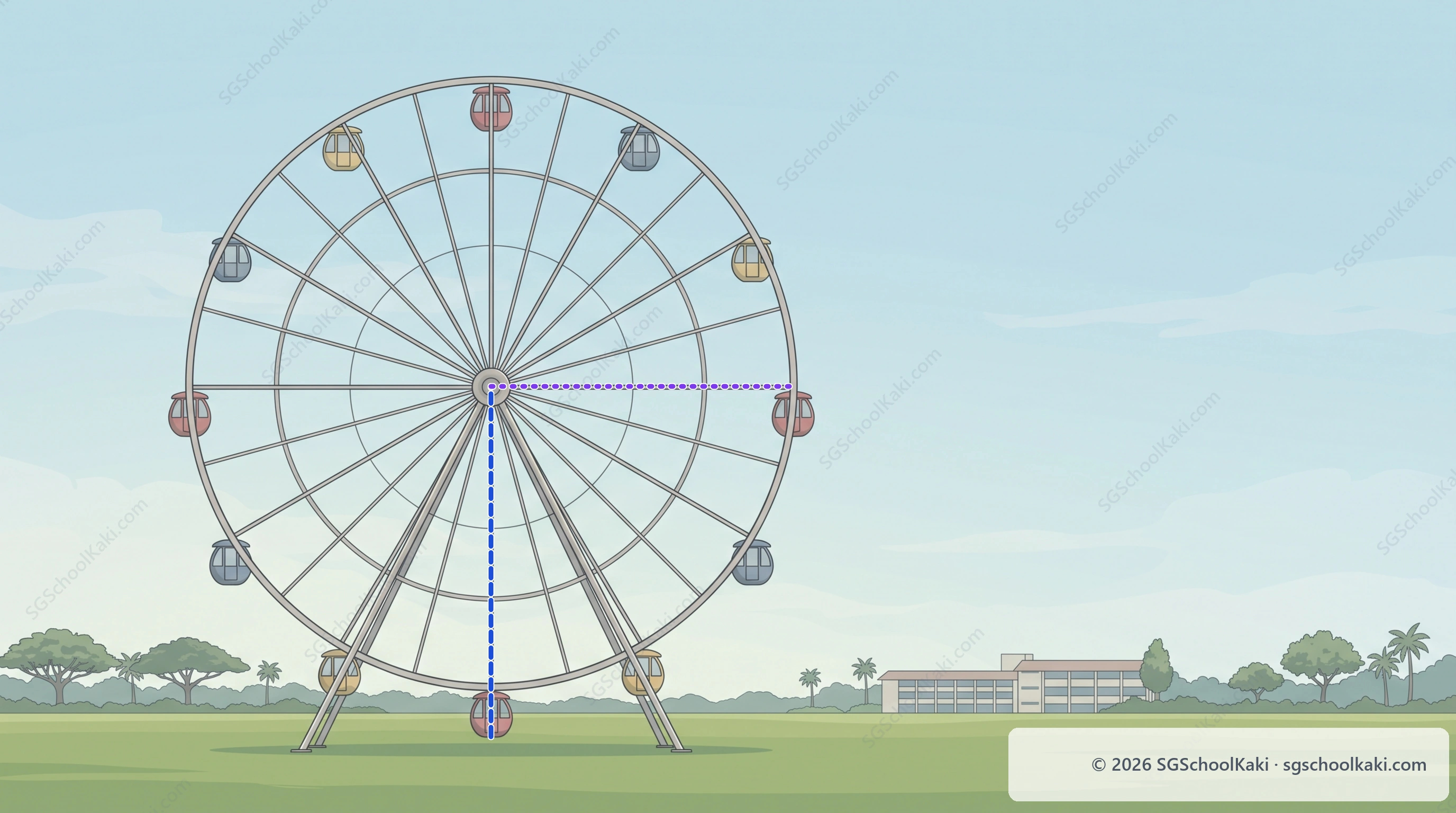
A Ferris wheel at the school carnival
A car on a Ferris wheel rises and falls in a smooth repeating wave as the wheel turns, which is exactly the shape of a cosine curve shifted up by the height of the axle.
At a school carnival a Ferris wheel turns steadily. The height y metres of a car above the ground is given by y=−12cosx+14, where x degrees is the angle the wheel has turned since the car was at its lowest point.
(a)Find the amplitude and the period of this graph, and the greatest and the least height of the car above the ground.
(b)When x=40∘ the car is at a certain height. Find every angle x from 0∘ to 360∘ at which the car is at this same height.
Show full solutionHide solution
Colour keybasic angle, side or quarter periodfinal value
(a)
amplitude=∣−12∣=12
The amplitude is the size of a, ignoring its sign.
period=360∘
With b=1 the curve repeats after one full cycle.
max=14+12=26
Highest value: midline plus amplitude.
min=14−12=2
Lowest value: midline minus amplitude.
(b)
θ1=40∘
The angle inside the trigonometric function at the given point.
θ2=360∘−40∘=320∘
The cosine curve is symmetric about 0 and 360∘: cosθ=cos(360∘−θ), so the height is the same at θ2.
x=40∘ or 320∘
With b=1 the angle is x, so both angles inside the turn are solutions.
Answer
(a) amplitude =12; period =360∘; maximum value =26; minimum value =2
(b)x=40∘ or 320∘
40 mdθplan view
Maths In Real Life 2
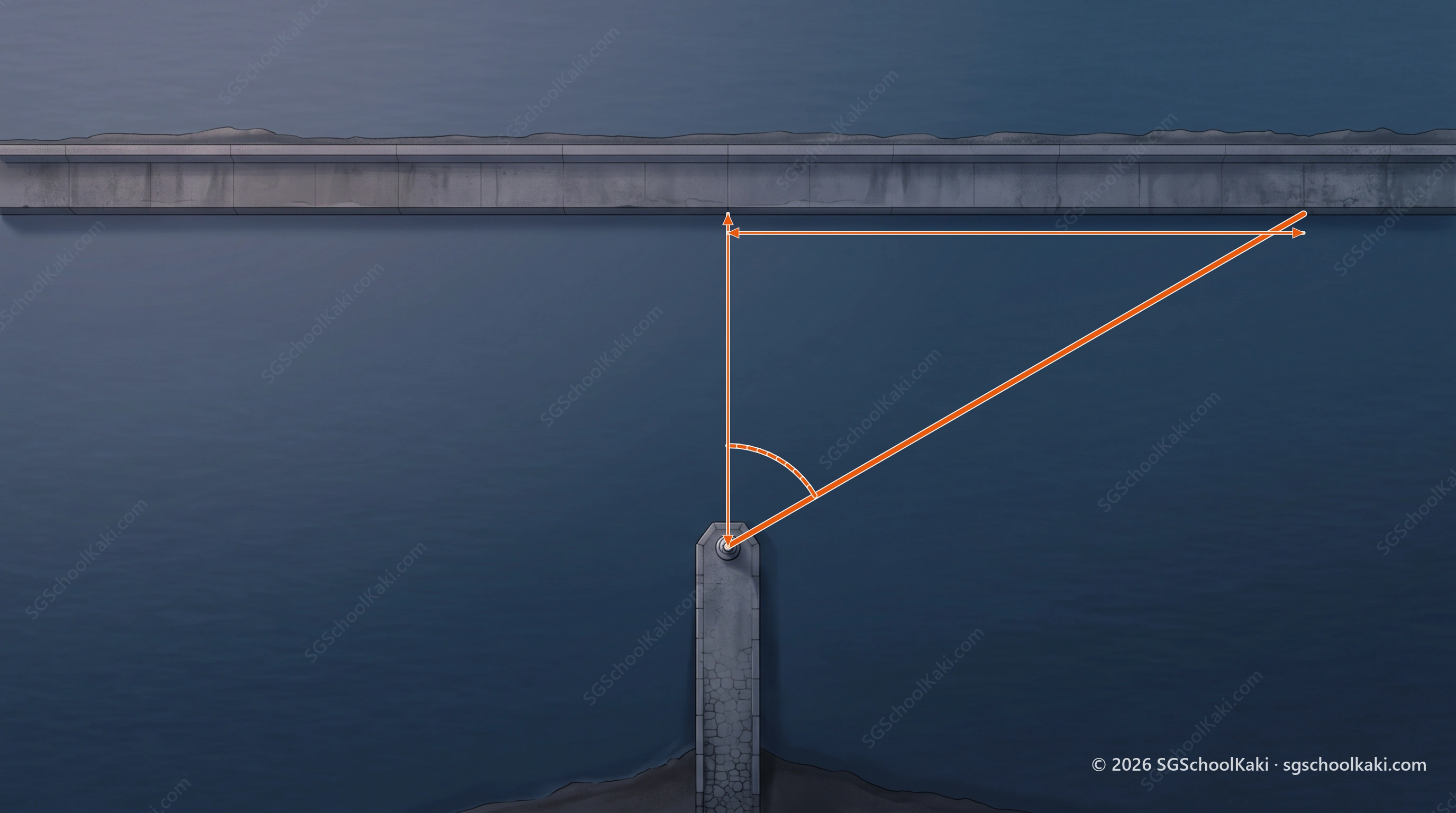
A searchlight sweeping a sea wall
A lighthouse or harbour searchlight turns steadily, but the spot of light it throws on a straight wall does not move steadily: it races along the wall when the beam is nearly parallel to it. That is exactly the behaviour of the tangent curve near an asymptote.
A searchlight stands on a pier, 40 m from a long straight sea wall, measured along the shortest line to the wall. The beam makes an angle θ with this shortest line, and the spot of light on the wall is a distance d metres from the nearest point of the wall, where d=40tanθ.
(a)The spot is 3 times as far along the wall as the searchlight is from the wall. Find the beam angle θ, as a principal value.
(b)Write d as y and θ as x, so that the curve is y=40tanx. State its period, and the equations of the two asymptotes that bound the beam angles −90∘<x<90∘.
Show full solutionHide solution
Colour keybasic angle, side or quarter periodfinal value
(a)
The principal value of tan−1x lies in the range −90∘<θ<90∘.
tanθ=3
tan−1(3) means the angle θ in the principal range whose tan is 3.
tan60∘=3
Reading the special-angle values backwards gives the basic angle.
θ=60∘
The value is not negative, so the basic angle is already inside the principal range.
(b)
period=180∘
With b=1 the tangent curve repeats every half turn.
The tangent curve has a vertical asymptote wherever the angle bx equals an odd multiple of a quarter turn.
first asymptote=90∘
With b=1 the first asymptote on the positive side is one quarter turn from the origin.
gap=180∘
Asymptotes repeat every period, so add the period to move to the next one.
x=90∘−180∘=−90∘
Subtract the gap from the first asymptote to reach the one on the negative side.
x=−90∘ or 90∘
Answer
(a)θ=60∘
(b) period =180∘; asymptotes: x=−90∘ or 90∘
8 m65πsplan view
Maths In Real Life 3
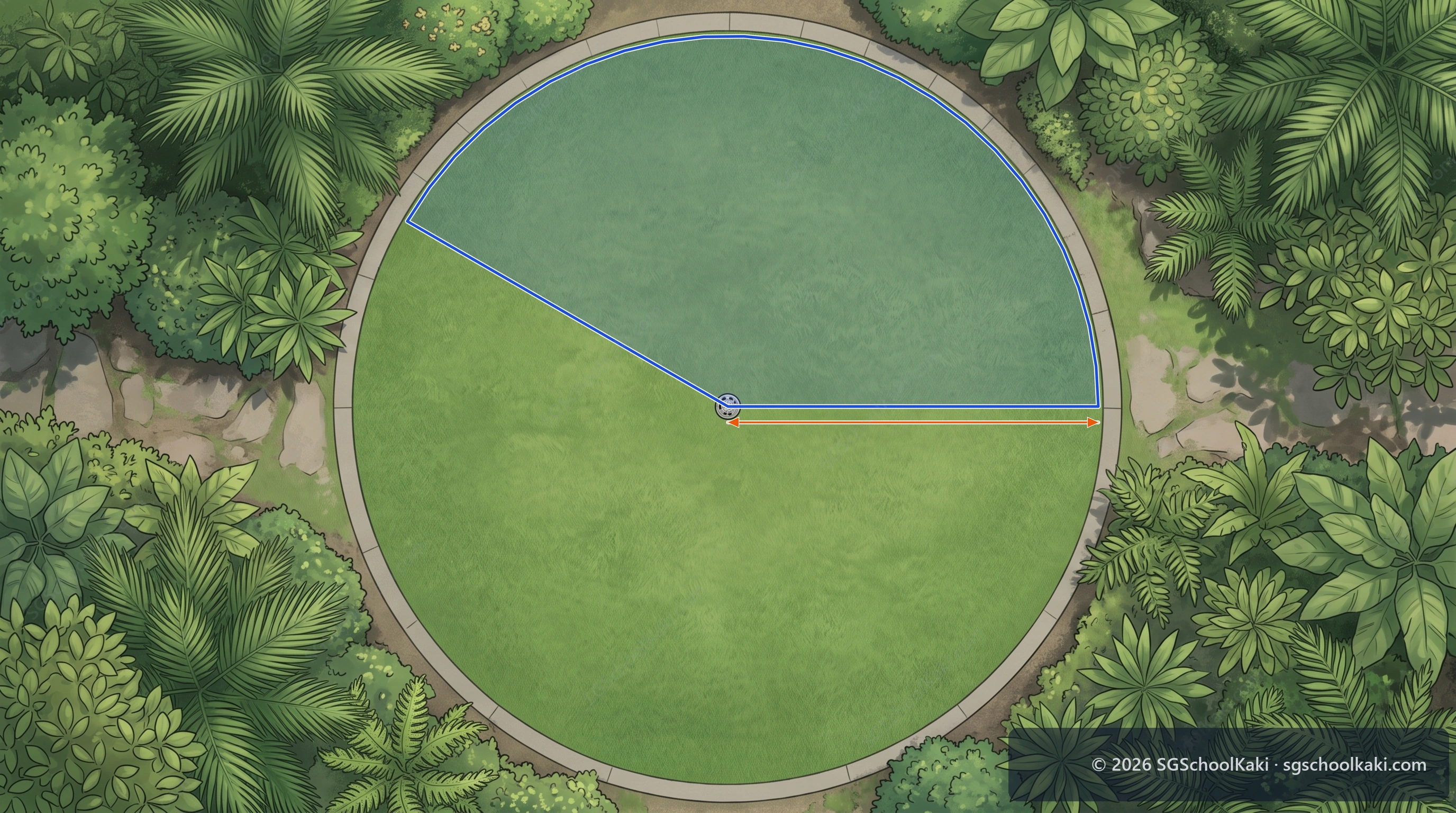
A rotating sprinkler on a round lawn
A rotating sprinkler sweeps back and forth through a fixed angle, so the watered patch is a sector. Because the angle is measured in radians, the length of the curved edge is simply the radius times the angle.
A rotating sprinkler stands at the centre of a round lawn of radius 8 m. It waters a sector of the lawn by swinging through an angle of 65π radians. A fence is to be put along the curved edge of the watered sector.
(a)Express the angle of the sector in degrees.
(b)Find the length of the fence along the curved edge and the area of the lawn that is watered, leaving your answers in terms of π.
Show full solutionHide solution
Colour keyfinal value
(a)
65π rad=65π×π180∘
Multiply by π180∘, the conversion factor from radians to degrees.
=150∘
The π cancels, leaving a number of degrees.
(b)
s=rθ=8×65π=320π
Arc length is radius times the angle, and the angle must be in radians.
A=21r2θ=21×82×65π=380π
Sector area is half the radius squared times the angle in radians.
Answer
(a)65π rad =150∘
(b) arc length in m =320π; area in square m =380π
01
Supports K341-G1-01
Degrees, radians and circles
Until now every angle in this course has been measured in degrees. A second unit, the radian, is used in all the later work on calculus, so this chapter introduces it and then uses both units side by side. One radian is the angle at the centre of a circle when the arc it cuts off is exactly as long as the radius.
Revision. A full turn is 360∘, a half turn (angles on a straight line) is 180∘ and a right angle is 90∘. Every conversion in this section rests on these three facts.
A full turn is 2π radians, so π rad =180∘. To change degrees into radians, multiply by 180π. To change radians into degrees, multiply by π180. A multiple of π such as 65π is an exact number of radians; a decimal such as 1.2 radians is a number of radians too, even with no π in sight.
Example 1.1
Degrees to radians
Express 150∘ in radians, in terms of π.
Show solutionHide solution
Colour keyfinal value
150∘=150×180π
Multiply by 180π, the conversion factor from degrees to radians.
=65π
Cancel the common factor in the fraction.
Answer
150∘=65π rad
Example 1.2
A negative angle
Express −60∘ in radians, in terms of π.
Show solutionHide solution
Colour keyfinal value
−60∘=−60×180π
Multiply by 180π, the conversion factor from degrees to radians.
=−3π
Cancel the common factor in the fraction.
Answer
−60∘=−3π rad
Common angles in degrees and radians
Degrees
Radians
0∘
0
30∘
6π
45∘
4π
60∘
3π
90∘
2π
180∘
π
270∘
23π
360∘
2π
SGSchoolKaki Tip
Learn the radian values of 30∘, 45∘, 60∘ and 90∘ from the table: 6π, 4π, 3π and 2π. Every other multiple of these comes by adding them up.
Example 1.3
Radians to degrees
Express 67π radians in degrees.
Show solutionHide solution
Colour keyfinal value
67π rad=67π×π180∘
Multiply by π180∘, the conversion factor from radians to degrees.
=210∘
The π cancels, leaving a number of degrees.
Answer
67π rad =210∘
Example 1.4
More than one full turn
Express 37π radians in degrees.
Show solutionHide solution
Colour keyfinal value
37π rad=37π×π180∘
Multiply by π180∘, the conversion factor from radians to degrees.
=420∘
The π cancels, leaving a number of degrees.
Answer
37π rad =420∘
Example 1.5
A decimal number of radians
An angle measures 1.2 radians. Use a calculator in radian mode to express it in degrees, correct to 1 decimal place.
Show solutionHide solution
Colour keyfinal value
1.2 rad=1.2×π180∘
Multiply by π180∘ to turn radians into degrees.
≈68.8∘
Use the calculator and round to 1 decimal place.
Answer
1.2 rad ≈68.8∘
A calculator has a degree mode and a radian mode. Use radian mode for an angle in radians. In degree mode the calculator treats 1.2 as 1.2 degrees, not 1.2 radians, and every answer that follows is wrong.
The Core Idea
Arc length and sector area.
For a sector of radius r and angle θ at the centre, arc length s=rθ and sector area A=21r2θ. θ must be in radians. The sector is the fraction 2πθ of the whole circle, which is why both formulas come out so simply.
Example 1.6
Arc length and sector area
A sector of a circle has radius 6 cm and angle 3π radians at the centre. Find, in terms of π, the length of the arc and the area of the sector.
Show solutionHide solution
Colour keyfinal value
s=rθ=6×3π=2π
Arc length is radius times the angle, and the angle must be in radians.
A=21r2θ=21×62×3π=6π
Sector area is half the radius squared times the angle in radians.
Answer
arc length =2π cm; area =6π cm2
Think About It
A semicircle has radius 5 cm. Try s=rθ with θ=180 and with θ=π. Which result is the length of the semicircular arc?
Show the full workingHide the working
5×180=900
With the angle written in degrees the 'arc' would come out far longer than the whole circle.
5×π=5π
With the angle in radians, a half turn is π.
21×2π×5=5π
Half of the circumference of a circle of radius 5.
Answer
Only 5π is the length of the semicircle: the formula s=rθ gives the right answer only when θ is in radians.
Example 1.7
A reflex sector
A sector of a circle has radius 8 cm and angle 45π radians at the centre. Find, in terms of π, the length of the arc and the area of the sector.
Show solutionHide solution
Colour keyfinal value
s=rθ=8×45π=10π
Arc length is radius times the angle, and the angle must be in radians.
A=21r2θ=21×82×45π=40π
Sector area is half the radius squared times the angle in radians.
Answer
arc length =10π cm; area =40π cm2
02
Supports K341-G1-01 · K341-G1-03
The six ratios and special angles
In a right-angled triangle the shape is fixed by one acute angle θ, and so are the ratios of the sides. Three ratios you already know are sine, cosine and tangent. Three more, the reciprocal ratios, turn those upside down.
SGSchoolKaki Tip
Draw the triangle first and label the sides opposite (opposite θ), adjacent (next to θ and not the longest side) and hypotenuse (opposite the right angle) before you write any ratio.
The Core Idea
The six ratios.
sinθ=hypopp, cosθ=hypadj and tanθ=adjopp. The reciprocal ratios are secθ=cosθ1, cosecθ=sinθ1 and cotθ=tanθ1. Each one is undefined when the ratio it flips is zero.
Example 2.1
Three ratios from a triangle
A right-angled triangle has an acute angle θ. The side opposite θ has length 3 and the side adjacent to θ has length 4. Find the length of the hypotenuse, and write down sinθ, cosθ and tanθ as exact values.
Show solutionHide solution
Colour keybasic angle, side or quarter periodfinal value
hyp=32+42=25=5
Pythagoras: the hypotenuse squared is the sum of the squares of the other two sides.
sinθ=53
Sin is opposite over hypotenuse.
cosθ=54
Cos is adjacent over hypotenuse.
tanθ=43
Tan is opposite over adjacent.
Answer
hypotenuse =5; sinθ=53; cosθ=54; tanθ=43
Example 2.2
The reciprocal ratios
A right-angled triangle has an acute angle θ. The side opposite θ has length 8 and the side adjacent to θ has length 15. Find the length of the hypotenuse, and write down secθ, cosecθ and cotθ as exact values.
Show solutionHide solution
Colour keybasic angle, side or quarter periodfinal value
hyp=82+152=289=17
Pythagoras: the hypotenuse squared is the sum of the squares of the other two sides.
secθ=1517
Sec is hypotenuse over adjacent (the flip of cosine).
cosecθ=817
Cosec is hypotenuse over opposite (the flip of sine).
cotθ=815
Cot is adjacent over opposite (the flip of tangent).
cosecθ means sinθ1. It is not the inverse function sin−1 that a calculator key of that name gives, which is a different idea met in a later section of this chapter.
Example 2.3
A surd hypotenuse
A right-angled triangle has an acute angle θ. The side opposite θ has length 2 and the side adjacent to θ has length 3. Find the length of the hypotenuse, and write down sinθ, cosθ and tanθ as exact values.
Show solutionHide solution
Colour keybasic angle, side or quarter periodfinal value
hyp=22+32=13
Pythagoras: the hypotenuse squared is the sum of the squares of the other two sides.
Half of a square of side 1 cut along its diagonal gives the 45∘ triangle with sides 1, 1, 2. Half of an equilateral triangle of side 2 gives the 30∘ and 60∘ triangle with sides 1, 3, 2. Reading ratios off these two triangles gives the values in the table, in degrees and in radians (30∘=6π, 45∘=4π, 60∘=3π).
Exact values at the three special angles
Angle
sin
cos
tan
30∘ or 6π
21
23
31
45∘ or 4π
21
21
1
60∘ or 3π
23
21
3
Example 2.4
A special angle in degrees
Use the special-angle values, with no calculator, to write sin45∘ exactly.
Show solutionHide solution
Colour keyfinal value
hyp=12+12=2
Half a unit square cut along its diagonal: both short sides are 1, so Pythagoras gives the hypotenuse.
sin45∘=21=22
Read the ratio off the triangle: opposite over hypotenuse.
Answer
sin45∘=22
Example 2.5
A special angle in radians
Use the special-angle values, with no calculator, to write tan3π exactly.
Show solutionHide solution
Colour keyfinal value
other side=22−12=3
Half an equilateral triangle of side 2: the hypotenuse is 2, the short side is 1, so Pythagoras gives the third side.
tan3π=13=3
Read the ratio off the triangle: opposite over adjacent.
Answer
tan3π=3
Think About It
Why is tan45∘ exactly 1? Use the triangle with two equal short sides.
Show the full workingHide the working
Let each of the two equal sides of the right-angled triangle have length k.
The 45∘ triangle is half of a square, so its two short sides are equal.
tan45∘=kk=1
Opposite and adjacent are the same length, so their ratio is 1.
Answer
The opposite and adjacent sides are equal, so tan45∘=1 whatever the size of the triangle.
Example 2.6
A reciprocal at a special angle
Find the exact value of sec30∘.
Show solutionHide solution
Colour keyfinal value
sec30∘=cos30∘1
Sec is the reciprocal of cos: find cos first.
cos30∘=23
First quadrant: all ratios are positive, so read the special-angle value.
sec30∘=231=323
Flip the fraction, then rationalise the denominator if a surd is left.
Answer
sec30∘=323
03
Supports K341-G1-01 · K341-G1-03
Angles of any size: quadrants and exact values
An angle does not have to be acute. Turn a line about the origin and its angle can be 150∘, 405∘ or even negative for a clockwise turn. The ratios still make sense, and the quadrant the line lands in decides their signs.
Revision. In a right-angled triangle, sinθ=hypopp, cosθ=hypadj and tanθ=adjopp, for an acute angle θ. Every value below is read from such a triangle for the basic angle.
The Core Idea
Quadrant, basic angle, sign (ASTC).
Measure angles anticlockwise from the positive x-axis. The basic angle α is the acute angle between the line and the x-axis. The quadrant gives the sign: All positive in I, Sine in II, Tangent in III, Cosine in IV. Then fn(angle) = (sign) fn(basic angle). Reciprocal functions take the sign of the function they flip.
the four quadrants with the ratios that are positive in eachExample 3.1
Second quadrant
Find the exact value of sin150∘.
Show solutionHide solution
Colour keybasic angle, side or quarter periodfinal value
α=180∘−150∘=30∘
In the second quadrant the basic angle is a half turn minus the angle.
sin150∘=sin30∘=21
In quadrant II only sine (and cosec) is positive, so the sign is positive.
Answer
sin150∘=21
Example 3.2
Third quadrant
Find the exact value of tan225∘.
Show solutionHide solution
Colour keybasic angle, side or quarter periodfinal value
α=225∘−180∘=45∘
In the third quadrant the basic angle is the angle minus a half turn.
tan225∘=tan45∘=1
In quadrant III only tangent (and cot) is positive, so the sign is positive.
Answer
tan225∘=1
Example 3.3
Fourth quadrant
Find the exact value of cos300∘.
Show solutionHide solution
Colour keybasic angle, side or quarter periodfinal value
α=360∘−300∘=60∘
In the fourth quadrant the basic angle is a full turn minus the angle.
cos300∘=cos60∘=21
In quadrant IV only cosine (and sec) is positive, so the sign is positive.
Answer
cos300∘=21
The four quadrants: sign and basic angle
Quadrant
Angle from the positive x-axis
Positive ratios
Basic angle for an angle θ
I
0∘ to 90∘
sin, cos and tan
θ
II
90∘ to 180∘
sin only
180∘−θ
III
180∘ to 270∘
tan only
θ−180∘
IV
270∘ to 360∘
cos only
360∘−θ
The Core Idea
Related angles.
Reading the table in terms of the angle θ gives the related-angle rules: sin(180∘−θ)=sinθ, cos(180∘−θ)=−cosθ, tan(180∘+θ)=tanθ, sin(360∘−θ)=−sinθ, cos(360∘−θ)=cosθ, sin(−θ)=−sinθ, cos(−θ)=cosθ and tan(−θ)=−tanθ. In radians replace 180∘ by π and 360∘ by 2π.
Example 3.4
Beyond one full turn
Find the exact value of sin405∘.
Show solutionHide solution
Colour keyfinal value
sin405∘=sin45∘
Remove whole turns: the ratio repeats every full turn.
=22
First quadrant: all ratios are positive, so read the special-angle value.
Answer
sin405∘=22
Example 3.5
A negative angle
Find the exact value of tan(−120∘).
Show solutionHide solution
Colour keybasic angle, side or quarter periodfinal value
tan(−120∘)=tan240∘
Add whole turns: the ratio repeats every full turn.
α=240∘−180∘=60∘
In the third quadrant the basic angle is the angle minus a half turn.
=tan60∘=3
In quadrant III only tangent (and cot) is positive, so the sign is positive.
Answer
tan(−120∘)=3
SGSchoolKaki Tip
For any angle: (1) take away whole turns, or add them for a negative angle, until the angle is between 0∘ and 360∘; (2) name the quadrant; (3) find the basic angle; (4) choose the sign from ASTC; (5) read the special-angle value.
the same four quadrants with angles in radiansExample 3.6
Radians in the second and third quadrants
Find the exact value of tan32π.
Show solutionHide solution
Colour keybasic angle, side or quarter periodfinal value
α=π−32π=3π
In the second quadrant the basic angle is a half turn minus the angle.
tan32π=−tan3π=−3
In quadrant II only sine (and cosec) is positive, so the sign is negative.
Answer
tan32π=−3
Example 3.7
A reciprocal function in radians
Find the exact value of cosec67π.
Show solutionHide solution
Colour keybasic angle, side or quarter periodfinal value
cosec67π=sin67π1
Cosec is the reciprocal of sin: find sin first.
α=67π−π=6π
In the third quadrant the basic angle is the angle minus a half turn.
sin67π=−sin6π=−21
In quadrant III only tangent (and cot) is positive, so the sign is negative.
cosec67π=−211=−2
Flip the fraction, then rationalise the denominator if a surd is left.
Answer
cosec67π=−2
tan90∘ is undefined, and so are sec90∘, cosec0∘ and cot0∘: each would need a division by zero. A calculator shows an error for them, and no exam question asks for them.
Example 3.8
A quadrantal angle
Write down the value of sin270∘.
Show solutionHide solution
Colour keyfinal value
sin270∘=−1
On the unit circle this angle is the point (0,−1): sine is its y-coordinate, cosine its x-coordinate, tangent is y over x.
Answer
sin270∘=−1
Think About It
Why is sin150∘ equal to sin30∘? Compare the two angles with the horizontal axis.
Show the full workingHide the working
180∘−150∘=30∘
The basic angle: how far 150∘ is from the horizontal axis.
sin150∘=sin30∘=21
Sine is positive in the second quadrant, so no sign change.
Answer
Both angles make the same acute angle with the horizontal axis and sine is positive in the second quadrant, so the two sines are equal.
Example 3.9
A ratio and a quadrant given
Given that sinA=135 and that A lies in the second quadrant, find the exact values of cosA and tanA.
Show solutionHide solution
Colour keybasic angle, side or quarter period
The basic-angle triangle has opposite 5 and hypotenuse 13.
adj=132−52=144=12
Pythagoras gives the third side of the triangle.
cosA=−1312
In quadrant II only sine (and cosec) is positive: cos is negative, so the answer is negative.
tanA=−125
In quadrant II only sine (and cosec) is positive: tan is negative, so the answer is negative.
Answer
cosA=−1312; tanA=−125
Example 3.10
A tangent and a quadrant given
Given that tanA=−43 and that A lies in the fourth quadrant, find the exact values of sinA and cosA.
Show solutionHide solution
Colour keybasic angle, side or quarter periodfinal value
The basic-angle triangle has opposite 3 and adjacent 4.
hyp=32+42=25=5
Pythagoras gives the third side of the triangle.
sinA=−53
In quadrant IV only cosine (and sec) is positive: sin is negative, so the answer is negative.
cosA=54
In quadrant IV only cosine (and sec) is positive: cos is positive, so the answer is positive.