Trigonometric identities, equations and proofs: formulae, solving and the R form
A handful of identities turn a hard trigonometric expression into an easy one. This chapter uses the Pythagorean and compound-angle identities, the double and half angle formulae and the R form a cos t + b sin t = R cos(t - alpha) to find exact values, prove identities, solve equations in a given interval and model tides and geometry. Every equation here is solved in a stated interval, and only the angles inside it are listed.
Your outcome tracker0 / 9
Let's go! Tick an outcome once you can pass its exam check. Saved on this device.
Chapter 10
Figure 1 · a cosine wave: amplitude 2 (the R of a cos t + b sin t is the amplitude of the combined wave)
r = 1y = sin θcos θ
5 outcomes · 1 page · every step shown ✦
Compound and double angles
sin(A ± B) = sin A cos B ± cos A sin B, cos(A ± B) = cos A cos B ∓ sin A sin B. Set B = A to get the double-angle formulae; pick the form of cos 2A that uses the ratio you were given.
Solve in the interval, never in general
Find the basic angle, use the quadrant to list the angles, then add whole turns until the range of the inner angle is covered. Factorise: never divide by sin x or cos x unless you have shown it cannot be 0 at a solution.
R form: one wave from two
acosθ+bsinθ=Rcos(θ−α) with R=a2+b2 and tanα=ab. Greatest value R, least −R.
By the end of this chapter
Use sin²A + cos²A = 1, sec²A = 1 + tan²A and cosec²A = 1 + cot²A, and find every ratio of an angle from one ratio and its quadrant.
Expand sin(A ± B), cos(A ± B) and tan(A ± B), and find the exact value of a non-special angle such as 75° or 105°.
Use sin 2A, the three forms of cos 2A and tan 2A, and the half-angle results cos²(x/2) = (1 + cos x)/2 and sin²(x/2) = (1 - cos x)/2.
Prove simple identities from the left side to the right side, and use a proved identity to solve an equation (the hence strategy).
Solve trigonometric equations in a given interval, including scaled and shifted angles, quadratics in one ratio, factorised equations and radians.
Write a cos t ± b sin t in the form R cos(t ± α) or R sin(t ± α), find its greatest and least values, solve equations with it and use it in models.
✶
Start here
Maths In Real Life
Three situations where an angle or a wave decides a fit, a depth or an area. The pictures come first; the working in each solution comes from the same numbers.
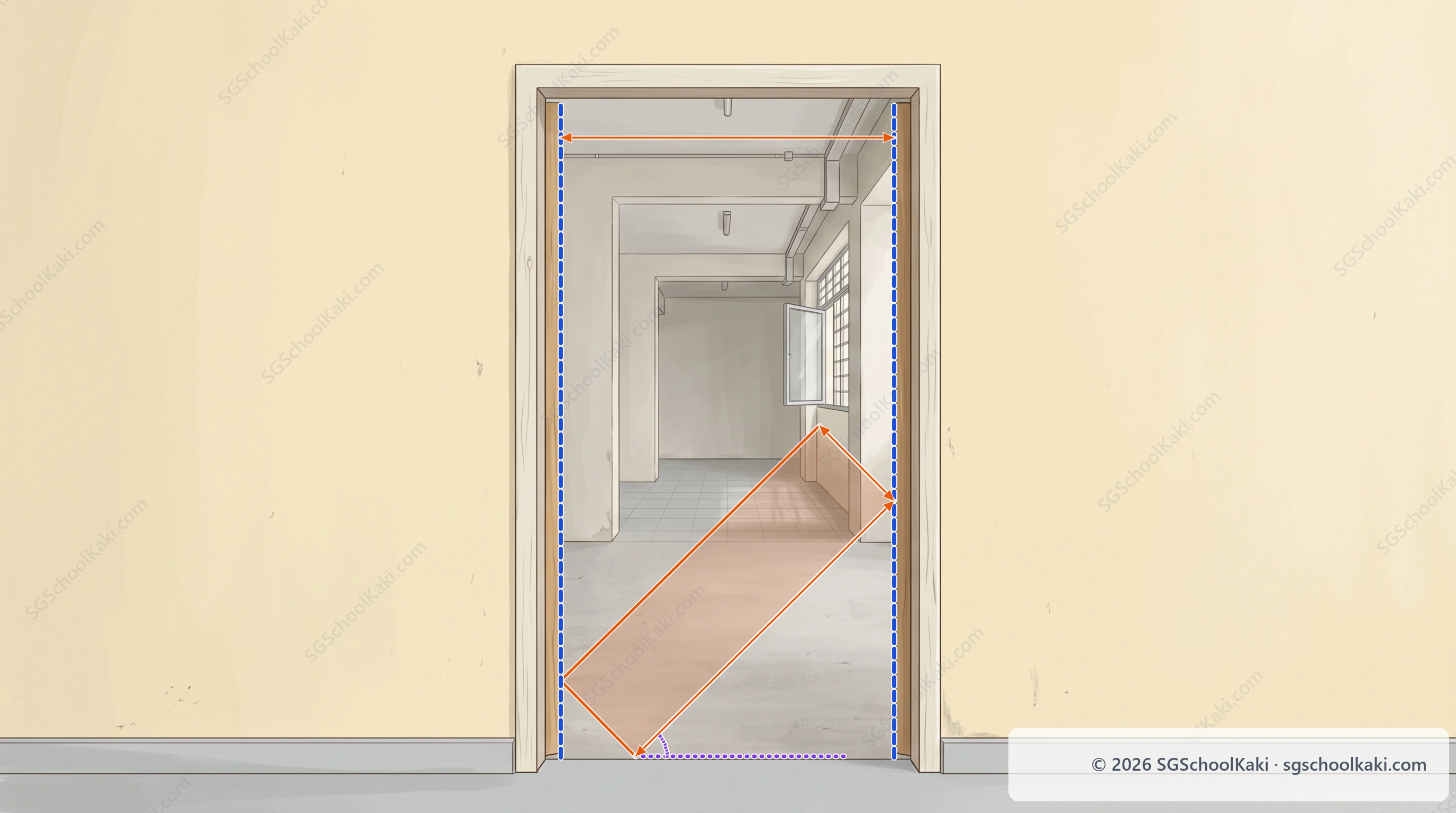
120 cm35 cm110 cmθ
Maths In Real Life 1
A plywood sheet through a workshop doorway
A rectangular sheet turned through an angle needs a doorway at least as wide as its horizontal shadow, and that width is a sum of a cosine and a sine: exactly the shape of a cosine wave with a larger amplitude.
In a school workshop a rectangular plywood sheet 120 cm long and 35 cm wide is slid through a doorway that is 110 cm wide, in the plane of the doorway. The long edge of the sheet makes an angle θ with the floor, 0∘≤θ≤90∘, and the sheet needs a width of (120cosθ+35sinθ) cm across the doorway.
(a)Write (120cosθ+35sinθ) in the form Rcos(θ−α), where R>0 and α is acute, and give R and α. Hence find the greatest width the sheet can need and the angle θ0 at which this happens.
(b)Find the angle θ at which the width needed is exactly 110 cm, correct to 1 decimal place.
Show full solutionHide solution
Colour keybasic angle or value found on the wayfinal value
(a)
Expanding: Rcos(θ−α)=Rcosθcosα+Rsinθsinα
Expand Rcos(θ−α) with the compound-angle formula, then match it with acosθ+bsinθ: the coefficients of cosθ and sinθ must agree.
Matching coefficients gives Rcosα=120 and Rsinα=35.
R=1202+352=125
Square both equations and add: cos2α+sin2α=1 leaves R2=a2+b2. R is the positive root.
tanα=RcosαRsinα=12035=247
Divide the two matching equations: R cancels. Both Rcosα and Rsinα are positive, so α is acute.
α=tan−1(247)≈16.3∘
Both Rcosα and Rsinα are positive, so α is acute: Use the calculator in degree mode and give 1 decimal place.
α was found in the working above.
greatest value=125
The cos of any angle lies between −1 and 1, so Rcos(…) lies between −R and R: the greatest value is R.
The greatest value is reached when cos(θ0−α)=1.
The maximum of cos is at the angle where it equals 1.
θ0−α=0
The angle whose cos is 1 in one turn.
θ0=0+16.3∘=16.3∘
The angle is α itself, or its negative when the form is the other way round.
(b)
Expanding: Rcos(θ−α)=Rcosθcosα+Rsinθsinα
Expand Rcos(θ−α) with the compound-angle formula, then match it with acosθ+bsinθ: the coefficients of cosθ and sinθ must agree.
Matching coefficients gives Rcosα=120 and Rsinα=35.
R=1202+352=125
Square both equations and add: cos2α+sin2α=1 leaves R2=a2+b2. R is the positive root.
tanα=RcosαRsinα=12035=247
Divide the two matching equations: R cancels. Both Rcosα and Rsinα are positive, so α is acute.
α=tan−1(247)≈16.260∘
Both Rcosα and Rsinα are positive, so α is acute: Use the calculator in degree mode and give 1 decimal place.
Using the R form found above (with α≈16.260∘): 120cosθ+35sinθ≈125cos(θ−16.260∘).
The R form found above.
125cos(θ−16.260∘)=110
Write the equation in the R form.
cos(θ−16.260∘)=125110=2522
Divide by R.
Let ϕ=θ−16.26∘. Since 0∘≤θ≤90∘, the angle ϕ runs from −16.26∘ to 73.74∘, so list every angle with this ratio in that range.
smallest angle=0∘−16.26∘=−16.26∘
Smallest angle: put the smallest θ into ϕ.
largest angle=90∘−16.26∘=73.74∘
Largest angle: put the largest θ into ϕ.
β=cos−1(2522)≈28.358∘
The basic angle β is the acute angle with this ratio: use the inverse function on the positive value.
ϕ1=28.358∘
Since cosine is positive in quadrants I and IV, the angles with this ratio in one full turn are:
ϕ2=360∘−28.358∘=331.642∘
The other angle in the same turn, from the symmetry of the quadrants.
ϕ2=331.642∘ is outside the range −16.26∘≤ϕ≤73.74∘, so it is not used as it stands.
θ1=28.358∘+16.26∘≈44.6∘
Add 16.26∘ back to return from ϕ to θ.
Answer
(a)R=125; α=16.3∘; max value =125; θ0=16.3∘
(b)θ=44.6∘
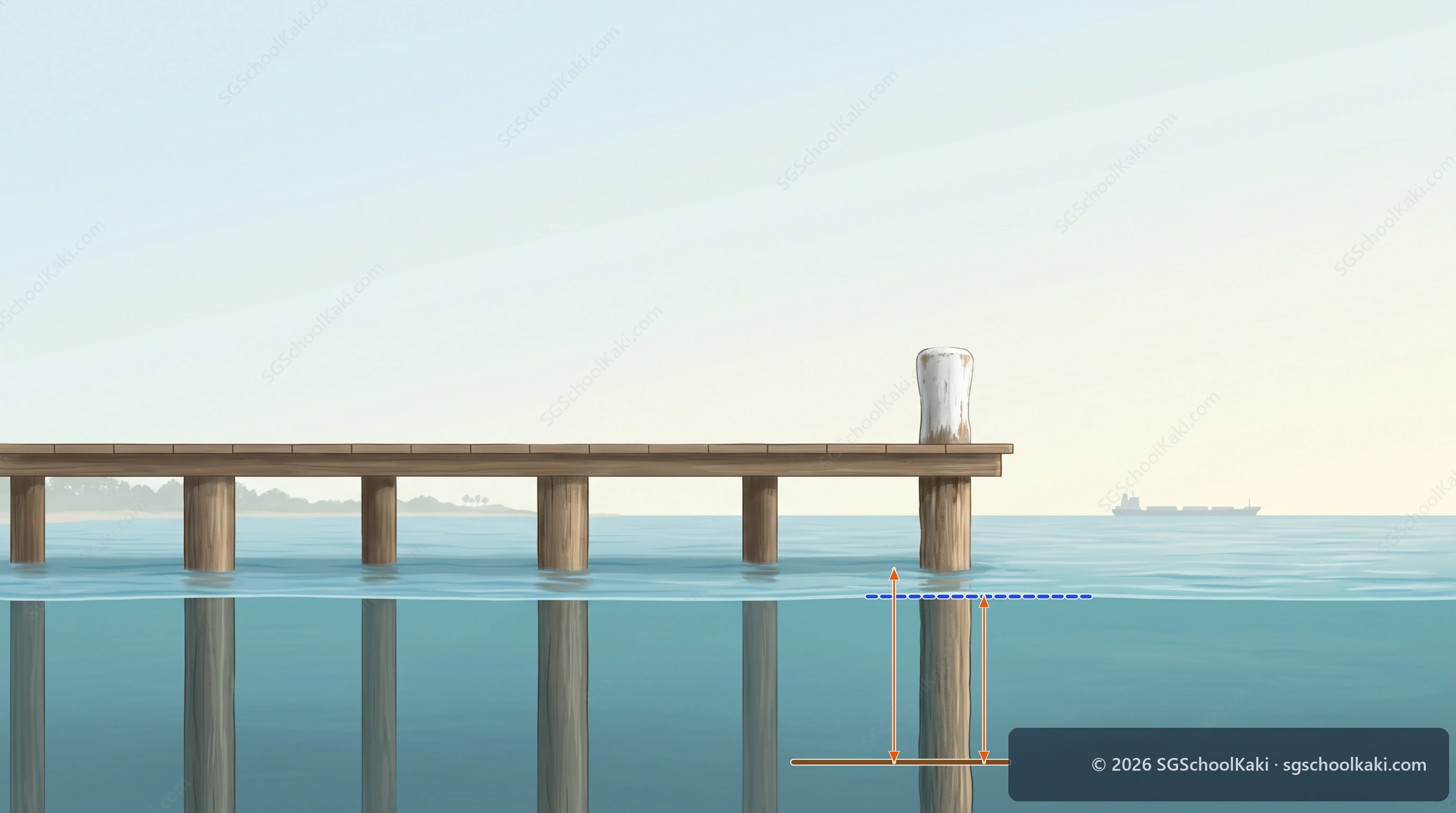
h3 mside viewseabed
Maths In Real Life 2
The depth of water at a jetty
Near the coast the water level rises and falls twice a day with the tide, so a harbour master has to know when the water is deep enough for a boat to dock. A cosine model with a time scale in degrees per hour is exactly what a tide table is built from.
The depth of water, h metres, at the end of a jetty t hours after midnight is modelled by h=2.5+0.6cos30t+0.8sin30t, where the angle is measured in degrees. A boat can dock only when the depth is at least 3 m. Consider the first 12 hours after midnight.
(a)Express h in the form c+Rcos(kt−α), where R>0 and α is acute.
(b)Find the greatest depth and the least depth of the water.
(c)Find the times when the depth is exactly 3 m. Give your answers correct to 2 decimal places.
(d)Find the intervals of time during which the boat can dock.
Show full solutionHide solution
Colour keybasic angle or value found on the wayfinal value
(a)
Let θ=30t, so that h=2.5+53cosθ+54sinθ with the angle θ in degrees.
Expanding: Rcos(θ−α)=Rcosθcosα+Rsinθsinα
Expand Rcos(θ−α) with the compound-angle formula, then match it with acosθ+bsinθ: the coefficients of cosθ and sinθ must agree.
Matching coefficients gives Rcosα=53 and Rsinα=54.
R=259+2516=1
Square both equations and add: cos2α+sin2α=1 leaves R2=a2+b2. R is the positive root.
tanα=RcosαRsinα=5354=34
Divide the two matching equations: R cancels. Both Rcosα and Rsinα are positive, so α is acute.
α=tan−1(34)≈53.1∘
Both Rcosα and Rsinα are positive, so α is acute: Use the calculator in degree mode and give 1 decimal place.
Putting R=1 and α≈53.1∘ back, and θ=30t again: h≈2.5+cos(30t−53.1∘) (angle to 1 decimal place).
Put R and α back into the form.
(b)
hmax=2.5+1=3.5
The cosine lies between −1 and 1, so Rcos(…) lies between −R and R: the greatest value of h is the constant plus R.
hmin=2.5−1=1.5
The cosine lies between −1 and 1, so Rcos(…) lies between −R and R: the least value of h is the constant minus R.
(c)
2.5+cos(θ−53.1∘)=3
Put h equal to the level, with θ=30t for the angle inside the brackets.
cos(θ−53.1∘)=13−(25)=21
Subtract the constant from both sides, then divide by R.
Let ϕ=θ−53.1∘. Since 0∘≤θ≤360∘, the angle ϕ runs from −53.1∘ to 306.9∘, so list every angle with this ratio in that range.
smallest angle=0∘−53.1∘=−53.1∘
Smallest angle: put the smallest θ into ϕ.
largest angle=360∘−53.1∘=306.9∘
Largest angle: put the largest θ into ϕ.
β=cos−1(21)=60∘
The basic angle β is the acute angle with this ratio: use the inverse function on the positive value.
ϕ1=60∘
Since cosine is positive in quadrants I and IV, the angles with this ratio in one full turn are:
ϕ2=360∘−60∘=300∘
The other angle in the same turn, from the symmetry of the quadrants.
θ1=60∘+53.1∘=113.1∘
Add 53.1∘ back to return from ϕ to θ.
θ2=300∘+53.1∘=353.1∘
Add 53.1∘ back to return from ϕ to θ.
t=30∘113.1∘≈3.77
Divide the angle by the number of degrees per unit of t. Give 2 decimal places.
t=30∘353.1∘≈11.77
Divide the angle by the number of degrees per unit of t. Give 2 decimal places.
(d)
h is continuous, so between two consecutive times it cannot cross the level: it is above the level for the whole gap or below it for the whole gap. Test one value of t half way along each gap, including the gaps at the ends of the interval.
ttest=20+3.77=1.885
Half way between 0 and 3.77.
h(1.885)=2.5+53cos56.55∘+54sin56.55∘≈3.5
Calculator in degree mode, 2 decimal places: this is above the level 3, so h is above it for the whole gap.
ttest=23.77+11.77=7.77
Half way between 3.77 and 11.77.
h(7.77)=2.5+53cos233.1∘+54sin233.1∘≈1.5
Calculator in degree mode, 2 decimal places: this is below the level 3, so h is below it for the whole gap.
ttest=211.77+12=11.885
Half way between 11.77 and 12.
h(11.885)=2.5+53cos356.55∘+54sin356.55∘≈3.05
Calculator in degree mode, 2 decimal places: this is above the level 3, so h is above it for the whole gap.
Joining the gaps where h is above the level, and keeping the end values (where h equals the level), gives the answer.
Answer
(a)h≈2.5+cos(30t−53.1∘)
(b) greatest value of h=3.5; least value of h=1.5
(c)t=3.77,11.77
(d)h≥3 for 0≤t≤3.77 and 11.77≤t≤12
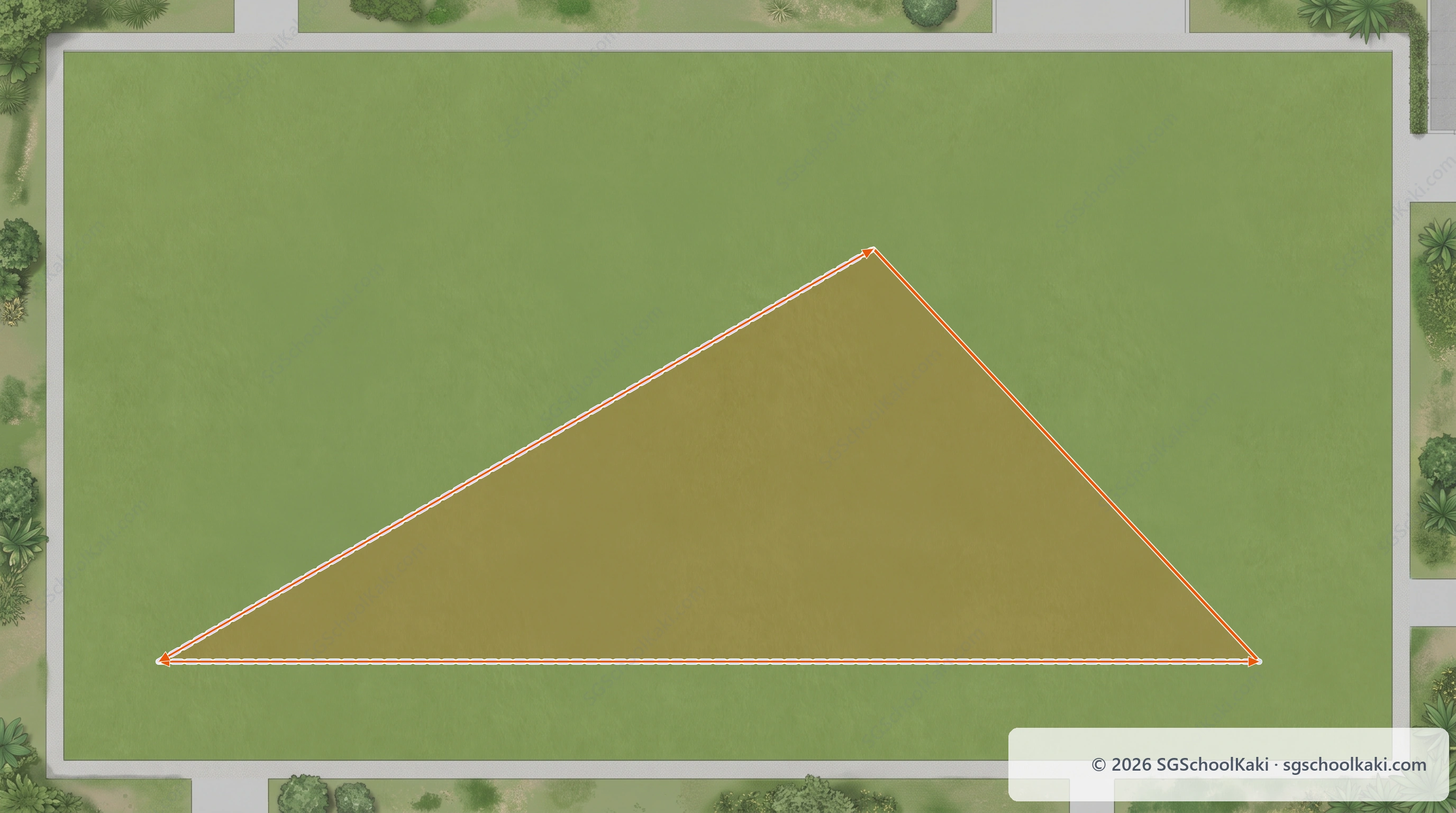
80 m60 mθ1200 m2plan view
Maths In Real Life 3
A triangular plot of grass
Two fences and the angle between them fix the size of a triangular plot: the area is half the product of the fences and the sine of the angle between them, and one value of the area is shared by an acute and an obtuse angle.
A triangular plot of grass is bounded by two straight fences of length 80 m and 60 m that meet at the angle θ. The plot has an area of 1200 square m, and a third fence closes the triangle.
(a)Find every possible value of the angle θ between the two fences.
(b)Find the length of the third fence when θ is the acute angle found in (a), correct to 1 decimal place.
(c)Find the length of the third fence when θ is the obtuse angle found in (a), correct to 1 decimal place.
Show full solutionHide solution
Colour keybasic angle or value found on the wayfinal value
(a)
Area=21×80×60×sinθ=2400sinθ
Area of a triangle from two sides and the angle between them: 21bcsinA, a formula on the formula page.
2400sinθ=1200
The area is given, so put the expression equal to it.
sinθ=24001200=21
Divide both sides by the coefficient of sinθ.
An angle of a triangle lies between 0∘ and 180∘, so list every angle in that range with this sine: one acute and one obtuse.
α=sin−1(21)=30∘
The basic angle α is the acute angle with this ratio: use the inverse function on the positive value.
θ1=30∘
Since sine is positive in quadrants I and II, the angles with this ratio in one full turn are:
θ2=180∘−30∘=150∘
The other angle in the same turn, from the symmetry of the quadrants.
(b)
a2=802+602−2×80×60×cos30∘
Cosine rule: a is the side opposite the angle between the sides of length 80 and 60.
=10000−9600×23=10000−48003
Put in the exact value of the cosine and multiply out.
a≈41.1
Take the positive square root of the right-hand side above with a calculator and round to 1 decimal place at the end.
(c)
a2=802+602−2×80×60×cos150∘
Cosine rule: a is the side opposite the angle between the sides of length 80 and 60.
=10000−9600×−23=48003+10000
Put in the exact value of the cosine and multiply out.
a≈135.3
Take the positive square root of the right-hand side above with a calculator and round to 1 decimal place at the end.
Answer
(a)θ=30∘ or 150∘
(b) third side ≈41.1 m
(c) third side ≈135.3 m
01
Supports K341-G1-06
Identities from one ratio: Pythagoras and the quotient
One trigonometric ratio of an angle, together with the quadrant the angle is in, fixes every other ratio of that angle. The tool is the Pythagorean identity: the three ratios of one angle are not independent, and the quadrant decides every sign.
Revision. In a right-angled triangle sinθ=hypopp, cosθ=hypadj and tanθ=adjopp, and opp2+adj2=hyp2. The signs by quadrant (All, Sine, Tangent, Cosine) are in Chapter 9.
The Core Idea
The Pythagorean and quotient identities.
For every angle A: sin2A+cos2A=1, sec2A=1+tan2A and cosec2A=1+cot2A. These three are on the formula page. The quotient identities tanA=cosAsinA and cotA=sinAcosA are not: memorise them.
SGSchoolKaki Tip
After you take a square root, state the quadrant sign first: in quadrant II, cosA is negative, so cosA is minus the square root of 1−sin2A, never the positive root by habit.
The sign of each ratio in each quadrant (All, Sine, Tangent, Cosine)
Quadrant
sin
cos
tan
Picture
I
positive
positive
positive
All three ratios are positive
II
positive
negative
negative
Only sine is positive
III
negative
negative
positive
Only tangent is positive
IV
negative
positive
negative
Only cosine is positive
Example 1.1
One ratio and a quadrant: sine given
Given that sinA=135 and that A lies in the second quadrant, find the exact values of cosA and tanA.
Show solutionHide solution
Colour keybasic angle or value found on the way
The basic-angle triangle has opposite 5 and hypotenuse 13.
adj=132−52=144=12
Pythagoras gives the third side of the triangle.
cosA=−1312
In quadrant II only sine (and cosec) is positive: cos is negative, so the answer is negative.
tanA=−125
In quadrant II only sine (and cosec) is positive: tan is negative, so the answer is negative.
Answer
cosA=−1312; tanA=−125
Example 1.2
Tangent given, reciprocal asked
Given that tanA=247 and that A lies in the third quadrant, find the exact values of sinA, cosA and cosecA.
Show solutionHide solution
Colour keybasic angle or value found on the way
The basic-angle triangle has opposite 7 and adjacent 24.
hyp=72+242=625=25
Pythagoras gives the third side of the triangle.
sinA=−257
In quadrant III only tangent (and cot) is positive: sin is negative, so the answer is negative.
cosA=−2524
In quadrant III only tangent (and cot) is positive: cos is negative, so the answer is negative.
cosecA=−725
In quadrant III only tangent (and cot) is positive: cosec is negative, so the answer is negative.
Answer
sinA=−257; cosA=−2524; cosecA=−725
A square root has two signs. cos2A=2516 gives cosA=54 or cosA=−54, and only the quadrant tells you which. Taking the positive root in every quadrant is the most common lost mark in this chapter.
Example 1.3
Cosine given, secant asked
Given that cosA=2920 and that A lies in the fourth quadrant, find the exact values of sinA, tanA and secA.
Show solutionHide solution
Colour keybasic angle or value found on the wayfinal value
The basic-angle triangle has adjacent 20 and hypotenuse 29.
opp=292−202=441=21
Pythagoras gives the third side of the triangle.
sinA=−2921
In quadrant IV only cosine (and sec) is positive: sin is negative, so the answer is negative.
tanA=−2021
In quadrant IV only cosine (and sec) is positive: tan is negative, so the answer is negative.
secA=2029
In quadrant IV only cosine (and sec) is positive: sec is positive, so the answer is positive.
Answer
sinA=−2921; tanA=−2021; secA=2029
Think About It
Why does sec2A=1+tan2A follow from sin2A+cos2A=1? Try dividing every term of the first identity by cos2A.
Show the full workingHide the working
cos2Asin2A+cos2A=cos2A1
Divide the left side of sin2A+cos2A=1 by cos2A; the right side 1 becomes cos2A1.
cos2Asin2A+cos2Acos2A=tan2A+1
Split the fraction: cosAsinA=tanA and the last term is 1.
Answer
Both left-hand sides are the same expression, so tan2A+1=cos2A1=sec2A. The same division by sin2A gives 1+cot2A=cosec2A.
The same triangle idea evaluates a nested expression such as tan(cos−153). Name the inner angle θ, so cosθ=53. The principal value of cos−1 lies between 0∘ and 180∘ and that of tan−1 lies between −90∘ and 90∘, which tells you the sign of the other ratios.
Example 1.4
Tangent of an inverse cosine
Using exact values only, with no calculator, evaluate tan(cos−1(53)).
Show solutionHide solution
Colour keybasic angle or value found on the wayfinal value
Let θ=cos−1(53).
cosθ=53
The principal value of cos−1 is an angle on the upper half of the unit circle, so sinθ≥0.
sinθ=1−(53)2=2516=54
Pythagorean identity, positive root because sinθ≥0 on this range.
tanθ=cosθsinθ=5354=34
Quotient identity.
Answer
tan(cos−1(53))=34
Example 1.5
Cosine of an inverse tangent of a negative number
Using exact values only, with no calculator, evaluate cos(tan−1(−43)).
Show solutionHide solution
Colour keybasic angle or value found on the way
Let θ=tan−1(−43).
tanθ=−43
The principal value of tan−1 is an angle strictly on the right-hand half of the unit circle, so cosθ>0.
What is sin75∘ exactly? It is not on the special-angle table, but 75∘=45∘+30∘ and both of those are. The compound-angle formulae turn the sine, cosine or tangent of a sum or a difference into ratios of the two parts.
The Core Idea
Compound-angle formulae (on the formula page).
sin(A±B)=sinAcosB±cosAsinB, cos(A±B)=cosAcosB∓sinAsinB and tan(A±B)=1∓tanAtanBtanA±tanB. They hold for every pair of angles, in degrees or in radians.
The six compound-angle formulae and the sign rule
Formula
Expansion
Sign rule
Picture
sin(A+B)
sinAcosB+cosAsinB
same sign as inside
The dashed segment is sin(A+B).
sin(A−B)
sinAcosB−cosAsinB
same sign as inside
The dashed segment is sin(A−B).
cos(A+B)
cosAcosB−sinAsinB
opposite sign to inside
The dashed segment is cos(A+B).
cos(A−B)
cosAcosB+sinAsinB
opposite sign to inside
The dashed segment is cos(A−B).
tan(A+B)
1−tanAtanBtanA+tanB
denominator has the opposite sign
The dashed segment is tan(A+B).
tan(A−B)
1+tanAtanBtanA−tanB
denominator has the opposite sign
The dashed segment is tan(A−B).
SGSchoolKaki Tip
Cosine flips the sign: cos(A+B) has a minus between the products and cos(A−B) has a plus. Sine keeps the sign. For tangent the sign in the denominator is the opposite of the sign inside the bracket.
Example 2.1
Exact value: sine of a sum
Use a compound-angle formula to find the exact value of sin75∘.
Show solutionHide solution
Colour keyfinal value
sin(45∘+30∘)=sin45∘cos30∘+cos45∘sin30∘
Sine of a sum: sin(A+B)=sinAcosB+cosAsinB.
=(22)(23)+(22)(21)
Replace each ratio by its exact value from the special-angle triangles.
=46+42
Multiply out each product and keep each term in surd form.
=42+6
Combine into one fraction (rationalising if needed).
Answer
sin(45∘+30∘)=42+6
Example 2.2
Exact value: cosine of a sum
Use a compound-angle formula to find the exact value of cos105∘.
Show solutionHide solution
Colour keyfinal value
cos(60∘+45∘)=cos60∘cos45∘−sin60∘sin45∘
Cosine of a sum: the sign between the two products is the opposite of the sign inside: cos(A+B)=cosAcosB−sinAsinB.
=(21)(22)−(23)(22)
Replace each ratio by its exact value from the special-angle triangles.
=42−46
Multiply out each product and keep each term in surd form.
=42−6
Combine into one fraction (rationalising if needed).
Answer
cos(60∘+45∘)=42−6
sin(A+B) is not sinA+sinB, and tan2A is not 2tanA. Test with A=B=30∘: sin60∘=23≈0.87 but sin30∘+sin30∘=1. In general a function of a sum is not the sum of the functions: always use the formula.
Example 2.3
Exact value: tangent of a difference or a sum
Use a compound-angle formula to find the exact value of tan15∘.
Show solutionHide solution
Colour keyfinal value
tan(60∘−45∘)=1+tan60∘tan45∘tan60∘−tan45∘
Tangent of a difference: tan(A−B)=1+tanAtanBtanA−tanB.
=1+(3)13−1
Replace each ratio by its exact value from the special-angle triangles.
=1+3−1+3
Multiply out each product and keep each term in surd form.
=2−3
Divide, then rationalise the denominator by multiplying top and bottom by its conjugate.
Answer
tan(60∘−45∘)=2−3
Example 2.4
Exact value in radians
Use a compound-angle formula to find the exact value of sin12π.
Show solutionHide solution
Colour keyfinal value
sin(4π−6π)=sin4πcos6π−cos4πsin6π
Sine of a difference: sin(A−B)=sinAcosB−cosAsinB.
=(22)(23)−(22)(21)
Replace each ratio by its exact value from the special-angle triangles.
=46−42
Multiply out each product and keep each term in surd form.
=46−2
Combine into one fraction (rationalising if needed).
Answer
sin(4π−6π)=46−2
Think About It
Is cos(A+B) equal to cosA+cosB? Test A=B=60∘.
Show the full workingHide the working
cos(60∘+60∘)=cos120∘=−21
Add the angles first, then take the cosine: 120∘ is in the second quadrant, where cosine is negative.
cos60∘+cos60∘=21+21=1
Take each cosine first, then add: a positive number.
Answer
−21=1, so cos(A+B) is not cosA+cosB. The correct expansion is cosAcosB−sinAsinB=41−43=−21.
When A and B are not special angles but you are given a ratio of each and the quadrant of each, first find the missing sine and cosine of each angle with the Pythagorean identity (the quadrant gives the signs), then use the formula.
Example 2.5
Two angles, sum of sine and cosine
The angle A lies in the first quadrant and the angle B lies in the first quadrant. Given that sinA=54 and cosB=135, find the exact values of sin(A+B) and cos(A+B).
Show solutionHide solution
Colour keybasic angle or value found on the wayfinal value
cos2A=1−sin2A=1−(54)2=259
Pythagorean identity: sin2A+cos2A=1, rearranged.
cosA=259=53
Angle A is in quadrant I, where cosine is positive, so take the positive root.
tanA=cosAsinA=5354=34
Quotient identity: tanA=cosAsinA.
sin2B=1−cos2B=1−(135)2=169144
Pythagorean identity: sin2A+cos2A=1, rearranged.
sinB=169144=1312
Angle B is in quadrant I, where sine is positive, so take the positive root.
tanB=cosBsinB=1351312=512
Quotient identity: tanA=cosAsinA.
sin(A+B)=sinAcosB+cosAsinB
Compound-angle formula for sine.
=(54)(135)+(53)(1312)=6556
Substitute the four values found above.
cos(A+B)=cosAcosB−sinAsinB
Compound-angle formula for cosine: the sign between the products is opposite to the sign inside the bracket.
=(53)(135)−(54)(1312)=−6533
Substitute the four values found above.
Answer
sin(A+B)=6556; cos(A+B)=−6533
Example 2.6
Tangent of a difference, angles in quadrants IV and II
The angle A lies in the fourth quadrant and the angle B lies in the second quadrant. Given that tanA=−125 and sinB=53, find the exact value of tan(A−B).
Show solutionHide solution
Colour keybasic angle or value found on the wayfinal value
sec2A=1+tan2A=1+(−125)2=144169
Pythagorean identity: sec2A=1+tan2A.
cosA=1441691=1312
Angle A is in quadrant IV, where cosine is positive; cos2A=sec2A1.
sinA=tanAcosA=(−125)(1312)=−135
From tanA=cosAsinA, so sinA=tanAcosA.
cos2B=1−sin2B=1−(53)2=2516
Pythagorean identity: sin2A+cos2A=1, rearranged.
cosB=−2516=−54
Angle B is in quadrant II, where cosine is negative, so take the negative root.
tanB=cosBsinB=−5453=−43
Quotient identity: tanA=cosAsinA.
tan(A−B)=1+tanAtanBtanA−tanB
Compound-angle formula for tangent.
=1+(−125)(−43)(−125)−(−43)=6316
Substitute the two tangents found above.
Answer
tan(A−B)=6316
Example 2.7
Both ratios are cosines
The angle A lies in the second quadrant and the angle B lies in the fourth quadrant. Given that cosA=−1715 and cosB=53, find the exact values of cos(A−B) and sin(A−B).
Show solutionHide solution
Colour keybasic angle or value found on the wayfinal value
sin2A=1−cos2A=1−(−1715)2=28964
Pythagorean identity: sin2A+cos2A=1, rearranged.
sinA=28964=178
Angle A is in quadrant II, where sine is positive, so take the positive root.
tanA=cosAsinA=−1715178=−158
Quotient identity: tanA=cosAsinA.
sin2B=1−cos2B=1−(53)2=2516
Pythagorean identity: sin2A+cos2A=1, rearranged.
sinB=−2516=−54
Angle B is in quadrant IV, where sine is negative, so take the negative root.
tanB=cosBsinB=53−54=−34
Quotient identity: tanA=cosAsinA.
cos(A−B)=cosAcosB+sinAsinB
Compound-angle formula for cosine: the sign between the products is opposite to the sign inside the bracket.
=(−1715)(53)+(178)(−54)=−8577
Substitute the four values found above.
sin(A−B)=sinAcosB−cosAsinB
Compound-angle formula for sine.
=(178)(53)−(−1715)(−54)=−8536
Substitute the four values found above.
Answer
cos(A−B)=−8577; sin(A−B)=−8536
Exam questions often give the ratios as letters instead of numbers: sinA=p and cosB=q. The method is identical, and the answer is an expression in p and q. The quadrant still decides each sign, now in front of a square root such as 1−p2.
Example 2.8
Letters p and q
The angle A lies in the first quadrant and the angle B lies in the first quadrant. Given that sinA=p and cosB=q, find sin(A+B) in terms of p and q.
Show solutionHide solution
Colour keyfinal value
p=sinA
The letter p stands for the given ratio sinA.
cos2A=1−sin2A=1−p2
Pythagorean identity: sin2A+cos2A=1, rearranged.
cosA=1−p2
Angle A is in quadrant I, where cosine is positive, so take the positive root.
q=cosB
The letter q stands for the given ratio cosB.
sin2B=1−cos2B=1−q2
Pythagorean identity: sin2A+cos2A=1, rearranged.
sinB=1−q2
Angle B is in quadrant I, where sine is positive, so take the positive root.
Put B=A in the compound-angle formulae and the double-angle formulae appear. They are on the formula page, and the half-angle results used in this chapter come straight from them.
The Core Idea
Double-angle formulae (on the formula page).
sin2A=2sinAcosA, cos2A=cos2A−sin2A=2cos2A−1=1−2sin2A and tan2A=1−tan2A2tanA. Rearranging the last two forms of cos2A gives the half-angle results cos2A=21+cos2A and sin2A=21−cos2A, which are not on the page: memorise them.
Which form of cos 2A to use
You are given
Use
Why
Picture
sinA only
1−2sin2A
only sine appears
Only the height (sine) of A is known.
cosA only
2cos2A−1
only cosine appears
Only the width (cosine) of A is known.
sinA and cosA (or tanA with the quadrant)
cos2A−sin2A
both are known
Both the height and the width of A are known.
SGSchoolKaki Tip
Choose the form of cos2A that uses the ratio you were given. Given sinA, use 1−2sin2A: no square root and no quadrant sign is needed for cos2A.
Example 3.1
All three double-angle ratios from the sine
Given that sinA=135 and that A lies in the second quadrant, find the exact values of sin2A, cos2A and tan2A.
Show solutionHide solution
Colour keybasic angle or value found on the wayfinal value
cos2A=1−sin2A=1−(135)2=169144
Pythagorean identity: sin2A+cos2A=1, rearranged.
cosA=−169144=−1312
Angle A is in quadrant II, where cosine is negative, so take the negative root.
tanA=cosAsinA=−1312135=−125
Quotient identity: tanA=cosAsinA.
sin2A=2sinAcosA
Double-angle formula for sine.
=2(135)(−1312)=−169120
Substitute the two ratios found above.
cos2A=1−2sin2A
Of the three forms of cos2A, choose the one that uses the ratio you were given: here sin.
=1−2(135)2=169119
Substitute the sine found above.
tan2A=1−tan2A2tanA
Double-angle formula for tangent.
=1−(−125)22(−125)=−119120
Substitute the tangent found above.
Answer
sin2A=−169120; cos2A=169119; tan2A=−119120
Example 3.2
Cosine and tangent of 2A from the tangent
Given that tanA=−34 and that A lies in the second quadrant, find the exact values of cos2A and tan2A.
Show solutionHide solution
Colour keybasic angle or value found on the wayfinal value
sec2A=1+tan2A=1+(−34)2=925
Pythagorean identity: sec2A=1+tan2A.
cosA=−9251=−53
Angle A is in quadrant II, where cosine is negative; cos2A=sec2A1.
sinA=tanAcosA=(−34)(−53)=54
From tanA=cosAsinA, so sinA=tanAcosA.
cos2A=cos2A−sin2A
Both sin and cos are known, so use the form cos2A−sin2A.
=(−53)2−(54)2=−257
Substitute both ratios found above.
tan2A=1−tan2A2tanA
Double-angle formula for tangent.
=1−(−34)22(−34)=724
Substitute the tangent found above.
Answer
cos2A=−257; tan2A=724
tan2A is not 2tanA, and sin2A is not 2sinA. Test with A=45∘: sin90∘=1 but 2sin45∘=2.
Example 3.3
Half angle: the angle x is in the first two quadrants
Given that cosx=257 and 0∘<x<180∘, find the exact values of cos22x and cos2x.
Show solutionHide solution
Colour keyfinal value
cos22x=21+cosx=21+(257)=2516
From cos2A=2cos2A−1 with A=2x: cos22x=21+cosx.
Since 0∘<x<180∘, the half angle satisfies 0∘<2x<90∘, which is in quadrant I, where cos is positive.
cos2x=2516=54
Take the positive square root because of the quadrant.
Answer
cos22x=2516; cos2x=54
Example 3.4
Half angle: a surd answer
Given that cosx=−91 and 0∘<x<180∘, find the exact values of sin22x and sin2x.
Show solutionHide solution
Colour keyfinal value
sin22x=21−cosx=21−(−91)=95
From cos2A=1−2sin2A with A=2x: sin22x=21−cosx.
Since 0∘<x<180∘, the half angle satisfies 0∘<2x<90∘, which is in quadrant I, where sin is positive.
sin2x=95=35
Take the positive square root because of the quadrant.
Answer
sin22x=95; sin2x=35
Think About It
The three forms of cos2A look different. Show that the second and third forms both come from the first.
Show the full workingHide the working
cos2A=cos2A−sin2A
Put B=A in cos(A+B)=cosAcosB−sinAsinB.
=cos2A−(1−cos2A)=2cos2A−1
Replace sin2A by 1−cos2A to keep only cosines.
cos2A=(1−sin2A)−sin2A=1−2sin2A
Replace cos2A by 1−sin2A to keep only sines.
Answer
One identity, sin2A+cos2A=1, turns the first form into the other two. So the three forms are always equal, and you may pick the most convenient.
Example 3.5
Find m: a sum of two sines
Find the exact value of the constant m for which sin(x+30∘)+sin(x−30∘)=msinx for every value of x.
Expand both brackets with the compound-angle formula for sine.
=2sinxcos30∘
The cosxsina terms are equal and opposite, so they cancel; the sinxcosa terms add.
=2(23)sinx=3sinx
Replace the exact value of the constant.
Answer
m=3
Example 3.6
Cosine of twice an inverse sine
Using exact values only, with no calculator, evaluate cos(2sin−1(53)).
Show solutionHide solution
Colour keybasic angle or value found on the wayfinal value
Let θ=sin−1(53).
sinθ=53
The principal value θ=sin−1(53) is an angle on the right-hand half of the unit circle, so cosθ≥0.
cosθ=1−(53)2=2516=54
Pythagorean identity, positive root because cosθ≥0 on this range.
cos2θ=cos2θ−sin2θ=(54)2−(53)2=257
Double-angle formula for cosine, in the form that uses both ratios.
Answer
cos(2sin−1(53))=257
04
Supports K341-G1-07 · K341-G1-09
Simplifying and proving identities
An identity is true for every angle where both sides exist, so it is proved, not solved. The aim is to start from one side and change it, one true step at a time, until it becomes the other side. The skill is choosing which step to take, and a short list of habits covers almost every proof you will meet.
The Core Idea
Prove an identity by working on one side only.
Start with the left side and turn it into the right side. Never start from the result: writing the answer first and then changing both sides assumes what you are trying to show. Four moves do most of the work: write everything in sine and cosine, put fractions over a common denominator, multiply by the conjugate (the same bracket with the middle sign changed, so that (1−cosx)(1+cosx)=1−cos2x=sin2x), and use a double-angle formula that removes the 1 or the square. A proof has at most six short lines.
Which technique for which look?
Technique
Use it when
The move
Picture
Sine and cosine
the identity has tan, cot, sec or cosec
tanx=cosxsinx, secx=cosx1, cosecx=sinx1
Both sides trace one curve: tan x cos x = sin x.
Common denominator
two fractions are added or subtracted
combine them, then use sin2x+cos2x=1 on the top or the bottom
Both sides trace one curve: 1/(2 + sin x) + 1/(2 − sin x) = 4/(4 − sin²x).
Conjugate
a denominator or numerator looks like 1±sinx or 1±cosx
multiply top and bottom by the same bracket with the sign changed
Both sides trace one curve: (1 − cos x)(1 + cos x) = sin²x.
Double angle
2x appears, or a 1±cos2x
pick the form of cos2x that cancels the 1: 1+cos2x=2cos2x, 1−cos2x=2sin2x
Both sides trace one curve: 1 + cos 2x = 2cos²x.
Square then expand
a bracket is squared, or a difference of two squares appears
expand, then use sin2x+cos2x=1 and sin2x=2sinxcosx
Both sides trace one curve: (sin x + cos x)² = 1 + sin 2x.
Example 4.1
Turn everything into sine and cosine
Prove that tanx+cotx≡secxcosecx.
Show solutionHide solution
Colour keyfinal value
tanx+cotx=cosxsinx+sinxcosx
Rewrite tan and cot as sine over cosine.
=sinxcosxsin2x+cos2x
Put both fractions over the common denominator sincos.
=sinxcosx1
Pythagorean identity: sin2+cos2=1.
=cosx1×sinx1=secxcosecx
Split into two reciprocals.
Answer
tanx+cotx≡secxcosecx (proved)
SGSchoolKaki Tip
Turn everything into sine and cosine first. Tangent, cotangent, secant and cosecant are all fractions of sine and cosine, so after one step you are working with just two functions and the Pythagorean identity does the rest.
Common denominator: multiply each fraction's top and bottom by the other bracket.
=1−sin2x2
The sin terms cancel on top; the bottom is a difference of two squares.
=cos2x2
Pythagorean identity: 1−sin2=cos2.
=2sec2x
cos21=sec2.
Answer
1−sinx1+1+sinx1≡2sec2x (proved)
Example 4.3
Multiply by the conjugate
Prove that sinx1−cosx≡1+cosxsinx.
Show solutionHide solution
Colour keyfinal value
sinx1−cosx=sinx(1+cosx)(1−cosx)(1+cosx)
Multiply top and bottom by the conjugate 1+cos to create a difference of squares.
=sinx(1+cosx)1−cos2x
Difference of two squares on top.
=sinx(1+cosx)sin2x
Pythagorean identity: 1−cos2=sin2.
=1+cosxsinx
Cancel one factor of sin from top and bottom.
Answer
sinx1−cosx≡1+cosxsinx (proved)
Do not move terms across the identity sign. Adding something to both sides or cross-multiplying is a way of solving an equation, and it assumes the two sides are already equal. In a proof the two sides are only shown equal at the very end, so you may only change one side, using steps that are always true.
Example 4.4
Use the double-angle form that removes the 1
Prove that 1+cos2xsin2x≡tanx.
Show solutionHide solution
Colour keyfinal value
1+cos2xsin2x=1+(2cos2x−1)2sinxcosx
Double-angle formulae: sin2A=2sinAcosA and the form cos2A=2cos2A−1 (it removes the 1 in the denominator).
=2cos2x2sinxcosx
The 1 and −1 cancel.
=cosxsinx=tanx
Cancel 2cos from top and bottom.
Answer
1+cos2xsin2x≡tanx (proved)
Think About It
A student writes cos2x=cosx. Is this always true? Test it with an angle in the second quadrant, x=120∘.
Show the full workingHide the working
cos120∘=−cos60∘=−21
Second quadrant: cosine is negative, and the basic angle is 180∘−120∘=60∘.
cos2120∘=(−21)2=41
Squaring removes the minus sign.
cos2120∘=41=21
A square root is never negative.
Answer
The square root gives 21 but cos120∘=−21, so cos2x=cosx is false here. In general cos2x=∣cosx∣, which equals cosx only when cosx is not negative, for example for an acute angle. So the root of a square needs the quadrant of the angle.
Example 4.5
Find the constant m
Given that sin(x+60∘)−sin(x−60∘)=mcosx, find the exact value of m.
Expand both brackets with the compound-angle formula for sine.
=2cosxsin60∘
The sinxcosa terms cancel; the cosxsina terms add.
=2(23)cosx=3cosx
Replace the exact value of the constant.
Answer
m=3
Links To
After a proof comes the other half of the skill: a proved identity is a tool for solving equations. The next section, Solving trigonometric equations in a given interval, shows how to find every angle in a stated range, and the next two Examples already use it with the word hence. Chapter 10: Trigonometric identities, equations and proofs
Example 4.6
Show that, then hence solve
Consider the expression cos4x−sin4x.
(i)Prove that cos4x−sin4x≡cos2x.
(ii)Hence solve the equation cos4x−sin4x=21 for 0∘≤x≤360∘, giving each answer exactly, or correct to 1 decimal place if it is not exact.
Show solutionHide solution
Colour keybasic angle or value found on the wayfinal value
(i)
cos4x−sin4x=(cos2x−sin2x)(cos2x+sin2x)
Difference of two squares, with cos4=(cos2)2.
=(cos2x−sin2x)×1
Pythagorean identity: cos2+sin2=1.
=cos2x
Double-angle formula cos2A=cos2A−sin2A.
(ii)
cos4x−sin4x=cos2x
Use the identity proved in the previous part: the left side of the equation is the left side of that identity, so it can be replaced by the right side.
cos2x=21
Write the equation again with the right side of the identity.
Let θ=2x. Since 0∘≤x≤360∘, the angle θ runs from 0∘ to 720∘, so list every angle with this ratio in that range.
largest angle=2×360∘=720∘
Largest angle: put the largest x into θ.
α=cos−1(21)=60∘
The basic angle α is the acute angle with this ratio: use the inverse function on the positive value.
θ1=60∘
Since cosine is positive in quadrants I and IV, the angles with this ratio in one full turn are:
θ2=360∘−60∘=300∘
The other angle in the same turn, from the symmetry of the quadrants.
θ3=60∘+360∘=420∘
Add a full turn to θ1: the ratio repeats every full turn.
θ4=300∘+360∘=660∘
Add a full turn to θ2: the ratio repeats every full turn.
x=260∘=30∘
Divide by the coefficient of x to return from θ to x.
x=2300∘=150∘
Divide by the coefficient of x to return from θ to x.
x=2420∘=210∘
Divide by the coefficient of x to return from θ to x.
x=2660∘=330∘
Divide by the coefficient of x to return from θ to x.
Answer
(i)cos4x−sin4x≡cos2x (proved)
(ii)x=30∘,150∘,210∘,330∘
Example 4.7
A second show-that-then-hence
Consider the expression cotx−tanx.
(i)Prove that cotx−tanx≡2cot2x.
(ii)Hence solve the equation cotx−tanx=2 for 0∘≤x≤180∘.
Show solutionHide solution
Colour keybasic angle or value found on the wayfinal value
(i)
cotx−tanx=sinxcosx−cosxsinx
Rewrite cot and tan in sine and cosine.
=sinxcosxcos2x−sin2x
Common denominator sincos.
=21sin2xcos2x
Double-angle formulae: cos2−sin2=cos2A and sinAcosA=21sin2A.
=sin2x2cos2x=2cot2x
Clear the half in the denominator.
(ii)
cotx−tanx=2cot2x
Use the identity proved in the previous part: the left side of the equation is the left side of that identity, so it can be replaced by the right side.
2cot2x=2
Write the equation again with the right side of the identity.
2cot2x=2×tan2x1=tan2x2
cot is the reciprocal of tan.
tan2x2=2
The equation in terms of tan2x.
tan2x=22=1
Swap tan2x and the right side: if tan2x2 equals a number, then tan2x equals 2 divided by that number.
Let θ=2x. Since 0∘≤x≤180∘, the angle θ runs from 0∘ to 360∘, so list every angle with this ratio in that range.
largest angle=2×180∘=360∘
Largest angle: put the largest x into θ.
α=tan−1(1)=45∘
The basic angle α is the acute angle with this ratio: use the inverse function on the positive value.
θ1=45∘
Since tangent is positive in quadrants I and III, and repeats every half turn, the angles with this ratio in one half turn are:
θ2=45∘+180∘=225∘
Add a half turn to θ1: the ratio repeats every half turn.
x=245∘=22.5∘
Divide by the coefficient of x to return from θ to x.
x=2225∘=112.5∘
Divide by the coefficient of x to return from θ to x.
Answer
(i)cotx−tanx≡2cot2x (proved)
(ii)x=22.5∘,112.5∘
Locked · Chapter 10
You've read the free 30%. Unlock the rest of Chapter 10.
Still to read in this chapter:
Solving
Quadratic in a ratio
R formula
Models
Geometry
Formula panel
Exercise
$9one-time · all 17 chapters · no subscription
Worked examples, formulas and exam checks. The whole A-Math syllabus.
ONE PRICE17chapters
Premium members get all 17 chapters included.
Notes version 1.0 · Last updated 3 Nov 2026 · Chapter 10 of 17