










Pythagoras' Theorem and Trigonometry: O-Level E-Math Notes
Almost every geometry question in the exam hides a triangle. In this chapter you learn to find any missing side or angle in a right-angled triangle, then in any triangle, and then to use the same tools on bearings, angles of elevation and depression, and three-dimensional shapes.
Your outcome tracker0 / 9
Let's go! Tick an outcome once you can pass its exam check. Saved on this device.
Chapter 13
Figure 1 · Pythagoras' theorem and trigonometry
7 outcomes · 28 worked examples · every step shown ✦
Pythagoras' theorem
Square the two short sides and add to get the long side squared.
Sine, cosine and tangent
SOH CAH TOA.
Elevation and depression
Draw the horizontal first.
By the end of this chapter
Use Pythagoras' theorem and its converse to find sides and to decide whether a triangle is right-angled.
Use sine, cosine and tangent to find unknown sides and angles in right-angled triangles.
Extend sine and cosine to obtuse angles, and see why a sine can give two angles.
Use the area formula, the sine rule (including the ambiguous case) and the cosine rule for any triangle.
Solve problems with three-figure bearings, angles of elevation and depression, and in three dimensions.
✶
Start here
Maths In Real Life
Real situations, each with its own picture. The pictures are drawn first, then the maths is placed on top.
Maths In Real Life 1
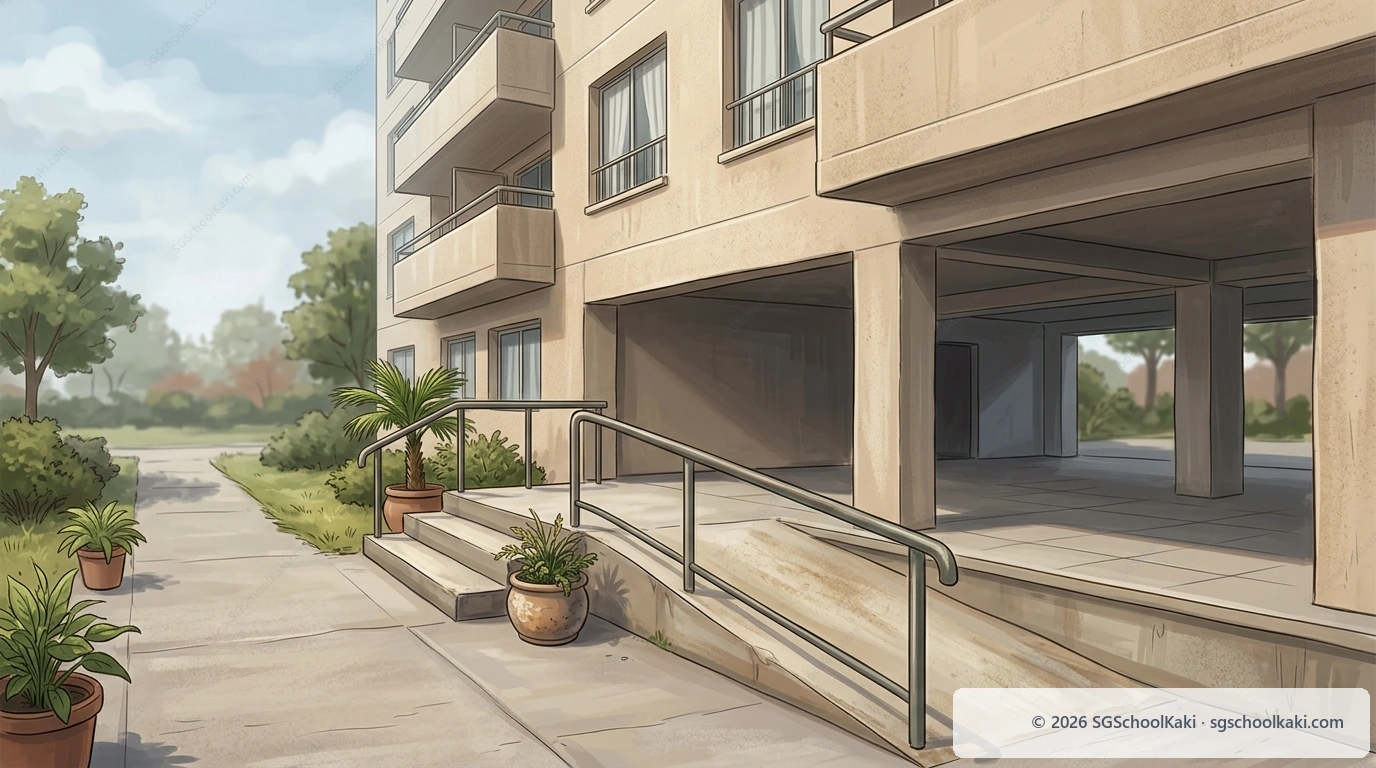
A ramp at the void deck
A ramp lets prams and wheelchairs roll up a small height without steps. The gentler the angle, the easier the climb, but the longer the ramp has to be.
A ramp rises 0.45 m over a horizontal distance of 5.4 m.
(a)Find the length of the ramp, to three significant figures.
(b)Find the angle the ramp makes with the ground, to one decimal place.
Show full solutionHide solution
Colour keyadd, subtract, multiply, divide or simplifyround, estimate or compare
(a)
length2=5.42+0.452=29.3625
Pythagoras.
length=29.3625≈5.4187
Square root.
length≈5.42
Round to the accuracy the question asks for.
(b)
tanθ=5.40.45≈0.083333
Opposite over adjacent.
θ=tan−1(0.083333)≈4.7636∘
Inverse tangent.
θ≈4.8∘
Round to the accuracy the question asks for.
Final answer
(a)The ramp is 5.42 m long.
(b)The angle is 4.8 degrees.
Maths In Real Life 2
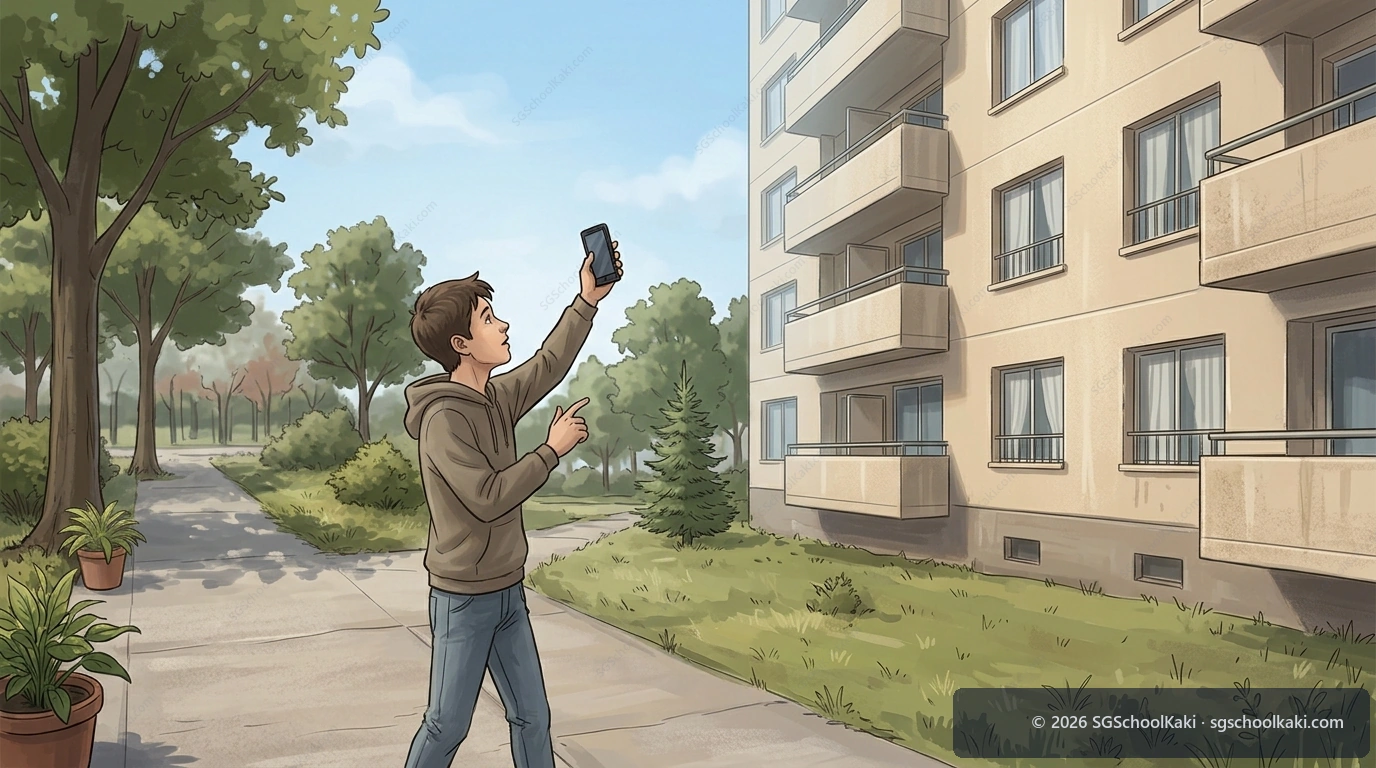
Measuring a block with a phone
Free clinometer apps use the phone's tilt sensor to show an angle of elevation. Combined with a measured distance, that is enough to find the height of a building.
A student stands 60 m from the foot of a block of flats on level ground. Her phone reads an angle of elevation of 49 degrees to the top of the block. Her eye is 1.55 m above the ground.
Find the height of the block, correct to three significant figures.
Show full solutionHide solution
Colour keyadd, subtract, multiply, divide or simplifyround, estimate or compare
tan49∘=60h
h is the height above her eye level.
h=60×1.1504≈69.022
Multiply.
69.022+1.55=70.572
Add her eye height.
69.022+1.55≈70.6
Round to the accuracy the question asks for.
Final answer
The block is 70.6 m tall.
Maths In Real Life 3
Two boats leaving harbour
Coast guards track boats by their bearing and distance from a base. Two bearings and two distances are enough to work out how far apart the boats are.
A patrol boat leaves a harbour H and travels 12 km on a bearing of 035°. A fishing boat leaves H and travels 9 km on a bearing of 112°.
Find the distance between the boats, correct to three significant figures.
Show full solutionHide solution
Colour keyadd, subtract, multiply, divide or simplifyround, estimate or compare
∠PHF=112∘−035∘=77∘
The angle between the two bearings.
d2=122+92−2×12×9×cos77∘
Cosine rule.
d2=122+92−2×12×9×0.22495≈176.41
Evaluate.
d=176.41≈13.282
Square root.
d≈13.3
Round to the accuracy the question asks for.
Final answer
The boats are 13.3 km apart.
01
Supports G4.1 · G4.2
Pythagoras' theorem and its converse
Quick recap. In a right-angled triangle the side opposite the right angle is the hypotenuse, and it is always the longest side. Pythagoras' theorem links the three sides: the square on the hypotenuse equals the sum of the squares on the other two sides.
The Core Idea
Square the two short sides and add to get the long side squared.
If the legs are a and b and the hypotenuse is c, then c2=a2+b2. To find a leg you subtract: a2=c2−b2. Before you press the calculator, ask: is the unknown side the longest side or not?
SGSchoolKaki Tip
Pythagoras needs a right angle. If the question gives you no right angle and no way to prove one, it is a job for the sine rule or the cosine rule (later in this chapter).
Think About It
Why can the hypotenuse never be shorter than a leg?
Show the worked answerHide the worked answer
Colour keyround, estimate or compare
Pythagoras says the square on the hypotenuse is the sum of the squares on the two legs.
Start from the theorem.
The square on the other leg is a positive amount, so the sum is bigger than the square on this leg.
Something positive is added.
A bigger square means a bigger side, so the hypotenuse is longer than each leg.
Compare the sides themselves.
Final answerA right-angled triangle always has its longest side opposite the right angle, so no leg can beat it.
Example 13.1
Finding the hypotenuse
A straight ramp rises 6 m over a horizontal distance of 9 m. Find the length of the ramp, correct to three significant figures.
Find the length of the ramp.
Show solutionHide solution
Colour keyadd, subtract, multiply, divide or simplifyexpand, rewrite, substitute or solveround, estimate or compare
Sketch the right-angled triangle. The ramp is opposite the right angle, so it is the hypotenuse c.
Spot the hypotenuse first.
c2=a2+b2
Pythagoras' theorem.
c2=92+62
Substitute the two shorter sides.
c2=117
Add the squares.
c=117≈10.817
Take the square root; keep extra figures in the working.
c≈10.8
Round to the accuracy the question asks for.
Final answer
The ramp is 10.8 m long.
Example 13.2
Finding a shorter side
A ladder of length 7.2 m rests against a vertical wall. Its foot is 2.1 m from the wall on level ground. How high up the wall does the ladder reach? Give your answer to three significant figures.
Find the height reached.
Show solutionHide solution
Colour keyadd, subtract, multiply, divide or simplifyexpand, rewrite, substitute or solveround, estimate or compare
The ladder is the hypotenuse, so the height is a shorter side. Subtract the squares.
Unknown is a leg, so subtract.
h2=c2−a2
Rearrange Pythagoras' theorem.
h2=7.22−2.12=51.84−4.41
Square each given side.
h2=47.43
Subtract.
h=47.43≈6.8869
Square root.
h≈6.89
Round to the accuracy the question asks for.
Final answer
The ladder reaches 6.89 m up the wall.
Example 13.3
Is the triangle right-angled?
Triangle P has sides 20 cm, 21 cm and 29 cm. Triangle Q has sides 9 cm, 12 cm and 16 cm. Decide, with working, which triangle is right-angled.
(i)Is triangle P right-angled?
(ii)Is triangle Q right-angled?
Show solutionHide solution
Colour keyadd, subtract, multiply, divide or simplify
(i)
Test the converse: if the square of the longest side equals the sum of the squares of the other two, the triangle has a right angle opposite it.
The longest side is the only possible hypotenuse.
202+212=841
Add the squares of the two shorter sides.
292=841
Square the longest side.
The two results are equal, so triangle P is right-angled.
Equal means the converse holds.
(ii)
92+122=225
Short sides first.
162=256
Longest side squared.
The results are different, so triangle Q is not right-angled.
One mismatch is enough to say no.
Final answer
(i)Triangle P is right-angled: 841 = 841.
(ii)Triangle Q is not right-angled: 225 is not 256.
Example 13.4
Pythagoras in an isosceles triangle
An isosceles triangle has two equal sides of 8.5 cm and a base of 7.2 cm. Find its perpendicular height and its area, each to three significant figures.
(i)Find the perpendicular height.
(ii)Find the area.
Show solutionHide solution
Colour keyadd, subtract, multiply, divide or simplifyround, estimate or compare
(i)
The height drops from the apex to the midpoint of the base, making two right-angled triangles.
An isosceles triangle splits into two equal right-angled triangles.
Pick one acute angle in a right-angled triangle and call it θ. Relative to θ, the side across from it is the opposite, the side touching it (that is not the hypotenuse) is the adjacent, and the longest side is the hypotenuse.
The three sides, named from the angle θ.
The Core Idea
SOH CAH TOA.
sinθ=hypotenuseopposite,cosθ=hypotenuseadjacent,tanθ=adjacentopposite. Write down which two sides are involved before choosing the ratio.
Case table: which ratio do I use?
Sides involved
Picture
Ratio
Use it when
opposite and hypotenuse
sinθ
sine: hypopp
you know one of these two and want the other, or the angle
adjacent and hypotenuse
cosθ
cosine: hypadj
you know one of these two and want the other, or the angle
opposite and adjacent
tanθ
tangent: adjopp
the hypotenuse is not involved
SGSchoolKaki Tip
Set the calculator to degrees (D). To find an angle from a ratio use the inverse keys sin−1,cos−1,tan−1. Keep the whole calculator value in the working and round only the final answer.
Example 13.5
Finding a side: unknown on top
In a right-angled triangle the hypotenuse is 12 cm and one acute angle is 35 degrees. Find the length x of the side opposite that angle, correct to three significant figures.
Find x.
Show solutionHide solution
Colour keyadd, subtract, multiply, divide or simplifyexpand, rewrite, substitute or solveround, estimate or compare
Label the sides from the given angle: x is opposite, and the hypotenuse is known. Opposite and hypotenuse means sine.
Name the two sides, then pick the ratio.
sin35∘=12x
Write the ratio with the unknown on top.
x=12×sin35∘
Multiply both sides by the hypotenuse.
x=12×0.57358
Calculator in degree mode.
x≈6.8829
Keep extra figures.
x≈6.88
Round to the accuracy the question asks for.
Final answer
x = 6.88 cm.
Example 13.6
Finding a side: unknown on the bottom
A support wire is fixed to the top of a pole and makes an angle of 28 degrees with the level ground. The wire is anchored 9.4 m from the foot of the pole. Find the length y of the wire, correct to three significant figures.
Find y.
Show solutionHide solution
Colour keyadd, subtract, multiply, divide or simplifyround, estimate or compare
Relative to the angle at the ground, the known side is the adjacent and y is the hypotenuse. Adjacent and hypotenuse means cosine.
Adjacent and hypotenuse: cosine.
cos28∘=y9.4
The unknown is now on the bottom.
y=cos28∘9.4
Swap y and cos: multiply by y, then divide by the cosine.
y=0.882959.4≈10.646
Divide, do not multiply.
y≈10.6
Round to the accuracy the question asks for.
Final answer
The wire is 10.6 m long.
Example 13.7
Finding an angle
In a right-angled triangle the side opposite the angle θ is 7 cm and the hypotenuse is 11 cm. Find θ and the other acute angle, each correct to one decimal place.
(i)Find θ.
(ii)Find the other acute angle.
Show solutionHide solution
Colour keyadd, subtract, multiply, divide or simplifyexpand, rewrite, substitute or solveround, estimate or compare
(i)
Opposite and hypotenuse, so use sine.
Name the sides first.
sinθ=117≈0.63636
Write the ratio as a number.
θ=sin−1(0.63636)≈39.521∘
Use the inverse sine key.
θ≈39.5∘
Round to the accuracy the question asks for.
(ii)
90∘−39.521∘≈50.479∘
The two acute angles of a right-angled triangle add up to ninety degrees.
90∘−39.521∘≈50.5∘
Round to the accuracy the question asks for.
Final answer
(i)θ = 39.5 degrees.
(ii)The other acute angle is 50.5 degrees.
Example 13.8
Solving a whole right-angled triangle
In triangle PQR, angle PQR is a right angle, PQ = 7.5 cm and QR = 4.2 cm. Find angle QPR, PR and angle PRQ, to the usual accuracy (angles to one decimal place, lengths to three significant figures).
(i)Find angle QPR.
(ii)Find PR.
(iii)Find angle PRQ.
Show solutionHide solution
Colour keyadd, subtract, multiply, divide or simplifyround, estimate or compare
(i)
Relative to angle QPR, QR is opposite and PQ is adjacent: use tangent.
Opposite and adjacent: tangent.
tanP=7.54.2=0.56
Ratio as a number.
P=tan−1(0.56)≈29.249∘
Inverse tangent.
P≈29.2∘
Round to the accuracy the question asks for.
(ii)
PR2=7.52+4.22=73.89
Use Pythagoras, so the rounded angle is not carried into the length.
PR=73.89≈8.5959
Square root.
PR≈8.60
Round to the accuracy the question asks for.
(iii)
90∘−29.249∘≈60.751∘
The angles of a triangle add up to 180∘, and the right angle uses ninety of them.
90∘−29.249∘≈60.8∘
Round to the accuracy the question asks for.
Final answer
(i)Angle QPR = 29.2 degrees.
(ii)PR = 8.60 cm.
(iii)Angle PRQ = 60.8 degrees.
03
Supports G4.7
Angles of elevation and depression
An angle of elevation is measured upwards from the horizontal to your line of sight. An angle of depression is measured downwards from the horizontal. Both are measured from a horizontal line, never from the vertical.
The Core Idea
Draw the horizontal first.
Mark the horizontal line through the observer, then the line of sight, then the angle between them. The right-angled triangle you need is usually hiding between the ground, the object and the line of sight.
SGSchoolKaki Tip
Do not measure the angle of elevation from the vertical wall or pole. It is always measured upwards from the horizontal ground.
Example 13.9
Angle of elevation
Ayesha stands 45 m from the foot of a tower on level ground. Her eyes are 1.6 m above the ground. She measures the angle of elevation of the top of the tower as 32 degrees. Find the height of the tower, correct to three significant figures.
Find the height of the tower.
Show solutionHide solution
Colour keyadd, subtract, multiply, divide or simplifyround, estimate or compare
The horizontal through the eyes meets the tower. Above that point the tower forms a right-angled triangle with the line of sight. The side above eye level is opposite the angle, and the distance 45 m is adjacent.
Opposite and adjacent: tangent.
tan32∘=45h
Let h be the height of the tower above eye level.
h=45×0.62487≈28.119
Multiply by the adjacent side.
Tower height=28.119+1.6=29.719
Add the eye height, because h stops at eye level.
Tower height≈29.7
Round to the accuracy the question asks for.
Final answer
The tower is 29.7 m tall.
Example 13.10
Angle of depression
From a window 60 m above level ground, the angle of depression of a bicycle on the ground is 25 degrees. Find the horizontal distance from the foot of the block to the bicycle, correct to three significant figures.
Find the horizontal distance d.
Show solutionHide solution
Colour keyadd, subtract, multiply, divide or simplifyround, estimate or compare
The angle of depression is measured down from the horizontal. The horizontal line at the window is parallel to the ground, so the angle of elevation of the window from the bicycle is equal to it (alternate angles).
Alternate angles between parallel lines are equal.
tan25∘=d60
Height is opposite, d is adjacent.
d=tan25∘60=0.4663160≈128.67
Unknown on the bottom: divide.
d≈129
Round to the accuracy the question asks for.
Final answer
The bicycle is 129 m from the foot of the block.
Example 13.11
Two observation points
Points A and B are on level ground in a straight line with the foot of a vertical tower, and B is between A and the tower. A and B are 50 m apart. The angle of elevation of the top of the tower is 20 degrees from A and 35 degrees from B. Find the height of the tower, correct to three significant figures.
Find the height h.
Show solutionHide solution
Colour keyadd, subtract, multiply, divide or simplifyround, estimate or compare
Let the distance from B to the foot of the tower be t. Both right-angled triangles share the height h.
Two triangles, two equations, one height.
h=ttan35∘andh=(t+50)tan20∘
Tangent in each triangle (opposite over adjacent).
t=h×tan35∘1=h×1.4281
Make t the subject from the first equation.
t+50=h×2.7475
From the second equation.
h×2.7475−h×1.4281=50
Subtract the two expressions for the horizontal distances.
h=1.319350≈37.898
Factor out h, then divide.
h≈37.9
Round to the accuracy the question asks for.
Final answer
The tower is 37.9 m tall.
Locked · Chapter 13
You've read the free 29%. Unlock the rest of Chapter 13.
Still to read in this chapter:
Bearings
Obtuse angles
Area of a triangle
Sine rule
Cosine rule
Three dimensions
Formula panel
Exercise
$9one-time · all 19 chapters · no subscription
Worked examples, formulas and exam checks. The whole E-Math syllabus.
ONE PRICE19chapters
Premium members get all 19 chapters included.
Notes version 1.0 · Last updated 3 Nov 2026 · Chapter 13 of 19