









SGSchoolKaki
Loading...
O-Level E-Math notes · Chapter 15

Coordinate Geometry: O-Level E-Math Notes

Coordinate geometry puts geometry on a grid so that points have addresses. Once every point is a pair of numbers, gradients, lengths and equations let you answer geometry questions with arithmetic.

Your outcome tracker0 / 5
Let's go! Tick an outcome once you can pass its exam check. Saved on this device.
Chapter
15
Figure 1 · Coordinate geometry
Run and riseTwo points on a line with a dashed right-angled triangle whose legs show the run and the rise0246024681012xy48A (2, 3)B (6, 11)
4 outcomes · 18 worked examples · every step shown ✦
Gradient

Gradient is rise over run.

Length of a line segment

Length is the square root of run squared plus rise squared.

Equation of a line

In y = mx + c, m is the slope and c is where it starts.

By the end of this chapter
  • Find the gradient of a straight line from the coordinates of two points on it.
  • Find the length of a line segment from the coordinates of its end points.
  • Interpret and find the equation of a straight line in the form y=mx+cy = mx + c, including the equation of a line parallel to a given line.
  • Solve geometric problems with coordinates: triangles, parallelograms, and lines meeting the axes.
Start here

Maths In Real Life

Real situations, each with its own picture. The pictures are drawn first, then the maths is placed on top.

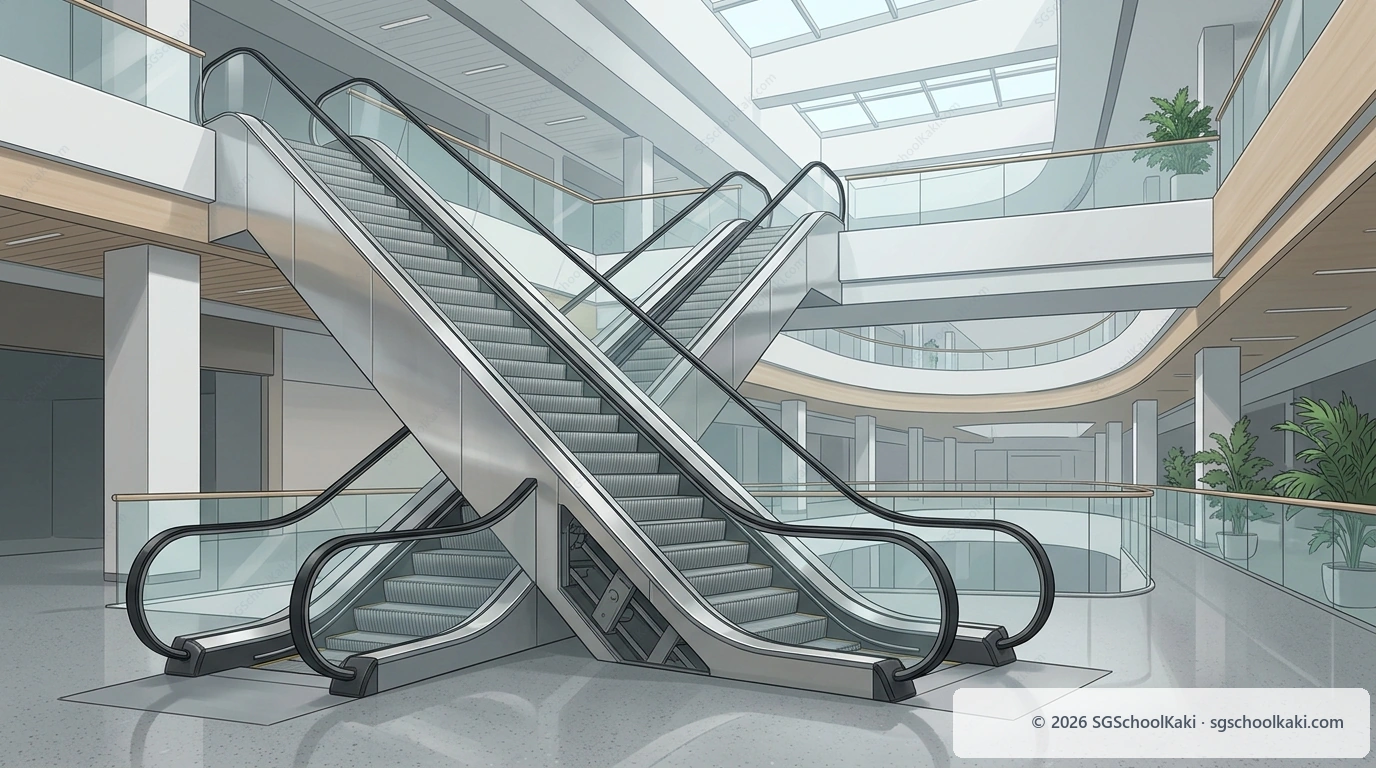
A long escalator seen from the side, with the horizontal distance and the height gained drawn over the picture
Run 12 mRise 7.5 m
Maths In Real Life 1

An escalator

An escalator is a moving straight line. How steep it is depends on how far it rises compared with how far it travels across, which is exactly its gradient.

An escalator rises 7.5 m while it travels 12 m across, measured on the floor. Take the bottom of the escalator as the origin, with xx the distance across and yy the height.

  • (a)Find the gradient of the escalator.
  • (b)How long is the escalator, to three significant figures.
  • (c)Find the height of a passenger when they are 4.8 m across from the bottom.
Show full solutionHide solution
Colour keyadd, subtract, multiply, divide or simplifyexpand, rewrite, substitute or solve
(a)
m=7.5−012−0=7.512=0.625\displaystyle m = \dfrac{7.5 - 0}{12 - 0} = \dfrac{7.5}{12} = 0.625
Rise over run from the bottom (the origin) to the top.
(b)
length2=122+7.52=200.25\displaystyle \text{length}^2 = 12^2 + 7.5^2 = 200.25
Distance formula from the origin to the top.
length=200.25≈14.151≈14.2\displaystyle \text{length} = \sqrt{200.25} \approx 14.151 \approx 14.2
Square root last.
(c)
The escalator is the line y=mxy = mx through the origin, with m=0.625m = 0.625.
A line through the origin has c=0c = 0.
y=0.625×4.8=3\displaystyle y = 0.625 \times 4.8 = 3
Put in the horizontal distance.
Final answer
(a)The gradient is 0.625.
(b)The escalator is 14.2 m long.
(c)The height is 3 m.
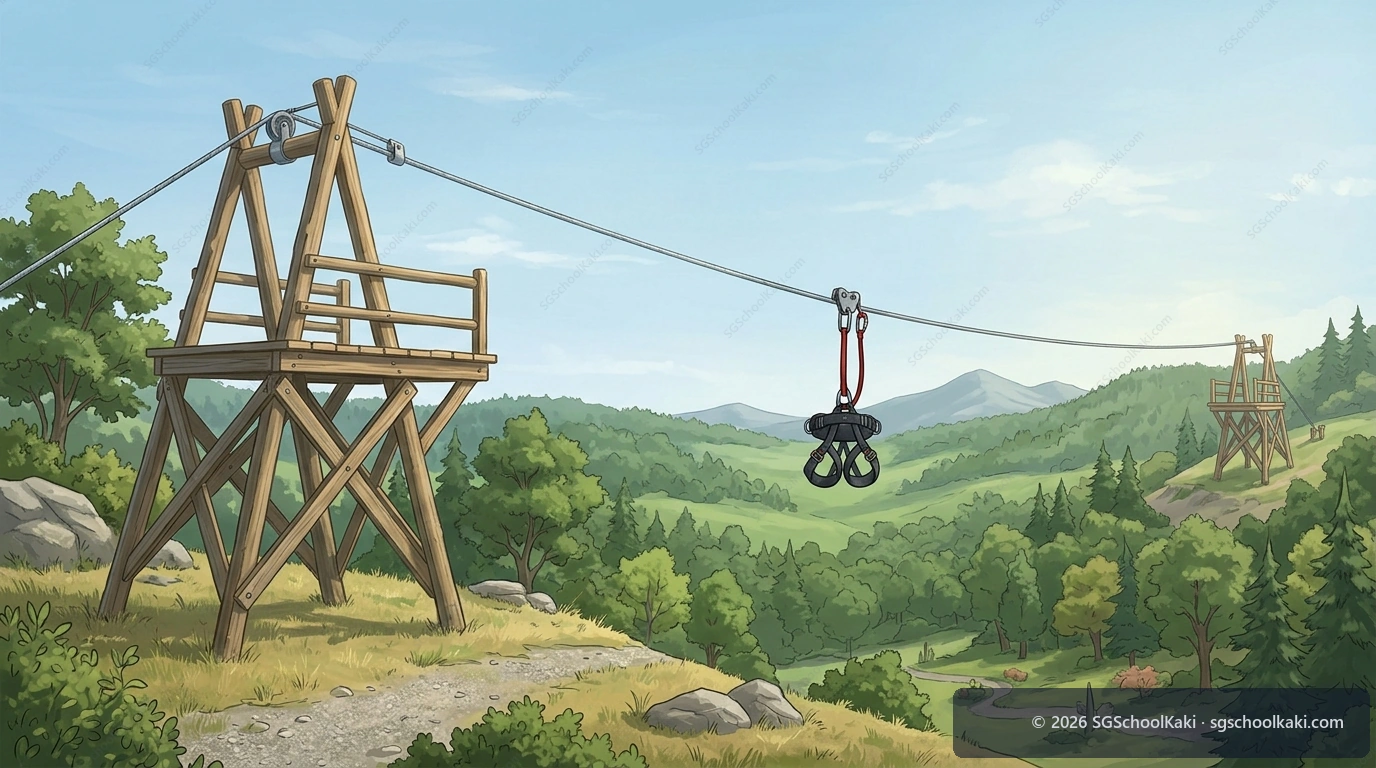
A zip line cable between two towers at different heights, with the ground distance and the heights drawn over the picture
Towers 40 m apartHeights 12 m and 4 m
Maths In Real Life 2

A zip line

A zip line is a straight cable between two towers. Its equation tells you the height of the rider at any distance along the ground, and its length tells you how much cable you need.

A zip line cable runs from the top of the first tower, at height 12 m, to the top of the second tower, at height 4 m. The towers are 40 m apart on level ground. Let xx be the distance from the first tower and yy the height of the cable, both in metres.

  • (a)Find the gradient of the cable.
  • (b)Find the equation of the cable.
  • (c)Find the height of the cable when x=25x = 25.
  • (d)How long is the cable, to three significant figures.
Show full solutionHide solution
Colour keyadd, subtract, multiply, divide or simplifyexpand, rewrite, substitute or solve
(a)
m=4−(12)40=−840=−0.2\displaystyle m = \dfrac{4 - (12)}{40} = \dfrac{-8}{40} = -0.2
The cable runs from the top of the first tower to the top of the second.
(b)
The cable starts at height 12 m when x=0x = 0, so the yy-intercept is c=12c = 12.
Read cc from the first tower.
Substitute mm and cc into y=mx+cy = mx + c.
Assemble.
y=−0.2x+12\displaystyle y = -0.2x + 12
The equation with mm and cc in place.
(c)
y=(−0.2)(25)+(12)=−5+(12)=7\displaystyle y = (-0.2)(25) + (12) = -5 + (12) = 7
Substitute xx into the equation.
(d)
length2=402+82=1664\displaystyle \text{length}^2 = 40^2 + 8^2 = 1664
Distance formula between the two tower tops.
length=1664≈40.792≈40.8\displaystyle \text{length} = \sqrt{1664} \approx 40.792 \approx 40.8
Square root.
Final answer
(a)The gradient is -0.2, so the cable goes down as xx increases.
(b)The equation is y=−0.2x+12y = -0.2x + 12.
(c)The height is 7 m.
(d)The cable is 40.8 m long.
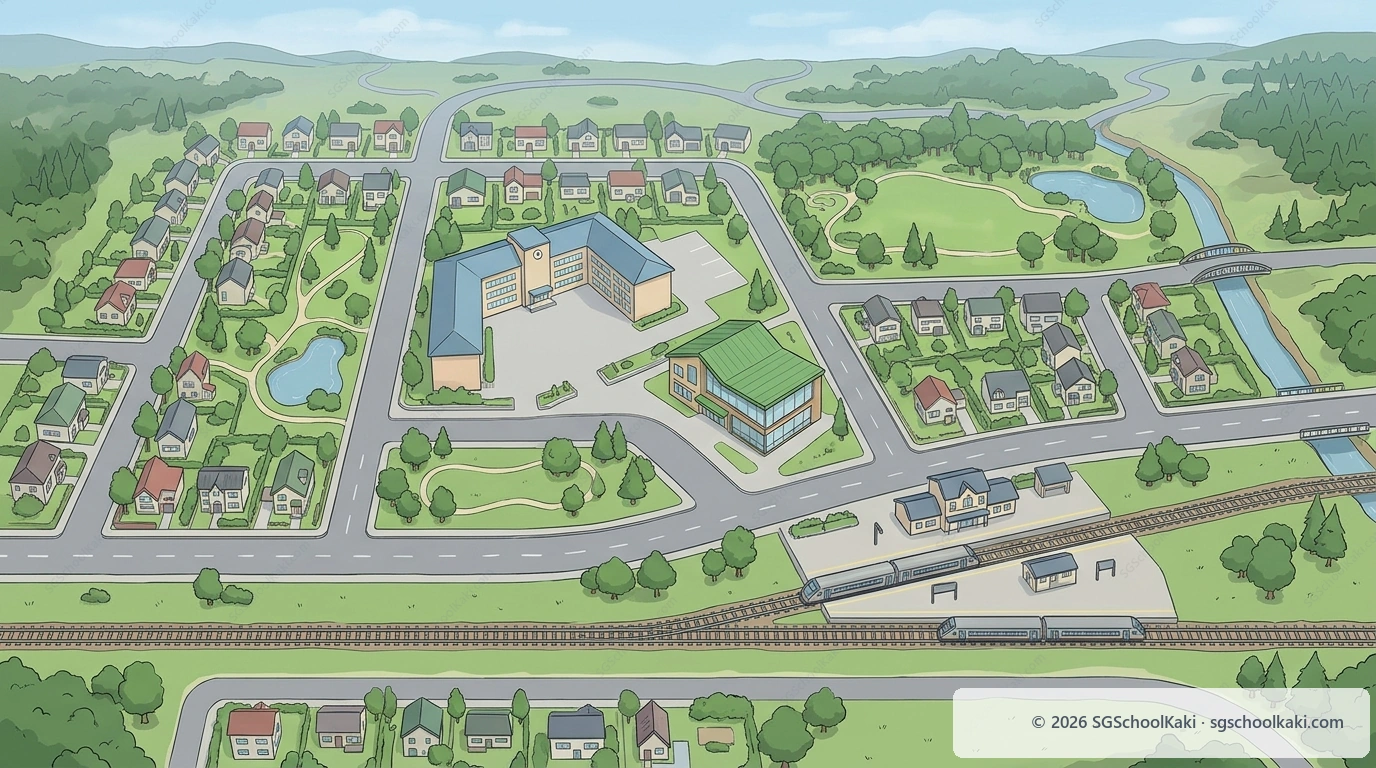
A neighbourhood map with a school, a station and a library on a grid, with the main road drawn as a straight line between the school and the station
Points (1, 2) and (6, 10)
Maths In Real Life 3

A map of the neighbourhood

Town planners put maps on a grid so that every place has coordinates. Distances and directions between places then become numbers.

On a map grid, each unit is one kilometre. The school S is at (1, 2), the station M is at (6, 10) and the library L is at (3, 5). A straight road runs from S to M.

  • (a)Find the distance from the school to the station, to three significant figures.
  • (b)Find the equation of the road.
  • (c)Does the library lie on the road? Give a reason.
Show full solutionHide solution
Colour keyadd, subtract, multiply, divide or simplifyexpand, rewrite, substitute or solve
(a)
SM2=(6−(1))2+(10−(2))2=52+82=89\displaystyle SM^2 = (6 - (1))^2 + (10 - (2))^2 = 5^2 + 8^2 = 89
Distance formula.
SM=89≈9.4340≈9.43\displaystyle SM = \sqrt{89} \approx 9.4340 \approx 9.43
Square root last.
(b)
m=10−(2)6−(1)=85=1.6\displaystyle m = \dfrac{10 - (2)}{6 - (1)} = \dfrac{8}{5} = 1.6
Gradient of the road.
c=2−(1.6)(1)=0.4\displaystyle c = 2 - (1.6)(1) = 0.4
Use the school's coordinates to find cc.
y=1.6x+0.4\displaystyle y = 1.6x + 0.4
Substitute mm and cc into y=mx+cy = mx + c.
(c)
y=(1.6)(3)+(0.4)=4.8+(0.4)=5.2\displaystyle y = (1.6)(3) + (0.4) = 4.8 + (0.4) = 5.2
The road's height at the library's xx-coordinate.
yL=5\displaystyle y_L = 5
The library's actual yy-coordinate is different, so it is not on the road.
Final answer
(a)The school is 9.43 km from the station.
(b)The equation of the road is y=1.6x+0.4y = 1.6x + 0.4.
(c)No: the road has y=5.2y = 5.2 there, but the library has y=5y = 5, so it is not on the road.
Supports G6.1

The gradient of a straight line

The gradient of a line tells you how steep it is and which way it leans. Move along the line from one point to another: the change upwards is the rise and the change across is the run.

The Core Idea

Gradient is rise over run.

m=y2−y1x2−x1m = \dfrac{y_2 - y_1}{x_2 - x_1} for two points (x1,y1)(x_1, y_1) and (x2,y2)(x_2, y_2). Subtract the yy values and the xx values in the same order.

SGSchoolKaki Tip

Keep brackets round negative coordinates when you substitute: y2−(−3)y_2 - (-3) is y2+3y_2 + 3. Most lost marks in this topic are sign slips.

Case table: what the gradient tells you
GradientPictureThe lineRise and run
positive
Gradient caseA line rising from left to right: positive gradientxy
m>0m > 0
rises from left to rightrise and run have the same sign
negative
Gradient caseA line falling from left to right: negative gradientxy
m<0m < 0
falls from left to rightrise and run have opposite signs
zero
Gradient caseA horizontal line: gradient zeroxy
m=0m = 0
is horizontalthe rise is zero
not defined
Gradient caseA vertical line: gradient not definedxy
no gradient
is verticalthe run is zero, and we cannot divide by zero
Example 15.1

Gradient from two points

Find the gradient of the line through the points A(2, 3) and B(6, 11).

Find the gradient.

Show solutionHide solution
Colour keyadd, subtract, multiply, divide or simplifyround, estimate or compare
m=y2−y1x2−x1\displaystyle m = \dfrac{y_2 - y_1}{x_2 - x_1}
Rise over run: change in yy over change in xx.
m=11−(3)6−(2)\displaystyle m = \dfrac{11 - (3)}{6 - (2)}
Substitute the coordinates, with brackets round each value.
m=84=2\displaystyle m = \dfrac{8}{4} = 2
Subtract, then divide.
Run and riseTwo points on a line with a dashed right-angled triangle whose legs show the run and the rise0246024681012xy48A (2, 3)B (6, 11)
Final answer
The gradient is 2.
Example 15.2

A negative gradient

Find the gradient of the line through A(-2, 6) and B(3, -4), and say whether the line rises or falls from left to right.

  • (i)Find the gradient.
  • (ii)Does the line rise or fall from left to right?
Show solutionHide solution
Colour keyadd, subtract, multiply, divide or simplifyround, estimate or compare
(i)
m=y2−y1x2−x1\displaystyle m = \dfrac{y_2 - y_1}{x_2 - x_1}
Rise over run.
m=−4−(6)3−(−2)\displaystyle m = \dfrac{-4 - (6)}{3 - (-2)}
Brackets round negative values keep the signs right.
m=−105=−2\displaystyle m = \dfrac{-10}{5} = -2
A negative divided by a positive is negative.
(ii)
The gradient is negative, so as xx increases, yy decreases.
Sign of the gradient tells the direction.
Run and riseTwo points on a line with a dashed right-angled triangle whose legs show the run and the rise-2-101234-4-3-2-101234567xy510A (-2, 6)B (3, -4)
Final answer
(i)The gradient is -2.
(ii)The line falls from left to right, because the gradient is negative.
Example 15.3

Horizontal and vertical lines

(i) Find the gradient of the line through (1, 4) and (5, 4). (ii) Explain what happens when you try to find the gradient of the line through (3, 1) and (3, 7).

  • (i)Find the gradient of the first line.
  • (ii)Explain what happens for the second line.
Show solutionHide solution
(i)
m=4−(4)5−(1)=04=0\displaystyle m = \dfrac{4 - (4)}{5 - (1)} = \dfrac{0}{4} = 0
The two yy values are equal, so the rise is zero.
(ii)
m=7−(1)3−(3)=60\displaystyle m = \dfrac{7 - (1)}{3 - (3)} = \dfrac{6}{0}
The two xx values are equal, so the run is zero.
Division by zero is not possible, so this line has no gradient. It is a vertical line.
A vertical line is infinitely steep.
Horizontal and vertical linesA horizontal segment AB and a vertical segment DE on a grid0123456012345678xyA (1, 4)B (5, 4)D (3, 1)E (3, 7)
Final answer
(i)The gradient is 0: the line is horizontal.
(ii)The run is zero, and dividing by zero is impossible, so the gradient is not defined: the line is vertical.
Example 15.4

Gradient from a graph

The graph shows a straight line passing through the points (2, 2) and (4, 5). Use the gradient triangle to find its gradient.

Find the gradient.

Show solutionHide solution
Colour keyadd, subtract, multiply, divide or simplify
Read the run and the rise from the sides of the triangle, which go from the first point across and then up.
Count along, then up.
m=riserun=32=1.5\displaystyle m = \dfrac{\text{rise}}{\text{run}} = \dfrac{3}{2} = 1.5
Divide the rise by the run.
Gradient from a graphA straight line with two marked points and a gradient triangle showing the run and the rise0246-20246810xy23y = 1.5x − 1(2, 2)(4, 5)
Final answer
The gradient is 1.5.
Supports G6.2

The length of a line segment

The straight-line distance between two points is the hypotenuse of a right-angled triangle whose sides run along the grid. So the length of a segment comes from Pythagoras' theorem.

The Core Idea

Length is the square root of run squared plus rise squared.

AB=(x2−x1)2+(y2−y1)2AB = \sqrt{(x_2 - x_1)^2 + (y_2 - y_1)^2}. The squares remove any minus signs, so the order of the points does not matter.

SGSchoolKaki Tip

Do not add before you square. Square each difference first, add, and take the square root last: a2+b2\sqrt{a^2 + b^2} is not a+ba + b.

Example 15.5

Distance between two points

Find the length of AB, where A is (-2, 3) and B is (5, 8). Give your answer to three significant figures if it is not exact.

Find the length of AB.

Show solutionHide solution
Colour keyadd, subtract, multiply, divide or simplify
AB2=(x2−x1)2+(y2−y1)2\displaystyle AB^2 = (x_2 - x_1)^2 + (y_2 - y_1)^2
Pythagoras: the legs are the differences in xx and in yy.
AB2=(5−(−2))2+(8−(3))2=72+52\displaystyle AB^2 = (5 - (-2))^2 + (8 - (3))^2 = 7^2 + 5^2
Substitute with brackets, then simplify each bracket.
AB2=74\displaystyle AB^2 = 74
Square and add.
AB=74≈8.6023≈8.60\displaystyle AB = \sqrt{74} \approx 8.6023 \approx 8.60
Square root last.
Distance between two pointsSegment AB with a dashed right-angled triangle: its legs are the horizontal and vertical differences-2024602468xyAB75A (-2, 3)B (5, 8)
Final answer
AB = 8.60 units.
Example 15.6

Finding an unknown coordinate

The point A is (2, 1) and the point B is (kk, 5). The length of AB is 5 units. Find the two possible values of kk.

Find the possible values of kk.

Show solutionHide solution
Colour keyadd, subtract, multiply, divide or simplifyexpand, rewrite, substitute or solve
AB2=(k−(2))2+(5−(1))2\displaystyle AB^2 = (k - (2))^2 + (5 - (1))^2
Distance formula with kk as the unknown.
25=(k−(2))2+16\displaystyle 25 = (k - (2))^2 + 16
Put in AB=5AB = 5, so AB2=25AB^2 = 25.
(k−(2))2=25−16=9\displaystyle (k - (2))^2 = 25 - 16 = 9
Rearrange to isolate the square.
k−(2)=±3\displaystyle k - (2) = \pm 3
Take the square root: two answers, positive and negative.
k=2+3=5ork=2−3=−1\displaystyle k = 2 + 3 = 5 \quad \text{or} \quad k = 2 - 3 = -1
Solve for each case.
Two possible pointsThe point A and the two possible positions of B on the horizontal line, each the same distance from A02460246xy55A (2, 1)B (5, 5)D (-1, 5)
Final answer
k=5k = 5 or k=−1k = -1.
Locked · Chapter 15

You've read the free 23%. Unlock the rest of Chapter 15.

Still to read in this chapter:

  • Equation of a line
  • Parallel lines
  • Geometric problems
  • Formula panel
  • Exercise

$9 one-time · all 19 chapters · no subscription

Worked examples, formulas and exam checks.
The whole E-Math syllabus.

Premium members get all 19 chapters included.

Notes version 1.0 · Last updated 3 Nov 2026 · Chapter 15 of 19