









SGSchoolKaki
Loading...
E-Math notes · Chapter 12

Properties of Circles: O-Level E-Math Notes

A circle is perfectly symmetrical, and that gives a short list of rules about chords, tangents and angles. By the end of this chapter you can use all of them, and write each reason in the standard wording.

Your outcome tracker0 / 7
Let's go! Tick an outcome once you can pass its exam check. Saved on this device.
Chapter
12
Figure 1 · Diagram for Example 12.22
A circleA circle with the points, lines and angles of the problem marked38°25°x°y°z°OACBD
2 outcomes · 22 worked examples · every step shown ✦
Chords

A chord and the centre: two facts.

Tangents

Three facts about tangents.

Angle in a semicircle

The angle in a semicircle is a right angle.

By the end of this chapter
  • Use the symmetry properties of circles: equal chords, the perpendicular bisector of a chord, and tangents from an external point.
  • Use the angle in a semicircle and the angle between a tangent and a radius.
  • Use the angle at the centre, the angle at the circumference and angles in the same segment.
  • Use angles in opposite segments (cyclic quadrilaterals), and give clear reasons.
Start here

Maths In Real Life

Three situations built on circles. The pictures are made separately and the circles are drawn on top by script, so every number matches its problem.

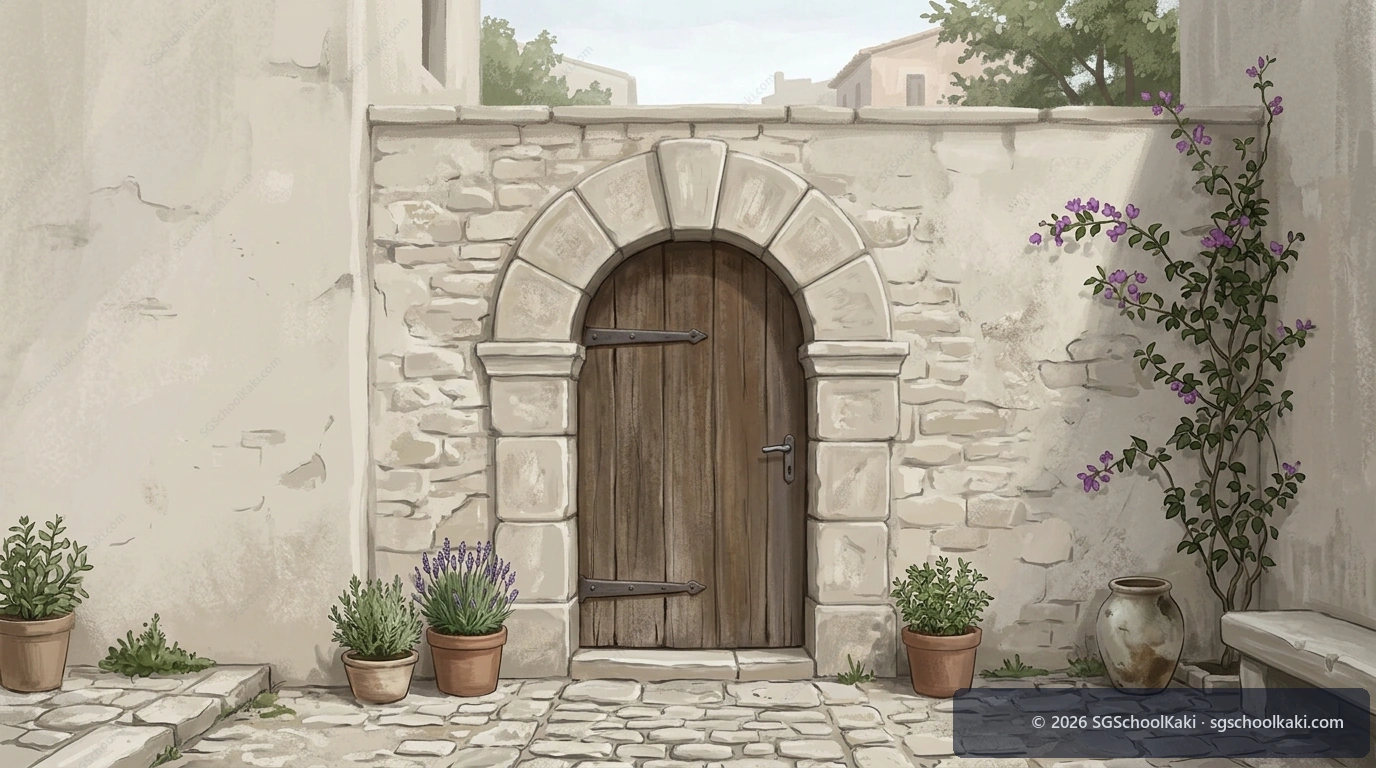
A circular arch over a doorway in a wall, with the base width and the height marked over the picture
Arch base 16 mArch height 4 mRadius r of the circle
Maths In Real Life 1

A circular arch

A circular arc over a doorway is part of a circle. Its base is a chord, and the centre lies on the perpendicular bisector of that chord.

A builder is designing a doorway.

A circular arch over a doorway has a base 16 m wide and is 4 m high at its highest point. Find the radius of the circle the arch belongs to.

Show full solutionHide solution
Colour keyadd, subtract, multiply, divide or simplify
half the base=8\displaystyle \text{half the base} = 8
the perpendicular from the centre to a chord bisects the chord
r2=82+(r−4)2\displaystyle r^2 = 8^2 + (r - 4)^2
Pythagoras' theorem: the distance from the centre to the base is r minus the height
8r=80\displaystyle 8r = 80
expand and cancel r²
r=80÷8=10\displaystyle r = 80 \div 8 = 10
Final answer
10 m
A circular pond in a park with a straight path touching its edge, with the radius and the path marked over the picture
Pond radius 12 mPath meets the pond at TCentre O to P: 13 m
Maths In Real Life 2

A path to a pond

A straight path that just touches a circular pond meets the radius at a right angle.

A walker is near a pond.

A walker at P wants to reach the edge of a circular pond of radius 12 m by a straight path that just touches the pond at T. P is 13 m from the centre O of the pond. How long is the path PT?

Show full solutionHide solution
∠OTP=90∘\displaystyle \angle\text{OTP} = 90^{\circ}
the tangent is perpendicular to the radius at the point of contact
PT2=132−122=25\displaystyle PT^2 = 13^2 - 12^2 = 25
Pythagoras' theorem
PT=5\displaystyle PT = 5
Final answer
5 m
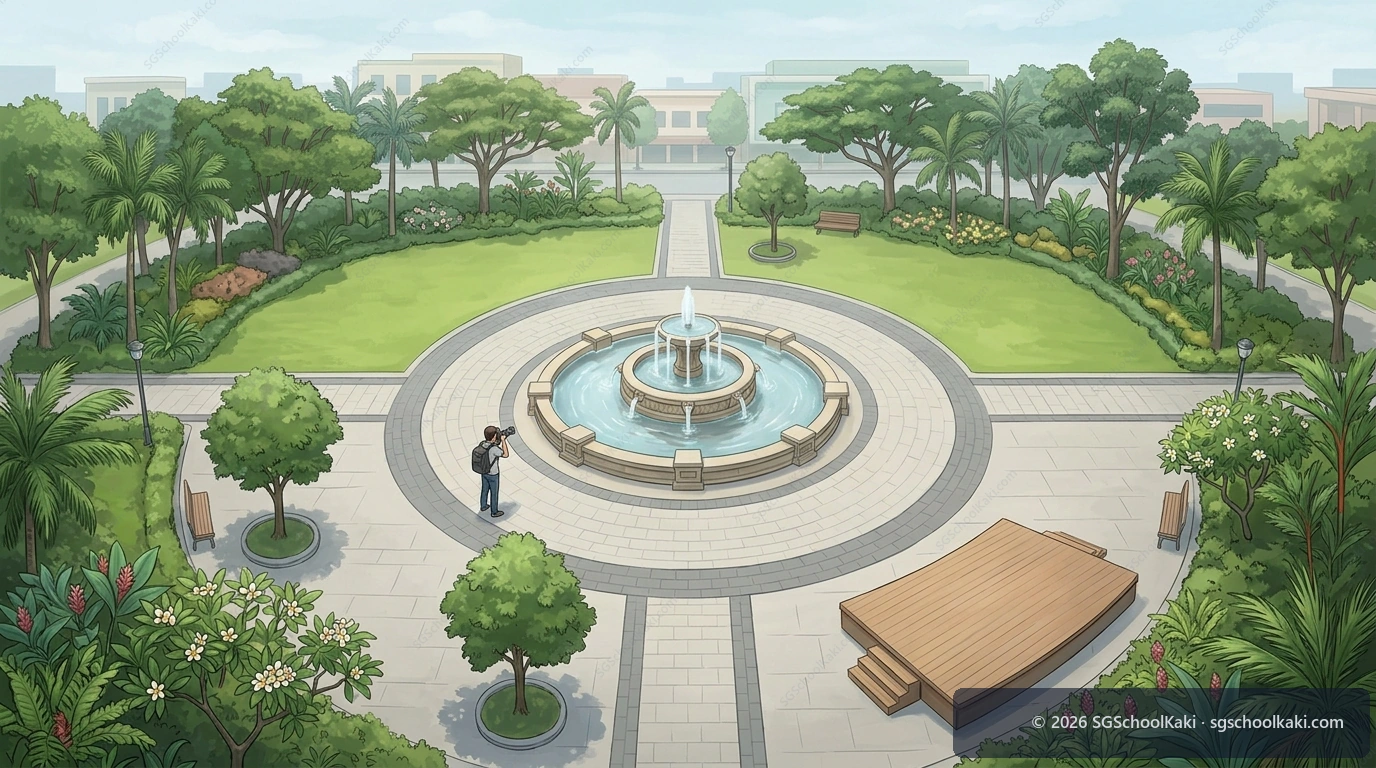
A circular path round a fountain with a stage, and a photographer on the path, with the viewing angles marked over the picture
Angle at P: 38°Angle at the centre O: 2 × 38°
Maths In Real Life 3

Photographs from a circular path

From any point on the same arc, the same two stage edges are seen at the same angle, and the angle at the centre is twice as large.

A photographer walks round a fountain.

A photographer stands at P on a circular path round a fountain and sees the stage edges A and B at an angle of 38°. She walks to Q, another point on the same arc on the same side of AB. What angle does she see at Q, and what is the angle AOB at the centre O of the path?

Show full solutionHide solution
∠AQB=∠APB=38\displaystyle \angle\text{AQB} = \angle\text{APB} = 38
angles in the same segment are equal
∠AOB=2×38=76\displaystyle \angle\text{AOB} = 2 \times 38 = 76
the angle at the centre is twice the angle at the circumference
Final answer
angle AQB = 38∘38^{\circ} and angle AOB = 76∘76^{\circ}
Supports G3.1.b · G3.1.a

Symmetry properties: chords

A chord is a straight line joining two points on a circle. The circle is perfectly symmetrical about its centre, and that gives two useful facts about chords.

The Core Idea

A chord and the centre: two facts.

The perpendicular from the centre to a chord bisects the chord, so the perpendicular bisector of a chord passes through the centre. Equal chords are the same distance from the centre, and the other way round.

SGSchoolKaki Tip

To find a length, draw the radius to one end of the chord and the perpendicular from the centre. You get a right-angled triangle: radius, half the chord, and the distance from the centre.

SGSchoolKaki Tip

The perpendicular distance from the centre is the SHORTEST distance, measured at a right angle to the chord. Do not measure it to an end of the chord.

Think About It
Where must the centre of a circle lie, if AB and BC are two chords of it?
Show the worked answerHide the worked answer
The centre lies on the perpendicular bisector of every chord.
the symmetry property
So it lies on the perpendicular bisector of AB and also on the perpendicular bisector of BC.
use it twice
Final answerThe centre is where the perpendicular bisectors of AB and BC cross.
A circleA circle with the points, lines and angles of the problem markedx cm3 cm5 cmOABM
Diagram for Example 12.1
Example 12.1

The length of a chord

O is the centre of the circle and OM is perpendicular to the chord AB. Find the length xx of AB.

Show solutionHide solution
Colour keyadd, subtract, multiply, divide or simplify
AM=MB=12AB\displaystyle AM = MB = \tfrac{1}{2} AB
the perpendicular from the centre to a chord bisects the chord
AM2=OA2−OM2=52−32=16\displaystyle AM^2 = OA^2 - OM^2 = 5^2 - 3^2 = 16
Pythagoras' theorem in triangle OAM
AM=16=4\displaystyle AM = \sqrt{16} = 4
take the square root
AB=2×4=8\displaystyle AB = 2 \times 4 = 8
AB is twice AM
Final answer
AB=8AB = 8 cm
A circleA circle with the points, lines and angles of the problem marked16 cmx cm10 cmOABM
Diagram for Example 12.2
Example 12.2

The distance from the centre

O is the centre of the circle. Find the distance xx from O to the chord AB.

Show solutionHide solution
AM=12×16=8\displaystyle AM = \tfrac{1}{2} \times 16 = 8
the perpendicular from the centre to a chord bisects the chord
OM2=OA2−AM2=102−82=36\displaystyle OM^2 = OA^2 - AM^2 = 10^2 - 8^2 = 36
Pythagoras' theorem in triangle OAM
OM=36=6\displaystyle OM = \sqrt{36} = 6
Final answer
x=6x = 6 cm
A circleA circle with the points, lines and angles of the problem marked(2x + 1) cm9 cmOABCDMN
Diagram for Example 12.3
Example 12.3

Equal chords

AB and CD are equal chords of a circle with centre O and radius 15 cm. Find xx and the length of AB.

  • (i)Find xx.
  • (ii)Find AB.
Show solutionHide solution
(i)
OM=ON\displaystyle OM = ON
equal chords are equidistant from the centre
2x+1=9\displaystyle 2x + 1 = 9
2x=9−1=8\displaystyle 2x = 9 - 1 = 8
move the number across
x=8÷2=4\displaystyle x = 8 \div 2 = 4
(ii)
AM2=OA2−OM2=152−92=144\displaystyle AM^2 = OA^2 - OM^2 = 15^2 - 9^2 = 144
Pythagoras' theorem in triangle OAM
AM=12,AB=2×12=24\displaystyle AM = 12, \quad AB = 2 \times 12 = 24
the perpendicular from the centre to a chord bisects the chord
Final answer
(i)x=4x = 4
(ii)AB=24AB = 24 cm
A circleA circle with the points, lines and angles of the problem marked80°x°y°OABM
Diagram for Example 12.4
Example 12.4

A chord and the angle at the centre

AB is a chord of a circle with centre O, and M is the midpoint of AB. Find xx (angle OAB) and yy (angle AOM).

  • (i)angle OAB
  • (ii)angle AOM
Show solutionHide solution
(i)
OA and OB are radii, so triangle OAB is isosceles.
OA = OB
x=(180−80)÷2=50\displaystyle x = (180 - 80) \div 2 = 50
base angles of an isosceles triangle and angle sum of a triangle
(ii)
y=80÷2=40\displaystyle y = 80 \div 2 = 40
OM is the perpendicular bisector of the chord, so it bisects angle AOB
Final answer
(i)50∘50^{\circ}
(ii)40∘40^{\circ}
Supports G3.1.c · G3.2.b · G3.1.d

Tangents to a circle

A tangent to a circle touches it at exactly one point, the point of contact. Two tangents can be drawn from a point outside the circle. Tangents link to the radius and to each other in three ways.

The Core Idea

Three facts about tangents.

A tangent is perpendicular to the radius at the point of contact. The two tangents from an external point are equal in length. The line from the external point to the centre bisects the angle between the tangents.

SGSchoolKaki Tip

When you see a tangent, draw the radius to the point of contact and mark the right angle. Then use Pythagoras, or the angle sum of a triangle or quadrilateral.

SGSchoolKaki Tip

The right angle is between the tangent and the RADIUS to the point of contact, not between the tangent and a chord.

Think About It
From an external point P, the tangents PA and PB are drawn to a circle with centre O. What kind of quadrilateral is OAPB?
Show the worked answerHide the worked answer
OA = OB because they are radii, and PA = PB because tangents from P are equal.
two pairs of equal adjacent sides
Angles OAP and OBP are both right angles.
tangent and radius
Final answerIt is a kite with two right angles. Its line of symmetry is OP.
A circleA circle with the points, lines and angles of the problem markedx cm13 cm5 cmOTP
Diagram for Example 12.5
Example 12.5

The length of a tangent

PT is a tangent to the circle with centre O. Find the length xx of PT.

Show solutionHide solution
∠OTP=90∘\displaystyle \angle\text{OTP} = 90^{\circ}
the tangent is perpendicular to the radius at the point of contact
PT2=OP2−OT2=132−52=144\displaystyle PT^2 = OP^2 - OT^2 = 13^2 - 5^2 = 144
Pythagoras' theorem in triangle OTP
PT=144=12\displaystyle PT = \sqrt{144} = 12
Final answer
x=12x = 12 cm
A circleA circle with the points, lines and angles of the problem marked62°x°OTP
Diagram for Example 12.6
Example 12.6

Angles with a tangent and a radius

PT is a tangent to the circle with centre O. Find xx, the angle OPT.

Show solutionHide solution
∠OTP=90∘\displaystyle \angle\text{OTP} = 90^{\circ}
the tangent is perpendicular to the radius at the point of contact
x+62+90=180\displaystyle x + 62 + 90 = 180
angle sum of a triangle OTP
x=180−62−90=28\displaystyle x = 180 - 62 - 90 = 28
Final answer
x=28∘x = 28^{\circ}
A circleA circle with the points, lines and angles of the problem marked(3x - 2) cm19 cm32°OABPNot drawn to scale
Diagram for Example 12.7
Example 12.7

Two tangents from a point

PA and PB are tangents from P to the circle with centre O. Find xx, angle APB and angle AOB.

  • (i)xx
  • (ii)angle APB
  • (iii)angle AOB
Show solutionHide solution
(i)
PA=PB\displaystyle PA = PB
tangents from an external point are equal in length
3x−2=19\displaystyle 3x - 2 = 19
3x=19+2=21\displaystyle 3x = 19 + 2 = 21
move the number across
x=21÷3=7\displaystyle x = 21 \div 3 = 7
(ii)
∠APB=2×32=64\displaystyle \angle\text{APB} = 2 \times 32 = 64
the line from the external point to the centre bisects the angle between the tangents
(iii)
∠OAP=∠OBP=90∘\displaystyle \angle\text{OAP} = \angle\text{OBP} = 90^{\circ}
the tangent is perpendicular to the radius at the point of contact
∠AOB=360−90−90−64=116\displaystyle \angle\text{AOB} = 360 - 90 - 90 - 64 = 116
angle sum of a quadrilateral OAPB
Final answer
(i)x=7x = 7
(ii)64∘64^{\circ}
(iii)116∘116^{\circ}
A circleA circle with the points, lines and angles of the problem marked70°x°y°z°OABP
Diagram for Example 12.8
Example 12.8

The kite made by two tangents

PA and PB are tangents from P to the circle with centre O. Find xx, yy and zz.

  • (i)angle AOB
  • (ii)angle OAB
  • (iii)angle PAB
Show solutionHide solution
Colour keyadd, subtract, multiply, divide or simplify
(i)
∠OAP=∠OBP=90∘\displaystyle \angle\text{OAP} = \angle\text{OBP} = 90^{\circ}
the tangent is perpendicular to the radius at the point of contact
x=360−90−90−70=110\displaystyle x = 360 - 90 - 90 - 70 = 110
angle sum of a quadrilateral OAPB
(ii)
OA = OB (radii), so triangle OAB is isosceles.
base angles are equal
y=(180−110)÷2=35\displaystyle y = (180 - 110) \div 2 = 35
angle sum of a triangle
(iii)
z=90−35=55\displaystyle z = 90 - 35 = 55
angle OAP is a right angle (tangent and radius), minus angle OAB
Check: PA = PB, so triangle PAB is isosceles and z = (180° - 70°) ÷ 2.
a second way
Final answer
(i)110∘110^{\circ}
(ii)35∘35^{\circ}
(iii)55∘55^{\circ}
Locked · Chapter 12

You've read the free 28%. Unlock the rest of Chapter 12.

Still to read in this chapter:

  • Angle in a semicircle
  • Angle at the centre
  • Angles in the same segment
  • Cyclic quadrilaterals
  • Mixed problems
  • Formula panel
  • Exercise

$9 one-time · all 19 chapters · no subscription

Worked examples, formulas and exam checks.
The whole E-Math syllabus.

Premium members get all 19 chapters included.

Notes version 1.0 · Last updated 3 Nov 2026 · Chapter 12 of 19