








SGSchoolKaki
Loading...
O-Level E-Math notes · Chapter 14

Mensuration: O-Level E-Math Notes

Mensuration is the maths of measuring: how long, how much surface, how much space. You will find areas and perimeters of flat shapes, volumes and surface areas of solids, and lengths and areas of circle parts, first in degrees and then in radians.

Your outcome tracker0 / 7
Let's go! Tick an outcome once you can pass its exam check. Saved on this device.
Chapter
14
Figure 1 · Mensuration
Cylinder with a hemisphere on topA cylinder with a hemispherical dome on top, with the radius and the height of the cylinder marked6 m2.5 m
7 outcomes · 22 worked examples · every step shown ✦
Area and perimeter

Area of a parallelogram is base times perpendicular height. Area of a trapezium is half the sum of the parallel sides times the height.

Converting units

Squares and cubes of the length factor.

Prisms and cylinders

Volume of a prism is cross-section area times length.

By the end of this chapter
  • Find the area of parallelograms and trapezia, and the perimeter and area of composite plane figures.
  • Convert between square centimetres and square metres, and between cubic centimetres and cubic metres.
  • Find the volume and surface area of a cube, cuboid, prism, cylinder, pyramid, cone and sphere, and of composite solids.
  • Find arc length, sector area and the area of a segment.
  • Use radian measure, and convert between radians and degrees.
Start here

Maths In Real Life

Real situations, each with its own picture. The pictures are drawn first, then the maths is placed on top.

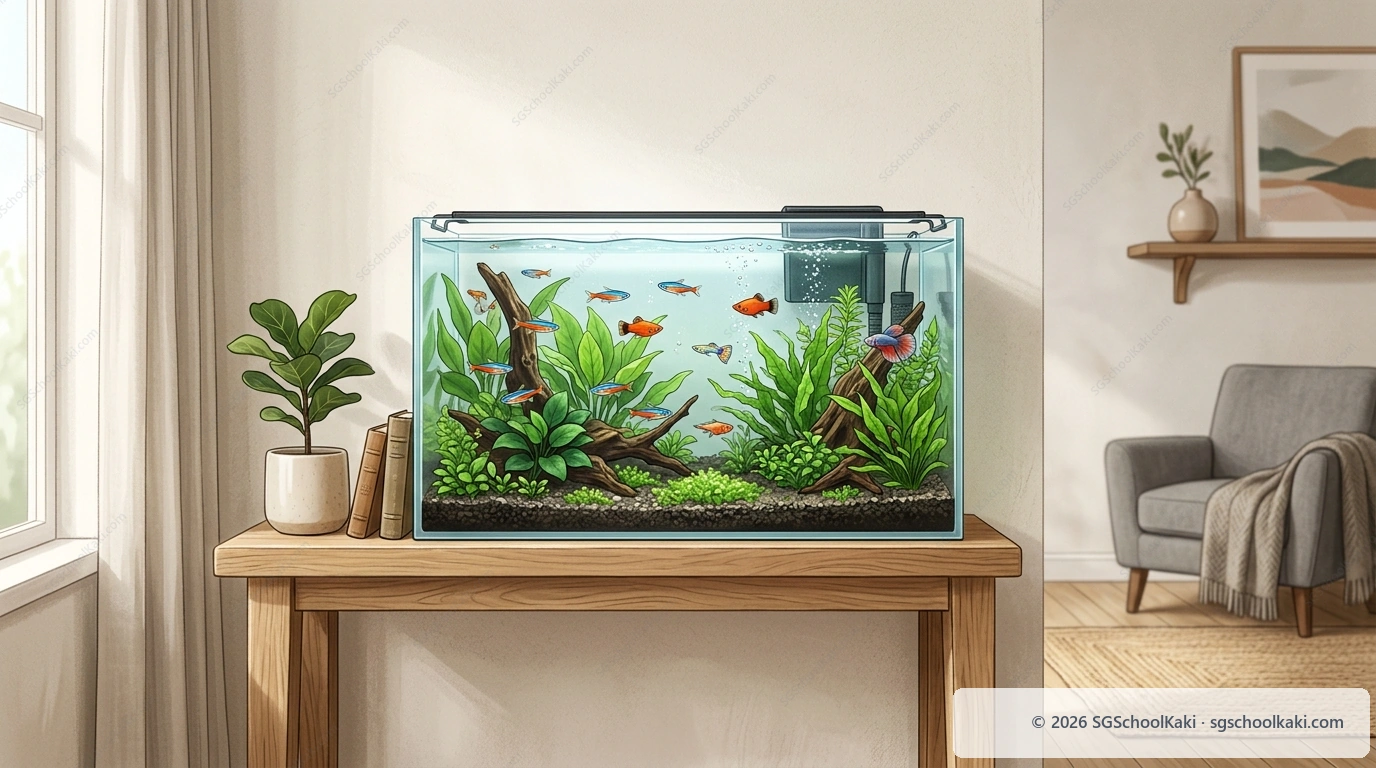
A rectangular fish tank on a stand, with its length, width and height drawn over the picture
Length 1.2 mWidth 0.5 mHeight 0.6 m
Maths In Real Life 1

Filling a fish tank

Pet shops sell tanks by their size. The volume tells you how much water fits inside, and it is the same amount whether you count in cubic metres or cubic centimetres.

A fish tank is a cuboid 1.2 m long, 0.5 m wide and 0.6 m high.

  • (a)Find the volume of the tank in m³.
  • (b)Give the volume in cm³.
  • (c)Find the area of the base of the tank in m² and in cm².
Show full solutionHide solution
Colour keyadd, subtract, multiply, divide or simplify
(a)
V=l×w×h=1.2×0.5×0.6=0.6×0.6=0.36\displaystyle V = l \times w \times h = 1.2 \times 0.5 \times 0.6 = 0.6 \times 0.6 = 0.36
Length times width times height, all in metres.
(b)
0.36×1000000=360000\displaystyle 0.36 \times 1000000 = 360000
Multiply by the volume factor, because there are 1003100^3 cubic centimetres in a cubic metre.
(c)
Base=1.2×0.5=0.6\displaystyle \text{Base} = 1.2 \times 0.5 = 0.6
Length times width.
0.6×10000=6000\displaystyle 0.6 \times 10000 = 6000
Multiply by the area factor.
Final answer
(a)The volume is 0.36 m³.
(b)The volume is 360000 cm³.
(c)The base is 0.6 m², which is 6000 cm².
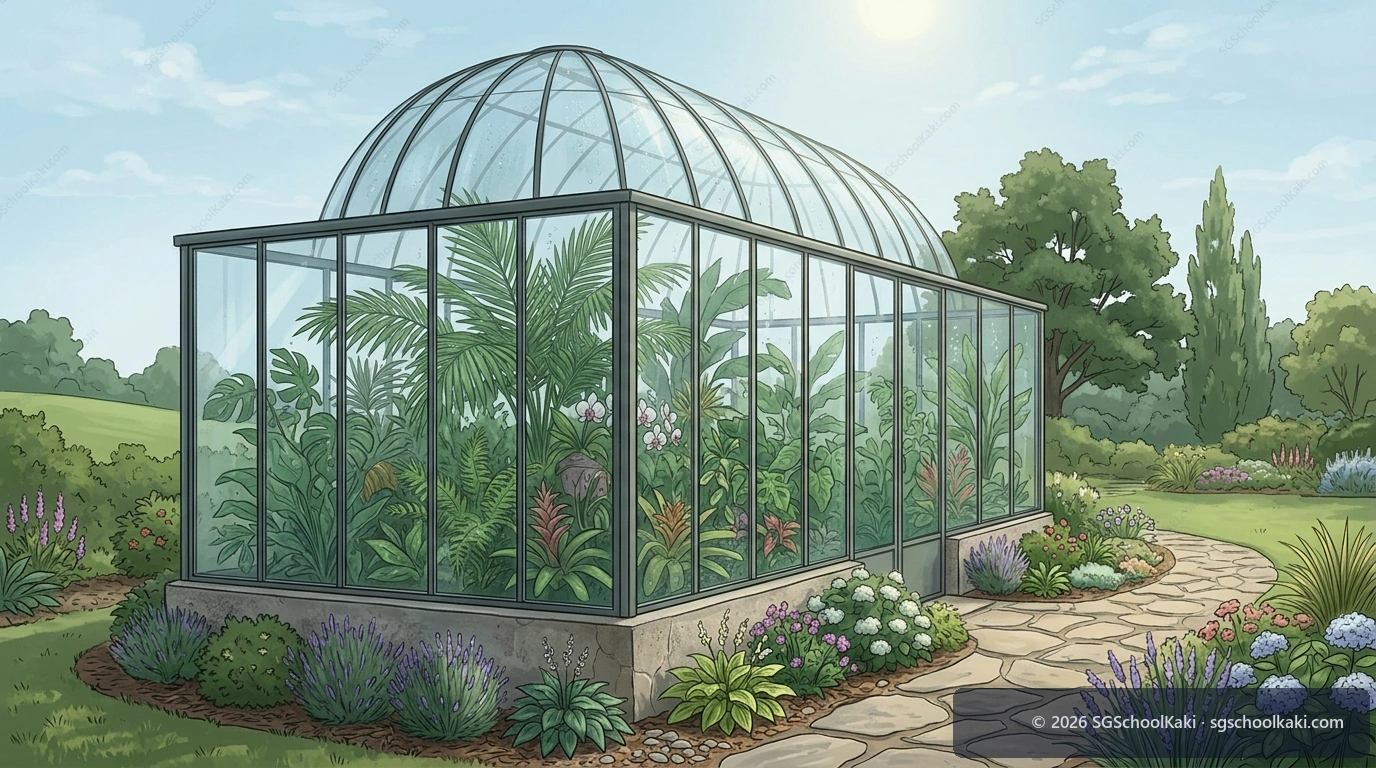
A greenhouse with straight glass walls and a dome-shaped glass roof, with the radius and the wall height drawn over the picture
Radius 4 mWall height 3.5 m
Maths In Real Life 2

A glass dome greenhouse

A greenhouse shaped like a cylinder with a dome on top lets plants get light from every side. Glass is bought by area, and the air inside is warmed by volume, so both measurements matter.

A greenhouse is a cylinder of radius 4 m and wall height 3.5 m with a hemispherical dome of the same radius on top. It has no glass floor.

  • (a)Find the area of glass needed for the walls and the dome, to three significant figures.
  • (b)Find the volume of air inside, to three significant figures.
Show full solutionHide solution
Colour keyadd, subtract, multiply, divide or simplify
(a)
Walls=2πrh=2×π×4×3.5≈87.965\displaystyle \text{Walls} = 2\pi r h = 2 \times \pi \times 4 \times 3.5 \approx 87.965
Curved surface of the cylinder.
Dome=2πr2=2×π×16≈100.53\displaystyle \text{Dome} = 2\pi r^2 = 2 \times \pi \times 16 \approx 100.53
Half of the sphere surface area.
Glass=87.965+100.53≈188.496≈188\displaystyle \text{Glass} = 87.965 + 100.53 \approx 188.496 \approx 188
Add; the floor is not glass and the join is inside.
(b)
Vcylinder=π×16×3.5≈175.93\displaystyle V_{\text{cylinder}} = \pi \times 16 \times 3.5 \approx 175.93
Circle area times height.
Vdome=23×π×64≈134.04\displaystyle V_{\text{dome}} = \tfrac{2}{3} \times \pi \times 64 \approx 134.04
Half of the sphere.
V=175.93+134.04=309.97≈310\displaystyle V = 175.93 + 134.04 = 309.97 \approx 310
Add.
Final answer
(a)The glass area is 188 m². (Using π = 3.142 gives 189 m².)
(b)The volume is 310 m³. (Using π = 3.142 gives 310 m³.)
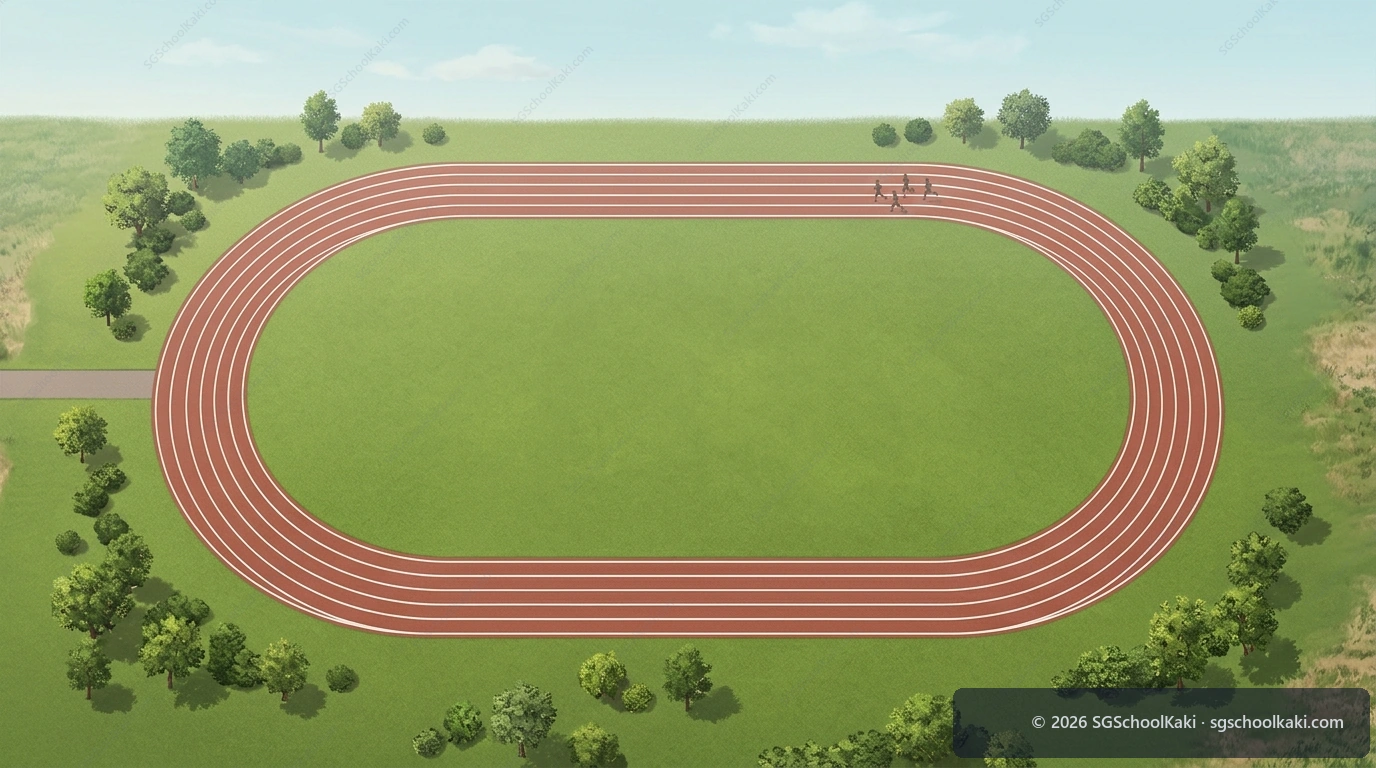
An aerial view of a running track with a green field in the middle, with the straight length and the width of the field drawn over the picture
Straight length 84 mWidth 36 m
Maths In Real Life 3

A running track

A running track has two straight sides and a semicircle at each end. The inside edge is the shortest lap, and the field in the middle is a rectangle with a semicircle on each end.

The inside edge of a running track is made of two straight sections of length 84 m and two semicircular ends of diameter 36 m. The field inside the track is the same shape.

  • (a)Find the length of one lap of the inside edge, to three significant figures.
  • (b)Find the area of the field, to three significant figures.
Show full solutionHide solution
Colour keyadd, subtract, multiply, divide or simplify
(a)
Straight parts=2×84=168\displaystyle \text{Straight parts} = 2 \times 84 = 168
Two straight sides.
Curved parts=π×36≈113.10\displaystyle \text{Curved parts} = \pi \times 36 \approx 113.10
Two semicircles make one full circle, circumference πd\pi d.
Lap=168+113.10=281.10≈281\displaystyle \text{Lap} = 168 + 113.10 = 281.10 \approx 281
Add.
(b)
Rectangle=84×36=3024\displaystyle \text{Rectangle} = 84 \times 36 = 3024
The middle rectangle.
Circle=π×182≈1017.9\displaystyle \text{Circle} = \pi \times 18^2 \approx 1017.9
The two semicircles make one circle of radius half the width.
Field=3024+1017.9=4041.9≈4040\displaystyle \text{Field} = 3024 + 1017.9 = 4041.9 \approx 4040
Add.
Final answer
(a)One lap is 281 m. (Using π = 3.142 gives 281 m.)
(b)The field has area 4040 m². (Using π = 3.142 gives 4040 m².)
Supports G5.1 · G5.2

Area and perimeter of plane figures

Perimeter is the distance all the way round a shape. Area is the amount of flat surface inside it. Both need the right measurements: the area of a slanted shape uses the perpendicular height, not a slanted side.

The Core Idea

Area of a parallelogram is base times perpendicular height. Area of a trapezium is half the sum of the parallel sides times the height.

For a parallelogram, A=bhA = bh. For a trapezium, A=12(a+b)hA = \tfrac{1}{2}(a+b)h. These two are not printed on the paper, so remember them.

SGSchoolKaki Tip

Do not use the slanted side as the height of a parallelogram or trapezium. The height is always at right angles to the base: look for the dashed line with the right-angle mark. A slanted side is for the perimeter, not for the area.

Example 14.1

Area and perimeter of a parallelogram

A parallelogram has a base of 12 cm, a slanted side of 7.2 cm and a perpendicular height of 5.5 cm. Find its area and its perimeter.

  • (i)Find the area.
  • (ii)Find the perimeter.
Show solutionHide solution
Colour keyadd, subtract, multiply, divide or simplify
(i)
Use the perpendicular height, not the slanted side.
Area needs the right-angled height.
Area=b×h\displaystyle \text{Area} = b \times h
Base times perpendicular height.
Area=12×5.5=66\displaystyle \text{Area} = 12 \times 5.5 = 66
Substitute and multiply.
(ii)
Opposite sides of a parallelogram are equal, so two sides are 12 cm and two sides are 7.2 cm.
Opposite sides are equal.
Perimeter=2(12+7.2)=2×19.2=38.4\displaystyle \text{Perimeter} = 2(12 + 7.2) = 2 \times 19.2 = 38.4
Add the two different sides, then double.
ParallelogramA parallelogram with its base, its slanted side and the dashed perpendicular height12 cm7.2 cm5.5 cmABCDF
Final answer
(i)The area is 66 cm².
(ii)The perimeter is 38.4 cm.
Example 14.2

Area of a trapezium, and working backwards

A trapezium has parallel sides of 7.5 cm and 13 cm, and the perpendicular distance between them is 6 cm. (i) Find its area. (ii) A different trapezium has parallel sides of 9 cm and 15 cm and an area of 84 cm². Find the distance between its parallel sides.

  • (i)Find the area of the first trapezium.
  • (ii)Find the distance between the parallel sides of the second trapezium.
Show solutionHide solution
Colour keyadd, subtract, multiply, divide or simplify
(i)
Area=12(a+b)h\displaystyle \text{Area} = \tfrac{1}{2}(a + b)h
Half the sum of the parallel sides times the height.
Area=12×(7.5+13)×6=12×20.5×6=61.5\displaystyle \text{Area} = \tfrac{1}{2} \times (7.5 + 13) \times 6 = \tfrac{1}{2} \times 20.5 \times 6 = 61.5
Add the parallel sides first.
(ii)
12×(9+15)×h=84\displaystyle \tfrac{1}{2} \times (9 + 15) \times h = 84
Put the area into the formula and keep hh as the unknown.
12×24×h=84\displaystyle \tfrac{1}{2} \times 24 \times h = 84
Add the parallel sides.
h=2×8424=16824=7\displaystyle h = \dfrac{2 \times 84}{24} = \dfrac{168}{24} = 7
Multiply by two, then divide by the sum of the parallel sides.
TrapeziumA trapezium with its two parallel sides and the dashed perpendicular height between them13 cm7.5 cm6 cmABCDF
Final answer
(i)The area is 61.5 cm².
(ii)The distance between the parallel sides is 7 cm.
Example 14.3

A composite figure: rectangle and semicircle

A shape is made from a rectangle 14 cm by 6 cm with a semicircle attached to one of its shorter sides. Find the perimeter and the area of the whole shape. Give each answer to three significant figures.

  • (i)Find the perimeter.
  • (ii)Find the area.
Show solutionHide solution
Colour keyadd, subtract, multiply, divide or simplify
(i)
The diameter of the semicircle is the shorter side, so the shorter side of the rectangle is not part of the outside edge.
The joined side is inside the shape.
r=6÷2=3\displaystyle r = 6 \div 2 = 3
Radius is half the diameter.
Straight edges=2×14+6=34\displaystyle \text{Straight edges} = 2 \times 14 + 6 = 34
Two long sides and the far short side.
Curved edge=π×3≈9.4248\displaystyle \text{Curved edge} = \pi \times 3 \approx 9.4248
Half of a circle: half of 2πr2\pi r.
Perimeter=34+9.4248≈43.425≈43.4\displaystyle \text{Perimeter} = 34 + 9.4248 \approx 43.425 \approx 43.4
Add the straight and curved parts.
(ii)
Rectangle=14×6=84\displaystyle \text{Rectangle} = 14 \times 6 = 84
Length times width.
Semicircle=12×π×32≈14.137\displaystyle \text{Semicircle} = \tfrac{1}{2} \times \pi \times 3^2 \approx 14.137
Half of πr2\pi r^2.
Area=84+14.137=98.137≈98.1\displaystyle \text{Area} = 84 + 14.137 = 98.137 \approx 98.1
Add the two areas.
Rectangle with a semicircleA rectangle with a semicircle attached to one of its shorter sides14 cm6 cm14 cmABCDM
Final answer
(i)The perimeter is 43.4 cm. (Using π = 3.142 gives 43.4 cm.)
(ii)The area is 98.1 cm². (Using π = 3.142 gives 98.1 cm².)
Example 14.4

An L-shaped figure

An L-shaped patio is made from a rectangle 12 m by 9 m by cutting a rectangle 5 m by 4 m out of one corner. Find the area and the perimeter of the patio.

  • (i)Find the area.
  • (ii)Find the perimeter.
Show solutionHide solution
Colour keyadd, subtract, multiply, divide or simplifyexpand, rewrite, substitute or solve
(i)
Find the area of the whole rectangle and subtract the corner that was cut away.
Big rectangle minus the missing corner.
Whole rectangle=12×9=108\displaystyle \text{Whole rectangle} = 12 \times 9 = 108
Length times width.
Cut-out=5×4=20\displaystyle \text{Cut-out} = 5 \times 4 = 20
The missing corner.
Area=108−20=88\displaystyle \text{Area} = 108 - 20 = 88
Subtract.
(ii)
Slide the two notch edges outwards: they fill in the missing corner, so the perimeter equals that of the whole rectangle.
A cut-out corner does not change the perimeter.
Perimeter=2(12+9)=2×21=42\displaystyle \text{Perimeter} = 2(12 + 9) = 2 \times 21 = 42
Double the sum of length and width.
12+5+5+4+7+9=42\displaystyle 12 + 5 + 5 + 4 + 7 + 9 = 42
Check by adding all six edges: the two unlabelled edges are 9−49 - 4 and 12−512 - 5.
L-shaped patioAn L-shaped patio: a large rectangle with a smaller rectangle cut out of one corner12 m5 m4 m9 mABCDEF
Final answer
(i)The area is 88 m².
(ii)The perimeter is 42 m.
Supports G5.4 · G5.3

Converting between square and cubic units

A length converts by one factor: 100 cm make one metre. An area is length times length, so the factor is used twice. A volume is length times length times length, so it is used three times.

The Core Idea

Squares and cubes of the length factor.

1 m=100 cm1 \text{ m} = 100 \text{ cm}, so 1 m2=100×100=10000 cm21 \text{ m}^2 = 100 \times 100 = 10000 \text{ cm}^2 and 1 m3=1000000 cm31 \text{ m}^3 = 1000000 \text{ cm}^3.

One square metreA square of side one metre is one hundred centimetres by one hundred centimetres100 cm100 cmABCD
One square metre is a square whose sides are each 100 cm: 10000 cm² in all.
Case table: which way do I convert?
ConvertOperationFactor
m² to cm²multiply10000
cm² to m²divide10000
m³ to cm³multiply1000000
cm³ to m³divide1000000
Think About It
Why do you divide by 10000, and not by 100, when you turn square centimetres into square metres?
Show the worked answerHide the worked answer
One square metre contains 100 rows of 100 square centimetres.
Picture the square metre cut into centimetre squares.
So one square metre holds 10000 square centimetres, which is the factor.
Rows times columns.
Going from small units to big units gives fewer units, so divide by 10000.
Bigger unit, smaller number.
Final answerBecause the factor must be applied to both dimensions of the area.
Example 14.5

Converting areas

(i) A floor has an area of 3.5 m². Give its area in cm². (ii) A poster has an area of 72000 cm². Give its area in m².

  • (i)Convert 3.5 m² to cm².
  • (ii)Convert 72000 cm² to m².
Show solutionHide solution
Colour keyadd, subtract, multiply, divide or simplify
(i)
Small units give a bigger number, so multiply by 10000.
Metres to centimetres: multiply.
3.5×10000=35000\displaystyle 3.5 \times 10000 = 35000
Multiply by the area factor.
(ii)
Big units give a smaller number, so divide by 10000.
Centimetres to metres: divide.
72000÷10000=7.2\displaystyle 72000 \div 10000 = 7.2
Divide by the area factor.
Final answer
(i)3.5 m² = 35000 cm².
(ii)72000 cm² = 7.2 m².
Example 14.6

Converting volumes

A water tank is a cuboid 150 cm long, 80 cm wide and 60 cm high. (i) Find its volume in cm³ and in m³. (ii) A pond holds 2.4 m³ of water. Give this volume in cm³.

  • (i)Find the volume of the tank in cm³ and in m³.
  • (ii)Convert 2.4 m³ to cm³.
Show solutionHide solution
Colour keyadd, subtract, multiply, divide or simplify
(i)
Volume=l×w×h\displaystyle \text{Volume} = l \times w \times h
Length times width times height.
Volume=150×80×60=12000×60=720000\displaystyle \text{Volume} = 150 \times 80 \times 60 = 12000 \times 60 = 720000
In cubic centimetres, because all lengths are in centimetres.
720000÷1000000=0.72\displaystyle 720000 \div 1000000 = 0.72
Divide by the volume factor to change cm³ into m³.
(ii)
2.4×1000000=2400000\displaystyle 2.4 \times 1000000 = 2400000
Multiply by the volume factor to change m³ into cm³.
Final answer
(i)The volume is 720000 cm³, which is 0.72 m³.
(ii)2.4 m³ = 2400000 cm³.
Supports G5.3 · G5.1

Volume and surface area: cuboids, prisms and cylinders

A prism has the same cross-section all the way along its length, so its volume is the area of the cross-section times the length. A cuboid, a cube and a cylinder are all prisms in this sense.

The Core Idea

Volume of a prism is cross-section area times length.

For a cylinder the cross-section is a circle, so V=πr2hV = \pi r^2 h. Surface area means the total area of all the faces, and a net (the solid unfolded flat) helps you see every face once.

SGSchoolKaki Tip

Know the formulas you must remember in your head: volume of prism, cylinder and pyramid, and the curved surface area of a cylinder. The cone and sphere formulas are printed on the paper.

Example 14.7

Cuboid: volume and total surface area

A cuboid measures 9 cm by 6 cm by 5 cm. Find its volume and its total surface area.

  • (i)Find the volume.
  • (ii)Find the total surface area.
Show solutionHide solution
Colour keyadd, subtract, multiply, divide or simplify
(i)
V=l×w×h\displaystyle V = l \times w \times h
Length times width times height.
V=9×6×5=270\displaystyle V = 9 \times 6 \times 5 = 270
Multiply.
(ii)
The net has three pairs of equal faces: base and top, front and back, left and right.
Each face appears twice.
base and top: 9×6=54\displaystyle \text{base and top: } 9 \times 6 = 54
Length times width.
front and back: 9×5=45\displaystyle \text{front and back: } 9 \times 5 = 45
Length times height.
left and right: 6×5=30\displaystyle \text{left and right: } 6 \times 5 = 30
Width times height.
Total=2(54+45+30)=2×129=258\displaystyle \text{Total} = 2(54 + 45 + 30) = 2 \times 129 = 258
Add one of each face, then double.
CuboidA cuboid with length, width and height labelled6 cm9 cm5 cm
Net of the cuboidThe six faces of the cuboid laid flat: the base, front, back, two sides and top9 cm6 cm5 cm
The net shows all six faces: two of each pair.
Final answer
(i)The volume is 270 cm³.
(ii)The total surface area is 258 cm².
Example 14.8

A triangular prism

A prism has a right-angled triangle as its cross-section, with the two shorter sides 5 cm and 12 cm. The prism is 20 cm long. Find its volume and its total surface area. Give the surface area to three significant figures if it is not exact.

  • (i)Find the volume.
  • (ii)Find the total surface area.
Show solutionHide solution
Colour keyadd, subtract, multiply, divide or simplify
(i)
Cross-section area=12×5×12=30\displaystyle \text{Cross-section area} = \tfrac{1}{2} \times 5 \times 12 = 30
Area of the right-angled triangle.
V=30×20=600\displaystyle V = 30 \times 20 = 600
Cross-section area times length.
(ii)
c2=52+122=169\displaystyle c^2 = 5^2 + 12^2 = 169
The slanted edge of the triangle, by Pythagoras.
c=169=13\displaystyle c = \sqrt{169} = 13
Square root.
Perimeter of the triangle=5+12+13=30\displaystyle \text{Perimeter of the triangle} = 5 + 12 + 13 = 30
The three rectangular faces share this perimeter as their total width.
Three rectangles=30×20=600\displaystyle \text{Three rectangles} = 30 \times 20 = 600
Perimeter times length.
Two triangles=2×30=60\displaystyle \text{Two triangles} = 2 \times 30 = 60
The two ends.
Total=600+60=660\displaystyle \text{Total} = 600 + 60 = 660
Add the rectangles and the two ends.
Triangular prismA prism whose cross-section is a right-angled triangle20 cm5 cm12 cm
Final answer
(i)The volume is 600 cm³.
(ii)The total surface area is 660 cm².
Example 14.9

Cylinder: volume and surface area

A cylinder has radius 3.5 cm and height 8 cm. Find its volume, its curved surface area and its total surface area. Give each answer to three significant figures.

  • (i)Find the volume.
  • (ii)Find the curved surface area.
  • (iii)Find the total surface area.
Show solutionHide solution
Colour keyadd, subtract, multiply, divide or simplifyexpand, rewrite, substitute or solve
(i)
V=πr2h\displaystyle V = \pi r^2 h
Area of the circle times the height.
V=π×3.52×8=π×12.25×8≈307.88≈308\displaystyle V = \pi \times 3.5^2 \times 8 = \pi \times 12.25 \times 8 \approx 307.88 \approx 308
Square the radius first.
(ii)
The curved surface unrolls into a rectangle: circumference times height.
See the net.
CSA=2πrh=2×π×3.5×8≈175.93≈176\displaystyle \text{CSA} = 2\pi r h = 2 \times \pi \times 3.5 \times 8 \approx 175.93 \approx 176
Substitute.
(iii)
Two ends=2×πr2=2×π×12.25≈76.969\displaystyle \text{Two ends} = 2 \times \pi r^2 = 2 \times \pi \times 12.25 \approx 76.969
Two circles.
Total=175.93+76.969≈252.90≈253\displaystyle \text{Total} = 175.93 + 76.969 \approx 252.90 \approx 253
Curved surface plus the two ends.
CylinderA cylinder with radius and height labelled8 cm3.5 cm
Net of the cylinderThe curved surface of a cylinder unrolls into a rectangle, plus two circles for the endscircumference8 cm3.5 cm
The curved surface unrolls into a rectangle of length 2πr2\pi r.
Final answer
(i)The volume is 308 cm³. (Using π = 3.142 gives 308 cm³.)
(ii)The curved surface area is 176 cm². (Using π = 3.142 gives 176 cm².)
(iii)The total surface area is 253 cm². (Using π = 3.142 gives 253 cm².)
Example 14.10

Working backwards from a volume

A cylindrical can has a volume of 500 cm³ and a height of 12 cm. Find its radius, correct to three significant figures.

Find the radius.

Show solutionHide solution
Colour keyadd, subtract, multiply, divide or simplify
πr2h=500\displaystyle \pi r^2 h = 500
Put the volume into the formula and leave rr unknown.
r2=500π×12≈50037.699≈13.263\displaystyle r^2 = \dfrac{500}{\pi \times 12} \approx \dfrac{500}{37.699} \approx 13.263
Divide by πh\pi h.
r=13.263≈3.6418≈3.64\displaystyle r = \sqrt{13.263} \approx 3.6418 \approx 3.64
Square root: the radius is the positive root.
Final answer
The radius is 3.64 cm. (Using π = 3.142 gives 3.64 cm.)
Locked · Chapter 14

You've read the free 32%. Unlock the rest of Chapter 14.

Still to read in this chapter:

  • Pyramids, cones and spheres
  • Composite solids
  • Arcs and sectors
  • Radians
  • Formula panel
  • Exercise

$9 one-time · all 19 chapters · no subscription

Worked examples, formulas and exam checks.
The whole E-Math syllabus.

Premium members get all 19 chapters included.

Notes version 1.0 · Last updated 3 Nov 2026 · Chapter 14 of 19