










SGSchoolKaki
Loading...

Not in G2 · G3 Additional Maths only

Chapter 8 · Additional Maths · G3 Linear law

Linear law: turning curves into straight lines

A straight line is the easiest graph to read. Linear law shows you how to rewrite a curved relationship as Y = mX + c, so that two points or one plotted line are enough to find the unknown constants. By the end of this chapter you can choose the right axes, work with logarithms when the model is a power or an exponential, and estimate values from the line.

Your outcome tracker0 / 6
Let's go! Tick an outcome once you can pass its exam check. Saved on this device.
Chapter
8
Figure 1 · a power law drawn as a straight line
Linear lawLinear-law plot of lg y against lg x for the data points; the points lie on a straight line with gradient 3 and intercept lg 8 = 0.903.lg xlg y0.10.20.30.40.50.60.70.80.51.522.53Oy = 8x3 → lg y against lg xgradient = 3intercept = lg 8 = 0.903
1 outcomes · 1 page · every step shown ✦
Everything is Y = mX + c

Rewrite the relation so that one expression is Y and another is X. The gradient and the intercept must be constants: they may not contain xx or yy.

Logs straighten powers

y=axny = ax^n becomes lg⁡y=nlg⁡x+lg⁡a\lg y = n\lg x + \lg a and y=kbxy = kb^x becomes lg⁡y=(lg⁡b)x+lg⁡k\lg y = (\lg b)x + \lg k. Read a=10ca = 10^c and b=10mb = 10^m from the line.

Convert before you read

A value given for yy on a lg⁡y\lg y axis is lg⁡\lg of that value. Convert it to the plotted variable, read the line, then convert back.

By the end of this chapter
  • Rewrite a relation such as y = ax^2 + b, y = a/x + b or y = ax + b/x in the form Y = mX + c and name X, Y, the gradient and the intercept.
  • Use lg or ln to straighten a power model y = ax^n or an exponential model y = kb^x, and recover the constants with 10^c and 10^m.
  • Find the constants from two points of the line, algebraically (paper 1 style) or from a plotted line (paper 2 style).
  • Convert a target value to the plotted variable before reading the line, and spot and correct one wrongly recorded data point.
  • Use a second line drawn on the same graph to solve a related equation, and apply the method to real data.
✶
Start here

Maths In Real Life

Two situations where measured data follow a curve. The pictures come first; the straight-line graph in each solution comes from the same numbers.

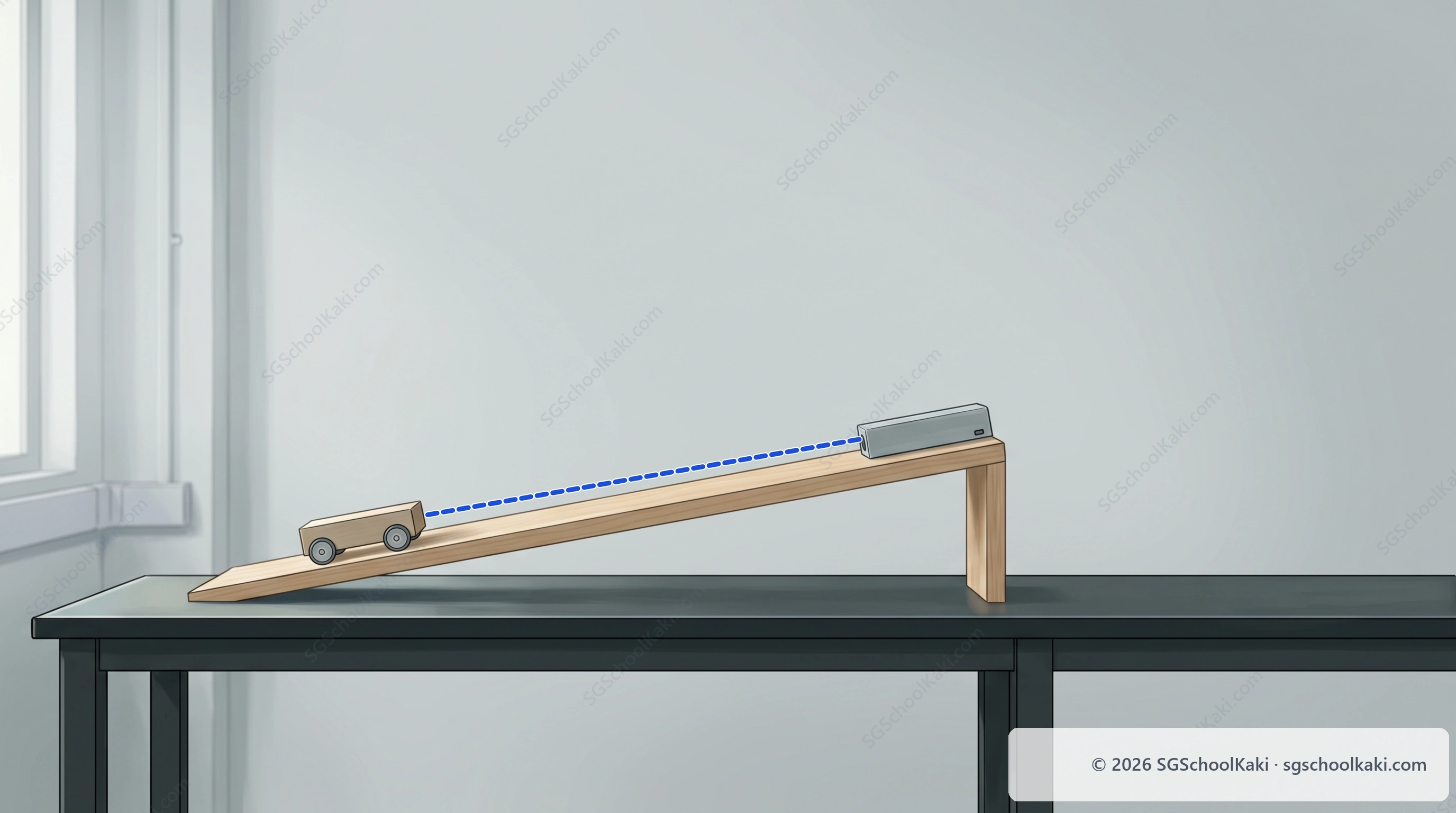
Side view of a school laboratory bench. A straight wooden ramp rises from the lower left to the upper right, a small trolley sits on the lower part of the ramp and a motion sensor is fixed at the top end of the ramp. The distance d from the sensor to the trolley is marked along the rampdd
Maths In Real Life 1

A trolley on a ramp

A trolley that speeds up steadily on a ramp covers a distance that grows with the square of the time, so plotting the distance against the time squared gives a straight line whose intercept is the starting distance.

A motion sensor at the top of a ramp measures the distance dd centimetres from the sensor to a trolley. The trolley is released and rolls down the ramp. At tt seconds after release, d=pt2+qd = pt^{2} + q, where pp and qq are constants. The sensor records d=25d = 25 when t=1t = 1 and d=65d = 65 when t=3t = 3.

  • (a)A graph of dd against t2t^{2} is a straight line through the two readings. Find the gradient and the intercept of the line.
  • (b)Hence find the values of pp and qq.
  • (c)The sensor stops recording when the trolley is 100100 centimetres from it. Use the straight line to find the time at which this happens.
Show full solutionHide solution
Colour keyplotted value X or Y worked outgradient mintercept cfinal constants
(a)
Straight-line shape: plot dd against t2t^{2}.
X1  =12=1\displaystyle X_1\;= 1^{2} = \textcolor{#010103}{1}
The first coordinate plotted for the point with t=1t = 1.
Y1  =25\displaystyle Y_1\;= \textcolor{#010103}{25}
X2  =32=9\displaystyle X_2\;= 3^{2} = \textcolor{#010103}{9}
Same for the second point.
Y2  =65\displaystyle Y_2\;= \textcolor{#010103}{65}
m  =Y2−Y1X2−X1=65−259−1=5\displaystyle m\;= \dfrac{Y_2 - Y_1}{X_2 - X_1} = \dfrac{65 - 25}{9 - 1} = \textcolor{#010104}{5}
The gradient of the straight line through the two plotted points.
c  =Y1−mX1=25−5=20\displaystyle c\;= Y_1 - mX_1 = 25 - 5 = \textcolor{#010105}{20}
Put one point back into Y=mX+cY = mX + c to find the intercept.
(b)
Straight-line shape: plot dd against t2t^{2}.
X1  =12=1\displaystyle X_1\;= 1^{2} = \textcolor{#010103}{1}
The first coordinate plotted for the point with t=1t = 1.
Y1  =25\displaystyle Y_1\;= \textcolor{#010103}{25}
X2  =32=9\displaystyle X_2\;= 3^{2} = \textcolor{#010103}{9}
Same for the second point.
Y2  =65\displaystyle Y_2\;= \textcolor{#010103}{65}
m  =Y2−Y1X2−X1=65−259−1=5\displaystyle m\;= \dfrac{Y_2 - Y_1}{X_2 - X_1} = \dfrac{65 - 25}{9 - 1} = \textcolor{#010104}{5}
The gradient of the straight line through the two plotted points.
c  =Y1−mX1=25−5=20\displaystyle c\;= Y_1 - mX_1 = 25 - 5 = \textcolor{#010105}{20}
Put one point back into Y=mX+cY = mX + c to find the intercept.
The model has p=mp = m and q=cq = c, so p=5p = 5 and q=20q = 20.
(c)
d  =5t2+20\displaystyle d\;= 5t^{2} + 20
The straight line, with mm and cc read from the model.
d  =100\displaystyle d\;= 100
Here the plotted YY is just dd, so put in the given value.
100=5t2+20\displaystyle 100 = 5t^{2} + 20
Put the plotted YY-value into the line equation.
t2  =100−205=16\displaystyle t^{2}\;= \dfrac{100 - 20}{5} = \textcolor{#010105}{16}
Solve the line equation for the plotted XX.
t  =16=4\displaystyle t\;= \sqrt{16} = \textcolor{#010106}{4}
Since X=t2X = t^{2} and tt is positive, take the positive square root.
Answer
(a) m=5m = 5, c=20c = 20
(b) p=5p = 5, q=20q = 20
(c) t=4t = 4
A top view of a round glass petri dish on a laboratory bench. Small round creamy colonies of bacteria are scattered over the pale agar, and the number of colonies is counted in the study.N=pqtN = pq^{t}
Maths In Real Life 2

Bacteria growing in a dish

Bacteria in a dish multiply by splitting, so the count grows by the same factor every hour. A graph of the count itself bends sharply upward, but its logarithm rises in a straight line, which is why scientists plot logs of counts.

A scientist counts the bacteria NN in a petri dish tt hours after a sample is placed in it. The counts follow N=pqtN = pq^t, where pp and qq are constants. After 11 hour the count is 120120 and after 33 hours it is 10801080.

  • (a)By plotting lg⁡N\lg N against tt, find the values of pp and qq.
  • (b)Use the line to estimate the time when the count reaches 32403240.
Show full solutionHide solution
Colour keygradient mintercept cfinal constants
(a)
Straight-line shape: plot lg⁡N\lg N against tt.
For the point with t=1t = 1 and N=120N = 120, the plotted XX-value is 11 and the plotted YY-value is lg⁡120\lg 120.
Each data point becomes a point (X,Y)(X, Y) on the lg⁡\lg scale.
For the point with t=3t = 3 and N=1080N = 1080, the plotted values are 33 and lg⁡1080\lg 1080.
m  =Y2−Y1X2−X1=lg⁡1080−lg⁡1203−1=lg⁡92\displaystyle m\;= \dfrac{Y_2 - Y_1}{X_2 - X_1} = \dfrac{\lg 1080 - \lg 120}{3 - 1} = \dfrac{\lg 9}{2}
Use lg⁡a−lg⁡b=lg⁡ab\lg a - \lg b = \lg \dfrac{a}{b} on the top.
lg⁡9=lg⁡32=2lg⁡3\displaystyle \lg 9 = \lg 3^{2} = 2 \lg 3
Write 99 as 323^{2} and bring the power down.
m  =2lg⁡32=lg⁡3\displaystyle m\;= \dfrac{2 \lg 3}{2} = \textcolor{#010104}{\lg 3}
The common factor cancels.
c  =Y1−mX1=lg⁡120−lg⁡3=lg⁡40\displaystyle c\;= Y_1 - mX_1 = \lg 120 - \lg 3 = \textcolor{#010105}{\lg 40}
Put one point back into Y=mX+cY = mX + c, then use lg⁡a−lg⁡b=lg⁡ab\lg a - \lg b = \lg \dfrac{a}{b}.
The gradient is m=lg⁡qm = \lg q and the intercept is c=lg⁡pc = \lg p.
lg⁡q  =lg⁡3\displaystyle \lg q\;= \lg 3
lg⁡p  =lg⁡40\displaystyle \lg p\;= \lg 40
So q=3q = 3 and p=40p = 40.
(b)
lg⁡N  =(lg⁡3)t+lg⁡40\displaystyle \lg N\;= \left(\lg 3\right)t + \lg 40
The straight line, with mm and cc read from the model.
lg⁡N  =lg⁡3240\displaystyle \lg N\;= \lg 3240
Convert the given value to the plotted variable before using the line.
lg⁡3240=(lg⁡3)t+lg⁡40\displaystyle \lg 3240 = \left(\lg 3\right)t + \lg 40
Put the plotted YY-value into the line equation.
t  =lg⁡3240−lg⁡40lg⁡3=lg⁡81lg⁡3\displaystyle t\;= \dfrac{\lg 3240 - \lg 40}{\lg 3} = \dfrac{\lg 81}{\lg 3}
Rearrange for the unknown, then use lg⁡a−lg⁡b=lg⁡ab\lg a - \lg b = \lg \dfrac{a}{b}.
lg⁡81=lg⁡34=4lg⁡3\displaystyle \lg 81 = \lg 3^{4} = 4 \lg 3
Write 8181 as 343^{4} and bring the power down.
t  =4lg⁡3lg⁡3=4\displaystyle t\;= \dfrac{4 \lg 3}{\lg 3} = \textcolor{#010106}{4}
The lg⁡\lg factors cancel.
Answer
(a) the two points (1,lg⁡120)(1, \lg 120), (3,lg⁡1080)(3, \lg 1080); m=lg⁡3m = \lg 3, c=lg⁡40c = \lg 40; p=40p = 40, q=3q = 3
(b) t=4t = 4
01
Supports K341-G2-05

Turning a relation into a straight line

A curve is hard to read and a straight line is easy. Linear law is the skill of rewriting a curved relation as a straight line, so that two points, or one drawn line, are enough to find the unknown constants.

Revision. A straight line y=mx+cy = mx + c has gradient mm, the rise divided by the run, and cuts the vertical axis at cc. In this chapter the axes are called XX and YY because they may carry whole expressions, such as x2x^{2} or 1x\dfrac{1}{x}, but the ideas are exactly the same.
The Core Idea

Reduce to Y=mX+cY = mX + c.

Rearrange the relation so that one expression is YY and another is XX, with the gradient mm and the intercept cc being constants: numbers that contain neither xx nor yy. Then YY plotted against XX is a straight line. Read off mm and cc, then use them to recover the constants of the original relation.

The usual moves are to multiply or divide both sides by xx, to treat a power such as x2x^{2} or a reciprocal such as 1x\dfrac{1}{x} as one variable, or (next section) to take logarithms. After the move, the right-hand side must be a number times XX plus a number.

Example 1.1

Adding a constant to x squared

The relation between xx and yy is y=3x2+2y = 3x^{2} + 2. State the quantities that should be plotted on the vertical and the horizontal axes to obtain a straight line, and find the gradient and the vertical intercept of that line.

Show solutionHide solution
Colour keygradient mintercept c
y=3x2+2\displaystyle y = 3x^{2} + 2
The relation we are given.
The right-hand side is already a straight-line shape if we treat x2x^{2} as one variable.
Compare with Y=mX+cY = mX + c. So plot yy on the vertical axis against x2x^{2} on the horizontal axis.
y  =3x2+2\displaystyle y\;= \textcolor{#010104}{3x^{2}} \textcolor{#010105}{+ 2}
Same shape as Y=mX+cY = mX + c: the number multiplying the variable is mm, the number added is cc.
So the gradient is m=3m = 3 and the vertical intercept is c=2c = 2.
Answer
Plot yy against x2x^{2}. m=3m = 3, c=2c = 2
Example 1.2

A reciprocal as the variable

A student wants to test the relation y=6x+1y = \dfrac{6}{x} + 1 with a straight-line graph. Say which quantity goes on each axis, and find the gradient and the vertical intercept of the line.

Show solutionHide solution
Colour keygradient mintercept c
y=6x+1\displaystyle y = \dfrac{6}{x} + 1
The relation we are given.
Write 6x\dfrac{6}{x} as 6×1x6 \times \dfrac{1}{x}, so 1x\dfrac{1}{x} plays the part of the variable.
Compare with Y=mX+cY = mX + c. So plot yy on the vertical axis against 1x\dfrac{1}{x} on the horizontal axis.
y  =61x+1\displaystyle y\;= \textcolor{#010104}{6\dfrac{1}{x}} \textcolor{#010105}{+ 1}
Same shape as Y=mX+cY = mX + c: the number multiplying the variable is mm, the number added is cc.
So the gradient is m=6m = 6 and the vertical intercept is c=1c = 1.
Answer
Plot yy against 1x\dfrac{1}{x}. m=6m = 6, c=1c = 1
SGSchoolKaki Tip

Look for the part of the relation that is multiplied by a number: that part is XX (or YY). The number that is added or subtracted on its own is the intercept cc.

Example 1.3

Clearing a fraction first

The variables xx and yy satisfy y=2x+3xy = 2x + \dfrac{3}{x}. By choosing suitable expressions for XX and YY, reduce the relation to a straight line. State XX and YY, and find the gradient and the vertical intercept.

Show solutionHide solution
Colour keygradient mintercept c
y=2x+3x\displaystyle y = 2x + \dfrac{3}{x}
The relation we are given.
xy=x(2x+3x)=2x2+3\displaystyle xy = x\left(2x + \dfrac{3}{x}\right) = 2x^{2} + 3
Multiply both sides by xx to clear the fraction in 3x\dfrac{3}{x}.
Compare with Y=mX+cY = mX + c. So plot xyxy on the vertical axis against x2x^{2} on the horizontal axis.
xy  =2x2+3\displaystyle xy\;= \textcolor{#010104}{2x^{2}} \textcolor{#010105}{+ 3}
Same shape as Y=mX+cY = mX + c: the number multiplying the variable is mm, the number added is cc.
So the gradient is m=2m = 2 and the vertical intercept is c=3c = 3.
Answer
Plot xyxy against x2x^{2}. m=2m = 2, c=3c = 3
The gradient and the intercept must be constants. The relation y=ax+bxy = ax + \dfrac{b}{x} does not give a straight line when yy is plotted against xx, because bx\dfrac{b}{x} changes as xx changes. Multiply both sides by xx first: then xy=ax2+bxy = ax^{2} + b is a straight line when xyxy is plotted against x2x^{2}.
Example 1.4

Dividing by x

The relation y=3x2−2xy = 3x^{2} - 2x is to be drawn as a straight line. Say which quantity goes on each axis (one of them needs a division), and find the gradient and the vertical intercept of the line.

Show solutionHide solution
Colour keygradient mintercept c
y=3x2−2x\displaystyle y = 3x^{2} - 2x
The relation we are given.
yx=3x−2\displaystyle \dfrac{y}{x} = 3x - 2
Divide both sides by xx so that the right-hand side is a straight-line shape in xx.
Compare with Y=mX+cY = mX + c. So plot yx\dfrac{y}{x} on the vertical axis against xx on the horizontal axis.
yx  =3x−2\displaystyle \dfrac{y}{x}\;= \textcolor{#010104}{3x} \textcolor{#010105}{-2}
Same shape as Y=mX+cY = mX + c: the number multiplying the variable is mm, the number added is cc.
So the gradient is m=3m = 3 and the vertical intercept is c=−2c = -2.
Answer
Plot yx\dfrac{y}{x} against xx. m=3m = 3, c=−2c = -2
Think About It
Why is y=4x+3xy = 4x + \dfrac{3}{x} not a straight line when yy is plotted against xx? Test it with three values of xx.
Show the full workingHide the working
Work out yy at three equally spaced values of xx: 11, 22 and 33. Equal steps in xx should give equal steps in yy on a straight line.
A straight line rises by the same amount for every equal step.
4×1+31=7\displaystyle 4 \times 1 + \dfrac{3}{1} = 7
The value of yy when x=1x = 1.
4×2+32=9.5\displaystyle 4 \times 2 + \dfrac{3}{2} = 9.5
The value of yy when x=2x = 2.
4×3+33=13\displaystyle 4 \times 3 + \dfrac{3}{3} = 13
The value of yy when x=3x = 3.
9.5−7=2.5\displaystyle 9.5 - 7 = 2.5
The first step up.
13−9.5=3.5\displaystyle 13 - 9.5 = 3.5
The second step up.
Answer
The steps 2.52.5 and 3.53.5 are different, so the points do not lie on a straight line: the term 3x\dfrac{3}{x} changes the gradient.
Which axes straighten which relation
RelationPlot Y against XGradientInterceptGraph
y=ax2+by = ax^{2} + byy against x2x^{2}aabb
Straight line of y against x²A rising straight line with y on the vertical axis and x² on the horizontal axis. Its gradient is m = a and it cuts the vertical axis at c = b.x²yc = bm = a
y=ax+by = \dfrac{a}{x} + byy against 1x\dfrac{1}{x}aabb
Straight line of y against 1/xA rising straight line with y on the vertical axis and 1/x on the horizontal axis. Its gradient is m = a and it cuts the vertical axis at c = b.1/xyc = bm = a
y=ax+by = a\sqrt{x} + byy against x\sqrt{x}aabb
Straight line of y against √xA rising straight line with y on the vertical axis and √x on the horizontal axis. Its gradient is m = a and it cuts the vertical axis at c = b.√xyc = bm = a
y=ax+bxy = ax + \dfrac{b}{x}xyxy against x2x^{2}aabb
Straight line of xy against x²A rising straight line with xy on the vertical axis and x² on the horizontal axis. Its gradient is m = a and it cuts the vertical axis at c = b.x²xyc = bm = a
multiply by xx first
y=ax2+bxy = ax^{2} + bxyx\dfrac{y}{x} against xxaabb
Straight line of y/x against xA rising straight line with y/x on the vertical axis and x on the horizontal axis. Its gradient is m = a and it cuts the vertical axis at c = b.xy/xc = bm = a
divide by xx first
y=axny = ax^{n}lg⁡y\lg y against lg⁡x\lg xnnlg⁡a\lg a
Straight line of lg y against lg xA rising straight line with lg y on the vertical axis and lg x on the horizontal axis. Its gradient is m = n and it cuts the vertical axis at c = lg a.lg xlg yc = lg am = n
y=kbxy = kb^{x}lg⁡y\lg y against xxlg⁡b\lg blg⁡k\lg k
Straight line of lg y against xA rising straight line with lg y on the vertical axis and x on the horizontal axis. Its gradient is m = lg b and it cuts the vertical axis at c = lg k.xlg yc = lg km = lg b
Example 1.5

A square root as the variable

The variables are related by y=4x−1y = 4\sqrt{x} - 1. Which quantity should be plotted against which to give a straight line? State the gradient and the vertical intercept.

Show solutionHide solution
Colour keygradient mintercept c
y=4x−1\displaystyle y = 4\sqrt{x} - 1
The relation we are given.
The variable on the right is x\sqrt{x}, to the power 1.
Compare with Y=mX+cY = mX + c. So plot yy on the vertical axis against x\sqrt{x} on the horizontal axis.
y  =4x−1\displaystyle y\;= \textcolor{#010104}{4\sqrt{x}} \textcolor{#010105}{-1}
Same shape as Y=mX+cY = mX + c: the number multiplying the variable is mm, the number added is cc.
So the gradient is m=4m = 4 and the vertical intercept is c=−1c = -1.
Answer
Plot yy against x\sqrt{x}. m=4m = 4, c=−1c = -1
Example 1.6

A cube plus a constant

A scientist records xx and yy and believes that y=2x3−3y = 2x^{3} - 3. Describe a straight-line graph that tests this belief, and find its gradient and intercept.

Show solutionHide solution
Colour keygradient mintercept c
y=2x3−3\displaystyle y = 2x^{3} - 3
The relation we are given.
The right-hand side is already a straight-line shape if we treat x3x^{3} as one variable.
Compare with Y=mX+cY = mX + c. So plot yy on the vertical axis against x3x^{3} on the horizontal axis.
y  =2x3−3\displaystyle y\;= \textcolor{#010104}{2x^{3}} \textcolor{#010105}{-3}
Same shape as Y=mX+cY = mX + c: the number multiplying the variable is mm, the number added is cc.
So the gradient is m=2m = 2 and the vertical intercept is c=−3c = -3.
Answer
Plot yy against x3x^{3}. m=2m = 2, c=−3c = -3
Example 1.7

One relation, two straight lines

The relation y=6x+5y = \dfrac{6}{x} + 5 can be reduced to a straight line in two different ways. First, put yy on the vertical axis: state what goes on the horizontal axis, and the gradient and the intercept. Second, put xyxy on the vertical axis: state what goes on the horizontal axis, and the gradient and the intercept.

  • (i)Put yy on the vertical axis. State what goes on the horizontal axis, and the gradient and the intercept.
  • (ii)Put xyxy on the vertical axis. State what goes on the horizontal axis, and the gradient and the intercept.
Show solutionHide solution
Colour keygradient mintercept c
(i)
y=6x+5\displaystyle y = \dfrac{6}{x} + 5
The relation we are given.
Write 6x\dfrac{6}{x} as 6×1x6 \times \dfrac{1}{x}, so 1x\dfrac{1}{x} plays the part of the variable.
Compare with Y=mX+cY = mX + c. So plot yy on the vertical axis against 1x\dfrac{1}{x} on the horizontal axis.
y  =61x+5\displaystyle y\;= \textcolor{#010104}{6\dfrac{1}{x}} \textcolor{#010105}{+ 5}
Same shape as Y=mX+cY = mX + c: the number multiplying the variable is mm, the number added is cc.
So the gradient is m=6m = 6 and the vertical intercept is c=5c = 5.
(ii)
xy  =x(6x+5)=6+5x\displaystyle xy\;= x\left(\dfrac{6}{x} + 5\right) = 6 + 5x
Multiply both sides by xx to clear the fraction: the left-hand side becomes xyxy.
xy  =5x+6\displaystyle xy\;= \textcolor{#010104}{5x} \textcolor{#010105}{ + 6}
Put the xx term first: the number multiplying xx is mm, the number added is cc.
So plot xyxy on the vertical axis against xx on the horizontal axis: the gradient is m=5m = 5 and the intercept is c=6c = 6.
Answer
(i) Plot yy against 1x\dfrac{1}{x}: m=6m = 6, c=5c = 5
(ii) Plot xyxy against xx: m=5m = 5, c=6c = 6
02
Supports K341-G2-05

Power and exponential models with logarithms

When xx is a power (y=axny = ax^{n}) or the variable is in an exponent (y=kbxy = kb^{x}), no rearrangement with ×\times or ÷\div gives a straight line. Logarithms do: they turn products into sums and powers into multiples.

Revision. For positive numbers, lg⁡(ab)=lg⁡a+lg⁡b\lg (ab) = \lg a + \lg b, lg⁡ab=lg⁡a−lg⁡b\lg \dfrac{a}{b} = \lg a - \lg b and lg⁡an=nlg⁡a\lg a^{n} = n \lg a. The same laws hold for ln⁡\ln, where ln⁡e=1\ln e = 1. Also 10lg⁡a=a10^{\lg a} = a, which undoes a logarithm.
The Core Idea

Take lg⁡\lg of both sides, then match Y=mX+cY = mX + c.

Power model: y=axny = ax^{n} gives lg⁡y=nlg⁡x+lg⁡a\lg y = n \lg x + \lg a. Plot lg⁡y\lg y against lg⁡x\lg x: gradient nn, intercept lg⁡a\lg a, so a=10ca = 10^{c}. Exponential model: y=kbxy = kb^{x} gives lg⁡y=(lg⁡b)x+lg⁡k\lg y = (\lg b)x + \lg k. Plot lg⁡y\lg y against xx: gradient lg⁡b\lg b, intercept lg⁡k\lg k, so b=10mb = 10^{m} and k=10ck = 10^{c}. Both need y>0y > 0, with a>0\textcolor{#010101}{a > 0} (power) or k>0k > 0 (exponential); the power model also needs x>0x > 0, because lg⁡x\lg x must exist.

SGSchoolKaki Tip

Say which logarithm you are using. With lg⁡\lg (base 1010) the constants come back with 10c10^{c} and 10m10^{m}; with ln⁡\ln they come back with ece^{c} and eme^{m}. Never write the intercept cc as if it were aa: c=lg⁡ac = \lg a.

Example 2.1

A power model

The relation between xx and yy is y=3x2y = 3x^{2}. Use logarithms (lg⁡\lg) to reduce the relation to a straight line. State what is plotted on each axis, and the gradient and the vertical intercept.

Show solutionHide solution
Colour keygradient mintercept c
y=3x2\displaystyle y = 3x^{2}
The relation we are given.
lg⁡y=lg⁡(3x2)=lg⁡3+2lg⁡x\displaystyle \lg y = \lg\left(3x^{2}\right) = \lg 3 + 2\lg x
Take lg⁡\lg of both sides, then use the product law and the power law.
Compare with Y=mX+cY = mX + c. So plot lg⁡y\lg y on the vertical axis against lg⁡x\lg x on the horizontal axis.
lg⁡y  =2lg⁡x+lg⁡3\displaystyle \lg y\;= \textcolor{#010104}{2\lg x} \textcolor{#010105}{+ \lg 3}
Same shape as Y=mX+cY = mX + c: the number multiplying the variable is mm, the number added is cc.
So the gradient is 22 and the vertical intercept is lg⁡3\lg 3.
Answer
Plot lg⁡y\lg y against lg⁡x\lg x. m=2m = 2, c=lg⁡3c = \lg 3
Example 2.2

An exponential model

The relation between xx and yy is y=2×5xy = 2 \times 5^{x}. Use logarithms (lg⁡\lg) to reduce the relation to a straight line. State what is plotted on each axis, and the gradient and the vertical intercept.

Show solutionHide solution
Colour keygradient mintercept c
y=2×5x\displaystyle y = 2 \times 5^{x}
The relation we are given.
lg⁡y=lg⁡(2×5x)=lg⁡2+x(lg⁡5)\displaystyle \lg y = \lg\left(2 \times 5^{x}\right) = \lg 2 + x\left(\lg 5\right)
Take lg⁡\lg of both sides, then the product law and the power law (the power is xx).
Compare with Y=mX+cY = mX + c. So plot lg⁡y\lg y on the vertical axis against xx on the horizontal axis.
lg⁡y  =(lg⁡5)x+lg⁡2\displaystyle \lg y\;= \textcolor{#010104}{\left(\lg 5\right)x} \textcolor{#010105}{+ \lg 2}
Same shape as Y=mX+cY = mX + c: the number multiplying the variable is mm, the number added is cc.
So the gradient is lg⁡5\lg 5 and the vertical intercept is lg⁡2\lg 2.
Answer
Plot lg⁡y\lg y against xx. m=lg⁡5m = \lg 5, c=lg⁡2c = \lg 2
Example 2.3

The natural exponential

The relation between xx and yy is y=4e3xy = 4e^{3x}. Use natural logarithms to reduce the relation to a straight line. State what is plotted on each axis, and the gradient and the vertical intercept.

Show solutionHide solution
Colour keygradient mintercept c
y=4e3x\displaystyle y = 4e^{3x}
The relation we are given.
ln⁡y=ln⁡(4e3x)=ln⁡4+3x\displaystyle \ln y = \ln\left(4e^{3x}\right) = \ln 4 + 3x
Take ln⁡\ln of both sides; ln⁡e=1\ln e = 1 removes the ee.
Compare with Y=mX+cY = mX + c. So plot ln⁡y\ln y on the vertical axis against xx on the horizontal axis.
ln⁡y  =3x+ln⁡4\displaystyle \ln y\;= \textcolor{#010104}{3x} \textcolor{#010105}{+ \ln 4}
Same shape as Y=mX+cY = mX + c: the number multiplying the variable is mm, the number added is cc.
So the gradient is 33 and the vertical intercept is ln⁡4\ln 4.
Answer
Plot ln⁡y\ln y against xx. m=3m = 3, c=ln⁡4c = \ln 4
The four logarithm models
ModelPlot Y against XGradientInterceptGraph
y=axny = ax^{n}lg⁡y\lg y against lg⁡x\lg xnnlg⁡a\lg a
Straight line of lg y against lg xA rising straight line with lg y on the vertical axis and lg x on the horizontal axis. Its gradient is m = n and it cuts the vertical axis at c = lg a.lg xlg yc = lg am = n
y=kbxy = kb^{x}lg⁡y\lg y against xxlg⁡b\lg blg⁡k\lg k
Straight line of lg y against xA rising straight line with lg y on the vertical axis and x on the horizontal axis. Its gradient is m = lg b and it cuts the vertical axis at c = lg k.xlg yc = lg km = lg b
y=aekxy = ae^{kx}ln⁡y\ln y against xxkkln⁡a\ln a
Straight line of ln y against xA rising straight line with ln y on the vertical axis and x on the horizontal axis. Its gradient is m = k and it cuts the vertical axis at c = ln a.xln yc = ln am = k
y=axn+ry = ax^{n} + rlg⁡(y−r)\lg (y - r) against lg⁡x\lg xnnlg⁡a\lg a
Straight line of lg (y − r) against lg xA rising straight line with lg (y − r) on the vertical axis and lg x on the horizontal axis. Its gradient is m = n and it cuts the vertical axis at c = lg a.lg xlg (y − r)c = lg am = n
Think About It
In the model y=axn+ry = ax^{n} + r, why must rr be taken away before taking logarithms? Test lg⁡(10+90)\lg (10 + 90).
Show the full workingHide the working
Compare lg⁡(a+b)\lg (a + b) with lg⁡a+lg⁡b\lg a + \lg b for a=10a = 10 and b=90b = 90.
The log laws turn products into sums, not sums into anything.
lg⁡(10+90)  =lg⁡100=2\displaystyle \lg (10 + 90)\;= \lg 100 = 2
Add first, then take the logarithm.
lg⁡10+lg⁡90  =lg⁡900=lg⁡100+lg⁡9=2+lg⁡9\displaystyle \lg 10 + \lg 90\;= \lg 900 = \lg 100 + \lg 9 = 2 + \lg 9
Adding logarithms multiplies the numbers.
Answer
Since lg⁡9≠0\lg 9 \neq 0 the two results differ, so lg⁡(a+b)\lg (a + b) is not lg⁡a+lg⁡b\lg a + \lg b. Subtract rr first, so that one product is left to take the logarithm of.
Example 2.4

A shifted power model

The relation between xx and yy is y=2x3+5y = 2x^{3} + 5. Reduce the relation to a straight line using logarithms (lg⁡\lg). State what is plotted on each axis, and the gradient and the vertical intercept.

Show solutionHide solution
Colour keygradient mintercept c
y=2x3+5\displaystyle y = 2x^{3} + 5
The relation we are given.
y−5=2x3\displaystyle y - 5 = 2x^{3}
Move the constant to the left so that only the power term is on the right.
lg⁡(y−5)=lg⁡2+3lg⁡x\displaystyle \lg\left(y - 5\right) = \lg 2 + 3\lg x
Now take lg⁡\lg of both sides.
Compare with Y=mX+cY = mX + c. So plot lg⁡(y−5)\lg \left(y -5\right) on the vertical axis against lg⁡x\lg x on the horizontal axis.
lg⁡(y−5)  =3lg⁡x+lg⁡2\displaystyle \lg \left(y -5\right)\;= \textcolor{#010104}{3\lg x} \textcolor{#010105}{+ \lg 2}
Same shape as Y=mX+cY = mX + c: the number multiplying the variable is mm, the number added is cc.
So the gradient is 33 and the vertical intercept is lg⁡2\lg 2.
Answer
Plot lg⁡(y−5)\lg \left(y -5\right) against lg⁡x\lg x. m=3m = 3, c=lg⁡2c = \lg 2
Example 2.5

A negative power

The intensity yy of a signal at distance xx follows y=5x−2y = 5x^{-2}. Reduce the relation to a straight line using logarithms (lg⁡\lg), then state the axes, the gradient and the vertical intercept.

Show solutionHide solution
Colour keygradient mintercept c
y=5x−2\displaystyle y = 5x^{-2}
The relation we are given.
lg⁡y=lg⁡(5x−2)=lg⁡5−2lg⁡x\displaystyle \lg y = \lg\left(5x^{-2}\right) = \lg 5 - 2\lg x
Take lg⁡\lg of both sides, then use the product law and the power law.
Compare with Y=mX+cY = mX + c. So plot lg⁡y\lg y on the vertical axis against lg⁡x\lg x on the horizontal axis.
lg⁡y  =−2lg⁡x+lg⁡5\displaystyle \lg y\;= \textcolor{#010104}{-2\lg x} \textcolor{#010105}{+ \lg 5}
Same shape as Y=mX+cY = mX + c: the number multiplying the variable is mm, the number added is cc.
So the gradient is −2-2 and the vertical intercept is lg⁡5\lg 5.
Answer
Plot lg⁡y\lg y against lg⁡x\lg x. m=−2m = -2, c=lg⁡5c = \lg 5
Example 2.6

Which axes make the data straight?

Four readings of yy are recorded at four values of xx: x=1x = 1 gives y=6y = 6, x=2x = 2 gives y=12y = 12, x=3x = 3 gives y=24y = 24 and x=4x = 4 gives y=48y = 48. The readings follow either y=abxy = ab^{x} or y=axny = ax^{n}, where aa, bb and nn are constants. By examining how the readings change, decide whether lg⁡y\lg y should be plotted against xx or against lg⁡x\lg x to give a straight line.

Show solutionHide solution
Colour keyplotted value X or Y worked out
Divide each reading of yy by the one before it.
y2y1  =126=2\displaystyle \dfrac{y_2}{y_1}\;= \dfrac{12}{6} = \textcolor{#010103}{2}
y3y2  =2412=2\displaystyle \dfrac{y_3}{y_2}\;= \dfrac{24}{12} = \textcolor{#010103}{2}
y4y3  =4824=2\displaystyle \dfrac{y_4}{y_3}\;= \dfrac{48}{24} = \textcolor{#010103}{2}
The xx-values go up in equal steps of 11 and yy is multiplied by 22 each time. Then lg⁡y\lg y goes up by the same amount each time:
lg⁡y2−lg⁡y1  =lg⁡12−lg⁡6=lg⁡2\displaystyle \lg y_2 - \lg y_1\;= \lg 12 - \lg 6 = \lg 2
lg⁡y3−lg⁡y2  =lg⁡24−lg⁡12=lg⁡2\displaystyle \lg y_3 - \lg y_2\;= \lg 24 - \lg 12 = \lg 2
lg⁡y4−lg⁡y3  =lg⁡48−lg⁡24=lg⁡2\displaystyle \lg y_4 - \lg y_3\;= \lg 48 - \lg 24 = \lg 2
Equal steps in xx give equal steps in lg⁡y\lg y, so lg⁡y\lg y plotted against xx is a straight line.
Answer
Plot lg⁡y\lg y against xx.
Locked · Chapter 8

You've read the free 24%. Unlock the rest of Chapter 8.

Still to read in this chapter:

  • Two points
  • Plot and read
  • Errors and second line
  • In context
  • Formula panel
  • Exercise

$9 one-time · all 17 chapters · no subscription

Worked examples, formulas and exam checks.
The whole A-Math syllabus.

Premium members get all 17 chapters included.

Notes version 1.0 · Last updated 3 Nov 2026 · Chapter 8 of 17