






In the QS World University Rankings 2027, released in June 2026, NUS slipped two places to #10 globally while NTU held steady at #12. NUS remains the top university in Asia despite the drop. Both stay comfortably inside the global top 15 — but challenger universities from East Asia and the Middle East are closing the gap fast.
The Result, in 30 Seconds
The QS World University Rankings 2027 evaluated 1,504 institutions, including 98 new entrants. MIT held onto 1st place for the 15th consecutive year. The very top of the table barely moved — the US and UK still hold four spots each of the global top 10 — but NUS's slide from 8th to 10th shows the middle of the elite tier is under real pressure from fast-rising challengers.
| Rank | University | Country |
|---|---|---|
| 1 | Massachusetts Institute of Technology (15th year at #1) |  United States United States |
| =2 | Imperial College London |  United Kingdom United Kingdom |
| =2 | Stanford University | United States |
| 4 | University of Oxford | United Kingdom |
| 5 | Harvard University | United States |
| 6 | University of Cambridge | United Kingdom |
| 7 | California Institute of Technology | United States |
| =8 | ETH Zurich |  Switzerland Switzerland |
| =8 | University College London | United Kingdom |
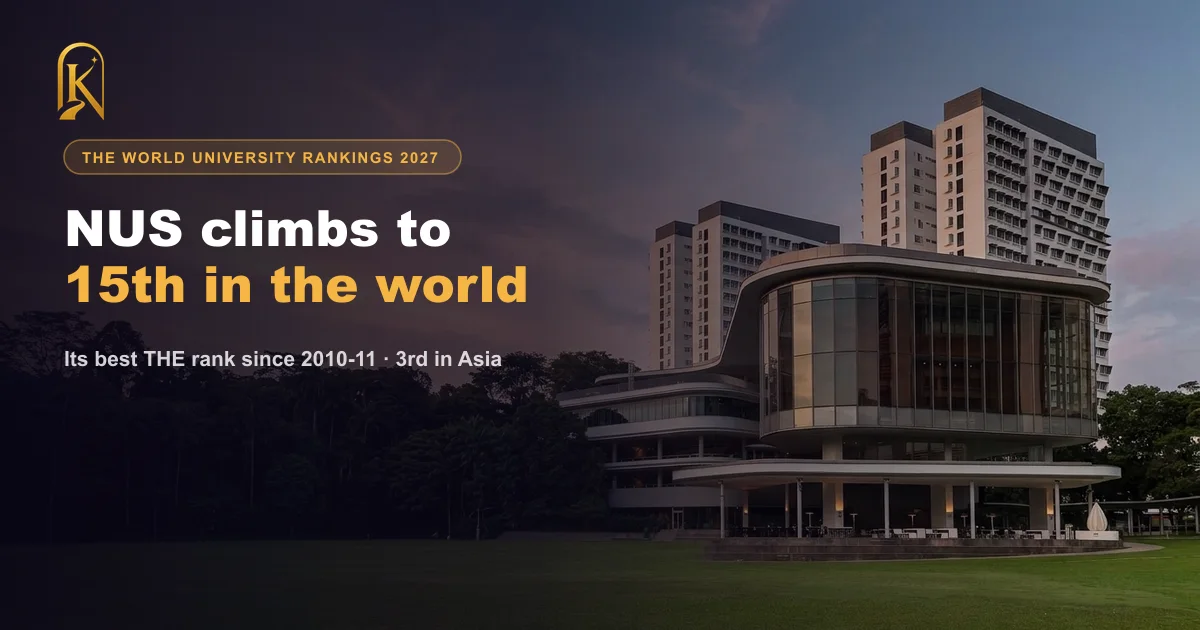
| 10 | National University of Singapore (NUS) |  Singapore Singapore |
Source: QS World University Rankings 2027 (released June 2026), via TopUniversities.com and Wikipedia's summary table.
Just outside the top 10
Rounding out the top 20: 11th University of Hong Kong, 12th NTU Singapore, 13th Peking University, 14th Tsinghua University, and — the biggest mover into the tier — 18th The Chinese University of Hong Kong, up 14 places. 19th is University of New South Wales. Five Asian universities now sit inside the global top 20.
Singapore's Universities in QS 2027
NUS and NTU dominate the headlines, but the biggest percentage mover among Singapore's publicly-funded universities this year was actually SUTD — see the table below.
| University | 2027 Rank | 2026 Rank | Movement |
|---|---|---|---|
| National University of Singapore | 10 | 8 | ↓ 2 places |
| Nanyang Technological University | 12 | 12 | — unchanged |
| Singapore University of Technology and Design | 266 | 519 | ↑ 253 places |
Sources: NUS Newsroom, NTU Singapore official news, SUTD official news (all June 2026, QS World University Rankings 2027).
A note on completeness: Singapore also has three other publicly-funded universities — SMU, SIT, and SUSS. We could not independently confirm their exact 2027 QS World Ranking positions from primary sources at the time of writing, so rather than guess, we have left those figures out. NUS, NTU, and SUTD above are all confirmed directly from official university newsrooms.
How we prepare them to think independently, create boldly as human-centred design innovators.
SUTD's jump was driven specifically by gains in citations per faculty and employer reputation, on top of an already-low faculty-to-student ratio — a reminder that a smaller, specialised university can move dramatically faster than a large comprehensive one.
Why the Drop? East Asia and the Middle East Are Closing In
Neither NUS nor QS published an indicator-by-indicator breakdown of exactly what cost NUS its two places. What QS did publish, in its official 2027 results commentary, is a clear regional story: challenger institutions across East Asia and the Middle East are becoming increasingly competitive, and a rise from below the top 10 can push an incumbent down a place or two even without any fall in its own absolute score.
East Asia's surge
- China: 29 institutions moved up more than 20 places; the highest number of new entrants of any country
- The Chinese University of Hong Kong jumped 14 places, the biggest climb into the global top 20 (now 18th)
- South Korea recorded 10 institutions with comparable large gains
Middle East's rise
- Saudi Arabia: 12 institutions moved up, led by KFUPM at 63rd globally — the first Arab university to hold a world top-100 spot for a second consecutive year
- UAE: 9 institutions moved up, including the country's first-ever top-150 entry
- Both countries credit targeted investment in research plus deliberate internationalisation strategy
QS also noted that, across all 1,504 ranked institutions, Academic Reputation was the single most-improved indicator (24% of institutions gained ground), while International Student Ratio and Employment Outcomes saw the steepest declines (37% of institutions fell). That is a global backdrop every top-10 university — NUS included — is competing inside, not a Singapore-specific problem.
How NTU Held Its Ground at #12
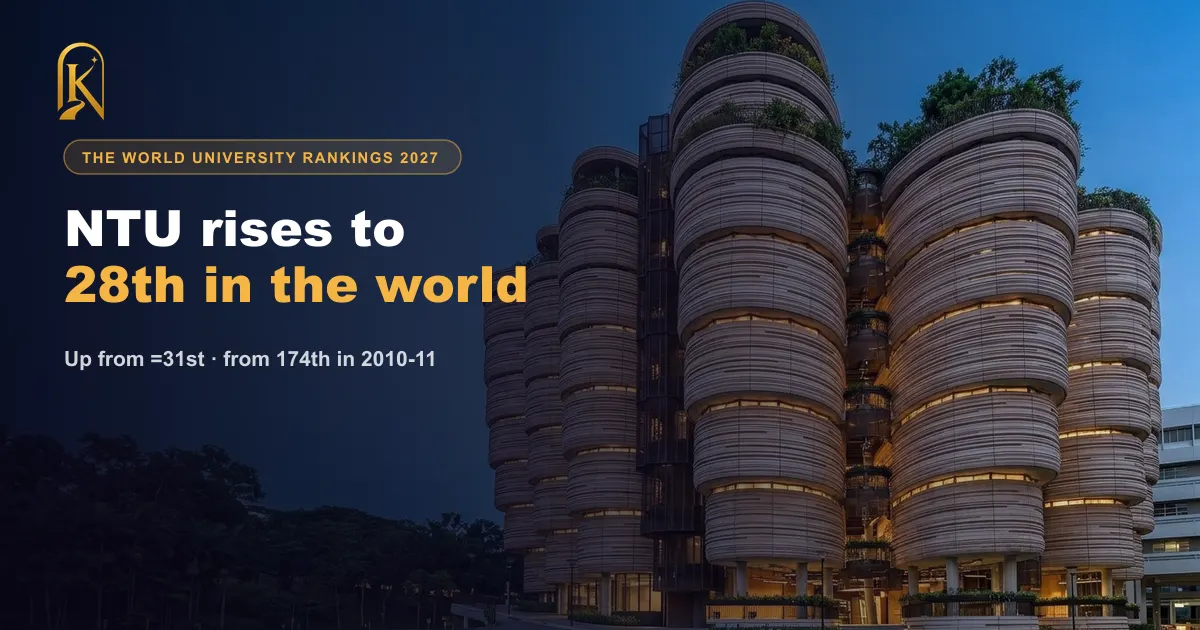
While NUS slipped, NTU stayed exactly where it was — #12 globally for the second consecutive year, and third among Asian universities. NTU's own released indicator ranks show where its strength lies: 36th in the world for academic reputation, 48th for employer reputation, and 50th for international faculty ratio.
Rankings capture a moment. What matters more is trajectory. NTU is investing in the foundations, research excellence, exceptional teaching and international openness that will define where we stand five and ten years from now.
NTU also picked up a separate accolade the same season: it climbed to 27th in the US News Best Global Universities Rankings 2026–2027(up one place), the fourth-highest position of any Asian university on that particular table — a useful reminder that “which is the best university in Asia” genuinely depends on which ranking you open.
What This Actually Means for Your Child
This is the section most parents actually came here for. Here is the honest, unpanicked answer.
QS World Ranking movements do not change NUS/NTU's Indicative Grade Profile cutoffs. Admission is decided by your A-Level results and the specific course's IGP — not by a league-table position.
Singapore employers recognise NUS and NTU degrees regardless of a two-place shift. Graduate employment surveys, not world rankings, are the better source for real starting-salary and employment-rate data.
#10 in the world and #1 in Asia is still an elite position by any measure. A student graduating from NUS or NTU in 2030 is not disadvantaged versus a 2025 graduate because of this one-year movement.
The honest framing
A move from 8th to 10th is a small shift among the world's elite, not a decline in quality. NUS is still comfortably inside the top 10 out of 1,504 ranked institutions worldwide — that is the 99.3rd percentile. If NUS had fallen from 8th to 40th, that would be a meaningful story. Two places, in a year when several Asian and Middle Eastern universities posted historic climbs, is competition doing exactly what competition is supposed to do.
Read how NUS admissions actually work in 2026How QS Actually Calculates the Ranking
QS combines nine weighted indicators into a single score. The three newest indicators — International Research Network, Employment Outcomes, and Sustainability — were added from the 2024 edition onward to capture dimensions beyond pure academic prestige.
| Indicator | Weight |
|---|---|
| Academic Reputation | 30% |
| Citations per Faculty | 20% |
| Employer Reputation | 15% |
| Faculty/Student Ratio | 10% |
| International Faculty Ratio | 5% |
| International Student Ratio | 5% |
| International Research Network | 5% |
| Employment Outcomes | 5% |
| Sustainability | 5% |
Source: QS World University Rankings methodology, as published by TopUniversities.com / QS.
Because Academic Reputation and Citations per Faculty together make up half the total score, they are the two indicators most capable of moving a top-10 university a few places in either direction from one year to the next — which is exactly the kind of movement NUS experienced this year.
Frequently Asked Questions
What rank is NUS in the QS World University Rankings 2027?
NUS is ranked 10th globally, down two places from 8th in the 2026 edition. Despite the drop, NUS remains the top-ranked university in Asia.
What rank is NTU in the QS World University Rankings 2027?
NTU is ranked 12th globally, unchanged from 2026 — the second consecutive year NTU has stayed inside the global top 15.
Why did NUS drop from 8th to 10th place?
No official NUS or QS statement broke down the exact indicator that cost NUS the two places. The broader pattern QS itself highlighted is intensifying competition from East Asian and Middle Eastern universities climbing the table — for example, the Chinese University of Hong Kong jumped 14 places into the global top 20. A rise from below can push an incumbent top-10 university down a place or two even without a fall in its own absolute score.
Does a two-place ranking drop affect my child’s NUS degree or admission chances?
No. QS World Ranking movements do not change NUS or NTU’s Indicative Grade Profile cutoffs, A-Level subject requirements, or how Singapore employers view the degree. Admission is decided by your A-Level results and course-specific IGP, not by a league-table position.
Which Singapore universities improved in the QS World University Rankings 2027?
SUTD was the standout mover, climbing 253 places to rank 266th globally (up from 519th in 2026), driven by gains in citations per faculty and employer reputation. NUS and NTU remain Singapore’s two globally top-ranked universities at 10th and 12th respectively.
How is the QS World Ranking different from the QS Asia Ranking or the THE Ranking?
QS World ranks universities against the entire globe, while QS Asia and THE Asia rank universities only against regional peers, using different indicator weightings. It is normal for the same university to place differently across tables in the same year — read more than one ranking before drawing conclusions.
Related Resources
QS Asia University Rankings 2026
Our companion deep-dive on the regional QS Asia table, where NUS and NTU were both tied 3rd behind HKU.
THE Asia University Rankings 2026
A different methodology, a different result: NUS 3rd and NTU tied 4th in Asia under Times Higher Education's table.
NUS vs NTU vs SMU: Full Comparison 2026
Tuition fees, programmes, campus culture, and graduate outcomes — the full side-by-side.
University IGP 2026/2027 Guide
Indicative Grade Profiles for every NUS, NTU, SMU, SUTD, SIT, and SUSS course — the real admissions gate.
Graduate Employment Survey 2025 — Salary Guide
Median starting salaries by university and course — the data that matters more than a rank.
A-Level Results 2026 — University Admission Guide
What to do with your A-Level results — EAE, early admission, appeal, and next steps.
Browse All Singapore Universities
NUS, NTU, SMU, SUTD, SIT, SUSS, UniSIM — profiles, courses, and campus information.
A-Level University Admission Calculator
Calculate your UAS/rank points and see which NUS, NTU, and SMU courses are within reach.
The bottom line
A two-place drop for a university ranked in the world's top 10 out of 1,504 is competition working as intended, not a warning sign. NUS is still Asia's top university and NTU still sits inside the global top 15. Use rankings as a compass to confirm Singapore's system is world-class — then make the actual decision on IGP fit, faculty strength, and where your child will thrive.
Sources
- 1.QS World University Rankings 2027 — official results, June 2026. qs.com
- 2.NUS Newsroom — “QS World University Rankings: NUS drops to 10th place, while NTU remains 12th”, June 2026. news.nus.edu.sg
- 3.NTU Singapore — “NTU Singapore ranks 12th in QS World University Rankings 2027”. ntu.edu.sg
- 4.SUTD — “SUTD Rises 253 Places to Rank 266th Globally in QS World University Rankings 2027”. sutd.edu.sg
- 5.QS Insights Newsletter — “QS World University Rankings 2027: Full results revealed. East Asia and the Middle East make gains.” newsletters.qs.com
- 6.University World News — “US, Europe challenged by Asia, Middle East: QS rankings”. universityworldnews.com
Also read the Times Higher Education view: NUS in the Times Higher Education rankings, NTU in the Times Higher Education rankings and the THE World University Rankings 2027 top 50.