







RP gets you in the running, but it may not be enough to seal the deal by itself.
SGSchoolKaki Education Team — our read on NUS admissions 2026
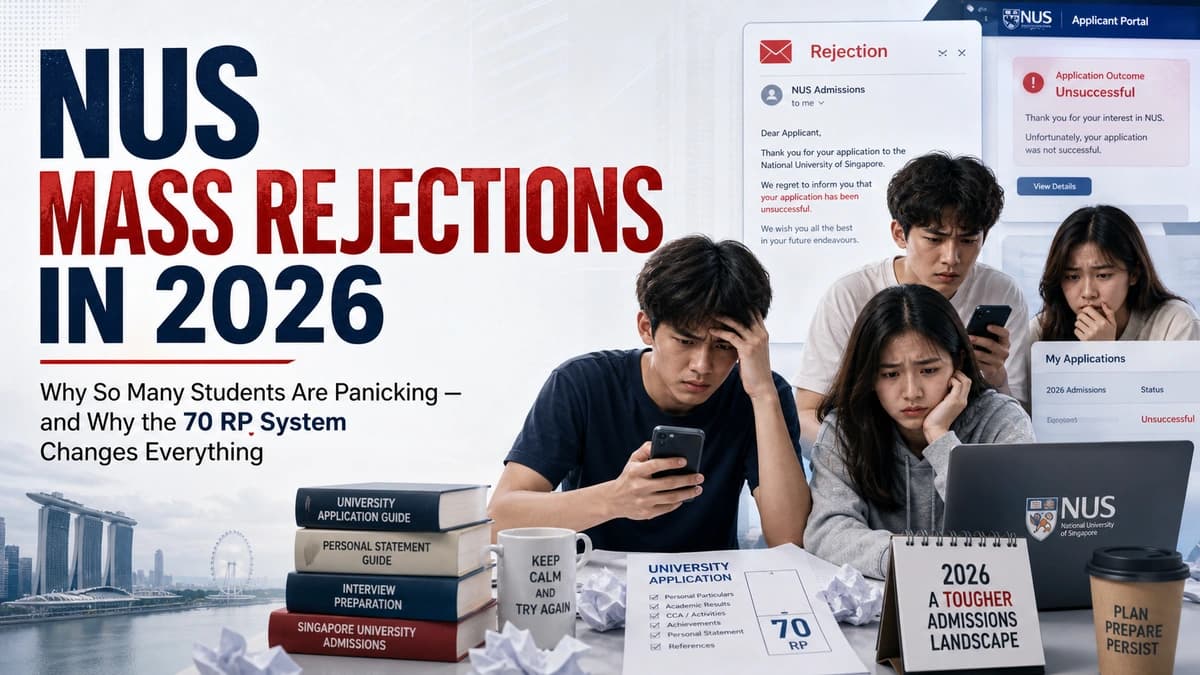
Over the past 48 hours, it has been hard to miss the mood on Reddit. On r/SGExams, students have been posting about “mass rejection” emails from NUS, portal status changes from “processed” to rejection, and the awkward silence before the outcome finally drops.
If you are one of the students who received a rejection letter, our first message is simple: we're sorry. It is never easy to work so hard, wait so long, and then get an outcome that feels sudden, cold, and honestly a bit sian.
One reason emotions are running so high is that, for many students, this did not feel gradual at all. It felt like the switch was flipped quite suddenly: weeks of silence, lots of checking, maybe a bit of hope, then rejection almost overnight. That is also why the “mass rejection” label is spreading so quickly online, even if the university itself would probably describe it as batch processing rather than anything dramatic.
Still, this is exactly the kind of moment that deserves a proper, grounded conversation. In our view, this year's NUS admissions cycle is the first proper test of the new 70 RP system, and that changes the way selection works quite a lot. It is not just about who scored the highest anymore; the margin is tighter now, and the rest of the application carries more weight than before.
What Reddit is Saying
The r/SGExams thread activity in the past 48 hours tells a consistent story. Students reported watching their NUS application portal change status without warning. Some had been sitting on “processed” for weeks before the outcome flipped. Others received their rejection email before the portal updated — creating a dissonance that added to the anxiety. The confusion is real, and we think it is worth naming clearly before we get into the substance.
One post described the portal sitting on “processed” for weeks, then a rejection email arriving without any warning. Students are sharing this experience in numbers — and the pattern feels very familiar to many applicants.
There are also posts where students are trying to figure out appeal timing, because the whole thing feels a bit rushed. Another thread said bluntly that NUS “does not care about appeals” — which shows how frustrated people are feeling when outcomes arrive with very little room to breathe.
That confusion is very normal. This is the first year students are applying under the new RP framework, and nobody has a fully settled benchmark yet.
Our read:The reaction online has been intense because the pattern feels very familiar to many applicants. The sense that “the rules changed” is factually accurate — they did. What we want to do in the rest of this post is explain how they changed, what it means for selection, and what the constructive next step looks like.
Why the 70 RP System Changes Everything
The new system makes university admissions more compressed, not less competitive. When the score scale changes from 90 to 70, the university is not making things easier; it is simply changing how students are compared against one another.
That matters a lot because a bigger group of applicants now sit within a very narrow score band. When many people are close on paper, universities naturally have to look at more than grades. Subject fit, portfolio, interview performance, relevant experience, leadership, and overall readiness all start to matter more.
That is why we think the selection process is still fair, even if it feels harsh. Fair does not mean everyone gets the same outcome. Fair means the university is using a consistent set of criteria, and in a tighter system like this, grades alone cannot carry everything.
This is the part that some applicants may not like, but it is worth saying plainly: a more compressed system does not remove competition; it redistributes it. Instead of spreading applicants out widely by score, it pushes more of them into the same zone, which means admissions teams must look harder at the details of each application.
Score Band Compression: Old 90 RP vs New 70 RP
Competitive applicants spread across ~15 RP points near the top — meaningful differentiation by score alone.
Competitive applicants crushed into 3–4 RP near the ceiling — score alone no longer separates candidates.
Key insight: When 68 RP, 69 RP, and 70 RP applicants are all fighting for the same seats in a compressed band, the score becomes the entry ticket to the shortlist — not the deciding factor. Portfolio, aptitude, and course-fit clarity take over.
At the same time, it is fair to say universities could communicate these realities more clearly. A lot of panic happens because applicants are left to decode the process from Reddit threads, Telegram chats, and portal status changes. When students do not understand what matters most, they fall back on the simplest metric — RP — even when that metric is no longer enough on its own.

Why Portfolio Matters More Now — This Is the Most Important Section
This is the part many students do not want to hear, but it is probably the most important takeaway. Under the 70 RP system, portfolio is no longer just a bonus. It is a real differentiator.
NUS has long said that admissions are not purely grades-based, and its aptitude-based admissions framework exists for exactly this reason. When the applicant pool is packed with strong scores, the university has to look for signs that a student is actually a good fit for the course.
So when students ask, “I already got a good RP, why still rejected?”, the uncomfortable answer may be this: plenty of other applicants also had strong RP, and the deciding factor may have been the strength of the rest of the application.
What NUS looks at beyond RP
Five pillars from NUS's published aptitude-based admissions framework — no invented weights
That does not mean your portfolio has to be flashy for no reason. It means it needs to make sense. A Computing applicant should not look like they pasted in a random list of CCAs. A Business applicant should not look like they only have generic volunteer hours. A Life Sciences applicant should not sound like they just copied a leadership template from somewhere.
It is not just what you did; it is also how clearly your application shows why you belong in that course.
And just as importantly, your first choice matters more than many students realise. Put your first choice clearly and deliberately, because in a system like this, the university is likely paying closer attention to where your strongest interest lies and how well your profile matches that particular course. If your first choice is vague, unrealistic, or poorly matched to your portfolio, it becomes harder for the admissions team to see a clear story in your application.
A Balanced View of the Selection System
We do not think the system is broken just because it produces disappointment. Any selective university will reject many capable students, and that is part of what makes admissions so stressful in the first place.
What we do think is that students and parents need to update how they read the system. The old habit of treating rank points as the whole story is becoming less useful. Now, RP gets you in the running, but it may not be enough to seal the deal by itself.
That is especially true for popular courses where the applicant pool is very stacked. In those cases, being “within range” does not automatically mean much, because almost everyone is within range. What separates one applicant from another is the story around the score.
What works about the new system
- Rewards genuine domain preparation, not just exam drilling
- Reduces the single-point-of-failure risk of one exam day
- Produces students with clearer course fit — which correlates with better completion and outcomes
- More comparable to how overseas universities have long selected
What universities could do better
- Students should not have to piece together the admissions timeline from Reddit posts and portal refreshes
- Portfolio expectations differ significantly by course — not made explicit enough
- The batch-processing timeline creates unnecessary emotional volatility
- Better transparency would cut down a lot of panic, even if the final outcomes stayed the same
At the same time, it is fair to say universities can still do better in communication. Students should not have to piece together the admissions timeline from Reddit posts and portal refreshes. Better transparency would cut down a lot of panic, even if the final outcomes stayed the same.
What Students Should Do Right Now
If you have just been rejected, do not rush into an emotional appeal. First, read the official outcome carefully and check whether you actually have anything new to submit. NUS appeals are meant to bring in new information, not just repeat the same application with more heartfelt words.
If you do appeal, make it specific. Show new achievements, updated results, a better-fit course choice, or a clearer explanation of why the course matches your track record. A vague appeal is easy to pass over, but a focused one gives the admissions team a real reason to look again.
You should also look seriously at your other offers. A rejection from NUS is not a verdict on your future, and Singapore has several strong local universities and pathways. Sometimes the place you did not expect becomes the one where you actually do well.
If you are applying in future cycles, this is also the time to be more strategic about course ranking. Do not throw your first choice away just because a course sounds prestigious. Put a first choice that you can actually justify with your subjects, activities, interests, and long-term direction. In a tighter admissions system, clarity of intent can matter a lot more than students think.
Check the official portal — not rumours
Status updates on Reddit can be incorrect or out of date. If your portal says something different from what you heard in a thread, believe the portal.
Appeal only if you have concrete new information
Show new achievements, updated results, a better-fit course choice, or a clearer explanation of why the course matches your track record. A vague appeal is easy to pass over.
Look seriously at your other offers
Singapore has several strong local universities and pathways. A rejection from NUS is not a verdict on your future. Sometimes the place you did not expect becomes the one where you actually do well.
Treat your portfolio as seriously as your grades
For next year's cycle, start now. Not because grades do not matter, but because in the new system, grades alone are increasingly not enough. Choose your first choice properly — in this cycle more than ever, students cannot afford to be careless with how they signal fit and seriousness.
Appeal Decision Tree
Submit a focused appeal
Lead with the new fact. Keep it concise. No emotional arguments.
Skip the appeal
Accept another strong offer. Use the year to build portfolio for next cycle.

What Parents Should Understand
For parents, the hardest part is often not the rejection itself but the uncertainty behind it. When the letter comes in batches and everyone online is talking about it, it is easy to feel like something strange or unfair happened.
Our honest view is that the anxiety is understandable, but it should not be mistaken for proof that the system is unfair. A batch rejection can simply reflect a very competitive intake process, where many applicants look strong enough on paper that small differences in fit and portfolio matter a lot.
The anxiety is understandable — but not proof of unfairness
A system can be fair and still feel devastating when you are on the receiving end of a rejection. Both things are true.
Universities can still do better in communication
Students should not have to piece together the admissions timeline from Reddit posts and portal refreshes. Better transparency would cut down a lot of panic, even if the final outcomes stayed the same.
Other offers deserve honest evaluation, not dismissal
NTU, SMU, and the other autonomous universities produce graduates who thrive in Singapore's economy. A child who enrols in a course that genuinely fits them at NTU will almost always do better than a child who chose NUS for prestige alone.
Our View, Plainly Stated
So here is our personal view: we believe the selection system is still fundamentally fair, but the new 70 RP framework makes it even more important to treat admissions as a whole-person process rather than a score race.
That means students should stop thinking, “I just need enough RP.” The better question now is, “Does my portfolio, interests, and experience show that I am a proper fit for this course?” And closely linked to that is another question students should ask early: “Is my first choicereally the course that best reflects who I am and what I can offer?” In our opinion, that is the real game now.
If the recent Reddit wave has shown anything, it is that many students are still adjusting to this reality. The earlier they understand it, the better they can prepare for future applications.
What to Do Next — Practical Steps
If you are still waiting for an outcome, stay calm and check the official portal rather than relying on rumours. If you have been rejected, take a bit of time, review your options, and only appeal if you have something concrete to add.
And if you are planning ahead for next year's cycle, treat your portfolio as seriously as your grades. Not because grades do not matter, but because in the new system, grades alone are increasingly not enough. At the same time, choose your first choice properly. In this cycle more than ever, students cannot afford to be careless with the way they signal fit and seriousness.
Check the official portal, not Reddit
If your portal says something different from what you heard in a thread, believe the portal. Stay calm and wait for the official outcome.
Only appeal if you have concrete new information
Show new achievements, updated results, a better-fit course choice, or a clearer explanation of why the course matches your track record. One clear new fact, stated plainly.
Evaluate every live offer seriously
Offer deadlines are real. NTU, SMU, SUTD, SIT, SUSS are all real options worth evaluating honestly. Do not let the focus on the rejection cause you to miss acceptance windows.
Build your portfolio for the next cycle — starting now
Identify what the course you want actually looks for, and start accumulating evidence that you belong there. The time to start is today, not in twelve months.
Frequently Asked Questions
Was there really a mass NUS rejection in 2026?
NUS processes applications in batches, so many students receive outcome emails around the same time — creating the impression of a "mass rejection". The volume of rejections may feel higher this year because the 70 RP system compressed score bands, meaning more applicants were competitive on paper but the selection criteria now extend beyond RP alone. NUS itself has not used the phrase "mass rejection"; the label is community-driven.
Is 70 RP enough for NUS in 2026?
70 RP is the new maximum under Singapore's revised A-Level scoring. Whether 70 RP is "enough" for a specific NUS course depends entirely on that course's IGP and the mix of other applicants. Because all high-scorers now cluster in a narrow RP band near the top, differentiation comes from portfolio, course fit, aptitude test results, and interview performance — not RP alone.
Should I appeal if NUS rejected me in 2026?
Appeal only if you have concrete new information that was not in your original application. A general "please reconsider" appeal almost never changes an outcome. If you have no new information, the more productive move is to accept another offer and build toward a stronger profile for a future cycle.
Does portfolio really matter more now under the 70 RP system?
Yes. The 70 RP system was explicitly designed to reduce over-reliance on exam scores and give aptitude, fit, and portfolio more weight. For courses like Computing, Business, and Life Sciences, the score gets you into the shortlist, but portfolio, course-fit essays, aptitude test results, and interview clarity decide the actual seat.
Will the same thing happen at NTU and SMU too?
NTU and SMU also receive and process applications in batches, so similar "batch rejection" experiences are possible. All three universities are moving toward more holistic admissions under the 70 RP framework. SMU, which runs aptitude tests and interviews for most courses, has operated this way for longer.
The bottom line
RP gets you in the running, but it may not be enough to seal the deal by itself. The better question now is whether your portfolio, interests, and experience show that you are a proper fit for the course. And whether your first choice truly reflects who you are. In our opinion, that is the real game now.
Related Resources
University IGP 2026/2027 Guide
Indicative Grade Profiles for every NUS, NTU, SMU, SUTD, SIT, and SUSS course. Check your real admissions threshold before deciding on an appeal.
NUS vs NTU vs SMU: Full Comparison 2026
Tuition fees, programmes, campus culture, and graduate outcomes — the full side-by-side for Singapore's top three universities.
Graduate Employment Survey 2025 — Salary Guide
Median starting salaries by university and course. See why NTU, SMU, and other universities often match NUS on graduate outcomes.
A-Level Results 2026 — University Admission Guide
What to do with your A-Level results — EAE, early admission, appeal process, and next steps if results are not what you hoped.