



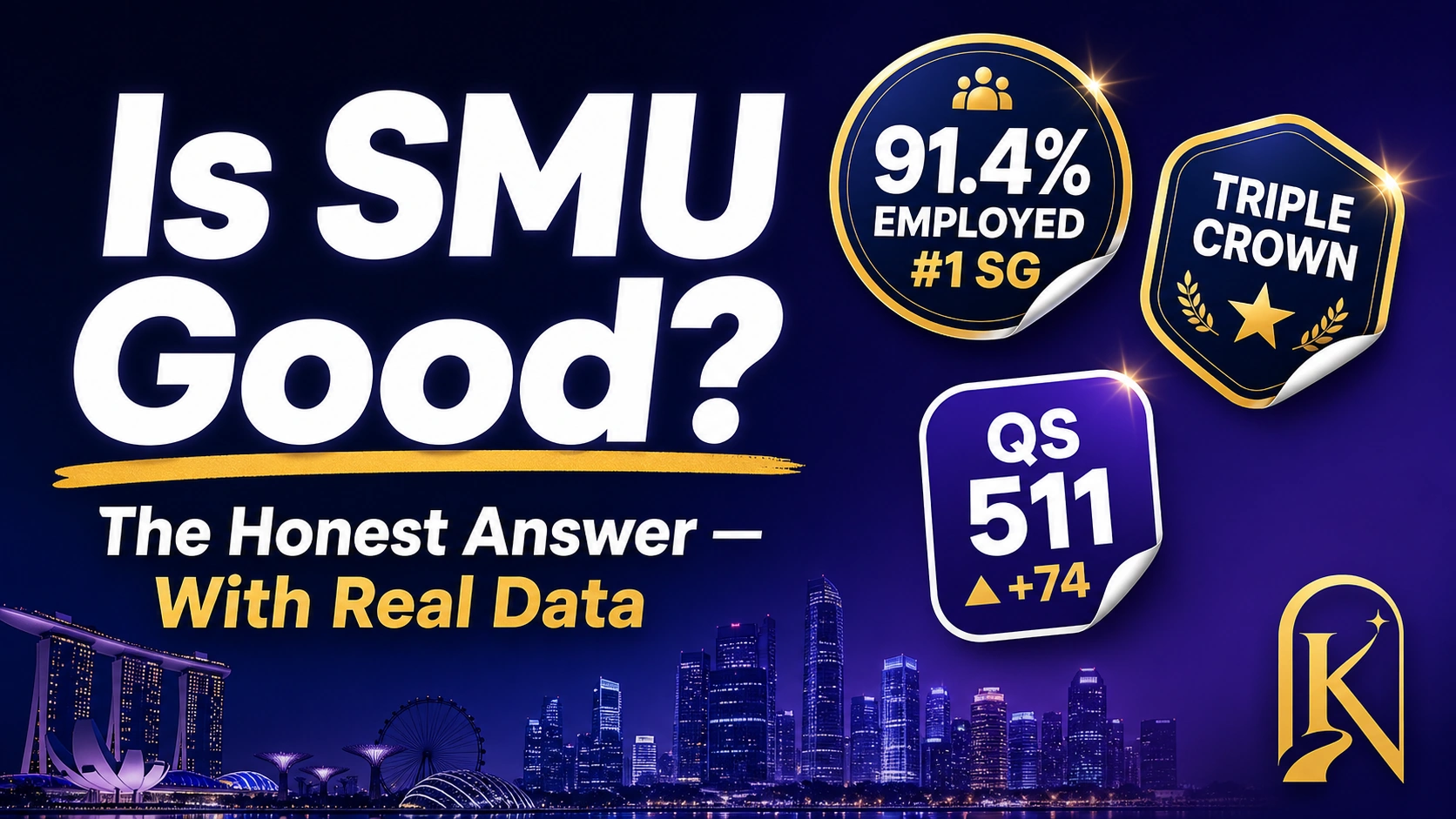
SMU is one of Singapore's Big 3 universities — alongside NUS and NTU — and one of 6 autonomous universities in the city-state. It is the only Triple Crown-accredited business school in Singapore, placing it in the top 1% of business schools worldwide. Yet many students and parents still ask: “Is SMU good?” and “Why is SMU ranked lower?”
This guide answers both questions honestly — with real data from GES 2025, QS 2026, and SMU's own official accolades — so you can make a decision based on facts, not ranking mythology.
SMU in 30 Seconds
“Why Is SMU Ranked Lower Than NUS & NTU?”
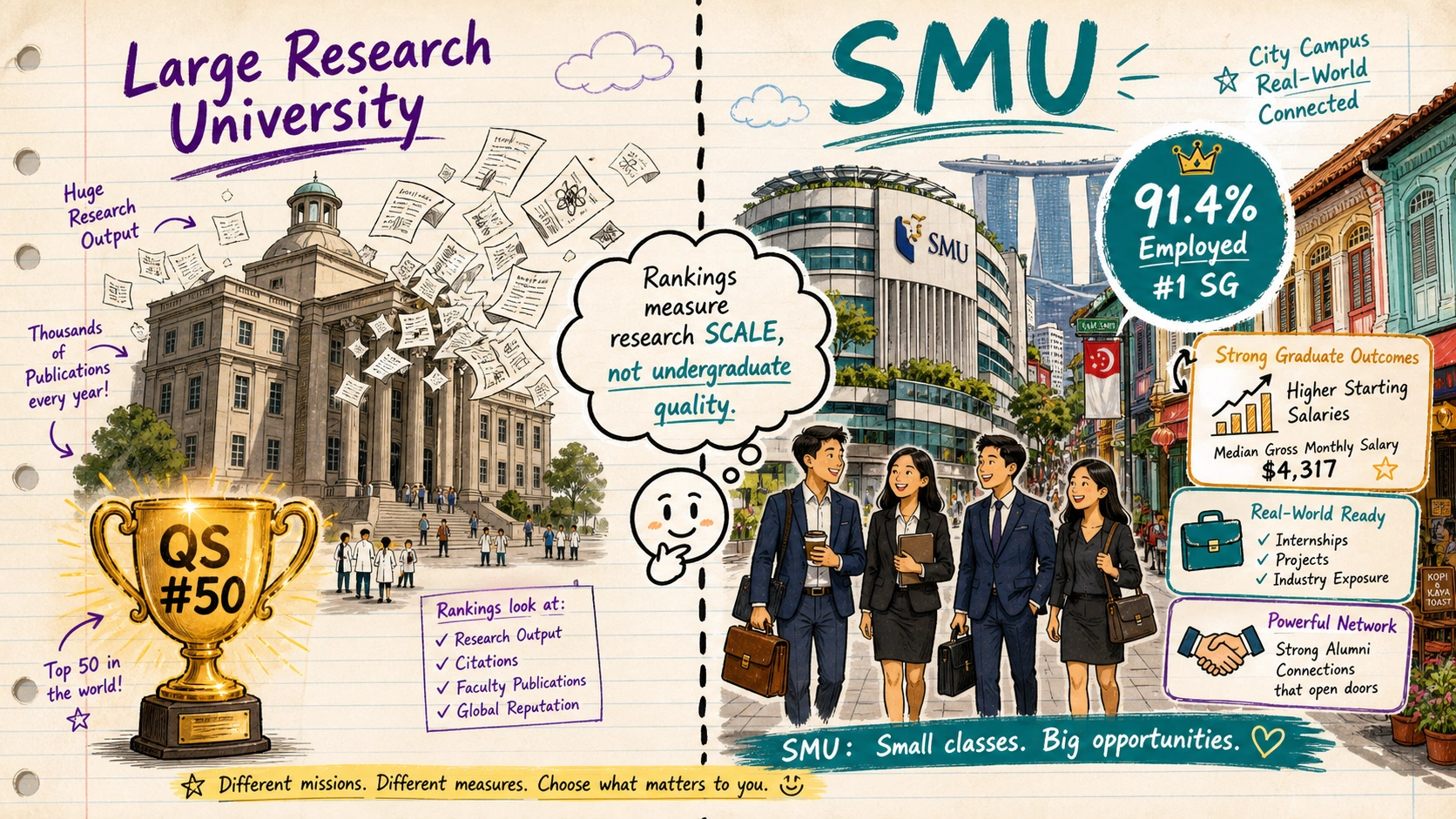
This is the most-searched question about SMU — and it deserves a straight answer. The short version: global rankings are designed around research scale, and SMU is a specialised university, not a research-first megalopolis. Here is how SMU's own admissions team explains it.
 Click to enlarge
SMU ranks lower on some global league tables because those rankings are heavily weighted toward research scale — large universities with medicine, science and engineering faculties produce far more papers, citations and patents. SMU is a smaller, specialised university, so it does not score the same way on those research-volume metrics. That does not mean the undergraduate experience is weaker. The more useful question for a student is: will this environment help me become confident, articulate, career-ready and well-connected?
The honest framing: SMU is a specialist university optimised for undergraduate career outcomes, not research volume. When you measure it on the dimensions that actually matter to undergraduates — employment rates, starting salaries, industry networks, and learning quality — SMU competes at a different level from what a single global rank number suggests.
One number worth remembering
GES 2025: SMU recorded 91.4% secured employment — the highest among all 6 Singapore autonomous universities. That is the real scorecard for undergraduates.
The Ranking Trend — SMU Is Moving Up Fast
While research-heavy rankings undercount SMU, the trajectory is unmistakeable: SMU climbed 74 places in QS World rankings in a single year — and was named the world's most improved university among institutions with 10+ ranked subjects.
Note: 2022–2024 ranks are band ranges (QS reported by band); 2025–2026 are point ranks. Bar height = relative position (higher bar = better rank). Source: QS World University Rankings 2026.
Beyond QS World, SMU holds a remarkable collection of specialist accolades:
QS groups universities by focus. SMU sits in the specialist universitiesclassification — institutions built around a focused set of disciplines (management, social sciences, technology and their intersections) rather than sprawling research-everything campuses. It is the same group that contains some of the world's most respected focused institutions:
Peer examples shown for context — these are globally recognised specialist universities in the same QS focus classification as SMU, not a ranked list.
Everything SMU Does First (in Singapore — or the World)
SMU built its reputation by pioneering what other Singapore universities later adopted. Here is the full list — every item is a verified first or exclusive:
Campus & Curriculum Firsts
Global & Career Firsts
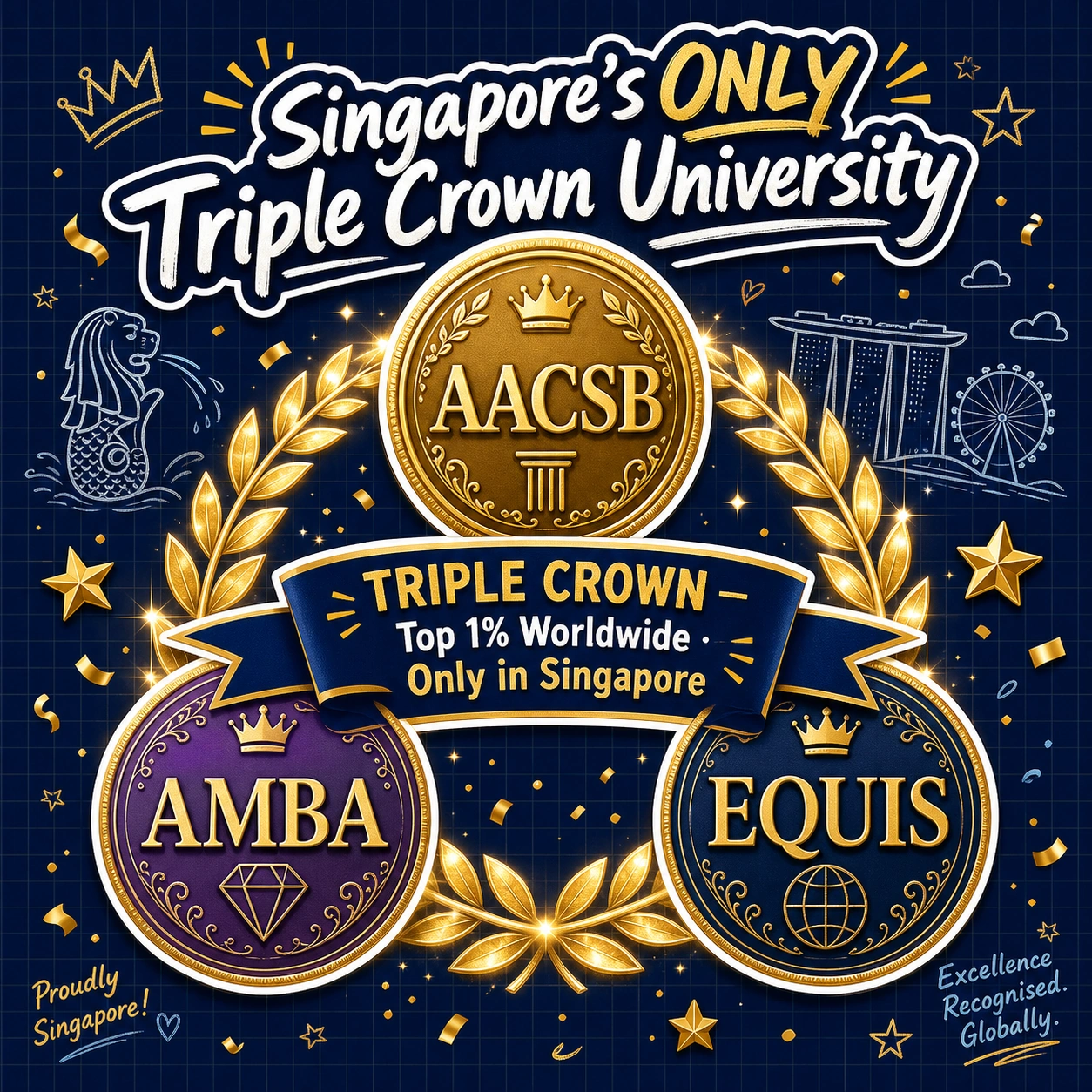
Triple Crown: The Top 1% of Business Schools Worldwide
The Triple Crown is the highest global standard for business schools. Only around 135 schools worldwide — less than 1% — have achieved it. SMU is the only university in Singapore with all three.
The ONLY university in Singapore — and among just ~135 schools worldwide (top 1% of business schools globally) — to hold all three.
 Click to enlarge
Beyond the Triple Crown, the Financial Times ranked SMU's research output 1st in Singapore, 2nd in Asia, and 21st worldwide in its Aggregated Global Business School Research Ranking (2025). SMU is also ranked 6th globally for Case Impact — meaning SMU business cases are actively used in classrooms worldwide.
Graduate Outcomes: The Scorecard That Actually Matters
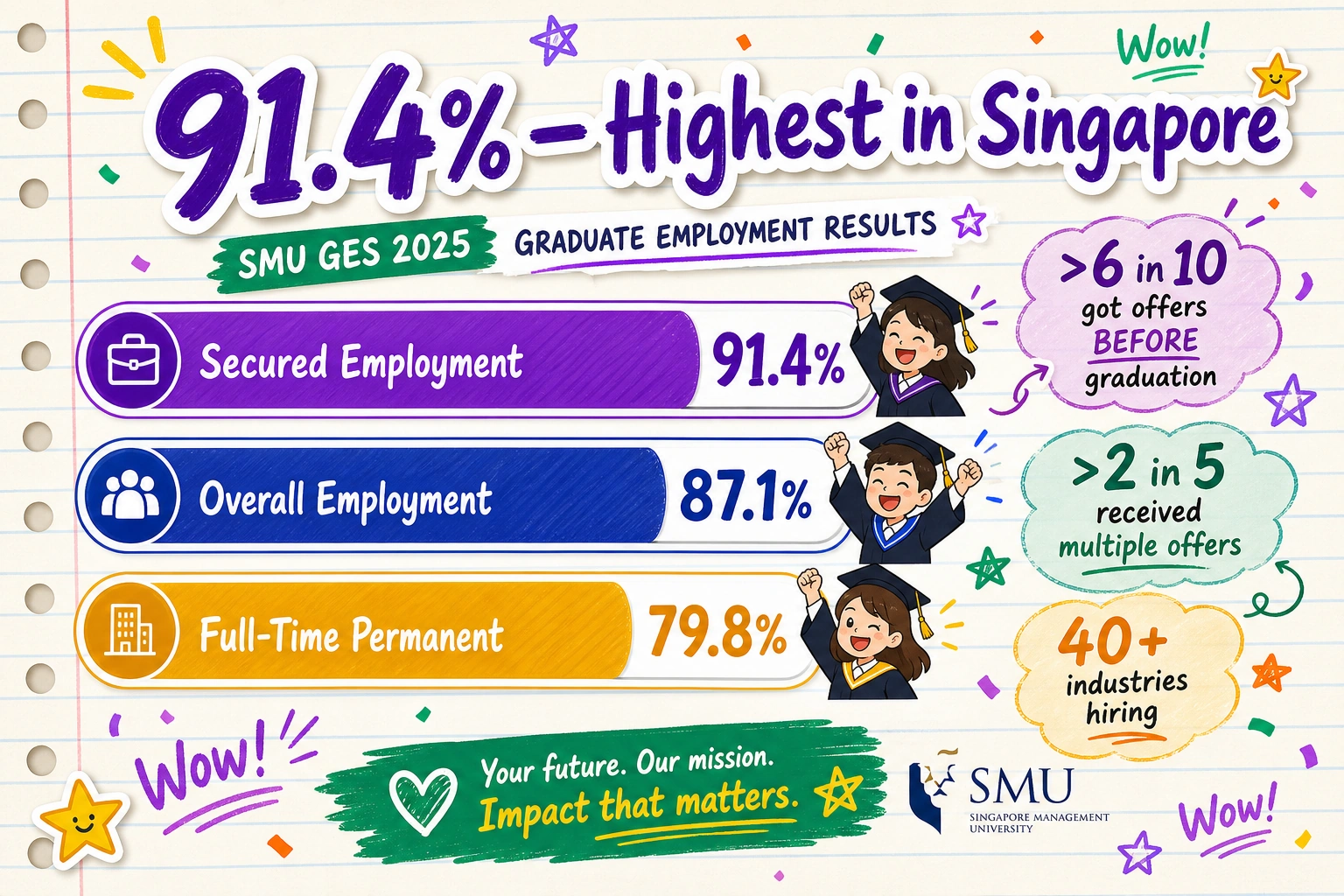
For undergraduates, the most relevant measure is not QS rank — it is what happens when you graduate. GES 2025 tells the story clearly.
Had at least one job offer accepted within 6 months of final exams
Employed in any capacity (FT, PT, freelance) at time of survey (Nov 2025)
Holding a full-time permanent role at time of survey
GES 2025 (MOE / SMU Newsroom, published 2026-03-05). SMU recorded the highest secured employment rate among Singapore's 6 autonomous universities. Class of 2025: 2,331 graduates, 1,710 respondents (73.4% response rate), surveyed November 2025.
Outcomes by programme from the Graduate Employment Survey 2025 (cum laude and above where indicated). Salaries are gross monthly medians with the 25th–75th percentile range:
Among the highest starting salaries of any local university computing programme. 85.7% in full-time permanent roles.
Business-meets-technology. Full placement; 93.5% in full-time permanent roles.
SMU's flagship — anchored by its Triple-Crown business school. 83% in full-time permanent roles.
The only combined Computing & Law degree in the world (figures shown are for all graduates, not cum laude only).
Source: SGSchoolKaki SMU Graduate Employment Survey 2025 (MOE GES via data.gov.sg). Software Engineering is not separately reported in GES 2025; it is ranked 2nd worldwide on CSRankings 2024 and includes a year-long apprenticeship.
Unlike NUS and NTU, which use the British honours system (First Class, Second Upper, etc.), SMU uses Latin honours adopted from the US university tradition — awarded on a cumulative GPA out of 4.00. In the GES table above, “cum laude and above” means the top three tiers (cGPA 3.40+) — a selective band, not all graduates. SMU states these awards do not equate to British-system degree classes.
| Latin honour | Meaning | cGPA (out of 4.00) |
|---|---|---|
| Summa Cum Laudecum laude+ | With Highest Distinction | 3.80 – 4.00 |
| Magna Cum Laudecum laude+ | With High Distinction | 3.60 – 3.79 |
| Cum Laudecum laude+ | With Distinction | 3.40 – 3.59 |
| High Merit | — | 3.20 – 3.39 |
| Merit | — | 3.00 – 3.19 |
Source: SMU Commencement — Cum Laude & Merit Awards (commencement.smu.edu.sg). SMU uses a 4.00-point cGPA scale.
 Click to enlarge
What Makes SMU Different: The Guarantees
SMU built its brand on concrete guarantees — things you are promised, not just offered. Every item below is verified from official SMU materials.
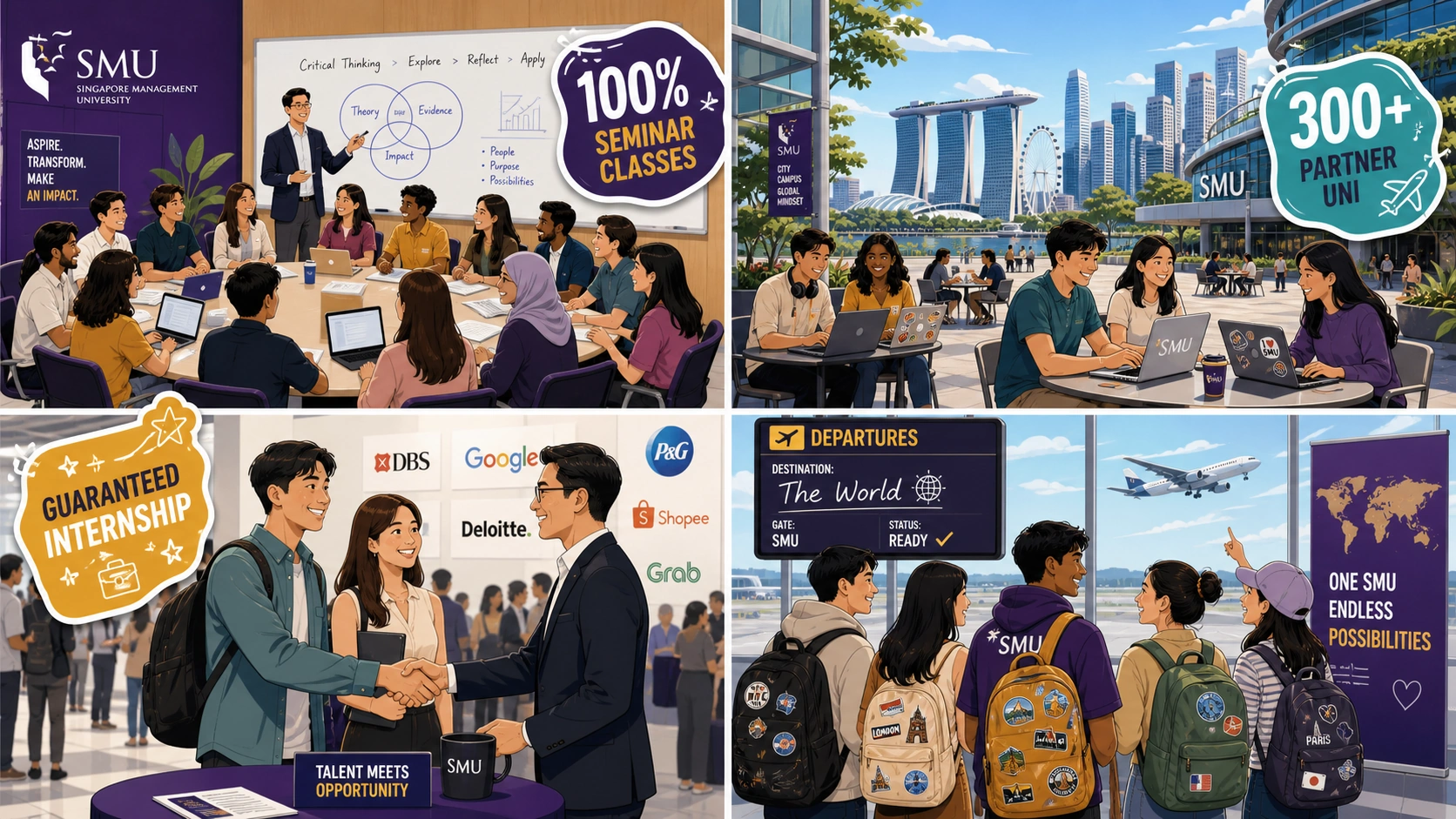 Click to enlarge
Who Is at SMU? The 2025 Freshmen Profile
SMU is a mid-sized university. The 2025 cohort of 2,600 freshmen arrived from 306 high schools across 147 cities in 30 nationalities. Eight degree programmes, one of which (Law) is restricted-admission.
All programmes offer Direct Meritorious Honours. Second majors are open to all students. Source: SMU Admissions “Destination: SMU” official data.
Cost & Financial Aid: SMU Access Plus
SMU Access Plus is SMU's flagship financial aid scheme for Singaporean students, designed to top up government bursaries so that financial circumstances do not prevent anyone from attending.
Apply via the SMU Applicant Self-Service Portal by 13 July. Contact the SMU Financial Aid Office for PCI tier breakdown.
Is SMU Right for You?
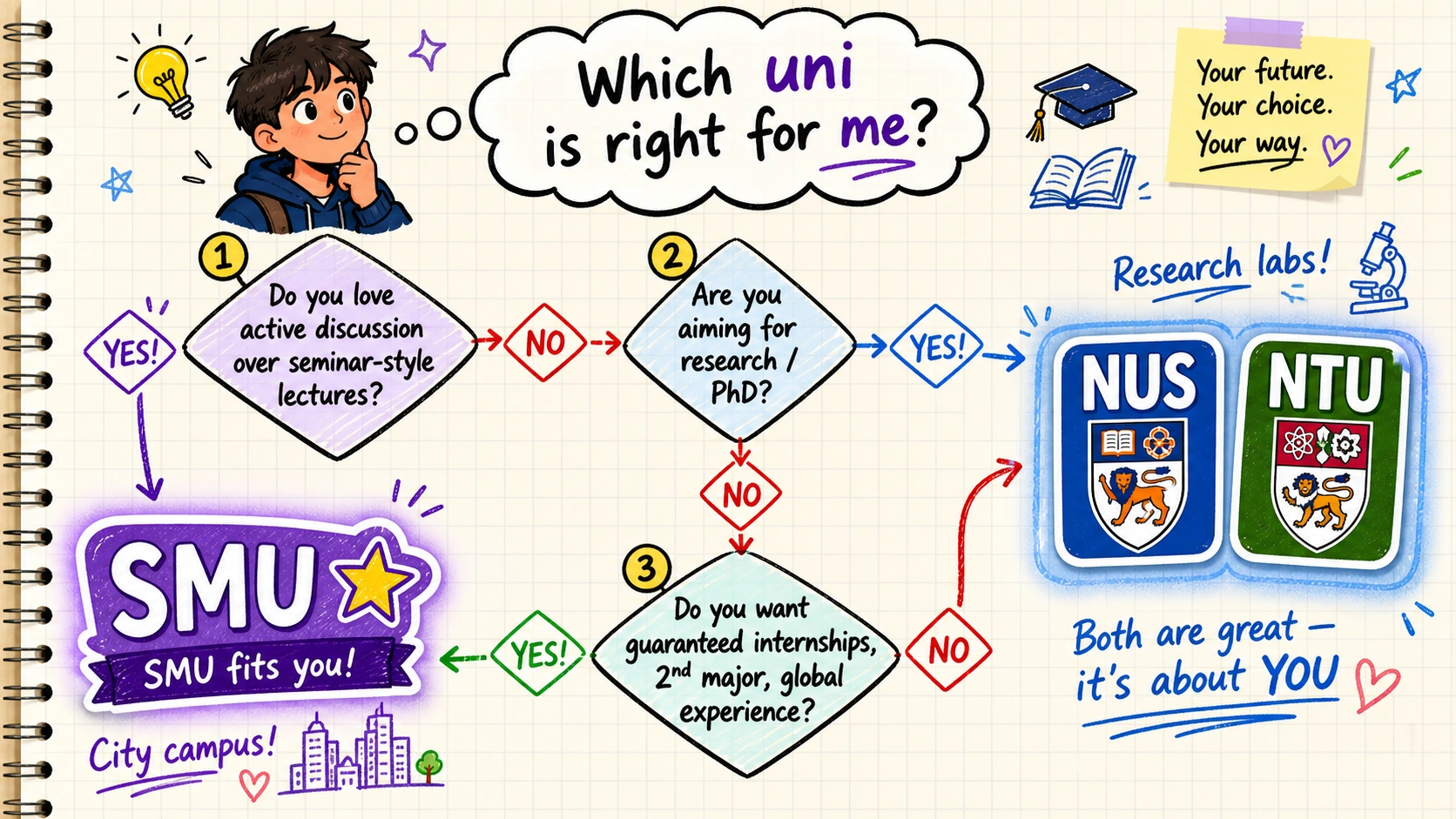
SMU is not the right university for everyone — and it is honest about that. The question is not whether SMU is “good enough” (it clearly is). The question is whether it matches your learning style and career goals.
- ✓You love seminar-style learning and active class participation
- ✓You want guaranteed internships, a 2nd major, and a global experience
- ✓Business, law, finance, computing, or social sciences is your goal
- ✓CBD city campus and industry networking appeal to you
- ✓You want to design your own degree or double-major
- ✓You thrive in smaller cohorts with professors from 33+ nationalities
- →You are aiming for research / PhD and want a large lab ecosystem
- →You prefer large-cohort lecture-style learning
- →Medicine or traditional engineering is your programme of choice
- →NUS / NTU has a stronger subject-level ranking for your exact field
- →You prefer a green residential campus over a city environment
 Click to enlarge
Frequently Asked Questions
Is SMU one of Singapore's Big 3 universities?
Yes. SMU is widely regarded as one of Singapore's Big 3 universities alongside NUS and NTU. It is one of six autonomous universities and the only one in Singapore with Triple Crown business accreditation (AACSB + AMBA + EQUIS), placing it in the top 1% of business schools worldwide.
Why is SMU ranked lower than NUS and NTU?
Global rankings are heavily influenced by research scale — total papers, citations, and patents. Large research universities with medicine, science, and engineering produce far more output. SMU is a smaller, specialised university, so it does not score the same on those volume metrics. However, on the dimensions that matter most to undergraduates — graduate employment, starting salaries, and learning quality — SMU leads. In GES 2025, SMU recorded the highest secured employment rate (91.4%) among Singapore's 6 autonomous universities.
What is SMU's employment rate in GES 2025?
SMU recorded 91.4% secured employment — the highest among Singapore's 6 autonomous universities — in Graduate Employment Survey 2025. Overall employment was 87.1%. Full-time permanent employment was 79.8%. More than 6 in 10 graduates secured job offers before graduation. Average gross monthly starting salary exceeded $5,100; the top 20% averaged above $7,600.
Is SMU prestigious? Is SMU a good university?
Yes. SMU holds Triple Crown accreditation (AACSB + AMBA + EQUIS) — held by only ~135 schools worldwide (top 1% of business schools). It ranked 15th worldwide for Best Specialist University (QS WUR 2026), 21st worldwide in FT Global Business School Research (2025), and was named the world's most improved university across 10+ ranked subjects in QS by Subject 2026. Prestige should be measured by the right yardstick: for specialised business/law/computing education, SMU is genuinely world-class.
SMU vs NUS vs NTU: which is better for business and law?
For business: SMU's Lee Kong Chian School of Business is the only Triple Crown-accredited school in Singapore — top 1% globally. FT ranked it 1st in Singapore, 2nd in Asia, 21st worldwide for research (2025). For law: NUS Law is the traditional prestige pick for pure law; SMU Law offers the world's only combined Computing & Law degree — a unique niche for tech-law careers. Learning style matters: SMU's 100% seminar classes suit active learners; NUS/NTU suit lecture-style learners.
Is SMU hard to get into?
SMU was Singapore's first local university to pioneer holistic admissions — considering academic results, co-curricular achievements, interview performance, and personal qualities. Law is the only restricted-admission programme. In 2025, 2,600 freshmen enrolled from 306 high schools across 147 cities and 30 nationalities. Check the IGP guide for the specific programme you are targeting.
Does SMU only do business?
No. SMU offers 8 degree programmes: Business Management (38%), Computing & Information Systems (25%), Accountancy (10%), Economics (8%), Social Sciences (8%), Law (7%), and Integrative Studies (3%). Computing is the world's only combined Computing & Law degree. SMU is also the only university in Asia offering Politics/Law/Economics and Design-Your-Own-Major programmes.
Related Resources
NUS vs NTU vs SMU: Full Comparison 2026
Side-by-side on tuition fees, programmes, campus culture, and graduate outcomes.
QS World University Rankings 2026 — Singapore
Full QS breakdown: NUS, NTU, SMU, and what the numbers actually mean.
THE Asia University Rankings 2026
NUS 3rd, NTU =4th — what THE's methodology measures and what it misses.
GES 2025: Singapore Graduate Salary Guide
Starting salaries across NUS, NTU, SMU, SUTD, SIT, and SUSS — by course.
University IGP 2026/2027 Guide
Indicative Grade Profiles for every SMU, NUS, NTU, SUTD, SIT, and SUSS course.
Singapore University Scholarships 2026
PSC, NUS, NTU, SMU, and statutory board scholarships — eligibility and tips.
Browse All Singapore Universities
NUS, NTU, SMU, SUTD, SIT, SUSS — profiles, programmes, and campus information.
A-Level University Admission Calculator
Calculate your UAS/rank points and see which SMU, NUS, and NTU courses are within reach.
Why SMU, really
for SG parents & students
SMU is one of Singapore's Big 3 — a first-choice specialist university for business, law, finance and computing, not a consolation prize for students who missed NUS or NTU. Its global-ranking gap reflects research volume — not undergraduate quality — and it posts the highest graduate employment rate of any Singapore university.
Choose a course by where it takes you. SMU guarantees internships, a second major and a global experience — and 91.4% of the Class of 2025 secured employment (GES 2025).
A lower global rank is not a weaker degree. SMU is a specialist university optimised for undergraduate outcomes, not research-paper volume.
Sources
- 1.SMU Newsroom — “91.4% Secured Employment”, published 2026-03-05. news.smu.edu.sg
- 2.MOE — Graduate Employment Survey 2025, official publication (Joint GES 2025 results).
- 3.QS World University Rankings 2026, QS Asia University Rankings 2026, QS World University Rankings by Subject 2026. topuniversities.com
- 4.QS and Times Higher Education ranking methodologies — both weight research output (publications, citations, patents) heavily, which structurally disadvantages smaller specialised universities. See the published QS and THE methodology pages.