

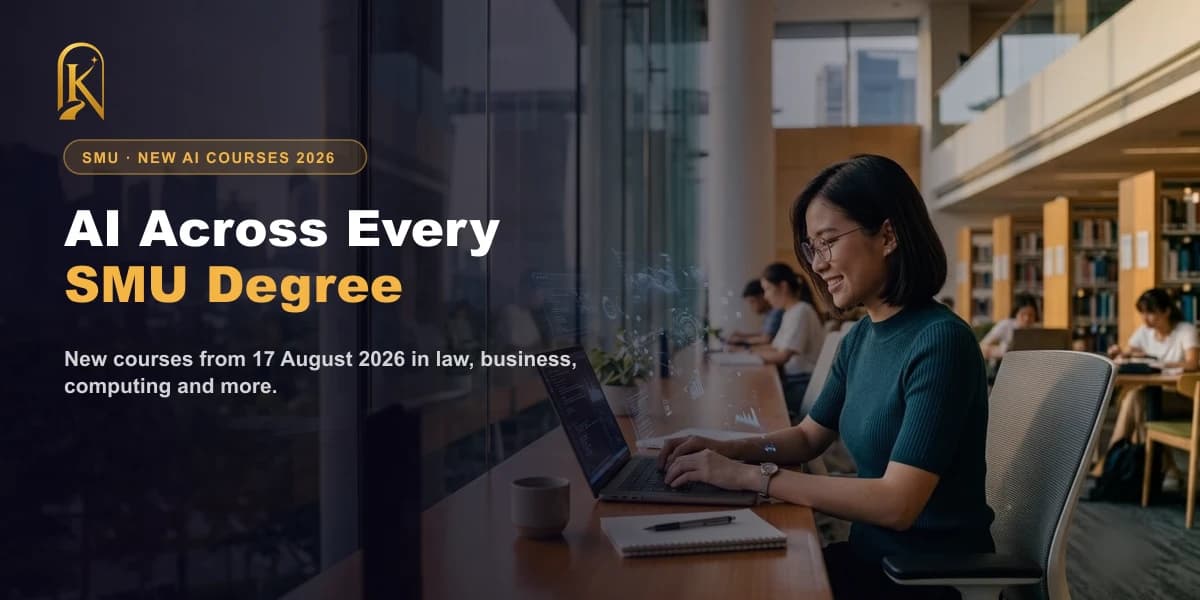
SMU is launching a new group of courses from 17 August 2026, the start of Academic Year 2026/27, to help students apply AI within their own disciplines while strengthening independent thinking, ethical judgement and creativity. For Singapore students and parents, the change matters because SMU is embedding AI across law, business, accountancy, computing, social sciences and integrative studies — not treating it as a standalone technical add-on.
Source: SMU Newsroom
Source: SMU Newsroom
What SMU Is Changing
The new courses introduced in AY2026/27 span AI, sustainability, law, psychology, business, technology and the arts. The aim is to combine disciplinary knowledge with critical thinking, creativity, ethical judgement and intercultural understanding — an early indication of a broader undergraduate curriculum transformation still to come.
Two steps, not one
SMU's wider AI in Education Strategy was “endorsed by the University's Board of Trustees in February 2026” and will reshape undergraduate education from AY2027/28. The AY2026/27 courses described here are an early step— the full strategy rolls out the following year.
Source: SMU Newsroom
AI Across Six SMU Schools
Each school is applying AI to its own discipline rather than treating it as one computing elective:
| SMU school | Examples of new courses | What students may explore |
|---|---|---|
| School of Computing and Information Systems |
| AI-enabled software development, data, financial services, audit, cybersecurity, digital investigations |
| Yong Pung How School of Law |
| Legal, economic and regulatory issues of emerging technology |
| School of Accountancy |
| AI agents in accounting practice |
| Lee Kong Chian School of Business |
| Applying classroom knowledge to organisational challenges via a 5-month work-study placement |
| School of Social Sciences |
| Identity, culture, society and personal narratives |
| College of Integrative Studies |
| Ethics, social responsibility, and Singapore's history and multiculturalism |
Also introduced: Open-Source Software Systems, Commercial Remedies in Litigation and Arbitration, Civil Litigation: Pre-trial Practice, and The Future of the Singapore Legal Profession. Choreographing the City-State begins in Term 2 of AY2026/27. More courses may follow.
Source: SMU Newsroom
The Three Commitments Behind the Strategy
| Commitment | What it means for students |
|---|---|
| Protect core competencies | Demonstrate critical thinking, independent reasoning, disciplinary and interdisciplinary understanding, and communication — independently of AI |
| Develop AI capabilities | Apply AI responsibly, effectively and fluently within studies and future professions |
| Strengthen human capabilities | Professional and ethical judgement, integrity, collaboration and creativity — value beyond the technology itself |
Source: SMU Centre for Teaching Excellence
Why Discipline-Specific AI Matters
In law, AI shows up in cybersecurity, cryptocurrency and legal practice. In accountancy, it is agentic AI applied to accounting work. In computing, it spans software engineering, audit, data protection and digital forensics. Across the board, AI is treated as professional practice, not a computing-only subject— extending into psychology, identity politics, ethics, dance and multiculturalism, where the focus stays on people, society, culture and judgement.
Source: SMU Newsroom
Financial Services AI Immersion Programme
IS4002 is a new SMU-X course connected to the Young Talent Programme – AI in Finance (YTP–AIF), announced at SMU in May 2026 by DPM Gan Kim Yong. It was developed by SMU-X and the School of Computing together with the Institute of Banking & Finance (IBF) and the Monetary Authority of Singapore (MAS).
How the programme runs
- Up to 13 weeks: a 2-week masterclass bootcamp, then course and project work during term time.
- Experiential learning plus internship placements (criteria apply).
- Open to eligible Year 2–4 university students in Singapore; prerequisites are relaxed for the pilot.
- Partners: AWS and Bloomberg, with “over 20 participating financial institutions” including JPMorgan Chase, DBS and Prudential.
- Curriculum covers AI foundations, financial data literacy, prompt engineering, responsible AI, AI risk management, data governance, security and auditability, with applications in risk, technology, operations, regulatory compliance and investment research.
Source: SMU Newsroom — SMU Supports a New Talent Pipeline for AI-Proficient Professionals
Work-Study and Applied Learning
MGMT389 Strategic Management Work-Study Elective is open to Year 3–4 students and combines self-directed academic learning with extended industry placements over 5 months. Under the “Design-Your-Own” model, students source internships matching their own interests, while faculty advisers support goal-setting, reviews and reflection.
Source: SMU Newsroom
Gemini Education Plus Access
Complimentary for every student
Every SMU student gets complimentary access to AI tools such as Gemini Education Plus. The purpose is to make AI fluency not dependent on personal affordability. Access to the tool does not replace the judgement students still need about when AI use is appropriate.
Source: SMU Newsroom
What SMU Leadership Says
Prof Venky Shankararaman, Vice Provost (Education Strategies and Innovation), frames the strategy this way: students should first demonstrate they can work independently of AI, then apply it within their discipline and articulate their human value-add. Technology fluency is necessary, but judgement, creativity and understanding of people and societies are what distinguish SMU graduates.
Preparing students for AI is not a matter of adding a course.
Source: SMU Newsroom
What It Means for Applicants
- You don't need to study computing to encounter AI learning at SMU — it now appears in accountancy, law, business, social sciences and integrative studies too.
- There is a financial-services applied pathway with AI, data, industry projects and internships (eligibility applies).
- Communication, ethics, creativity and social understanding are treated as part of AI readiness, not separate from it.
- Distinguish the AY2026/27 courses from the broader AY2027/28 strategy — the second is a bigger curriculum change still to come.
Always check the latest official course information, prerequisites and availability before deciding.
Frequently Asked Questions
When do the new AI-ready courses launch at SMU?
From 17 August 2026, the start of Academic Year 2026/27. One course, Choreographing the City-State: Dance and Multiculturalism in Singapore, begins in Term 2 of AY2026/27 rather than at the start of the year.
Is this the same as SMU’s wider AI in Education Strategy?
No. These AY2026/27 courses are an early step. The broader AI in Education Strategy, endorsed by SMU’s Board of Trustees in February 2026, will reshape undergraduate education more fully from AY2027/28 onward.
Which SMU schools are involved?
Six: the School of Computing and Information Systems, Yong Pung How School of Law, School of Accountancy, Lee Kong Chian School of Business, School of Social Sciences, and the College of Integrative Studies.
Is this only relevant to computing students?
No. New AI-related courses span law, accountancy, business, social sciences and integrative studies as well as computing — the strategy treats AI as a skill applied within each discipline, not a computing-only subject.
What is the Financial Services AI Immersion Programme?
It is IS4002, a new SMU-X course linked to the Young Talent Programme – AI in Finance (YTP–AIF), developed by SMU-X and the School of Computing with the Institute of Banking & Finance (IBF) and the Monetary Authority of Singapore (MAS). It runs up to 13 weeks, combining a 2-week masterclass bootcamp with course and project work, experiential learning, and internship placements (criteria apply), open to eligible Year 2–4 university students in Singapore.
Which industry partners are involved in the Financial Services AI Immersion Programme?
AWS and Bloomberg are partners, alongside “over 20 participating financial institutions” including JPMorgan Chase, DBS and Prudential. The Institute of Banking & Finance and the Monetary Authority of Singapore co-developed the wider Young Talent Programme – AI in Finance.
What AI tools do SMU students get access to?
Every student gets complimentary access to AI tools such as Gemini Education Plus, so AI fluency does not depend on personal affordability. Access does not replace the judgement needed to decide when AI use is appropriate.
Related Resources
NUS ChatGPT Edu & the OpenAI Deal
How NUS' campus-wide OpenAI collaboration compares with SMU's discipline-specific approach.
NTU–Google AI Partnership 2026
See how NTU's Google-powered AI rollout stacks up against SMU and NUS.
The bottom line
SMU's AY2026/27 courses show AI being applied inside law, business, accountancy, computing and social sciences — not bolted on as a separate module. For families, the mix of discipline-specific AI courses, an applied financial-services pathway, and complimentary AI tool access is worth understanding now, ahead of the fuller AI in Education Strategy rollout from AY2027/28.
Note on completeness: Only details verified from the fetched SMU Newsroom announcement, SMU Centre for Teaching Excellence strategy page, and SMU's Financial Services AI programme announcement are included here. No admission scores, tuition fees, prerequisites, timetables, assessment details or guaranteed internship outcomes were in those sources, so they are omitted. The course list reflects what was confirmed at publication and may expand.
Sources
- 1.SMU Newsroom — SMU unveils new courses to prepare graduates for an AI-enabled future. news.smu.edu.sg
- 2.SMU Centre for Teaching Excellence — AI in SMU Education: Our Approach. cte.smu.edu.sg
- 3.SMU Newsroom — SMU Supports a New Talent Pipeline for AI-Proficient Professionals.
Cite this page: SGSchoolKaki Education Team, “SMU New AI Courses 2026 Singapore: AI Across Degrees,” SGSchoolKaki, 31 Aug 2026, https://sgschoolkaki.com/blog/smu-new-ai-courses-2026.