


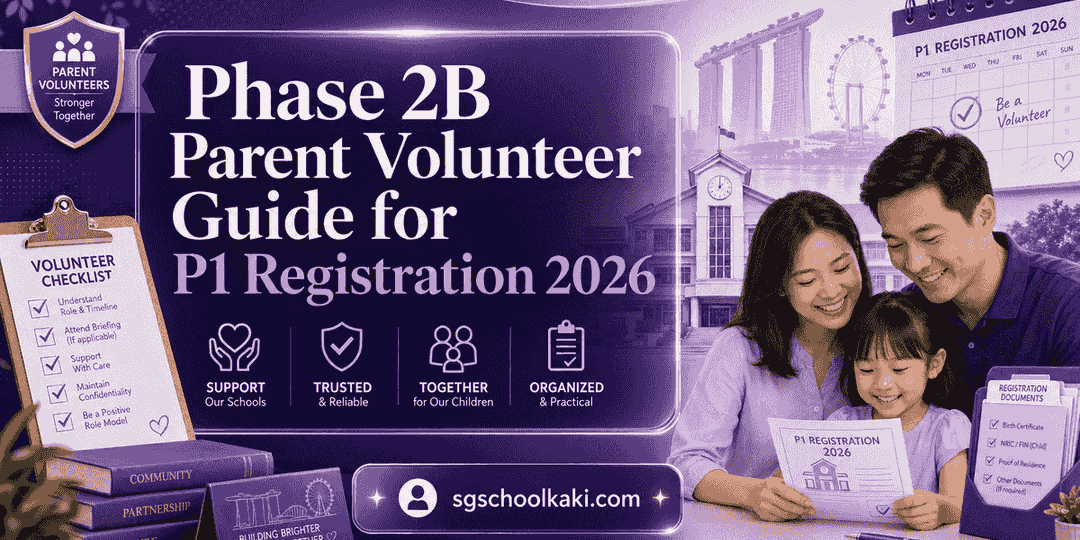
Phase 2B is the second-to-last phase of P1 Registration where parents who volunteered at least 40 hours at their target primary school can register their child. For the 2026 P1 Registration Exercise, parents must complete 40+ hours by 30 June 2026 — meaning volunteering should start by July 2025 for safe margins. This guide covers eligibility, accepted activities, the application process, and strategy for picking the right school.
What Is Phase 2B?
P1 Registration in Singapore proceeds through a series of phases, each targeting a different group of applicants. Phase 2B sits after Phase 2A (children of alumni, school staff, and affiliated organisations) and before Phase 2C (the open ballot). Only children whose parents qualify through one of the three Phase 2B pathways — or who have not yet been registered — may register in this phase.
Phase 2B 2026 Dates (CONFIRMED by MOE)
Registration Window
20 – 21 July 2026
9am Mon to 4:30pm Tue
Results Announced
27 July 2026
MOE-confirmed result release
Source: official MOE 2026 P1 Registration Exercise. Verify at moe.gov.sg/primary/p1-registration
Three Eligibility Pathways in Phase 2B
Parent Volunteer (most common)
Parent or legal guardian has volunteered at least 40 hours at the school, with hours accumulated over at least one year before the P1 registration exercise.
Church / Clan Endorsement
Parent is an active member of a church or clan that is directly affiliated with the school. The affiliation must be formally recognised by MOE — check the school's own affiliations list on their website.
Endorsed Community Leader
Parent is an endorsed active community leader — typically those serving in grassroots or Residents' Committee (RC) roles. This pathway has very narrow eligibility and is rarely applicable.
Vacancy cap: Each school reserves only 20 places for Phase 2B. If more eligible applicants register than there are places, a computerised ballot is held. Volunteering for 40 hours qualifies you to enter Phase 2B — it does not guarantee a place if the phase is oversubscribed.
The 40-Hour Volunteer Requirement
MOE requires the volunteering to be genuine and sustained. The 40 hours are not a one-off commitment — they must be accumulated over at least one year before the registration exercise. That means you cannot complete all 40 hours in a single month just before the July 2026 exercise.
Key Rules at a Glance
- Minimum 40 hours, cumulativeSpread across sessions over at least one year — not compressed into a short window
- Must be at the same school you register atHours at School A do not qualify you for Phase 2B at School B
- Parent or legal guardian onlyGrandparents, aunts/uncles, or domestic helpers cannot volunteer on your behalf
- For 2026: start by July 2025Starting in July 2025 gives you a full 12 months to comfortably clear 40 hours before the June 2026 attestation deadline
- Higher hours do not improve ballot oddsIf Phase 2B is oversubscribed, MOE runs a computerised ballot — volunteer hours are not a tiebreaker. 41 hours and 200 hours carry equal weight in the ballot.
How to Apply for Volunteering — Step by Step
Each school manages its own parent volunteer programme. There is no central MOE portal for applications. The process below reflects the typical workflow across most Singapore primary schools.
Identify your target school by distance
Use our P1 Registration distance checker to find primary schools within 1km and 2km of your home. Even if you qualify for Phase 2B, distance is still a tiebreaker if the phase is oversubscribed — being within 1km of your target school improves your position.
Contact the school general office
Call or email the school's general office, or visit their website and look for a 'Parent Volunteer' or 'School Partnership' section. Ask specifically whether they are accepting volunteer applications for the 2026 P1 intake year. Popular schools often fill volunteer slots early.
Complete the volunteer application form
Fill in the school's application form. Typical fields: child's expected P1 intake year, your NRIC details, contact information, skill set (e.g. first aid, reading, art), and available hours per month. Submit by post, email, or in person as instructed.
Wait for school approval — follow up if waitlisted
Schools with popular volunteer programmes may have waiting lists. If approved, you will receive onboarding details. If waitlisted, check in proactively every 1–2 months. Do not assume silence means rejection.
Volunteer and log every hour carefully
Attend your scheduled sessions and record all hours using the school-issued tracking sheet or digital log. Keep your own copy as backup. Hours that are not properly logged may not be accepted during attestation.
Submit final attestation by 30 Jun 2026
For the 2026 P1 Registration Exercise, your 40+ volunteer hours must be attested by the school before 30 June 2026. Check with your school whether you need to submit a form or whether they update records automatically.
Volunteer Activities — What Counts and What Does Not
Schools define the scope of qualifying activities. As a general rule, hours must be school-directed, unpaid, and directly beneficial to the school community. The following is a representative (not exhaustive) list based on typical school programmes:
Activities That Typically Count
- Library / book collection and book-checking duty
- Environmental / cleanliness and recycling programmes
- Reading-aloud sessions in lower primary classes
- Sports Day and school event support
- Parent-teacher conference and fair organisation
- Gardening and school grounds maintenance
- Specialist contributions (first aid, art, drama)
- School open house and orientation day support
Activities That Do NOT Count
- Paid tutoring or coaching (remunerated work)
- Volunteering at a different school entirely
- Activities organised outside school premises without school direction
- Volunteer hours at community centres or RC
- Ad-hoc personal help to individual teachers
- Attending your child's enrichment classes as a parent observer
- Corporate social responsibility (CSR) work for your employer
When in doubt, ask the school. Each school's parent volunteer coordinator has the definitive list of accepted activities. Confirming upfront saves disappointment when you submit for attestation.
Other Phase 2B Pathways: Church / Clan and Community Leaders
While the parent volunteer pathway is by far the most commonly used, two narrower pathways also qualify parents for Phase 2B:
Church or Clan Endorsement
If a parent is an active member of a church or clan that is formally affiliated with the school, they may register in Phase 2B under the endorsed pathway. The key constraint: the affiliation must be the school's own — not any church/clan generally, but specifically the one named in the school's founding or management documents.
To verify, visit the school's official website or call the general office to ask for their list of affiliated organisations. You can also browse our primary school directory and filter by affiliation type.
Endorsed Active Community Leader
This pathway is available to parents recognised as active community leaders — typically those serving in grassroots roles such as Residents' Committee (RC) members or active People's Association volunteers. If you believe you qualify, contact MOE or the school directly for the formal endorsement process. This is the rarest of the three pathways and not widely applicable.
Strategy: Which Schools to Target for Phase 2B
Logging 40+ volunteer hours is a real investment of time. Before committing, think carefully about whether Phase 2B is likely to be oversubscribed at your target school. Qualifying for Phase 2B does not guarantee entry — if more eligible parents apply than there are 20 places, a computerised ballot is held.
Smart Targeting Checklist
- Check the school's 2025 Phase 2B vacancy historySchools where Phase 2B filled via ballot in prior years are high-risk for 2026 too. See our oversubscribed schools analysis.
- Ensure your distance band is a fallbackEven if Phase 2B fails (you lose the ballot), check that you have a reasonable chance in Phase 2C with your home-school distance. Check your distance band.
- Do not put all your eggs in one basketConsider volunteering at a school that is your genuine first choice — but also make sure you have a Phase 2C backup plan at a school where you have within-1km priority.
- Confirm the school is accepting volunteersSome schools cap their volunteer intake. If they are not accepting new volunteers, you cannot qualify for Phase 2B there — contact the school early.
2026 Considerations: Intake Reduction Impact
Starting from 2026, MOE is reducing intake at selected primary schools to right-size enrolment in line with falling birth rates. This has a direct knock-on effect on Phase 2B: if a school's total intake shrinks, the fixed 20-place Phase 2B allocation becomes a larger proportion of a smaller pie — but also more contested if the school remains desirable.
Action required now: If you are targeting a school that has announced intake reduction for 2026 or 2027, call the school in May–June 2025 to confirm their Phase 2B quota and whether they are still accepting volunteer applications. Do not assume the 20-place cap is unchanged.
For a full breakdown of which schools are affected and how Phase 2B interacts with reduced intakes, read our P1 Registration Intake Reduction analysis.
Frequently Asked Questions
Can I volunteer at multiple schools for Phase 2B?
Yes, you can volunteer at more than one school, but your hours do not transfer between schools. MOE requires 40+ hours specifically at the school you intend to register your child at. Hours logged at another school count only for Phase 2B eligibility at that school.
Does grandmother volunteering count for Phase 2B?
No. MOE requires the volunteer to be a parent or legal guardian of the child. Grandparents, relatives, or other family members who volunteer at the school cannot qualify the child for Phase 2B under the parent volunteer pathway.
What if I move house while volunteering?
Your logged volunteer hours stay counted at the original school. If you move and your new address makes a different school more strategically sensible, you will need to restart volunteering at the new school — you cannot transfer hours. Carefully weigh whether you have enough time to reach 40 hours at a new school before the June 2026 deadline.
Is there a maximum on volunteer hours for Phase 2B?
No, there is no official maximum. The minimum to qualify is 40 hours. If Phase 2B is oversubscribed, the ballot is computerised and randomised — MOE does not use volunteer hours as a tiebreaker. Logging 200 hours carries no ballot advantage over 41 hours.
Continue Your P1 Planning
P1 Registration Calculator
Check which schools are within 1km and 2km of your home, and see past balloting data by phase.
Home-School Distance Rule
How the 1km and 2km priority tiers work in Phase 2B, 2C, and 2C Supplementary.
2025 Oversubscribed Schools
Which primary schools balloted in each phase in 2025 — essential reading before you choose your volunteer school.
Primary School Directory
Browse all 182 primary schools with affiliations, CCAs, programmes, and location information.
Sources: Phase 2B eligibility and volunteer requirements based on MOE P1 Registration — How to Register and MOE Registration Phases. All dates are MOE-confirmed for the 2026 P1 Registration Exercise; latest at moe.gov.sg/primary/p1-registration.