










Movement of Substances
SEAB syllabus topic 2: diffusion, osmosis and active transport, with the why, the practical, the traps and the exam checks.

Diffusion is passive and moves particles down a concentration gradient.
Osmosis moves water molecules down a water potential gradient through a partially permeable membrane.
Active transport moves particles against a concentration gradient and needs energy from respiration.
Diffusion
define diffusion and describe its role in nutrient uptake and gaseous exchange in plants and humans
Diffusion is the net movement of particles from a region of higher concentration to a region of lower concentration, down a concentration gradient, as a result of their random movement.
- Diffusion
- Diffusion: the net movement of particles from a region of higher concentration to a region of lower concentration, down a concentration gradient, as a result of their random movement
- Concentration gradient
- Concentration gradient: a difference in concentration between two regions
- Net movement
- Net movement: the overall movement of particles after movement in both directions is taken into account
- Passive process
- Passive process: a process that does not need energy from respiration; diffusion is a passive process
- Rate of diffusion
- The rate of diffusion increases with surface area and concentration difference, and decreases as the diffusion distance increases. supports K325-2(a)
- Diffusion distance
- Diffusion is fast enough over very short distances but too slow over long distances, which is why large organisms need transport systems. supports K325-2(a)
How it works and where it matters
Figure 1. Particles move randomly, but the net movement is from higher to lower concentration.
| Factor | Effect | Why |
|---|---|---|
| Steeper concentration gradient | Steeper concentration gradient gives a faster rate of diffusion. | More particles move from the higher concentration than back from the lower concentration. |
| Higher temperature | Higher temperature gives a faster rate of diffusion. | Particles have more kinetic energy and move faster. |
| Larger surface area | Larger surface area gives a faster rate of diffusion. | More particles can cross at the same time. |
| Shorter distance | Shorter distance gives a faster rate of diffusion. | Particles have less far to travel. |
| Higher surface area to volume ratio | A higher surface area to volume ratio lets diffusion supply the whole cell more quickly. | There is more surface through which particles can cross for each unit of volume. |
| Smaller molecules | In the same conditions, smaller molecules diffuse faster than larger molecules, for example glucose diffuses faster than sucrose in a solution. | At the same temperature, smaller molecules move about faster, so they spread out more quickly. |
Plants: gaseous exchange (leaf)
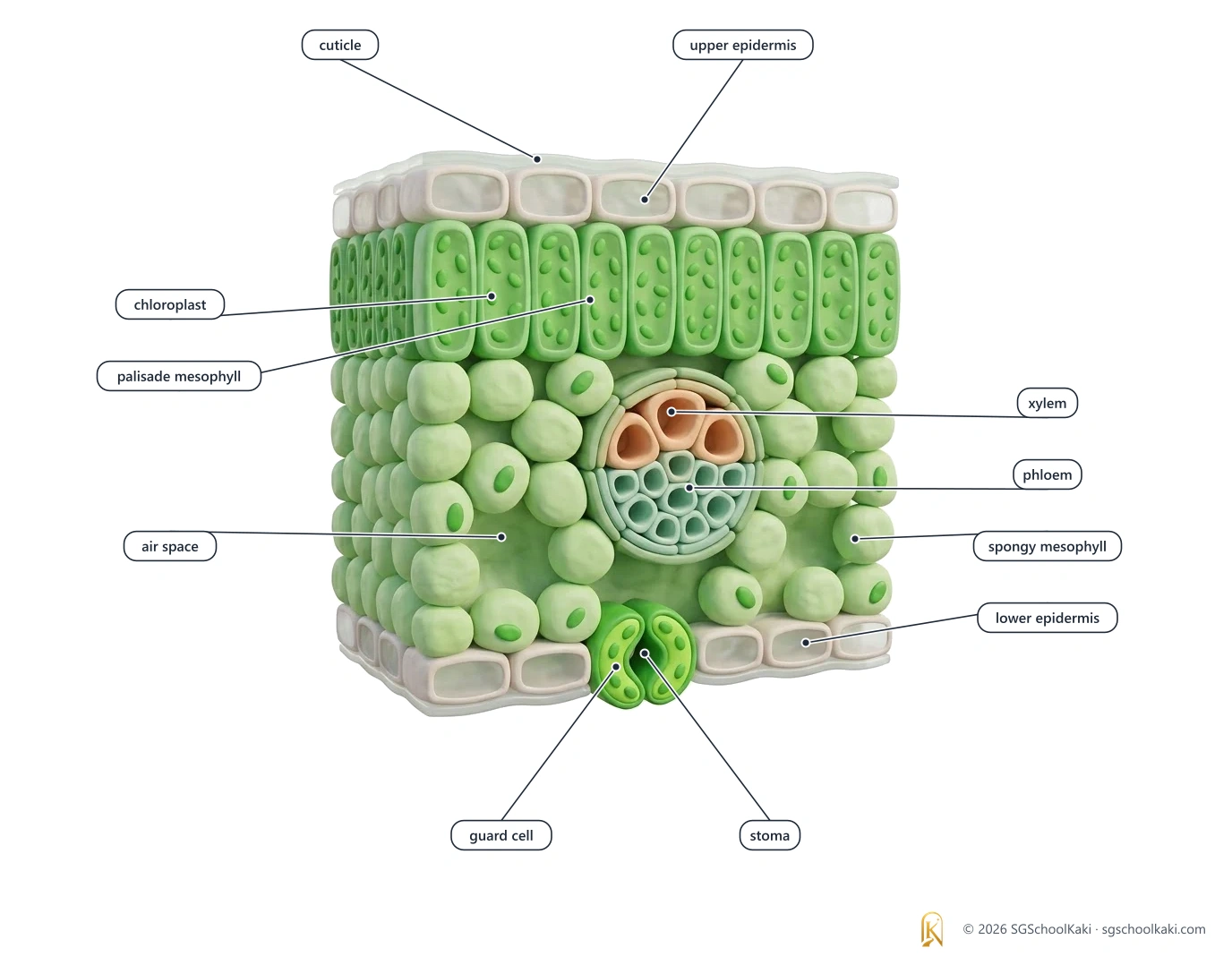
In bright light, when the rate of photosynthesis is higher than the rate of respiration, photosynthesis uses carbon dioxide, so its concentration inside the leaf is lower than in the air; carbon dioxide diffuses in through the stomata and oxygen produced diffuses out.
Plants: carbon dioxide uptake
Carbon dioxide diffuses into leaf cells as a raw material for photosynthesis.
Humans: gaseous exchange (alveoli)
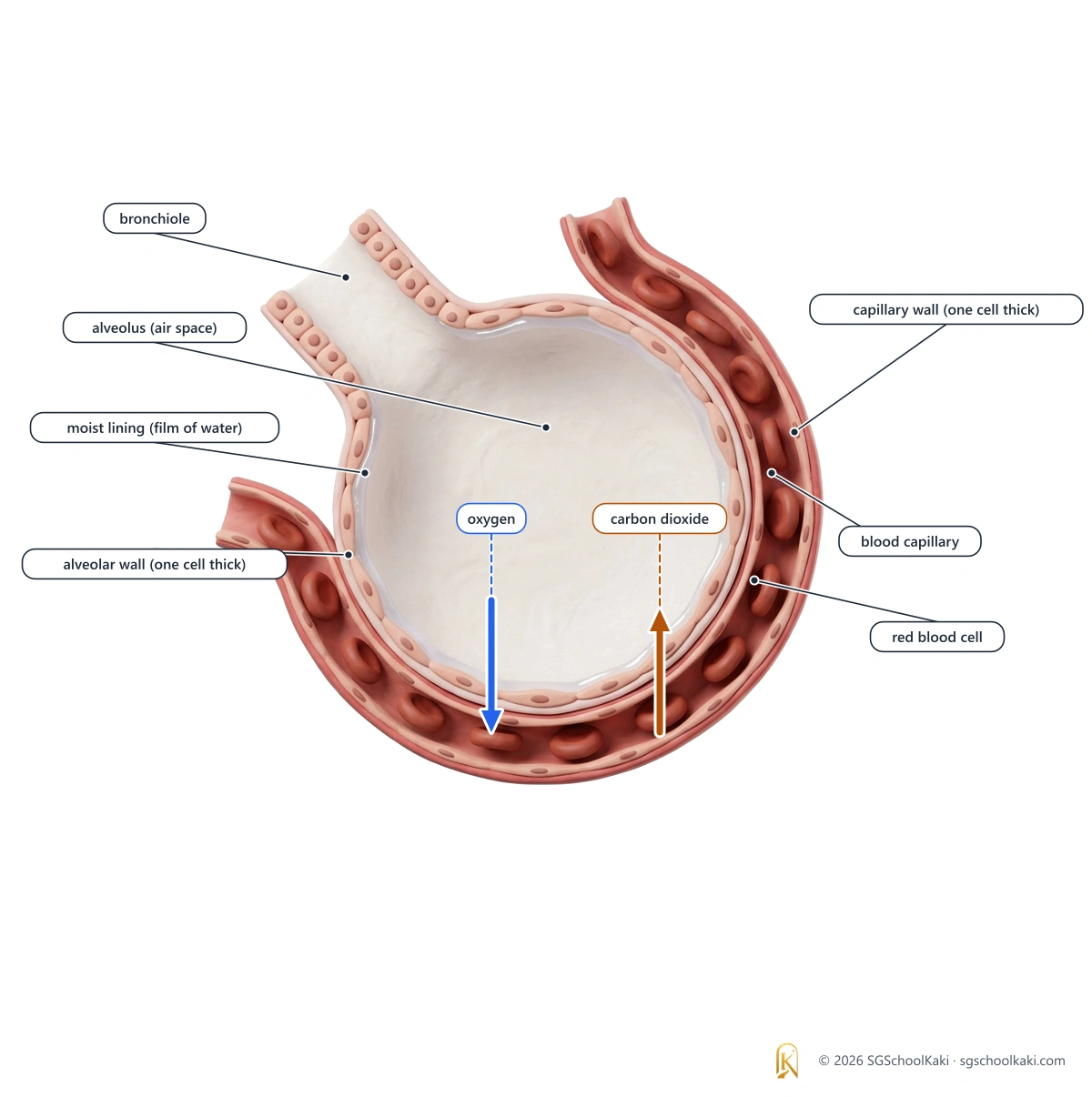
Oxygen diffuses from the air in the alveoli, where its concentration is higher, into the blood, where it is lower. Carbon dioxide diffuses from the blood into the alveolar air.
Humans: nutrient uptake (villi)
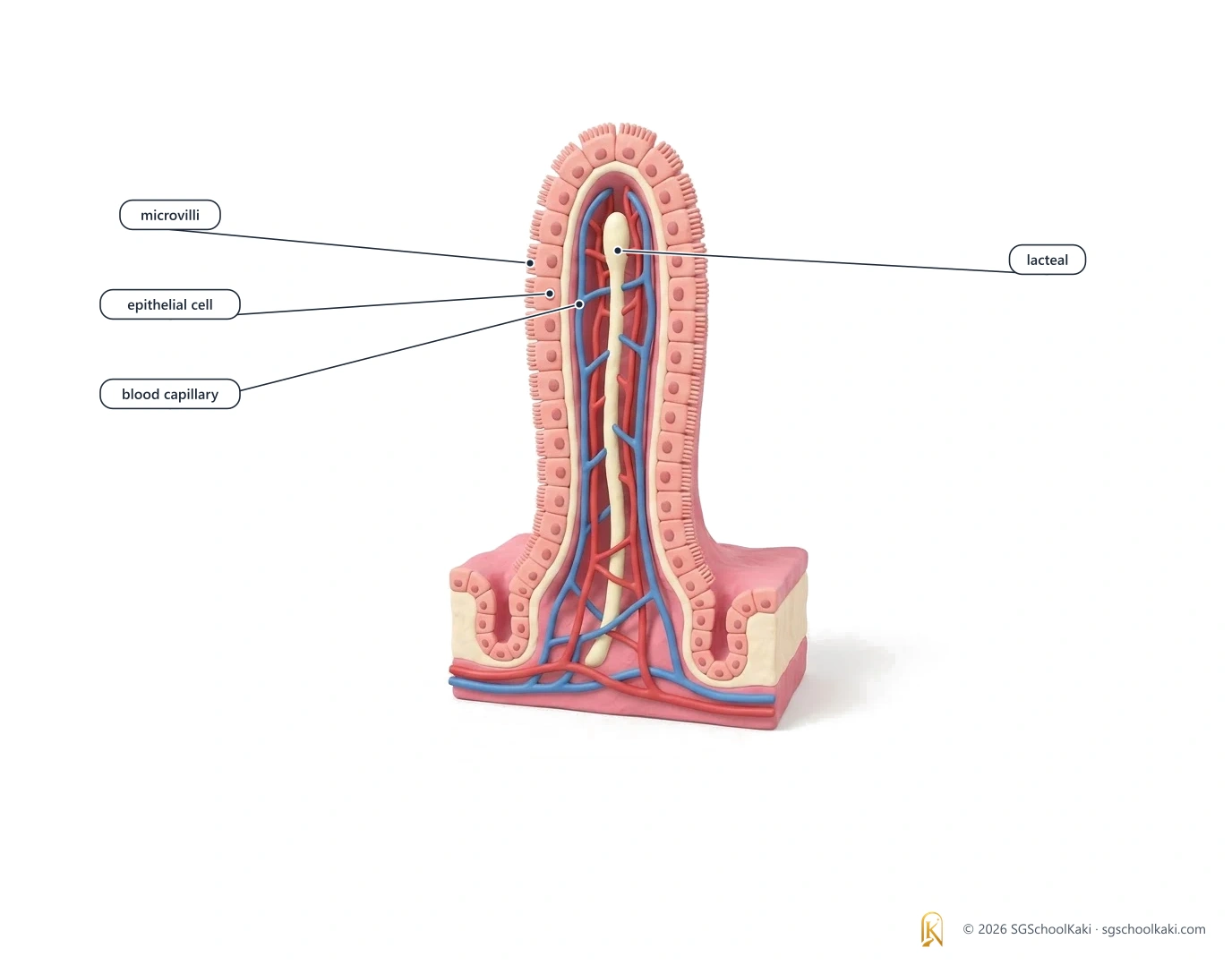
Digested food molecules such as glucose and amino acids can diffuse from the small intestine into the blood capillaries in the villi when their concentration in the intestine is higher than in the blood.
Exchange surfaces: extra exam points
If a question asks you to define diffusion for a named gas, keep the full definition and name the gas, for example: 'Diffusion of carbon dioxide is the net movement of carbon dioxide molecules from a region of higher concentration to a region of lower concentration, down a concentration gradient, as a result of their random movement.' supports K325-2(a)
Villus: food molecules
Glucose and amino acids diffuse from the small intestine into the cells lining a villus and then into the blood capillaries while their concentration in the intestine is higher. When the concentration in the intestine becomes lower than in the villus cells, they are absorbed by active transport, which uses energy from respiration. supports K325-2(a)/(c)
Alveolus: moisture film
At an alveolus, oxygen first dissolves in the thin film of moisture lining the alveolar air space and then diffuses into the blood, while carbon dioxide diffuses from the blood into the alveolar air space. supports K325-2(a)
Leaf: stomata
In the light, when the rate of photosynthesis is higher than the rate of respiration, carbon dioxide diffuses from the air through the stomata into the air spaces between the mesophyll cells, and oxygen diffuses out of these air spaces through the stomata into the air. In the dark, only respiration takes place, so oxygen diffuses in and carbon dioxide diffuses out. supports K325-2(a)
Depth: why and how
- Why does the concentration gradient at the alveoli stay steep? Blood flowing past the alveoli keeps carrying oxygen away, and breathing keeps replacing the oxygen in the alveolar air.
- Why are the alveolar walls a good design for diffusion? The walls are one cell thick, so the diffusion distance is short, and there are many alveoli, so the surface area is large.
- Why does the leaf keep a steep gradient for carbon dioxide in the light? Photosynthesis in the mesophyll cells keeps using carbon dioxide, so the concentration inside stays lower than outside.
- Cross-link to Nutrition in humans: the villi have a rich blood supply, which carries absorbed food molecules away and keeps the concentration gradient steep.
- Cross-link to Transport in flowering plants: root hair cells have a large surface area, and air spaces in the spongy mesophyll let gases diffuse through the leaf.
Common mistakes
Diffusion is when particles move from high concentration to low concentration.
Diffusion is the net movement of particles from a region of higher concentration to a region of lower concentration, down a concentration gradient, as a result of their random movement.
The particles want to spread out evenly, so they move.
The particles move because of their random movement, and the net movement is down the concentration gradient.
Oxygen diffuses into the blood because the body needs it.
Oxygen diffuses into the blood because its concentration is higher in the alveolar air than in the blood.
Diffusion stops when the concentrations become equal.
When concentrations are equal, particles still move randomly but there is no net movement.
HIGH to LOW, let it spread: random moves make the NET go. Fast diffusion = STAT: Steep gradient, Temperature high, Area large, Thin (short diffusion distance).
STAT is my own hook for the four main factors: Steep gradient, Temperature high, Area large, Thin (short diffusion distance). A higher surface area to volume ratio and smaller molecules also speed up diffusion.Diffusion is a passive process, so it needs no energy from respiration, and the net movement is always down the concentration gradient.
Exam check
Q1 Which statement defines diffusion?
- A The net movement of particles from a region of higher concentration to a region of lower concentration, down a concentration gradient, as a result of their random movement
- B The net movement of water molecules from a region of higher water potential to a region of lower water potential through a partially permeable membrane
- C The movement of particles against a concentration gradient using energy from respiration
- D The movement of particles from a lower to a higher concentration through a carrier protein
Show answer
MCQ answer key A (The net movement of particles from a region of higher concentration to a region of lower concentration, down a concentration gradient, as a result of their random movement): this is the definition of diffusion; B defines osmosis and C and D describe active transport.
Q2 A drop of dye spreads faster in warm water than in cold water of the same volume. What is the best explanation?
- A The dye particles have more kinetic energy and move faster in warm water
- B The dye particles become smaller in warm water
- C Warm water contains less dye
- D Diffusion only happens in warm water
Show answer
MCQ answer key A (The dye particles have more kinetic energy and move faster in warm water): a higher temperature gives particles more kinetic energy so they move faster and diffusion is faster.
Q3 Which change would increase the rate of diffusion of oxygen from the alveolar air into the blood?
- A A thicker alveolar wall
- B A lower concentration of oxygen in the alveolar air
- C Faster blood flow that carries oxygen away from the alveoli
- D Fewer alveoli
Show answer
MCQ answer key C (Faster blood flow that carries oxygen away from the alveoli): faster blood flow removes oxygen and keeps the concentration gradient steep, whereas A, B and D would slow diffusion.
Structured Carbon dioxide diffuses into a leaf during the day.
- Name the openings in the leaf surface through which carbon dioxide enters. [1]
- Explain why there is a net movement of carbon dioxide into the leaf in bright light. [2]
- State one feature of the leaf that helps gases to diffuse quickly, and explain how it helps. [1]
Total: 4 marks
Show mark scheme
(a) 1 mark
- Mark scheme: stomata (stoma)
(b) 2 marks
- Mark scheme: photosynthesis uses carbon dioxide, so the concentration of carbon dioxide inside the leaf is lower than in the air outside
- Mark scheme: carbon dioxide diffuses down the concentration gradient from the air into the leaf
(c) 1 mark
- Mark scheme: air spaces in the spongy mesophyll allow gases to diffuse quickly through the leaf, OR a thin leaf gives a short diffusion distance, OR a large surface area of mesophyll cells lets more gas diffuse at the same time
You've read the free 28%. Unlock the rest of Topic 2.
Still to read in this topic:
- Osmosis
- Active transport
$9 one-time · all 14 topics · no subscription
Less than a fast-food meal.
Yours for the whole O-Level.
Premium members get all 14 topics included.
Notes version 1.0 · Last updated 30 Sept 2026 · Topic 2 of 14