





NUS & SMU Law:
A-Level Cutoff & IGP 2026
Singapore's two primary undergraduate law schools compared — AAA/A cutoff, 423 total places, $7,000/month graduate salary & everything you need to know.

Why Law Is Singapore's Most Prestigious Course
A law degree in Singapore isn't just a qualification — it's an elite ticket to the pinnacle of professional achievement. With only two primary undergraduate law schools (NUS and SMU) for corporate and commercial law, a combined intake of just 423 places, and a cutoff that demands nothing less than AAA/A, getting into law is arguably harder than getting into medicine. (SUSS also offers a law programme focused on family and criminal law, but NUS and SMU remain the main pathways for aspiring corporate lawyers.)
Ultra-Competitive Entry
- AAA/A at both 10th and 90th percentile — no grade range at all
- NUS poly GPA 3.86 — highest of ANY course in Singapore
- Only 423 total places for the whole country
- Additional aptitude tests and interviews required
Career Gateway
- Singapore Legal Service & judiciary pathway
- Big Four law firms: Allen & Gledhill, Rajah & Tann, WongPartnership, Drew & Napier
- Banking, government, consulting & compliance roles
- Singapore as Asia's international arbitration hub
Did you know? Unlike most countries that have dozens of law schools, Singapore has only 3 accredited undergraduate law programmes — NUS, SMU, and SUSS (which focuses on family and criminal law). NUS and SMU are the two primary pathways for corporate and commercial law, with just 423 combined seats. The AAA/A cutoff at both percentiles tells you something remarkable: virtually every single admitted student scored straight A's.
NUS vs SMU Law: Complete IGP Comparison (AY2025/2026)
Both law schools demand the highest grades in Singapore. Here's a detailed side-by-side comparison of the latest IGP data from the AY2025/2026 admission exercise.
| Criteria | NUS Law | SMU Law | SMU Computing & Law |
|---|---|---|---|
| Faculty | Faculty of Law | Yong Pung How School of Law | School of Computing & Law |
| A-Level 10th Percentile | AAA/A | AAA/A | ABB/A |
| A-Level 90th Percentile | AAA/A | AAA/A | AAA/A |
| Poly GPA 10th Percentile | 3.86 | 3.75 | Eligible (data not published) |
| Poly GPA 90th Percentile | 3.99 | 3.97 | Eligible (data not published) |
| Intake Places | 246 | 177 | 18 |
| Duration | 4 Years (Honours) | 4 Years | 4 Years |
| Aptitude Test | LNAT Required | Interview + Written Test | Interview + Written Test |
| Teaching Style | Lectures + Tutorials | Interactive Seminars | Interactive Seminars |
Source: AY2025/2026 Indicative Grade Profiles from NUS and SMU. Data reflects grades of students admitted in the most recent intake.
NUS Faculty of Law
Established 1956 — Asia's Global Law School
- Traditional research-oriented curriculum with strong academic rigour
- Renowned mooting culture — Jessup, Vis, Willem C. Vis international competitions
- Extensive exchange programmes with top global law schools (Harvard, Oxford, Columbia)
- Larger cohort of 246 — more diverse peer group
- Kent Ridge campus with dedicated Bukit Timah Law School building
- Centre for International Law, Asian Law Institute research centres
SMU Yong Pung How School of Law
Established 2007 — City Campus, Industry-Connected
- Interactive seminar-style teaching (max 45 students per class)
- Mandatory internships — practical legal exposure from Year 2
- Prime city campus in Bras Basah — next to Supreme Court & law firms
- Smaller cohort of 177 — tighter community, more professor access
- Cross-disciplinary opportunities with SMU Business & Computing
- Strong alumni network in corporate & commercial law
SMU Computing & Law — The New Frontier
Only 18 places — Tech meets legal in one degree
SMU's Bachelor of Science (Computing & Law) is a cutting-edge cross-disciplinary programme designed for students interested in the intersection of technology and law. With only 18 intake places, it's one of the most exclusive programmes in Singapore.
Note: SMU Computing & Law has a lower 10th percentile (ABB/A) but the same 90th percentile (AAA/A), reflecting a wide grade range among admitted students. Polytechnic graduates are eligible to apply, but GPA data is not published due to the small cohort size (18 places).
Historical IGP Trends: Law Has Always Been at the Top
Unlike many university programmes where cutoffs fluctuate from year to year, law has been remarkably consistent. The A-Level IGP for both NUS and SMU Law has remained at AAA/A for at least the past 5 years — at both the 10th and 90th percentile. This means there is effectively no grade range: virtually every admitted student scored straight A's.
| Academic Year | NUS Law (A-Level) | SMU Law (A-Level) | NUS Poly GPA | SMU Poly GPA |
|---|---|---|---|---|
| AY2025/2026 | AAA/A | AAA/A | 3.86 – 3.99 | 3.75 – 3.97 |
| AY2024/2025 | AAA/A | AAA/A | 3.85 – 3.98 | 3.74 – 3.96 |
| AY2023/2024 | AAA/A | AAA/A | 3.84 – 3.98 | 3.72 – 3.95 |
| AY2022/2023 | AAA/A | AAA/A | 3.83 – 3.97 | 3.70 – 3.94 |
Key Takeaway: Poly GPA Is Rising
While A-Level cutoffs have remained static at AAA/A, the poly GPA requirements have been gradually increasingyear on year. NUS Law's 10th percentile poly GPA has risen from 3.83 to 3.86 in just 3 years — making it the highest poly GPA cutoff of any university course in Singapore. This reflects growing competition from polytechnic applicants who are increasingly well-prepared for law school admission.
Beyond Grades: What Law Schools Actually Look For
Getting AAA/A is just the first filter. Both NUS and SMU use holistic assessment beyond grades. Here's what separates successful applicants from the rest.
LNAT (Law National Aptitude Test) — Required for NUS
The LNAT is a standardised aptitude test used by NUS Law to assess critical thinking and verbal reasoning skills. It consists of two sections:
Section A: Multiple Choice (42 questions, 95 min)
Reading comprehension passages testing logical reasoning, inference, and analysis of complex arguments. No legal knowledge required.
Section B: Essay (1 essay, 40 min)
Choose from 3 topics and write a persuasive essay. Tests ability to construct and sustain an argument on general topics.
Note: SMU Law does NOT require the LNAT. SMU uses its own interview and written assessment process.
Academic Indicators
- General Paper (GP) performance is critical — top GP grades expected
- H1 Mother Tongue — distinction grade adds to your profile
- Strong performance in essay-based H2 subjects (History, Literature, Economics)
- Project Work — Pass is mandatory, oral presentation skills matter
Co-Curricular & Personal
- Debate & MUN — top CCAs for law school applicants
- Public speaking competitions (Oratorical, Parliamentary Debate)
- Law firm attachments or community legal clinic volunteering
- Current affairs awareness — read The Straits Times, CNA regularly
Interview & Written Assessment Tips
Know Singapore Law
Be aware of recent legal developments in Singapore — FICA, POFMA, Section 377A repeal, death penalty debates.
Articulate Your Why
Go beyond "I want to help people." Share specific legal issues that interest you and why.
Think Critically
Law schools want students who can see multiple perspectives. Practice arguing both sides of an issue.
Graduate Employment & Salary Data (2024 GES)
Law consistently tops the graduate salary charts in Singapore. Based on the 2024 Graduate Employment Survey (GES), here's what fresh law graduates can expect.
NUS Law Graduate Salary
Source: NUS Graduate Employment Survey 2024. NUS Law ranked #1 across all degree programmes by mean starting salary.
SMU Law Graduate Salary
Source: SMU Graduate Employment Survey 2024. Data obtained from follow-up survey after completion of practice training.
Why Same Median But Different Mean?
Both NUS and SMU Law show the same $7,000 median salary, but NUS has a higher mean ($6,999 vs $6,585). This suggests NUS has a few more graduates going into higher-paying Big Law positions that pull the average up, while both schools' "typical" graduate earns around the same. The key takeaway: both law schools produce equally employable graduates with excellent starting salaries.
Career Paths & Salary Progression
| Career Stage | Estimated Monthly Salary | Notes |
|---|---|---|
| Practice Training (6 months) | $2,000 – $2,500 | Trainee allowance at Big Four firms |
| Junior Associate (Year 1–3) | $5,500 – $8,000 | Big Four starts higher; mid-size firms $5,000+ |
| Senior Associate (Year 4–7) | $10,000 – $18,000 | Significant jump with specialisation |
| Partner / Director | $25,000 – $100,000+ | Equity partners at top firms; variable with billings |
| In-House Counsel (Corporate) | $8,000 – $25,000 | Banks, MNCs; better work-life balance |
| Government Legal Service | $6,000 – $15,000 | AGC, Ministry of Law; civil service benefits |
| Judicial Service | $10,000 – $30,000+ | District Judge to High Court Judge |
Salary estimates based on Glassdoor Singapore, SGLegalJobs, and industry sources (2024). Actual salaries vary by firm, specialisation, and individual performance.
Singapore's Big Four Law Firms
The "Big Four" Singapore law firms are the most prestigious and highest-paying domestic firms. They recruit heavily from both NUS and SMU:
International Magic Circle firms (Clifford Chance, Allen & Overy, Linklaters) also have Singapore offices and recruit NUS/SMU graduates for international arbitration, M&A, and capital markets work.
Why Law Remains a Top Choice in 2026
Despite the demanding curriculum and gruelling training contracts, law continues to attract Singapore's brightest students. Here's why.
Intellectual Challenge
Law is one of the most intellectually stimulating fields. You'll dissect complex cases, construct persuasive arguments, and grapple with the most pressing ethical questions of our time.
Singapore as Asia's Legal Hub
Singapore is the #1 international arbitration seat in Asia and #3 globally (QMUL Survey 2024). The Singapore International Arbitration Centre (SIAC) handles billions in disputes.
Versatile Degree
A law degree opens doors far beyond legal practice. NUS Law graduates work in banking, consulting, government policy, compliance, fintech — the analytical skills transfer everywhere.
High Earning Potential
Starting at $7,000/month as a fresh graduate, with potential to earn $25,000–$100,000+/month as a partner. Law offers one of the steepest salary growth curves of any profession.
Policy Influence
Many of Singapore's political leaders and senior civil servants hold law degrees. The legal profession is a traditional pathway to public service and national policy-making.
Prestige & Respect
In Singapore's meritocratic society, the legal profession commands deep respect. Lawyers are addressed as "Counsel" in court and hold a unique standing in the community.
Alternative Pathways to Becoming a Lawyer
Didn't make the cutoff for NUS or SMU Law? The legal profession in Singapore has other recognised pathways. Here's what you need to know.
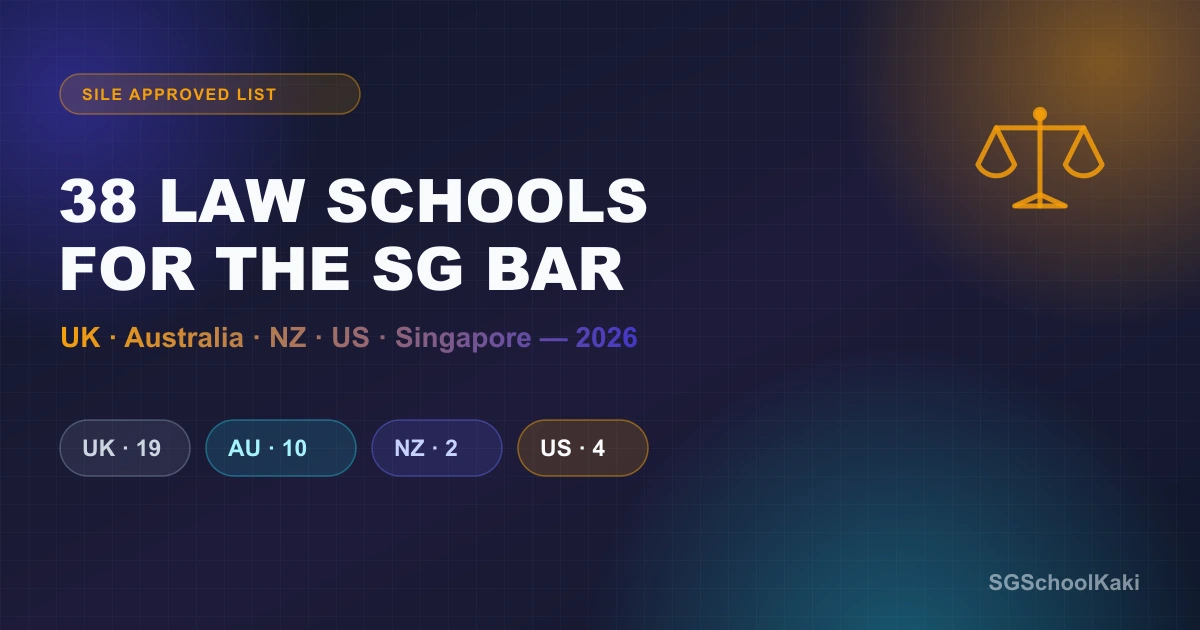
Overseas Law Schools Recognised by SILE
The Singapore Institute of Legal Education (SILE) recognises law degrees from select universities for admission to the Singapore Bar. These "scheduled universities" include:
Graduates from scheduled universities must pass the Part B Singapore Bar Examinations and complete practice training to be called to the Singapore Bar. Check the SILE website for the latest approved list.
Part B Singapore Bar Examinations
Whether you graduate from NUS, SMU, or an approved overseas law school, you must pass the Part B Bar Examinations conducted by SILE to practise law in Singapore. Key requirements:
- Complete a qualifying law degree (NUS, SMU, or SILE-approved overseas university)
- Pass 5 compulsory subjects in Part B covering Singapore law
- Complete 6 months of practice training (pupillage) at a Singapore law firm
- Be "called to the Bar" and admitted as an Advocate & Solicitor of Singapore
Related Degree Alternatives
Political Science & Public Policy
NUS Political Science or NTU Public Policy offer pathways to government and policy work. While you can't practise law, these degrees complement a later graduate law degree (JD).
Philosophy & Liberal Arts
NUS Philosophy or Yale-NUS (now NUS College) develop the critical thinking and argumentation skills valued in law. Some graduates pursue law as a second degree.
SMU Computing & Law
With only 18 places and a lower 10th percentile cutoff (ABB/A), this cross-disciplinary programme is ideal for students interested in technology law, data privacy, and legal tech.
Juris Doctor (JD) Graduate Path
Both NUS and SMU offer JD programmes for graduates of other disciplines. This 3-year postgraduate path lets you convert to law after completing a different undergraduate degree.
Scholarships for Law Students
Law school tuition can be significant, but numerous scholarships are available for outstanding students. NUS and SMU both offer merit-based scholarships, and government agencies like AGC, MinLaw, and the Legal Service Commission offer bonded scholarships that cover full tuition plus a living allowance.
Read our complete 2026 University Scholarships GuideCareer Paths for NUS Law Graduates
The NUS Faculty of Law lists the following career outcomes for its graduates. A law degree opens doors to an exceptionally wide range of professions.
Legal Counsel
Private practice & in-house
Professional Support
Knowledge management
Legal Service
AGC & Ministry of Law
Civil Service
Government ministries
Academia
Research & teaching
Banking / Corporate
Management trainee
Contract Management
Commercial negotiations
Compliance
Regulatory & risk
Source: NUS Faculty of Law, AY2025/2026 programme listing. Career outcomes include but are not limited to the roles listed above.
Frequently Asked Questions
What grades do I need for NUS Law?
For AY2025/2026, NUS Law requires AAA/A at both the 10th and 90th percentile for A-Level applicants. This means virtually every admitted student scored straight A's in their three H2 subjects and H1 GP. For polytechnic applicants, the GPA cutoff is 3.86 (10th percentile) to 3.99 (90th percentile) — the highest poly GPA requirement of any university course in Singapore. NUS requires the LNAT aptitude test (SMU uses its own written test instead) and an interview.
Is NUS or SMU Law harder to get into?
Both require the same A-Level grades (AAA/A), but they differ in other respects. NUS Law has a higher poly GPA cutoff (3.86 vs 3.75), more intake places (246 vs 177), and requires the LNAT aptitude test. SMU Law uses its own internal written test and interview instead. In terms of raw A-Level entry, they are equally competitive. Choose based on teaching style (NUS: traditional lectures vs SMU: interactive seminars) and career goals rather than perceived difficulty.
Do I need LNAT for SMU Law?
No.The LNAT (Law National Aptitude Test) is required only for NUS Law. SMU Law has its own selection process which includes interviews and written assessments. However, strong General Paper performance and current affairs awareness are important for both schools' selection processes.
What is the starting salary for lawyers in Singapore?
According to the 2024 Graduate Employment Survey, NUS Law graduates earn a mean starting salary of $6,999/month and a median of $7,000/month. SMU Law graduates earn a mean of $6,585/month and the same median of $7,000/month. Note that these figures are for graduates who have completed their practice training period. During practice training (pupillage), trainees at Big Four firms earn approximately $2,000–$2,500/month.
Can poly students apply for Law?
Yes, polytechnic graduates can apply for both NUS and SMU Law. However, the GPA requirements are exceptionally high: NUS Law requires 3.86–3.99 GPA (the highest of any course in Singapore), while SMU Law requires 3.75–3.97. Poly applicants will also need to pass the same aptitude tests and interviews as JC applicants. SMU Computing & Law also accepts poly graduates, but GPA data is not published due to small cohort size.
Useful Tools & Related Guides
A-Level Rank Point Calculator
Calculate your UAS score under the new 70-point system
University IGP Database
Search all NUS, NTU, SMU cutoffs for AY2025/2026
2026 Scholarships Guide
Complete guide to university scholarships in Singapore
University Admission Guide 2026
Complete guide to applying after A-Level results
Low Rank Points? Your Options
37+ courses you can still qualify for
A-Level Results 2026 Hub
All guides, calculator & resources in one place
Official Law School & Admissions Resources
SGSchoolKaki Education Team
Ex-MOE Teachers, Private Tutors & Education Data Analysts with 15+ Years Combined Experience
Reviewed by: KW Phoon
Founder, BEng(Hons) in Computing Engineering
Data-Driven Education Platform