

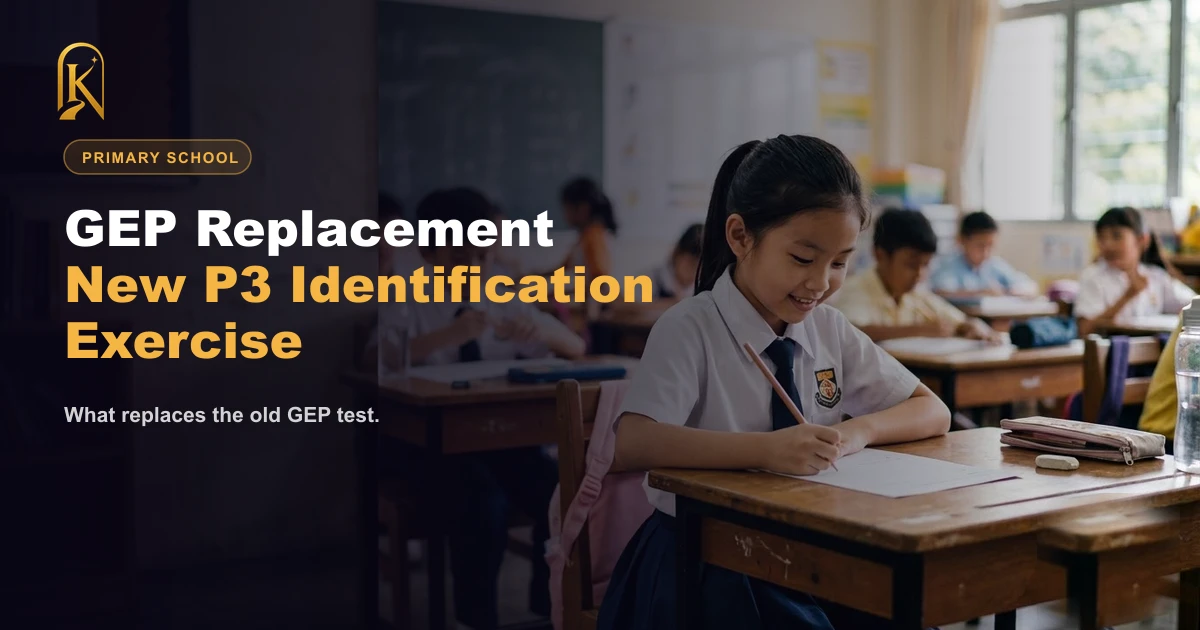


After 40 years, Singapore's Gifted Education Programme (GEP) is officially coming to an end. On 3 March 2026, MOE announced that the GEP will be replaced by a new Advanced Modules system starting in 2027, with 15 primary schools serving as designated centres across the island.
This is the biggest structural change to gifted education in Singapore since the GEP was introduced in 1984. Instead of pulling top students out of their home schools and placing them in 9 designated GEP schools, the new system lets children stay at their home school and attend Advanced Module sessions at nearby centres.
What This Means for Your Child
- Children identified as high-ability stay at their home school — no more transferring at P4
- They attend Advanced Modules at 1 of 15 centres during school hours
- The cohort expands from the top 1% to around 2%+ of each cohort
- A single identification test at P3 replaces the old 2-stage GEP screening
- Multiple entry points — students can join in later years, not just P3
- Interdisciplinary holiday programmes supplement the subject-based modules
Old GEP vs New Advanced Modules: Side-by-Side
Old GEP (1984-2027)
- ✗2-stage screening — Selection Test + Selection Exercise
- ✗Top 1% of cohort (~500 students/year)
- ✗Transfer to GEP school at P4 — leave friends behind
- ✗Single entry point — P3 only, no second chances
- ✗9 GEP schools — clustered in central/south Singapore
- ✗Full replacement curriculum — separate from normal classes
New Advanced Modules (2027+)
- 1-stage test — streamlined identification at P3
- Top 2%+ of cohort — more students benefit
- Stay at home school — attend modules at nearby centre
- Multiple entry points — can join in later years
- 15 centres — spread across all regions of Singapore
- Subject modules + holiday programmes — supplementary enrichment
The 9 Original GEP Schools (Being Phased Out)
Since 1984, these 9 schools have hosted the Gifted Education Programme. Students identified through the GEP screening test were transferred to one of these schools at P4, leaving their original school behind.
A key issue MOE wanted to address: geographic clustering. These 9 schools are heavily concentrated in central and southern Singapore — Barker Road, Bukit Timah, Holland, Bishan, Marine Parade. Families in the north, northeast, and west had far fewer options, leading to long commutes for young children.
Anglo-Chinese School (Primary)
Barker Road
Catholic High School (Primary Section)
Bishan
Henry Park Primary School
Holland
Nan Hua Primary School
Clementi
Nanyang Primary School
King's Road
Raffles Girls' Primary School
Hillcrest
Rosyth School
Serangoon North
St. Hilda's Primary School
Tampines
Tao Nan School
Marine Parade
These schools remain excellent
The end of GEP hosting does not diminish these schools. They retain their strong alumni networks, established traditions, and affiliation benefits. They simply will no longer serve as the exclusive centres for gifted education.
The 15 New Advanced Module Centres
The new centres are deliberately spread across the island. Compare the map below — the old GEP schools (red) cluster in central/south Singapore, while the new centres (green) reach into Yishun, Woodlands, Punggol, Jurong West, Tengah, and Bedok. This geographic equity is one of the key motivations behind the change.
Advanced Module Centres Map
Click on any marker to see school details and profile link
Distance Calculator: How Far Are the 15 Centres from You?
Enter your postal code to see straight-line distances to all 15 Advanced Module centres.
Ahmad Ibrahim Primary School
Yishun
Clementi Primary School
Clementi
Geylang Methodist School (Primary)
Geylang
Innova Primary School
Woodlands
Jurong West Primary School
Jurong West
Kheng Cheng School
Toa Payoh
Palm View Primary School
Sengkang
Pioneer Primary School
Tengah
Punggol View Primary School
Punggol
Queenstown Primary School
Queenstown
St. Gabriel's Primary School
Lorong Chuan
Tampines Primary School
Tampines
Teck Ghee Primary School
Ang Mo Kio
Yew Tee Primary School
Choa Chu Kang
Yu Neng Primary School
Bedok
P1 Registration Demand for the 15 Centres
Here's how the 15 new centres performed during the 2025 P1 Registration Exercise. Schools with higher demand may become even more competitive once parents associate them with the Advanced Modules programme.
| School | Area | Total Vac | 2C Vac | 2C Apps | Balloting? | Demand |
|---|---|---|---|---|---|---|
| Ahmad Ibrahim Primary School | Yishun | 270 | 40 | 18 | No | Low |
| Clementi Primary School | Clementi | 240 | 40 | 22 | No | Low |
| Geylang Methodist School (Primary) | Geylang | 270 | 40 | 42 | 2C (2024) | Moderate |
| Innova Primary School | Woodlands | 300 | 60 | 30 | No | Low |
| Jurong West Primary School | Jurong West | 270 | 40 | 52 | 2C | High |
| Kheng Cheng School | Toa Payoh | 210 | 40 | 48 | 2C | High |
| Palm View Primary School | Sengkang | 300 | 60 | 25 | No | Low |
| Pioneer Primary School | Tengah | 300 | 60 | 20 | No | Low |
| Punggol View Primary School | Punggol | 300 | 40 | 44 | 2C Supp | Moderate |
| Queenstown Primary School | Queenstown | 210 | 30 | 38 | 2C | High |
| St. Gabriel's Primary School | Lorong Chuan | 270 | 40 | 35 | No | Moderate |
| Tampines Primary School | Tampines | 300 | 40 | 50 | 2C Supp | High |
| Teck Ghee Primary School | Ang Mo Kio | 300 | 60 | 28 | No | Low |
| Yew Tee Primary School | Choa Chu Kang | 300 | 60 | 22 | No | Low |
| Yu Neng Primary School | Bedok | 240 | 30 | 40 | 2C | High |
Demand may shift in 2027
These figures reflect 2025 P1 registration. Once these schools are officially designated as Advanced Module centres, some parents may specifically target them during P1 registration — especially under Phases 2B and 2C. However, MOE has indicated that centres can be rotated, which may discourage property speculation.
Transition Timeline
March 2026
•Committee of Supply
MOE Announces GEP Discontinuation
Education Minister announces that the GEP will end and be replaced by Advanced Modules at 15 designated centres across Singapore.
August 2026
•Primary 3 Cohort
First P3 Identification Test (New Format)
The first single-stage identification test replaces the old 2-stage GEP screening. Results determine who qualifies for Advanced Modules.
2027
•Primary 4 Onwards
Advanced Modules Begin
Identified students start attending Advanced Module sessions at their nearest centre while remaining enrolled at their home school.
2028
•Final Year
Last GEP Cohort Completes P6
The final batch of students in the old GEP format complete their primary education. The GEP officially ceases to exist.
Ongoing
•Every Semester
Flexible Entry Points
Unlike the old GEP which only had one entry point at P3, the new system allows students to be identified and join Advanced Modules at multiple points throughout primary school.
How the New System Works
Identification
A single test at P3 (replacing the 2-stage GEP screening) identifies students in the top 2%+ of the national cohort. The test is designed to be harder to game through intensive preparation.
Subject-Based Modules
Identified students attend Advanced Module sessions in subjects like Mathematics, Science, and English at their designated centre, typically during school hours. These supplement — not replace — the normal curriculum.
Specialist Teachers
Each centre has specially trained teachers with expertise in gifted education pedagogy. These teachers will rotate across the 15 centres to ensure consistent quality.
Holiday Programmes
Beyond regular modules, students participate in interdisciplinary holiday programmes — covering areas like creative problem-solving, research skills, and cross-subject projects.
Multiple Entry Points
Unlike the old GEP (one shot at P3), students can be identified and join Advanced Modules at various points throughout primary school. Late bloomers are not locked out.
Public Sentiment & Reactions
The announcement triggered intense discussion across Reddit, parent forums, and news comment sections. Here are the dominant themes:
Disclaimer: The views and quotes below are curated from public online discussions and do not represent the views of SGSchoolKaki. We present multiple voices on this matter to help parents understand the range of perspectives surrounding this policy change.
"GEP Reskin" Skepticism
The most common reaction: many feel this is "change soup never change medicine" — the same programme under a different name. Some point out that the travel burden now falls on the child, commuting to centres up to 3-4 times per day instead of attending one school.
"So GEP but now punish you for being gifted by making you travel outside of school."
— Parent on Reddit r/singapore
Levels the Playing Field
Strong support from those who see this as removing the incentive to game GEP entry for "branded school" access. Children stay at their home school, maintaining friendships. Access widens from 1% to 2%+ of each cohort. Neighbourhood schools get a boost as gifted students no longer leave.
"This makes GEP more accessible to everyone. Kids don't have to uproot their social circles at P4 anymore."
— Educator perspective, online forum
Concern for Truly Gifted Kids
The old GEP replaced the normal curriculum with non-examinable enrichment — Greek mythology, Mayan numerals, and deep-dive projects. The new system adds to the normal curriculum, meaning gifted kids may still be bored in regular class. Many gifted children have ADHD or are neurodivergent — sitting through "normal" school then travelling for enrichment may not suit them.
"Gifted kids don't need more school. They need different school. There's a huge difference."
— GEP alumni, Reddit discussion
Property & Kiasu Parent Impact
Will the 15 new centres become the next "hot" schools? Some think so, but others note that PSLE results "belong" to the home school, not the centre — reducing prestige transfer. MOE also said centres can be rotated, which should discourage property speculation. The original branded schools (ACS, RGPS, Nan Hua) keep their appeal through affiliations, alumni networks, and facilities.
"Smart move by MOE to say centres can rotate. That should cool down the property agents."
— Parent on Reddit r/singapore
GEP Tuition Industry Criticism
The GEP screening test spawned a cottage industry of specialist tuition centres charging thousands of dollars to prepare P2-P3 students. The single-stage test aims to reduce gaming, though skeptics note that "all standardised tests can be gamed." Still, a less predictable format may weaken the prep industry.
"The GEP tuition industry will pivot to 'Advanced Module prep' within months. Guaranteed."
— Parent on Reddit r/singapore
Residential Clustering Angle
Some commentators argue that the GEP had become dominated by families who specifically moved near the 9 GEP schools, creating residential clusters around these "branded" institutions. The geographic spread of the new 15 centres is seen as a way to break up these education-driven residential patterns and promote more even distribution of high-ability students across the island.
What Parents Should Do Now
Don't panic about P1 registration — the new centres are spread across the island, so geographic proximity matters less than before.
Focus on your child's overall development rather than GEP prep. The new single-stage test is designed to be harder to game.
Check if your preferred school is one of the 15 centres — use our school profiles to compare.
Explore nowUse our P1 Registration tool to check distance eligibility for any primary school.
Explore nowRemember that the centres can be rotated — don't make property decisions based on this alone.
Late bloomers get a second chance — the multiple entry points mean your child isn't locked out if they miss P3.
Find Centres Near You
See all 15 Advanced Module centres sorted by distance from your planning area. Each page shows the nearest centres, travel info, and what the changes mean for parents in your neighbourhood.
Frequently Asked Questions
When exactly does the GEP end?+
The last GEP cohort will complete P6 in 2028. From 2027 onwards, newly identified students enter the Advanced Modules system instead.
Will my child still be tested at P3?+
Yes, but with a single-stage test (replacing the old 2-stage screening). The first test under the new format takes place in August 2026.
Does my child need to transfer schools?+
No. This is the biggest change — children stay enrolled at their home school and travel to a nearby Advanced Module centre for enrichment sessions.
What if my child misses the P3 test?+
The new system offers multiple entry points. Students can be identified and join Advanced Modules at later stages, unlike the old GEP which only had one chance at P3.
Will the 15 centres change over time?+
MOE has indicated that centres can be rotated, meaning the list of 15 schools may change in future years. This is designed to prevent property speculation.
Are Advanced Modules the same as the old GEP curriculum?+
Not exactly. The old GEP replaced the entire curriculum. Advanced Modules supplement the normal curriculum with subject-specific enrichment and holiday programmes. Students still follow the standard syllabus at their home school.