

20 Questions Answered
Advanced Modules FAQ.
Everything parents need to know about the Advanced Modules programme replacing GEP from 2027. Eligibility, selection process, logistics, centre locations, and impact.
What & Why
What are Advanced Modules?
Advanced Modules are MOE's replacement for the Gifted Education Programme (GEP), starting from 2027. They are after-school stretch programmes in Mathematics, Science, and English Language held at 15 designated primary school centres across Singapore. Students remain enrolled at their home school and attend sessions at the nearest centre.
Why was the GEP discontinued?
MOE announced in March 2026 that GEP would be replaced to address geographic inequity. The old GEP had only 9 schools, mostly in central/southern Singapore, requiring students to transfer full-time. The new Advanced Modules system has 15 centres spread island-wide, so students stay at their home school and enrichment comes to them.
What subjects do Advanced Modules cover?
The programme covers three subjects: Mathematics, Science, and English Language. These are the same core subjects that the GEP covered, delivered through enriched and accelerated curricula designed for high-ability learners.
When do Advanced Modules start?
Advanced Modules begin in 2027. The first cohort will be Primary 3 students identified through the selection process. The current GEP will continue for existing students until they complete the programme.
Eligibility & Selection
How are students selected for Advanced Modules?
Students are identified through a selection process at Primary 3, similar to the former GEP screening but with a wider intake. MOE will announce specific details of the selection criteria and process closer to 2027.
Is there still a GEP test?
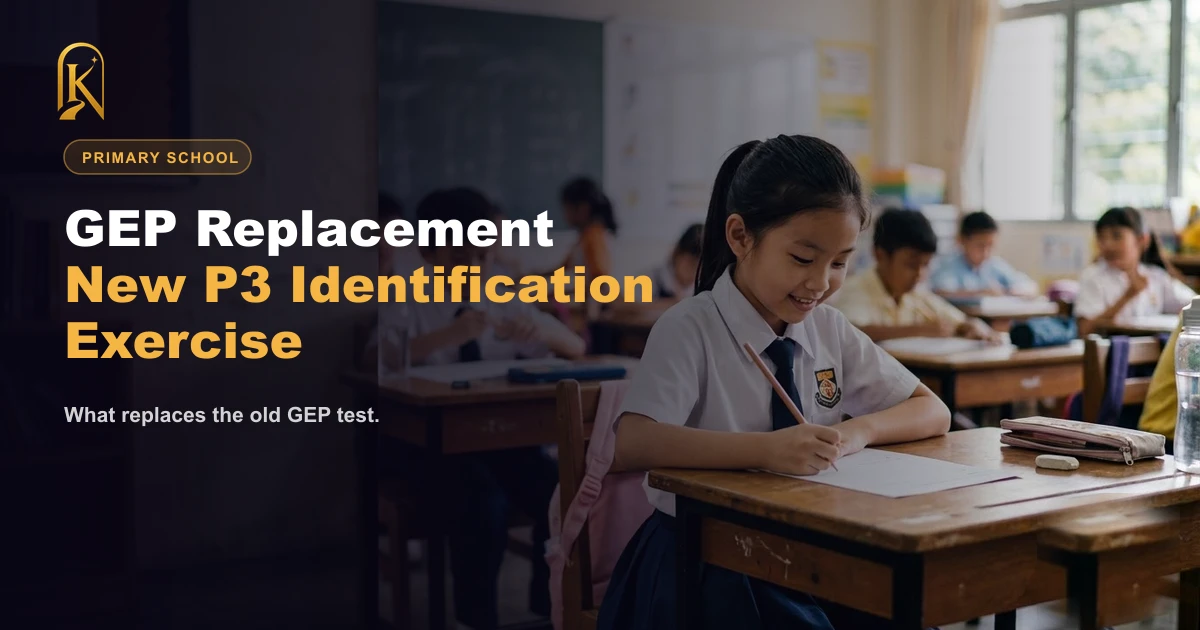
The traditional GEP Screening and Selection Tests will be replaced by a new identification process for Advanced Modules. While the exact format has not been announced, it is expected to be similar in nature but designed to identify a broader pool of students.
Can students from any primary school be selected?
Yes. Unlike GEP where students transferred to designated schools, Advanced Modules are open to students from any primary school. Selected students attend sessions at the nearest centre while staying enrolled at their home school.
How many students will be selected?
MOE has indicated that Advanced Modules will have a wider intake compared to GEP, which served approximately the top 1% of each cohort. Exact numbers have not been announced.
Logistics & Practicalities
Do students need to transfer to a centre school?
No. This is a key difference from GEP. Students remain enrolled at their home (neighbourhood) school for all regular lessons. They travel to the nearest Advanced Module centre only for enrichment sessions, which are held after school hours.
What time are Advanced Module lessons?
Sessions are held after regular school hours. The exact schedule will be set by MOE, but they are designed to complement, not replace, the regular school timetable.
How will students travel to the centres?
Transport arrangements are the responsibility of parents. MOE has spread centres across Singapore to minimize travel distances. Each planning area has a centre within reasonable distance.
Which school is nearest to me?
Use our area-specific pages to find the nearest centre. Browse by your planning area (e.g., "Advanced Modules near Sengkang") or by region to see all centres sorted by distance.
Are there centres in every planning area?
Not every planning area has a centre, but the 15 centres are spread across all 5 regions of Singapore (North, North-East, East, West, Central). Most areas have a centre within 5km.
Location & Centres
How many Advanced Module centres are there?
There are 15 designated Advanced Module centres across Singapore. This is an increase from 9 GEP schools, providing better geographic coverage.
Where are the 15 centres located?
Centres are located in: Yishun (Ahmad Ibrahim PS), Woodlands (Innova PS), Ang Mo Kio (Teck Ghee PS), Sengkang (Palm View PS), Punggol (Punggol View PS), Serangoon (St. Gabriel's PS), Tampines (Tampines PS), Bedok (Yu Neng PS), Jurong West (Jurong West PS), Clementi (Clementi PS), Queenstown (Queenstown PS), Tengah (Pioneer PS), Choa Chu Kang (Yew Tee PS), Toa Payoh (Kheng Cheng School), and Central (Geylang Methodist School).
Will more centres be added in the future?
MOE has not announced plans for additional centres beyond the initial 15. The selection of 15 schools was designed to provide island-wide coverage with centres in all 5 regions.
Impact & Comparisons
Will this affect P1 registration demand at centre schools?
It is possible that some parents may consider centre schools for convenience, but MOE has emphasized that students attend from their home school. The 15 centres are spread island-wide to reduce incentive to cluster near any single school.
Is Advanced Modules the same as GEP?
Not exactly. While both serve high-ability learners, key differences include: (1) Students stay at home school instead of transferring, (2) 15 centres vs 9 GEP schools for wider access, (3) After-school model vs full-time programme, (4) Wider selection intake expected.
What happens to current GEP students?
Students already in the GEP will complete the programme under the current format. The transition to Advanced Modules applies to new cohorts starting from 2027.
How does this compare to the old GEP geographically?
The old 9 GEP schools were concentrated in central/southern Singapore (Bukit Timah, Queenstown, Toa Payoh, Marine Parade). The new 15 centres reach Woodlands, Yishun, Punggol, Sengkang, Jurong West, and Tengah — areas that previously had no nearby GEP school.
Find your nearest centre.
Keep learning with SGSchoolKaki
Ask KlickAI, our AI tutor
Stuck on a concept? Get a step-by-step explanation aligned to the Singapore syllabus. Free to start.
Try KlickAI
Practise real exam-style questions
Past-paper style questions with worked solutions, so students learn from every answer. Free practice available.
Open the Question Bank
Written by
SGSchoolKaki Education Team
Our team of ex-MOE teachers, private tutors and education data analysts brings 16+ years of combined experience.