










The Particulate Nature of Matter
SEAB syllabus topic 2: how particles explain solids, liquids, gases and diffusion, and how protons, neutrons and electrons build atoms and ions, with the reasons, the common mistakes and an exam check for every outcome.

Solids, liquids and gases differ in how close their particles are and how fast they move, and a change of state absorbs or releases energy as attractions between particles are overcome or formed.
Diffusion is the spreading of particles from a higher to a lower concentration by their random motion, and it is faster for lighter molecules and at a higher temperature.
An atom has a nucleus of protons and neutrons with electrons in shells around it, and the numbers of these particles are found from the proton number, the nucleon number and the charge.
States of matter and changes of state
describe the solid, liquid and gaseous states of matter and explain their interconversion in terms of the kinetic particle theory and of the energy changes involved
Matter is made of tiny particles that are always moving, and whether a substance is a solid, a liquid or a gas depends on how close its particles are, how strongly they attract each other and how fast they move.
- Kinetic particle theory
- Kinetic particle theory: the idea that all matter is made of particles that are constantly moving, and that the energy of the particles decides the state of the substance
- Solid
- Solid: a state of matter in which particles are packed closely in a regular pattern and can only vibrate about fixed positions
- Liquid
- Liquid: a state of matter in which particles are packed closely but irregularly and can slide past one another
- Gas
- Gas: a state of matter in which particles are far apart and move quickly and randomly in all directions
- Interparticle attraction
- Interparticle attraction: the force that pulls neighbouring particles together and that must be overcome for a solid to melt or a liquid to boil supports K324-2.1(a)
- Melting point
- Melting point: the temperature at which a pure solid changes to a liquid supports K324-2.1(a)
- Boiling point
- Boiling point: the temperature at which a pure liquid boils and changes to a gas supports K324-2.1(a)
- Sublimation
- Sublimation: a change of state in which a solid turns directly into a gas without becoming a liquid supports K324-2.1(a)
Solids, liquids and gases compared
| Property | Solid | Liquid | Gas |
|---|---|---|---|
| Arrangement of particles | Particles in a solid are in a regular pattern. | Particles in a liquid are in an irregular arrangement. | Particles in a gas are arranged randomly. |
| Spacing of particles | Particles in a solid are close together. | Particles in a liquid are close together. | Particles in a gas are far apart. |
| Movement of particles | Particles in a solid vibrate about fixed positions. | Particles in a liquid slide past one another. | Particles in a gas move quickly and randomly in all directions. |
| Attractions between particles | The attractions in a solid are strong. | The attractions in a liquid are weaker than in a solid. | The attractions in a gas are very weak. |
| Shape | A solid has a fixed shape. | A liquid takes the shape of its container. | A gas fills its container completely. |
| Volume | A solid has a fixed volume. | A liquid has a fixed volume. | A gas has no fixed volume. |
| Compressibility | A solid is very hard to compress because its particles are already packed closely together. | A liquid is very hard to compress. | A gas can be compressed easily because of the large gaps between particles. |

Changes of state
| Change of state | Picture | From and to | Energy | What happens to the particles |
|---|---|---|---|---|
| Melting | 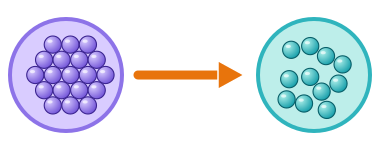 | solid to liquid | Energy is absorbed. | The particles vibrate more vigorously until some attractions are overcome and the particles can slide past each other. |
| Freezing | 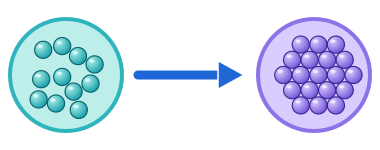 | liquid to solid | Energy is released. | The particles slow down and attractions pull them into fixed positions. |
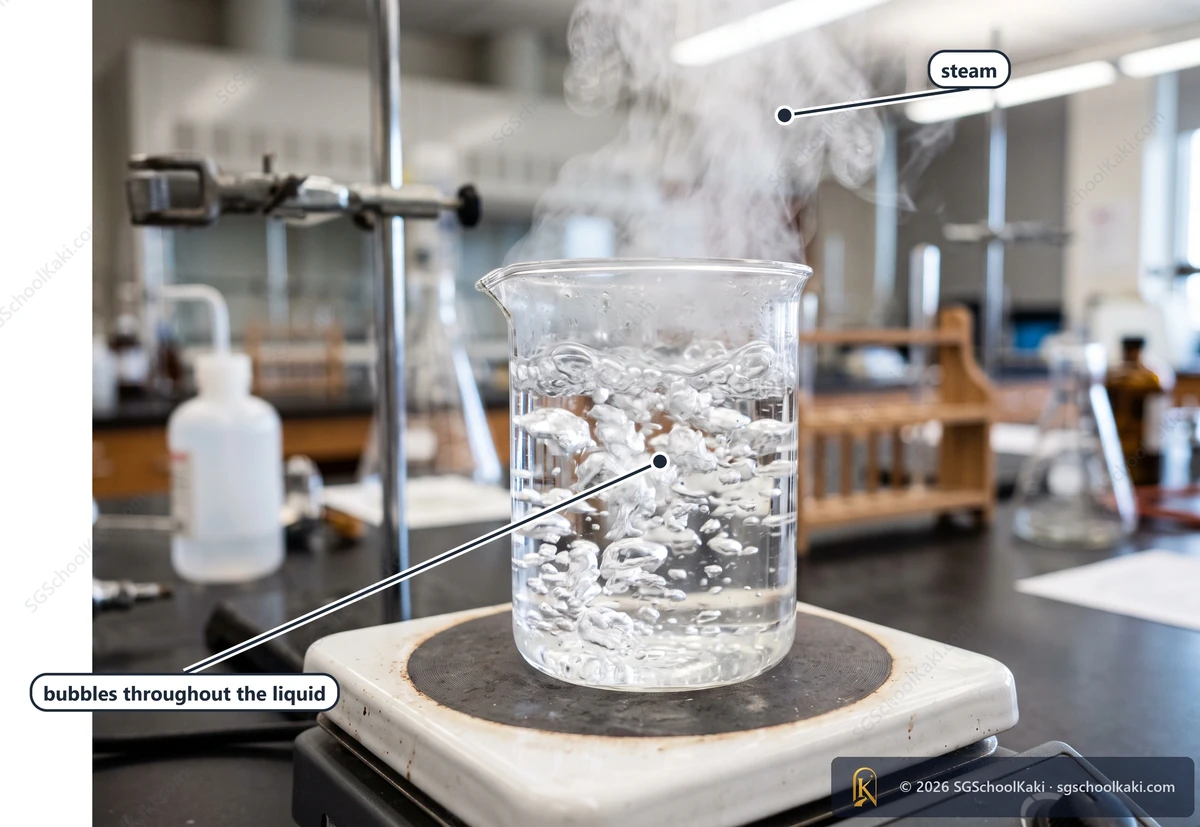
| Boiling | 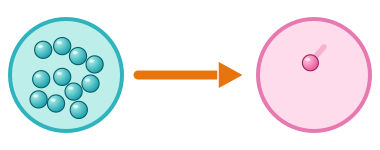 | liquid to gas throughout the liquid, at the boiling point | Energy is absorbed. | The attractions between the particles are overcome completely and the particles move apart. |
| Evaporation | 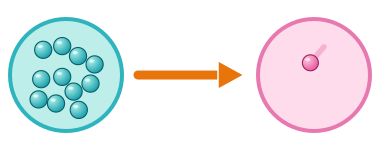 | liquid to gas at the surface, below the boiling point | Energy is absorbed. | The faster particles at the surface escape from the liquid. |
| Condensation | 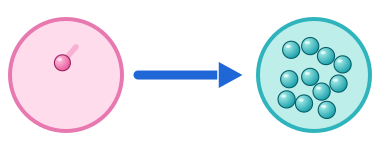 | gas to liquid | Energy is released. | The particles slow down and attractions pull them close together. |
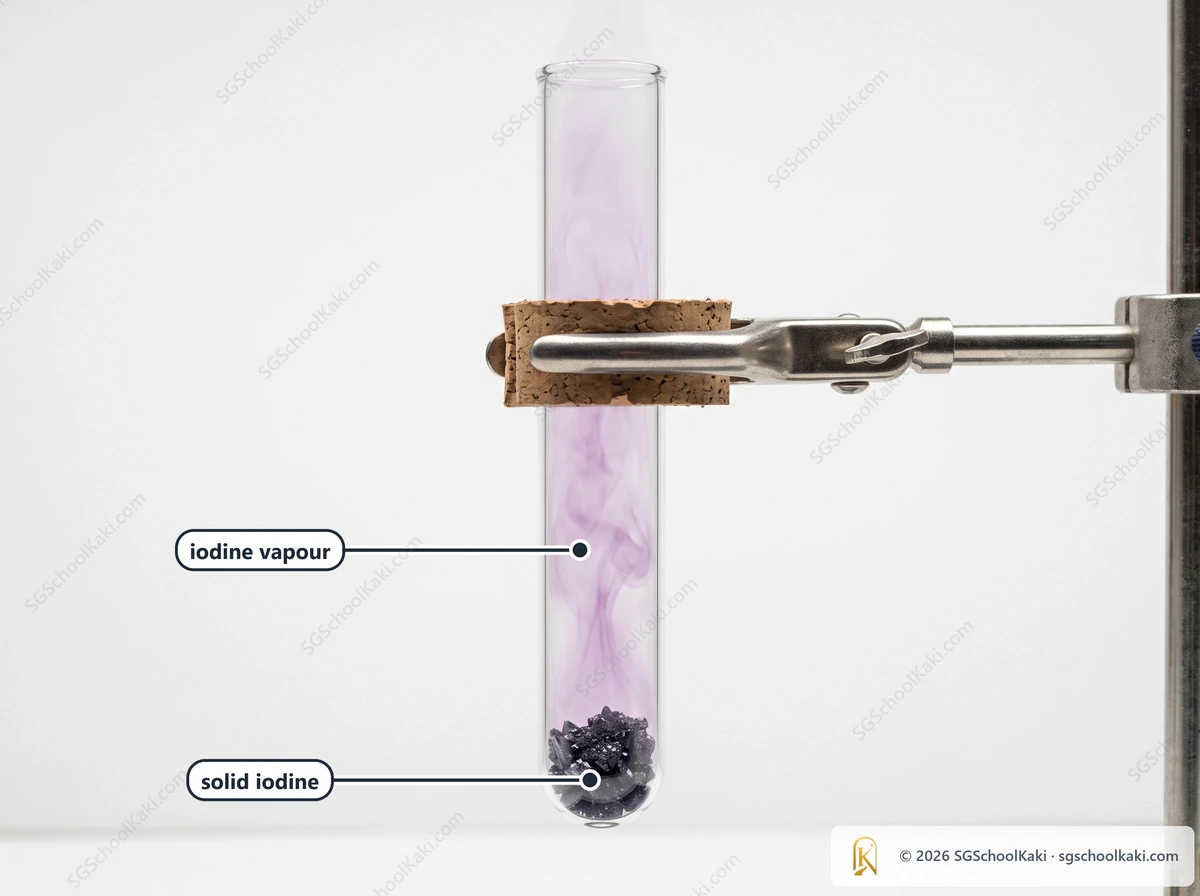
| Sublimation | 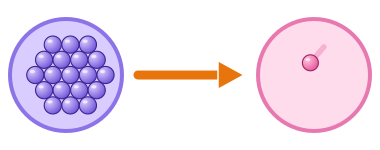 | solid to gas | Energy is absorbed. | The particles gain enough energy to overcome the attractions and leave the solid without forming a liquid. |
| Deposition (also called sublimation in some texts; K324 does not use the name deposition) | 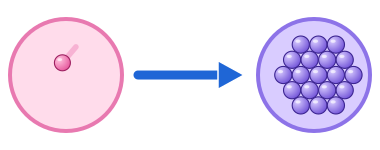 | gas to solid | Energy is released. | The particles lose enough energy for the attractions to hold them in a solid. |
H2O(s) → H2O(l)Ice melts to form liquid water.
H2O(l) → H2O(g)Liquid water boils or evaporates to form steam or water vapour.
H2O(g) → H2O(l)Water vapour condenses to form liquid water.
I2(s) → I2(g)Solid iodine sublimes to form iodine vapour when it is warmed.
CO2(s) → CO2(g)Solid carbon dioxide sublimes at room temperature.
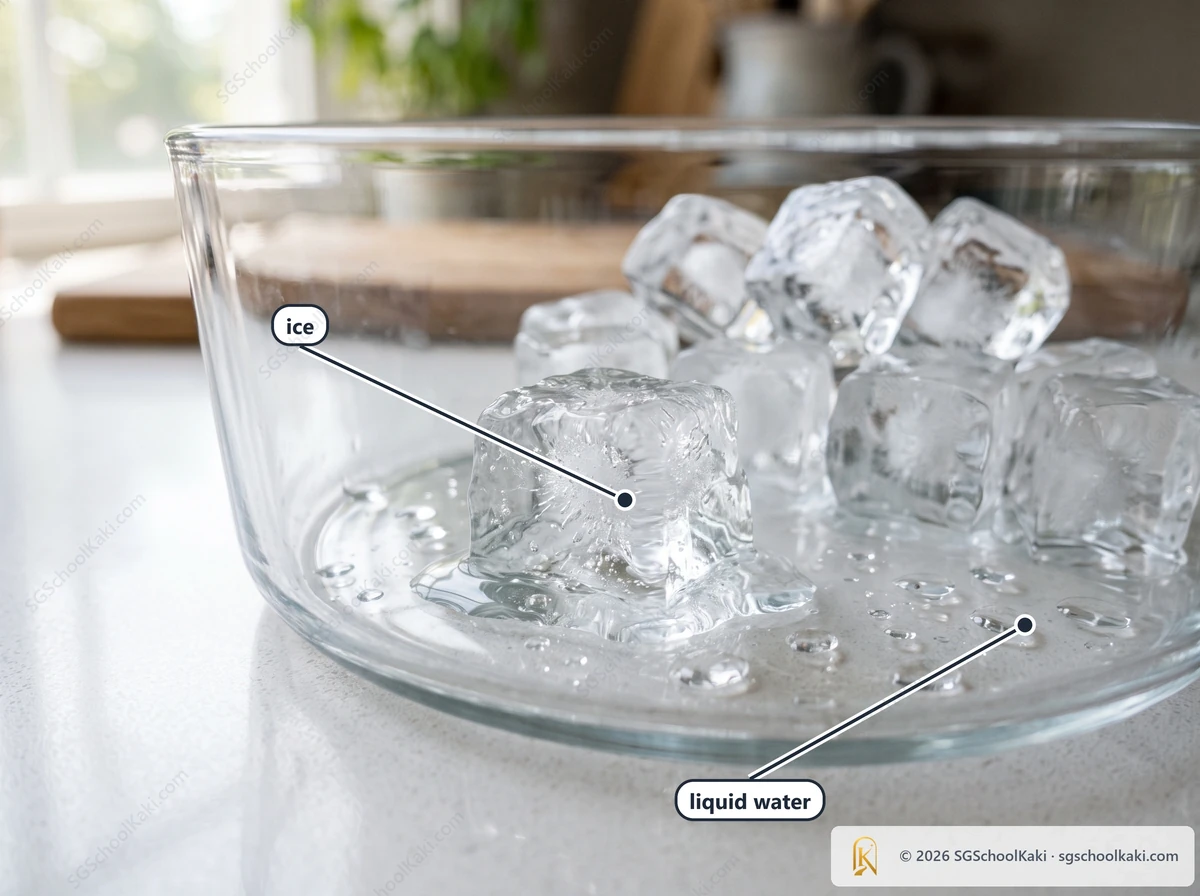

Heating and cooling curves


The temperature stays constant during melting and boiling because the energy that is absorbed is used to overcome the attractions between particles, so the kinetic energy of the particles does not increase and the particles do not move faster. supports K324-2.1(a)
Many Exams Bring Stress
M stands for melting, E for evaporation, B for boiling and S for sublimation, the four changes of state in which energy is absorbed.Key: The other three changes, freezing, condensation and deposition (gas to solid, a name K324 does not use), release energy.The SEAB glossary says “Explain may imply reasoning or some reference to theory, depending on the context”, so when you explain a change of state, refer to the energy absorbed or released and to the attractions between particles.
Depth: why and how
- Why does a gas fill its container? The particles of a gas move quickly in all directions with very weak attractions between them, so they spread out until they meet the walls of the container.
- Why can a gas be compressed easily but a liquid is very hard to compress? There are large gaps between the particles of a gas, but the particles of a liquid are already close together.
- What is the difference between evaporation and boiling? Evaporation happens only at the surface of the liquid and below the boiling point, but boiling happens throughout the liquid at the boiling point.
- Why does evaporation cool the liquid that is left behind? The faster particles with the most energy escape, so the particles that remain have a lower average energy.
- Why is steam at the boiling point able to cause worse burns than boiling water at the same temperature? The steam condenses on the skin and releases the energy that was absorbed when the water boiled, in addition to the energy released as the liquid cools.
- Cross-link to Chemical Energetics: energy that is absorbed from the surroundings in melting or boiling is the same idea as an endothermic process.
Common mistakes
The particles themselves expand when a solid is heated.
The particles stay the same size but vibrate more vigorously, with larger vibrations, so the gaps between them become larger.
The particles in a solid do not move.
The particles in a solid vibrate about fixed positions.
The temperature rises during melting because heat is still being supplied.
The temperature stays constant during melting because the energy is used to overcome the attractions between particles.
Boiling and evaporation are the same process.
Boiling takes place throughout the liquid at the boiling point, and evaporation takes place at the surface at lower temperatures.
Particles gain energy and overcome attractions in melting, boiling and sublimation, and they lose energy and are pulled together in freezing, condensation and deposition (gas to solid).
Exam check
Q1Which statement describes the particles in a liquid?
- AThey are far apart and move randomly.
- BThey are in a regular pattern and only vibrate.
- CThey are far apart and vibrate about fixed positions.
- DThey are close together and can slide past one another.
Show answer
MCQ answer key D (They are close together and can slide past one another.): particles in a liquid are close together but irregular and can slide past each other, whereas the other statements describe gases and solids.
Q2Which change of state releases energy to the surroundings?
- Amelting
- Bboiling
- Ccondensation
- Dsublimation
Show answer
MCQ answer key C (condensation): condensation is a gas changing to a liquid and the attractions between particles form, which releases energy, whereas the other three changes absorb energy.
Q3A pure solid is heated steadily and its temperature stays constant while it melts. Which statement explains this?
- AThe energy absorbed is used to overcome attractions between the particles.
- BThe particles stop moving during melting.
- CThe energy absorbed makes the particles move faster.
- DThe particles become smaller during melting.
Show answer
MCQ answer key A (The energy absorbed is used to overcome attractions between the particles.): the temperature of the substance depends on the average kinetic energy of the particles, and during melting the energy goes into overcoming attractions.
StructuredA piece of a pure solid is heated steadily until it is a gas.
- State the name of the change of state when the solid changes to a liquid. [1]
- Describe the arrangement and the movement of the particles in the liquid. [2]
- Explain, in terms of particles and energy, why the temperature stays constant while the liquid boils. [2]
- State one difference between boiling and evaporation. [1]
Total: 6 marks
Show mark scheme
(a) 1 mark
- Mark scheme: melting
(b) 2 marks
- Mark scheme: the particles are close together in an irregular arrangement
- Mark scheme: the particles slide past one another
(c) 2 marks
- Mark scheme: the energy that is absorbed is used to overcome the attractions between the particles
- Mark scheme: so the average kinetic energy of the particles does not increase and the temperature stays constant
(d) 1 mark
- Mark scheme: boiling happens throughout the liquid at the boiling point, but evaporation happens only at the surface below the boiling point
Evidence for moving particles
describe and explain evidence for the movement of particles in liquids and gases (the treatment of Brownian motion is not required)
Diffusion in gases and liquids is evidence that their particles move, because a colour or a smell spreads through the whole liquid or gas without anything stirring it.
- Diffusion
- Diffusion: the overall spreading of particles from where there are more of them to where there are fewer of them, caused by their random motion
- Random motion
- Random motion: movement of particles in all directions with no pattern, so that the particles collide and change direction supports K324-2.1(b)
- Region of higher concentration
- Region of higher concentration: a part of the liquid or gas that contains more particles of a substance in the same space supports K324-2.1(b)
- Evidence
- Evidence: an observation that supports an explanation, such as a spreading colour that supports the idea that particles move supports K324-2.1(b)
- Net movement
- Net movement: the overall movement of particles, in which more particles leave the crowded region than enter it supports K324-2.1(b)
Experiments that show particle movement
| Experiment | Picture | Observation | Explanation in terms of particles |
|---|---|---|---|
| Brown bromine vapour in a gas jar placed below a gas jar of air, with the cover between them removed | 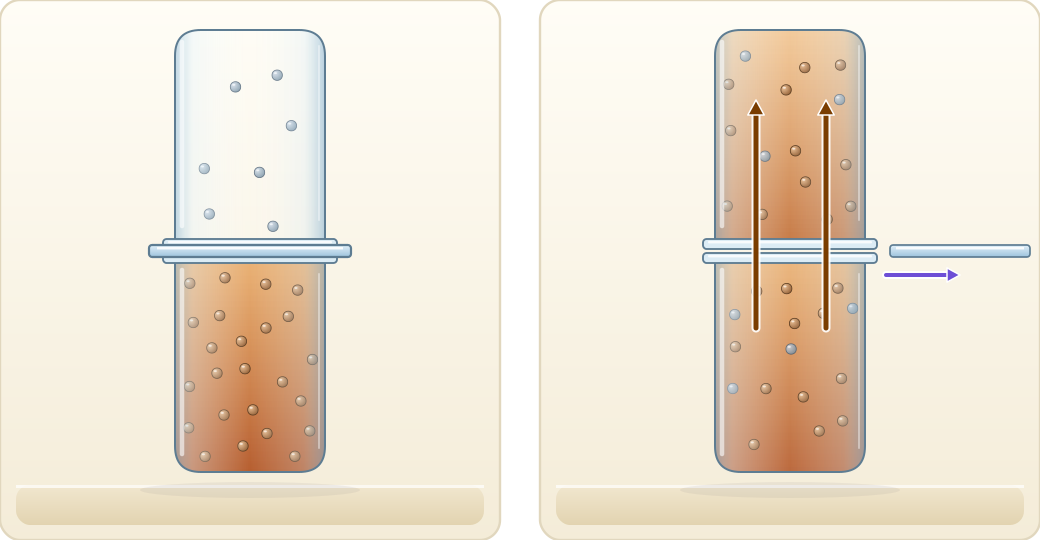 | The brown colour spreads upwards until both jars are brown. | The bromine molecules move randomly between the air particles and spread into the upper jar, and because bromine vapour is denser than air yet still spreads upwards, the particles must be moving by themselves. |
| A crystal of potassium manganate(VII) in a beaker of water that is not stirred | 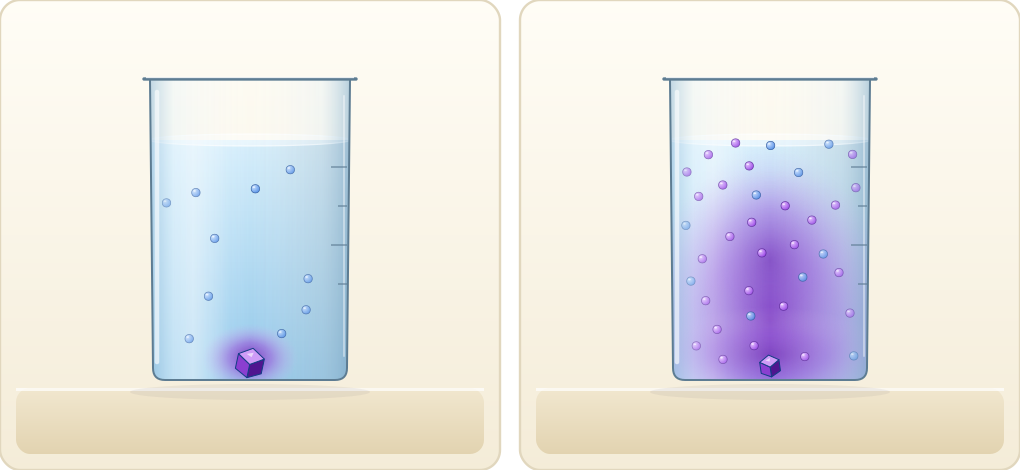 | The purple colour spreads slowly through the water. | The particles from the crystal move among the water particles and spread through the liquid. |
| A drop of perfume or an opened bottle of ammonia solution in one corner of a room | 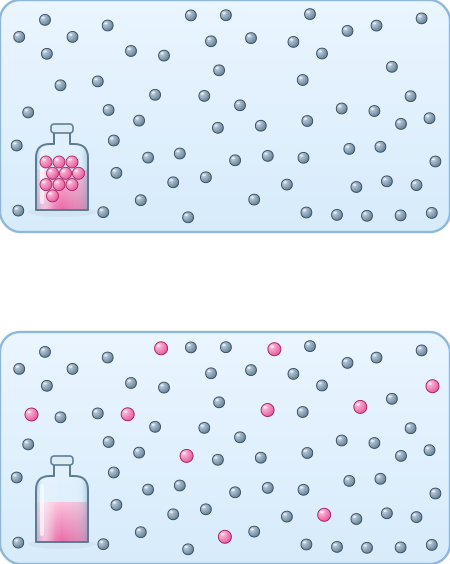 | The smell is soon noticed in other parts of the room. | The particles in the gas phase move randomly through the air until they reach your nose. |
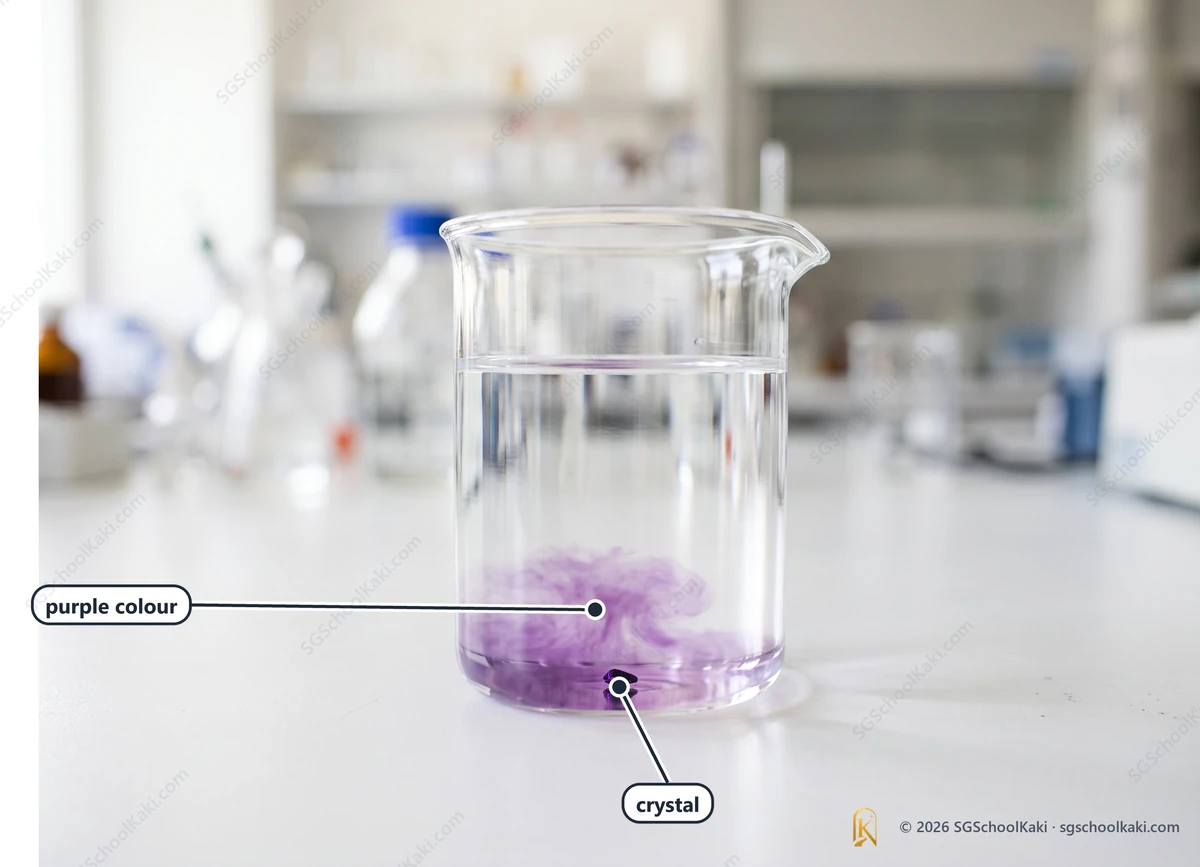


Diffusion happens in gases and liquids, and it is faster in gases than in liquids because gas particles are far apart and move faster. supports K324-2.1(b)
The SEAB outcome says “the treatment of Brownian motion is not required”, so use diffusion experiments as your evidence and do not describe Brownian motion in an answer.
Depth: why and how
- Why is a colour spreading without stirring good evidence for moving particles? If the particles did not move, the colour would stay where it started.
- Why does the colour of the potassium manganate(VII) spread more slowly than the colour of bromine vapour? The particles in a liquid are close together and collide with their neighbours often, so they spread slowly.
- Why does the movement of particles from a crowded region to a less crowded region need no energy supply from outside? The particles are already moving randomly, so more of them leave the crowded region than enter it.
- Does diffusion stop when the colour looks the same everywhere? No, the particles keep moving randomly, but the net movement stops because the particles are evenly spread.
- Cross-link to Experimental Chemistry: a coloured substance is used in these experiments so that the movement of particles can be seen.
Common mistakes
Diffusion happens because the particles are pushed by a force from outside.
Diffusion happens because the particles move randomly by themselves.
Diffusion stops moving the particles once the colour is even.
The particles keep moving after the colour is even, but there is no net movement.
Diffusion happens in solids as quickly as in gases.
Diffusion in a solid is much slower than in a gas, because the particles of a solid only vibrate about fixed positions, while gas particles move quickly and are far apart.
A colour or smell that spreads without stirring is evidence that gas and liquid particles move randomly.
Exam check
Q1Which observation is evidence that the particles in a liquid are moving?
- AWater takes the shape of its container.
- BA purple crystal in still water gives a colour that spreads through the water.
- CWater freezes when it is cooled.
- DA liquid is very hard to compress.
Show answer
MCQ answer key B (A purple crystal in still water gives a colour that spreads through the water.): a colour spreading through still water shows that particles move among the water particles, whereas the other observations are about shape, change of state and compressibility.
Q2What is diffusion?
- Athe movement of particles from low to high concentration
- Bthe melting of a solid
- Cthe overall spreading of particles from where there are more of them to where there are fewer of them
- Dthe stopping of all particle movement
Show answer
MCQ answer key C (the overall spreading of particles from where there are more of them to where there are fewer of them): diffusion is the net movement from higher to lower concentration, caused by random motion.
Q3Why does the smell of cooking spread through a kitchen?
- AThe particles of the smell are pushed by a force.
- BThe particles of the smell move randomly through the air.
- CThe air particles stop moving.
- DThe particles of the smell are heavy and sink.
Show answer
MCQ answer key B (The particles of the smell move randomly through the air.): the particles of a gas move randomly and spread into the whole space.
StructuredA crystal of potassium manganate(VII) is placed at the bottom of a beaker of cold water and left for some time without stirring.
- Describe what you would see after some time. [1]
- Name the process that makes the colour spread. [1]
- Explain, in terms of particles, why the colour spreads. [2]
- State what the experiment is evidence for. [1]
Total: 5 marks
Show mark scheme
(a) 1 mark
- Mark scheme: the purple colour spreads through the water
(b) 1 mark
- Mark scheme: diffusion
(c) 2 marks
- Mark scheme: the particles of the crystal and the water particles move randomly
- Mark scheme: so the particles of the crystal spread from where there are more of them to where there are fewer
(d) 1 mark
- Mark scheme: particles in liquids move
Everyday effects of diffusion
explain everyday effects of diffusion in terms of particles, e.g. the spread of perfumes and cooking aromas; tea and coffee grains in water
Everyday effects of diffusion, such as the spread of a perfume or cooking aromas through air and of tea or coffee grains through water, happen because the particles of one substance move randomly and mix with the particles of another.
- Perfume
- Perfume: a liquid that evaporates easily, so its particles enter the air and spread through it
- Cooking aroma
- Cooking aroma: particles of gases and vapours from hot food that diffuse through the air to reach your nose
- Tea or coffee grains in water
- Tea or coffee grains in water: soluble particles that leave the grains, spread through the water and make the whole drink coloured
- Dissolving
- Dissolving: the process in which particles of a solute spread among the particles of a solvent supports K324-2.1(c)
- Mixing of gases
- Mixing of gases: the spreading of different gases into the same space until they are evenly mixed supports K324-2.1(c)
Everyday examples
| Everyday example | Picture | What the particles do |
|---|---|---|
| Perfume sprayed in one corner of a room | | The perfume particles evaporate, move randomly among the air particles and spread through the room. |
| Cooking aroma reaching another room | – | Particles from the hot food enter the air and move randomly until they reach your nose. |
| Tea or coffee grains in a cup of water | 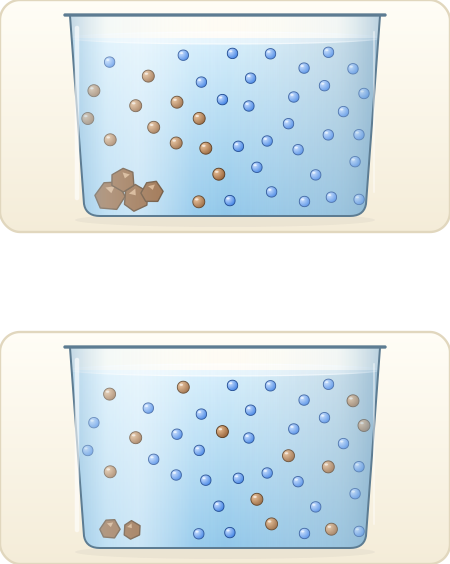 | Particles from the grains move into the water and spread among the water particles. |
| A drop of ink in a glass of water | – | The particles of ink move among the water particles until the colour is even. |
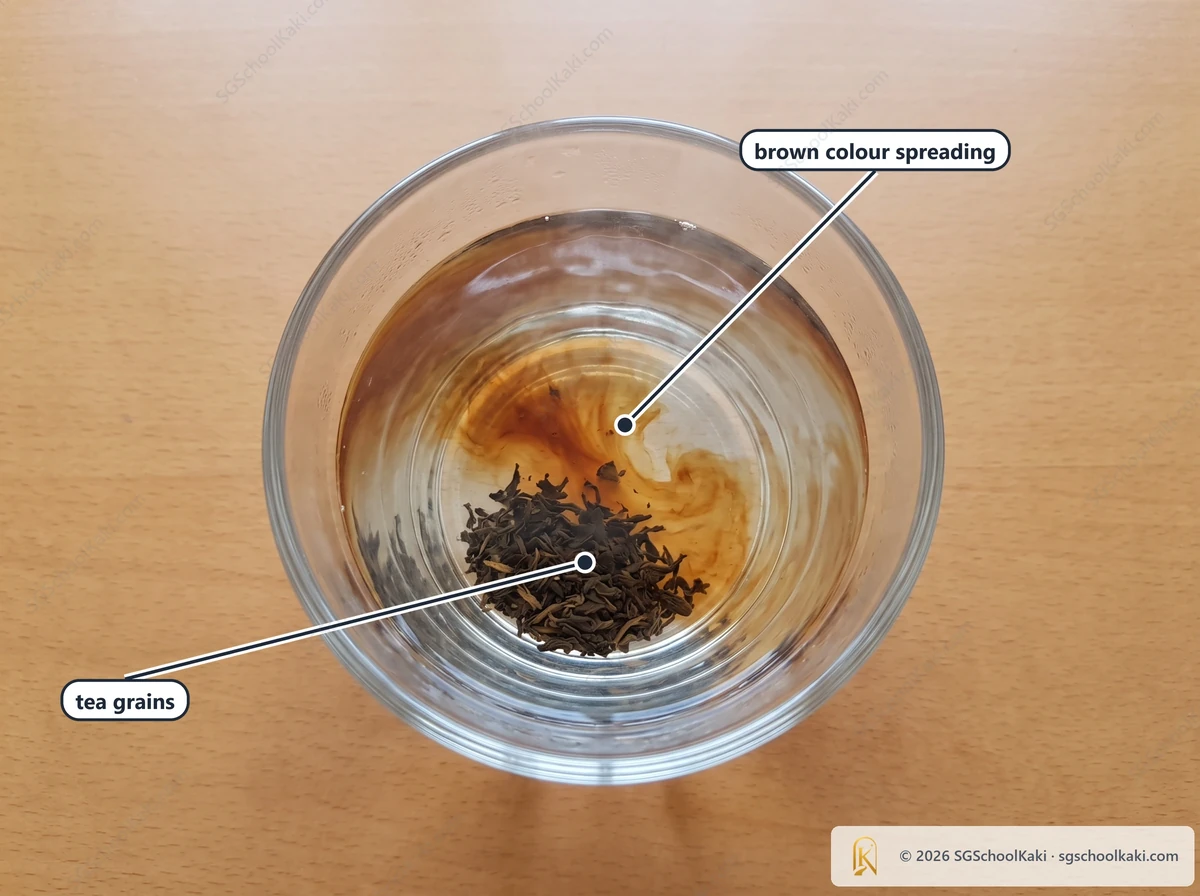

Diffusion is quicker in hot surroundings than in cold surroundings because the particles move faster. supports K324-2.1(c)
The SEAB glossary says “Explain may imply reasoning or some reference to theory, depending on the context”, so for an everyday example, say that the particles move randomly and spread from a higher concentration to a lower concentration.
Depth: why and how
- Why can you smell a perfume across a room but not see it? Its particles are too small to see, but they spread through the air and reach the nose.
- Why does a cup of tea become the same colour all through even without stirring? The particles from the tea spread among the water particles until they are evenly mixed.
- Why is stirring useful if diffusion already mixes the particles? Stirring spreads the particles more quickly than diffusion alone.
- Why does a cooking aroma spread faster in a warm kitchen than in a cold one? The particles move faster at a higher temperature.
- Cross-link to Experimental Chemistry: dissolving a solid in a liquid is a mixing process that is often speeded up by stirring and by warming.
Lighter molecules diffuse faster than heavier ones at the same temperature, so perfume particles diffuse more slowly than the particles of a very light gas because they are heavier, which is the idea in the next outcome. supports K324-2.1(d)
Common mistakes
Tea grains dissolve because the water pushes them apart.
Particles from the grains move randomly into the water and spread among the water particles.
The smell of food travels because the air carries it in a stream only.
The particles of the smell move randomly, so they spread even in still air.
Diffusion is the mixing of particles by stirring.
Diffusion is the spreading of particles by their own random motion, without stirring.
The spread of a perfume, a cooking aroma and tea grains in water can each be explained by the random motion of particles spreading from a higher concentration to a lower concentration.
Exam check
Q1Which is an everyday example of diffusion?
- Aice melting in a drink
- Ba balloon being squashed
- Cwater boiling in a kettle
- Dthe smell of cooking spreading through a house
Show answer
MCQ answer key D (the smell of cooking spreading through a house): the smell spreads because particles move randomly, whereas the other examples are about change of state and compression.
Q2Tea grains are placed in water. Why does the water become coloured throughout?
- AThe water particles stop moving.
- BThe grains are heavier than the water.
- CParticles from the grains move randomly and spread among the water particles.
- DThe water is pushed up through the grains.
Show answer
MCQ answer key C (Particles from the grains move randomly and spread among the water particles.): the particles from the grains diffuse among the water particles.
Q3A bottle of perfume is opened in a room. Which statement is correct?
- AThe perfume particles spread from a higher to a lower concentration.
- BThe perfume particles spread from a lower to a higher concentration.
- CThe perfume particles stay in the bottle.
- DThe air particles stay still while the perfume particles move.
Show answer
MCQ answer key A (The perfume particles spread from a higher to a lower concentration.): diffusion is the net movement from higher to lower concentration.
StructuredA cup of coffee is made by adding coffee grains to hot water and leaving it to stand without stirring.
- Name the process that makes the colour spread through the water. [1]
- Explain, in terms of particles, why the colour spreads. [2]
- Suggest why the colour spreads more quickly in hot water than in cold water. [2]
- Give one other everyday example of diffusion. [1]
Total: 6 marks
Show mark scheme
(a) 1 mark
- Mark scheme: diffusion
(b) 2 marks
- Mark scheme: particles from the coffee grains move randomly
- Mark scheme: and spread among the water particles from the crowded region to the less crowded region
(c) 2 marks
- Mark scheme: the particles move faster at a higher temperature
- Mark scheme: so the particles from the grains spread faster
(d) 1 mark
- Mark scheme: the spread of a perfume or a cooking aroma through air
You've read the free 34%. Unlock the rest of Chapter 2.
Still to read in this chapter:
- Diffusion, molecular mass and temperature
- Protons, neutrons and electrons
- Structure of an atom
- Proton number and nucleon number
- Nuclide notation
- Isotopes
- Counting particles in atoms and ions
$9 one-time · all 13 chapters · no subscription
Less than a fast-food meal.
Yours for the whole syllabus.
Premium members get all 13 chapters included.
Notes version 1.0 · Last updated 2 Oct 2026 · Chapter 2 of 13