










Chemical Bonding and Structure
SEAB syllabus topic 3: how ionic, covalent and metallic bonding work, how structure explains properties, with the reasons, the common mistakes and an exam check for every outcome.

In ionic bonding a metal atom transfers electrons to a non-metal atom, and the oppositely charged ions that form are held together by electrostatic attraction.
In covalent bonding two non-metal atoms share a pair of electrons, and the shared pair of electrons holds the atoms together in a molecule.
In metallic bonding positive ions sit in a lattice and are held together by a sea of electrons that is free to move through the metal.
Formation of ions
describe the formation of ions by electron loss/gain and that these ions usually have the electronic configuration of a noble gas
An atom forms an ion by losing or gaining electrons, and the ion that forms usually has the electronic configuration of a noble gas, which is a full outer shell.
- Ion
- Ion: an atom or group of atoms that has lost or gained electrons, so it carries an overall electric charge
- Cation
- Cation: a positive ion, formed when an atom loses electrons; metal atoms tend to form cations
- Anion
- Anion: a negative ion, formed when an atom gains electrons; non-metal atoms tend to form anions
- Electronic configuration
- Electronic configuration: the number of electrons in each shell of an atom or ion, written in order from the innermost shell outwards supports K324-3.1(a)
- Full outer shell
- Full outer shell: an outer shell that holds as many electrons as it can, which is stable and makes an atom unreactive supports K324-3.1(a)
- Noble gas
- Noble gas: an element in Group 18, such as helium, neon or argon, whose atoms already have a full outer shell and are unreactive supports K324-3.1(a)
- Ionic charge
- Ionic charge: the charge on an ion, which equals the number of electrons lost (positive) or gained (negative) supports K324-3.1(a)
Forming ions by electron loss or gain
Na → Na+ + e–A sodium atom loses one electron to form a sodium ion.
Mg → Mg2+ + 2e–A magnesium atom loses two electrons to form a magnesium ion.
Al → Al3+ + 3e–An aluminium atom loses three electrons to form an aluminium ion.
Cl + e– → Cl–A chlorine atom gains one electron to form a chloride ion.
O + 2e– → O2–An oxygen atom gains two electrons to form an oxide ion.
Atoms and the ions they form
| Element | Picture | Atom | Electron change | Ion and its configuration | Matches the noble gas |
|---|---|---|---|---|---|
| Sodium | 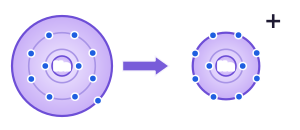 | A sodium atom has the electronic configuration 2,8,1. | It loses one electron. | The ion formed is Na+, with the electronic configuration 2,8. | This is the same configuration as neon. |
| Magnesium | 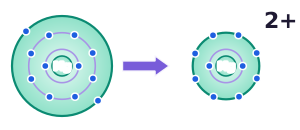 | A magnesium atom has the electronic configuration 2,8,2. | It loses two electrons. | The ion formed is Mg2+, with the electronic configuration 2,8. | This is the same configuration as neon. |
| Aluminium | 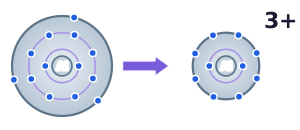 | An aluminium atom has the electronic configuration 2,8,3. | It loses three electrons. | The ion formed is Al3+, with the electronic configuration 2,8. | This is the same configuration as neon. |
| Oxygen | 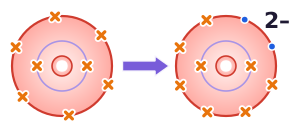 | An oxygen atom has the electronic configuration 2,6. | It gains two electrons. | The ion formed is O2–, with the electronic configuration 2,8. | This is the same configuration as neon. |
| Chlorine | 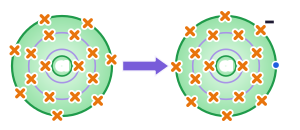 | A chlorine atom has the electronic configuration 2,8,7. | It gains one electron. | The ion formed is Cl–, with the electronic configuration 2,8,8. | This is the same configuration as argon. |
| Calcium | 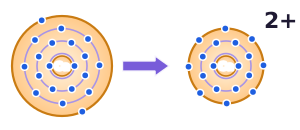 | A calcium atom has the electronic configuration 2,8,8,2. | It loses two electrons. | The ion formed is Ca2+, with the electronic configuration 2,8,8. | This is the same configuration as argon. |

The SEAB glossary says “Describe requires candidates to state in words (using diagrams where appropriate) the main points of the topic”, so when you describe how an ion forms, say which atom loses or gains electrons, how many, and the charge that results.
An ion has a different number of electrons from its atom but the same number of protons, so the nucleus does not change when an ion forms. supports K324-3.1(a)
Depth: why and how
- Why do metal atoms tend to lose electrons and non-metal atoms tend to gain them? A metal atom has few outer electrons, so losing them leaves a full shell underneath, whereas a non-metal atom is only a few electrons short of a full outer shell, so gaining them is easier.
- Why are noble gases unreactive? Their atoms already have a full outer shell, so they have no tendency to lose, gain or share electrons.
- Why does the charge of an ion equal the number of electrons lost or gained? Each electron has a charge of one negative unit and the number of protons stays the same, so losing an electron leaves one more positive charge and gaining an electron leaves one more negative charge.
- Why does K324 say that ions usually have a noble gas configuration? Ions of transition elements, such as iron, form without reaching a noble gas configuration, so the rule is true of most but not every ion.
- Cross-link to The Particulate Nature of Matter: a neutral atom has as many electrons as protons, so its electronic configuration follows from its proton number.
Common mistakes
A sodium atom becomes a sodium ion by gaining an electron.
A sodium atom becomes a sodium ion by losing one electron, so the ion has a charge of one positive unit.
Positive ions form because the atom gains protons.
An atom forms a positive ion by losing electrons; the number of protons in the nucleus never changes when an ion forms.
Non-metals form positive ions.
Non-metal atoms tend to gain electrons and form negative ions, whereas metal atoms tend to lose electrons and form positive ions.
A chloride ion has the same configuration as a neon atom.
A chloride ion has the same configuration as an argon atom, because chlorine gains an electron to reach a full third shell.
Atoms form ions by losing or gaining electrons so that they usually reach the configuration of a noble gas: metals form positive ions and non-metals form negative ions.
Exam check
Q1Which change forms a positive ion?
- AA magnesium atom loses two electrons.
- BA magnesium atom gains two electrons.
- CAn oxygen atom gains two electrons.
- DA chlorine atom gains one electron.
Show answer
MCQ answer key A (A magnesium atom loses two electrons.): metal atoms tend to lose electrons, so a magnesium atom that loses two electrons forms a positive ion, whereas gaining electrons forms negative ions.
Q2What is the electronic configuration of a sodium ion, Na+?
- A2,8
- B2,8,1
- C2,8,8
- D2,8,2
Show answer
MCQ answer key A (2,8): a sodium atom loses its single outer electron, so the ion has the configuration of neon, and the other options are the atoms of sodium and magnesium or a chloride ion.
Q3Why does a chlorine atom form a chloride ion, Cl–?
- AIt loses one electron to obtain a full outer shell.
- BIt gains one electron to obtain a full outer shell.
- CIt gains one proton to obtain a full outer shell.
- DIt loses seven electrons to obtain a charge of seven positive units.
Show answer
MCQ answer key B (It gains one electron to obtain a full outer shell.): a chlorine atom is one electron short of a full outer shell, so it gains one electron, which makes the ion negative.
StructuredAtoms of sodium, oxygen and chlorine form ions.
- State the meaning of the term ion. [1]
- Describe, in terms of electrons, how a sodium atom forms a sodium ion. [2]
- Write an equation for the formation of an oxide ion from an oxygen atom, and state the number of electrons gained. [2]
- Explain why a chlorine atom forms a negative ion and not a positive ion. [2]
Total: 7 marks
Show mark scheme
(a) 1 mark
- Mark scheme: an atom or group of atoms that has lost or gained electrons, so it has an overall charge
(b) 2 marks
- Mark scheme: a sodium atom loses one electron
- Mark scheme: so the ion has a charge of one positive unit and the configuration of a noble gas
(c) 2 marks
- Mark scheme: O + 2e– → O2–
- Mark scheme: two electrons are gained
(d) 2 marks
- Mark scheme: a chlorine atom is one electron short of a full outer shell
- Mark scheme: gaining one electron is easier than losing seven electrons
Ionic bonding
describe, including the use of ‘dot-and-cross’ diagrams, the formation of ionic bonds between metals and non-metals, e.g. NaCl ; MgCl 2
An ionic bond forms when a metal atom transfers electrons to a non-metal atom, and the oppositely charged ions that form are held together by strong electrostatic attraction.
- Ionic bond
- Ionic bond: the strong electrostatic attraction between oppositely charged ions
- Electron transfer
- Electron transfer: the movement of one or more electrons from a metal atom to a non-metal atom, which forms a positive ion and a negative ion
- Electrostatic attraction
- Electrostatic attraction: the force of attraction between particles of opposite charge supports K324-3.1(b)
- Dot-and-cross diagram
- Dot-and-cross diagram: a diagram that shows the outer-shell electrons of the atoms, with dots for the electrons of one atom and crosses for the electrons of the other, so that the transfer or sharing can be followed
- Square brackets in an ionic diagram
- Square brackets in an ionic diagram: each ion is drawn in square brackets with its charge at the top right, to show that the electrons now belong to that ion supports K324-3.1(b)
- Ionic compound
- Ionic compound: a compound made of a metal and a non-metal, in which ions are present supports K324-3.1(b)
- Formula of an ionic compound
- Formula of an ionic compound: the simplest ratio of ions in the compound, chosen so that the total positive charge equals the total negative charge supports K324-3.1(b)
From atoms to an ionic compound
- 1Write the electronic configuration of the metal atom and the non-metal atom, and draw the outer shell of each.
- 2Show the outer electrons of the metal atom as dots and the outer electrons of the non-metal atom as crosses.
- 3Draw an arrow, or move the electron, from the metal atom to the non-metal atom, using one non-metal atom for each electron that the metal atom must lose.
- 4Draw each ion in square brackets with its charge, and check that every ion has a full outer shell.
- 5Check that the total positive charge equals the total negative charge, and write the ratio of ions as the formula.
Dot-and-cross diagrams: sodium chloride and magnesium chloride


Other ionic compounds
| Compound | Picture | Atoms that react | Electron transfer | Ions formed and their configurations | Ratio of ions |
|---|---|---|---|---|---|
| Sodium chloride |  | Sodium atoms react with chlorine atoms. | Each sodium atom transfers one electron to a chlorine atom. | The ions formed are Na+ 2,8 and Cl– 2,8,8. | There is one Na+ ion for each Cl– ion. |
| Magnesium chloride |  | Magnesium atoms react with chlorine atoms. | Each magnesium atom transfers an electron to each of the two chlorine atoms. | The ions formed are Mg2+ 2,8 and Cl– 2,8,8. | There is one Mg2+ ion for every two Cl– ions. |
| Magnesium oxide | 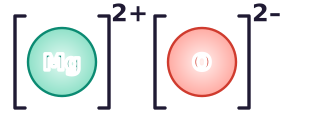 | Magnesium atoms react with oxygen atoms. | Each magnesium atom transfers two electrons to an oxygen atom. | The ions formed are Mg2+ 2,8 and O2– 2,8. | There is one Mg2+ ion for each O2– ion. |
| Calcium chloride |  | Calcium atoms react with chlorine atoms. | Each calcium atom transfers an electron to each of the two chlorine atoms. | The ions formed are Ca2+ 2,8,8 and Cl– 2,8,8. | There is one Ca2+ ion for every two Cl– ions. |
| Sodium oxide |  | Sodium atoms react with oxygen atoms. | Each oxygen atom receives one electron from each of two sodium atoms. | The ions formed are Na+ 2,8 and O2– 2,8. | There are two Na+ ions for each O2– ion. |

Equations for forming ionic compounds
2Na(s) + Cl2(g) → 2NaCl(s)Sodium reacts with chlorine to form sodium chloride, an ionic compound.
Mg(s) + Cl2(g) → MgCl2(s)Magnesium reacts with chlorine to form magnesium chloride, in which there is one magnesium ion for every two chloride ions.
2Mg(s) + O2(g) → 2MgO(s)Magnesium reacts with oxygen to form magnesium oxide.
The SEAB glossary says “Describe requires candidates to state in words (using diagrams where appropriate) the main points of the topic”, so a description of ionic bonding should name the atoms, state the electron transfer and name the force between the ions.
A dot-and-cross diagram of an ionic compound shows only the outer shell of each atom or ion, because the inner shells are already full and do not change. supports K324-3.1(b)
Depth: why and how
- Why do two chlorine atoms react with one magnesium atom? A magnesium atom must lose two electrons to reach a full outer shell and each chlorine atom can accept only one, so two chlorine atoms are needed.
- Why is the formula of an ionic compound a ratio? The compound is a giant lattice of ions and has no separate molecules, so the formula shows the simplest ratio of positive to negative ions.
- Why must the total charge of an ionic compound be zero? Each electron lost by the metal atoms is gained by the non-metal atoms, so the positive and negative charges cancel and the compound is electrically neutral.
- Why is an ionic bond strong? Every ion is attracted to many oppositely charged ions around it, and oppositely charged particles attract strongly.
- Cross-link to Chemical Calculations: the ratio of ions in an ionic compound is the formula that you use to calculate its relative formula mass.
Common mistakes
In sodium chloride the sodium atom and the chlorine atom share a pair of electrons.
In sodium chloride the sodium atom transfers an electron to the chlorine atom, and the ions formed attract each other.
The ions in an ionic compound are held together by the electron that moved from one atom to the other.
The ionic bond is the electrostatic attraction between the oppositely charged ions; the electron transfer is how the ions form.
Magnesium chloride is MgCl because magnesium gives one electron to chlorine.
Magnesium chloride is MgCl2 because a magnesium atom loses two electrons and each chlorine atom gains one.
A dot-and-cross diagram of an ion needs no charge because the electrons are shown.
Each ion in a dot-and-cross diagram is drawn in square brackets with its charge, because the charge shows the number of electrons lost or gained.
In ionic bonding a metal atom transfers electrons to a non-metal atom, and the oppositely charged ions with full outer shells attract each other strongly.
Exam check
Q1Which pair of elements forms an ionic compound?
- Acarbon and oxygen
- Bhydrogen and chlorine
- Cnitrogen and hydrogen
- Dmagnesium and chlorine
Show answer
MCQ answer key D (magnesium and chlorine): a metal and a non-metal react by electron transfer to form an ionic compound, whereas two non-metals share electrons.
Q2How many chloride ions combine with each magnesium ion in magnesium chloride?
- Aone
- Bthree
- Cfour
- Dtwo
Show answer
MCQ answer key D (two): the magnesium ion has two positive charges and each chloride ion has one negative charge, so two chloride ions balance one magnesium ion.
Q3What is an ionic bond?
- Athe sharing of a pair of electrons between two atoms
- Bthe attraction between positive ions and a sea of electrons
- Cthe electrostatic attraction between oppositely charged ions
- Dthe transfer of electrons from a non-metal to a metal
Show answer
MCQ answer key C (the electrostatic attraction between oppositely charged ions): an ionic bond is the electrostatic attraction between positive and negative ions, whereas sharing is covalent and the sea of electrons is metallic.
StructuredCalcium reacts with chlorine to form calcium chloride, an ionic compound.
- State the number of electrons that each calcium atom loses. [1]
- Describe, in terms of electrons, how calcium chloride is formed from calcium and chlorine. [3]
- State the name of the force that holds the ions together. [1]
- Explain why the formula of calcium chloride is CaCl2. [2]
Total: 7 marks
Show mark scheme
(a) 1 mark
- Mark scheme: two electrons
(b) 3 marks
- Mark scheme: a calcium atom transfers an electron to each of the two chlorine atoms
- Mark scheme: forming a calcium ion with two positive charges
- Mark scheme: and two chloride ions, each with one negative charge
(c) 1 mark
- Mark scheme: electrostatic attraction between oppositely charged ions
(d) 2 marks
- Mark scheme: the calcium ion has a charge of two positive units and each chloride ion has one negative unit
- Mark scheme: so there are two chloride ions for each calcium ion, and the charges add up to zero
Giant ionic lattices
state that ionic materials contain a giant lattice in which the ions are held by electrostatic attraction, e.g. NaCl (candidates will not be required to draw diagrams of ionic lattices)
An ionic material contains a giant lattice, in which a very large number of positive and negative ions are held in a regular repeating arrangement by electrostatic attraction.
- Giant lattice
- Giant lattice: a very large, regular, repeating three-dimensional arrangement of particles
- Ionic lattice
- Ionic lattice: a giant lattice in which positive ions and negative ions alternate and are held together by electrostatic attraction
- Electrostatic attraction
- Electrostatic attraction: the force between a positive ion and a negative ion, which acts in every direction around each ion supports K324-3.1(c)
- Giant structure
- Giant structure: a structure with no separate small units, so that the whole crystal is one continuous arrangement of particles supports K324-3.1(c)
- Crystal
- Crystal: a solid in which the particles are arranged in a regular pattern, so ionic compounds form crystals with flat faces supports K324-3.1(c)
- Formula unit
- Formula unit: the simplest ratio of ions shown by the formula of an ionic compound, such as NaCl, which is not a molecule supports K324-3.1(c)
Features of the lattice
| Feature | In a giant ionic lattice such as sodium chloride |
|---|---|
| Particles | The particles are positive ions and negative ions, and there are no molecules. |
| Arrangement | The ions alternate in a regular repeating pattern, so each positive ion is surrounded by negative ions and each negative ion by positive ions. |
| Forces | Strong electrostatic attraction acts between oppositely charged ions in every direction throughout the crystal. |
| Formula | The formula NaCl shows the ratio of ions, which is one Na+ ion for each Cl– ion. |
| Size of the structure | The lattice continues in all directions, so a grain of salt is one giant structure of a very large number of ions. |
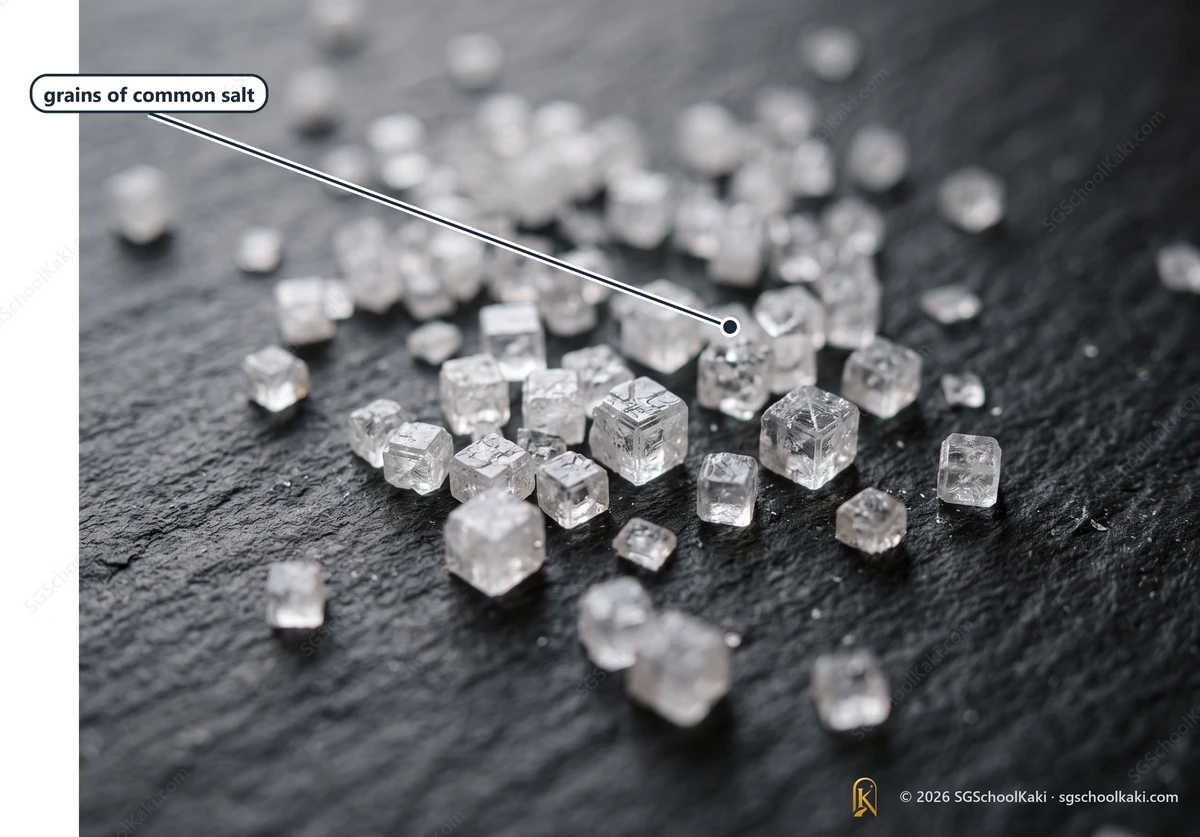

K324 says that “candidates will not be required to draw diagrams of ionic lattices”, so concentrate on recognising a lattice from a diagram and on stating that the ions are held by electrostatic attraction in a giant lattice.
A diagram of a lattice shows only a small part of the structure, because the real lattice continues in every direction. supports K324-3.1(c)
Depth: why and how
- Why do the ions alternate in the lattice? Oppositely charged ions attract each other, so the arrangement with each ion surrounded by ions of opposite charge is the most stable one.
- Why is NaCl not a molecule? The compound has no separate pairs of ions, because every ion is attracted to all the oppositely charged ions around it, so the formula only gives the ratio of ions.
- Why does the lattice have a regular shape? The ions pack together in a repeating pattern, so crystals of ionic compounds grow with flat faces and regular shapes.
- Why can the same lattice picture show different compounds? Many ionic compounds have lattices of similar patterns, and the compound is identified by the ions that are labelled.
- Cross-link to The Particulate Nature of Matter: in a solid the particles are close together in a regular arrangement and vibrate about fixed positions.
Common mistakes
Sodium chloride consists of molecules, each made of one sodium ion and one chloride ion.
Sodium chloride is a giant lattice of ions, and each ion is attracted to all the oppositely charged ions around it.
The ions in a lattice attract only the one ion next to them.
Each ion in a lattice is attracted to the oppositely charged ions in every direction around it.
Positive ions are next to other positive ions in the lattice.
In the lattice the ions alternate, so positive ions are next to negative ions.
The lattice of an ionic compound contains free electrons.
The ions in the lattice stay in fixed positions and there are no free electrons.
An ionic compound is a giant lattice of alternating positive and negative ions held in place by electrostatic attraction, and its formula gives only the ratio of ions.
Exam check
Q1Which statement describes the structure of sodium chloride?
- Asmall molecules of sodium and chlorine atoms
- Bpositive ions in a sea of electrons
- Ca network of atoms joined by shared pairs of electrons
- Da giant lattice of alternating positive and negative ions
Show answer
MCQ answer key D (a giant lattice of alternating positive and negative ions): sodium chloride is ionic and forms a giant lattice, whereas the other three options describe molecules, a metal and a giant covalent substance.
Q2What holds the ions together in a giant ionic lattice?
- Ashared pairs of electrons between ions
- Belectrostatic attraction between oppositely charged ions
- Cweak forces between molecules
- Dattraction between ions and a sea of electrons
Show answer
MCQ answer key B (electrostatic attraction between oppositely charged ions): the ions have opposite charges, so they are held by electrostatic attraction.
Q3What does the formula NaCl show?
- Athe number of atoms in one molecule of salt
- Bthe number of electrons that are shared
- Cthe ratio of sodium ions to chloride ions in the lattice
- Dthe number of ions in one crystal
Show answer
MCQ answer key C (the ratio of sodium ions to chloride ions in the lattice): an ionic compound has no molecules, so the formula shows the simplest ratio of its ions.
StructuredSodium chloride is an ionic compound that has a giant lattice structure.
- State what is meant by a giant lattice. [1]
- Describe the arrangement of the ions in the lattice of sodium chloride. [2]
- Name the force that holds the ions in the lattice. [1]
- Explain why the formula NaCl is not the formula of a molecule. [2]
Total: 6 marks
Show mark scheme
(a) 1 mark
- Mark scheme: a very large regular repeating arrangement of particles
(b) 2 marks
- Mark scheme: the positive ions and negative ions alternate
- Mark scheme: in a regular repeating pattern in all directions
(c) 1 mark
- Mark scheme: electrostatic attraction
(d) 2 marks
- Mark scheme: sodium chloride contains no separate molecules
- Mark scheme: the formula only shows the ratio of the ions in the giant lattice
Properties of ionic compounds
relate the physical properties (including electrical property) of ionic compounds to their lattice structure (see also 3.4(g)).
Ionic compounds have high melting points and boiling points, and they conduct electricity only when molten or dissolved in water, because of the strong attractions between ions and the fixed positions of the ions in the solid lattice.
- Melting point
- Melting point: the temperature at which a solid changes to a liquid, which is high when a lot of energy is needed to separate the particles
- Electrical conductor
- Electrical conductor: a substance that allows electric charge to flow, which needs charged particles that are free to move
- Molten
- Molten: a solid that has been heated until it is a liquid, so the ions in an ionic compound are free to move supports K324-3.1(d)
- Aqueous solution of an ionic compound
- Aqueous solution of an ionic compound: an ionic compound dissolved in water, where the ions separate and are free to move supports K324-3.1(d)
- Electrolyte
- Electrolyte: a molten or dissolved ionic compound that conducts electricity because its ions are free to move supports K324-3.1(d)
- Brittle
- Brittle: a solid that shatters when it is hit, instead of bending supports K324-3.1(d)
Properties explained by the lattice
| Property | Observation | Explanation from the lattice |
|---|---|---|
| Melting and boiling points | Ionic compounds have high melting points and boiling points. | A lot of energy is needed to overcome the strong electrostatic attraction between the oppositely charged ions in the giant lattice. |
| Conduction as a solid | Ionic compounds do not conduct electricity when solid. | The ions stay in fixed positions in the lattice, so there are no charged particles free to move. |
| Conduction when molten | Ionic compounds conduct electricity when molten. | The lattice has broken down, so the ions are free to move and carry the charge. |
| Conduction when dissolved | Ionic compounds that dissolve in water conduct electricity in solution. | The ions separate in water and are free to move and carry the charge. |
| Hardness | Ionic crystals are hard but brittle. | A hit moves one layer of ions over another, so ions of the same charge become neighbours and repel each other and the crystal shatters. |
Ions in solution
NaCl(s) → Na+(aq) + Cl–(aq)When sodium chloride dissolves, the ions separate and can move through the solution.
MgCl2(s) → Mg2+(aq) + 2Cl–(aq)When magnesium chloride dissolves, each formula unit gives one magnesium ion and two chloride ions.
Ions with higher charges attract each other more strongly, so magnesium oxide, with ions of two positive and two negative units, has a stronger lattice and a higher melting point than sodium chloride, with ions of one positive and one negative unit. supports K324-3.1(d)
The SEAB glossary says “Explain may imply reasoning or some reference to theory, depending on the context”, so for conduction you must name the particles that carry the charge and say whether they are free to move or fixed in position.
Depth: why and how
- Why can an ionic solid not conduct although it contains charged particles? The ions are in fixed positions and cannot move from place to place, so no charge can flow through the solid.
- Why does a molten ionic compound conduct although it contains no free electrons? The ions are free to move, and the movement of charged ions is a flow of charge.
- Why do ionic compounds break into pieces instead of bending? Moving a layer by one position brings like charges together, and the repulsion splits the crystal.
- Why do many ionic compounds dissolve in water? Water molecules are attracted to the ions and pull them out of the lattice, so the compound goes into solution.
- Cross-link to Redox Chemistry: molten and aqueous ionic compounds are electrolytes, and electrolysis can only happen because their ions are free to move.
Common mistakes
Ionic compounds conduct when solid because they contain ions.
Ionic compounds do not conduct when solid, because the ions stay in fixed positions in the lattice and cannot move.
Ionic compounds conduct when molten because electrons are free to move.
Ionic compounds conduct when molten because the ions are free to move; the electrons stay in the ions.
Ionic compounds have high melting points because the ionic bonds inside molecules are strong.
Ionic compounds have high melting points because a lot of energy is needed to overcome the electrostatic attraction between ions in the giant lattice, and there are no molecules.
Ionic compounds are hard, so they are not brittle.
Ionic compounds are hard but brittle, because a hit moves layers of ions so that like charges meet and repel.
Ionic compounds have high melting points because of strong attractions in the lattice, and they conduct only when their ions are free to move, which is when they are molten or dissolved.
High Insulator Current
Ionic compounds have high melting and boiling points, do not conduct electricity when solid, and conduct when molten or dissolved.Key: H is high melting and boiling points, I is insulator when solid, and C is conducts when molten or dissolved.Exam check
Q1Why does solid sodium chloride not conduct electricity?
- AIts ions are held in fixed positions.
- BIt has no ions.
- CIts electrons are held in fixed positions.
- DIts ions are too small to carry charge.
Show answer
MCQ answer key A (Its ions are held in fixed positions.): solid sodium chloride contains ions, but they cannot move, so no charge can flow.
Q2Which statement explains why magnesium chloride has a high melting point?
- AThe covalent bonds in its molecules are strong.
- BIts electrons are free to move.
- CThe molecules are very large.
- DA lot of energy is needed to overcome the strong attraction between ions.
Show answer
MCQ answer key D (A lot of energy is needed to overcome the strong attraction between ions.): magnesium chloride is a giant lattice of ions, so melting needs energy to overcome strong electrostatic attraction, and it has no molecules or covalent bonds.
Q3Which description of an ionic compound is correct?
- AIt conducts electricity when solid but not when molten.
- BIt conducts electricity when solid and when molten.
- CIt conducts electricity when dissolved in water but not when solid.
- DIt does not conduct electricity in any state.
Show answer
MCQ answer key C (It conducts electricity when dissolved in water but not when solid.): ions are free to move only when the compound is molten or dissolved.
StructuredLead(II) bromide, an ionic compound, is a solid at room temperature. It is heated until it melts.
- State whether solid lead(II) bromide conducts electricity. [1]
- Explain your answer to part (a). [2]
- State and explain what happens to the electrical conductivity when the solid melts. [2]
- Explain why the melting point of an ionic compound is high. [2]
Total: 7 marks
Show mark scheme
(a) 1 mark
- Mark scheme: no, it does not conduct
(b) 2 marks
- Mark scheme: the ions stay in fixed positions in the lattice
- Mark scheme: so there are no charged particles free to move
(c) 2 marks
- Mark scheme: it conducts
- Mark scheme: the ions are free to move and carry the charge
(d) 2 marks
- Mark scheme: the lattice has strong electrostatic attraction between oppositely charged ions
- Mark scheme: so a lot of energy is needed to separate the ions
Covalent bonding
describe the formation of a covalent bond by the sharing of a pair of electrons and that the atoms in the molecules usually have the electronic configuration of a noble gas
A covalent bond forms when two atoms share a pair of electrons, and the shared pair of electrons is attracted to the nuclei of both atoms, so the atoms in the molecule usually have the electronic configuration of a noble gas.
- Covalent bond
- Covalent bond: the attraction between the nuclei of two atoms and the shared pair of electrons between them
- Shared pair of electrons
- Shared pair of electrons: two electrons, one from each atom, that are attracted to both nuclei and hold the atoms together
- Molecule
- Molecule: a group of atoms joined together by covalent bonds supports K324-3.2(a)
- Single bond
- Single bond: one shared pair of electrons between two atoms supports K324-3.2(a)
- Double bond
- Double bond: two shared pairs of electrons between two atoms supports K324-3.2(a)
- Triple bond
- Triple bond: three shared pairs of electrons between two atoms supports K324-3.2(a)
- Lone pair
- Lone pair: a pair of outer electrons on one atom that is not shared with another atom supports K324-3.2(a)
- Non-metal
- Non-metal: an element whose atoms tend to gain or share electrons, so non-metals bond with each other covalently supports K324-3.2(a)
How a covalent bond forms
- 1Two non-metal atoms come close together, and each atom has outer electrons that are not yet in a full shell.
- 2Each atom puts one electron into a shared pair of electrons, so the two atoms are joined by a single covalent bond.
- 3The shared pair of electrons is attracted to the nuclei of both atoms, and this electrostatic attraction holds the atoms together.
- 4Each atom counts the shared pair as part of its own outer shell, so each atom reaches the electronic configuration of a noble gas.
Two examples
In a hydrogen molecule, each hydrogen atom contributes one electron to one shared pair of electrons, so each atom has the electronic configuration of helium.
In a chlorine molecule, each chlorine atom has seven outer electrons and shares one pair, so each atom has eight outer electrons like argon.
Ionic and covalent bonding compared
| Feature | Ionic bonding | 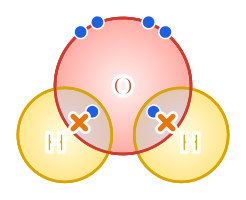 Covalent bonding |
|---|---|---|
| Atoms involved | Ionic bonding is between a metal and a non-metal. | Covalent bonding is between non-metal atoms. |
| What happens to the electrons | Electrons are transferred from one atom to the other. | A pair of electrons is shared between the two atoms. |
| Particles formed | Positive ions and negative ions form. | Molecules form (or, for diamond and silicon dioxide, a giant covalent structure), and the atoms stay neutral. |
| What holds the particles together | Electrostatic attraction between oppositely charged ions holds the ions together. | The attraction between the nuclei and the shared pair of electrons holds the atoms together. |
| Noble gas configuration | The ions usually have the electronic configuration of a noble gas. | The atoms in the molecule usually have the electronic configuration of a noble gas. |
The SEAB glossary says “Compare requires candidates to provide both similarities and differences between things or concepts”, so when you compare ionic and covalent bonding, state a similarity as well, which is that the atoms usually reach the electronic configuration of a noble gas.
For SEAB answers, write a shared pair of electrons, and do not write that atoms share electrons without saying that each bond is a pair. supports K324-3.2(a)
Depth: why and how
- Why do two non-metal atoms share electrons instead of transferring them? Both atoms need electrons to fill their outer shells, so neither atom can give electrons away, and sharing lets both of them count the shared pair.
- Why does a shared pair hold two atoms together? The two electrons are attracted to both positive nuclei at the same time, so the electrostatic attraction pulls the nuclei towards the electrons between them.
- Why is a double bond stronger than a single bond? A double bond has two shared pairs of electrons, so there is more attraction between the nuclei and the shared electrons.
- Why do atoms in a molecule keep their own identity? No electrons are lost or gained overall, so each atom stays neutral and the molecule has no overall charge.
- Cross-link to Chemical Bonding and Structure 3.1(b): in ionic bonding the electrons are transferred, so ions form, whereas in covalent bonding the electrons are shared, so molecules form.
Common mistakes
In covalent bonding one atom gives electrons to the other atom.
In covalent bonding two atoms share a pair of electrons, and the shared pair is attracted to both nuclei.
A covalent bond is formed when a single electron is shared between two atoms.
A covalent bond forms when two atoms share a pair of electrons, and the shared pair is attracted to the nuclei of both atoms.
Covalent bonds form between a metal and a non-metal.
Covalent bonds form between non-metal atoms, whereas a metal and a non-metal form an ionic bond.
Atoms in a molecule become ions.
Atoms in a molecule stay neutral, because electrons are shared and not lost or gained.
A covalent bond forms when two non-metal atoms share a pair of electrons, and the bond is the attraction between the nuclei and the shared pair of electrons; the sharing gives each atom the electronic configuration of a noble gas.
Exam check
Q1What is a covalent bond?
- Athe attraction between a positive ion and a negative ion
- Bthe attraction between two nuclei and a shared pair of electrons
- Cthe attraction between positive ions and a sea of electrons
- Dthe transfer of a pair of electrons from one atom to another
Show answer
MCQ answer key B (the attraction between two nuclei and a shared pair of electrons): a covalent bond forms when a pair of electrons is shared, and that pair is attracted to both nuclei.
Q2Which pair of elements bonds by sharing electrons?
- Asodium and chlorine
- Bcarbon and oxygen
- Cmagnesium and oxygen
- Dcalcium and chlorine
Show answer
MCQ answer key B (carbon and oxygen): two non-metals share electrons to form a covalent bond, whereas a metal and a non-metal form an ionic bond.
Q3What is the electronic configuration of each atom in a hydrogen molecule?
- Athe same as neon
- Bthe same as argon
- Cthe same as helium
- Dthe same as a hydrogen atom
Show answer
MCQ answer key C (the same as helium): each hydrogen atom has one electron of its own and shares one pair, so it has two electrons, which is the configuration of helium.
StructuredTwo chlorine atoms bond to form a chlorine molecule.
- State the type of bonding in a chlorine molecule. [1]
- Describe how a covalent bond forms between two chlorine atoms. [2]
- State the noble gas whose electronic configuration each chlorine atom now has. [1]
- State one difference between how a covalent bond and an ionic bond form. [2]
Total: 6 marks
Show mark scheme
(a) 1 mark
- Mark scheme: covalent
(b) 2 marks
- Mark scheme: each atom contributes one electron to a shared pair of electrons
- Mark scheme: the shared pair is attracted to both nuclei
(c) 1 mark
- Mark scheme: argon
(d) 2 marks
- Mark scheme: covalent bonds form by the sharing of a pair of electrons
- Mark scheme: ionic bonds form by the transfer of electrons from a metal atom to a non-metal atom
You've read the free 29%. Unlock the rest of Chapter 3.
Still to read in this chapter:
- Dot-and-cross diagrams of molecules
- Electron arrangements in other molecules
- Properties of covalent substances
- Metallic bonding
- Properties of metals
- Elements, compounds and mixtures
- Alloys
- Recognising metals and alloys in diagrams
- Why alloys differ from pure metals
- Comparing molecular and giant structures
- Diamond and graphite
- Deducing properties from structure and bonding
$9 one-time · all 13 chapters · no subscription
Less than a fast-food meal.
Yours for the whole syllabus.
Premium members get all 13 chapters included.
Notes version 1.0 · Last updated 2 Oct 2026 · Chapter 3 of 13