










Experimental Chemistry
SEAB syllabus topic 1: how to measure, collect gases, separate mixtures and judge purity, with the reasons, the common mistakes, the practical skills and an exam check for every outcome.

Match each apparatus to its quantity, then collect a gas by the method that suits its solubility and density.
Find the property in which the substances differ, then choose filtration, crystallisation, sublimation, distillation, a separating funnel or chromatography.
A pure substance has a sharp melting point, whereas an impure substance melts lower and over a range of temperatures.
Measuring time, temperature, mass and volume
name appropriate apparatus for the measurement of time, temperature, mass and volume; including burettes, pipettes, measuring cylinders and gas syringes
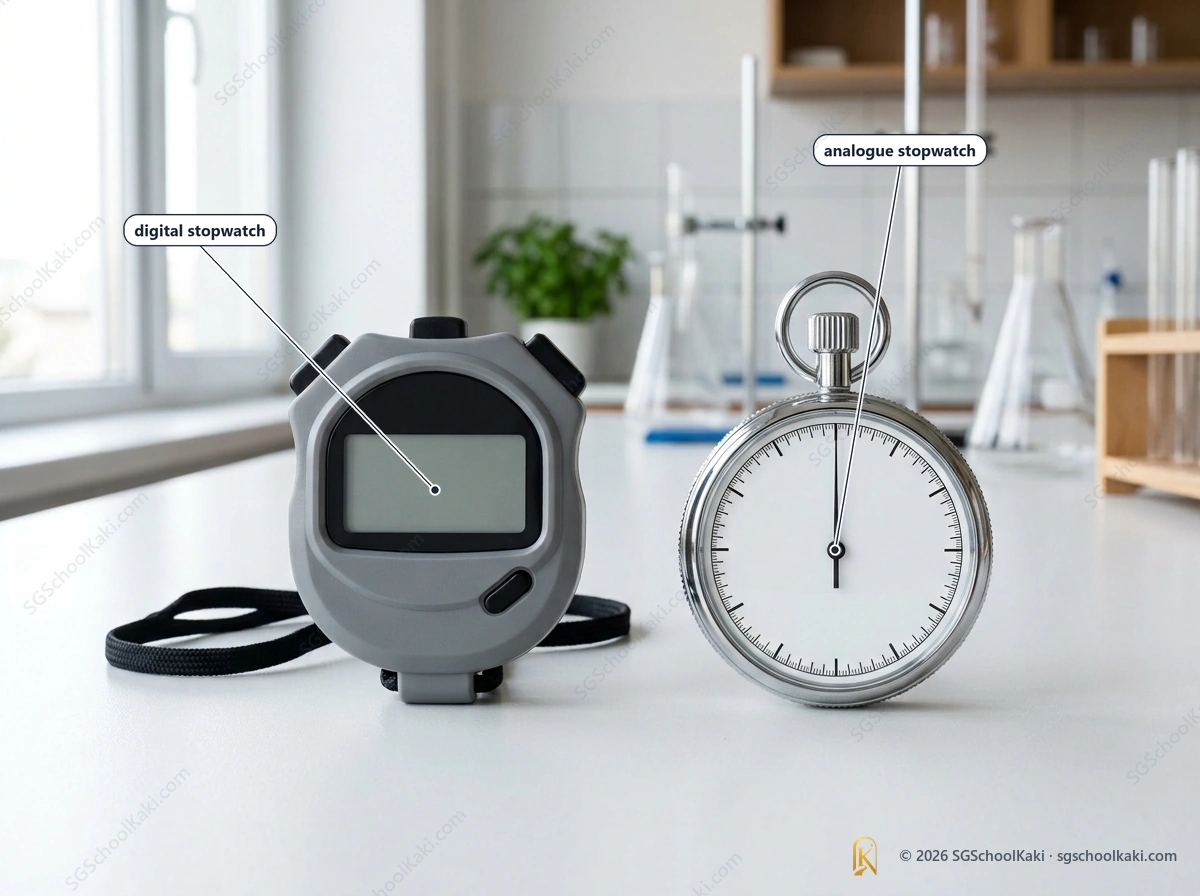
Choose the apparatus that measures the quantity you need and gives the precision the experiment needs: a stopwatch for time, a thermometer for temperature, a balance for mass, and a burette, pipette, measuring cylinder or gas syringe for volume.
- Stopwatch
- Stopwatch: measures time, and the SEAB apparatus list gives an accuracy of about 1 s
- Thermometer
- Thermometer: measures temperature, and the SEAB apparatus list gives a range of −10 °C to +110 °C with 1 °C graduations
- Balance
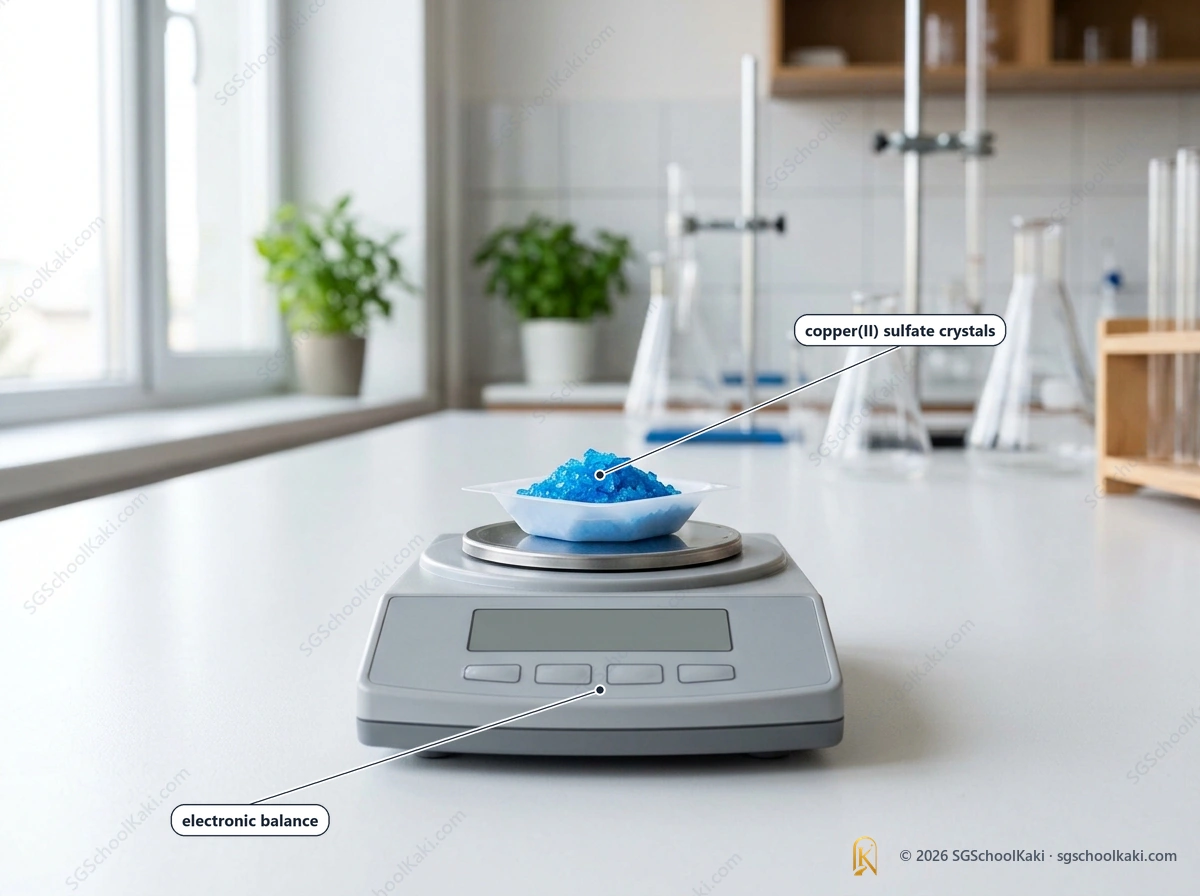
- Balance: measures mass, and the SEAB apparatus list gives a single-pan, direct-reading balance that reads to 0.01 g or better
- Burette
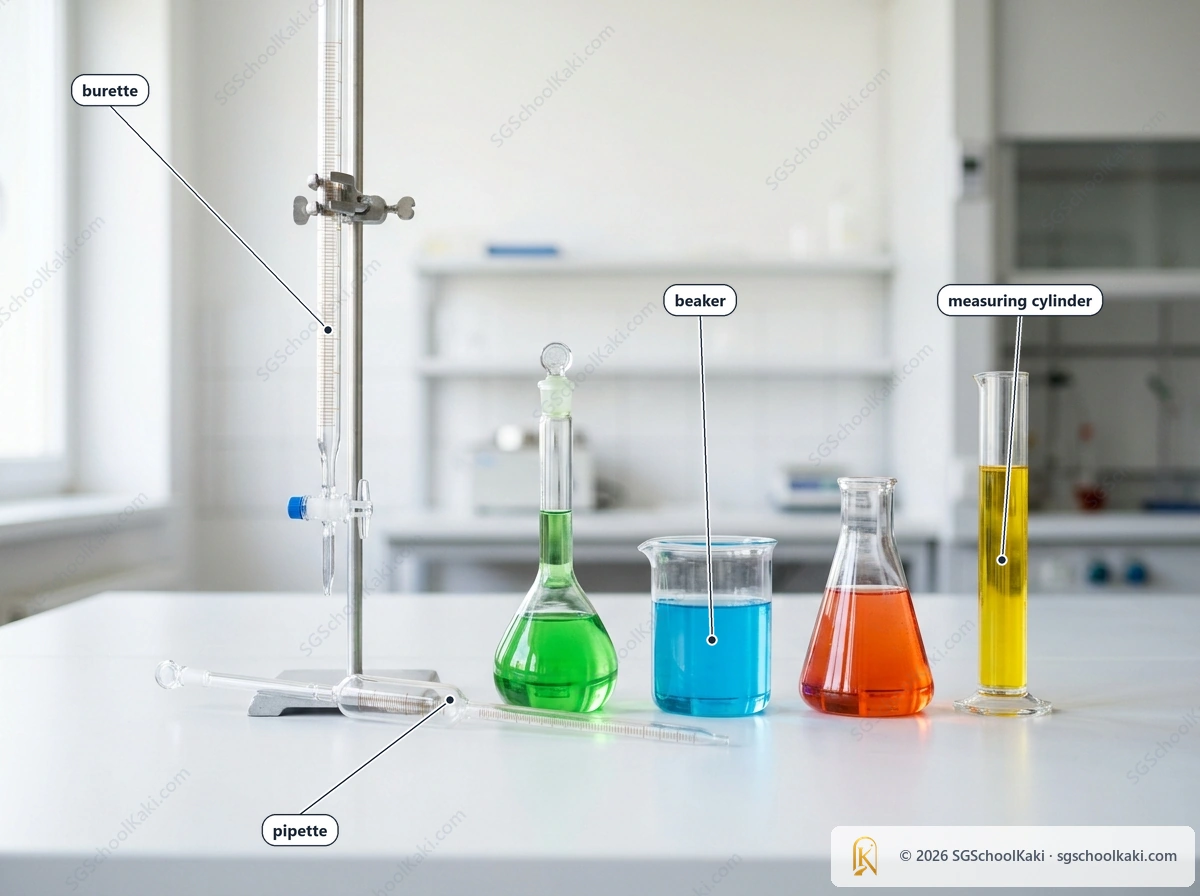
- Burette: a long graduated tube with a tap that delivers a variable volume of liquid, and the SEAB apparatus list gives a size of 50 cm³
- Pipette
- Pipette: measures out one fixed volume of liquid very accurately, such as the 25 cm³ pipette on the SEAB apparatus list, and is used with a pipette filler
- Measuring cylinder
- Measuring cylinder: measures a variable volume of liquid less accurately than a burette or a pipette, and the SEAB apparatus list gives sizes of 10 cm³, 25 cm³, 50 cm³ and 100 cm³
- Gas syringe
- Gas syringe: a graduated syringe that measures the volume of a gas collected in an experiment
- Beaker
- Beaker: holds and heats liquids and gives only a rough measure of volume supports K324-1.1(a)
- Meniscus
- Meniscus: the curved surface of a liquid in a narrow tube, which is read at its lowest point for water and aqueous solutions supports K324-1.1(a)
Which apparatus for which quantity
| Quantity | Picture | Apparatus | Unit | Detail |
|---|---|---|---|---|
| Time |  | A stopwatch measures time. | The unit of time is the second, s. | The SEAB apparatus list gives a stopwatch that measures to an accuracy of about 1 s. |
| Temperature | 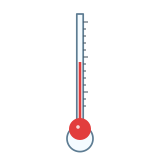 | A thermometer measures temperature. | The unit of temperature is the degree Celsius, °C. | The SEAB apparatus list gives a thermometer from −10 °C to +110 °C with 1 °C graduations. |
| Mass |  | A balance measures mass. | The unit of mass is the gram, g. | The SEAB apparatus list gives a single-pan, direct-reading balance of 0.01 g or better. |
| Length |  | A rule measures length, for example the distance moved by a spot on a chromatogram. | The unit of length used in the laboratory is the centimetre, cm, or the millimetre, mm. | The SEAB glossary says that measure implies a quantity obtained directly from a suitable instrument, such as length using a rule. |
| Volume of a liquid | 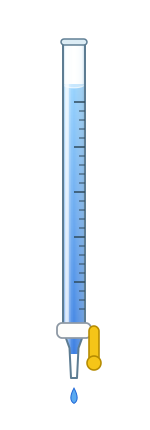 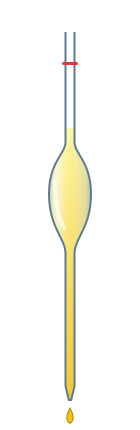 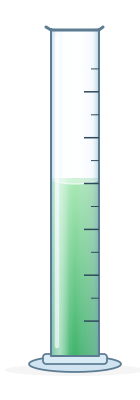 | A burette, a pipette or a measuring cylinder measures the volume of a liquid. | The units of volume are the cubic centimetre, cm³, and the cubic decimetre, dm³. | SEAB uses dm³ in place of litre or l, so write dm³. |
| Volume of a gas | 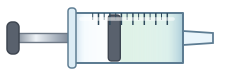 | A gas syringe measures the volume of a gas. | The volume of a gas is also given in cm³ or dm³. | A gas syringe gives the volume directly, so no water is needed to trap the gas. |
Volume-measuring apparatus
| Apparatus | Picture | What it measures | Relative accuracy |
|---|---|---|---|
| Pipette | | A pipette measures one fixed volume of liquid. | more accurate A pipette is more accurate than a measuring cylinder for a fixed volume, so it is used to measure 25.0 cm³ of alkali for a titration. |
| Burette | | A burette delivers any volume of liquid up to its maximum. | more accurate A burette is more accurate than a measuring cylinder for a variable volume, because it is read to the nearest 0.05 cm³. |
| Measuring cylinder | | A measuring cylinder measures a variable volume of liquid. | less accurate A measuring cylinder is less accurate, so it suits quantities that need not be exact, such as the volume of water used to dissolve a solid. |
| Gas syringe | | A gas syringe measures the volume of a gas. | reads directly A gas syringe reads the volume of gas directly from its scale. |
| Beaker | 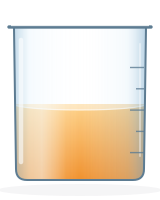 | A beaker holds liquid and has a rough scale. | least accurate A beaker is the least accurate, so use it as a rough measure only. |
Burette readings are normally recorded to the nearest 0.05 cm³, so a reading has two decimal places and ends in 0 or 5. supports K324-1.1(a)

Reading and recording a measurement
- 1Place the apparatus on a flat surface, or hold a burette upright in a stand and clamp.
- 2Put your eye level with the lowest point of the meniscus so that you do not read the scale from above or below.
- 3Read the scale at the lowest point of the meniscus for water and aqueous solutions.
- 4Record the reading with the unit and with the number of decimal places that the apparatus allows.

Chemical calculations need volumes in dm³, so convert cm³ to dm³ by dividing by 1000, because 1 dm³ = 1000 cm³: for example, 25.0 cm³ = 25.0 ÷ 1000 = 0.0250 dm³. supports K324-1.1(a)
The SEAB glossary says “Measure implies that the quantity concerned can be directly obtained from a suitable measuring instrument”, so for a measure question name the instrument and the unit.
Depth: why and how
- Why is a pipette used for the alkali and a burette for the acid in a titration? The pipette delivers one exact volume of alkali each time, and the burette delivers a variable volume of acid that is read before and after.
- Why is a gas syringe better than a measuring cylinder for measuring a gas? It reads the volume of the gas directly from the scale, and the gas does not have to be collected over water.
- Why does the same apparatus need a stopwatch as well as a measuring device in a rate experiment? Rate depends on how much changes in a given time, so both the quantity and the time must be measured.
- Why must the unit be written with every measurement? A number without a unit does not show whether it is a time, a mass or a volume, and SEAB warns that failure to quote units where necessary is liable to be penalised.
- Cross-link to Chemical Calculations: the volume read from a burette or pipette in cm³ must be converted to dm³ before it is used with a concentration in mol/dm³.
Common mistakes
A burette is read to the nearest 0.1 cm³.
Burette readings are normally recorded to the nearest 0.05 cm³, so a reading ends in 0 or 5 in the second decimal place.
A measuring cylinder is the best apparatus for 25.0 cm³ of alkali in a titration.
A pipette measures a fixed volume such as 25 cm³ more accurately than a measuring cylinder.
A beaker gives an accurate volume because it has a scale.
A beaker gives only a rough volume, so use a pipette, a burette or a measuring cylinder when the volume matters.
Read the meniscus from above the liquid.
Read the meniscus with your eye level with its lowest point.
Match the apparatus to the quantity and the precision needed, and record the unit with every reading.
Exam check
Q1Which apparatus measures 25 cm³ of a liquid most accurately?
- Ameasuring cylinder
- Bbeaker
- Cgas syringe
- Dpipette
Show answer
MCQ answer key D (pipette): a pipette delivers one fixed volume very accurately, whereas a measuring cylinder is less accurate, a beaker is only a rough measure and a gas syringe measures gas.
Q2To what precision are burette readings normally recorded?
- Ato the nearest 1 cm³
- Bto the nearest 0.5 cm³
- Cto the nearest 5 cm³
- Dto the nearest 0.05 cm³
Show answer
MCQ answer key D (to the nearest 0.05 cm³): SEAB expects burette readings to be recorded to the nearest 0.05 cm³.
Q3Which apparatus measures the volume of a gas given off in a reaction?
- Agas syringe
- Bpipette
- Cbalance
- Dfilter funnel
Show answer
MCQ answer key A (gas syringe): a gas syringe reads the volume of a gas directly, whereas a pipette measures liquid, a balance measures mass and a filter funnel does not measure.
StructuredA student plans to find how quickly magnesium reacts with dilute hydrochloric acid, using the reaction Mg(s) + 2HCl(aq) → MgCl2(aq) + H2(g)
- Name the apparatus used to measure the time taken. [1]
- Name the apparatus that measures 25.0 cm³ of the acid most accurately. [1]
- Name the apparatus that measures the volume of hydrogen produced. [1]
- Convert 25.0 cm³ into dm³. [1]
- Explain why a pipette is better than a measuring cylinder for the acid. [2]
Total: 6 marks
Show mark scheme
(a) 1 mark
- Mark scheme: stopwatch
(b) 1 mark
- Mark scheme: pipette
(c) 1 mark
- Mark scheme: gas syringe
(d) 1 mark
- Mark scheme: 25.0 ÷ 1000 = 0.0250 dm³
(e) 2 marks
- Mark scheme: a pipette measures a fixed volume more accurately
- Mark scheme: so the volume of acid is the same in every experiment
Apparatus for gases and rates of reaction
suggest suitable apparatus, given relevant information, for a variety of simple experiments, including drying and collection of gases and measurement of rates of reaction (drying agents will be limited to calcium oxide, concentrated sulfuric acid and fused calcium chloride).
Collect a gas over water if it is poorly soluble in water, by downward delivery if it is denser than air and by upward delivery if it is less dense than air, and dry it first, when a dry gas is needed, with a drying agent that does not react with it.
- Collection over water
- Collection over water: a method in which a gas pushes water out of an inverted container, and it suits a gas that is poorly soluble in water supports K324-1.1(b)
- Downward delivery
- Downward delivery: a method in which a gas enters an upright gas jar and pushes the air upward out of it, and it suits a gas that is denser than air supports K324-1.1(b)
- Upward delivery
- Upward delivery: a method in which a gas enters an inverted container and pushes the air downward out of it, and it suits a gas that is less dense than air supports K324-1.1(b)
- Drying agent
- Drying agent: a substance that removes water vapour from a gas, and SEAB limits the drying agents to calcium oxide, concentrated sulfuric acid and fused calcium chloride
- Gas syringe
- Gas syringe: a graduated syringe that collects a gas and measures its volume, so it is used to follow the speed of a reaction that produces a gas supports K324-1.1(b)
- Delivery tube
- Delivery tube: a tube that carries a gas from the reaction vessel to the collecting apparatus or the drying agent supports K324-1.1(b)
- Acidic gas
- Acidic gas: a gas such as carbon dioxide, sulfur dioxide, chlorine or hydrogen chloride that dissolves in water to give an acidic solution supports K324-1.1(b)
- Basic gas
- Basic gas: a gas such as ammonia that dissolves in water to give an alkaline solution supports K324-1.1(b)
Choosing how to collect a gas
| Method | Apparatus | Use it when the gas is | Examples | Notes |
|---|---|---|---|---|
| Over water | 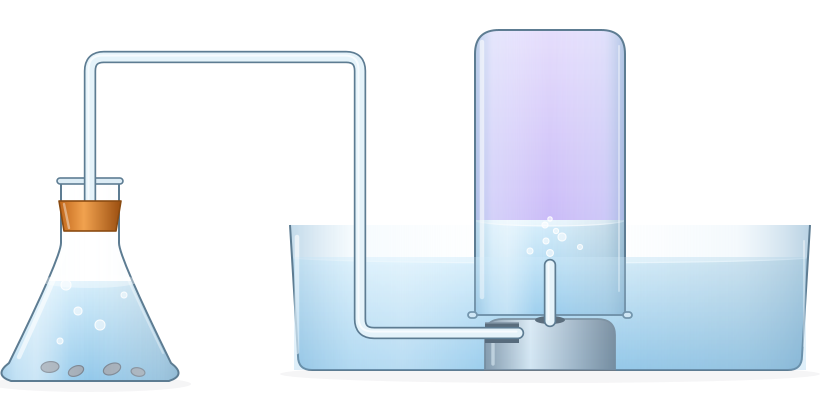 | The gas is poorly soluble in water. | Hydrogen and oxygen are collected over water. | A gas collected over water is wet, so it needs drying if a dry gas is required. |
| Downward delivery | 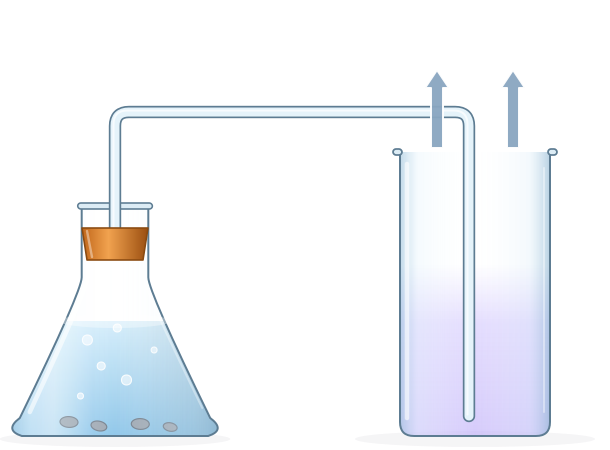 | The gas is denser than air. | Carbon dioxide, with Mr 44, and chlorine, with Mr 71, are collected by downward delivery. | Hydrogen chloride, with Mr 36.5, and sulfur dioxide, with Mr 64, are soluble in water, so they are collected by downward delivery and not over water. |
| Upward delivery | 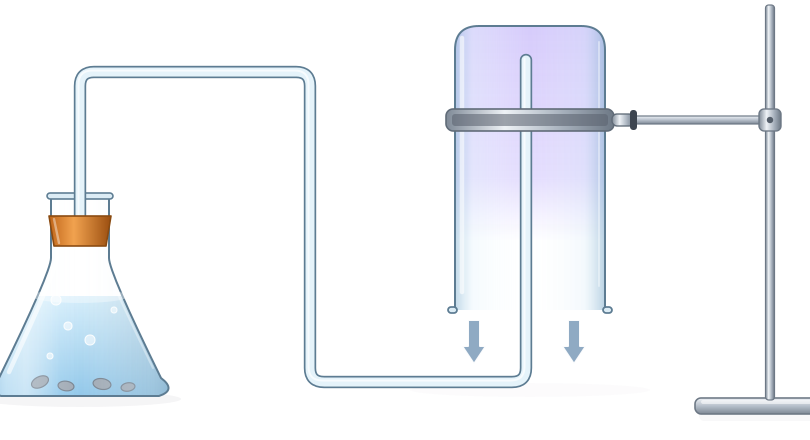 | The gas is less dense than air. | Ammonia, with Mr 17, and hydrogen, with Mr 2, are collected by upward delivery. | Ammonia is very soluble in water, so it must not be collected over water. |
Air is mainly nitrogen, with Mr 28, and oxygen, with Mr 32, so a gas with Mr greater than 32 is denser than air and a gas with Mr less than 28 is less dense than air. supports K324-1.1(b)


Ice Drops Late
A gas that is poorly soluble in water is collected over water, a gas denser than air by downward delivery and a gas lighter than air by upward delivery.Key: I is In water: the gas is poorly soluble in water, D is denser than air and L is lighter than air. Check solubility first, because a very soluble gas is never collected over water.Drying a gas
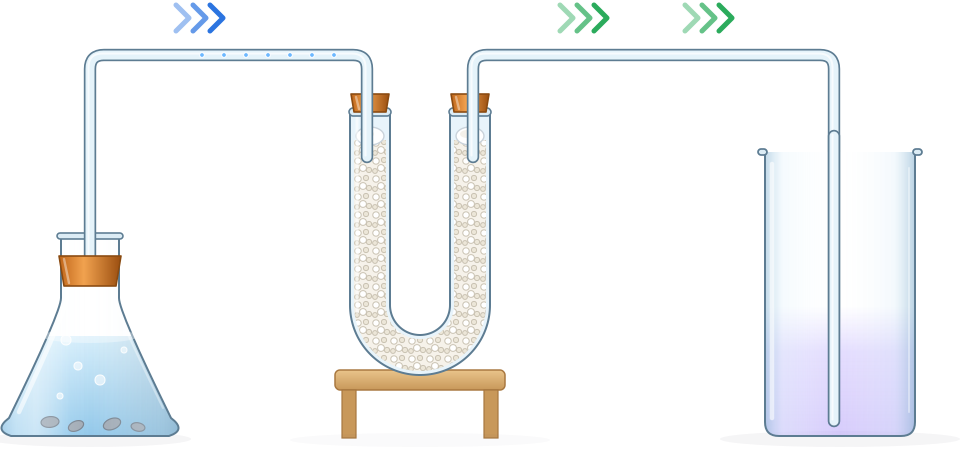
| Drying agent | Gases it can dry | Gases it cannot dry | Reason |
|---|---|---|---|
| Concentrated sulfuric acid | Concentrated sulfuric acid dries neutral and acidic gases such as hydrogen, oxygen, carbon dioxide and chlorine. | Concentrated sulfuric acid cannot dry ammonia. | The acid reacts with ammonia, which is a basic gas. |
| Calcium oxide | Calcium oxide dries ammonia and neutral gases such as hydrogen and oxygen. | Calcium oxide cannot dry acidic gases such as carbon dioxide and hydrogen chloride. | Calcium oxide is a basic oxide, so it reacts with acidic gases. |
| Fused calcium chloride | Fused calcium chloride dries neutral and acidic gases such as hydrogen, oxygen, carbon dioxide and hydrogen chloride. | Fused calcium chloride cannot dry ammonia. | Calcium chloride combines with ammonia. |
2NH3(g) + H2SO4(l) → (NH4)2SO4(s)Concentrated sulfuric acid reacts with ammonia, so it cannot dry ammonia.
CaO(s) + CO2(g) → CaCO3(s)Calcium oxide reacts with carbon dioxide, so it cannot dry carbon dioxide.
CaO(s) + 2HCl(g) → CaCl2(s) + H2O(l)Calcium oxide reacts with hydrogen chloride, so it cannot dry hydrogen chloride.
CaO(s) + H2O(g) → Ca(OH)2(s)Calcium oxide removes water vapour by reacting with it, which is how it dries a gas such as ammonia.
Preparing and collecting gases
Zn(s) + 2HCl(aq) → ZnCl2(aq) + H2(g)Hydrogen is poorly soluble in water, so it can be collected over water.
2H2O2(aq) → 2H2O(l) + O2(g)Manganese(IV) oxide catalyses this reaction, and oxygen is poorly soluble in water, so it is collected over water.
CaCO3(s) + 2HCl(aq) → CaCl2(aq) + H2O(l) + CO2(g)Carbon dioxide is denser than air, so it is collected by downward delivery.
2NH4Cl(s) + Ca(OH)2(s) → CaCl2(s) + 2H2O(g) + 2NH3(g)Ammonia is dried with calcium oxide and collected by upward delivery because it is less dense than air.
Following the speed of a reaction
| What is measured | Picture | Apparatus | Example |
|---|---|---|---|
| Volume of gas produced against time | | A gas syringe or an inverted measuring cylinder over water, with a stopwatch, measures the volume of gas produced against time. | Magnesium reacting with dilute hydrochloric acid produces hydrogen that is collected in a gas syringe. |
| Mass lost against time | | A balance and a stopwatch measure the mass lost when a gas escapes from the reaction mixture. | Marble chips reacting with dilute hydrochloric acid lose mass as carbon dioxide escapes, and a cotton wool plug stops spray leaving the flask. |
| Time for a change to happen | | A stopwatch measures the time taken for a change such as a mixture turning cloudy so that a cross under the flask can no longer be seen. | Dilute acid is added to a solution that turns cloudy, and the stopwatch records the time taken until a cross under the flask can no longer be seen. |
| Temperature of the mixture | | A thermometer measures the temperature of the mixture. | The temperature is recorded, or kept the same as a controlled variable, during the experiment. |
The SEAB glossary says “Suggest is used in two main contexts, i.e. either to imply that there is no unique answer, or to imply that candidates are expected to apply their general knowledge to a ‘novel’ situation”, so for an unfamiliar gas use its solubility, its density compared with air and whether it is acidic or basic.
Depth: why and how
- Why can hydrogen chloride not be collected over water? It is very soluble in water, so it would dissolve in the water instead of collecting as a gas.
- Why does a gas collected over water need drying? The gas is in contact with liquid water, so it carries water vapour.
- Why is calcium oxide suitable for drying ammonia but not carbon dioxide? Calcium oxide is a basic oxide, so it reacts with the acidic gas carbon dioxide but not with the basic gas ammonia.
- Why is concentrated sulfuric acid not used to dry ammonia? The acid reacts with ammonia to form ammonium sulfate, so the gas would be lost.
- How do you decide whether a gas is denser than air? Compare its Mr with the Mr of nitrogen and oxygen, the main gases in air.
- Cross-link to Rate of Reactions: the gas syringe, the balance and the stopwatch in this topic are the apparatus used to follow the speed of a reaction.
- Cross-link to Acid-Base Chemistry: ammonia is a basic gas, so it is dried with calcium oxide and not with concentrated sulfuric acid; it is very soluble in water, so it is not collected over water; and it is less dense than air, so it is collected by upward delivery.
Common mistakes
Ammonia is collected by downward delivery.
Ammonia is less dense than air, so it is collected by upward delivery, and it is not collected over water because it is very soluble.
Concentrated sulfuric acid dries every gas.
Concentrated sulfuric acid cannot dry ammonia, because the acid reacts with the basic gas.
Calcium oxide can dry carbon dioxide.
Calcium oxide reacts with acidic gases such as carbon dioxide, so it cannot dry them.
A gas collected over water is dry.
A gas collected over water is wet, so it must be dried if a dry gas is needed.
Match the collection method to the solubility and density of the gas, and choose a drying agent that does not react with it.
Exam check
Q1Which gas is collected by upward delivery?
- Acarbon dioxide
- Bchlorine
- Csulfur dioxide
- Dammonia
Show answer
MCQ answer key D (ammonia): ammonia, with Mr 17, is less dense than air, whereas carbon dioxide, chlorine and sulfur dioxide are denser than air.
Q2Which drying agent can be used to dry ammonia?
- Aconcentrated sulfuric acid
- Bfused calcium chloride
- Ccalcium oxide
- Ddilute sulfuric acid
Show answer
MCQ answer key C (calcium oxide): calcium oxide is a basic oxide that does not react with ammonia, whereas concentrated sulfuric acid reacts with it, fused calcium chloride combines with it and dilute sulfuric acid contains water.
Q3Hydrogen chloride is soluble in water and denser than air. How is a dry gas jar of hydrogen chloride collected?
- Adownward delivery after drying with concentrated sulfuric acid
- Bover water
- Cupward delivery after drying with calcium oxide
- Ddownward delivery after drying with calcium oxide
Show answer
MCQ answer key A (downward delivery after drying with concentrated sulfuric acid): the gas is denser than air, so it is collected by downward delivery, and concentrated sulfuric acid dries it, whereas calcium oxide reacts with it and water would dissolve it.
StructuredDry ammonia is made by heating ammonium chloride with calcium hydroxide, using the reaction 2NH4Cl(s) + Ca(OH)2(s) → CaCl2(s) + 2H2O(g) + 2NH3(g)
- Name a suitable drying agent for the ammonia. [1]
- Explain why concentrated sulfuric acid is not suitable. [2]
- State how dry ammonia is collected and explain why. [2]
- Explain why ammonia is not collected over water. [1]
Total: 6 marks
Show mark scheme
(a) 1 mark
- Mark scheme: calcium oxide
(b) 2 marks
- Mark scheme: ammonia is a basic gas
- Mark scheme: so it reacts with the acid
(c) 2 marks
- Mark scheme: by upward delivery
- Mark scheme: because ammonia is less dense than air
(d) 1 mark
- Mark scheme: ammonia is very soluble in water
You've read the free 28%. Unlock the rest of Chapter 1.
Still to read in this chapter:
- Methods of separation and purification
- Choosing a separation method
- Paper chromatograms and Rf values
- Locating agents
- Melting point, boiling point and purity
- Why purity matters in everyday life
- Practical skills
$9 one-time · all 13 chapters · no subscription
Less than a fast-food meal.
Yours for the whole syllabus.
Premium members get all 13 chapters included.
Notes version 1.0 · Last updated 2 Oct 2026 · Chapter 1 of 13