










Rate of Reactions
SEAB syllabus topic 10: what makes a reaction faster or slower, how catalysts and enzymes work, how to investigate a rate and how to read rate data, with the reasons, the common mistakes and an exam check for every outcome.

A reaction goes faster when there are more effective collisions in each second, which a higher concentration, a higher pressure of a gas, smaller pieces of solid and a higher temperature all give.
A catalyst gives the reaction a pathway with a lower activation energy and is chemically unchanged at the end, and enzymes are the biological catalysts.
Rates are followed by gas volume, mass loss or the time for a cross to disappear, and on a graph a steeper line means a faster rate and a flat line means the reaction has stopped.
Factors that change the rate
describe the effect of concentration, pressure, particle size and temperature on the rates of reactions and explain these effects in terms of collisions between reacting particles
A reaction happens when particles collide with at least the activation energy and in a suitable orientation, so the rate of a reaction depends on the number of effective collisions in each second, and concentration, pressure, particle size and temperature all change that number.
- Rate of reaction
- Rate of reaction: how quickly the reactants are used up or the products are formed, shown by the change in an amount for each unit of time
- Collision
- Collision: an event in which two reacting particles hit each other, which must happen before a reaction can take place
- Effective collision
- Effective collision: a collision in which the particles have at least the activation energy and meet in a suitable orientation, so that a reaction takes place
- Activation energy
- Activation energy: the minimum energy that colliding particles must have for a reaction to take place supports K324-10(c)
- Concentration
- Concentration: the amount of a dissolved substance in a given volume of solution
- Pressure of a gas
- Pressure of a gas: the force of the gas particles on the walls of the container, and when a gas is squeezed into a smaller volume the same particles are closer together, so the pressure is higher
- Particle size
- Particle size: the size of the pieces of a solid, and smaller pieces give a larger surface area for the same mass
- Temperature
- Temperature: a measure of the average kinetic energy of the particles
Factors that change the rate
| Change that is made | Picture | Effect on the rate | Explanation in terms of collisions |
|---|---|---|---|
| A higher concentration of a solution | 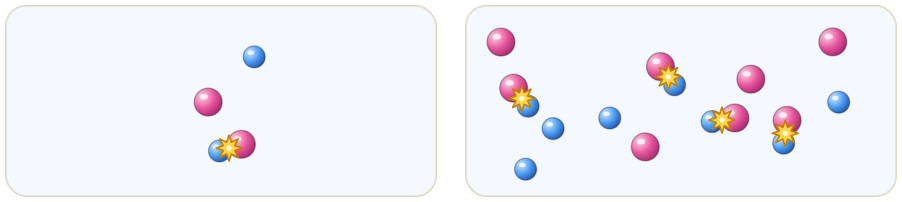 | A higher concentration increases the rate. | There are more reacting particles in the same volume, so the particles collide more often and there are more effective collisions in each second. |
| A higher pressure of a gas | 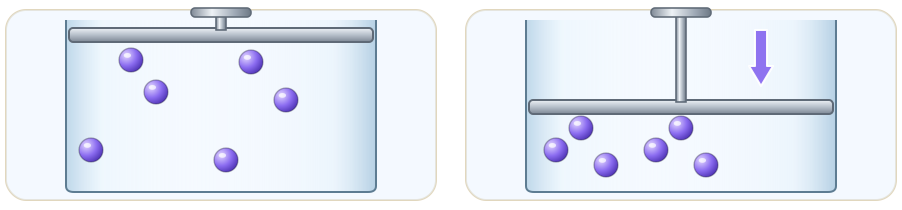 | A higher pressure increases the rate of a reaction that involves gases. | The gas particles are squeezed into a smaller volume, so they are closer together, collide more often and there are more effective collisions in each second. |
| Smaller particles of a solid, with the same mass | 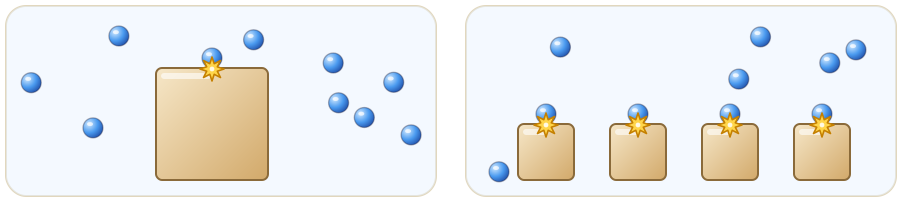 | Smaller particles increase the rate. | The solid has a larger surface area, so more of its particles can be hit by the other reactant at the same time and there are more effective collisions in each second. |
| A higher temperature | 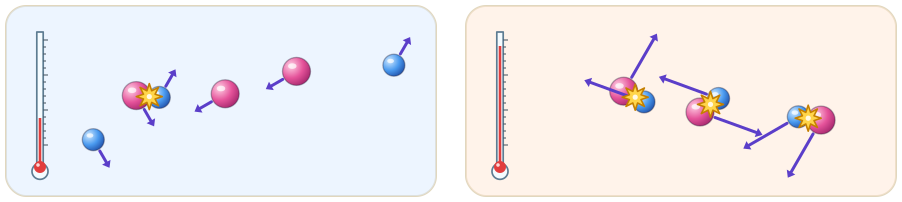 | A higher temperature increases the rate. | The particles move faster, so they collide more often, and a greater proportion of the collisions have at least the activation energy, so there are more effective collisions in each second. |
| Adding a catalyst | 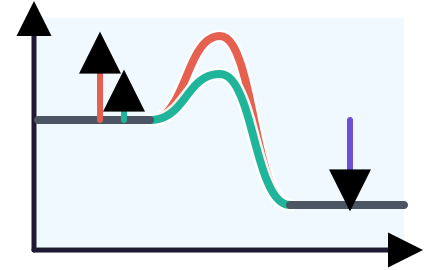 | A catalyst increases the rate. | A catalyst gives a pathway with a lower activation energy, so a greater proportion of the collisions are effective, as explained in outcome 10(c). |
Pressure and temperature in more detail
Pressure changes the rate of a reaction only when gases are involved, because the volume of a solid or a liquid hardly changes when the pressure changes, so changing the pressure of a reaction between solids and liquids has no useful effect. supports K324-10(a)
A higher temperature has two effects, because the particles collide more often and a greater proportion of the collisions have at least the activation energy, and the second effect is the larger one. supports K324-10(a)
K324 10(a) names four factors, and the catalyst row is in the table for comparison and is tested under outcomes 10(b) and 10(c). supports K324-10(b)
CaCO3(s) + 2HCl(aq) → CaCl2(aq) + H2O(l) + CO2(g)Marble chips, which are calcium carbonate, react with dilute hydrochloric acid to give carbon dioxide gas, so the speed of the reaction can be followed.
Mg(s) + 2HCl(aq) → MgCl2(aq) + H2(g)Magnesium reacts with dilute hydrochloric acid to give hydrogen gas, which is another reaction whose rate is easy to measure.
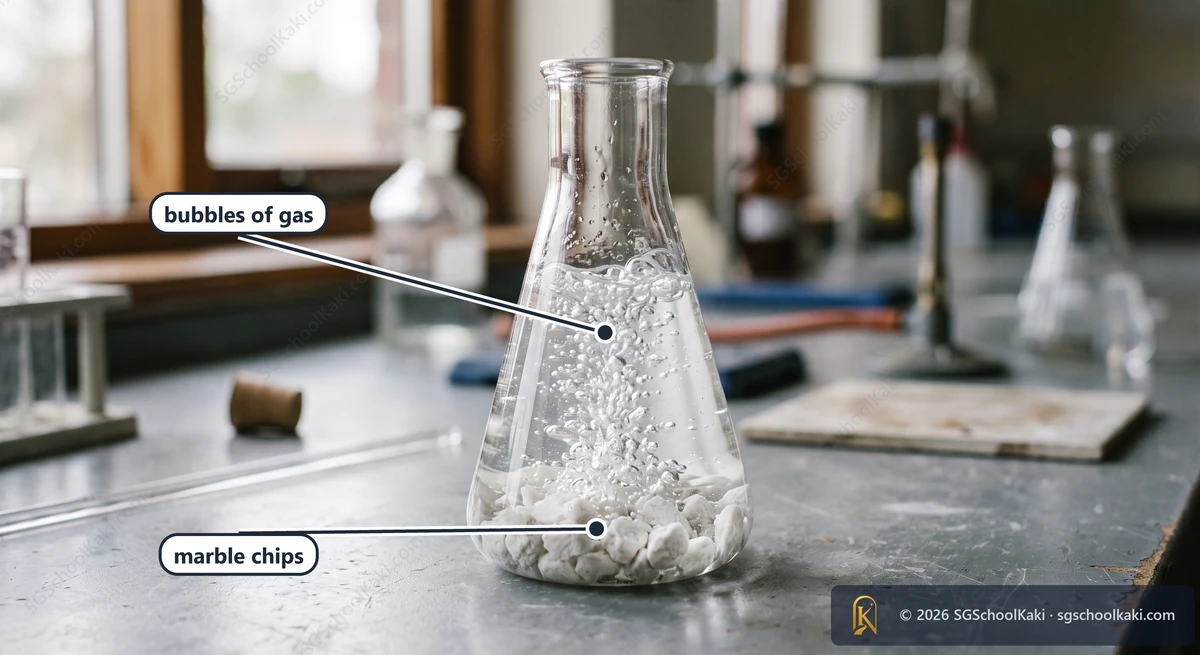
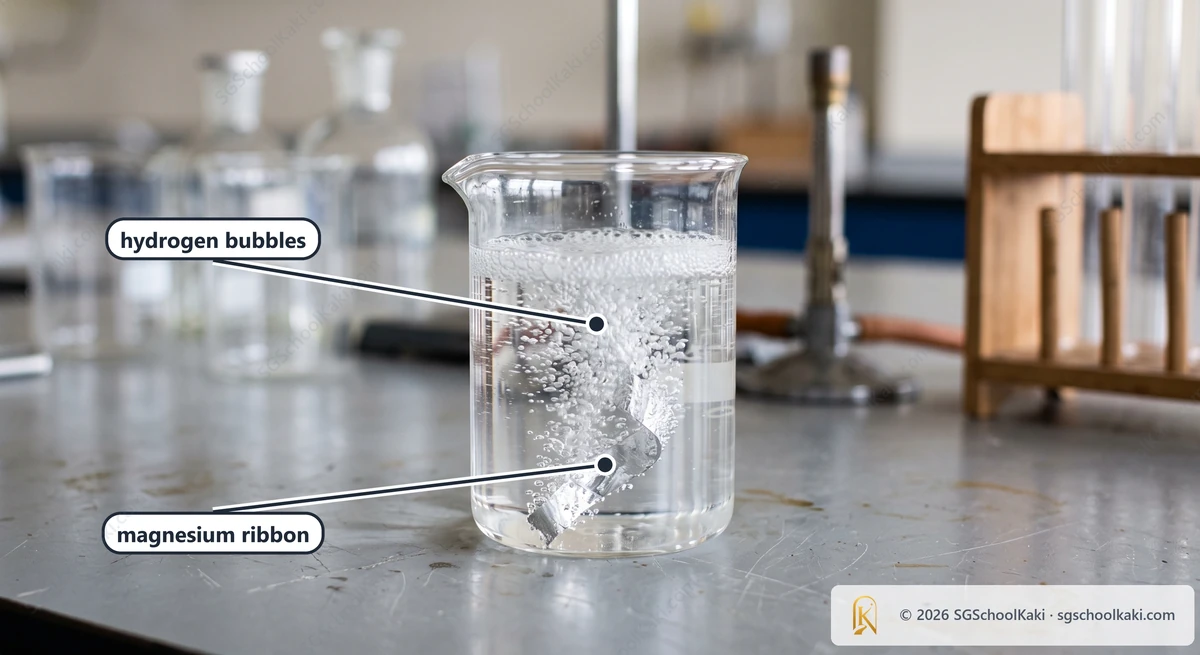

The SEAB glossary says “Explain may imply reasoning or some reference to theory, depending on the context”, so when you explain a change in rate, link it to the number of effective collisions in each second and do not stop at saying that the particles collide more.
Cats Prefer Pizza Today
K324 10(a) names concentration, pressure, particle size and temperature as the four factors whose effect on the rate of a reaction you must describe and explain.Key: C is concentration, the first P is pressure, the second P is particle size and T is temperature.Depth: why and how
- Why does a higher concentration increase the rate? There are more reacting particles in every unit of volume, so each particle meets another reacting particle more often.
- Why do powders react faster than lumps? Only the particles at the surface of a solid can be hit by the other reactant, so smaller pieces expose more particles for the same mass.
- Why does a small rise in temperature have a large effect on the rate? The particles move faster and collide more often, and a much greater proportion of them have at least the activation energy, so the number of effective collisions rises a lot.
- Why does a collision have to be effective? Many collisions are too gentle to break the bonds in the reactants, and particles that meet in an unsuitable orientation do not react, so only some collisions lead to a reaction.
- Why does a reaction slow down as it goes on? The reactants are used up, so their concentration falls and effective collisions happen less often.
- Cross-link to Chemical Energetics: the activation energy is the energy barrier that is shown as the peak on an energy profile diagram, and a higher temperature helps more particles to get over it.
Common mistakes
A higher temperature only makes the particles collide more often.
A higher temperature makes the particles collide more often, and a greater proportion of the collisions have at least the activation energy.
A higher concentration gives each particle more energy.
A higher concentration puts more particles into the same volume, so collisions are more frequent, but the energy of each particle does not change.
Increasing the pressure speeds up every reaction.
Increasing the pressure speeds up a reaction only when gases are involved.
A powder reacts faster because its particles have more energy.
A powder reacts faster because it has a larger surface area, so more of its particles can be hit by the other reactant at the same time.
A higher concentration, a higher pressure of a gas, smaller pieces of a solid and a higher temperature all increase the rate by increasing the number of effective collisions in each second.
Exam check
Q1Marble chips react with dilute hydrochloric acid. Which change increases the rate by giving the solid a larger surface area?
- Acrushing the marble chips into a powder
- Busing the same mass of larger marble chips
- Cusing a lower temperature
- Ddiluting the acid with water
Show answer
MCQ answer key A (crushing the marble chips into a powder): a powder has a larger surface area than lumps of the same mass, so more particles collide with the acid in each second, whereas using larger pieces gives a smaller surface area, a lower temperature slows the particles and diluting the acid lowers its concentration.
Q2Why does increasing the pressure of a mixture of gases increase the rate of a reaction between them?
- AEach gas particle has more energy.
- BThe activation energy decreases.
- CThe gas particles become larger.
- DThe gas particles are closer together, so there are more effective collisions in each second.
Show answer
MCQ answer key D (The gas particles are closer together, so there are more effective collisions in each second.): squeezing the gas into a smaller volume puts the particles closer together, so collisions are more frequent and there are more effective collisions in each second, whereas pressure does not change the energy of a particle or the activation energy.
Q3In an experiment, a student obtained times of 52 s, 27 s and 14 s for a cross to disappear at 20 °C, 30 °C and 40 °C. Which conclusion is correct?
- AA higher temperature gives a faster reaction.
- BThe rate does not depend on the temperature.
- CThe reaction at 20 °C is the fastest.
- DThe reaction at 40 °C takes the longest time.
Show answer
MCQ answer key A (A higher temperature gives a faster reaction.): the time for the cross to disappear falls from 52 s to 27 s to 14 s as the temperature rises, so the rate increases with temperature.
StructuredMagnesium reacts with dilute hydrochloric acid and hydrogen gas is given off.
- Construct the equation, with state symbols, for the reaction. [2]
- State the effect on the rate of using a more concentrated acid. [1]
- Explain, in terms of collisions, why the rate changes when a more concentrated acid is used. [2]
- Magnesium powder is used instead of magnesium ribbon of the same mass. State and explain the effect on the rate. [3]
Total: 8 marks
Show mark scheme
(a) 2 marks
- Mark scheme: the formulae of the reactants and the products are correct
- Mark scheme: the equation is balanced and has the state symbols: Mg(s) + 2HCl(aq) → MgCl2(aq) + H2(g)
(b) 1 mark
- Mark scheme: the rate increases, so the reaction is faster
(c) 2 marks
- Mark scheme: there are more acid particles in the same volume
- Mark scheme: so the particles collide more often and there are more effective collisions in each second
(d) 3 marks
- Mark scheme: the rate increases
- Mark scheme: the powder has a larger surface area
- Mark scheme: so more magnesium particles can be hit by acid particles at the same time and effective collisions are more frequent
Catalysts and enzymes
define the term catalyst and describe the effect of catalysts (including enzymes) on the rates of reactions
A catalyst speeds up a reaction by increasing its rate and is chemically unchanged at the end of the reaction, and enzymes are catalysts that are made by living things.
- Catalyst
- Catalyst: a substance that increases the rate of a reaction and is chemically unchanged at the end of the reaction
- Catalysed reaction
- Catalysed reaction: a reaction that takes place in the presence of a catalyst
- Uncatalysed reaction
- Uncatalysed reaction: the same reaction when no catalyst is present, which is slower
- Enzyme
- Enzyme: a protein that acts as a biological catalyst, speeding up a reaction in a living thing
- Specific
- Specific: an enzyme is specific when it catalyses one reaction or one type of reaction
- Optimum temperature
- Optimum temperature: the temperature at which an enzyme catalyses its reaction fastest
- Optimum pH
- Optimum pH: the pH at which an enzyme catalyses its reaction fastest
- Denatured
- Denatured: an enzyme is denatured when its shape has changed permanently, so it can no longer act as a catalyst
What a catalyst does
| Question | Answer for a catalyst |
|---|---|
| What happens to the rate? | A catalyst increases the rate of the reaction. |
| Is the catalyst used up? | A catalyst is not used up, so it is chemically unchanged at the end and can be used again. |
| Does the amount of product change? | A catalyst does not change the amount of product that is made, because that depends on the amount of the limiting reactant, and it changes only how fast the product forms. |
| Is the catalyst written in the equation? | A catalyst is not written as a reactant or as a product, and its name or formula can be written above the arrow. |
| Is one catalyst suitable for every reaction? | Different reactions need different catalysts, and an enzyme catalyses one reaction or one type of reaction. |
For SEAB answers, write that a catalyst speeds up a reaction and is chemically unchanged at the end, and do not write that a catalyst supplies energy, because it works by giving the reaction a pathway with a lower activation energy. supports K324-10(b)
Enzymes
| Condition | Picture | Effect on an enzyme |
|---|---|---|
| A low temperature |  | At a low temperature an enzyme-catalysed reaction is slow, because the particles have little energy, but the enzyme is not destroyed. |
| The optimum temperature |  | At the optimum temperature the enzyme catalyses its reaction fastest. |
| A high temperature |  | At a high temperature the enzyme is denatured, so its shape changes permanently and it stops working. |
| The optimum pH | | Each enzyme catalyses its reaction fastest at its own optimum pH. |
| A pH far from the optimum | | A pH far from the optimum can denature the enzyme. |
Taught in schools: K324 itself only says that enzymes are biological catalysts, and the table gives the usual qualitative school detail about the effect of temperature and pH. supports K324-10(b)
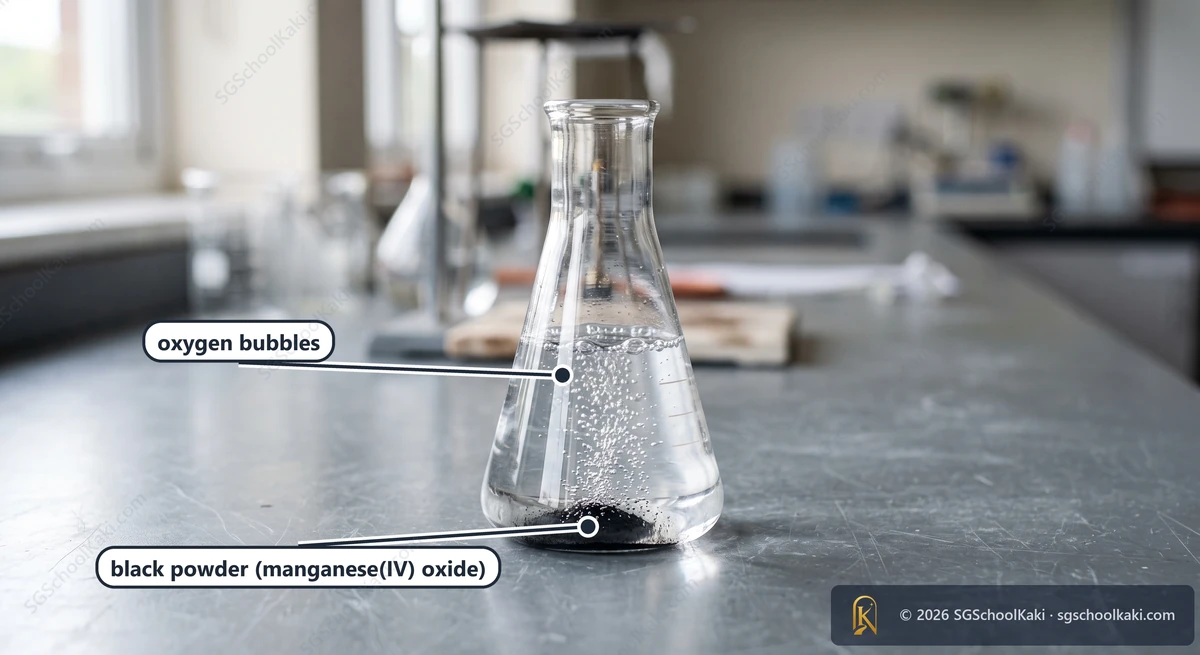
2H2O2(aq) MnO2→ 2H2O(l) + O2(g)Manganese(IV) oxide, or the enzyme catalase that is found in living cells, speeds up the decomposition of hydrogen peroxide, and the catalyst is written above the arrow and not in the equation.

The SEAB glossary says that a definition needs “Only a formal statement or equivalent paraphrase being required”, so define a catalyst in one sentence that says it increases the rate and is chemically unchanged at the end.
Depth: why and how
- Why can a small amount of catalyst speed up a large amount of reactant? The catalyst is not used up, so the same particles of catalyst can help the reaction again and again.
- How can you show that a catalyst is not used up? Filter off the manganese(IV) oxide at the end of the hydrogen peroxide reaction, wash it, dry it and weigh it, and its mass is the same as at the start.
- Why does a catalyst not change the amount of product? The amount of product depends on the amount of the limiting reactant, and a catalyst changes only how fast the reaction goes.
- Why does boiling destroy an enzyme? A high temperature changes the shape of the enzyme molecule permanently, so it can no longer fit its reactant and cannot catalyse the reaction.
- Why can a solid catalyst work better as a powder? The reaction takes place on the surface of the solid catalyst, so a powder, which has a larger surface area, gives more places for the reaction to happen.
- Cross-link to Patterns in the Periodic Table: transition elements and their compounds are often able to act as catalysts.
Common mistakes
A catalyst is used up in the reaction.
A catalyst is not used up, and it is chemically unchanged at the end of the reaction.
A catalyst increases the amount of product.
A catalyst changes the rate only, and the amount of product depends on the amount of the limiting reactant.
A catalyst gives energy to the reacting particles.
A catalyst gives the reaction a pathway with a lower activation energy and does not add energy to the particles.
An enzyme works faster at every higher temperature.
An enzyme works fastest at its optimum temperature, and at a higher temperature it is denatured and stops working.
A catalyst increases the rate and is chemically unchanged at the end, and an enzyme is a biological catalyst that works best at its optimum temperature and pH and is denatured by a high temperature.
Exam check
Q1Which statement defines a catalyst?
- Aa substance that increases the rate of a reaction and is used up
- Ba substance that increases the rate of a reaction and is chemically unchanged at the end
- Ca substance that increases the amount of product that is made
- Da substance that supplies energy to the reactants
Show answer
MCQ answer key B (a substance that increases the rate of a reaction and is chemically unchanged at the end): a catalyst increases the rate without being used up, whereas it does not increase the amount of product and does not supply energy.
Q2Manganese(IV) oxide is added to aqueous hydrogen peroxide and oxygen is given off faster. How does the mass of the manganese(IV) oxide at the end compare with the mass at the start?
- AIt is greater.
- BIt is the same.
- CIt is smaller.
- DIt is zero.
Show answer
MCQ answer key B (It is the same.): a catalyst is chemically unchanged at the end of the reaction, so its mass is the same.
Q3Boiled liver does not make hydrogen peroxide give off bubbles of oxygen, but fresh liver does. Which explanation is correct?
- ABoiling used up the enzyme in the liver.
- BBoiling made the hydrogen peroxide unreactive.
- CBoiling removed the activation energy of the reaction.
- DThe high temperature denatured the enzyme in the liver.
Show answer
MCQ answer key D (The high temperature denatured the enzyme in the liver.): fresh liver contains the enzyme catalase, and boiling changes its shape permanently, so it can no longer catalyse the decomposition.
StructuredManganese(IV) oxide is added to aqueous hydrogen peroxide at room temperature.
- Define the term catalyst. [1]
- State what you would see when the manganese(IV) oxide is added. [1]
- Describe how you could show that the manganese(IV) oxide is not used up. [2]
- Raw potato contains an enzyme that catalyses the same reaction, but boiled potato does not. Explain why. [2]
Total: 6 marks
Show mark scheme
(a) 1 mark
- Mark scheme: a substance that increases the rate of a reaction and is chemically unchanged at the end
(b) 1 mark
- Mark scheme: bubbles of gas (effervescence) are given off, or are given off faster than without the catalyst (accept either, and accept fizzing)
(c) 2 marks
- Mark scheme: filter off, wash and dry the solid
- Mark scheme: weigh it and show that its mass is the same as the mass at the start
(d) 2 marks
- Mark scheme: the high temperature denatured the enzyme in the boiled potato
- Mark scheme: its shape has changed permanently, so it can no longer act as a catalyst
You've read the free 32%. Unlock the rest of Chapter 10.
Still to read in this chapter:
- Activation energy and catalysts
- Industrial catalysts and enzymes
- Investigating the rate of a reaction
- Interpreting rate data
$9 one-time · all 13 chapters · no subscription
Less than a fast-food meal.
Yours for the whole syllabus.
Premium members get all 13 chapters included.
Notes version 1.0 · Last updated 2 Oct 2026 · Chapter 10 of 13