










Organic Chemistry: Fuels and Hydrocarbons
SEAB syllabus topic 11, part 1: fuels and crude oil, then the alkanes and the alkenes, with the reasons, the common mistakes, the practical skills and an exam check for every outcome.

Crude oil is a mixture of hydrocarbons that fractional distillation separates into fractions, which are used as fuels and as a source of chemicals.
Alkanes are saturated hydrocarbons with only single bonds, and they are generally unreactive except for combustion and substitution by chlorine.
Alkenes are unsaturated hydrocarbons with a C=C double bond, so they decolourise aqueous bromine and undergo addition reactions.
Natural gas and crude oil
name natural gas, mainly methane, and crude oil as non-renewable sources of energy
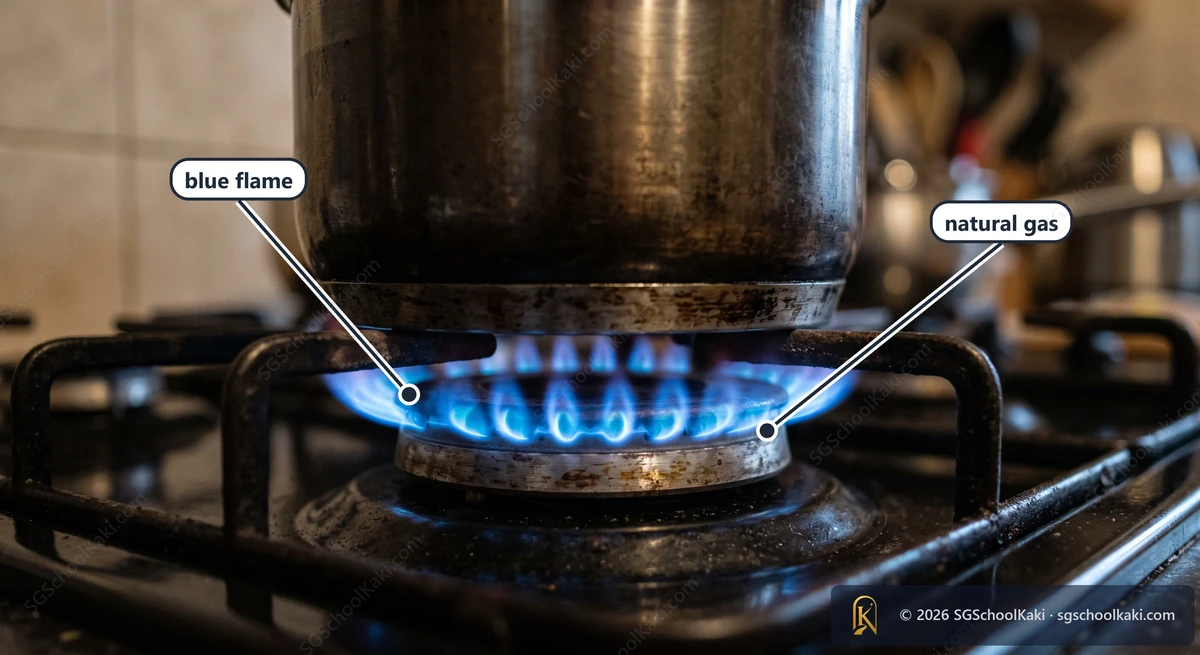
Natural gas, which is mainly methane, and crude oil are non-renewable sources of energy, because they formed over millions of years and are being used up much faster than they can be replaced.
- Natural gas
- Natural gas: a fossil fuel found underground, often with crude oil, that is mainly methane, CH4
- Crude oil
- Crude oil: a thick liquid found underground that is a mixture of hydrocarbons
- Fossil fuel
- Fossil fuel: a fuel, such as coal, crude oil or natural gas, that formed from the remains of ancient living things over millions of years supports K324-11.1(a)
- Non-renewable
- Non-renewable: describes an energy source that is used up faster than it is replaced, so it will eventually run out
- Renewable
- Renewable: describes an energy source that can be replaced as fast as it is used supports K324-11.1(c)
- Hydrocarbon
- Hydrocarbon: a compound that contains hydrogen and carbon only supports K324-11.2(a)
- Combustion
- Combustion: burning in oxygen, which releases energy as heat supports K324-11.1(a)
- Complete combustion
- Complete combustion: burning in excess oxygen, which gives carbon dioxide and water supports K324-11.1(a)
Natural gas and crude oil in use
| Energy source | What it is | Uses as a fuel | Uses as a source of chemicals |
|---|---|---|---|
| Natural gas | Natural gas is mainly methane, CH4. | Natural gas is burned for cooking, for heating and in power stations to generate electricity. | Methane can also be used as a raw material for making other chemicals. |
| Crude oil | Crude oil is a mixture of hydrocarbons. | Crude oil is separated into fuels for cars, lorries, ships and aircraft. | Crude oil also supplies the raw materials for making plastics and many other chemicals. |
Burning fossil fuels
CH4(g) + 2O2(g) → CO2(g) + 2H2O(l)Methane burns in excess oxygen to give carbon dioxide and water, and the reaction releases energy as heat.
Any hydrocarbon fuel burns completely in excess oxygen to give carbon dioxide and water, so burning fossil fuels adds carbon dioxide to the air. supports K324-11.1(a)
The SEAB glossary says “State implies a concise answer with little or no supporting argument”, so when you state why natural gas is non-renewable, write that it takes millions of years to form and is used faster than it is replaced.
Depth: why and how
- Why are natural gas and crude oil called fossil fuels? They formed from the remains of ancient living things that were buried and changed by heat and pressure over millions of years.
- Why does burning a fossil fuel release carbon dioxide? The fuel is a hydrocarbon, so its carbon combines with oxygen to form carbon dioxide and its hydrogen forms water.
- Why is crude oil more than just a fuel? Its hydrocarbons are also the raw material for plastics and many other chemicals, so burning them uses up a resource that has other uses.
- Why do people still depend on natural gas and crude oil? They release a large amount of energy when they burn and they are easy to store and transport.
- Cross-link to Chemical Energetics: combustion is an exothermic reaction, which means that it transfers energy to the surroundings.
- Cross-link to Maintaining Air Quality: burning fossil fuels in a limited supply of oxygen also gives carbon monoxide, which is a harmful pollutant.
Common mistakes
Natural gas is mainly ethane.
Natural gas is mainly methane.
Crude oil is renewable because the Earth keeps making more.
Crude oil is non-renewable because it takes millions of years to form, which is far longer than the time taken to use it.
Crude oil is a single compound.
Crude oil is a mixture of hydrocarbons.
Crude oil is used only as a fuel.
Crude oil is used both as a fuel and as a source of chemicals.
Natural gas, which is mainly methane, and crude oil are non-renewable fossil fuels that release energy when they burn and also supply chemicals.
Exam check
Q1Which substance is the main component of natural gas?
- Aethane
- Bhydrogen
- Cmethane
- Dcarbon monoxide
Show answer
MCQ answer key C (methane): natural gas is mainly methane, CH4, whereas the other substances are not its main component.
Q2Why is crude oil described as a non-renewable source of energy?
- AIt forms over millions of years, much more slowly than it is used.
- BIt cannot be burned more than once.
- CIt is a compound of carbon only.
- DIt is found only under the sea.
Show answer
MCQ answer key A (It forms over millions of years, much more slowly than it is used.): a non-renewable source is used up faster than it is replaced, and crude oil takes millions of years to form.
Q3Which products form when natural gas burns completely in excess oxygen?
- Acarbon monoxide and water
- Bcarbon dioxide and water
- Ccarbon and hydrogen
- Dcarbon dioxide and hydrogen
Show answer
MCQ answer key B (carbon dioxide and water): complete combustion of a hydrocarbon gives carbon dioxide and water, whereas carbon monoxide forms only when the oxygen supply is limited.
StructuredNatural gas and crude oil are used as fuels.
- State the name of the main hydrocarbon in natural gas. [1]
- Explain why natural gas and crude oil are described as non-renewable. [2]
- Write an equation, with state symbols, for the complete combustion of methane. [2]
- State one use of crude oil other than as a fuel. [1]
Total: 6 marks
Show mark scheme
(a) 1 mark
- Mark scheme: methane
(b) 2 marks
- Mark scheme: they take millions of years to form
- Mark scheme: they are used faster than they are replaced, so they will run out
(c) 2 marks
- Mark scheme: CH4(g) + 2O2(g) → CO2(g) + 2H2O(l)
- Mark scheme: all four state symbols are correct
(d) 1 mark
- Mark scheme: as a source of chemicals, such as the raw materials for plastics
Crude oil and fractional distillation
describe crude oil as a mixture of hydrocarbons and its separation by fractional distillation to yield fractions which have competing uses as fuels and as a source of chemicals (see also 1.2(a))
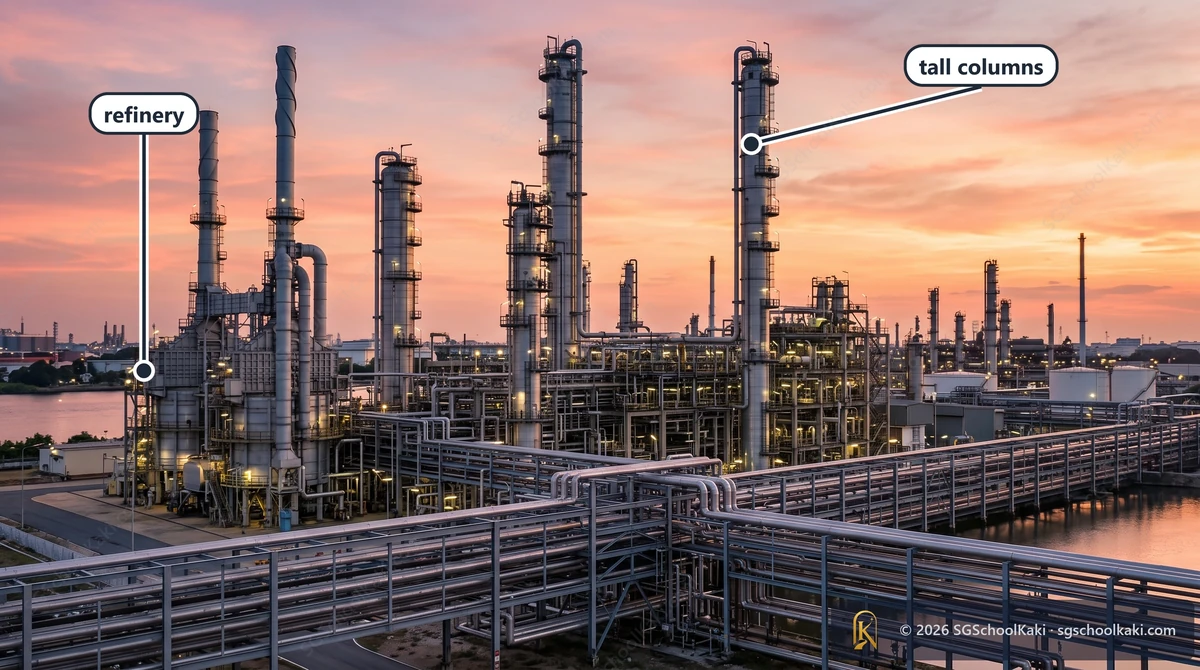
Crude oil is a mixture of hydrocarbons that is separated by fractional distillation into fractions, and the fractions have competing uses as fuels and as a source of chemicals.
- Crude oil
- Crude oil: a mixture of hydrocarbons with molecules of many different sizes
- Fraction
- Fraction: a group of hydrocarbons with boiling points close together that are collected together during fractional distillation
- Fractional distillation
- Fractional distillation: a method that separates a mixture of liquids by their different boiling points supports K324-1.2(a)
- Boiling point
- Boiling point: the temperature at which a liquid changes to a gas throughout the liquid supports K324-1.2(a)
- Competing uses
- Competing uses: different uses for the same hydrocarbons, such as burning them as a fuel or making chemicals from them, so using them for one purpose means they are not available for the other
- Chemical feedstock
- Chemical feedstock: a raw material that is used to make other chemicals, such as plastics supports K324-11.1(b)
- Refinery
- Refinery: a factory where crude oil is separated into fractions and processed supports K324-11.1(b)
Separating crude oil
- 1Crude oil is heated until most of it has turned into vapour.
- 2The hydrocarbons have different boiling points, so they turn back into liquid at different temperatures as the vapour cools.
- 3The liquids that collect together are fractions, and each fraction is a mixture of hydrocarbons with similar boiling points.
| Property | Fractions with small molecules | Fractions with large molecules |
|---|---|---|
| Boiling point | Small molecules have low boiling points. | Large molecules have high boiling points. |
| Attractions between molecules | Small molecules have weak attractions between them. | Large molecules have strong attractions between them. |
| Viscosity | Small molecules form runny liquids. | Large molecules form thick liquids. |
Write crude oil in answers, because K324 11.1(b) uses the term crude oil, whereas older notes call the same mixture petroleum. supports K324-11.1(b)
Fractional distillation is also the method for separating a mixture of miscible liquids that have different boiling points in the laboratory. supports K324-1.2(a)
Competing uses
A refinery has to decide how much of each fraction to burn as fuel and how much to keep as a chemical feedstock, because the same hydrocarbons cannot be used for both purposes at the same time. supports K324-11.1(b)

The SEAB glossary says “Describe requires candidates to state in words (using diagrams where appropriate) the main points of the topic”, so to describe the separation of crude oil, name fractional distillation and state that the fractions are separated by their different boiling points.
Depth: why and how
- Why can crude oil be separated by fractional distillation? Its hydrocarbons mix together as liquids but have different boiling points, so they can be separated by boiling point.
- Why is each fraction still a mixture? A fraction contains hydrocarbons with boiling points in a narrow range, not one single compound.
- Why do larger molecules have higher boiling points? Larger molecules have stronger attractions between them, so more energy is needed to separate them into a gas.
- Why is crude oil not simply all burned as a fuel? The hydrocarbons are also raw materials for chemicals such as plastics, so burning them all would leave less for making chemicals.
- Cross-link to Experimental Chemistry: fractional distillation uses the same idea as the laboratory method for separating liquids that have different boiling points.
Common mistakes
Fractional distillation separates crude oil into pure compounds.
Fractional distillation separates crude oil into fractions, and each fraction is a mixture of hydrocarbons with similar boiling points.
Crude oil is separated because its hydrocarbons have different melting points.
Crude oil is separated because its hydrocarbons have different boiling points.
Crude oil is a compound of carbon and hydrogen.
Crude oil is a mixture of hydrocarbons.
Petroleum is the word to use for the mixture in a SEAB answer.
Use the word crude oil, which is the term in K324 11.1(b).
Crude oil is a mixture of hydrocarbons that fractional distillation separates by boiling point into fractions, which are used as fuels and as a source of chemicals.
Exam check
Q1Which statement about crude oil is correct?
- AIt is a mixture of hydrocarbons.
- BIt is a single compound of carbon and hydrogen.
- CIt is an element.
- DIt is a mixture of alkenes only.
Show answer
MCQ answer key A (It is a mixture of hydrocarbons.): crude oil is a mixture of hydrocarbons of many sizes, and it contains far more than alkenes.
Q2Fractional distillation separates the fractions of crude oil by which property?
- Asolubility in water
- Belectrical conductivity
- Ccolour
- Dboiling point
Show answer
MCQ answer key D (boiling point): the hydrocarbons have different boiling points, so they condense at different temperatures.
Q3A refinery burns a fraction as fuel. Which statement describes a competing use of the same fraction?
- AIt could be used as a source of chemicals instead.
- BIt could be turned into an element by filtration.
- CIt could be used to extract metals from their ores by electrolysis.
- DIt could be dissolved in water to make a fuel.
Show answer
MCQ answer key A (It could be used as a source of chemicals instead.): hydrocarbons can be burned as a fuel or used as a chemical feedstock, but not both at once.
StructuredCrude oil is separated into fractions in a refinery.
- State the name of the method used to separate crude oil into fractions. [1]
- State the property of the hydrocarbons that allows crude oil to be separated by this method. [1]
- Explain why a fraction with larger molecules has a higher boiling point than a fraction with smaller molecules. [2]
- State what is meant by a competing use of a fraction. [2]
Total: 6 marks
Show mark scheme
(a) 1 mark
- Mark scheme: fractional distillation
(b) 1 mark
- Mark scheme: different boiling points
(c) 2 marks
- Mark scheme: larger molecules have stronger attractions between them
- Mark scheme: so more energy is needed to separate the molecules
(d) 2 marks
- Mark scheme: the fraction can be used as a fuel or as a source of chemicals
- Mark scheme: using it for one purpose means that it is not available for the other
Biofuels
describe biofuel (exemplified by bioethanol from sugarcane) as a renewable alternative to natural gas and crude oil
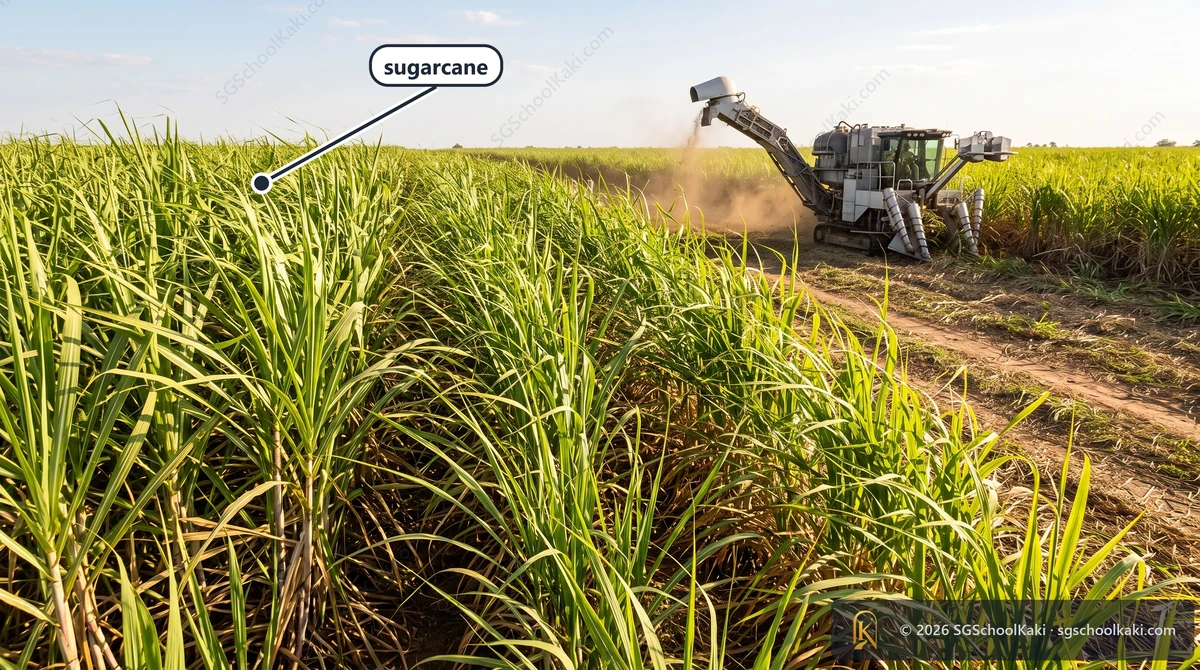
A biofuel, exemplified by bioethanol from sugarcane, is a renewable alternative to natural gas and crude oil, because it is made from plants that can be grown again.
- Biofuel
- Biofuel: a fuel made from plant material
- Bioethanol
- Bioethanol: ethanol made by fermenting the sugar from a crop such as sugarcane
- Sugarcane
- Sugarcane: a tall grass crop whose juice contains a lot of sugar supports K324-11.1(c)
- Fermentation
- Fermentation: a reaction in which yeast changes sugar into ethanol and carbon dioxide in the absence of air supports K324-11.3
- Renewable
- Renewable: describes an energy source that can be replaced as fast as it is used, because the crop can be grown again
- Yeast
- Yeast: a microorganism whose enzymes cause fermentation supports K324-11.3
- Alternative fuel
- Alternative fuel: a fuel that can be used instead of natural gas or petrol supports K324-11.1(c)
Making bioethanol
- 1The sugarcane is crushed to squeeze out its juice, which contains sugar.
- 2Yeast is added and the warm mixture is kept in the absence of air, so the sugar ferments to ethanol and carbon dioxide.
- 3The ethanol is separated from the mixture by fractional distillation.
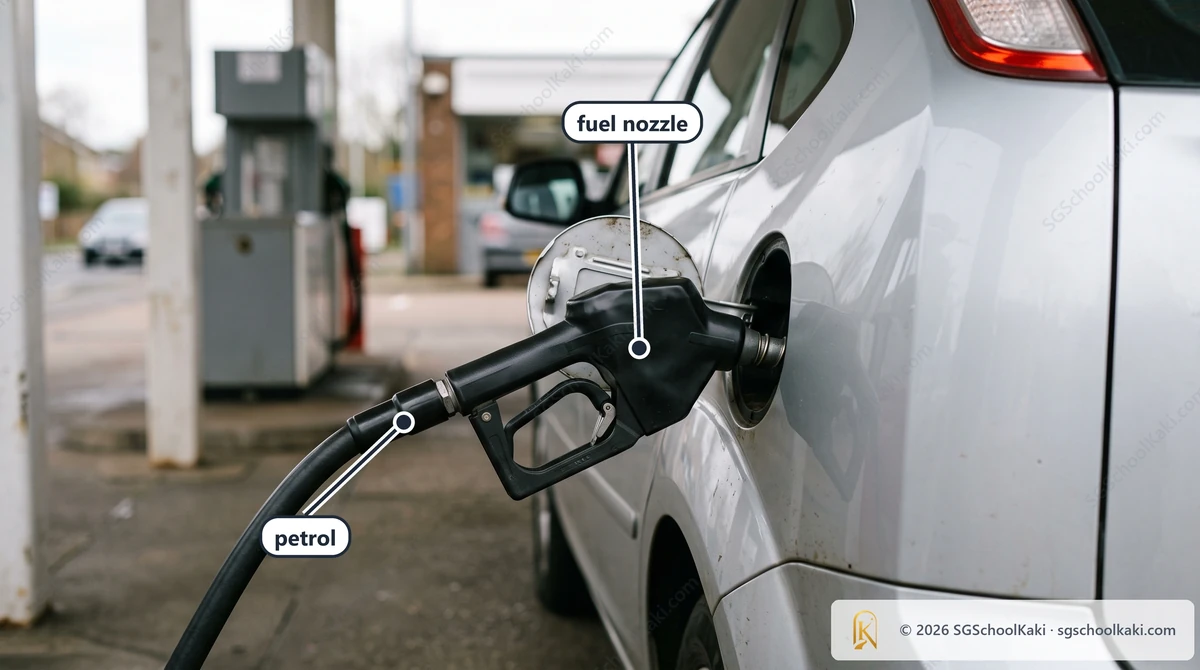
- 4The ethanol is used as a fuel, either on its own or mixed with petrol.
C6H12O6(aq) → 2C2H5OH(aq) + 2CO2(g)Yeast changes the sugar glucose into ethanol and carbon dioxide during fermentation.
C2H5OH(l) + 3O2(g) → 2CO2(g) + 3H2O(l)Ethanol burns completely in oxygen to give carbon dioxide and water, and the reaction releases energy.
Biofuel compared with fossil fuels
| Feature | Natural gas and crude oil | Bioethanol from sugarcane |
|---|---|---|
| Where it comes from | Natural gas and crude oil come from the remains of ancient living things. | Bioethanol comes from sugarcane plants that are grown for the purpose. |
| Renewable or non-renewable | Natural gas and crude oil are non-renewable. | Bioethanol is renewable, because the crop can be grown again each season. |
| What is needed to produce it | They are drilled from underground and then processed. | It needs farmland, water, energy for farming and a fermentation plant. |
| Energy release | Both release energy by combustion. | Bioethanol also releases energy by combustion. |
The SEAB glossary says “Describe requires candidates to state in words (using diagrams where appropriate) the main points of the topic”, so describe a biofuel by naming the example, bioethanol, its source, sugarcane, and the reason it is renewable.
Depth: why and how
- Why is bioethanol renewable? The sugarcane that it is made from can be grown again, so the supply can be replaced as fast as it is used.
- Why is the fermentation done in the absence of air? Without air, yeast changes sugar into ethanol, whereas with air it can use the sugar to form carbon dioxide and water instead.
- Why can biofuels not simply replace all fossil fuels? Growing fuel crops needs large areas of land and water that could otherwise be used to grow food.
- Why is ethanol separated by fractional distillation? Ethanol and water have different boiling points, so distillation separates the ethanol from the fermented mixture.
- Cross-link to Organic Chemistry, alcohols and carboxylic acids: bioethanol is simply the alcohol ethanol made by fermentation instead of from crude oil.
Common mistakes
Biofuels are made from crude oil.
Biofuels are made from plant material, and bioethanol is made from sugarcane.
Bioethanol is made from sugarcane by cracking.
Bioethanol is made from sugarcane by fermentation with yeast.
Renewable means that the fuel does not release carbon dioxide.
Renewable means that the energy source can be replaced as fast as it is used, and bioethanol still releases carbon dioxide when it burns.
Bioethanol from sugarcane is a renewable biofuel that is made by fermentation and can be used in place of natural gas and crude oil products.
Exam check
Q1By which process is bioethanol produced from sugarcane juice?
- Acracking
- Bpolymerisation
- Cfermentation
- Dcombustion
Show answer
MCQ answer key C (fermentation): yeast changes the sugar into ethanol by fermentation, whereas the other processes do not make ethanol from sugar.
Q2Why is bioethanol described as renewable?
- AIt does not release carbon dioxide when it burns.
- BThe crop that it is made from can be grown again.
- CIt is made from crude oil, which forms again quickly.
- DIt is a compound that contains hydrogen only.
Show answer
MCQ answer key B (The crop that it is made from can be grown again.): a renewable energy source can be replaced as fast as it is used, and sugarcane can be regrown.
Q3Which equation represents the fermentation of glucose to ethanol?
- AC6H12O6(aq) → 6C(s) + 6H2O(l)
- BC6H12O6(aq) → 3C2H4(g) + 3O2(g)
- CC6H12O6(aq) → 2C3H6(g) + 3O2(g)
- DC6H12O6(aq) → 2C2H5OH(aq) + 2CO2(g)
Show answer
MCQ answer key D (C6H12O6(aq) → 2C2H5OH(aq) + 2CO2(g)): glucose forms ethanol and carbon dioxide, and the other equations are balanced but show products that fermentation does not make.
StructuredBioethanol is made from sugarcane.
- State what is meant by the term biofuel. [1]
- Name the process that changes sugar into ethanol. [1]
- Construct an equation, with state symbols, for the complete combustion of ethanol. [2]
- Explain why bioethanol is described as renewable. [2]
Total: 6 marks
Show mark scheme
(a) 1 mark
- Mark scheme: a fuel made from plant material
(b) 1 mark
- Mark scheme: fermentation
(c) 2 marks
- Mark scheme: C2H5OH(l) + 3O2(g) → 2CO2(g) + 3H2O(l)
- Mark scheme: all four state symbols are correct
(d) 2 marks
- Mark scheme: sugarcane can be grown again
- Mark scheme: so the supply can be replaced as fast as it is used
Biofuels and carbon dioxide
describe how biofuel, when compared to fossil fuels, can be more environmentally sustainable in terms of carbon dioxide emission (see also 12(g)).
Biofuel can be more environmentally sustainable than a fossil fuel in terms of carbon dioxide emission, because the plants absorb carbon dioxide from the air as they grow, which offsets the carbon dioxide released when the biofuel burns.
- Carbon dioxide emission
- Carbon dioxide emission: the carbon dioxide released into the air, for example when a fuel burns
- Sustainable
- Sustainable: describes a way of meeting our needs that does not use up resources or damage the environment for future generations supports K324-11.1(d)
- Greenhouse gas
- Greenhouse gas: a gas, such as carbon dioxide, that traps heat in the atmosphere supports K324-12
- Photosynthesis
- Photosynthesis: the process in which green plants use light energy, carbon dioxide and water to make glucose and release oxygen supports K324-11.1(d)
- Net emission
- Net emission: the carbon dioxide released minus the carbon dioxide taken in supports K324-11.1(d)
- Fossil carbon
- Fossil carbon: carbon that has been locked underground in fossil fuels for millions of years supports K324-11.1(d)
Carbon dioxide: fossil fuel and biofuel compared
| Question | Fossil fuel | Biofuel |
|---|---|---|
| Where did the carbon come from? | The carbon in a fossil fuel was locked underground for millions of years. | The carbon in a biofuel was taken from the air by the growing plants. |
| What happens when it burns? | Burning a fossil fuel releases carbon dioxide into the air. | Burning a biofuel releases carbon dioxide into the air. |
| Effect on the carbon dioxide in the air | The carbon dioxide adds to the amount in the air, so the net emission rises. | The carbon dioxide released was absorbed while the plants grew, so the net emission can be lower. |
6CO2(g) + 6H2O(l) → C6H12O6(aq) + 6O2(g)Photosynthesis in the growing sugarcane removes carbon dioxide from the air.
C2H5OH(l) + 3O2(g) → 2CO2(g) + 3H2O(l)Burning the bioethanol returns carbon dioxide to the air.

The saving is not complete, because growing, harvesting, fermenting and transporting the crop also use energy, which often comes from fossil fuels. supports K324-11.1(d)
Clearing forest to plant fuel crops can release stored carbon and reduce the benefit of the biofuel. supports K324-11.1(d)
The SEAB glossary says “Compare requires candidates to provide both similarities and differences between things or concepts”, so when you compare a biofuel with a fossil fuel, state that both release carbon dioxide when they burn and that only the biofuel carbon was taken from the air by the growing plants.
Depth: why and how
- Why can a biofuel add less net carbon dioxide to the air than a fossil fuel? The carbon dioxide that it releases was absorbed from the air by the plants as they grew, whereas a fossil fuel releases carbon that was locked underground.
- Why does burning a fossil fuel increase the carbon dioxide in the air? The carbon in the fuel was not part of the air's carbon dioxide before, so burning it adds new carbon dioxide.
- Why is a biofuel not automatically free of carbon dioxide emission? Making the fuel needs energy for farming, processing and transport, and much of that energy often comes from burning fossil fuels.
- Why is the amount of carbon dioxide in the air a concern? Carbon dioxide is a greenhouse gas that traps heat, so more of it in the air contributes to global warming.
- Cross-link to Maintaining Air Quality: K324 12(g) links carbon dioxide emission to the greenhouse effect and global warming.
Common mistakes
Biofuels release no carbon dioxide when they burn.
Biofuels release carbon dioxide when they burn, but the growing plants absorbed carbon dioxide, so the net emission can be lower than for a fossil fuel.
Photosynthesis releases carbon dioxide into the air.
Photosynthesis absorbs carbon dioxide from the air and releases oxygen.
A biofuel is better for the environment in every way.
A biofuel can be more sustainable in terms of carbon dioxide emission, but growing the crop uses land, water and energy.
A biofuel can be more sustainable than a fossil fuel because the growing plants absorb carbon dioxide that offsets the carbon dioxide released when it burns.
Exam check
Q1Which process removes carbon dioxide from the air as sugarcane grows?
- Acombustion
- Bfermentation
- Cphotosynthesis
- Dcracking
Show answer
MCQ answer key C (photosynthesis): green plants take in carbon dioxide by photosynthesis, whereas combustion and fermentation release it.
Q2Why can burning bioethanol add less net carbon dioxide to the air than burning petrol?
- ABioethanol contains no carbon.
- BBioethanol burns without forming carbon dioxide.
- CPetrol is a renewable fuel.
- DThe carbon dioxide released was absorbed by the sugarcane as it grew.
Show answer
MCQ answer key D (The carbon dioxide released was absorbed by the sugarcane as it grew.): bioethanol releases carbon dioxide, but the plants took it from the air, whereas petrol releases carbon that was locked underground.
Q3Which statement is a reason why a biofuel may not fully offset its carbon dioxide emission?
- APlants release more carbon dioxide than they absorb while growing.
- BBiofuels cannot be burned.
- CGrowing and processing the crop uses energy, often from fossil fuels.
- DFossil fuels absorb carbon dioxide when they burn.
Show answer
MCQ answer key C (Growing and processing the crop uses energy, often from fossil fuels.): farming, fermenting and transport use energy that often comes from fossil fuels, which releases carbon dioxide.
StructuredA fuel company compares petrol with bioethanol made from sugarcane.
- State the type of fuel that bioethanol is. [1]
- Name the process by which sugarcane plants absorb carbon dioxide. [1]
- Explain why using bioethanol instead of petrol can reduce the net carbon dioxide emission. [3]
- Suggest one reason why the reduction may be smaller than expected. [1]
Total: 6 marks
Show mark scheme
(a) 1 mark
- Mark scheme: a biofuel
(b) 1 mark
- Mark scheme: photosynthesis
(c) 3 marks
- Mark scheme: both fuels release carbon dioxide when they burn
- Mark scheme: the sugarcane absorbed carbon dioxide from the air as it grew
- Mark scheme: petrol releases carbon that was locked underground for millions of years, which adds extra carbon dioxide to the air
(d) 1 mark
- Mark scheme: growing, harvesting and processing the crop uses energy, often from fossil fuels
Homologous series
describe a homologous series as a group of compounds with a general formula, similar chemical properties and showing a gradation in physical properties as a result of increase in the size and mass of the molecules, e.g. melting and boiling points; viscosity
A homologous series is a group of compounds with a general formula and similar chemical properties, and with a gradation in physical properties, such as melting point, boiling point and viscosity, as the size and mass of the molecules increase.
- Homologous series
- Homologous series: a group of compounds with a general formula, similar chemical properties (because they have the same type of bonding or functional group) and a gradation in physical properties
- General formula
- General formula: a formula that gives the ratio of atoms for every member of a homologous series, such as CnH2n+2 for the alkanes
- Functional group
- Functional group: the atom or group of atoms that gives a homologous series its characteristic chemical properties supports K324-11.2(a)
- Gradation
- Gradation: a gradual change in a property from one member of a series to the next
- Hydrocarbon
- Hydrocarbon: a compound that contains hydrogen and carbon only supports K324-11.2(a)
- Viscosity
- Viscosity: how thick a liquid is, which means how slowly it flows
- Displayed formula
- Displayed formula: a formula that shows every atom and every bond in a molecule supports K324-11.2(c)
Naming the first members
| Carbon atoms | Prefix | Alkane | Alkene |
|---|---|---|---|
| one | The prefix for one carbon atom is meth-. | Methane has the molecular formula CH4, and its name ends in -ane. | There is no alkene with one carbon atom, because a C=C double bond needs two carbon atoms. |
| two | The prefix for two carbon atoms is eth-. | Ethane has the molecular formula C2H6, and its name ends in -ane. | Ethene has the molecular formula C2H4, and its name ends in -ene. |
| three | The prefix for three carbon atoms is prop-. | Propane has the molecular formula C3H8, and its name ends in -ane. | Propene has the molecular formula C3H6, and its name ends in -ene. |
| four | The prefix for four carbon atoms is but-. | Butane has the molecular formula C4H10, and its name ends in -ane. | Butene has the molecular formula C4H8, and its name ends in -ene. |
Endings of other series
| Homologous series | Ending of the name | Example |
|---|---|---|
| alkanes | The names of alkanes end in -ane. | Ethane is an alkane with the formula C2H6. |
| alkenes | The names of alkenes end in -ene. | Ethene is an alkene with the formula C2H4. |
| alcohols | The names of alcohols end in -ol. | Ethanol is an alcohol with the formula C2H5OH. |
| carboxylic acids | The names of carboxylic acids end in -oic acid. | Ethanoic acid is a carboxylic acid with the formula CH3COOH. |
For SEAB answers, write that a homologous series is “a group of compounds with a general formula, similar chemical properties and showing a gradation in physical properties”. supports K324-11.2(a)
Gradation in physical properties
| Property | As the number of carbon atoms increases |
|---|---|
| Melting point | The melting point increases. |
| Boiling point | The boiling point increases. |
| Viscosity | The viscosity increases, so the liquid flows less easily. |
| State at room temperature | Methane, ethane, propane and butane are gases at room temperature, and the larger alkanes are liquids and solids. |
| Chemical properties | The chemical properties stay similar, because every alkane has the same type of bonds. |
SEAB 11.2(a) names melting point, boiling point and viscosity as the physical properties that show a gradation, so quote these three in answers. supports K324-11.2(a)
Worked example
Calculate the relative molecular mass, Mr, of methane, CH4, ethane, C2H6, propane, C3H8 and butane, C4H10, and state the difference between one member and the next.
- Mr of CH4 = 12 + 4 × 1 = 16, so Mr of methane is 16.
- Mr of C2H6 = 2 × 12 + 6 × 1 = 30, so Mr of ethane is 30.
- Mr of C3H8 = 3 × 12 + 8 × 1 = 44, so Mr of propane is 44.
- Mr of C4H10 = 4 × 12 + 10 × 1 = 58, so Mr of butane is 58.
- Each member has one more CH2 unit than the one before, and the Mr of CH2 is 14.
The Mr values of methane, ethane, propane and butane are 16, 30, 44 and 58, and each member is heavier than the previous one by 14, the Mr of CH2.
The SEAB glossary says “Only a formal statement or equivalent paraphrase being required” for a definition, so a definition of homologous series needs a general formula, similar chemical properties and a gradation in physical properties.
Depth: why and how
- Why do the members of a homologous series have similar chemical properties? They have the same type of bonds (or the same functional group, such as C=C in the alkenes), so they react in a similar way.
- Why does the boiling point increase along a homologous series? Larger molecules have stronger attractions between them, so more energy is needed to separate them.
- Why does the viscosity increase as the molecules get larger? Larger molecules attract one another more strongly and are harder to slide past each other, so the liquid flows less easily.
- Why does each member differ from the next by a CH2 unit? Each member has one more carbon atom and two more hydrogen atoms than the member before it.
- Cross-link to Chemical Bonding and Structure: when a simple molecular substance melts or boils, it is the attractions between the molecules that are overcome, and the covalent bonds inside the molecules stay intact.
Common mistakes
The members of a homologous series have different chemical properties.
The members of a homologous series have similar chemical properties, because they have the same type of bonds or functional group.
The boiling points of the alkanes decrease as the molecules get larger.
The boiling points of the alkanes increase as the molecules get larger.
Any group of hydrocarbons is a homologous series.
A homologous series must have one general formula and similar chemical properties, so the alkanes and the alkenes are two different series.
The first alkene is methene.
The first alkene is ethene, because a C=C double bond needs two carbon atoms.
In a homologous series the members share a general formula and similar chemical properties, while melting point, boiling point and viscosity change gradually as the molecules get larger.
Exam check
Q1Which statement describes a homologous series?
- AA group of compounds with the same molecular formula but different structures.
- BA group of elements with the same number of outer-shell electrons.
- CA group of compounds with identical physical properties.
- DA group of compounds with the same general formula and similar chemical properties.
Show answer
MCQ answer key D (A group of compounds with the same general formula and similar chemical properties.): members of a homologous series share a general formula and similar chemical properties, but their physical properties change gradually.
Q2What happens to the boiling points of the alkanes as the number of carbon atoms increases?
- AThey increase.
- BThey decrease.
- CThey stay the same.
- DThey increase and then decrease.
Show answer
MCQ answer key A (They increase.): larger molecules have stronger attractions between them, so the boiling points increase.
Q3Which two compounds are in the same homologous series?
- AC2H4 and C3H8
- BCH4 and C2H4
- CC2H6 and C3H8
- DC3H6 and C4H10
Show answer
MCQ answer key C (C2H6 and C3H8): C2H6 and C3H8 both fit CnH2n+2, whereas each of the other pairs mixes an alkene with an alkane.
StructuredMethane, ethane, propane and butane are members of the alkane homologous series.
- State what is meant by the term homologous series. [2]
- State the general formula of the alkanes. [1]
- Describe the trend in boiling point from methane to butane and explain it. [2]
- Calculate the difference between the Mr of butane and the Mr of propane. [Ar: C = 12, H = 1] [2]
Total: 7 marks
Show mark scheme
(a) 2 marks, any two from:
- Mark scheme: a group of compounds with a general formula
- Mark scheme: similar chemical properties
- Mark scheme: a gradation in physical properties
(b) 1 mark
- Mark scheme: CnH2n+2
(c) 2 marks
- Mark scheme: the boiling point increases
- Mark scheme: larger molecules have stronger attractions between them, so more energy is needed to separate them
(d) 2 marks
- Mark scheme: Mr of C4H10 = 4 × 12 + 10 × 1 = 58 and Mr of C3H8 = 3 × 12 + 8 × 1 = 44
- Mark scheme: the difference is 14, which is the Mr of CH2
You've read the free 31%. Unlock the rest of Chapter 11A.
Still to read in this chapter:
- Alkanes
- Drawing and naming alkanes
- Isomers
- Reactions of alkanes
- Alkenes
- Drawing and naming alkenes
- Cracking
- Saturated and unsaturated hydrocarbons
- Reactions of alkenes
- Polyunsaturated food products
- Making margarine
- Practical skills
$9 one-time · all 13 chapters · no subscription
Less than a fast-food meal.
Yours for the whole syllabus.
Premium members get all 13 chapters included.
Notes version 1.0 · Last updated 2 Oct 2026 · Chapter 11A of 13