









Organic Chemistry
SEAB syllabus topic 11, second half: how alcohols, carboxylic acids, esters and polymers are named, drawn, made and used, with the reasons, the common mistakes and an exam check for every outcome.

Alcohols have the –OH group, and ethanol is made by the addition of steam to ethene or by the fermentation of glucose.
A carboxylic acid and an alcohol react to form an ester and water, and the first word of the name of the ester comes from the alcohol.
Polymers are made from monomers by addition polymerisation, as in poly(ethene), or by condensation polymerisation, as in nylon and Terylene.
Alcohols as a homologous series
describe the alcohols as a homologous series containing the –OH group
Alcohols make up a homologous series in which every molecule contains the –OH group, and the name of an alcohol ends in -ol.
- Homologous series
- Homologous series: a family of organic compounds that have the same functional group and the same general formula, with each member differing from the next by a CH2 group, so that the members have similar chemical properties and show a gradation in physical properties
- Functional group
- Functional group: the atom or group of atoms in a molecule that decides its chemical properties, such as the –OH group in an alcohol supports K324-11.3(a)
- Alcohol
- Alcohol: an organic compound whose molecules contain the –OH group joined to a carbon atom, so that its name ends in -ol
- General formula
- General formula: a formula that fits every member of a series, which for the alcohols is CnH2n+1OH supports K324-11.3(a)
- Hydroxyl group
- Hydroxyl group: the –OH group of an alcohol, in which the oxygen atom is joined to the carbon chain by a covalent bond, so it is not a hydroxide ion supports K324-11.3(a)
Homologous series compared
| Series | Functional group or bond | Example from the series |
|---|---|---|
| Alkanes | Alkanes have only single bonds between carbon atoms and no functional group. | Ethane, C2H6, is an alkane. |
| Alkenes | Alkenes have a C=C double bond between two carbon atoms. | Ethene, C2H4, is an alkene. |
| Alcohols | Alcohols have the –OH group. | Ethanol, C2H5OH, is an alcohol. |
| Carboxylic acids | Carboxylic acids have the –CO2H group, which is also written –COOH. | Ethanoic acid, CH3COOH, is a carboxylic acid. |
| Esters | Esters have the –COO– link between two carbon chains. | Ethyl ethanoate, CH3COOC2H5, is an ester. |
Recognising an alcohol
- 1Look for an –OH group joined to a carbon atom that has no C=O double bond to oxygen.
- 2Check that the name ends in -ol, as in methanol and ethanol.
- 3Check that the formula fits CnH2n+1OH, as C4H9OH does for butanol.
The SEAB glossary says “Define (the term(s)…) is intended literally”, with “Only a formal statement or equivalent paraphrase being required”, so define a homologous series with two or more of these points: the same functional group, the same general formula, the CH2 difference between neighbours, similar chemical properties and a gradation in physical properties.
Depth: why and how
- Why do the members of a homologous series have similar chemical properties? They have the same functional group, and the functional group decides how the molecule reacts.
- Why is the –OH group of an alcohol not a hydroxide ion? It is joined to the carbon chain by a covalent bond, so an alcohol does not release hydroxide ions in water and is not an alkali.
- How does the formula change from one alcohol to the next? Each alcohol has one more CH2 group than the alcohol before it.
- How can you tell from a formula that a compound may be an alcohol? Check whether it fits CnH2n+1OH; for example C3H7OH fits, with three carbon atoms.
- Cross-link to Fuels and Hydrocarbons: alkanes and alkenes are homologous series too, and ethene from crude oil is one starting material for making ethanol.
Common mistakes
The –OH group makes an alcohol an alkali.
An alcohol is a neutral covalent compound, and the –OH group does not release hydroxide ions in water.
Every compound that contains an O–H bond is an alcohol.
A compound with the –CO2H group is a carboxylic acid, even though that group contains an O–H bond; an alcohol has the –OH group on a carbon atom with no C=O double bond.
The name of an alcohol ends in -ane.
The name of an alcohol ends in -ol, and -ane is the ending for an alkane.
The members of a homologous series all have exactly the same physical properties.
The members of a homologous series have similar chemical properties, but their physical properties change gradually as the molecules get larger.
Alcohols are a homologous series with the –OH group, the general formula CnH2n+1OH and names that end in -ol.
Exam check
Q1Which compound is an alcohol?
- AC3H8
- BC3H6
- CC3H7OH
- DC2H5COOH
Show answer
MCQ answer key C (C3H7OH): C3H7OH contains the –OH group, whereas C3H8 is an alkane, C3H6 is an alkene and C2H5COOH is a carboxylic acid.
Q2Which general formula represents the alcohols?
- ACnH2n+2
- BCnH2n
- CCnH2n+1OH
- DCnH2n+1COOH
Show answer
MCQ answer key C (CnH2n+1OH): the alcohols have one –OH group on an alkyl chain, so they fit CnH2n+1OH, whereas the other formulae fit alkanes, alkenes and carboxylic acids.
Q3Which statement about the members of a homologous series is correct?
- AEach member differs from the next by a CH2 group.
- BAll members have the same molecular formula.
- CAll members have different functional groups.
- DAll members have identical physical properties.
Show answer
MCQ answer key A (Each member differs from the next by a CH2 group.): a homologous series has one functional group and one general formula, with a CH2 difference between neighbours, and its physical properties change gradually.
StructuredMethanol, ethanol and propanol are the first three members of the homologous series of alcohols.
- State what is meant by the term homologous series. [2]
- State the functional group of an alcohol. [1]
- Write the formula of the alcohol that has four carbon atoms, using the general formula. [1]
- Explain why ethanol is not an alkali. [2]
Total: 6 marks
Show mark scheme
(a) 2 marks
Accept any two of these points, 1 mark each.
- Mark scheme: a family of compounds with the same functional group
- Mark scheme: the same general formula
- Mark scheme: each member differing from the next by a CH2 group
- Mark scheme: similar chemical properties
- Mark scheme: a gradation in physical properties
(b) 1 mark
- Mark scheme: the –OH group
(c) 1 mark
- Mark scheme: C4H9OH
(d) 2 marks
- Mark scheme: its –OH group is joined to carbon by a covalent bond
- Mark scheme: so it does not release hydroxide ions in water
Structures and names of alcohols
draw the structures of branched and unbranched alcohols, C1 to C4, and name the unbranched alcohols methanol to butanol
The first four alcohols are methanol, ethanol, propanol and butanol, which have one to four carbon atoms, and each alcohol is drawn by showing its –OH group on a chain of carbon atoms that may be branched or unbranched.
- Methanol
- Methanol: the alcohol with one carbon atom, CH3OH
- Ethanol
- Ethanol: the alcohol with two carbon atoms, CH3CH2OH, which can also be written C2H5OH
- Propanol
- Propanol: the alcohol with three carbon atoms, CH3CH2CH2OH
- Butanol
- Butanol: the alcohol with four carbon atoms, CH3CH2CH2CH2OH
- Displayed formula
- Displayed formula: a formula that shows every atom and every bond in the molecule supports K324-11.3(b)
- Condensed formula
- Condensed formula: a short formula that shows the atoms in order along the chain, such as CH3CH2OH supports K324-11.3(b)
- Branched chain
- Branched chain: a carbon chain with a side chain attached to it, whereas an unbranched chain is a single straight line of carbon atoms
- Isomers
- Isomers: compounds with the same molecular formula but different structures supports K324-11.3(b)
The first four alcohols
| Name | Picture | Carbon atoms | Condensed formula | Fits the general formula |
|---|---|---|---|---|
| methanol |  | Methanol has one carbon atom. | The formula of methanol is CH3OH. | Methanol fits CnH2n+1OH with one carbon atom. |
| ethanol |  | Ethanol has two carbon atoms. | The formula of ethanol is CH3CH2OH. | Ethanol fits CnH2n+1OH with two carbon atoms. |
| propanol | 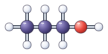 | Propanol has three carbon atoms. | The formula of propan-1-ol is CH3CH2CH2OH. | Propanol fits CnH2n+1OH with three carbon atoms. |
| butanol | 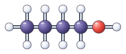 | Butanol has four carbon atoms. | The formula of butan-1-ol is CH3CH2CH2CH2OH. | Butanol fits CnH2n+1OH with four carbon atoms. |
Drawing an alcohol
- 1Draw the carbon skeleton, as a straight chain or with a branch, using the number of carbon atoms in the name.
- 2Join the oxygen atom to one carbon atom, and join a hydrogen atom to the oxygen atom, so that the carbon is bonded to the oxygen atom and not to the hydrogen atom.
- 3Add hydrogen atoms until every carbon atom has four bonds, and check that the oxygen atom has two bonds.
- 4Count the atoms to check the molecular formula, for example C2H6O for ethanol.

Isomers of propanol and butanol
| Name | Picture | How the structure differs | Condensed formula |
|---|---|---|---|
| propan-1-ol | | In propan-1-ol the –OH group is on an end carbon atom of an unbranched chain. | Propan-1-ol is CH3CH2CH2OH. |
| propan-2-ol |  | In propan-2-ol the –OH group is on the middle carbon atom of an unbranched chain. | Propan-2-ol is CH3CH(OH)CH3. |
| butan-1-ol | | In butan-1-ol the –OH group is on an end carbon atom of an unbranched chain. | Butan-1-ol is CH3CH2CH2CH2OH. |
| butan-2-ol | 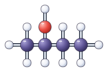 | In butan-2-ol the –OH group is on the second carbon atom of an unbranched chain. | Butan-2-ol is CH3CH(OH)CH2CH3. |
| 2-methylpropan-1-ol | 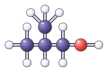 | In 2-methylpropan-1-ol the chain is branched, with a methyl side chain, and the –OH group is on an end carbon atom. | 2-methylpropan-1-ol is (CH3)2CHCH2OH. |
| 2-methylpropan-2-ol |  | In 2-methylpropan-2-ol the chain is branched, with a methyl side chain, and the –OH group is on the carbon atom that carries the branch. | 2-methylpropan-2-ol is (CH3)3COH. |
K324 asks you to name only the unbranched alcohols methanol to butanol, so for SEAB answers you may write propanol and butanol for propan-1-ol and butan-1-ol, and the numbers in propan-2-ol and butan-2-ol only tell you where the –OH group sits. supports K324-11.3(b)
The SEAB nomenclature note says that “full structural formulae (displayed formulae) in answers should show in detail both the relative placing of atoms and the number of bonds between the atoms”, so draw every bond, including the O–H bond.
Depth: why and how
- Why does every carbon atom in an alcohol have four bonds? A carbon atom has four outer electrons, so it forms four covalent bonds, and an oxygen atom forms two.
- Why are propan-1-ol and propan-2-ol different compounds with the same molecular formula? They are isomers, because the –OH group is on a different carbon atom, so the atoms are arranged differently.
- How many alcohols have the molecular formula C4H9OH? There are four, which are butan-1-ol, butan-2-ol, 2-methylpropan-1-ol and 2-methylpropan-2-ol.
- Why must the oxygen atom be bonded to the carbon atom and not through the hydrogen atom? The –OH group is joined to the chain by its oxygen atom, because oxygen forms two bonds and hydrogen forms only one.
- Cross-link to Chemical Bonding and Structure: the bonds in alcohol molecules are covalent bonds, and a displayed formula shows each shared pair of electrons as one line.
Common mistakes
Ethanol is drawn as C–H–O–H, with the carbon joined to the hydrogen of the –OH group.
In ethanol the oxygen atom is bonded to a carbon atom and to a hydrogen atom, so the group is C–O–H.
A displayed formula of butanol can leave out the C–H bonds.
A displayed formula shows every atom and every bond, so every C–H bond and the O–H bond must be drawn.
The formula C3H7OH fits only one alcohol.
The formula C3H7OH fits two alcohols, propan-1-ol, with the –OH group on an end carbon atom, which K324 calls propanol, and its isomer propan-2-ol, with the –OH group on the middle carbon atom.
The formula C4H9OH fits only unbranched alcohols.
The formula C4H9OH fits four alcohols, the unbranched butan-1-ol and butan-2-ol and the branched 2-methylpropan-1-ol and 2-methylpropan-2-ol, and K324 names only the unbranched butan-1-ol as butanol.
Name the unbranched alcohols methanol to butanol by the number of carbon atoms, and draw every atom and every bond, including the O–H bond.
Exam check
Q1What is the molecular formula of propanol?
- AC3H6O
- BC3H8O
- CC2H6O
- DC3H8O2
Show answer
MCQ answer key B (C3H8O): propanol has three carbon atoms and fits CnH2n+1OH, so it is C3H7OH, which is C3H8O as a molecular formula.
Q2Which alcohol has the condensed formula CH3CH2CH2CH2OH?
- Apropanol
- Bethanol
- Cbutanol
- Dmethanol
Show answer
MCQ answer key C (butanol): the chain has four carbon atoms, so the alcohol is butanol, which may also be named butan-1-ol.
Q3Which two alcohols are isomers of each other?
- Amethanol and ethanol
- Bethanol and propan-1-ol
- Cpropan-1-ol and propan-2-ol
- Dbutan-1-ol and propan-2-ol
Show answer
MCQ answer key C (propan-1-ol and propan-2-ol): isomers have the same molecular formula, and propan-1-ol and propan-2-ol are both C3H8O, whereas the other pairs have different numbers of carbon atoms.
StructuredEthanol is the alcohol with two carbon atoms.
- Draw the displayed formula of ethanol. [2]
- State the molecular formula of ethanol. [1]
- Name the alcohol with the condensed formula CH3CH2CH2OH. [1]
- Draw the structure of one branched alcohol that has four carbon atoms. [2]
Total: 6 marks
Show mark scheme
(a) 2 marks
- Mark scheme: a carbon–carbon bond with a hydrogen atom bonded to each carbon as needed, three on one carbon and two on the other
- Mark scheme: an O–H group bonded to the carbon atom that has two hydrogen atoms
(b) 1 mark
- Mark scheme: C2H6O
(c) 1 mark
- Mark scheme: propanol, and propan-1-ol is also accepted
(d) 2 marks
- Mark scheme: a chain of three carbon atoms with a methyl branch on the middle carbon atom
- Mark scheme: an –OH group on one carbon atom and enough hydrogen atoms for four bonds on every carbon
Combustion and oxidation of alcohols
describe the reactions of alcohols in terms of combustion and oxidation to carboxylic acids
Alcohols burn in plenty of oxygen to form carbon dioxide and water, and an alcohol with its –OH group on an end carbon atom is oxidised to a carboxylic acid, for example by acidified potassium manganate(VII).
- Combustion
- Combustion: burning in oxygen, which for an alcohol gives carbon dioxide and water when the oxygen supply is plentiful
- Complete combustion
- Complete combustion: combustion in plenty of oxygen, in which all the carbon becomes carbon dioxide and all the hydrogen becomes water supports K324-11.3(c)
- Oxidation
- Oxidation: a reaction in which a substance gains oxygen, so an alcohol is oxidised when its –CH2OH end becomes the –CO2H group of a carboxylic acid supports K324-11.3(c)
- Oxidising agent
- Oxidising agent: a substance that oxidises another substance, such as oxygen from the air or acidified potassium manganate(VII) supports K324-11.3(c)
- Acidified potassium manganate(VII)
- Acidified potassium manganate(VII): an aqueous oxidising agent that is purple, and it turns colourless when it is used up by an excess of alcohol supports K324-11.3(c)
Complete combustion
2CH3OH(l) + 3O2(g) → 2CO2(g) + 4H2O(l)Methanol burns to form carbon dioxide and water.
C2H5OH(l) + 3O2(g) → 2CO2(g) + 3H2O(l)Ethanol burns to form carbon dioxide and water.
2C3H7OH(l) + 9O2(g) → 6CO2(g) + 8H2O(l)Propanol burns to form carbon dioxide and water.
C4H9OH(l) + 6O2(g) → 4CO2(g) + 5H2O(l)Butanol burns to form carbon dioxide and water.
Oxidation to carboxylic acids
CH3OH(l) + O2(g) → HCOOH(l) + H2O(l)Methanol is oxidised to methanoic acid.
C2H5OH(l) + O2(g) → CH3COOH(l) + H2O(l)Ethanol is oxidised to ethanoic acid.
C3H7OH(l) + O2(g) → C2H5COOH(l) + H2O(l)Propan-1-ol is oxidised to propanoic acid.
C4H9OH(l) + O2(g) → C3H7COOH(l) + H2O(l)Butan-1-ol is oxidised to butanoic acid.
- Add a few drops of the purple oxidising agent to the alcohol and warm the mixture gently.
- The purple colour disappears and the solution becomes colourless, because the manganate(VII) is used up as the alcohol is oxidised.
- The product is a carboxylic acid, for example ethanoic acid from ethanol, which has a sharp smell of vinegar.
K324 names the oxidising agent as acidified potassium manganate(VII), and not permanganate. supports K324-11.3(c)
Combustion compared with oxidation
| Feature | Complete combustion | Oxidation to a carboxylic acid |
|---|---|---|
| Oxidising agent | Complete combustion uses oxygen from the air in plenty. | Oxidation uses oxygen from the air, or acidified potassium manganate(VII). |
| Products from ethanol | Ethanol burns to form carbon dioxide and water. | Ethanol is oxidised to ethanoic acid and water. |
| What happens to the carbon chain | The carbon chain is broken down completely into carbon dioxide. | The carbon chain stays intact, and only the end with the –OH group changes. |
| Energy | Combustion releases heat. | Oxidation by acidified potassium manganate(VII) happens when the mixture is warmed. |
If the oxygen supply is limited, an alcohol undergoes incomplete combustion and forms carbon monoxide or soot as well as water, so the equations above apply only to complete combustion. supports K324-11.3(c)
The SEAB glossary says “Construct is often used in relation to chemical equations where a candidate is expected to write a balanced equation, not by factual recall but by analogy or by using information in the question”, so use the pattern alcohol + oxygen → carbon dioxide + water for any alcohol in the question.
Depth: why and how
- Why do alcohols burn so readily? Their molecules contain carbon and hydrogen that combine with oxygen to release heat, as in the combustion of any organic fuel.
- Why does acidified potassium manganate(VII) turn colourless? The manganate(VII) is the oxidising agent and it is used up, so the purple colour disappears as the alcohol is oxidised.
- How can you balance the equation for the combustion of an alcohol? Balance carbon first as carbon dioxide, then hydrogen as water, and then count the oxygen atoms to find the number of oxygen molecules.
- Why is the product of oxidising ethanol an acid and not another alcohol? The –CH2OH end of the molecule gains oxygen and becomes the –CO2H group, which is the functional group of a carboxylic acid.
- Cross-link to Chemical Energetics: the combustion of an alcohol is an exothermic reaction, which means that it releases heat to the surroundings.
Common mistakes
Alcohols burn to form carbon monoxide and water.
When there is plenty of oxygen, alcohols burn completely to form carbon dioxide and water.
Oxidising ethanol gives ethene.
Oxidising ethanol gives ethanoic acid, and ethene is made from ethanol by a different reaction.
Acidified potassium manganate(VII) turns from colourless to purple when it oxidises an alcohol.
Acidified potassium manganate(VII) turns from purple to colourless when it oxidises an alcohol.
In the equation for combustion of ethanol, the number of oxygen molecules is two.
In the equation for the complete combustion of ethanol, three oxygen molecules react with each ethanol molecule.
Combustion destroys the carbon chain to give carbon dioxide and water, but oxidation keeps the chain and turns the –CH2OH end into the –CO2H group of a carboxylic acid.
Exam check
Q1Which products are formed by the complete combustion of ethanol?
- Acarbon dioxide and water
- Bcarbon monoxide and water
- Ccarbon dioxide and hydrogen
- Dethanoic acid and water
Show answer
MCQ answer key A (carbon dioxide and water): complete combustion of an alcohol forms carbon dioxide and water, and ethanoic acid is the product of oxidation, not of burning.
Q2What is the colour change when acidified potassium manganate(VII) is warmed with an excess of ethanol?
- Acolourless to purple
- Bpurple to colourless
- Corange to green
- Dblue to colourless
Show answer
MCQ answer key B (purple to colourless): the purple manganate(VII) is used up as the ethanol is oxidised, so the solution becomes colourless.
Q3Which equation shows the complete combustion of butanol?
- AC4H9OH(l) + O2(g) → C3H7COOH(aq) + H2O(l)
- BC4H9OH(l) + 4O2(g) → 4CO(g) + 5H2O(l)
- CC2H5OH(l) + 3O2(g) → 2CO2(g) + 3H2O(l)
- DC4H9OH(l) + 6O2(g) → 4CO2(g) + 5H2O(l)
Show answer
MCQ answer key D (C4H9OH(l) + 6O2(g) → 4CO2(g) + 5H2O(l)): butanol has four carbon atoms and ten hydrogen atoms, so it gives four carbon dioxide molecules and five water molecules, which needs six oxygen molecules, whereas the other equations show oxidation, incomplete combustion and the combustion of ethanol.
StructuredPropan-1-ol is an alcohol that burns in air and is oxidised by acidified potassium manganate(VII).
- Write an equation, with state symbols, for the complete combustion of propanol. [2]
- State the colour change when acidified potassium manganate(VII) is warmed with an excess of propan-1-ol. [1]
- Name the carboxylic acid formed when propan-1-ol is oxidised. [1]
- State one other oxidising agent that can oxidise an alcohol to a carboxylic acid. [1]
Total: 5 marks
Show mark scheme
(a) 2 marks
- Mark scheme: 2C3H7OH(l) + 9O2(g) → 6CO2(g) + 8H2O(l)
- Mark scheme: all state symbols are correct
(b) 1 mark
- Mark scheme: purple to colourless
(c) 1 mark
- Mark scheme: propanoic acid
(d) 1 mark
- Mark scheme: oxygen from the air
Making ethanol
describe the formation of ethanol by the catalysed addition of steam to ethene and by fermentation of glucose
Ethanol is made by the catalysed addition of steam to ethene, and by the fermentation of glucose using the enzymes in yeast.
- Addition of steam
- Addition of steam: the reaction in which a water molecule adds across the C=C double bond of ethene to form ethanol, with phosphoric acid as the catalyst
- Fermentation
- Fermentation: the breakdown of glucose by the enzymes in yeast, which forms ethanol and carbon dioxide
- Catalyst
- Catalyst: a substance that speeds up a reaction and is not used up in it supports K324-11.3(d)
- Enzyme
- Enzyme: a biological catalyst, such as the enzymes in yeast that ferment glucose supports K324-11.3(d)
- Yeast
- Yeast: a single-celled fungus whose enzymes ferment glucose to ethanol, and which is killed if the ethanol becomes too concentrated
- Fractional distillation
- Fractional distillation: a method of separating a mixture of liquids with different boiling points, used to obtain more concentrated ethanol from the dilute solution made by fermentation supports K324-11.3(d)
Two routes to ethanol
C2H4(g) + H2O(g) ⇌ C2H5OH(g)Ethene and steam form ethanol, in a reaction that is reversible and uses a phosphoric acid catalyst with heat and pressure.
C6H12O6(aq) → 2C2H5OH(aq) + 2CO2(g)Glucose is fermented by yeast to ethanol and carbon dioxide, without oxygen and at a warm temperature.
| Feature | Steam and ethene | Fermentation of glucose |
|---|---|---|
| Starting material | Ethene comes from crude oil, which is not renewable. | Glucose comes from plants such as sugar cane, which are renewable. |
| Catalyst | The catalyst is phosphoric acid. | The catalysts are the enzymes in yeast. |
| Conditions | Ethene and steam react at high temperature and high pressure. | The mixture is kept warm, close to body temperature, without oxygen. |
| Rate | The reaction is fast. | The reaction is slow. |
| Type of process | The process is continuous, because ethene and steam keep flowing through the reactor. | The process is a batch process, because each batch is made and then emptied. |
| Product | The ethanol is purer, because there is no other product. | The ethanol solution is dilute and also forms carbon dioxide, so it needs fractional distillation to concentrate it. |
The routes as pictures

Fermentation in the laboratory

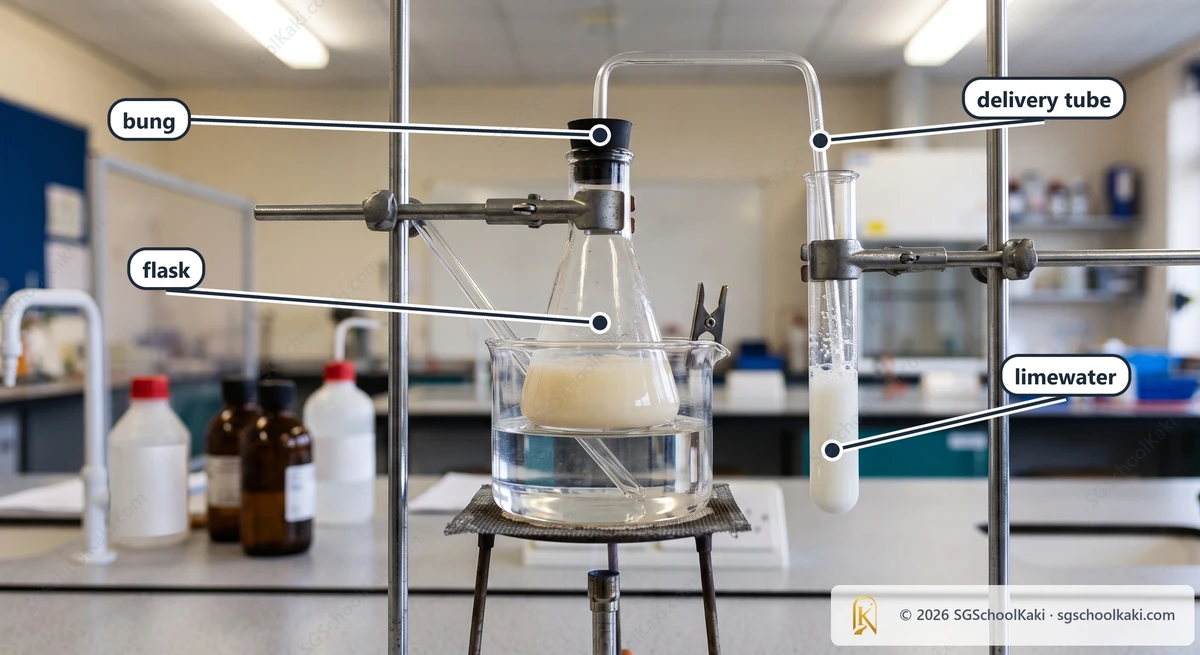
The carbon dioxide from fermentation is tested with limewater, because carbon dioxide “gives white ppt. with limewater”. supports K324-11.3(d)
Worked example
In an experiment, 18.0 g of glucose is completely fermented by yeast, as in C6H12O6(aq) → 2C2H5OH(aq) + 2CO2(g). Calculate the mass of ethanol and the volume of carbon dioxide at r.t.p.
- Mr of C6H12O6 = 6 × 12 + 12 × 1 + 6 × 16 = 180.
- Amount of glucose = 18.0 ÷ 180 = 0.100 mol.
- From the equation, 1 mol of glucose gives 2 mol of ethanol and 2 mol of carbon dioxide, so each amount is 2 × 0.100 = 0.200 mol.
- Mr of C2H5OH = 2 × 12 + 6 × 1 + 16 = 46.
- Mass of ethanol = 0.200 × 46 = 9.20 g.
- Volume of carbon dioxide at r.t.p. = 0.200 × 24 = 4.80 dm³.
The mass of ethanol is 9.20 g and the volume of carbon dioxide at r.t.p. is 4.80 dm³, to 3 significant figures.
The SEAB glossary says “Describe requires candidates to state in words (using diagrams where appropriate) the main points of the topic”, so when you describe a route to ethanol, give the starting materials, the catalyst or the enzyme, and the conditions.
The K324 note for this topic says “In describing reactions, candidates will be expected to quote the reagents” and “the essential conditions”, and it adds “Detailed conditions involving specific temperature and pressure values are not required”, so for each route you quote the catalyst or enzyme and say whether the conditions are high temperature and pressure, or warm and without oxygen, and you do not need to give specific values.
Depth: why and how
- Why must fermentation take place without oxygen? If oxygen is present, bacteria and oxygen can oxidise the ethanol to ethanoic acid, so the product would turn sour.
- Why is the temperature of fermentation kept warm and not hot? The enzymes in yeast work best at a warm temperature close to body temperature, and a high temperature destroys the enzymes.
- Why does fermentation stop when the ethanol concentration becomes high? The yeast is killed by concentrated ethanol, so the solution cannot be stronger than a dilute solution of ethanol.
- Why is the reaction of ethene with steam shown with a reversible arrow? The reaction can go both ways, so some ethene and steam remain unreacted and they are recycled.
- Cross-link to Chemical Calculations: the amounts of glucose, ethanol and carbon dioxide in fermentation are linked by the mole ratio in the balanced equation.
Common mistakes
Fermentation needs oxygen to make ethanol.
Fermentation takes place without oxygen, and oxygen would oxidise the ethanol to ethanoic acid.
Fermentation makes pure ethanol.
Fermentation makes a dilute solution of ethanol, which is concentrated by fractional distillation.
The reaction of ethene with steam makes carbon dioxide as well as ethanol.
Ethene and steam combine in an addition reaction and form ethanol as the only product.
Yeast works best at a very high temperature.
Yeast works best at a warm temperature, and a high temperature destroys the enzymes.
Ethene and steam make purer ethanol quickly in a continuous process, whereas fermentation of glucose makes dilute ethanol slowly in a batch process from a renewable starting material.
Exam check
Q1Which substances are the starting materials for the catalysed manufacture of ethanol from crude oil?
- Aethane and oxygen
- Bethene and steam
- Cglucose and yeast
- Dethanoic acid and water
Show answer
MCQ answer key B (ethene and steam): ethene from crude oil adds steam in the presence of a phosphoric acid catalyst to form ethanol.
Q2Which condition is needed for the fermentation of glucose?
- Aa high pressure
- Ba very high temperature
- Ca phosphoric acid catalyst
- Dthe absence of oxygen
Show answer
MCQ answer key D (the absence of oxygen): yeast ferments glucose without oxygen at a warm temperature, and oxygen would oxidise the ethanol.
Q336.0 g of glucose is completely fermented to ethanol. What mass of ethanol is formed? [Ar: H = 1, C = 12, O = 16]
- A9.20 g
- B36.8 g
- C18.4 g
- D4.60 g
Show answer
MCQ answer key C (18.4 g): the amount of glucose is 36.0 ÷ 180 = 0.200 mol, this gives twice that amount of ethanol, and the mass is 0.400 × 46 = 18.4 g.
StructuredEthanol can be made by fermentation of glucose or from ethene.
- Write an equation, with state symbols, for the fermentation of glucose. [2]
- State two conditions needed for fermentation. [2]
- Name the catalyst used when ethene reacts with steam to make ethanol. [1]
- State one advantage of making ethanol from ethene and one advantage of making it by fermentation. [2]
Total: 7 marks
Show mark scheme
(a) 2 marks
- Mark scheme: C6H12O6(aq) → 2C2H5OH(aq) + 2CO2(g)
- Mark scheme: all state symbols are correct
(b) 2 marks
- Mark scheme: the absence of oxygen
- Mark scheme: a warm temperature, with yeast present
(c) 1 mark
- Mark scheme: phosphoric acid
(d) 2 marks
- Mark scheme: from ethene: the ethanol is purer, or the process is fast and continuous
- Mark scheme: by fermentation: the glucose is a renewable starting material
Carboxylic acids as a homologous series
describe the carboxylic acids as a homologous series containing the –CO2H group
Carboxylic acids are a homologous series whose molecules contain the –CO2H group, which is also written –COOH, and the names of carboxylic acids end in -oic acid.
- Carboxylic acid
- Carboxylic acid: an organic compound whose molecules contain the –CO2H group, so that its name ends in -oic acid
- Carboxyl group
- Carboxyl group: the –CO2H group, in which one carbon atom is joined by a double bond to one oxygen atom and by a single bond to an –OH group supports K324-11.3(e)
- General formula
- General formula: the formula CnH2n+1COOH fits the carboxylic acids, where n is zero for methanoic acid supports K324-11.3(e)
- Homologous series
- Homologous series: carboxylic acids form a homologous series because they have the same functional group and general formula, differ by a CH2 group from one member to the next, have similar chemical properties and show a gradation in physical properties supports K324-11.3(e)
- Vinegar
- Vinegar: a dilute solution of ethanoic acid in water supports K324-11.3(e)
K324 writes the functional group of a carboxylic acid as –CO2H, and answers may also show it as –COOH, which means the same group. supports K324-11.3(e)
Alcohols and carboxylic acids compared
| Feature | Alcohol | Carboxylic acid |
|---|---|---|
| Functional group | An alcohol has the –OH group. | A carboxylic acid has the –CO2H group. |
| Ending of the name | The name of an alcohol ends in -ol. | The name of a carboxylic acid ends in -oic acid. |
| Example with two carbon atoms | Ethanol is C2H5OH. | Ethanoic acid is CH3COOH. |
| Effect on litmus paper | An alcohol is neutral and does not change the colour of litmus paper. | A carboxylic acid turns blue litmus paper red. |
| Strength | An alcohol does not ionise in water. | A carboxylic acid is a weak acid and ionises only partially in water. |
Recognising a carboxylic acid
- 1Look for a carbon atom that has a C=O double bond to oxygen and also an –OH group on the same carbon atom.
- 2Check that the name ends in -oic acid, as in methanoic acid and ethanoic acid.
- 3Check that the formula fits CnH2n+1COOH, as C3H7COOH does for butanoic acid.
The SEAB glossary says “Describe requires candidates to state in words (using diagrams where appropriate) the main points of the topic”, so describe the carboxylic acids by their functional group, the ending of the name and their weak acidity.
Depth: why and how
- Why is a carboxylic acid not an alcohol, although its group contains an O–H bond? The –OH is joined to a carbon atom that also has a C=O double bond, and this arrangement makes the hydrogen atom able to ionise as H+ in water.
- Why do carboxylic acids form a homologous series? They have the same functional group and the same general formula, and each acid has one more CH2 group than the one before it.
- How can ethanoic acid be recognised in everyday life? Vinegar is a dilute solution of ethanoic acid, so it tastes sour and turns blue litmus paper red.
- Why are carboxylic acids weak acids? Only the hydrogen atom of the –CO2H group can ionise, and it ionises only partially in water.
- Cross-link to Acid-Base Chemistry: the idea of strong and weak acids in that topic applies here, because carboxylic acids are weak acids.
Common mistakes
The names of carboxylic acids end in -ol.
The names of carboxylic acids end in -oic acid, and -ol is the ending for an alcohol.
The –CO2H group is the same as an –OH group.
The –CO2H group has a C=O double bond as well as an –OH group on the same carbon atom, so it is different from the –OH group of an alcohol.
Carboxylic acids have the general formula CnH2n+1OH.
Carboxylic acids fit CnH2n+1COOH, and CnH2n+1OH is the general formula of the alcohols.
Ethanoic acid is a strong acid.
Ethanoic acid is a weak acid, because it ionises only partially in water.
Carboxylic acids are a homologous series with the –CO2H group and names that end in -oic acid.
Exam check
Q1Which compound is a carboxylic acid?
- ACH3COOH
- BCH3CH2OH
- CCH3COOCH3
- DCH3CH3
Show answer
MCQ answer key A (CH3COOH): CH3COOH has the –CO2H group, whereas CH3CH2OH is an alcohol, CH3COOCH3 is an ester and CH3CH3 is an alkane.
Q2What is the ending of the name of a carboxylic acid?
- A-ol
- B-oic acid
- C-ane
- D-ene
Show answer
MCQ answer key B (-oic acid): carboxylic acids are named with the ending -oic acid, whereas alcohols end in -ol, alkanes in -ane and alkenes in -ene.
Q3Which general formula represents the carboxylic acids?
- ACnH2n+1OH
- BCnH2n+2
- CCnH2n
- DCnH2n+1COOH
Show answer
MCQ answer key D (CnH2n+1COOH): a carboxylic acid is an alkyl chain joined to a –COOH group, so it fits CnH2n+1COOH.
StructuredEthanoic acid is a carboxylic acid with the formula CH3COOH.
- State the name of the functional group in a carboxylic acid. [1]
- State what is meant by the term homologous series. [2]
- State the colour change when ethanoic acid is added to blue litmus paper. [1]
- Explain why ethanoic acid is a weak acid. [2]
Total: 6 marks
Show mark scheme
(a) 1 mark
- Mark scheme: the carboxyl group, –CO2H
(b) 2 marks
Accept any two of these points, 1 mark each.
- Mark scheme: a family of compounds with the same functional group
- Mark scheme: the same general formula
- Mark scheme: each member differing from the next by a CH2 group
- Mark scheme: similar chemical properties
- Mark scheme: a gradation in physical properties
(c) 1 mark
- Mark scheme: blue to red
(d) 2 marks
- Mark scheme: it ionises only partially in water
- Mark scheme: so only some of its molecules form H+ ions
You've read the free 28%. Unlock the rest of Chapter 11B.
Still to read in this chapter:
- Structures and names of carboxylic acids
- Carboxylic acids as weak acids
- Making ethanoic acid
- Making esters
- Names and formulae of esters
- What polymers are
- Addition polymerisation of ethene
- Uses of poly(ethene)
- Polymers from monomers and back
- Nylon and Terylene, the condensation polymers
- Uses of man-made fibres
- Pollution from plastics
- Two ways to recycle plastics
- Depolymerisation
- Issues of recycling plastics
$9 one-time · all 13 chapters · no subscription
Less than a fast-food meal.
Yours for the whole syllabus.
Premium members get all 13 chapters included.
Notes version 1.0 · Last updated 2 Oct 2026 · Chapter 11B of 13