










Chemical Calculations
SEAB syllabus topic 4: how to write formulae and equations and how to calculate with moles, with the method, the common mistakes and an exam check for every outcome.

A chemical equation must be balanced, so that every element has equal numbers of atoms on its two sides, and it uses the state symbols (s), (l), (g) and (aq).
One mole of a substance contains the Avogadro constant, L = 6.02 × 10²³ mol⁻¹, of particles, and the amount of substance in moles links mass, gas volume and concentration.
In a calculation, the mole ratio in the balanced equation links the amount of one substance to the amount of another, and one mole of any gas occupies 24 dm³ at room temperature and pressure.
Symbols of elements and formulae of compounds
state the symbols of the elements and formulae of the compounds mentioned in the syllabus
Every element has a symbol of one or two letters, with a capital first letter and a small second letter, and the formula of a compound uses these symbols with small subscript numbers to show how many atoms of each element are present.
- Element
- Element: a substance made of only one type of atom, and every element has its own symbol
- Compound
- Compound: a substance made of two or more elements chemically combined, and it is shown by a formula
- Symbol
- Symbol: one capital letter, or a capital letter followed by a small letter, that stands for one atom of an element supports K324-4.1(a)
- Formula
- Formula: the symbols of the elements in a compound, with subscript numbers to show how many atoms of each element are present supports K324-4.1(a)
- Subscript
- Subscript: a small number written below and after a symbol; when there is no subscript, the number of atoms is 1 supports K324-4.1(a)
- Molecule
- Molecule: a group of atoms joined together by covalent bonds supports K324-4.1(a)
Symbols of common elements
| Element | Symbol |
|---|---|
| hydrogen | The symbol of hydrogen is H. |
| carbon | The symbol of carbon is C. |
| nitrogen | The symbol of nitrogen is N. |
| oxygen | The symbol of oxygen is O. |
| sodium | The symbol of sodium is Na. |
| magnesium | The symbol of magnesium is Mg. |
| aluminium | The symbol of aluminium is Al. |
| sulfur | The symbol of sulfur is S. |
| chlorine | The symbol of chlorine is Cl. |
| potassium | The symbol of potassium is K. |
| calcium | The symbol of calcium is Ca. |
| iron | The symbol of iron is Fe. |
| copper | The symbol of copper is Cu. |
| zinc | The symbol of zinc is Zn. |
| silver | The symbol of silver is Ag. |
| bromine | The symbol of bromine is Br. |
Formulae of common compounds
| Compound | Picture | Formula | Atoms in one molecule |
|---|---|---|---|
| water | 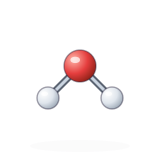 | The formula of water is H2O. | One molecule of water contains 2 hydrogen atoms and 1 oxygen atom. |
| carbon dioxide | 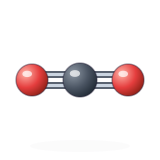 | The formula of carbon dioxide is CO2. | One molecule of carbon dioxide contains 1 carbon atom and 2 oxygen atoms. |
| ammonia |  | The formula of ammonia is NH3. | One molecule of ammonia contains 1 nitrogen atom and 3 hydrogen atoms. |
| methane | 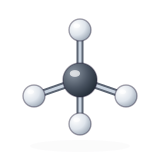 | The formula of methane is CH4. | One molecule of methane contains 1 carbon atom and 4 hydrogen atoms. |
| hydrogen chloride | 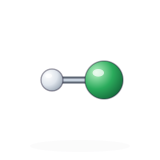 | The formula of hydrogen chloride is HCl. | One molecule of hydrogen chloride contains 1 hydrogen atom and 1 chlorine atom. |
| sulfuric acid | 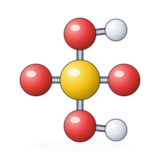 | The formula of sulfuric acid is H2SO4. | One molecule of sulfuric acid contains 2 hydrogen atoms, 1 sulfur atom and 4 oxygen atoms. |
The SEAB glossary says “State implies a concise answer with little or no supporting argument”, so write the symbol or formula on its own, with the correct capital and small letters.
Depth: why and how
- Why is the second letter of a symbol a small letter? The small letter shows that the two letters stand for one element, so Co is cobalt, whereas CO is the compound carbon monoxide made of carbon and oxygen.
- Why does a compound always have the same formula? Its elements are combined in a fixed ratio, so every unit of the compound has the same numbers of atoms of each element.
- Why is the formula of oxygen gas written O2? Oxygen gas is made of molecules of two atoms joined by a covalent bond, and hydrogen, nitrogen and chlorine are written H2, N2 and Cl2 for the same reason.
- Cross-link to Chemical Bonding and Structure: the formula of a simple covalent molecule shows the actual numbers of atoms in one molecule, whereas the formula of an ionic compound shows the simplest ratio of its ions and the formula of a giant covalent substance such as SiO2 shows the simplest ratio of its atoms.
Common mistakes
The symbol for chlorine is CL.
The symbol for chlorine is Cl, with a capital first letter and a small second letter.
CO is the formula of cobalt.
Cobalt has the symbol Co, whereas CO is carbon monoxide, a compound of carbon and oxygen.
Water is HO2, because the 2 is written after the O.
A subscript belongs to the symbol before it, so H2O has two hydrogen atoms and one oxygen atom.
Chlorine gas is written Cl.
Chlorine gas is made of molecules, so it is written Cl2.
A symbol starts with a capital letter, a formula shows how many atoms of each element are present, and the subscript belongs to the symbol before it.
Exam check
Q1Which is the correct symbol for sodium?
- ANA
- BSd
- CSo
- DNa
Show answer
MCQ answer key D (Na): the first letter of a symbol is a capital letter and the second is a small letter, so sodium is Na.
Q2How many atoms are present in one molecule of sulfuric acid, H2SO4?
- A4
- B7
- C3
- D6
Show answer
MCQ answer key B (7): one molecule has 2 hydrogen atoms, 1 sulfur atom and 4 oxygen atoms, which is 7 atoms in total.
Q3Which of these is the formula of a compound?
- ACO
- BCo
- CO2
- DH2
Show answer
MCQ answer key A (CO): CO contains two elements, carbon and oxygen, whereas Co is the element cobalt and O2 and H2 are elements.
StructuredAmmonia is a compound of nitrogen and hydrogen with the formula NH3.
- State the symbols of nitrogen and hydrogen. [2]
- State the total number of atoms in one molecule of ammonia. [1]
- State the difference between Co and CO. [2]
- Explain why the symbol for chlorine is not written as CL. [1]
Total: 6 marks
Show mark scheme
(a) 2 marks
- Mark scheme: N for nitrogen
- Mark scheme: H for hydrogen
(b) 1 mark
- Mark scheme: 4
(c) 2 marks
- Mark scheme: Co is the element cobalt
- Mark scheme: CO is a compound of carbon and oxygen
(d) 1 mark
- Mark scheme: the second letter of a symbol must be a small letter
Formulae from the numbers of atoms
deduce the formulae of simple compounds from the relative numbers of atoms present and vice versa
To deduce a formula from the numbers of atoms, write the symbol of each element followed by its number of atoms as a subscript, and to deduce the numbers of atoms from a formula, read each subscript.
- Molecular formula
- Molecular formula: the formula that gives the real count of every kind of atom in one molecule supports K324-4.1(b)
- Structural formula
- Structural formula: a formula that shows how the atoms in a molecule are joined, such as CH3CH2OH for ethanol supports K324-4.1(b)
- Brackets in a formula
- Brackets in a formula: a group of atoms in brackets with a subscript outside, such as Ca(OH)2, means that every atom inside the brackets is multiplied by the subscript supports K324-4.1(b)
- Simplest ratio
- Simplest ratio: the smallest whole-number ratio of the atoms of the elements in a compound supports K324-4.1(b)
Deducing a formula and reading a formula
- 1To deduce a formula, list the elements present and write the number of atoms of each element, using no subscript when there is only one atom.
- 2Write the symbols in the usual order, for example carbon first and hydrogen next in a hydrocarbon, with each number as a subscript after its symbol.
- 3To read the numbers of atoms from a formula, multiply the subscript of any bracket by every subscript inside it, so Ca(OH)2 has 1 calcium atom, 2 oxygen atoms and 2 hydrogen atoms.
| Substance | Formula | Atoms present |
|---|---|---|
| ethane | The formula of ethane is C2H6. | C2H6 contains 2 carbon atoms and 6 hydrogen atoms. |
| ethene | The formula of ethene is C2H4. | C2H4 contains 2 carbon atoms and 4 hydrogen atoms. |
| ethanol | The formula of ethanol is C2H6O. | C2H6O contains 2 carbon atoms, 6 hydrogen atoms and 1 oxygen atom. |
| ethanoic acid | The formula of ethanoic acid is C2H4O2. | C2H4O2 contains 2 carbon atoms, 4 hydrogen atoms and 2 oxygen atoms. |
| calcium hydroxide | The formula of calcium hydroxide is Ca(OH)2. | Ca(OH)2 contains 1 calcium atom, 2 oxygen atoms and 2 hydrogen atoms. |
| ammonium sulfate | The formula of ammonium sulfate is (NH4)2SO4. | (NH4)2SO4 contains 2 nitrogen atoms, 8 hydrogen atoms, 1 sulfur atom and 4 oxygen atoms. |
The formula of an ionic compound is the simplest ratio of its ions, whereas the molecular formula of a simple covalent compound can be a multiple of its simplest ratio, as ethane C2H6 has the simplest ratio CH3. supports K324-4.1(b)
The SEAB glossary says “Predict or deduce implies that the candidate is not expected to produce the required answer by recall but by making a logical connection between other pieces of information”, so use the numbers of atoms given in the question to build the formula.
Depth: why and how
- Why does Ca(OH)2 have two oxygen atoms and not one? The subscript 2 outside the bracket multiplies every atom inside the bracket, so there are two oxygen atoms and two hydrogen atoms.
- Why can the same elements form more than one compound? The elements can combine in different numbers of atoms, so carbon and oxygen form CO and CO2, which are different substances with different properties.
- Why is a formula with no subscript read as one atom? A subscript is only written when the number of atoms is more than 1, so the symbol Na on its own means one sodium atom.
- Cross-link to Chemical Bonding and Structure: how many atoms of each kind a covalent molecule contains is set by the number of bonds that each atom forms.
Common mistakes
Ca(OH)2 has 1 oxygen atom and 1 hydrogen atom.
Ca(OH)2 has 2 oxygen atoms and 2 hydrogen atoms, because the subscript outside the bracket multiplies every atom inside it.
Ethane is C6H2.
Ethane is C2H6, with the number of atoms written after the symbol of each element in the order carbon then hydrogen.
To balance a formula, change the subscript of a compound.
A change in a subscript makes a different compound, so the formula of a compound is fixed and only the numbers in front of it in an equation can change.
Write each symbol with its number of atoms as a subscript, and multiply the atoms inside brackets by the subscript outside.
Exam check
Q1A molecule contains 2 carbon atoms, 4 hydrogen atoms and 2 oxygen atoms. Which is its formula?
- AC2H2O4
- BC4H2O2
- CC2H4O
- DC2H4O2
Show answer
MCQ answer key D (C2H4O2): the number of atoms of each element is written as a subscript after its symbol, so 2 carbon, 4 hydrogen and 2 oxygen is C2H4O2.
Q2How many hydrogen atoms are in one formula unit of (NH4)2SO4?
- A8
- B4
- C2
- D6
Show answer
MCQ answer key A (8): the bracket (NH4) contains 4 hydrogen atoms and the subscript 2 doubles it, which gives 8 hydrogen atoms.
Q3How many atoms are present altogether in the formula Ca(OH)2?
- A3
- B4
- C6
- D5
Show answer
MCQ answer key D (5): there is 1 calcium atom, 2 oxygen atoms and 2 hydrogen atoms, which is 5 atoms in total.
StructuredA compound has the formula C2H6O.
- State the number of atoms of each element in one molecule of the compound. [3]
- State the total number of atoms in one molecule. [1]
- Calcium hydroxide has the formula Ca(OH)2. State the number of hydrogen atoms in one formula unit of calcium hydroxide. [1]
Total: 5 marks
Show mark scheme
(a) 3 marks
- Mark scheme: 2 carbon atoms
- Mark scheme: 6 hydrogen atoms
- Mark scheme: 1 oxygen atom
(b) 1 mark
- Mark scheme: 9
(c) 1 mark
- Mark scheme: 2
Formulae of ionic compounds from ion charges
deduce the formulae of ionic compounds from the charges on the ions present and vice versa
The formula of an ionic compound has equal total positive and negative charge, so the charge of each ion is swapped to give the number of the other ion, and the formula is written in its simplest ratio.
- Ion
- Ion: an atom or a group of atoms that has gained or lost electrons and so has an electric charge supports K324-4.1(c)
- Cation
- Cation: a positively charged ion, such as a metal ion that is formed when a metal atom loses electrons supports K324-4.1(c)
- Anion
- Anion: a negatively charged ion, such as a non-metal ion that is formed when an atom gains electrons supports K324-4.1(c)
- Polyatomic ion
- Polyatomic ion: an ion made of a group of atoms, such as SO42–, which is put in brackets when more than one is needed supports K324-4.1(c)
- Formula unit
- Formula unit: the simplest ratio of the ions in an ionic compound, such as MgCl2 supports K324-4.1(c)
Charges of common ions
| Ion | Formula and charge |
|---|---|
| hydrogen ion | The hydrogen ion is H+, which has a charge of 1+. |
| sodium ion | The sodium ion is Na+, which has a charge of 1+. |
| potassium ion | The potassium ion is K+, which has a charge of 1+. |
| silver ion | The silver ion is Ag+, which has a charge of 1+. |
| ammonium ion | The ammonium ion is NH4+, which has a charge of 1+. |
| magnesium ion | The magnesium ion is Mg2+, which has a charge of 2+. |
| calcium ion | The calcium ion is Ca2+, which has a charge of 2+. |
| zinc ion | The zinc ion is Zn2+, which has a charge of 2+. |
| barium ion | The barium ion is Ba2+, which has a charge of 2+. |
| copper(II) ion | The copper(II) ion is Cu2+, which has a charge of 2+. |
| iron(II) ion | The iron(II) ion is Fe2+, which has a charge of 2+. |
| lead(II) ion | The lead(II) ion is Pb2+, which has a charge of 2+. |
| aluminium ion | The aluminium ion is Al3+, which has a charge of 3+. |
| iron(III) ion | The iron(III) ion is Fe3+, which has a charge of 3+. |
| chloride ion | The chloride ion is Cl–, which has a charge of 1−. |
| bromide ion | The bromide ion is Br–, which has a charge of 1−. |
| iodide ion | The iodide ion is I–, which has a charge of 1−. |
| hydroxide ion | The hydroxide ion is OH–, which has a charge of 1−. |
| nitrate ion | The nitrate ion is NO3–, which has a charge of 1−. |
| oxide ion | The oxide ion is O2–, which has a charge of 2−. |
| sulfate ion | The sulfate ion is SO42–, which has a charge of 2−. |
| carbonate ion | The carbonate ion is CO32–, which has a charge of 2−. |
Formulae from charges, step by step
- 1Write the ions with their charges, for example Al3+ and O2– for aluminium oxide.
- 2Swap the numbers of the charges, ignoring the signs, and write them as subscripts, so the 3 from Al3+ goes to oxygen and the 2 from O2– goes to aluminium.
- 3Divide by any common factor to give the simplest ratio, and put a polyatomic ion in brackets when its subscript is more than 1.
- 4Check that the total positive charge equals the total negative charge, so the compound is neutral overall.
| Compound | Formula | Ions combining, with the charges balanced |
|---|---|---|
| magnesium chloride | The formula of magnesium chloride is MgCl2. | Mg2+ + 2Cl– → MgCl2 |
| aluminium oxide | The formula of aluminium oxide is Al2O3. | 2Al3+ + 3O2– → Al2O3 |
| calcium hydroxide | The formula of calcium hydroxide is Ca(OH)2. | Ca2+ + 2OH– → Ca(OH)2 |
| sodium sulfate | The formula of sodium sulfate is Na2SO4. | 2Na+ + SO42– → Na2SO4 |
| aluminium sulfate | The formula of aluminium sulfate is Al2(SO4)3. | 2Al3+ + 3SO42– → Al2(SO4)3 |
| ammonium carbonate | The formula of ammonium carbonate is (NH4)2CO3. | 2NH4+ + CO32– → (NH4)2CO3 |
| iron(III) hydroxide | The formula of iron(III) hydroxide is Fe(OH)3. | Fe3+ + 3OH– → Fe(OH)3 |
| zinc nitrate | The formula of zinc nitrate is Zn(NO3)2. | Zn2+ + 2NO3– → Zn(NO3)2 |
To deduce the charge of a metal ion from a formula, balance it against the known charge of the negative ion, so FeCl3 contains Fe3+ because three Cl– ions have a total charge of 3−. supports K324-4.1(c)
A Roman numeral in the name of a metal compound gives the charge of the metal ion, so iron(II) oxide contains Fe2+ and iron(III) oxide contains Fe3+. supports K324-4.1(c)
The SEAB glossary says “Predict or deduce implies that the candidate is not expected to produce the required answer by recall but by making a logical connection between other pieces of information”, so use the charges to work out the formula and show the check that the charges balance.
Depth: why and how
- Why must the total charge of an ionic compound be zero? The compound is electrically neutral, so the positive charge of the cations must cancel the negative charge of the anions.
- Why is Mg2+ with O2– written MgO and not Mg2O2? The formula shows the simplest ratio of ions, and one Mg2+ ion balances one O2– ion.
- Why is the sulfate ion put in brackets in Al2(SO4)3? The subscript 3 applies to the whole SO42– ion, so the brackets show that there are three sulfate ions, each with one sulfur atom and four oxygen atoms.
- Why can iron form more than one oxide? Iron forms two ions, Fe2+ and Fe3+, so it forms iron(II) oxide and iron(III) oxide, and the Roman numeral in the name shows which ion is present.
- Cross-link to Chemical Bonding and Structure: the charge of an ion depends on the number of electrons that its atom loses or gains to obtain a full outer shell.
Common mistakes
The formula of aluminium oxide is AlO.
The formula of aluminium oxide is Al2O3, because two Al3+ ions have a total charge of 6+ and three O2– ions have a total charge of 6−.
The formula of calcium hydroxide is CaOH2.
The formula of calcium hydroxide is Ca(OH)2, because the OH– ion needs brackets when the subscript is more than 1.
The charge on the sulfate ion in Na2SO4 is 4−, because of the subscript 4.
The 4 in SO4 counts oxygen atoms, whereas the charge of the sulfate ion is 2−, which is why two Na+ ions are needed.
Swap the charges to give the subscripts, simplify to the smallest ratio, and check that the total positive and negative charges are equal.
Exam check
Q1Which is the formula of magnesium nitrate?
- AMgNO3
- BMg(NO3)2
- CMg2NO3
- DMg(NO3)3
Show answer
MCQ answer key B (Mg(NO3)2): magnesium is Mg2+ and nitrate is NO3–, so two nitrate ions are needed and the nitrate ion is put in brackets.
Q2Which is the formula of aluminium sulfate?
- AAlSO4
- BAl2(SO4)3
- CAl3(SO4)2
- DAl2SO4
Show answer
MCQ answer key B (Al2(SO4)3): aluminium is Al3+ and sulfate is SO42–, so the charges swap to give 2 aluminium ions and 3 sulfate ions.
Q3The formula of an iron compound is Fe2O3. Which ion of iron does it contain?
- AFe2+
- BFe+
- CFe3+
- DFe6+
Show answer
MCQ answer key C (Fe3+): three O2– ions have a total charge of 6−, which is balanced by two iron ions of charge 3+ each.
StructuredZinc forms the ion Zn2+ and the nitrate ion is NO3–.
- Write the formula of zinc nitrate. [1]
- Explain why the nitrate ion is in brackets in the formula. [2]
- Write the formula of aluminium oxide. [1]
- Deduce the charge on the iron ion in FeCl3. [2]
Total: 6 marks
Show mark scheme
(a) 1 mark
- Mark scheme: Zn(NO3)2
(b) 2 marks
- Mark scheme: two nitrate ions are needed
- Mark scheme: the subscript 2 applies to the whole group of atoms in the ion
(c) 1 mark
- Mark scheme: Al2O3
(d) 2 marks
- Mark scheme: there are three chloride ions, with a total charge of 3−
- Mark scheme: so the iron ion is Fe3+
Interpreting equations with state symbols
interpret chemical equations with state symbols
A chemical equation with state symbols shows the reactants and products, the physical state of each, and, from the numbers in front of the formulae, the ratio in which the amounts of substances react.
- Reactant
- Reactant: a substance that is used up in a chemical reaction, written on the left of the arrow supports K324-4.1(d)
- Product
- Product: a substance that is made in a chemical reaction, written on the right of the arrow supports K324-4.1(d)
- Coefficient
- Coefficient: the number written in front of a formula in an equation, which gives the amount in moles of that substance in the reaction supports K324-4.1(d)
- State symbol
- State symbol: a symbol in brackets after a formula to show the physical state of the substance supports K324-4.1(d)
- Aqueous
- Aqueous: dissolved in water, shown by the state symbol (aq) supports K324-4.1(d)
State symbols
| State symbol | Picture | Meaning | Example |
|---|---|---|---|
| (s) |  | The state symbol (s) means solid. | Mg(s) is magnesium metal. |
| (l) |  | The state symbol (l) means liquid. | H2O(l) is pure liquid water. |
| (g) |  | The state symbol (g) means gas. | CO2(g) is carbon dioxide gas. |
| (aq) |  | The state symbol (aq) means aqueous, which is a solution in water. | HCl(aq) is hydrochloric acid, which is hydrogen chloride dissolved in water. |
Reading a balanced equation
2Mg(s) + O2(g) → 2MgO(s)Two moles of solid magnesium react with one mole of oxygen gas to form two moles of solid magnesium oxide.
CaCO3(s) + 2HCl(aq) → CaCl2(aq) + H2O(l) + CO2(g)One mole of solid calcium carbonate reacts with two moles of hydrochloric acid to form one mole each of aqueous calcium chloride, liquid water and carbon dioxide gas.
From Mg, O2 and MgO the masses in the equation are 2 × 24 = 48 g of magnesium and 32 g of oxygen, which together make 80 g of magnesium oxide, so the total mass of the reactants equals the total mass of the products.
The coefficients in an equation give the ratio of the amounts in moles and of the particles, but they do not give the ratio of the masses, because the masses also depend on the relative formula mass of each substance. supports K324-4.1(d)
The SEAB glossary says “State implies a concise answer with little or no supporting argument”, so when you are asked what (aq) means, write only that the substance is dissolved in water.
Depth: why and how
- Why is the state symbol of water (l) and not (aq)? Pure water is a liquid, whereas (aq) is used only for a substance dissolved in water.
- Why does the total mass stay the same in a reaction? Atoms are rearranged but none are created or destroyed, so the total mass of the reactants equals the total mass of the products.
- Why does a gas product matter in an experiment? A gas such as carbon dioxide can escape from an open container, so the mass of the container falls even though the total mass of the products is the same.
- Why can state symbols tell you how to separate the products? A solid product (s) can be filtered off from a solution, whereas a product with (aq) stays dissolved in the filtrate.
- Cross-link to Acid-Base Chemistry: the state symbols in an equation for a salt show whether the salt dissolves, so (s) shows a precipitate and (aq) shows a soluble salt.
Common mistakes
The coefficients show that 2 g of magnesium reacts with 1 g of oxygen.
The coefficients show that 2 mol of magnesium react with 1 mol of oxygen, and the masses are found from the relative atomic mass or relative formula mass of each substance.
H2O(aq) is written for the water that is formed in a reaction.
The water formed is pure liquid water, so it is written H2O(l), and (aq) is kept for a substance dissolved in water.
A reaction in an open flask loses mass, so mass is not conserved.
The mass of the open flask falls only because a gas escapes, and the total mass of reactants and products together is the same.
State symbols show the physical state, and the coefficients show the ratio of the amounts in moles, not the ratio of the masses.
Exam check
Q1What does the state symbol (aq) show?
- AThe substance is a pure liquid.
- BThe substance is dissolved in water.
- CThe substance is a gas.
- DThe substance is a solid.
Show answer
MCQ answer key B (The substance is dissolved in water.): (aq) means aqueous, which is a solution in water, whereas the symbols (l), (g) and (s) show a liquid, a gas and a solid.
Q2The equation is 2Mg(s) + O2(g) → 2MgO(s) How many moles of magnesium oxide are formed from 1 mol of oxygen gas?
- A1
- B4
- C2
- D3
Show answer
MCQ answer key C (2): the ratio of O2 to MgO in the equation is 1 : 2, so 1 mol of oxygen gas forms 2 mol of magnesium oxide.
Q3The equation is CaCO3(s) + 2HCl(aq) → CaCl2(aq) + H2O(l) + CO2(g) Which product is a gas?
- ACaCl2
- BH2O
- CCO2
- DHCl
Show answer
MCQ answer key C (CO2): the state symbol (g) after CO2 shows that carbon dioxide is a gas, whereas CaCl2 is aqueous, H2O is a liquid and HCl is a reactant.
StructuredMagnesium burns in oxygen: 2Mg(s) + O2(g) → 2MgO(s)
- State the physical state of magnesium oxide. [1]
- State the number of moles of magnesium that react with 1 mol of oxygen. [1]
- State what the number 2 in front of MgO shows. [1]
- Explain why the ratio of the masses of magnesium and oxygen is not 2 : 1. [2]
Total: 5 marks
Show mark scheme
(a) 1 mark
- Mark scheme: solid
(b) 1 mark
- Mark scheme: 2
(c) 1 mark
- Mark scheme: 2 mol of magnesium oxide are formed
(d) 2 marks
- Mark scheme: the coefficients give the ratio of moles
- Mark scheme: oxygen has a different relative formula mass from magnesium, so the masses are not in the same ratio
You've read the free 32%. Unlock the rest of Chapter 4.
Still to read in this chapter:
- Constructing equations, including ionic equations
- Relative atomic mass, Ar
- Relative molecular mass, Mr, and relative formula mass
- The mole and the Avogadro constant
- Percentage mass of an element in a compound
- Empirical and molecular formulae
- Reacting masses, gas volumes and limiting reactants
- Solution concentration and titration calculations
- Percentage yield and percentage purity
$9 one-time · all 13 chapters · no subscription
Less than a fast-food meal.
Yours for the whole syllabus.
Premium members get all 13 chapters included.
Notes version 1.0 · Last updated 2 Oct 2026 · Chapter 4 of 13