










Acid-Base Chemistry
SEAB syllabus topic 5: how acids, alkalis, salts and ammonia behave, with the reasons, the common mistakes, the practical skills and an exam check for every outcome.

Acids produce H+ ions in water, alkalis produce OH– ions in water, and the two react together in neutralisation to form a salt and water.
The method for preparing a salt depends on its solubility: precipitation for an insoluble salt, titration for a soluble Group 1 or ammonium salt, and an excess of solid for other soluble salts.
Ammonia is made in the Haber process from nitrogen from the air and hydrogen from the cracking of crude oil, in a reaction that is reversible.
Acids and alkalis
describe the meanings of the terms acid and alkali in terms of the ions they produce in aqueous solution and their effects on Universal Indicator
An acid is a substance that produces hydrogen ions, H+, in aqueous solution, and an alkali is a substance that produces hydroxide ions, OH–, in aqueous solution.
- Acid
- Acid: a substance that produces hydrogen ions, H+, when it dissolves in water
- Alkali
- Alkali: a base that dissolves in water and produces hydroxide ions, OH–, in the solution
- Base
- Base: a substance that neutralises an acid to form a salt (and water, except for ammonia), such as a metal oxide, a metal hydroxide or ammonia supports K324-5.1(a)
- Aqueous solution
- Aqueous solution: a solution in which the solvent is water, shown by the state symbol (aq) supports K324-5.1(a)
- Hydrogen ion
- Hydrogen ion: H+, a hydrogen atom that has lost its electron supports K324-5.1(a)
- Indicator
- Indicator: a substance that changes colour to show whether a solution is acidic or alkaline supports K324-5.1(a)
- Universal Indicator
- Universal Indicator: a mixture of indicators that gives a range of colours across the pH scale
- Litmus
- Litmus: an indicator that is red in acidic solutions and blue in alkaline solutions supports K324-5.1(a)
- Effect of an acid on indicators
- Effect of an acid on indicators: an acid turns blue litmus paper red and turns Universal Indicator red or orange
- Effect of an alkali on indicators
- Effect of an alkali on indicators: an alkali turns red litmus paper blue and turns Universal Indicator blue or violet
Ions produced in aqueous solution
HCl(aq) → H+(aq) + Cl–(aq)Hydrochloric acid produces hydrogen ions and chloride ions.
H2SO4(aq) → 2H+(aq) + SO42–(aq)Each molecule of sulfuric acid produces two hydrogen ions and one sulfate ion.
NaOH(aq) → Na+(aq) + OH–(aq)Sodium hydroxide produces sodium ions and hydroxide ions.
Ca(OH)2(s) → Ca2+(aq) + 2OH–(aq)Calcium hydroxide dissolves only slightly in water, but the part that dissolves produces hydroxide ions.
Indicator colours
| Indicator | Picture | In acidic solution | In neutral solution | In alkaline solution |
|---|---|---|---|---|
| Litmus | 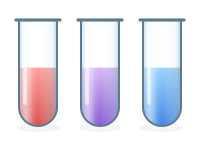 | Litmus is red in acidic solution. | Litmus is purple in neutral solution. | Litmus is blue in alkaline solution. |
| Universal Indicator | 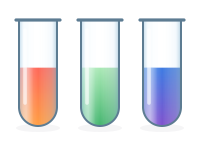 | Universal Indicator is red or orange in acidic solution. | Universal Indicator is green in neutral solution. | Universal Indicator is blue or violet in alkaline solution. |
| Methyl orange | 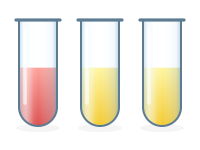 | Methyl orange is red in acidic solution. | Methyl orange is yellow in neutral solution. | Methyl orange is yellow in alkaline solution. |
| Thymolphthalein | 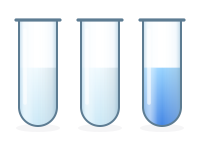 | Thymolphthalein is colourless in acidic solution. | Thymolphthalein is colourless in neutral solution. | Thymolphthalein is blue in strongly alkaline solution. |
The SEAB glossary says “Describe requires candidates to state in words (using diagrams where appropriate) the main points of the topic”, so when you describe the meaning of acid or alkali, name the ion and say that it forms in aqueous solution.
In water, a hydrogen ion is attached to a water molecule as H3O+, but for SEAB answers, write H+ or hydrogen ions. supports K324-5.1(a)
Depth: why and how
- Why must an acid be dissolved in water before it shows acidic properties? Without water the acid does not produce hydrogen ions, so dry hydrogen chloride gas does not turn dry blue litmus paper red, but hydrochloric acid does.
- Why is every alkali a base but not every base an alkali? A base such as copper(II) oxide neutralises acids but does not dissolve in water, so it cannot produce hydroxide ions in solution and is not an alkali.
- Why does Universal Indicator show a range of colours? It is a mixture of several indicators, and each indicator changes colour at a different pH.
- Cross-link to Chemical Bonding and Structure: hydrogen chloride and sulfuric acid are covalent molecules that form ions only when they dissolve in water.
Common mistakes
An alkali is any base.
An alkali is a base that dissolves in water to produce hydroxide ions; a base that does not dissolve in water, such as copper(II) oxide, is not an alkali.
Acids produce hydrogen ions even when they are dry.
An acid produces hydrogen ions only when it dissolves in water, so dry hydrogen chloride gas shows no acidic properties.
An acid turns red litmus paper blue.
An acid turns blue litmus paper red, and an alkali turns red litmus paper blue.
Universal Indicator is green in an acid.
Universal Indicator is green only in a neutral solution; it is red, orange or yellow in an acidic solution.
An acid produces H+ in water and an alkali produces OH– in water, so always name the ion and say that it forms in aqueous solution.
Exam check
Q1Which ion is present in excess in an aqueous solution of an acid?
- AOH–
- BH+
- CNa+
- DSO42–
Show answer
MCQ answer key B (H+): all acids produce hydrogen ions, H+, in aqueous solution, whereas OH– ions are produced by alkalis.
Q2Which substance is an alkali?
- Asodium hydroxide
- Bcopper(II) oxide
- Ciron(III) hydroxide
- Dzinc oxide
Show answer
MCQ answer key A (sodium hydroxide): sodium hydroxide is a base that dissolves in water to give hydroxide ions, whereas the other three bases do not dissolve in water.
Q3Which statement explains why dry hydrogen chloride gas does not turn dry blue litmus paper red?
- AIt is a base.
- BIt is not a covalent compound.
- CIt contains no hydrogen.
- DIt does not produce hydrogen ions without water.
Show answer
MCQ answer key D (It does not produce hydrogen ions without water.): an acid produces hydrogen ions only in aqueous solution, and hydrogen chloride contains hydrogen and is covalent.
StructuredHydrochloric acid and aqueous sodium hydroxide are tested with indicators.
- State what is meant by the term acid. [1]
- State the colour of Universal Indicator in aqueous sodium hydroxide and name the ion responsible for this colour. [2]
- Write an equation, with state symbols, to show how hydrochloric acid produces ions in water. [2]
- Explain why dry hydrogen chloride gas does not turn dry blue litmus paper red. [2]
Total: 7 marks
Show mark scheme
(a) 1 mark
- Mark scheme: a substance that produces hydrogen ions, H+, in aqueous solution
(b) 2 marks
- Mark scheme: blue or violet
- Mark scheme: hydroxide ions, OH–
(c) 2 marks
- Mark scheme: HCl(aq) → H+(aq) + Cl–(aq)
- Mark scheme: all three state symbols are correct, and HCl(g) is accepted for the reactant
(d) 2 marks
- Mark scheme: there is no water present
- Mark scheme: so hydrogen ions are not produced
Neutrality, pH and relative acidity
describe neutrality and relative acidity and alkalinity, in terms of (i) relative H+ and OH- ion concentrations, (ii) colour in Universal Indicator, and (iii) the pH scale (calculation of pH from hydrogen ion concentration is not required)
A neutral solution has equal concentrations of H+ and OH– ions and pH 7; an acidic solution has more H+ than OH– ions and pH below 7; an alkaline solution has more OH– than H+ ions and pH above 7.
- Neutral solution
- Neutral solution: a solution with equal concentrations of H+ and OH– ions, pH 7 and a green colour in Universal Indicator
- Acidic solution
- Acidic solution: a solution with a higher concentration of H+ ions than OH– ions and a pH below 7
- Alkaline solution
- Alkaline solution: a solution with a higher concentration of OH– ions than H+ ions and a pH above 7
- pH scale
- pH scale: a scale from 0 to 14 that shows how acidic or alkaline a solution is, using the amounts of H+ and OH– ions in the solution
- Relative acidity
- Relative acidity: how acidic one solution is compared with another; the lower the pH, the higher the concentration of H+ ions and the more acidic the solution
- pH probe
- pH probe: a sensor that measures pH and, when connected to a data-logger, gives a numerical reading supports K324-5.1(b)
Comparing solutions by pH
| Type of solution | Picture | Relative ions | pH | Universal Indicator | Litmus |
|---|---|---|---|---|---|
| Strongly acidic | 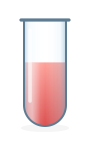 | Much more H+ than OH– ions. | pH much lower than 7 | red | red |
| Weakly acidic | 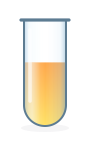 | Slightly more H+ than OH– ions. | pH below 7 but close to 7 | orange or yellow | red |
| Neutral | 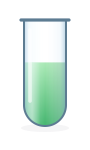 | Equal concentrations of H+ and OH– ions. | pH 7 | green | purple |
| Weakly alkaline | 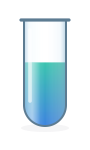 | Slightly more OH– than H+ ions. | pH above 7 but close to 7 | blue-green or blue | blue |
| Strongly alkaline | 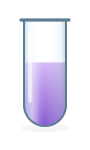 | Much more OH– than H+ ions. | pH much higher than 7 | violet | blue |
The exact pH range for each Universal Indicator colour differs slightly between brands, so use the colour chart supplied with the indicator or in the question; as the pH rises, the colour goes from red through orange, yellow, green and blue to violet. supports K324-5.1(b)
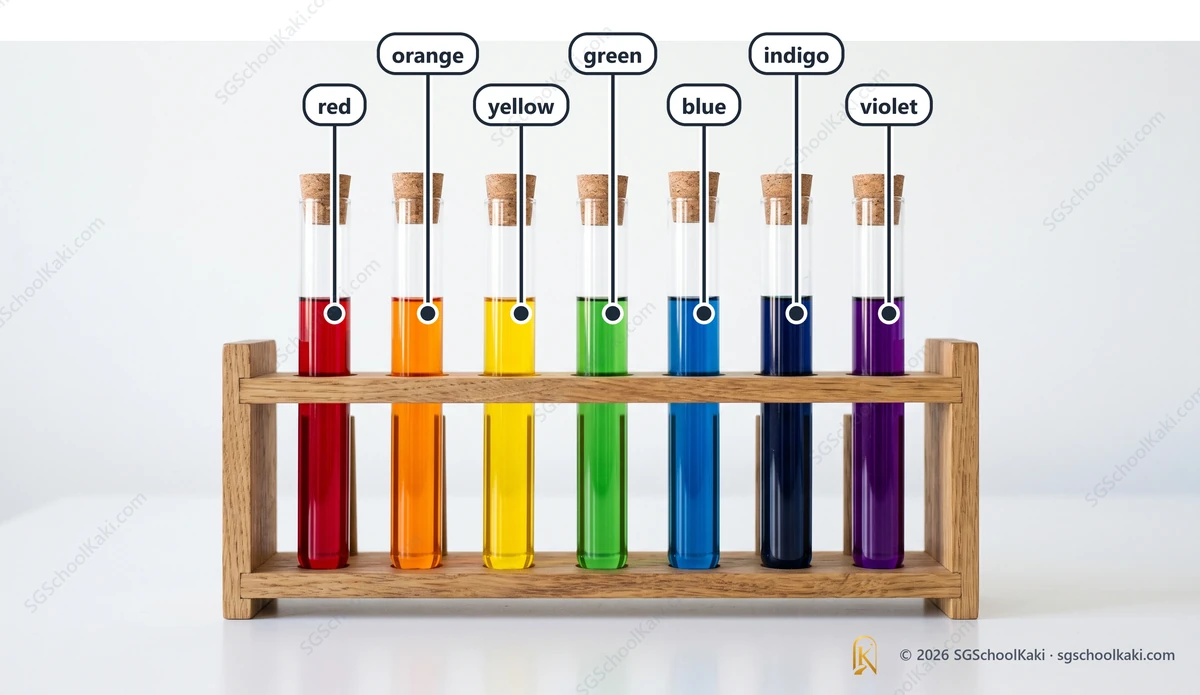
The pH scale

The SEAB glossary says “Describe requires candidates to state in words (using diagrams where appropriate) the main points of the topic” and the outcome asks you to describe neutrality in terms of ions, colour and pH, so give all three.
Depth: why and how
- Why is the pH of a neutral solution 7? A neutral solution has equal concentrations of H+ and OH– ions, and pH 7 is the point on the scale that matches this balance.
- What does a change of one pH unit mean? Each decrease of one pH unit means that the concentration of H+ ions is ten times higher.
- Why is Universal Indicator better than litmus for comparing acids? Litmus only shows whether a solution is acidic or alkaline, but Universal Indicator shows relative acidity by its range of colours.
- How can pH be measured more precisely than with Universal Indicator? A pH probe connected to a data-logger gives a numerical reading, and SEAB expects candidates to be familiar with the use of data-loggers.
- Cross-link to Chemical Calculations: concentration is an amount of substance in a volume, in mol/dm³, but SEAB states that calculating pH from the hydrogen ion concentration is not required.
Common mistakes
A solution with pH 7 contains no ions.
A solution with pH 7 is neutral because it has equal concentrations of H+ and OH– ions, not because it has no ions.
A solution with pH 14 is acidic.
A solution with a pH above 7 is alkaline, and the higher the pH, the higher the concentration of OH– ions.
A lower pH means a lower concentration of H+ ions.
A lower pH means a higher concentration of H+ ions.
Universal Indicator is red in a neutral solution.
Universal Indicator is green in a neutral solution.
A pH below 7 is acidic, pH 7 is neutral and a pH above 7 is alkaline, and the lower the pH, the more H+ ions there are.
Exam check
Q1A solution has a pH of 3. Which statement about this solution is correct?
- AIt contains more H+ ions than OH– ions.
- BIt contains more OH– ions than H+ ions.
- CIt contains equal numbers of H+ and OH– ions.
- DIt turns red litmus paper blue.
Show answer
MCQ answer key A (It contains more H+ ions than OH– ions.): a pH below 7 means that the solution is acidic, with more H+ than OH– ions, and acidic solutions turn blue litmus paper red.
Q2Which solution has the highest concentration of H+ ions?
- ApH 5
- BpH 2
- CpH 7
- DpH 12
Show answer
MCQ answer key B (pH 2): the lower the pH, the higher the concentration of H+ ions, so pH 2 has the highest concentration.
Q3What colour is Universal Indicator in a neutral solution?
- Agreen
- Bred
- Corange
- Dviolet
Show answer
MCQ answer key A (green): Universal Indicator is green in a neutral solution, red in strongly acidic and violet in strongly alkaline solutions.
StructuredThree solutions P, Q and R have pH values of 2, 7 and 13.
- State which solution is neutral. [1]
- State the colour of Universal Indicator in solution R. [1]
- Compare the concentrations of H+ and OH– ions in solution P. [1]
- Suggest one advantage of measuring pH with a pH probe and data-logger instead of Universal Indicator. [1]
Total: 4 marks
Show mark scheme
(a) 1 mark
- Mark scheme: solution Q
(b) 1 mark
- Mark scheme: blue or violet
(c) 1 mark
- Mark scheme: solution P has a higher concentration of H+ ions than OH– ions
(d) 1 mark
- Mark scheme: it gives a numerical pH reading, or it does not depend on matching a colour to a chart by eye
Strong and weak acids
describe qualitatively the difference between strong and weak acids in terms of the extent of ionisation
A strong acid ionises completely in water, but a weak acid ionises only partially, so the strength of an acid depends on its extent of ionisation and not on its concentration.
- Strong acid
- Strong acid: an acid that ionises completely in water, such as hydrochloric acid, nitric acid and sulfuric acid
- Weak acid
- Weak acid: an acid that ionises only partially in water, so most of its molecules stay unchanged, such as ethanoic acid
- Ionisation
- Ionisation: the process in which molecules form ions when they dissolve in water supports K324-5.1(c)
- Strength of an acid
- Strength of an acid: the extent to which the acid ionises in water
- Concentration of an acid
- Concentration of an acid: the amount of acid dissolved in a given volume of solution, for example in mol/dm³
- Concentrated acid
- Concentrated acid: a solution that contains a large amount of acid in a given volume, whether the acid is strong or weak supports K324-5.1(c)
- Dilute acid
- Dilute acid: a solution that contains a small amount of acid in a given volume, whether the acid is strong or weak supports K324-5.1(c)
- Basicity
- Basicity: the number of hydrogen ions that one molecule of an acid can produce, so hydrochloric acid and ethanoic acid are monobasic and sulfuric acid is dibasic supports K324-5.1(c)
- Reversible arrow
- Reversible arrow: the sign ⇌, used when a reaction can go in both directions, as in the partial ionisation of a weak acid supports K324-5.1(c)
Complete and partial ionisation
HCl(aq) → H+(aq) + Cl–(aq)Hydrochloric acid is a strong acid, so every molecule ionises and a single arrow is used.
CH3COOH(aq) ⇌ H+(aq) + CH3COO–(aq)Ethanoic acid is a weak acid, so only some molecules ionise and the reversible arrow is used.
Strong and weak acids compared
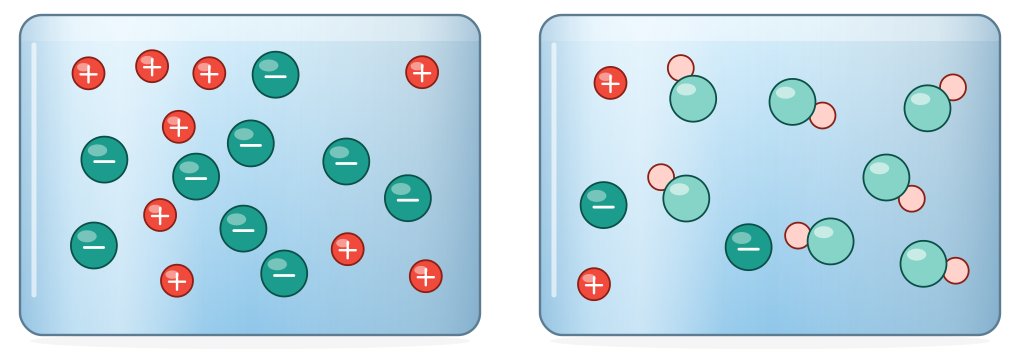
| Property | Strong acid, for example hydrochloric acid | Weak acid, for example ethanoic acid |
|---|---|---|
| Ionisation in water | Hydrochloric acid ionises completely. | Ethanoic acid ionises only partially. |
| Arrow in the ionisation equation | A single arrow → is used. | A reversible arrow ⇌ is used. |
| Concentration of H+ ions at the same acid concentration | The concentration of H+ ions is higher. | The concentration of H+ ions is lower. |
| pH at the same acid concentration | The pH is lower. | The pH is higher. |
| Reaction with magnesium ribbon at the same concentration | The effervescence is faster. | The effervescence is slower. |
| Electrical conductivity at the same concentration | The conductivity is higher because there are more ions. | The conductivity is lower because there are fewer ions. |

The SEAB glossary says “Explain may imply reasoning or some reference to theory, depending on the context”, so when you explain why one acid is weaker, refer to the extent of ionisation and not to the concentration.
Depth: why and how
- How can you show by experiment that ethanoic acid is weaker than hydrochloric acid of the same concentration? Hydrochloric acid has a lower pH, reacts faster with magnesium ribbon and conducts electricity better.
- Why is a dilute solution of a strong acid not a weak acid? A dilute strong acid still ionises completely and simply contains a small amount of acid, whereas a weak acid is one in which most of the molecules do not ionise.
- Why do equal amounts of a strong monobasic acid and a weak monobasic acid give the same total volume of hydrogen with excess magnesium? Both contain the same amount of hydrogen that can be replaced, but the reaction with the weak acid is slower.
- What does the reversible arrow in the equation for ethanoic acid mean? The reaction can go in both directions, so the solution contains ethanoic acid molecules as well as hydrogen ions and ethanoate ions.
- Cross-link to Organic Chemistry: carboxylic acids such as ethanoic acid are weak acids.
Common mistakes
A strong acid is a concentrated acid.
A strong acid ionises completely whatever its concentration, and a concentrated acid is one that contains a large amount of acid in a given volume.
A weak acid does not react with metals.
A weak acid does react with metals such as magnesium, but more slowly than a strong acid of the same concentration.
A weak acid does not ionise at all.
A weak acid ionises only partially in water.
Ethanoic acid is a strong acid because it contains four hydrogen atoms.
Ethanoic acid is a weak acid, because only the hydrogen atom in the carboxyl group can ionise and it ionises only partially.
Strong and weak describe how much an acid ionises, concentrated and dilute describe how much acid is dissolved, and the two properties are independent.
Exam check
Q1Which equation shows the ionisation of ethanoic acid, a weak acid, in water?
- ACH3COOH(aq) → H+(aq) + CH3COO–(aq)
- BHCl(aq) → H+(aq) + Cl–(aq)
- CCH3COOH(aq) ⇌ H+(aq) + CH3COO–(aq)
- DHNO3(aq) → H+(aq) + NO3–(aq)
Show answer
MCQ answer key C (CH3COOH(aq) ⇌ H+(aq) + CH3COO–(aq)): a weak acid ionises only partially, which is shown by the reversible arrow, whereas the other three equations show complete ionisation.
Q2Solution X is 0.1 mol/dm³ hydrochloric acid and solution Y is 0.1 mol/dm³ ethanoic acid. Which statement is correct?
- AX has a higher pH than Y.
- BY has a higher concentration of H+ ions than X.
- CX and Y have the same pH.
- DX reacts faster with magnesium ribbon than Y.
Show answer
MCQ answer key D (X reacts faster with magnesium ribbon than Y.): hydrochloric acid is a strong acid, so X has the higher concentration of H+ ions, the lower pH and the faster reaction with magnesium.
Q3Which statement about a strong acid is correct?
- AIt has a high pH.
- BIt always contains a large amount of acid in a given volume.
- CIt does not react with magnesium.
- DIt ionises completely in water.
Show answer
MCQ answer key D (It ionises completely in water.): strength means the extent of ionisation, so a strong acid ionises completely, whatever its concentration.
StructuredHydrochloric acid and ethanoic acid solutions both have a concentration of 0.10 mol/dm³.
- State what is meant by the term weak acid. [1]
- Write an equation, with state symbols, for the ionisation of ethanoic acid in water. [2]
- State which solution has the lower pH and explain your answer. [2]
- Describe one observation, when magnesium ribbon is added to each solution, that shows the difference in strength. [1]
Total: 6 marks
Show mark scheme
(a) 1 mark
- Mark scheme: an acid that ionises only partially in water
(b) 2 marks
- Mark scheme: CH3COOH(aq) ⇌ H+(aq) + CH3COO–(aq)
- Mark scheme: the reversible arrow is used
(c) 2 marks
- Mark scheme: hydrochloric acid
- Mark scheme: it ionises completely, so it has a higher concentration of H+ ions
(d) 1 mark
- Mark scheme: the effervescence is faster with hydrochloric acid
Reactions of acids
describe the characteristic properties of acids as in reactions with metals, bases and carbonates to form salts
Acids react with metals to form a salt and hydrogen, with bases to form a salt and water (ammonia forms only a salt), and with carbonates to form a salt, water and carbon dioxide.
- Salt
- Salt: an ionic compound formed when the hydrogen ions of an acid are replaced by metal ions or by ammonium ions
- Effervescence
- Effervescence: the bubbles of gas that are given off when a solid or a liquid reacts to form a gas supports K324-5.1(d)
- Reactivity series
- Reactivity series: a list of metals in order of how readily they react, with hydrogen included as a reference point supports K324-5.1(d)
- Hydrochloric acid, sulfuric acid and nitric acid
- Hydrochloric acid, sulfuric acid and nitric acid: these acids form chlorides, sulfates and nitrates respectively supports K324-5.1(d)
- Carbonate
- Carbonate: a compound that contains the carbonate ion, CO32–, and reacts with acids to give carbon dioxide supports K324-5.1(d)
- Base
- Base: a substance that neutralises an acid to form a salt (and water, except for ammonia), such as a metal oxide, a metal hydroxide or ammonia
The three reactions of acids
| Reaction | Word equation | What you see | Example equation |
|---|---|---|---|
| Acid + metal | acid + metal → salt + hydrogen | The metal dissolves with effervescence, and the gas ‘pops’ with a lighted splint. | Mg(s) + 2HCl(aq) → MgCl2(aq) + H2(g) |
| Acid + insoluble base | acid + base → salt + water | The solid dissolves; for example, black copper(II) oxide dissolves to give a blue solution. | CuO(s) + H2SO4(aq) → CuSO4(aq) + H2O(l) |
| Acid + alkali | acid + alkali → salt + water | There is no visible change, so an indicator or a pH measurement is used to follow the reaction. | NaOH(aq) + HCl(aq) → NaCl(aq) + H2O(l) |
| Acid + carbonate | acid + carbonate → salt + water + carbon dioxide | There is effervescence, and the gas gives white ppt. with limewater. | CaCO3(s) + 2HCl(aq) → CaCl2(aq) + H2O(l) + CO2(g) |
Which metals can be used?
| Metal | Behaviour with a dilute acid such as hydrochloric acid |
|---|---|
| Sodium | Sodium reacts so violently with dilute acid that it is dangerous to use. |
| Magnesium | Magnesium reacts quickly with steady effervescence. |
| Zinc | Zinc reacts at a moderate rate. |
| Iron | Iron reacts slowly and forms an iron(II) salt. |
| Copper | Copper does not react, because it is below hydrogen in the reactivity series. |
Equations to practise
Zn(s) + H2SO4(aq) → ZnSO4(aq) + H2(g)Zinc and dilute sulfuric acid form zinc sulfate and hydrogen.
Fe(s) + 2HCl(aq) → FeCl2(aq) + H2(g)Iron forms iron(II) chloride, not iron(III) chloride, with dilute hydrochloric acid.
ZnO(s) + 2HCl(aq) → ZnCl2(aq) + H2O(l)Zinc oxide reacts as a base here and forms zinc chloride and water.
Na2CO3(aq) + 2HCl(aq) → 2NaCl(aq) + H2O(l) + CO2(g)Sodium carbonate is soluble, so its carbonate ions react with the hydrogen ions in the acid.
Mg(s) + 2H+(aq) → Mg2+(aq) + H2(g)The ionic equation for a metal with an acid shows that only the metal and the hydrogen ions take part, and the chloride ions are spectator ions.
CO32–(aq) + 2H+(aq) → H2O(l) + CO2(g)The ionic equation for a soluble carbonate with an acid is the same whichever strong acid is used.
Worked examples
1.30 g of zinc reacts with excess dilute hydrochloric acid, and the equation is Zn(s) + 2HCl(aq) → ZnCl2(aq) + H2(g). Calculate the volume of hydrogen formed at r.t.p.
- Amount of zinc = 1.30 ÷ 65 = 0.0200 mol.
- From the equation, 1 mol of Zn gives 1 mol of H2, so the amount of H2 is 0.0200 mol.
- Volume of H2 at r.t.p. = 0.0200 × 24 = 0.480 dm³.
- In cm³, the volume is 0.480 × 1000 = 480 cm³.
The volume of hydrogen formed at r.t.p. is 480 cm³, to 3 significant figures.
2.50 g of calcium carbonate reacts with excess dilute hydrochloric acid, as in CaCO3(s) + 2HCl(aq) → CaCl2(aq) + H2O(l) + CO2(g). Calculate the volume of carbon dioxide formed at r.t.p.
- Mr of CaCO3 = 40 + 12 + 3 × 16 = 100.
- Amount of CaCO3 = 2.50 ÷ 100 = 0.0250 mol.
- From the equation, 1 mol of CaCO3 gives 1 mol of CO2, so the amount of CO2 is 0.0250 mol.
- Volume of CO2 at r.t.p. = 0.0250 × 24 = 0.600 dm³.
The volume of carbon dioxide formed at r.t.p. is 0.600 dm³, to 3 significant figures.
The SEAB glossary says “Construct is often used in relation to chemical equations where a candidate is expected to write a balanced equation, not by factual recall but by analogy or by using information in the question”, so use the pattern for acid + metal, acid + base or acid + carbonate when the metal or salt is new to you.
The SEAB glossary says “Calculate is used when a numerical answer is required. In general, working should be shown, especially where two or more steps are involved”, so show the amount in moles before the gas volume.
Depth: why and how
- Why do copper and silver not react with dilute acids? They are below hydrogen in the reactivity series, so they cannot displace hydrogen from an acid.
- Why does calcium carbonate react only briefly with dilute sulfuric acid? Calcium sulfate is insoluble, so a layer of it forms on the carbonate and stops the reaction, whereas dilute hydrochloric acid gives soluble calcium chloride.
- How can you identify hydrogen? Hydrogen ‘pops’ with a lighted splint.
- How can you identify carbon dioxide? Carbon dioxide gives white ppt. with limewater.
- Why does the effervescence stop when an acid reacts with a carbonate? One of the reactants has been used up.
- Cross-link to Patterns in the Periodic Table: the reactivity series predicts which metals react with a dilute acid and how fast.
Common mistakes
An acid and a metal form a salt and water.
An acid and a metal form a salt and hydrogen.
Dilute acids react with all metals.
Dilute acids react only with metals above hydrogen in the reactivity series, so copper does not react.
The gas given off when an acid reacts with a carbonate is hydrogen.
The gas given off is carbon dioxide, which gives white ppt. with limewater.
An acid and a carbonate form a salt and carbon dioxide only.
An acid and a carbonate form a salt, water and carbon dioxide.
All three reactions make a salt, and the other products tell you the reactant: hydrogen for a metal, only water for a metal oxide or metal hydroxide, and water with carbon dioxide for a carbonate.
Exam check
Q1Which gas is given off when dilute sulfuric acid is added to zinc?
- Aoxygen
- Bcarbon dioxide
- Chydrogen
- Dsulfur dioxide
Show answer
MCQ answer key C (hydrogen): a metal above hydrogen in the reactivity series displaces hydrogen from a dilute acid.
Q23.25 g of zinc reacts with excess dilute hydrochloric acid. What volume of hydrogen is formed at r.t.p.? [Ar: Zn = 65]
- A0.600 dm³
- B2.40 dm³
- C1.20 dm³
- D0.120 dm³
Show answer
MCQ answer key C (1.20 dm³): the amount of zinc is 3.25 ÷ 65 = 0.0500 mol, this gives the same amount of hydrogen, and the volume is 0.0500 × 24 = 1.20 dm³.
Q3Effervescence occurs when dilute hydrochloric acid is added to solid X, and the gas gives white ppt. with limewater. What is X?
- Aa metal
- Ba metal oxide
- Can alkali
- Da carbonate
Show answer
MCQ answer key D (a carbonate): carbon dioxide is given off when an acid reacts with a carbonate, whereas a metal gives hydrogen and a base or an alkali gives no gas.
StructuredMagnesium and magnesium carbonate are added separately to dilute acids.
- Write an equation, with state symbols, for the reaction between magnesium and dilute sulfuric acid. [2]
- Describe the test for hydrogen and the result of the test. [2]
- Name the salt formed when magnesium carbonate reacts with dilute nitric acid. [1]
- Calculate the volume of carbon dioxide formed at r.t.p. when 4.20 g of magnesium carbonate reacts with excess dilute acid. [3]
Total: 8 marks
Show mark scheme
(a) 2 marks
- Mark scheme: Mg(s) + H2SO4(aq) → MgSO4(aq) + H2(g)
- Mark scheme: all four state symbols are correct
(b) 2 marks
- Mark scheme: a lighted splint is placed at the mouth of the test tube
- Mark scheme: the gas ‘pops’
(c) 1 mark
- Mark scheme: magnesium nitrate
(d) 3 marks
- Mark scheme: Mr of MgCO3 = 24 + 12 + 3 × 16 = 84
- Mark scheme: amount of MgCO3 = 4.20 ÷ 84 = 0.0500 mol
- Mark scheme: volume of CO2 = 0.0500 × 24 = 1.20 dm³
Neutralisation
describe the reaction between hydrogen ions and hydroxide ions to produce water, H+ + OH– → H2O, as neutralisation
Neutralisation is the reaction between hydrogen ions and hydroxide ions to produce water, H+(aq) + OH–(aq) → H2O(l)
- Neutralisation
- Neutralisation: the reaction between hydrogen ions and hydroxide ions to produce water
- Ionic equation
- Ionic equation: an equation that shows only the ions or particles that take part in a reaction supports K324-5.1(e)
- Spectator ion
- Spectator ion: an ion that is present before and after a reaction and does not take part in it, such as Na+ and Cl– in the reaction of sodium hydroxide with hydrochloric acid supports K324-5.1(e)
- End-point
- End-point: the point at which the acid and the alkali have reacted exactly, shown by the colour change of an indicator supports K324-5.1(e)
- Salt
- Salt: the compound formed together with water when an acid neutralises an alkali supports K324-5.1(e)
From the full equation to the ionic equation
- 1Write the full equation: NaOH(aq) + HCl(aq) → NaCl(aq) + H2O(l)
- 2Write the soluble ionic compounds as ions: Na+(aq) + OH–(aq) + H+(aq) + Cl–(aq) → Na+(aq) + Cl–(aq) + H2O(l)
- 3Cancel the spectator ions, Na+ and Cl–, to leave the ionic equation: H+(aq) + OH–(aq) → H2O(l)
Salts formed in neutralisation
| Acid | Alkali | Salt formed | Equation |
|---|---|---|---|
| hydrochloric acid | potassium hydroxide | The salt formed is potassium chloride. | HCl(aq) + KOH(aq) → KCl(aq) + H2O(l) |
| sulfuric acid | potassium hydroxide | The salt formed is potassium sulfate. | H2SO4(aq) + 2KOH(aq) → K2SO4(aq) + 2H2O(l) |
| nitric acid | sodium hydroxide | The salt formed is sodium nitrate. | HNO3(aq) + NaOH(aq) → NaNO3(aq) + H2O(l) |
Worked example
To convert a volume from cm³ to dm³, divide by 1000, and to convert a volume from dm³ to cm³, multiply by 1000, because 1 dm³ is 1000 cm³. supports K324-5.1(e)
25.0 cm³ of 0.100 mol/dm³ aqueous sodium hydroxide is exactly neutralised by 20.0 cm³ of hydrochloric acid. Calculate the concentration of the hydrochloric acid.
- Convert the volumes from cm³ to dm³ by dividing by 1000: 25.0 cm³ = 25.0 ÷ 1000 = 0.0250 dm³ and 20.0 cm³ = 20.0 ÷ 1000 = 0.0200 dm³.
- Amount of NaOH = concentration × volume in dm³ = 0.100 × 0.0250 = 0.00250 mol.
- From the equation, 1 mol of NaOH reacts with 1 mol of HCl, so the amount of HCl is 0.00250 mol.
- Concentration of HCl = amount ÷ volume in dm³ = 0.00250 ÷ 0.0200 = 0.125 mol/dm³.
The concentration of the hydrochloric acid is 0.125 mol/dm³, to 3 significant figures.
The SEAB glossary says “Define (the term(s)…) is intended literally”, with “Only a formal statement or equivalent paraphrase being required”, so define neutralisation in one sentence and include the ions.
Depth: why and how
- Why are the Na+ and Cl– ions left out of the ionic equation? They are spectator ions: they are present before and after the reaction and do not change.
- Why is the ionic equation for neutralisation the same for many different acids and alkalis? Whenever the other ions, such as Na+, K+, Cl– and NO3–, stay in solution as spectator ions, the hydrogen ions combine with hydroxide ions to form water. Dilute sulfuric acid with barium hydroxide is different, because insoluble barium sulfate forms as well as water.
- How can you tell when neutralisation is complete? An indicator changes colour at the end-point, and Universal Indicator is green when the solution is neutral.
- Why does the temperature rise during neutralisation? Neutralisation is exothermic, so it gives out heat to the surroundings.
- Cross-link to Chemical Energetics: neutralisation is an exothermic reaction.
Common mistakes
Neutralisation produces only water.
Neutralisation of an acid by an alkali produces a salt and water, and the ionic equation shows only the formation of the water.
The ionic equation for neutralisation is NaOH + HCl → NaCl + H2O
That is the full equation without state symbols; the ionic equation is H+(aq) + OH–(aq) → H2O(l)
Neutralisation always gives a solution with pH 7.
Neutralisation does not always give pH 7: a strong acid that reacts exactly with a strong alkali gives a neutral solution of pH 7, but a weak acid with a strong alkali gives a solution with a pH above 7.
The ions that take part in the reaction of sodium hydroxide with hydrochloric acid are Na+ and Cl–.
The ions that take part are H+ and OH–, and Na+ and Cl– are spectator ions.
In neutralisation, H+ and OH– ions form water, so the ionic equation is the same whenever the other ions stay in solution as spectator ions.
Exam check
Q1Which equation is the ionic equation for the neutralisation of an acid by an alkali?
- A2H+(aq) + CO32–(aq) → H2O(l) + CO2(g)
- BAg+(aq) + Cl–(aq) → AgCl(s)
- CBa2+(aq) + SO42–(aq) → BaSO4(s)
- DH+(aq) + OH–(aq) → H2O(l)
Show answer
MCQ answer key D (H+(aq) + OH–(aq) → H2O(l)): neutralisation is the reaction of hydrogen ions with hydroxide ions to form water, whereas the other equations show an acid with a carbonate and two precipitation reactions.
Q230.0 cm³ of 0.200 mol/dm³ aqueous potassium hydroxide is exactly neutralised by 24.0 cm³ of nitric acid. What is the concentration of the nitric acid?
- A0.250 mol/dm³
- B0.160 mol/dm³
- C0.200 mol/dm³
- D0.500 mol/dm³
Show answer
MCQ answer key A (0.250 mol/dm³): 30.0 cm³ = 0.0300 dm³, so the amount of KOH is 0.200 × 0.0300 = 0.00600 mol, the acid reacts in a 1 : 1 ratio, and the concentration is 0.00600 ÷ 0.0240 = 0.250 mol/dm³, because 24.0 cm³ = 0.0240 dm³.
Q3Which two ions are the spectator ions when aqueous potassium hydroxide reacts with nitric acid?
- AH+ and OH–
- BK+ and OH–
- CK+ and NO3–
- DH+ and NO3–
Show answer
MCQ answer key C (K+ and NO3–): the potassium ions and the nitrate ions are present before and after the reaction, whereas H+ and OH– combine to form water.
StructuredDilute hydrochloric acid is added to aqueous sodium hydroxide that contains Universal Indicator.
- Name the type of reaction that takes place. [1]
- State the colour of the indicator at the start and the colour when the solution is exactly neutral. [2]
- Write the ionic equation for the reaction, with state symbols. [2]
- Name the salt formed. [1]
Total: 6 marks
Show mark scheme
(a) 1 mark
- Mark scheme: neutralisation
(b) 2 marks
- Mark scheme: blue or violet at the start
- Mark scheme: green when the solution is neutral
(c) 2 marks
- Mark scheme: H+(aq) + OH–(aq) → H2O(l)
- Mark scheme: all three state symbols are correct
(d) 1 mark
- Mark scheme: sodium chloride
You've read the free 31%. Unlock the rest of Chapter 5.
Still to read in this chapter:
- Soil pH and calcium hydroxide
- Bases, acids and ammonium salts
- Acidic, basic, amphoteric and neutral oxides
- Preparing, separating and purifying salts
- Solubility rules for salts
- Choosing a method to prepare a salt
- Making ammonia
- Reversible reactions
- Industrial conditions for ammonia
- Practical skills
$9 one-time · all 13 chapters · no subscription
Less than a fast-food meal.
Yours for the whole syllabus.
Premium members get all 13 chapters included.
Notes version 1.0 · Last updated 2 Oct 2026 · Chapter 5 of 13