










Qualitative Analysis
SEAB syllabus Topic 6: the tests for seven cations, five anions and six gases, with complete result tables, worked deductions, the practical procedure, the common mistakes and an exam check for every outcome.

Aqueous sodium hydroxide and aqueous ammonia identify a cation by the colour of the ppt. and by whether it dissolves in excess.
Carbonate, chloride, iodide, nitrate and sulfate each have a test, and dilute nitric acid is used to acidify the halide and sulfate tests.
Ammonia, carbon dioxide, chlorine, hydrogen, oxygen and sulfur dioxide are each identified by one test with one result.
Tests for cations
describe the use of aqueous sodium hydroxide and/or aqueous ammonia to identify the following aqueous cations through the formation of precipitates (if any) and their subsequent solubility: aluminium, ammonium (together with evolution of ammonia gas upon warming), calcium, copper(II), iron(II), iron(III) and zinc (formulae of complex ions are not required)
Aqueous sodium hydroxide and aqueous ammonia form a precipitate with most of the cations in the SEAB notes, and the colour of the precipitate and whether it dissolves in excess reagent show which cation is present.
- Cation
- Cation: a positively charged ion, such as Cu2+ or NH4+
- Precipitate
- Precipitate: an insoluble solid that forms when two solutions react, written ppt. in the SEAB notes and (s) in an equation
- Excess
- Excess: more reagent than is needed to react with all of the test solution, added after the first change until no further change is seen supports K324-6(a)
- Dropwise
- Dropwise: adding the reagent a few drops at a time, with mixing, so that you can see the first change supports K324-6(a)
- Aqueous sodium hydroxide
- Aqueous sodium hydroxide: a solution of NaOH in water, a strong alkali that supplies plenty of hydroxide ions, OH– supports K324-6(a)
- Aqueous ammonia
- Aqueous ammonia: a solution of ammonia gas, NH3, in water, a weak alkali that supplies only a few hydroxide ions supports K324-6(a)
- Ammonia gas
- Ammonia gas: the gas NH3 that is given off when ammonium ions are warmed with aqueous sodium hydroxide, which is different from aqueous ammonia, the reagent supports K324-6(a)
- Soluble in excess
- Soluble in excess: the ppt. dissolves when more of the reagent is added, giving a solution supports K324-6(a)
- Insoluble in excess
- Insoluble in excess: the ppt. stays when more of the reagent is added supports K324-6(a)
Results from the SEAB notes
| Cation | Picture | Effect of aqueous sodium hydroxide | Effect of aqueous ammonia |
|---|---|---|---|
| aluminium, Al3+ | 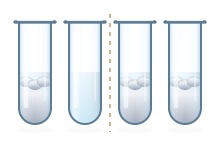 | white ppt., soluble in excess giving a colourless solution | white ppt., insoluble in excess |
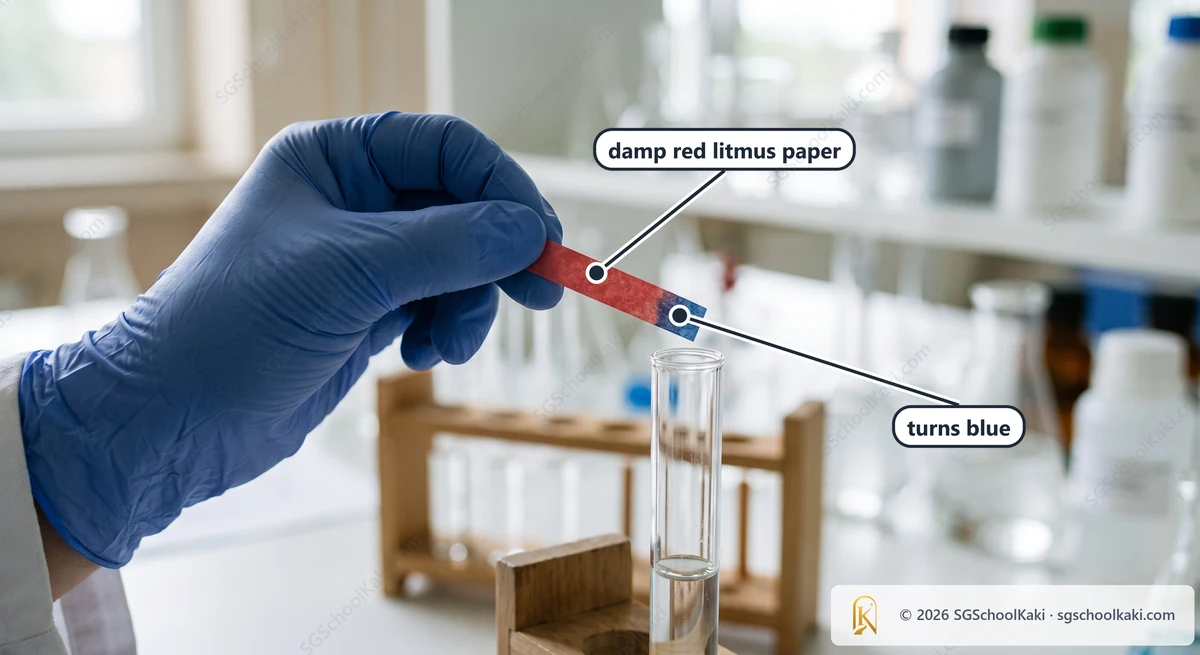
| ammonium, NH4+ | 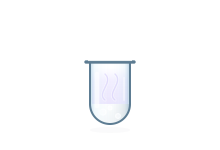 | ammonia produced on warming | – |
| calcium, Ca2+ | 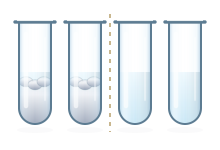 | white ppt., insoluble in excess | no ppt. |
| copper(II), Cu2+ | 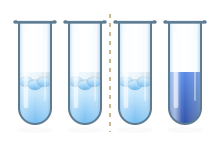 | light blue ppt., insoluble in excess | light blue ppt., soluble in excess giving a dark blue solution |
| iron(II), Fe2+ | 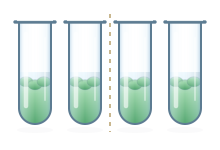 | green ppt., insoluble in excess | green ppt., insoluble in excess |
| iron(III), Fe3+ | 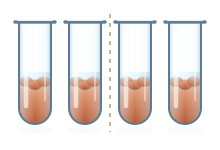 | red-brown ppt., insoluble in excess | red-brown ppt., insoluble in excess |
| zinc, Zn2+ | 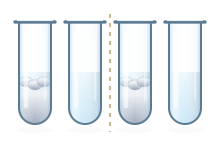 | white ppt., soluble in excess giving a colourless solution | white ppt., soluble in excess giving a colourless solution |
For SEAB answers, use only the seven cations in the notes, write green ppt. for iron(II), and write dark blue solution for copper(II) in excess aqueous ammonia. supports K324-6(a)
Telling similar cations apart
| If you see | The cation could be | Add this to decide | Result that decides |
|---|---|---|---|
| white ppt. with aqueous sodium hydroxide | Aluminium, calcium or zinc. | Excess aqueous sodium hydroxide, then aqueous ammonia on a fresh portion. | Calcium gives white ppt. that is insoluble in excess aqueous sodium hydroxide and no ppt. with aqueous ammonia. |
| white ppt. that dissolves in excess aqueous sodium hydroxide | Aluminium or zinc. | Aqueous ammonia, dropwise and then in excess. | Zinc gives white ppt. that dissolves in excess aqueous ammonia, and aluminium gives white ppt. that does not. |
| coloured ppt. with aqueous sodium hydroxide | Copper(II), iron(II) or iron(III). | Look at the colour of the ppt. | Light blue is copper(II), green is iron(II) and red-brown is iron(III). |
| no ppt. with aqueous sodium hydroxide, or any other result | Ammonium is possible, either alone or together with another cation. | Warm a fresh portion with aqueous sodium hydroxide whether or not a ppt. formed, and test the gas with damp red litmus paper. | Ammonium ions give ammonia, which turns damp red litmus paper blue; do this test for every unknown. |
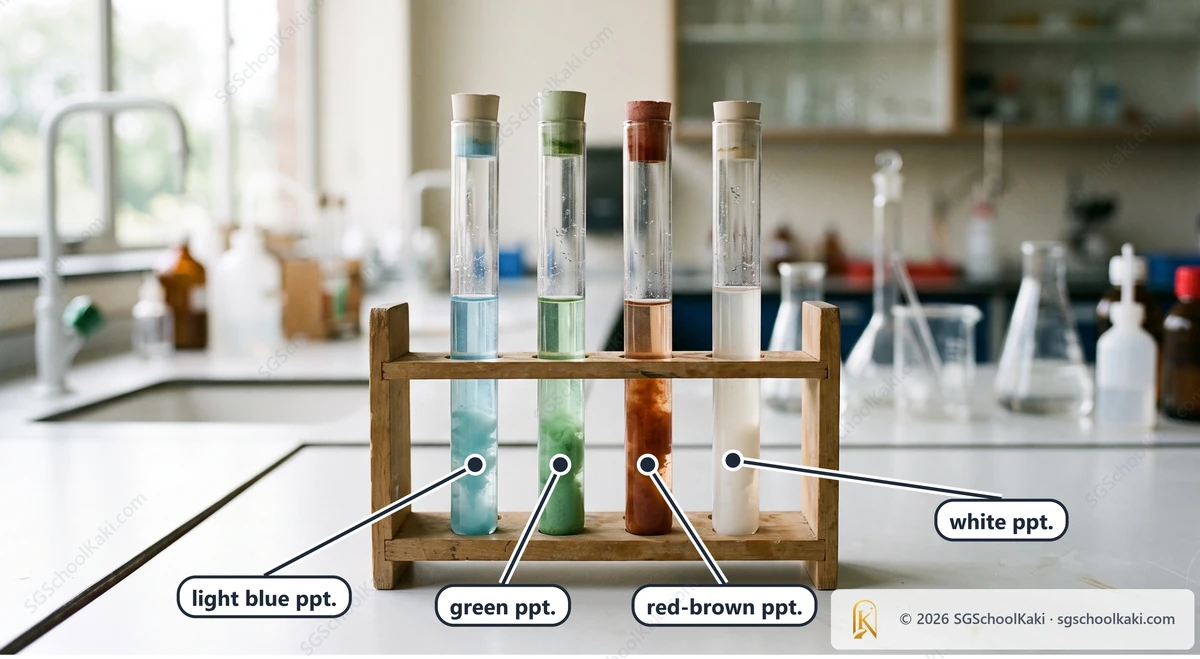
SEAB states “Notes for Qualitative Analysis will be included in the question paper for the use of candidates in the examination”, so the skill that is marked is choosing the right test and reading the result correctly, and the table is there for you to use.
How to test for a cation
- 1Put about 1 cm depth of the test solution, which is 1 to 2 cm³, in a test-tube.
- 2Add aqueous sodium hydroxide dropwise, with mixing, and note the colour of any ppt. and the stage at which it forms.
- 3Keep adding aqueous sodium hydroxide until no further change is seen, and note whether the ppt. dissolves in excess.
- 4Repeat with a fresh portion of the test solution and aqueous ammonia, again adding it dropwise and then in excess.
- 5Warm a fresh portion with aqueous sodium hydroxide whether or not a ppt. formed, and hold damp red litmus paper near the open end of the tube, because ammonium ions can be present with another cation.
- 6Use the table of results to name the cation, and write the observation before the deduction.
When is ammonia given off?
| Situation | What you add and do | Is ammonia gas given off? | What you do with the gas |
|---|---|---|---|
| Test for ammonium ions | Add aqueous sodium hydroxide to the test solution and warm it. | Yes, if ammonium ions are present, because the notes say ammonia produced on warming. | Hold damp red litmus paper near the open end of the tube, and it turns blue. |
| Test for nitrate ions | Add aqueous sodium hydroxide, then aluminium foil, and warm carefully. | Yes, if nitrate ions are present, because the aluminium reduces the nitrate ions to ammonia. | Test it in the same way with damp red litmus paper, but only after you have shown that ammonia was not given off before the foil was added. |
| Aqueous ammonia used as a reagent | Add aqueous ammonia dropwise and then in excess to the test solution. | No gas test is needed, because aqueous ammonia is the reagent and the observation is a ppt. or no ppt. | Look at the ppt. and at whether it dissolves in excess, and do not warm the mixture or use litmus paper. |
| Any other test in the SEAB notes | Add the reagent named in the notes for that ion. | No, because among the SEAB tests ammonia gas is produced in only two of them, the ammonium test and the nitrate test. | If a gas is given off, name it and give the test for it. |
- Wet the red litmus paper with a drop of distilled water and hold it near the open end of the tube, so that it does not touch the hot liquid.
- Warm gently and carefully, because a hot alkaline solution can spit out of the tube.
- Good practice, not in the SEAB notes: do the ammonium test with aqueous sodium hydroxide alone before the nitrate test, so that you know whether ammonium ions are present.
- Count the result only when the damp red litmus paper turns blue, because that is the SEAB test for ammonia.
Equations
Al3+(aq) + 3OH–(aq) → Al(OH)3(s)Aluminium ions and hydroxide ions form white ppt. of aluminium hydroxide.
Ca2+(aq) + 2OH–(aq) → Ca(OH)2(s)Calcium ions and hydroxide ions form white ppt. of calcium hydroxide, which is only slightly soluble.
Cu2+(aq) + 2OH–(aq) → Cu(OH)2(s)Copper(II) ions form light blue ppt. of copper(II) hydroxide.
Fe2+(aq) + 2OH–(aq) → Fe(OH)2(s)Iron(II) ions form green ppt. of iron(II) hydroxide.
Fe3+(aq) + 3OH–(aq) → Fe(OH)3(s)Iron(III) ions form red-brown ppt. of iron(III) hydroxide.
Zn2+(aq) + 2OH–(aq) → Zn(OH)2(s)Zinc ions form white ppt. of zinc hydroxide.
NH4+(aq) + OH–(aq) → NH3(g) + H2O(l)Ammonium ions and hydroxide ions give ammonia gas and water when warmed.
NH3(aq) + H2O(l) ⇌ NH4+(aq) + OH–(aq)Aqueous ammonia is a weak alkali because only a small fraction of its ammonia molecules react with water to form hydroxide ions.
All Cats Zoom
Aluminium, calcium and zinc are the three cations in the SEAB notes that give white ppt. with aqueous sodium hydroxide.Key: A is aluminium, C is calcium and Z is zinc, and each of them gives white ppt. with aqueous sodium hydroxide.Lions Grow Rapidly
With aqueous sodium hydroxide, copper(II) gives light blue ppt., iron(II) gives green ppt. and iron(III) gives red-brown ppt.Key: L is light blue for copper(II), G is green for iron(II) and R is red-brown for iron(III).Sort the cations by the colour of the ppt. first, then use excess aqueous sodium hydroxide and aqueous ammonia to separate aluminium, calcium and zinc, and warm with aqueous sodium hydroxide to find ammonium.
The SEAB practical notes say “Answers should include details of colour changes and precipitates formed, and the name and test for any gases evolved”, so write the colour of the ppt., whether it dissolves in excess, and the stage at which each change happens.
Depth: why and how
- Why is the reagent added dropwise first and then in excess? A ppt. may appear after only a few drops and may dissolve when more reagent is added, so adding it slowly lets you see the first change and then see whether the ppt. dissolves in excess.
- Why does the table give a result for aqueous ammonia as well as aqueous sodium hydroxide? The two reagents give the same result for some cations and a different result for others, so using both is how aluminium is told from zinc and calcium is told from aluminium.
- Why is a colourless solution not the same as a white ppt.? A colourless solution is clear and see-through, whereas a white ppt. is a cloudy mixture of tiny solid particles, so write colourless solution only when the ppt. has dissolved.
- Why do the white ppts. of aluminium and zinc dissolve in excess aqueous sodium hydroxide? Aluminium hydroxide and zinc hydroxide are amphoteric, as in K324-5.1(h) on amphoteric oxides, so they react with excess alkali to give a colourless solution, whereas calcium hydroxide is not amphoteric, so its ppt. stays.
- Why does calcium give a ppt. with aqueous sodium hydroxide but no ppt. with aqueous ammonia? Aqueous sodium hydroxide supplies many hydroxide ions but aqueous ammonia supplies only a few, and calcium hydroxide is slightly soluble, so the few hydroxide ions are not enough to form a ppt.
- Why must the mixture with ammonium ions be warmed? Ammonia is very soluble in water, so warming helps to drive the gas out of the solution so that damp red litmus paper can detect it.
- Why can the colour of the ppt. also show the oxidation state of iron? Iron(II) hydroxide is green and iron(III) hydroxide is red-brown, so the colour tells you whether the iron in the solution is iron(II) or iron(III).
- Cross-link to Acid-Base Chemistry: most hydroxides are insoluble in water, which is why aqueous hydroxide ions form a ppt. with most of these cations.
- Cross-link to Redox Chemistry: iron(II) and iron(III) differ in oxidation state, and the two ppt. colours are how the test tells them apart.
Common mistakes
Aluminium gives a white ppt. that dissolves in excess aqueous ammonia.
Aluminium gives white ppt. that is insoluble in excess aqueous ammonia, and only the white ppt. of zinc dissolves in excess aqueous ammonia.
Copper(II) ions give a dark blue solution with aqueous sodium hydroxide.
Copper(II) ions give light blue ppt. that is insoluble in excess aqueous sodium hydroxide, and the dark blue solution forms only in excess aqueous ammonia.
Calcium ions give no ppt. with aqueous sodium hydroxide.
Calcium ions give white ppt. that is insoluble in excess aqueous sodium hydroxide, and no ppt. with aqueous ammonia.
Ammonium ions give a ppt. with aqueous sodium hydroxide.
Ammonium ions give no ppt.; they give ammonia produced on warming, which turns damp red litmus paper blue.
When the ppt. dissolves, the solution is white.
When the ppt. dissolves, the result is written as a colourless solution, or a dark blue solution for copper(II) with aqueous ammonia.
Ammonia gas is given off whenever aqueous ammonia is added to a solution.
Aqueous ammonia is a reagent that gives a ppt. or no ppt., and ammonia gas is the product that is tested for in the ammonium test and the nitrate test.
Exam check
Q1Aqueous sodium hydroxide is added to a colourless solution, giving white ppt. that dissolves in excess to give a colourless solution. Aqueous ammonia gives white ppt. that is insoluble in excess. Which cation is present?
- AAl3+
- BZn2+
- CCa2+
- DFe2+
Show answer
MCQ answer key A (Al3+): white ppt. that dissolves in excess aqueous sodium hydroxide means aluminium or zinc, and white ppt. that is insoluble in excess aqueous ammonia means aluminium, because the ppt. of zinc dissolves.
Q2Which cation gives light blue ppt. with aqueous ammonia that dissolves in excess to give a dark blue solution?
- AFe3+
- BCu2+
- CZn2+
- DCa2+
Show answer
MCQ answer key B (Cu2+): copper(II) is the cation whose light blue ppt. dissolves in excess aqueous ammonia to give a dark blue solution, whereas zinc gives a colourless solution and calcium gives no ppt.
Q3A solution is warmed with aqueous sodium hydroxide and the gas given off turns damp red litmus paper blue. Which ion is present?
- ANH4+
- BCa2+
- CFe3+
- DAl3+
Show answer
MCQ answer key A (NH4+): ammonium ions give ammonia produced on warming with aqueous sodium hydroxide, whereas calcium, iron(III) and aluminium ions give a ppt. and no ammonia.
StructuredA student has unlabelled solutions of aluminium nitrate, calcium nitrate and zinc nitrate, and uses aqueous sodium hydroxide and aqueous ammonia to tell them apart.
- State what is seen when aqueous sodium hydroxide is added dropwise and then in excess to calcium nitrate solution. [2]
- Describe a test that distinguishes zinc nitrate solution from aluminium nitrate solution, and state the results. [3]
- Describe how to show that another solution contains ammonium ions. [3]
- Write an ionic equation, with state symbols, for the formation of white ppt. when aqueous sodium hydroxide is added to aluminium ions. [2]
Total: 10 marks
Show mark scheme
(a) 2 marks
- Mark scheme: white ppt.
- Mark scheme: insoluble in excess
(b) 3 marks
- Mark scheme: add aqueous ammonia dropwise and then in excess to each solution
- Mark scheme: zinc gives white ppt. that dissolves in excess giving a colourless solution
- Mark scheme: aluminium gives white ppt. that is insoluble in excess
(c) 3 marks
- Mark scheme: add aqueous sodium hydroxide and warm
- Mark scheme: ammonia produced
- Mark scheme: it turns damp red litmus paper blue
(d) 2 marks
- Mark scheme: Al3+(aq) + 3OH–(aq) → Al(OH)3(s)
- Mark scheme: all state symbols are correct
You've read the free 33%. Unlock the rest of Chapter 6.
Still to read in this chapter:
- Tests for anions
- Tests for gases
- Practical skills
$9 one-time · all 13 chapters · no subscription
Less than a fast-food meal.
Yours for the whole syllabus.
Premium members get all 13 chapters included.
Notes version 1.0 · Last updated 2 Oct 2026 · Chapter 6 of 13