




Nutrition in Humans
SEAB syllabus topic 4: the digestive system, peristalsis, enzymes, the villus, the hepatic portal vein, the liver and alcohol, with the why, the traps and the exam checks.
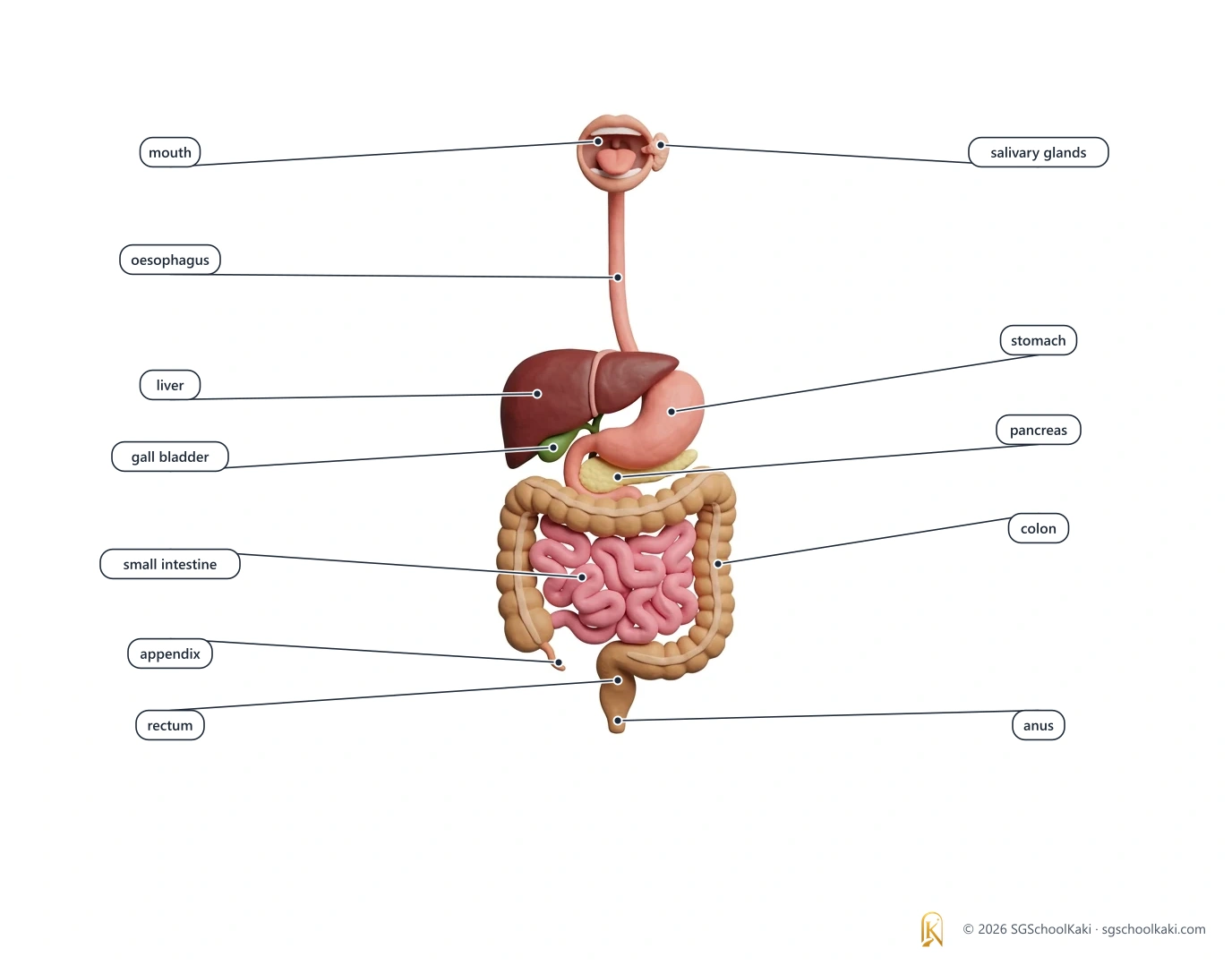

The digestive system breaks food down and absorbs it, from ingestion at the mouth to egestion at the anus.
Peristalsis is the rhythmic, wave-like contraction of the muscles in the wall of the alimentary canal, which mixes the food and pushes it along.
Digestive enzymes break large food molecules into small, soluble molecules.
A villus is adapted for absorption by its large surface area and short diffusion distance.
The hepatic portal vein carries absorbed nutrients from the small intestine to the liver.
The liver stores glucose as glycogen, makes bile, forms urea, and breaks down alcohol and hormones.
Excessive alcohol harms the brain and liver, and affects families and society.
Digestive system
describe the functions of the various parts of the digestive system: mouth, salivary glands, oesophagus, stomach, duodenum, pancreas, gall bladder, liver, ileum, colon, rectum, anus, in relation to ingestion, digestion, absorption, assimilation and egestion of food, as appropriate
The digestive system is the alimentary canal, a long tube from the mouth to the anus, together with the salivary glands, liver, gall bladder and pancreas, which release their secretions into the canal.
- Ingestion
- Ingestion is the taking of food into the body through the mouth.
- Digestion
- Digestion is the process that breaks food down, physically or chemically, into small soluble molecules that the body can absorb.
- Absorption
- Absorption is the movement of digested food substances from the alimentary canal into the blood and lymph.
- Assimilation
- Assimilation is the use of digested food substances by body cells, to build new cell parts or to release energy.
- Egestion
- Egestion is the passing out of undigested food waste (faeces) through the anus.
- Physical digestion
- Physical digestion is the breakdown of food into smaller pieces without changing the food molecules, for example by chewing and churning. supports K325-4(a)
- Chemical digestion
- Chemical digestion is the breakdown of large food molecules into small molecules by enzymes. supports K325-4(a)
- Bolus
- A bolus is a soft ball of chewed food mixed with saliva, which is swallowed. supports K325-4(a)
- Faeces
- Faeces are the undigested food waste that is egested through the anus. supports K325-4(a)
Large food molecules such as starch, proteins and fats are too large to pass through the wall of the alimentary canal into the blood, so they must be digested into small, soluble molecules. supports K325-4(a)
The digestive system
The alimentary canal is made up of the mouth, pharynx, oesophagus, stomach, small intestine (duodenum, jejunum and ileum), colon, rectum and anus, in that order.
The salivary glands, liver, gall bladder and pancreas are not part of the canal: food does not pass through them, and they release their secretions into the canal through ducts, such as the bile duct and the pancreatic duct.
The journey of food, step by step
- 1In the mouth, the teeth chew the food and salivary amylase begins to digest starch into maltose.
- 2The tongue rolls the food into a bolus, which is swallowed and pushed down the oesophagus by peristalsis.
- 3In the stomach, the food is churned and mixed with gastric juice, and protease begins to digest proteins into short polypeptides.
- 4In the duodenum, bile and pancreatic juice are added, and the digestion of starch and proteins continues, and the digestion of fats begins, in alkaline conditions.
- 5In the rest of the small intestine, digestion is completed, and digested food molecules are absorbed into the blood and lymph, mainly in the ileum.
- 6In the colon, most of the remaining water and the mineral salts are absorbed from the undigested food.
- 7The faeces are stored in the rectum and then egested through the anus.
Parts of the alimentary canal: what each does
| Part | What happens there | pH and enzyme |
|---|---|---|
| Mouth | Ingestion and the start of digestion take place in the mouth. The teeth chew the food into smaller pieces, which is physical digestion and increases the surface area to volume ratio of the food. The tongue rolls the chewed food into a bolus and mixes it with saliva. | The pH in the mouth is about 7, and the enzyme is salivary amylase. |
| Pharynx | The pharynx is the region at the back of the mouth, and the bolus passes through it when the food is swallowed. supports K325-4(a) | No digestion takes place in the pharynx. supports K325-4(a) |
| Oesophagus | The oesophagus, or gullet, is a muscular tube that pushes the food to the stomach. | The pH in the oesophagus is about 7, and there is no digestive enzyme. |
| Stomach | Digestion takes place in the stomach. The gastric glands in the wall of the stomach secrete gastric juice, which contains hydrochloric acid and protease. The muscles of the stomach churn the food and mix it with gastric juice, which is physical digestion. | The pH in the stomach is about 2, and the enzyme is protease. |
| Duodenum | The duodenum is the first part of the small intestine, where mainly digestion and some absorption take place. Bile from the gall bladder and pancreatic juice from the pancreas flow into the duodenum. | The pH in the small intestine is about 8, which is alkaline. |
| Jejunum | The jejunum is the middle part of the small intestine, where digestion and absorption both take place; most absorption happens in the small intestine, and O-Level answers name the ileum as the main site of absorption. supports K325-4(a) | The jejunum has the same alkaline conditions as the rest of the small intestine. supports K325-4(a) |
| Ileum | The ileum is the last part of the small intestine, where some digestion and mainly absorption take place. Digestion and absorption in the small intestine are helped by its great length, which gives the food more time, and by its many folds, which give a large surface area to volume ratio. Assimilation does not take place in the small intestine, but throughout the body. | The cells lining the small intestine make maltase, protease and some lipase, but most lipase comes from the pancreas. |
| Colon | The colon, or large intestine, absorbs most of the remaining water and the mineral salts from the undigested food. The colon has no villi, so the villus adaptations belong to the small intestine only. | The colon does not make digestive enzymes. supports K325-4(a) |
| Rectum | The rectum stores the faeces temporarily. | No digestion takes place in the rectum. supports K325-4(a) |
| Anus | The anus is the opening through which the faeces are egested. | No digestion takes place at the anus. supports K325-4(a) |
Organs that add juices to the canal
| Organ | What it does |
|---|---|
| Salivary glands | The salivary glands secrete saliva, which contains salivary amylase that digests starch into maltose. Saliva also moistens the food, which makes it easier to swallow. supports K325-4(a) |
| Liver | The liver makes bile. |
| Gall bladder | The gall bladder stores bile, which is a yellow-green alkaline liquid. Bile is released into the duodenum through the bile duct. Bile contains bile salts, which emulsify large fat droplets into smaller droplets, so that lipase can act on a larger surface area to volume ratio. Bile contains no enzymes, and it makes the contents of the duodenum alkaline. supports K325-4(a) |
| Pancreas | The pancreas secretes alkaline pancreatic juice into the duodenum through the pancreatic duct. Pancreatic juice contains pancreatic lipase, amylase and protease. |
Depth: why and how
- Why is the small intestine so long? A longer tube gives the food more time to be digested and absorbed, and more surface area for absorption.
- Why does chewing speed up digestion? Chewing breaks the food into smaller pieces, which increases the surface area to volume ratio, so the enzymes can reach more of the food at the same time.
- Why do the pH values differ along the canal? Each enzyme works best at its own optimum pH, so the acid in the stomach suits gastric protease, while the alkaline bile and pancreatic juice suit the enzymes in the small intestine.
- Why are the liver, gall bladder and pancreas not part of the alimentary canal? Food does not pass through them; they make or store juices that are carried to the duodenum by ducts.
- Cross-link to Movement of substances: glucose and amino acids are absorbed in the small intestine by diffusion and by active transport.
- Cross-link to Transport in humans: the blood in the capillaries of the small intestine carries the absorbed food molecules away.
Common mistakes
Digestion is the absorption of food into the blood.
Digestion is the process that breaks food down, physically or chemically, into small soluble molecules, and absorption is the movement of the digested substances into the blood and lymph.
Egestion is the same as excretion.
Egestion is the removal of undigested food waste, which has never entered the body cells, while excretion is the removal of metabolic waste made by the cells.
Food passes through the liver and the pancreas.
Food does not pass through the liver, gall bladder or pancreas; they release their secretions into the canal.
Most absorption takes place in the stomach.
Most absorption takes place in the small intestine, mainly in the ileum.
Ingestion means the breakdown of food in the mouth.
Ingestion is only the taking of food into the body through the mouth; chewing is physical digestion.
Do Jump In
- D Duodenum comes first: it is the first part of the small intestine, where bile and pancreatic juice enter.
- J Jejunum comes second: it is the middle part of the small intestine.
- I Ileum comes last: it is the last part of the small intestine, and O-Level answers name it as the main site of absorption.
Food is ingested at the mouth, digested along the canal, absorbed mainly in the small intestine, assimilated by the body cells, and the undigested waste is egested at the anus.
Exam check
Q1 Which organ stores bile?
- A Liver
- B Pancreas
- C Gall bladder
- D Stomach
Show answer
MCQ answer key C (Gall bladder): the gall bladder stores bile, which is made in the liver and released into the duodenum through the bile duct.
Q2 Which part of the alimentary canal has the main function of absorbing water and mineral salts from undigested food?
- A Oesophagus
- B Stomach
- C Colon
- D Anus
Show answer
MCQ answer key C (Colon): the colon absorbs most of the remaining water and the mineral salts from the undigested food, while the anus is only the opening for egestion.
Q3 Which row correctly matches a part of the alimentary canal with a process that takes place there?
- A Oesophagus: digestion of starch
- B Stomach: digestion of proteins
- C Rectum: absorption of glucose
- D Anus: digestion of fats
Show answer
MCQ answer key B (Stomach: digestion of proteins): protease in the stomach starts the digestion of proteins, whereas the oesophagus, rectum and anus do not digest food.
Structured Food that is eaten passes along the alimentary canal.
- Name the process by which undigested food waste is removed from the body. [1]
- State the difference between digestion and absorption. [2]
- Explain why food is chewed in the mouth. [2]
Total: 5 marks
Show mark scheme
(a) 1 mark
- Mark scheme: egestion
(b) 2 marks
- Mark scheme: digestion breaks large food molecules down into small soluble ones
- Mark scheme: absorption is the movement of the digested substances into the blood and lymph
(c) 2 marks
- Mark scheme: chewing breaks the food into smaller pieces, which is physical digestion
- Mark scheme: this increases the surface area to volume ratio of the food, so enzymes can act faster
You've read the free 21%. Unlock the rest of Topic 4.
Still to read in this topic:
- Peristalsis
- Digestive enzymes
- Villus and absorption
- Hepatic portal vein
- Liver
- Alcohol
$9 one-time · all 14 topics · no subscription
Less than a fast-food meal.
Yours for the whole O-Level.
Premium members get all 14 topics included.
Notes version 1.0 · Last updated 30 Sept 2026 · Topic 4 of 14