










Nutrition and Transport in Flowering Plants
SEAB syllabus topic 10: the leaf, photosynthesis, limiting factors, water uptake, xylem and phloem, transpiration and translocation, with the why, the practicals, the traps and the exam checks.

Photosynthesis makes glucose and oxygen from carbon dioxide and water, using light energy absorbed by chlorophyll.
Water and mineral ions move up the xylem, pulled by transpiration pull.
Sucrose is translocated in the phloem from the sources to the sinks.
Transport in flowering plants links four ideas: root hairs absorb water and mineral ions, the xylem and phloem carry water and food, water is lost by transpiration, and a plant wilts when it loses water faster than its roots take it up.
The leaf: built for photosynthesis
identify the cellular and tissue structure of a dicotyledonous leaf, as seen in transverse section using the light microscope and describe the significance of these features in terms of their functions, such as the
- distribution of chloroplasts for photosynthesis
- stomata and mesophyll cells for gaseous exchange
- vascular bundles for transport
describe how carbon dioxide reaches mesophyll cells in a leaf
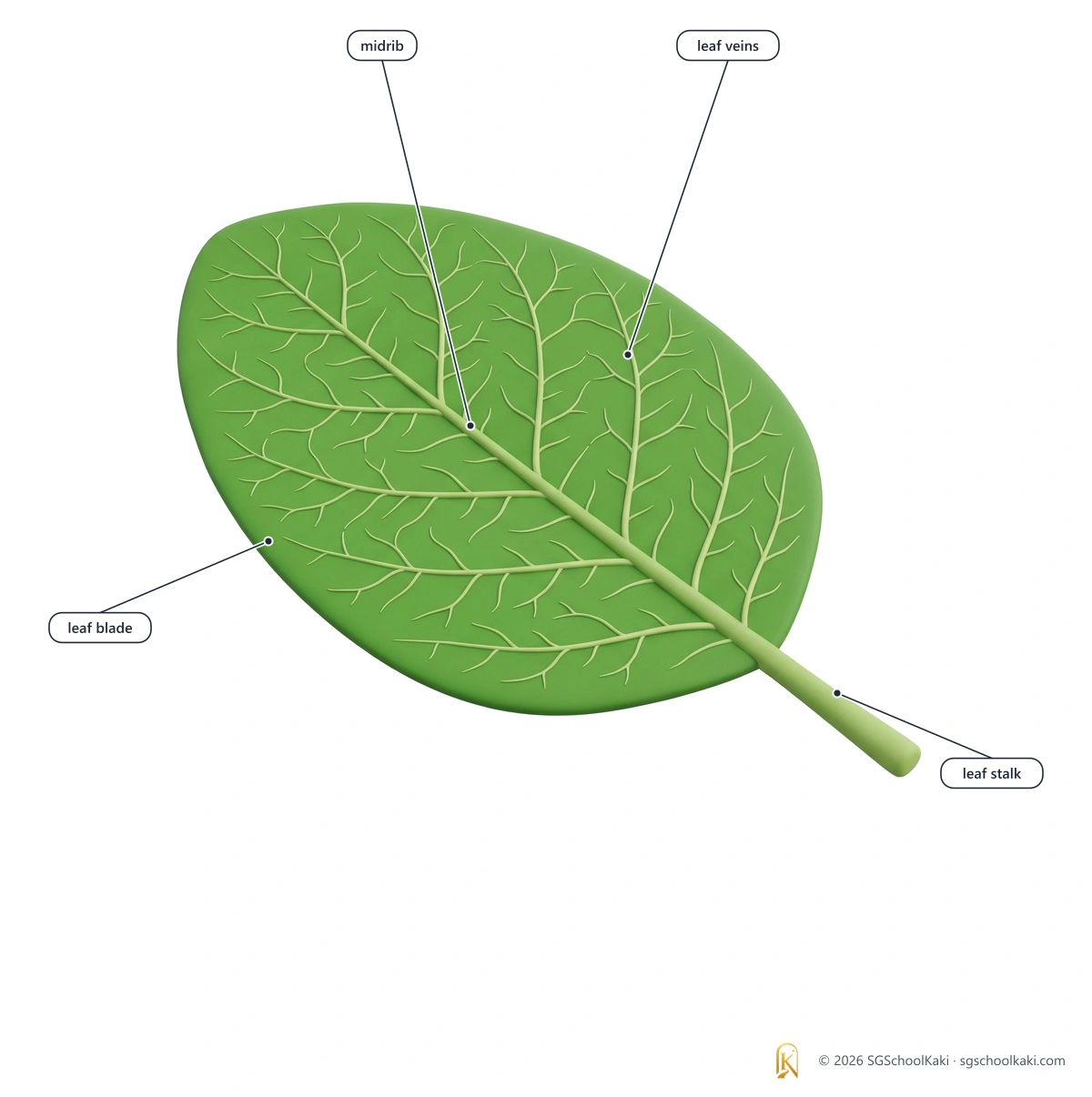
A dicotyledonous leaf is thin and flat, and its tissues are arranged so that light reaches the chloroplasts, gases can move in and out, and water and food can be carried to and from every cell.
- Leaf blade
- Leaf blade: the broad, flat, thin part of the leaf that absorbs light supports K325-10(a)
- Leaf stalk
- Leaf stalk: the stalk that joins the leaf blade to the stem supports K325-10(a)
- Leaf vein
- Leaf vein: a vascular bundle, containing xylem and phloem, that runs through the leaf blade supports K325-10(a)
- Mesophyll
- Mesophyll: the tissue between the upper epidermis and the lower epidermis, made up of palisade mesophyll cells and spongy mesophyll cells supports K325-10(a)
- Stoma
- Stoma: a small pore in the leaf surface, between two guard cells, through which gases and water vapour diffuse; the plural is stomata
- Guard cell
- Guard cell: one of a pair of cells that surround a stoma and open or close it
- Intercellular air space
- Intercellular air space: an air-filled gap between neighbouring mesophyll cells
The parts of a leaf, and what each does
Light passes through the layers of a leaf in this order: cuticle, upper epidermis, palisade mesophyll, spongy mesophyll, and lower epidermis. supports K325-10(a)
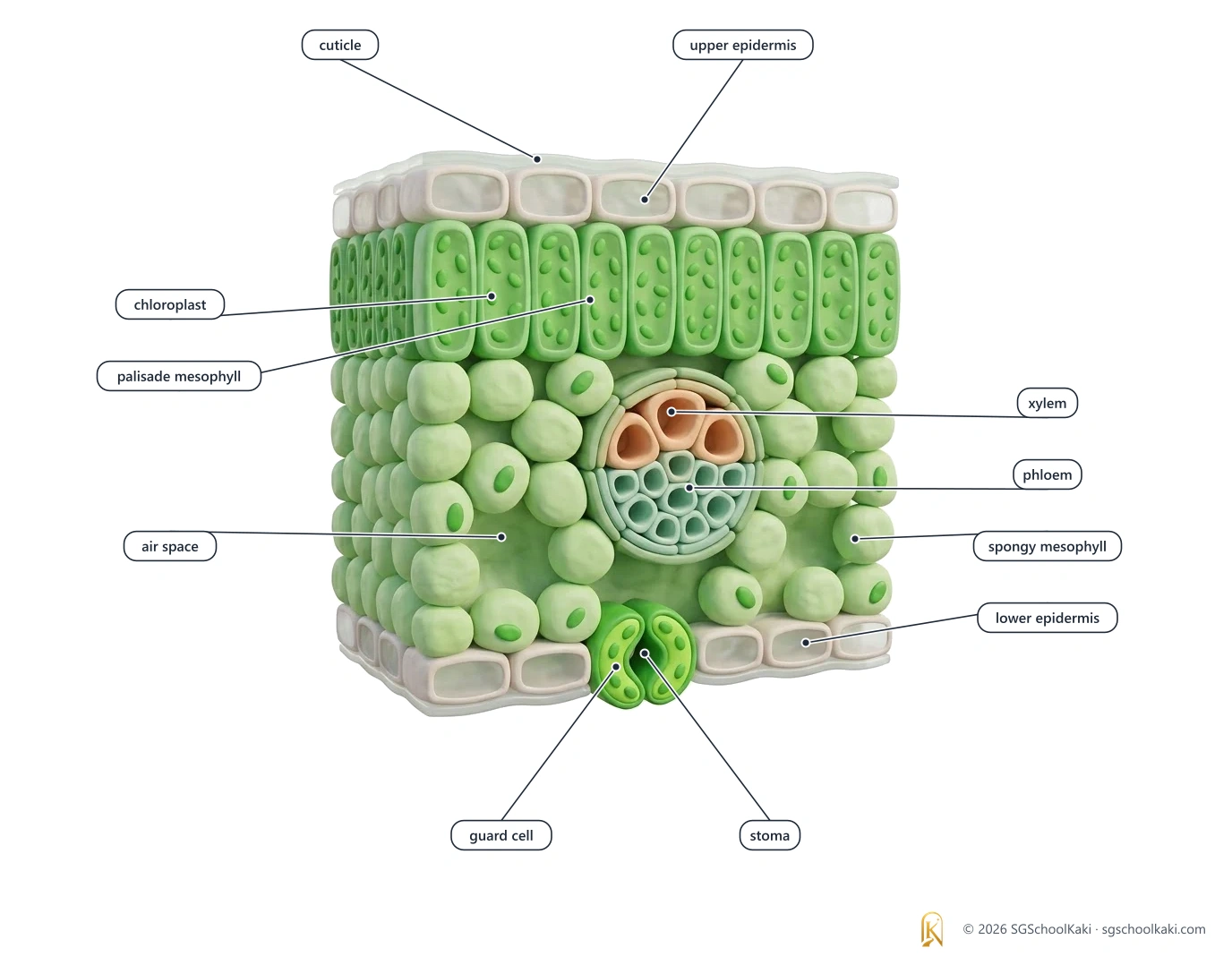
| Leaf part | Structure | Function and why it suits photosynthesis |
|---|---|---|
| Waxy cuticle | A thin layer of wax on the outer surface of the epidermis, produced by the epidermal cells. | It is transparent, so light passes through it to the mesophyll, and it is waterproof, so it reduces the loss of water by evaporation from the leaf surface. |
| Upper and lower epidermis | A single layer of closely packed cells on each surface of the leaf; the epidermal cells contain no chloroplasts, but the guard cells in the epidermis do. | The epidermis protects the tissues inside the leaf, and because the epidermal cells are transparent, light passes through them to the mesophyll cells beneath. |
| Stoma with two guard cells | A pore between two guard cells; most stomata are on the lower epidermis of a dicotyledonous leaf. | Stomata let carbon dioxide and oxygen diffuse in and out of the leaf for gaseous exchange, and let water vapour escape in transpiration; the guard cells open the stoma in the light and close it in the dark. |
| Palisade mesophyll | A layer of long, cylindrical cells, arranged upright and packed closely together, just below the upper epidermis. | The cells contain many chloroplasts, and because they are near the upper surface they absorb the maximum amount of light for photosynthesis. |
| Spongy mesophyll | Irregularly shaped cells, loosely arranged, with large intercellular air spaces between them; the cells contain fewer chloroplasts than the palisade cells. | The air spaces let gases diffuse quickly through the leaf, and the cells still carry out some photosynthesis. |
| Intercellular air spaces | Air-filled gaps between the mesophyll cells, which are connected to the stomata. | The surfaces of the mesophyll cells are covered with a thin film of moisture in which carbon dioxide dissolves, and the air spaces give a large surface area for gases to diffuse into the cells. |
| Vascular bundle (vein) | A bundle of xylem vessels and phloem tissue that runs through each leaf vein. | Xylem brings water and mineral ions from the roots to the leaf, and phloem carries the food made by photosynthesis away from the leaf. |
| Leaf shape | The leaf blade is thin and broad. | This gives a large surface area to volume ratio for absorbing light, a short diffusion distance for gases, and lets light reach all the cells. |
Why these features matter
Most chloroplasts are in the palisade mesophyll, fewer are in the spongy mesophyll, and the guard cells also have some, so photosynthesis happens mainly just below the upper surface where the light is strongest.
The stomata and the air spaces around the mesophyll cells let carbon dioxide reach the cells and let oxygen leave.
The vascular bundles form a network of veins through the leaf, so water and mineral ions reach every mesophyll cell and the food made can leave.
How carbon dioxide reaches the mesophyll cells
- 1In the light, carbon dioxide from the air diffuses into the leaf through the open stomata.
- 2It diffuses into the intercellular air spaces between the mesophyll cells.
- 3It dissolves in the thin film of moisture on the surfaces of the mesophyll cells.
- 4It diffuses through the cell wall and cell membrane into the mesophyll cells, and then into the chloroplasts, where it is used for photosynthesis.
- Carbon dioxide moves into the leaf because photosynthesis uses it up, so its concentration in the mesophyll cells is lower than in the air outside, and it diffuses down the concentration gradient. supports K325-10(g)
- In the dark, only respiration takes place in the leaf. The stomata are mostly closed, so only a small amount of gas is exchanged: carbon dioxide diffuses out and oxygen diffuses in. supports K325-10(g)
Depth: why and how
- Why must the cuticle be transparent? The cuticle covers the upper surface, so if it were opaque, light would not reach the palisade cells.
- Why are there air spaces inside the leaf? Gases diffuse much faster through air than through water or cells, so the air spaces let carbon dioxide reach all the mesophyll cells quickly.
- Why do the stomata close in the dark? There is no photosynthesis in the dark, so the leaf does not need carbon dioxide, and closing the stomata reduces the loss of water.
- Why does the leaf need a network of veins? Every mesophyll cell must be close to a vein so that it can be supplied with water, and so that the sugars made can be carried away.
- Cross-link to Movement of substances: carbon dioxide and oxygen move through the stomata and air spaces by diffusion, down concentration gradients.
- Cross-link to Transpiration: the same open stomata that let carbon dioxide in also let water vapour out.
Common mistakes
Carbon dioxide enters the leaf through the xylem.
Carbon dioxide enters the leaf through the stomata, by diffusion.
Stomata are pores in the cuticle.
Stomata are pores in the epidermis, between two guard cells; the cuticle is a waxy layer that covers the epidermis.
The spongy mesophyll contains the most chloroplasts.
The palisade mesophyll contains the most chloroplasts.
Guard cells have no chloroplasts, like the other epidermal cells.
Guard cells contain chloroplasts, unlike the other epidermal cells.
Palisade = Packed at the top, for light. Spongy = Spaces, for gas.
Two of my own hooks: P for Packed and S for Spaces.Every feature of the leaf serves photosynthesis: the palisade mesophyll catches light, the stomata and air spaces bring in carbon dioxide, and the veins bring water and take food away.
Exam check
Q1 Which part of a leaf contains the greatest number of chloroplasts?
- A Upper epidermis
- B Spongy mesophyll
- C Palisade mesophyll
- D Lower epidermis
Show answer
MCQ answer key C (Palisade mesophyll): the palisade mesophyll cells contain the most chloroplasts and lie just below the upper epidermis, where they absorb the most light.
Q2 Which is the correct route taken by carbon dioxide from the air to a chloroplast in the light?
- A stoma, intercellular air space, film of moisture, mesophyll cell, chloroplast
- B stoma, xylem, mesophyll cell, chloroplast
- C cuticle, epidermis, phloem, mesophyll cell, chloroplast
- D stoma, film of moisture, intercellular air space, mesophyll cell, chloroplast
Show answer
MCQ answer key A (stoma, intercellular air space, film of moisture, mesophyll cell, chloroplast): carbon dioxide diffuses through a stoma into the air spaces, dissolves in the film of moisture on the cells, and then diffuses into the cells and the chloroplasts.
Q3 What is the function of the waxy cuticle of a leaf?
- A It is opaque, so it protects the leaf from light
- B It has pores that let gases into the leaf
- C It carries water to the mesophyll
- D It is transparent and waterproof, so it lets light through and reduces water loss
Show answer
MCQ answer key D (It is transparent and waterproof, so it lets light through and reduces water loss): the cuticle is transparent, so light reaches the mesophyll, and waterproof, so it reduces evaporation.
Structured A student examined a transverse section of a dicotyledonous leaf under the light microscope.
- Name the layer of cells that contains the most chloroplasts. [1]
- Explain why this layer is found just below the upper epidermis. [2]
- Describe how carbon dioxide gets from the air to the cells of the spongy mesophyll. [3]
Total: 6 marks
Show mark scheme
(a) 1 mark
- Mark scheme: palisade mesophyll
(b) 2 marks
- Mark scheme: it is close to the upper surface, which receives the most light
- Mark scheme: so the cells absorb the maximum amount of light for photosynthesis
(c) 3 marks
- Mark scheme: carbon dioxide diffuses in through the open stomata into the air spaces
- Mark scheme: it dissolves in the film of moisture on the surface of the cells
- Mark scheme: it then diffuses into the cells
Photosynthesis
state that chlorophyll absorbs light energy and converts it into chemical energy for the formation of carbohydrates and their subsequent uses
briefly explain why most forms of life are completely dependent on photosynthesis
state the equation, in words and symbols, for photosynthesis (details of light-dependent and light- independent stages are not required)
Photosynthesis is the process by which plants make glucose from carbon dioxide and water, using light energy absorbed by chlorophyll, and release oxygen as a by-product.
- Chlorophyll
- Chlorophyll: the green pigment in chloroplasts that absorbs light energy and converts it into chemical energy
- Chloroplast
- Chloroplast: an organelle that contains chlorophyll, where photosynthesis takes place
- Glucose
- Glucose: the simple sugar made in photosynthesis, which stores chemical energy
- By-product
- By-product: a substance that is made in a process but is not its main aim; oxygen is a by-product of photosynthesis
- Chlorophyll absorbs light energy and converts it into chemical energy, which is stored in glucose and in the other carbohydrates made from it.
- Chlorophyll absorbs mostly red light and blue light and reflects green light, which is why leaves look green. supports K325-10(d)
The equation for photosynthesis
The word equation for photosynthesis is: carbon dioxide + water, in the presence of light energy and chlorophyll, forms glucose + oxygen.
The chemical equation for photosynthesis is: 6CO₂ + 6H₂O, in the presence of light energy and chlorophyll, forms C₆H₁₂O₆ + 6O₂.
| Substance | Where it comes from, or where it goes |
|---|---|
| Carbon dioxide | Carbon dioxide comes from the air and enters the leaf through the stomata. |
| Water | Water comes from the soil, is absorbed by the root hairs, and is carried to the leaf in the xylem. |
| Light energy | Light energy comes from the Sun, and is absorbed by chlorophyll in the chloroplasts. |
| Glucose | Glucose is used in respiration, converted to starch for storage, or converted to sucrose for transport, as shown in the next table. |
| Oxygen | Oxygen leaves the leaf through the stomata, or is used in respiration by the plant's own cells. |
What happens to the glucose?
| What the plant does with glucose | Explanation |
|---|---|
| Respiration | Some glucose is used in aerobic respiration, which releases energy for the plant's life processes, such as active transport and growth. |
| Stored as starch | Excess glucose is converted to starch, which is stored in leaves, stems, roots and seeds; starch is insoluble, so it does not affect the water potential of the cells. |
| Cellulose | Glucose is converted to cellulose, which is used to build cell walls. |
| Sucrose | Glucose is converted to sucrose, a soluble sugar, which is transported in the phloem to other parts of the plant. |
| Amino acids and proteins | Glucose is combined with nitrogen from nitrate ions, absorbed from the soil, to make amino acids, which are joined together to make proteins. |
| Fats and oils | Glucose is converted to lipids (fats and oils), which are stored in some seeds and used to build cell membranes. |
Why most life depends on photosynthesis
- Plants make carbohydrates by photosynthesis, and these carbohydrates are the source of food and energy for almost all other living things.
- Animals cannot photosynthesise, so they depend on plants, either by eating plants or by eating animals that have eaten plants.
- Photosynthesis releases oxygen, which most organisms need for aerobic respiration.
- In water, photosynthesising algae and other producers are the start of the food chains.
- Photosynthesis removes carbon dioxide from the atmosphere, which is produced by respiration and by burning fuels. supports K325-10(e)
🍃 Practical skills: testing a leaf for starch
Method
- 1Destarch the plant by keeping it in the dark for about 24 to 48 hours, so that its leaves use up their stored starch.
- 2Expose the plant to the conditions being tested, such as light or darkness, then pick a leaf.
- 3Boil the leaf in water for about 1 to 2 minutes, which kills the cells and softens the leaf.
- 4Turn off the Bunsen burner, then heat the leaf in ethanol in a hot water bath; the ethanol dissolves the chlorophyll, so the leaf turns pale.
- 5Dip the leaf in hot water to soften it again and to remove the ethanol.
- 6Spread the leaf on a white tile and add iodine solution.
Reading the result
- Iodine solution turns blue-black if starch is present, and stays orange-brown if starch is absent.
- The chlorophyll is removed first because the green colour would hide the colour change.
- Ethanol is flammable, so it must be heated only in a hot water bath, with the Bunsen burner switched off.
- A blue-black leaf shows that starch is present, and the starch was made from glucose produced by photosynthesis.
Which conditions are needed? Variegated leaf and other set-ups
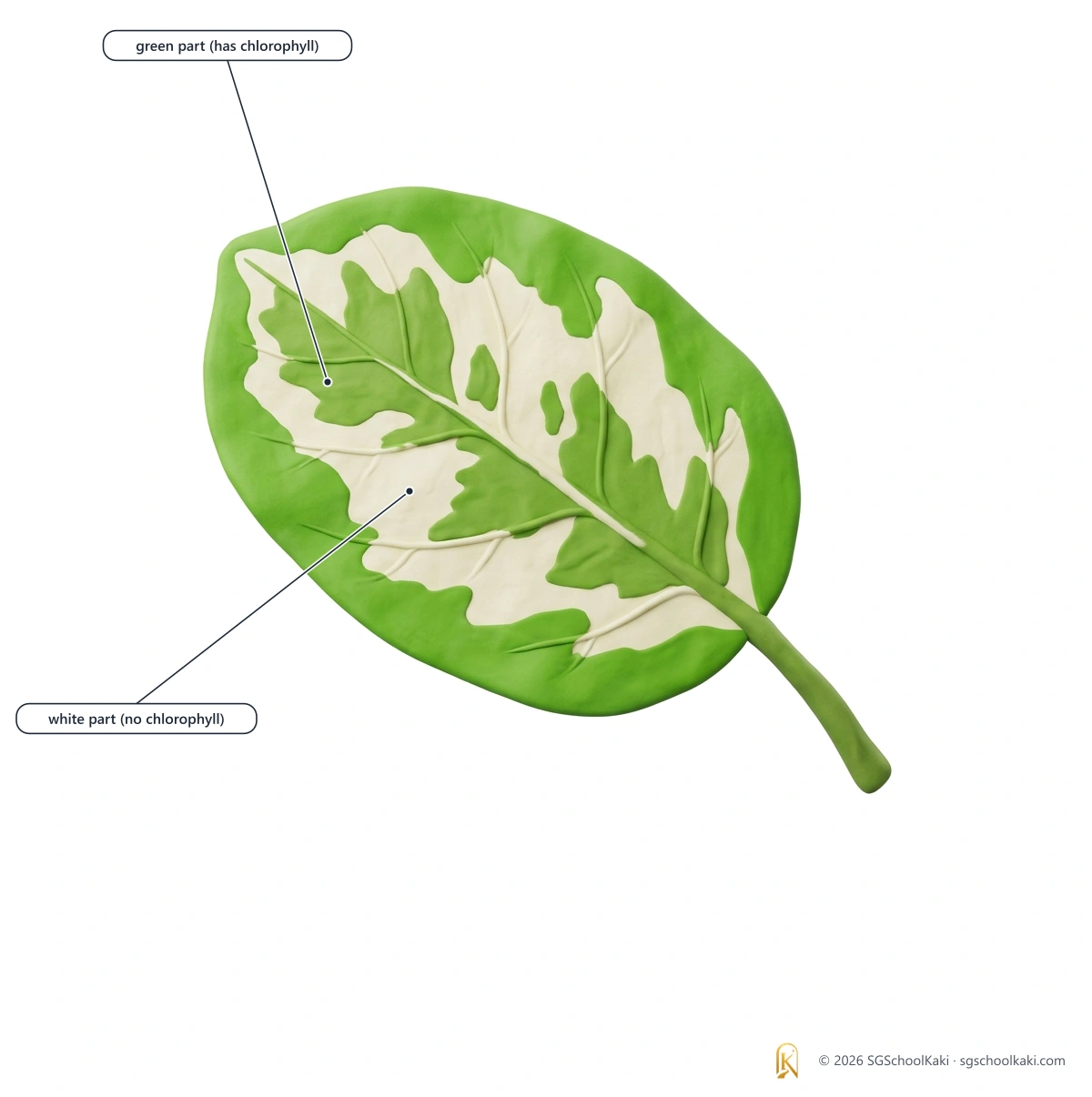
In a variegated leaf, only the green parts that contain chlorophyll turn blue-black with iodine; the white parts stay orange-brown, which shows that chlorophyll is needed for photosynthesis. supports K325-10(d)
| What is tested | Set-up | Result | Conclusion |
|---|---|---|---|
| Is light needed? | Cover part of a destarched leaf with black paper or foil, and leave the plant in bright light. supports K325-10(d) | Only the uncovered part of the leaf turns blue-black with iodine. supports K325-10(d) | Light is needed for photosynthesis. supports K325-10(d) |
| Is chlorophyll needed? | Test a variegated leaf that has been in bright light. supports K325-10(d) | Only the green parts turn blue-black with iodine. supports K325-10(d) | Chlorophyll is needed for photosynthesis. supports K325-10(d) |
| Is carbon dioxide needed? | Enclose a destarched leaf, in the light, in a bag or flask that contains soda lime, which absorbs carbon dioxide. supports K325-10(d) | The leaf does not turn blue-black with iodine. supports K325-10(d) | Carbon dioxide is needed for photosynthesis. supports K325-10(d) |
Depth: why and how
- Why can plants photosynthesise but animals cannot? Plant cells contain chloroplasts with chlorophyll, which absorb light energy, and animal cells do not.
- How is photosynthesis linked with respiration? Respiration uses glucose and oxygen and releases carbon dioxide, so it is almost the reverse of photosynthesis, and both take place in the leaf cells in the light.
- Why does a plant also need mineral ions? Nitrate ions are needed to make amino acids and proteins, and magnesium ions are needed to make chlorophyll.
- Cross-link to Nutrition in humans: animals get their carbohydrates, proteins and fats from plants, or from animals that ate plants.
- Cross-link to Respiration: the glucose made in photosynthesis is used in aerobic respiration to release energy.
Common mistakes
Photosynthesis makes energy.
Photosynthesis converts light energy into chemical energy, which is stored in glucose.
Plants respire only at night and photosynthesise only in the day.
Plants respire all the time, and photosynthesise only when there is light.
In photosynthesis, plants take in oxygen and give out carbon dioxide.
In photosynthesis, plants take in carbon dioxide and give out oxygen.
Light is a raw material of photosynthesis.
Light is the source of energy, not a raw material; the raw materials are carbon dioxide and water.
Iodine turns black in a leaf that has no starch.
Iodine solution stays orange-brown in a leaf with no starch, and turns blue-black when starch is present.
BERI, like berry: Boil the leaf in water, Ethanol in a hot water bath, Rinse in hot water, Iodine drops. Destarch the plant first.
BERI is my own hook for the order of the four steps of the starch test.Photosynthesis uses carbon dioxide, water and light energy absorbed by chlorophyll to make glucose and oxygen, and the glucose is then used, stored or transported.
Exam check
Q1 Which row shows the raw materials and the products of photosynthesis?
- A raw materials: glucose and oxygen; products: carbon dioxide and water
- B raw materials: carbon dioxide and water; products: glucose and oxygen
- C raw materials: carbon dioxide and oxygen; products: glucose and water
- D raw materials: water and glucose; products: carbon dioxide and oxygen
Show answer
MCQ answer key B (raw materials: carbon dioxide and water; products: glucose and oxygen): photosynthesis uses carbon dioxide and water, with light energy absorbed by chlorophyll, to make glucose and oxygen.
Q2 A variegated leaf that has been in bright light is tested for starch. What is the result?
- A Only the green parts turn blue-black
- B The whole leaf turns blue-black
- C Only the white parts turn blue-black
- D No part turns blue-black
Show answer
MCQ answer key A (Only the green parts turn blue-black): only the green parts contain chlorophyll, so only they photosynthesise and make starch, which turns blue-black with iodine.
Q3 Why do animals depend on photosynthesis?
- A Animals need carbon dioxide from plants
- B Animals absorb light energy through their skin
- C Plants make carbohydrates that start the food chains, and release oxygen for respiration
- D Plants make fat that animals absorb directly
Show answer
MCQ answer key C (Plants make carbohydrates that start the food chains, and release oxygen for respiration): photosynthesis makes the carbohydrates that are the source of food and energy in food chains, and it releases oxygen.
Structured A student destarched a potted plant, covered part of one leaf with black paper, and left the plant in bright light for six hours. She then tested the leaf for starch.
- Explain why the plant was destarched first. [1]
- State the colour of the uncovered part and the colour of the covered part after adding iodine solution. [2]
- State the conclusion of the experiment. [1]
- Explain why the leaf was heated in ethanol before adding iodine. [2]
Total: 6 marks
Show mark scheme
(a) 1 mark
- Mark scheme: so that any starch in the leaf at the end was made during the experiment, and not before
(b) 2 marks
- Mark scheme: the uncovered part turns blue-black
- Mark scheme: the covered part stays orange-brown
(c) 1 mark
- Mark scheme: light is needed for photosynthesis
(d) 2 marks
- Mark scheme: to remove (dissolve) the chlorophyll
- Mark scheme: because the green colour would hide the colour change with iodine
Limiting factors of photosynthesis
investigate and discuss the effects of varying light intensity, carbon dioxide concentration and temperature on the rate of photosynthesis (e.g. in submerged aquatic plant)
discuss light intensity, carbon dioxide concentration and temperature as limiting factors on the rate of photosynthesis
A limiting factor is the factor in shortest supply that directly limits the rate of a process, so increasing this factor increases the rate until another factor becomes limiting.
- Rate of photosynthesis
- Rate of photosynthesis: how fast the plant makes glucose or oxygen, or uses carbon dioxide, in a given time supports K325-10(i)
- Light intensity
- Light intensity: how bright the light is; moving a lamp closer to the plant increases it supports K325-10(i)
- Carbon dioxide concentration
- Carbon dioxide concentration: the proportion of carbon dioxide in the air or water around the plant supports K325-10(i)
- Optimum temperature
- Optimum temperature: the temperature at which the rate of an enzyme-controlled reaction is highest supports K325-10(i)
- Plateau
- Plateau: the flat part of a graph, where the rate no longer increases even though the factor on the x-axis keeps increasing supports K325-10(i)
Three factors that can limit photosynthesis
Light intensity
- As light intensity increases, the rate of photosynthesis increases steeply at first, because more light energy is absorbed by chlorophyll.
- At high light intensity the rate levels off at a plateau, because another factor, such as carbon dioxide concentration or temperature, has become limiting.
Carbon dioxide concentration
- As carbon dioxide concentration increases, the rate of photosynthesis increases, because more carbon dioxide is available for the reaction.
- The rate levels off when another factor, such as light intensity or temperature, becomes limiting.
- The concentration of carbon dioxide in the air is only about 0.04% (older textbooks give 0.03%), so carbon dioxide is often the limiting factor in bright, warm conditions. supports K325-10(i)
- The rate levels off at a carbon dioxide concentration that depends on the light intensity and temperature, so read the plateau value from the graph given. supports K325-10(i)
Temperature
- Photosynthesis is controlled by enzymes, so the graph of rate against temperature has a similar shape to an enzyme graph.
- The rate increases as the temperature rises, up to the optimum temperature, because the molecules have more kinetic energy and collide more often.
- Above the optimum temperature the rate falls quickly, because the enzymes are denatured, and it falls to zero when the enzymes are completely denatured.
- At low temperatures the rate is low because the enzymes work slowly.
- Unlike the light intensity graph and the carbon dioxide graph, the temperature graph does not stay flat, because high temperatures damage the enzymes.
Reading limiting-factor graphs
- On the rising part of a graph, the factor on the x-axis is the limiting factor. supports K325-10(i)
- On the plateau, the factor on the x-axis is not limiting, and another factor, such as temperature or carbon dioxide concentration, is limiting. supports K325-10(i)
- If raising a second factor makes the plateau higher, then that second factor was limiting on the first plateau. supports K325-10(i)
- In very dim light, light intensity is the limiting factor, so raising the temperature or the carbon dioxide concentration does not increase the rate. supports K325-10(i)
- On a very hot day the stomata may close to save water, which reduces the carbon dioxide entering the leaf and limits the rate of photosynthesis. supports K325-10(i)
💧 Practical skills: investigating photosynthesis in a submerged aquatic plant
Method
- 1Place a freshly cut piece of Hydrilla, a submerged aquatic plant, in a beaker of water containing a little sodium hydrogencarbonate, which supplies dissolved carbon dioxide.
- 2Place a lamp at a measured distance from the beaker, with a beaker of water or a heat shield in between, so that the temperature stays constant.
- 3Leave the plant for a few minutes to adjust to the conditions.
- 4Count the number of bubbles released from the cut end of the stem in a fixed time, such as 1 minute; the bubbles are mainly oxygen.
- 5Repeat the count at least three times and calculate the mean number of bubbles per minute.
- 6Change only one factor at a time, then repeat the counts.
Changing one factor at a time
| Factor investigated | How it is changed | What is kept constant |
|---|---|---|
| Light intensity | Change the distance between the lamp and the plant; a smaller distance gives a higher light intensity. | Keep the temperature, the sodium hydrogencarbonate solution, the piece of plant and the counting time the same. |
| Carbon dioxide concentration | Use different concentrations of sodium hydrogencarbonate solution, which is the source of dissolved carbon dioxide. | Keep the light intensity (the lamp distance), the temperature, the piece of plant and the counting time the same. |
| Temperature | Place the beaker in water baths at different temperatures, checked with a thermometer. | Keep the light intensity, the sodium hydrogencarbonate solution, the piece of plant and the counting time the same. |
Results and limitations
- Expected result: the number of bubbles per minute increases as light intensity or carbon dioxide concentration increases, and then levels off.
- Expected result: the number of bubbles per minute increases with temperature up to an optimum, and then falls.
- Counting bubbles is only an estimate of the rate of photosynthesis, because the bubbles may differ in size and some oxygen dissolves in the water or is used in respiration.
- Collecting the gas in a syringe and measuring its volume gives a more accurate measurement than counting bubbles.
Depth: why and how
- Why does the rate stop increasing at high light intensity? Another factor, such as carbon dioxide concentration or temperature, is now in shortest supply.
- Why does the temperature graph fall after the optimum but the light graph does not? Very high temperatures denature the enzymes of photosynthesis, but extra light does not damage them at the levels used in school experiments.
- How can a greenhouse grower increase the rate of photosynthesis? The grower can raise the light intensity with lamps, add carbon dioxide and keep the temperature near the optimum, so that none of these factors is limiting.
- Cross-link to Biological molecules: photosynthesis is controlled by enzymes, so its temperature graph has the same shape as an enzyme graph.
- Cross-link to Transpiration: on a very hot day the stomata may close, which reduces the carbon dioxide entering the leaf.
Common mistakes
The rate stops increasing because the plant is full.
The rate stops increasing because another factor has become limiting.
At the plateau on the light graph, light is the limiting factor.
At the plateau on the light graph, light is not limiting, and another factor is limiting.
A higher temperature always increases the rate of photosynthesis.
A higher temperature increases the rate only up to the optimum temperature; above it the enzymes are denatured and the rate falls.
The bubbles from Hydrilla are carbon dioxide.
The bubbles from Hydrilla are mainly oxygen, released by photosynthesis.
LCT: Light, Carbon dioxide, Temperature. When the graph goes flat, check them: Let's Check Them.
LCT is my own hook for the three limiting factors, in the same order as the syllabus.Whichever of light intensity, carbon dioxide concentration and temperature is in shortest supply limits the rate of photosynthesis, so on a plateau look for another limiting factor.
Exam check
Q1 The rate of photosynthesis levels off at high light intensity. Which statement explains this?
- A Chlorophyll has been used up
- B Another factor, such as carbon dioxide concentration or temperature, is limiting
- C Light is no longer needed
- D The plant has stopped respiring
Show answer
MCQ answer key B (Another factor, such as carbon dioxide concentration or temperature, is limiting): at the plateau light is no longer the limiting factor, so another factor such as carbon dioxide concentration or temperature is limiting.
Q2 Which describes the graph of rate of photosynthesis against temperature?
- A a straight line that keeps rising
- B a curve that rises and then stays flat
- C a horizontal line
- D a curve that rises to an optimum and then falls
Show answer
MCQ answer key D (a curve that rises to an optimum and then falls): photosynthesis is controlled by enzymes, so the rate rises to an optimum temperature and then falls as the enzymes are denatured.
Q3 In an investigation with Hydrilla, the lamp is moved closer to the plant. What is the independent variable?
- A The number of bubbles per minute
- B The mass of the plant
- C The distance between the lamp and the plant
- D The volume of the beaker
Show answer
MCQ answer key C (The distance between the lamp and the plant): the student changes the distance between the lamp and the plant, which changes the light intensity; the number of bubbles per minute is the dependent variable.
Structured The rate of photosynthesis of a plant was measured at different light intensities. The rate increased as light intensity increased from 0 to 6 units, and then stayed constant from 6 to 10 units.
- State the limiting factor at 3 units of light intensity. [1]
- Explain why the rate stays constant between 6 and 10 units. [2]
- Suggest one change that would raise the plateau. [1]
- Explain why raising the temperature far above the optimum would decrease the rate. [2]
Total: 6 marks
Show mark scheme
(a) 1 mark
- Mark scheme: light intensity
(b) 2 marks
- Mark scheme: light intensity is no longer the limiting factor
- Mark scheme: another factor, such as carbon dioxide concentration or temperature, is limiting
(c) 1 mark
- Mark scheme: increase the carbon dioxide concentration, or raise the temperature up to the optimum
(d) 2 marks
- Mark scheme: the enzymes that control photosynthesis are denatured
- Mark scheme: so the rate falls
You've read the free 34%. Unlock the rest of Topic 10.
Still to read in this topic:
- Roots and the uptake of water
- Xylem and phloem
- Transpiration and the transport of water
- Translocation
$9 one-time · all 14 topics · no subscription
Less than a fast-food meal.
Yours for the whole O-Level.
Premium members get all 14 topics included.
Notes version 1.0 · Last updated 30 Sept 2026 · Topic 10 of 14