Sets give you a precise language for groups of things, and Venn diagrams let you see them. In this chapter you learn the notation, combine sets with union, intersection and complement, and fill and shade Venn diagrams.
Your outcome tracker0 / 4
Let's go! Tick an outcome once you can pass its exam check. Saved on this device.
Chapter 8
Figure 1 · A∪B
3 outcomes · 9 worked examples · every step shown ✦
Set language and notation
Learn the symbols as a language: each one is a short way to say something you already understand.
Union, intersection and complement
n(A∪B)=n(A)+n(B)−n(A∩B)
Venn diagrams
Every element of E lives in exactly one of four regions: A only, both, B only, or outside both.
By the end of this chapter
Use set language and the notation for elements, subsets, the empty set, the universal set, number of elements and complement.
Find the union and intersection of two sets and count the union without counting the overlap twice.
Draw, fill and shade Venn diagrams with a test letter in every region.
✶
Start here
Maths In Real Life
Three real situations where sets and Venn diagrams count people without counting anyone twice. The pictures are drawn first, then the Venn diagram is placed on top by script so the numbers match the problem exactly.
Maths In Real Life 1
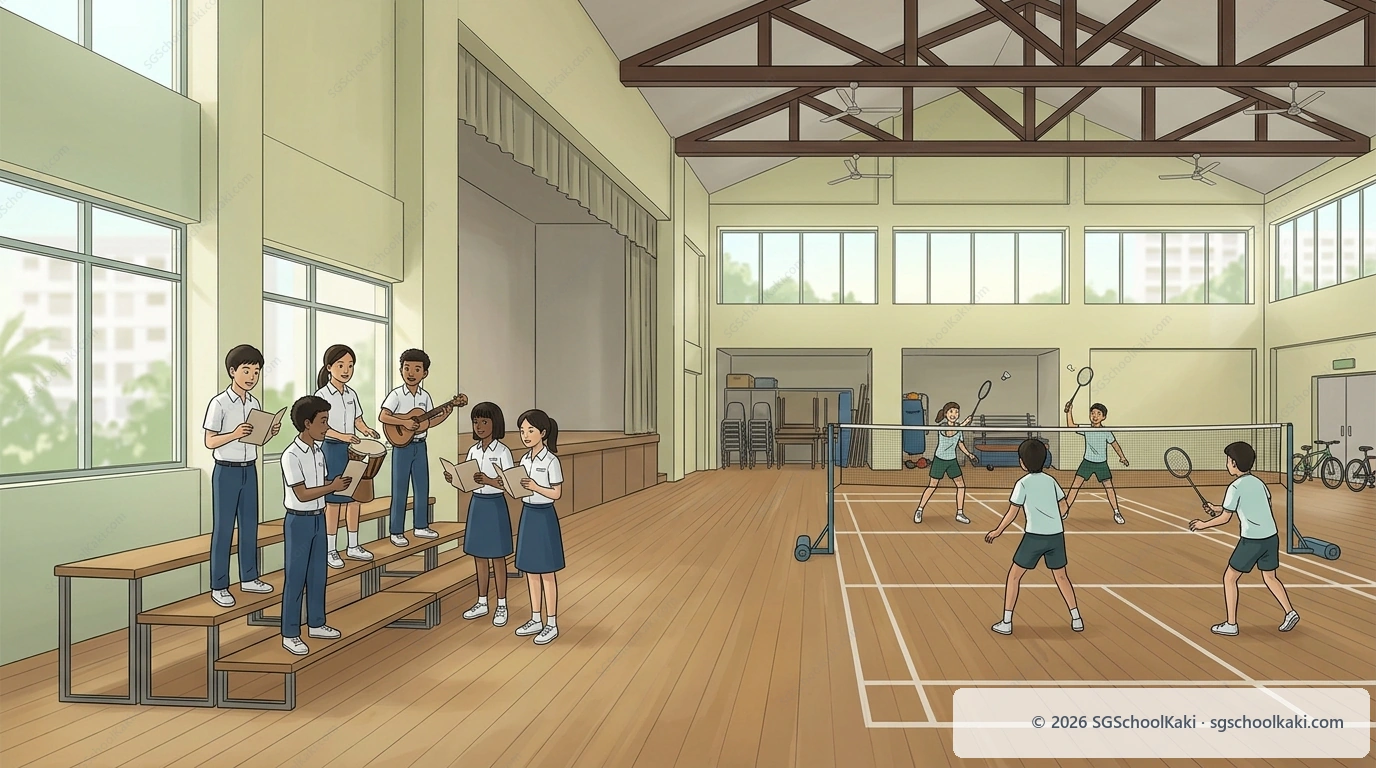
The after-school clubs
A Venn diagram counts people once, even when they belong to two groups.
In a class of 36 students, 20 are in the choir (A),15 are in the badminton team (B) and 8 are in both.
(a)Find how many are in at least one of the two groups.
(b)Find how many are in neither group.
(c)Find how many are in the choir group only.
The four regions of the survey.Show full solutionHide solution
Colour keyadd, subtract, multiply, divide or simplifyexpand, rewrite, substitute or solve
(a)
n(A∪B)=n(A)+n(B)−n(A∩B)
The counting formula: the people in BOTH sets were counted twice, so subtract them once.
n(A∪B)=20+15−8=27
Substitute: choir is A, badminton is B.
(b)
n(E)−n(A∪B)=36−27=9
People in NEITHER set: everyone minus those in at least one set.
(c)
n(A only)=20−8=12
Take the overlap out of set A.
Final answer
(a)27 are in at least one group.
(b)9 are in neither group.
(c)12 are in the choir group only.
Maths In Real Life 2
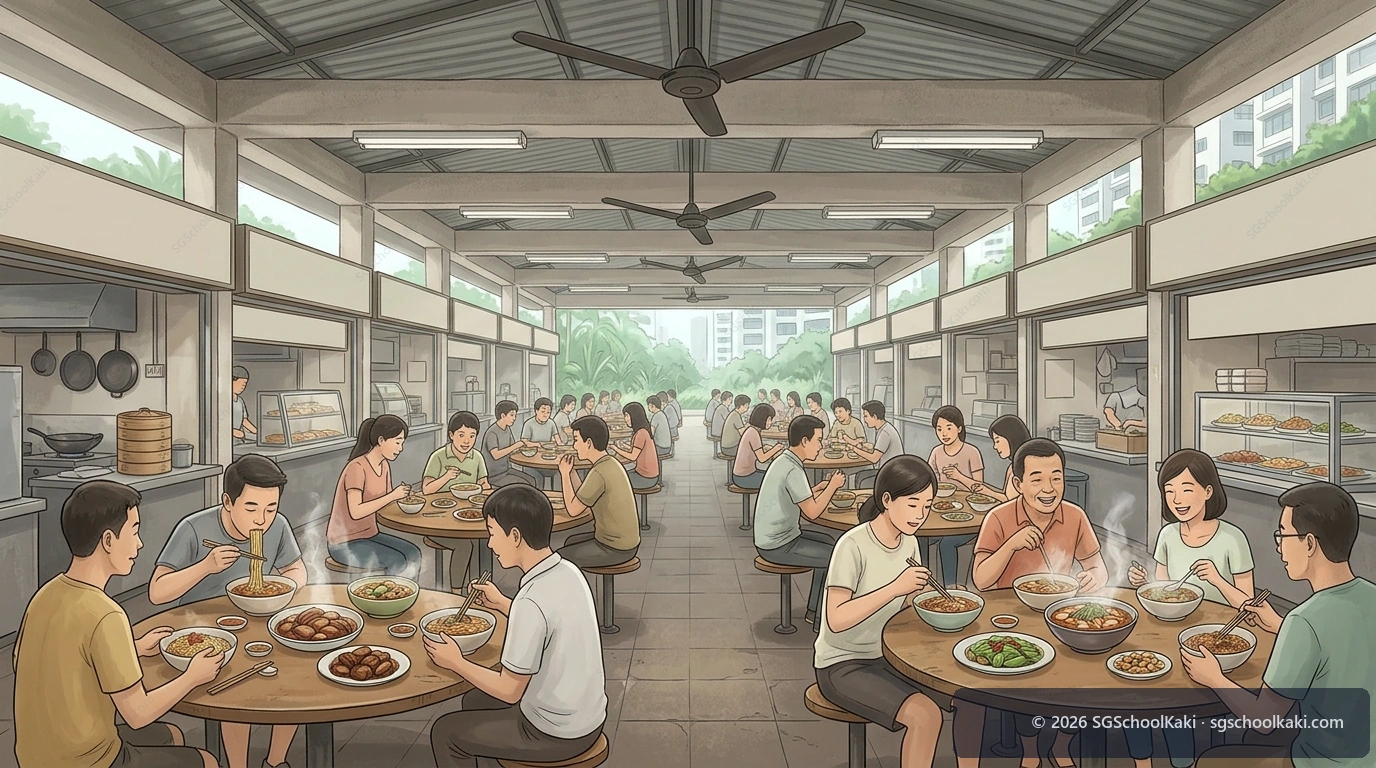
The lunch-time survey
Surveys use overlapping sets to avoid counting the same person twice.
At a hawker centre, 50 customers are surveyed. 31 ordered noodles (A),26 ordered soup (B) and 14 ordered both.
(a)Find how many are in at least one of the two groups.
(b)Find how many are in neither group.
(c)Find how many are in the noodles group only.
The four regions of the survey.Show full solutionHide solution
Colour keyadd, subtract, multiply, divide or simplifyexpand, rewrite, substitute or solve
(a)
n(A∪B)=n(A)+n(B)−n(A∩B)
The counting formula: the people in BOTH sets were counted twice, so subtract them once.
n(A∪B)=31+26−14=43
Substitute: noodles is A, soup is B.
(b)
n(E)−n(A∪B)=50−43=7
People in NEITHER set: everyone minus those in at least one set.
(c)
n(A only)=31−14=17
Take the overlap out of set A.
Final answer
(a)43 are in at least one group.
(b)7 are in neither group.
(c)17 are in the noodles group only.
Maths In Real Life 3
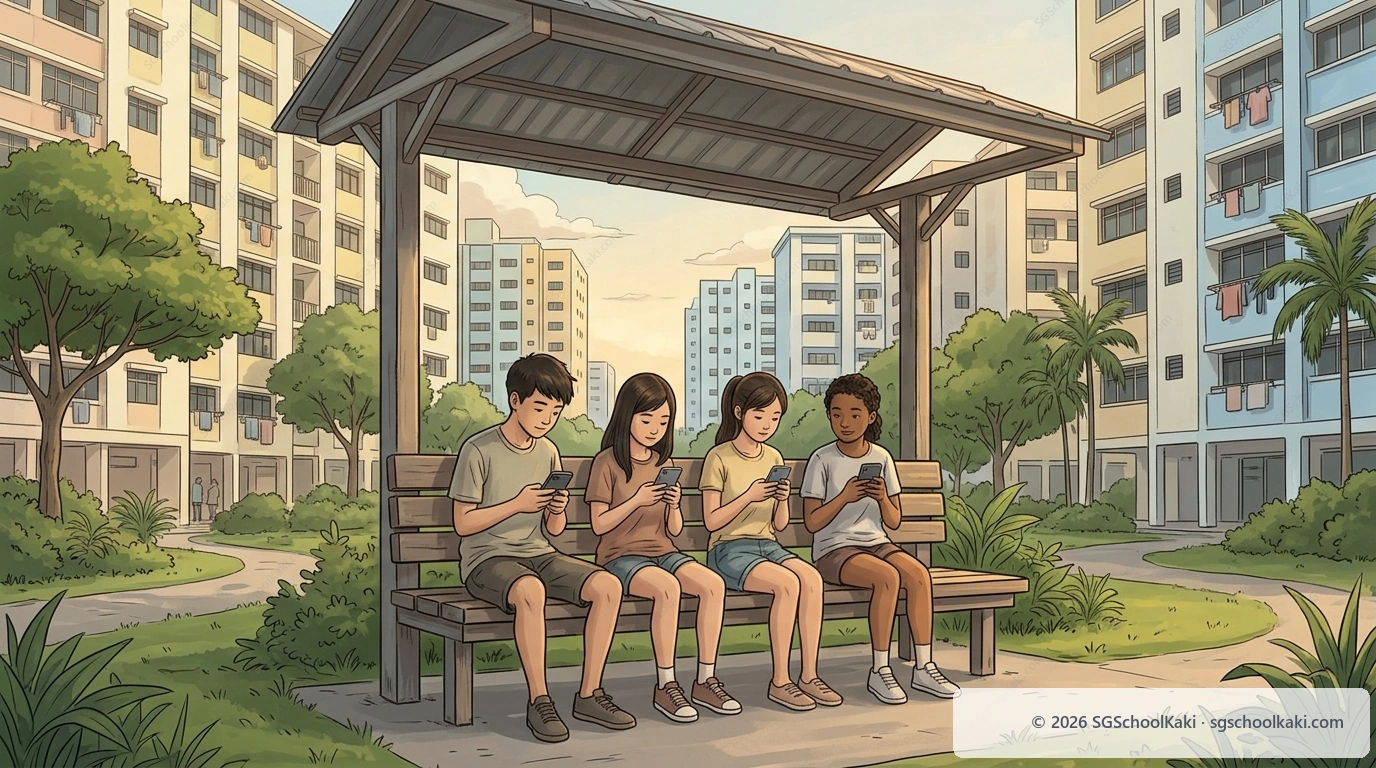
The apps teenagers use
The overlap of two groups is where both memberships are true.
Of 40 teenagers surveyed, 28 use a messaging app (A),22 use a video app (B) and 15 use both.
(a)Find how many are in at least one of the two groups.
(b)Find how many are in neither group.
(c)Find how many are in the messaging group only.
The four regions of the survey.Show full solutionHide solution
Colour keyadd, subtract, multiply, divide or simplifyexpand, rewrite, substitute or solve
(a)
n(A∪B)=n(A)+n(B)−n(A∩B)
The counting formula: the people in BOTH sets were counted twice, so subtract them once.
n(A∪B)=28+22−15=35
Substitute: messaging is A, video is B.
(b)
n(E)−n(A∪B)=40−35=5
People in NEITHER set: everyone minus those in at least one set.
(c)
n(A only)=28−15=13
Take the overlap out of set A.
Final answer
(a)35 are in at least one group.
(b)5 are in neither group.
(c)13 are in the messaging group only.
01
Supports N8.1
Set language and notation
A set is a collection of things, called its elements. We write a set inside curly brackets, for example {a,b,c}. The order does not matter and an element is never written twice.
Learn the symbols as a language: each one is a short way to say something you already understand.
∈ means "is an element of", n(A) counts the elements, A′ is everything NOT in A, and E is the universal set: everything we are talking about.
Case table 1: the notation of sets
Symbol
Read as
Meaning
E
the universal set
everything under discussion
∅ or {}
the empty set
a set with no elements
x∈A
x is an element of A
3∈{1,2,3}
x∈/A
x is not an element of A
5∈/{1,2,3}
n(A)
the number of elements in A
n({4,6,8})=3
A′
the complement of A
all elements of E not in A
A∪B
the union of A and B
in A or B (or both)
A∩B
the intersection of A and B
in both A and B
A⊆B
A is a subset of B
every element of A is in B
A⊈B
A is not a subset of B
some element of A is not in B
A⊂B
A is a proper subset of B
a subset of B that is not B itself
A⊂B
A is not a proper subset of B
either not a subset, or equal to B
SGSchoolKaki Tip
Say it out loud: "A∩B" is "A and B", "A∪B" is "A or B". The cap looks like an upside-down cup: the cup holds everything, the cap keeps only what is common.
Example 1.1
Listing a set and counting it
List the elements of the following set and write down n(A), the number of elements: A={x:x is an integer,3<x≤9}.
Show solutionHide solution
The set A is described by a rule. List every value that satisfies it.
Read the rule slowly, then test each candidate.
A={x:x is an integer,3<x≤9}
The rule.
A={4,5,6,7,8,9}
List the elements in order, once each, inside curly brackets.
n(A)=6
n(A) is the number of elements in the set: count them.
Final answer
A={4,5,6,7,8,9} and n(A)=6
Example 1.2
Is it an element or not?
Here is a set described by a rule: B={x:x is a prime number,x<20}. Write each of 7∈B,9∈B,13∈B and decide whether it is true or false.
Show solutionHide solution
B={x:x is a prime number,x<20}
The rule for the set.
B={2,3,5,7,11,13,17,19}
List its elements first.
7∈B
7 is in the list, so 7∈B (true).
9∈/B
9 is NOT in the list, so the statement 9∈B is false.
13∈B
13 is in the list, so 13∈B (true).
Final answer
7∈B: true; 9∈/B: true, so the statement 9∈B is false; 13∈B: true
Think About It
Is the empty set ∅ a subset of {a,b}? Is {a,b} a proper subset of itself?
Show the worked answerHide the worked answer
S={a,b}
The set.
A set with 2 elements has 22 subsets, because each element is either IN a subset or OUT of it.
Two choices for each element.
∅⊆S
The empty set has NO element that could be missing from S: every element of ∅ is in S.
{a,b}⊂S
S is not a PROPER subset of itself: {a,b} is S itself, so it is not a PROPER subset.
Final answerYes to the first: to fail, ∅ would need an element that is not in the set, and it has none. No to the second: a proper subset must be smaller than the set.
Example 1.3
Subsets and proper subsets
S={a,b,c}. For each statement, decide whether it is true: {a,b}⊂S,{a,b,c}⊂S,∅⊆S,{a,d}⊆S. How many subsets does S have?
Show solutionHide solution
S={a,b,c}
The set.
A set with 3 elements has 23 subsets, because each element is either IN a subset or OUT of it.
Two choices for each element.
{a,b}⊂S
Two of the three elements: a subset of S that is not S itself.
{a,b,c}⊂S
All of the elements: {a,b,c} is S itself, so it is not a PROPER subset.
∅⊆S
No elements: every element of ∅ is in S.
{a,d}⊈S
It contains d:{a,d} has an element that is not in S.
Final answer
{a,b}⊂S;{a,b,c}⊂S;∅⊆S;{a,d}⊈S;8 subsets in all
SGSchoolKaki Tip
Do not mix up ∈ and ⊆.3∈A says the element 3 is in the set; {3}⊆A says the set {3} is inside A.
Locked · Chapter 8
You've read the free 23%. Unlock the rest of Chapter 8.
Still to read in this chapter:
Union, intersection and complement
Venn diagrams
Quick answers
Formula panel
Exercise
$9one-time · all 19 chapters · no subscription
Worked examples, formulas and exam checks. The whole E-Math syllabus.
ONE PRICE19chapters
Premium members get all 19 chapters included.
Notes version 1.0 · Last updated 3 Nov 2026 · Chapter 8 of 19