Ratio and proportion turn up in recipes, maps, money and speed. By the end you can simplify and share in a ratio, read and draw maps with a scale (for lengths and areas), and solve direct and inverse proportion problems.
Your outcome tracker0 / 7
Let's go! Tick an outcome once you can pass its exam check. Saved on this device.
Chapter 2
Figure 1 · Direct: y=kx: a straight line through the origin
4 outcomes · 31 worked examples · every step shown ✦
Ratio basics
Multiply or divide every term by the same number and the ratio does not change.
Fractions, decimals and units
Clear the fractions or decimals, make the units the same, then simplify.
Sharing and changing ratios
Total ÷ total parts = one part. Each share = its parts × one part.
By the end of this chapter
Write ratios of rational numbers in simplest form and share a quantity in a ratio.
Solve ratio problems where one quantity changes.
Use a map scale to find real distances and areas, and the other way round.
Recognise direct and inverse proportion, find the constant, and solve problems.
Use the graph and a table to tell direct from inverse proportion.
✶
Start here
Maths In Real Life
Maths In Real Life 1
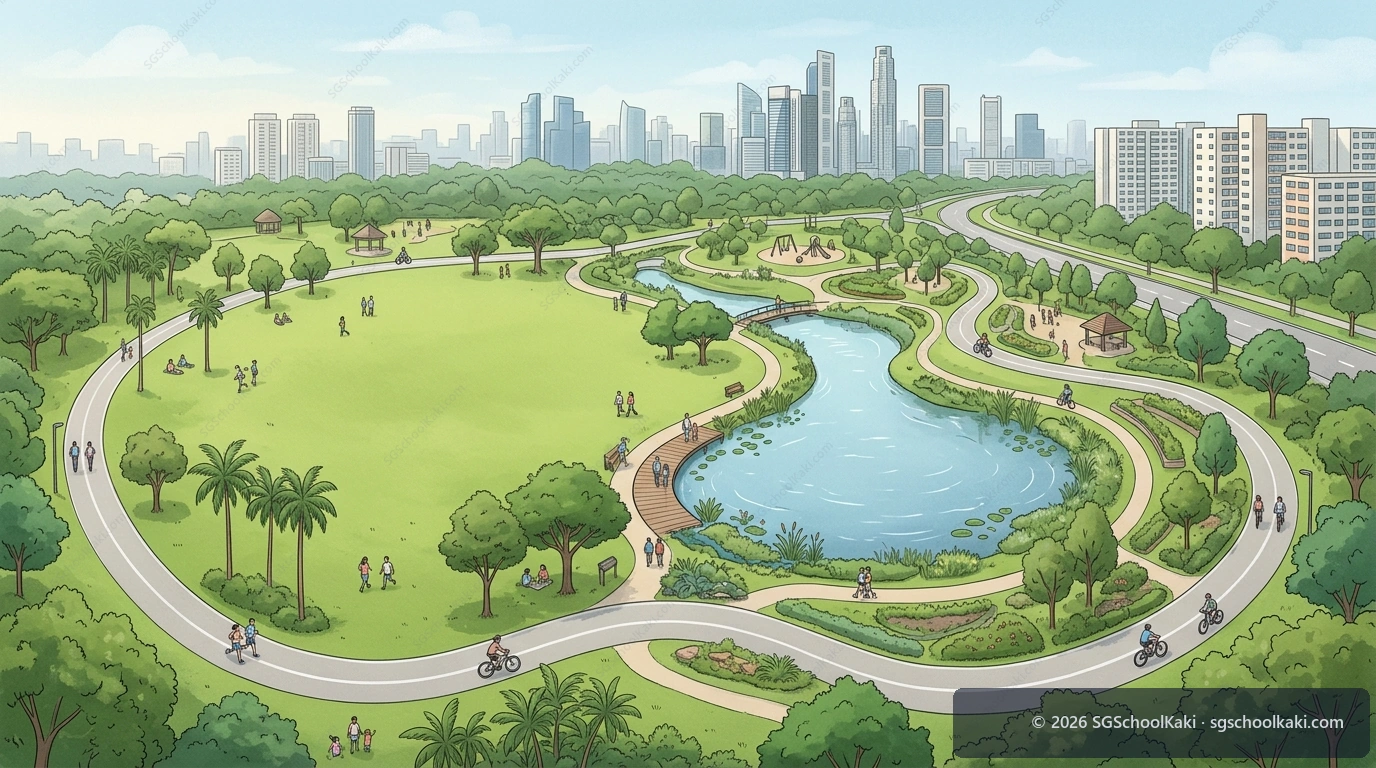
Planning a park run
A map scale lets planners work out real distances and areas from a drawing. Lengths use the scale; areas use the square of the scale.
A park map has scale 1:25000 (made-up map). The running path is 9.2 cm long on the map and the park lawn has area 16 cm² on the map.
(a)Find the real length of the running path in km.
(b)Find the real area of the lawn in km².
(c)A water point is 1.5 km from the start. How far is it from the start on the map?
Show full solutionHide solution
Colour keyadd, subtract, multiply, divide or simplifyexpand, rewrite, substitute or solve
(a)
actual=9.2×25000=230000cm
The scale 1 : 25000 means 1 cm on the map is 25000 cm on the ground.
230000cm÷100000=2.3km
Change centimetres to km: divide by 100000.
(b)
area scale=1:(25000)2=1:625000000
The area scale is the SQUARE of the length scale.
actual=16×625000000=10000000000cm2
Multiply the map area by the area scale number.
10000000000÷10000000000=1km2
Change cm² to km²: divide by 10000000000 (because 1 km = 100000 cm, so 1 km² = 10000000000 cm²).
(c)
1.5km=1.5×100000=150000cm
Change km to centimetres first.
map length=150000÷25000=6cm
Divide by the scale number to shrink the actual length onto the map.
Final answer
(a)2.3km
(b)1km2
(c)6cm
Maths In Real Life 2
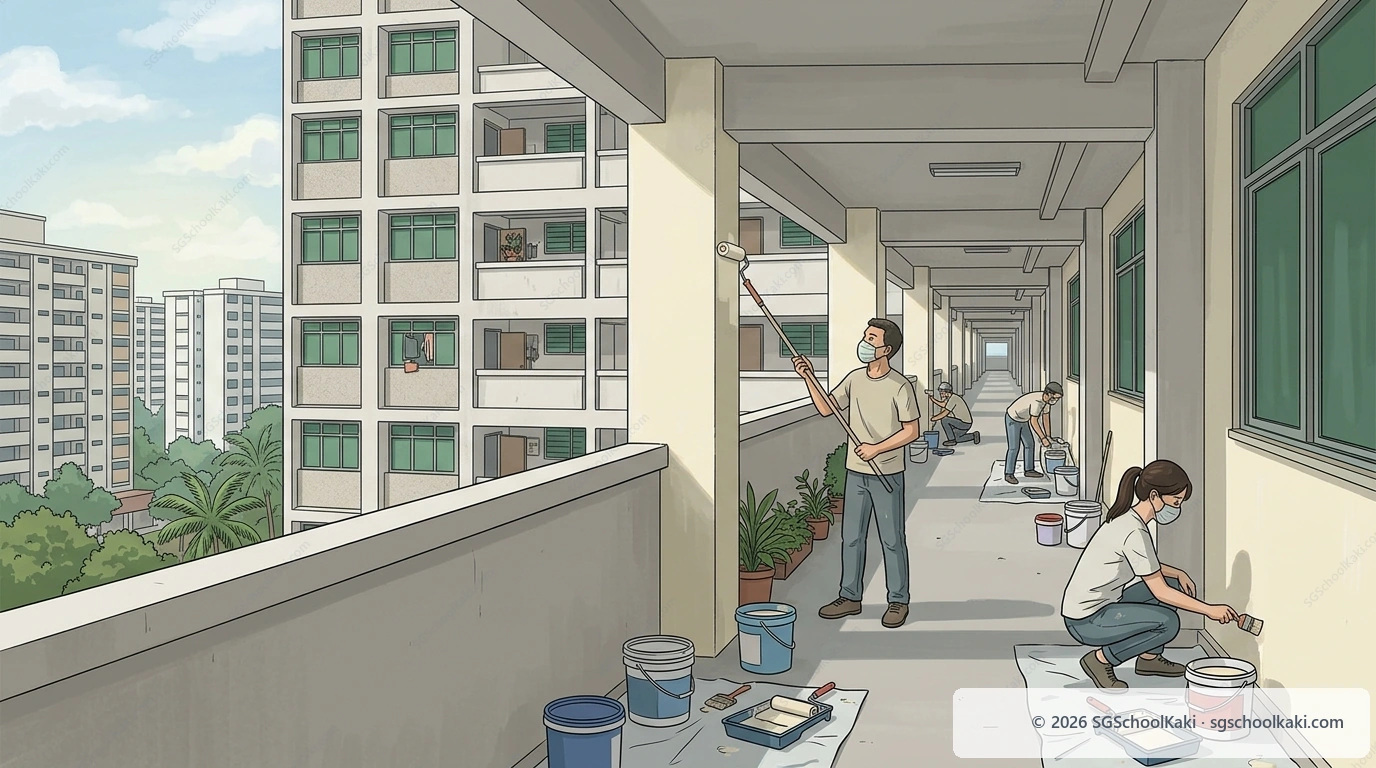
Painting the corridor
When a job is shared among more people, it takes fewer days. Planners use inverse proportion to schedule the work.
5 painters take 12 days to paint all the corridors of a block of flats (made-up numbers). All the painters work at the same rate.
(a)How many days would 4 painters take?
(b)The work must be finished in 6 days. How many painters are needed?
Show full solutionHide solution
Colour keyadd, subtract, multiply, divide or simplify
(a)
More painters means fewer days: the number of days is inversely proportional to the number of painters.
Inverse proportion.
total work=5×12=60(painters×days)
The total amount of work does not change.
days=60÷4=15
Divide the total work by the new number of painters.
(b)
The total work is the same, so painters × days is constant.
Inverse proportion.
5×12=60
Painters × days = total work.
60÷6=10
Divide the total work by the number of days wanted to find the painters needed.
Final answer
(a)15 days
(b)10 painters
Maths In Real Life 3
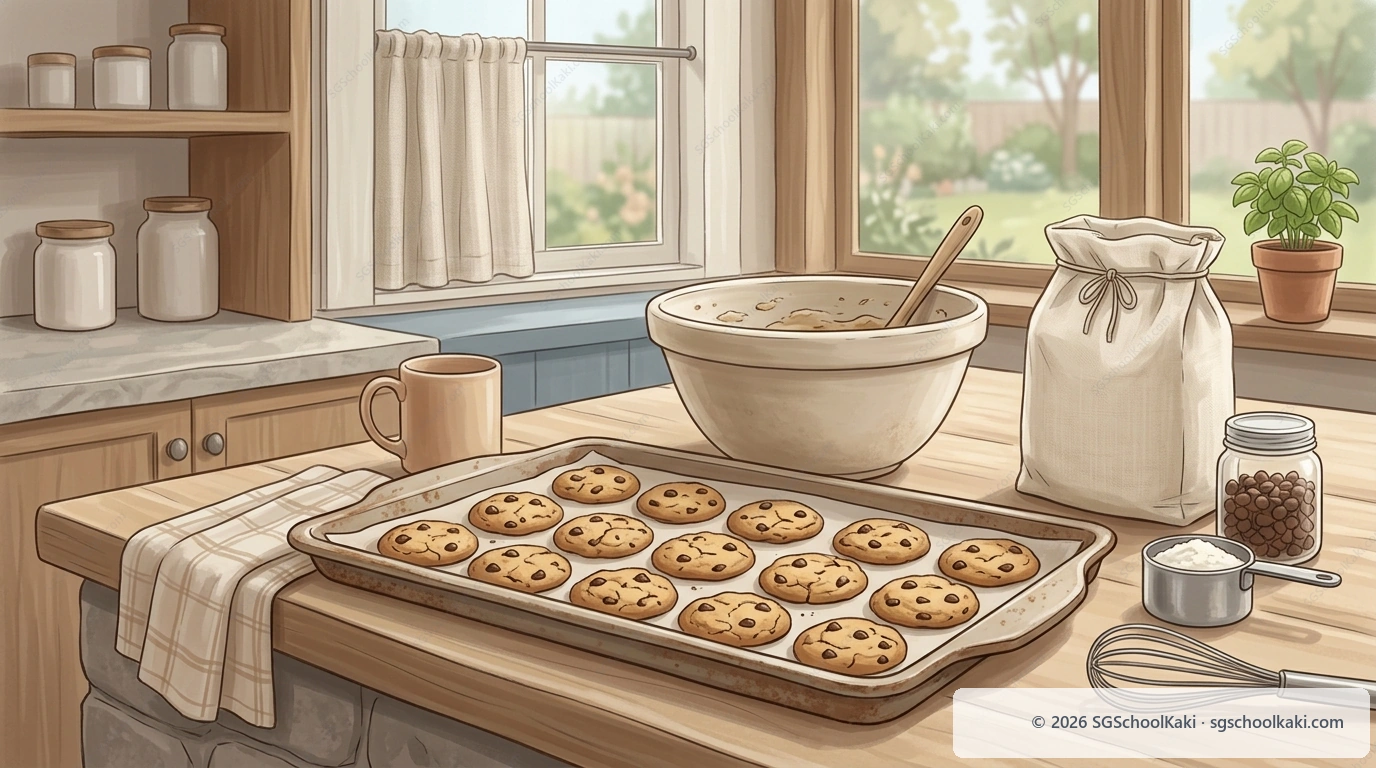
Scaling a recipe
A recipe is a direct proportion: double the cookies and you double the flour. The recipe numbers here are made up.
A recipe uses 300 g of flour to make 12 cookies. The mass m of flour is directly proportional to the number n of cookies.
(a)How much flour is needed for 20 cookies?
(b)How many cookies can be made with 750 g of flour?
Show full solutionHide solution
Colour keyadd, subtract, multiply, divide or simplifyexpand, rewrite, substitute or solve
(a)
m is directly proportional to n, so m=kn for a constant k.
Direct proportion: both quantities grow (or shrink) by the same factor.
300=k×12⇒k=12300=25
Use the given pair of values to find the constant k.
m=25n
Write the relationship with the value of k.
m=25×20=500
Substitute n = 20.
(b)
m is directly proportional to n, so m=kn for a constant k.
Direct proportion: both quantities grow (or shrink) by the same factor.
300=k×12⇒k=12300=25
Use the given pair of values to find the constant k.
What this chapter covers (SEC G3 Mathematics, K310, topic N2)
N2.1: ratios involving rational numbers
N2.2: writing a ratio in its simplest form
N2.3: map scales (distance and area)
N2.4: direct and inverse proportion
Quick refresher (supports K310 topic N2). The ideas below are used throughout this chapter: comparison between two or more quantities by ratio; relationship between ratio and fraction; dividing a quantity in a given ratio; equivalent ratios.
A ratio compares quantities that are measured in the same unit. We write it as a:b. Two ratios are equivalent when you can get one from the other by multiplying or dividing every term by the same number, like 2:3 and 4:6. A ratio is in its simplest form when the terms are whole numbers with no common factor.
The Core Idea
Multiply or divide every term by the same number and the ratio does not change.
Divide by the HCF of all the terms to reach the simplest form.
Example 1.1
Simplest form
Write each ratio in its simplest form.
(i)48:36
(ii)24:36:60
Show solutionHide solution
Colour keyfactorise, HCF or LCM
(i)
HCF of 48,36=12
The HCF is the biggest number that divides every term: use prime factors from Chapter 1.
48:36=48÷12:36÷12=4:3
Divide every term by the HCF. The ratio keeps its meaning but uses the smallest whole numbers.
(ii)
HCF of 24,36,60=12
The HCF is the biggest number that divides every term: use prime factors from Chapter 1.
24:36:60=24÷12:36÷12:60÷12=2:3:5
Divide every term by the HCF. The ratio keeps its meaning but uses the smallest whole numbers.
Final answer
(i)4:3
(ii)2:3:5
Example 1.2
Finding a missing term
Find the value of x in each pair of equivalent ratios.
(i)3:5=x:35
(ii)4:7=20:x
Show solutionHide solution
Colour keyadd, subtract, multiply, divide or simplifyround, estimate or compare
(i)
35÷5=7
Compare the known terms in the same position: the scale factor is 7.
x=3×7=21
Multiply the other term by the same scale factor to keep the ratio equivalent.
(ii)
20÷4=5
Compare the known terms in the same position: the scale factor is 5.
x=7×5=35
Multiply the other term by the same scale factor to keep the ratio equivalent.
Final answer
(i)x=21
(ii)x=35
Ratio and fraction
In the ratio 3:5 there are 3+5=8 parts altogether, so the first share is 83 of the whole, not 53.
Think About It
Is the ratio 3:5 the same as the fraction 53?
Show the worked answerHide the worked answer
Colour keyadd, subtract, multiply, divide or simplify
3+5=8
Add the parts to get the total number of parts.
first share=83
A share is its parts out of ALL the parts, not out of the other share.
Final answerNo. The ratio has 8 parts in all, so the first share is a fraction with 8 on the bottom.
Example 1.3
Ratio as a fraction of the whole
Ali and Ben share some sweets in the ratio 3:5.
(i)What fraction of the sweets does Ali get?
(ii)There are 64 sweets. How many does Ben get?
Show solutionHide solution
Colour keyadd, subtract, multiply, divide or simplify
(i)
3+5=8
Add the parts to get the total number of parts.
the first share=83,the second share=85
Each part is that many parts out of the total number of parts.
(ii)
3+5=8
Total number of parts.
85×64=40
Fraction of the total × the total.
Final answer
(i)The first share is 83 of the total and the second is 85 of the total.
Ratios often involve fractions, decimals or different units. Turn them into whole numbers first: multiply by a number that clears the fractions or decimal points, convert to a common unit, then simplify. When two ratios share a quantity, match that quantity to combine them.
The Core Idea
Clear the fractions or decimals, make the units the same, then simplify.
The ratio of two rational numbers is a ratio of whole numbers once you scale up.
Example 2.1
A ratio of fractions
Write 32:65 as a ratio of whole numbers in simplest form.
Show solutionHide solution
Colour keyfactorise, HCF or LCM
32:65=32×6:65×6
Multiply every term by the LCM of the denominators, 6, to clear the fractions.
=4:5
All the terms are now whole numbers.
Final answer
4:5
Example 2.2
A ratio of decimals
Write 0.45:0.6 in simplest form.
Show solutionHide solution
Colour keyadd, subtract, multiply, divide or simplifyfactorise, HCF or LCM
0.45:0.6=0.45×20:0.6×20
Multiply every term by 20 (a number that makes every decimal a whole number) to clear the decimal points.
=9:12
All the terms are now whole numbers.
=3:4
Divide by the HCF, 3, to reach the simplest form.
Final answer
3:4
Example 2.3
Different units
A film lasts 1.5 hours and an advert break lasts 40 minutes. Find the ratio of the film time to the break time in simplest form.
Show solutionHide solution
Colour keyfactorise, HCF or LCMexpand, rewrite, substitute or solve
1.5hours=1.5×60=90minutes
There are 60 minutes in 1 hour: change hours to minutes so both are in the same unit.
90:40
Now both quantities are in the same unit, so the units can be dropped.
HCF of 90,40=10
The HCF is the biggest number that divides every term: use prime factors from Chapter 1.
90:40=90÷10:40÷10=9:4
Divide every term by the HCF. The ratio keeps its meaning but uses the smallest whole numbers.
Final answer
9:4
Example 2.4
Joining two ratios
a:b=3:4 and b:c=6:7. Find a:b:c.
Show solutionHide solution
Colour keyfactorise, HCF or LCMexpand, rewrite, substitute or solve
LCM of 4 and 6=12
Make the shared quantity (the middle term) the same in both ratios.
3:4=9:12(×3),6:7=12:14(×2)
Scale each ratio so that its middle term equals the LCM.
9:12:14
Now the middle terms match, so the two ratios can be joined.
Final answer
9:12:14
SGSchoolKaki Tip
Always check the answer by reading it back: does the first ratio still appear when you take the first two terms?
03
Supports N2.1 · K210-N2.3
Sharing in a ratio and ratio problems
To share a quantity in a ratio, add the parts, find the value of ONE part, then multiply. Many ratio problems give a difference, or a change to one quantity, instead of a total. In every case, find what one part is worth.
The Core Idea
Total ÷ total parts = one part. Each share = its parts × one part.
If you are given a difference instead, divide it by the number of parts it covers.
Example 3.1
Sharing money in a ratio
Mei and Raj share $180.00 in the ratio 3:5. Find how much each person gets.
Show solutionHide solution
Colour keyadd, subtract, multiply, divide or simplify
3+5=8
Add the parts to find the total number of parts.
1 part=$180.00÷8=$22.50
Divide the total by the number of parts to find the value of one part.
3×$22.50=$67.50,5×$22.50=$112.50
Multiply by the number of parts in each share.
$67.50+$112.50=$180.00
Check: the shares add up to the total.
Final answer
Mei: $67.50; Raj: $112.50
Example 3.2
A three-way share
96 kg of rice is shared among A, B and C in the ratio 2:3:5. Find each share.
Show solutionHide solution
Colour keyadd, subtract, multiply, divide or simplify
2+3+5=10
Add the parts to find the total number of parts.
1 part=96kg÷10=9.6kg
Divide the total by the number of parts to find the value of one part.
2×9.6=19.2,3×9.6=28.8,5×9.6=48
Multiply by the number of parts in each share.
19.2+28.8+48=96
Check: the shares add up to the total.
Final answer
A: 19.2kg; B: 28.8kg; C: 48kg
Example 3.3
A difference is given
Two friends save in the ratio 2:5. The second has $45.00 more than the first. Find the total saved.
Show solutionHide solution
Colour keyadd, subtract, multiply, divide or simplify
5−2=3
The difference between the two shares is this many parts.
3 part(s)=$45.00⇒1 part=$15.00
Divide the known difference by the number of parts it covers.
total=7×$15.00=$105.00
Multiply by the total number of parts.
Final answer
The total is $105.00.
Example 3.4
A quantity changes
A bag has red and blue marbles in the ratio 7:4. After 12 blue marbles are added, the ratio becomes 7:6. How many marbles of each colour were there at first?
Show solutionHide solution
Colour keyadd, subtract, multiply, divide or simplifyexpand, rewrite, substitute or solve
red:blue=7:4before,7:6after
Write the ratio before and after.
The number of red does not change, and its parts are already equal in both ratios.
Match the unchanged quantity.
after=7:6
The unchanged part is now the same in both ratios.
6−4=2parts
This many parts are the 12 that were added.
2 part(s)=12⇒1 part=6
Find the value of one part.
red:7×6=42,blue:4×6=24
Original amounts = parts × value of one part.
Final answer
Originally: red 42, blue 24.
Example 3.5
The unchanged part needs matching
A class has boys and girls in the ratio 4:5. After 6 girls join, the ratio becomes 2:3. How many boys and girls were there at first?
Show solutionHide solution
Colour keyadd, subtract, multiply, divide or simplifyexpand, rewrite, substitute or solve
boys:girls=4:5before,2:3after
Write the ratio before and after.
The number of boys does not change, so make its parts equal in both ratios: multiply the new ratio by 2.
Match the unchanged quantity.
after=4:6
The unchanged part is now the same in both ratios.
6−5=1parts
This many parts are the 6 that were added.
1 part(s)=6⇒1 part=6
Find the value of one part.
boys:4×6=24,girls:5×6=30
Original amounts = parts × value of one part.
Final answer
Originally: boys 24, girls 30.
SGSchoolKaki Tip
When one quantity changes, do not add the change to the ratio terms. The change is a number of items, so it must be matched with the right number of parts.
04
Supports N2.3
Map scales: distance
A map scale links a length on the map to the real length on the ground. The ratio scale 1:n means that 1 cm on the map stands for n cm on the ground. Convert centimetres to metres or kilometres at the end: 100 cm = 1 m and 100 000 cm = 1 km.
The Core Idea
Map length × n = real length. Real length ÷ n = map length.
Work in centimetres, then convert to metres or kilometres.
Figure 1: a park drawn at scale 1 : 50 000. The scale bar shows how far 4 cm on the map is on the ground.Example 4.1
From the map to the ground
The scale of a map is 1:50000. Two MRT stations are 6.4 cm apart on the map. Find the real distance in km.
Show solutionHide solution
Colour keyadd, subtract, multiply, divide or simplify
actual=6.4×50000=320000cm
The scale 1 : 50000 means 1 cm on the map is 50000 cm on the ground.
320000cm÷100000=3.2km
Change centimetres to km: divide by 100000.
Final answer
3.2km
Example 4.2
From the ground to the map
The scale of a map is 1:50000. A road is 4.5 km long. How long is it on the map, in cm?
Show solutionHide solution
Colour keyadd, subtract, multiply, divide or simplifyexpand, rewrite, substitute or solve
4.5km=4.5×100000=450000cm
Change km to centimetres first.
map length=450000÷50000=9cm
Divide by the scale number to shrink the actual length onto the map.
Final answer
9cm
Example 4.3
Finding the scale
On a map, 3 cm represents 1.2 km. Write the scale in the form 1:n.
Show solutionHide solution
Colour keyadd, subtract, multiply, divide or simplifyexpand, rewrite, substitute or solve
1.2km=120000cm
Change km to centimetres so both lengths use the same unit.
3cm:120000cm=1:120000÷3
Divide both terms by the map length to get 1 on the left.
=1:40000
This is the ratio scale.
Final answer
1:40000
Example 4.4
Two questions on one map
A running track measures 36 cm on a map with scale 1:20000.
(i)Find the real length of the track in km.
(ii)A runner covers 5 km. How long would that be on the map?
Show solutionHide solution
Colour keyadd, subtract, multiply, divide or simplifyexpand, rewrite, substitute or solve
(i)
actual=36×20000=720000cm
The scale 1 : 20000 means 1 cm on the map is 20000 cm on the ground.
720000cm÷100000=7.2km
Change centimetres to km: divide by 100000.
(ii)
5km=5×100000=500000cm
Change km to centimetres first.
map length=500000÷20000=25cm
Divide by the scale number to shrink the actual length onto the map.
Final answer
(i)7.2km
(ii)25cm
SGSchoolKaki Tip
Keep the units straight: the scale 1 : 50 000 compares centimetres with centimetres. Convert to km only at the end.
Locked · Chapter 2
You've read the free 32%. Unlock the rest of Chapter 2.
Still to read in this chapter:
Map scales: area
Direct proportion
Inverse proportion
Formula panel
Exercise
$9one-time · all 19 chapters · no subscription
Worked examples, formulas and exam checks. The whole E-Math syllabus.
ONE PRICE19chapters
Premium members get all 19 chapters included.
Notes version 1.0 · Last updated 3 Nov 2026 · Chapter 2 of 19