









SGSchoolKaki
Loading...
O-Level E-Math notes · Chapter 4

Rate and Speed: O-Level E-Math Notes

Rates are everywhere: litres per minute, dollars per kilogram, kilometres per hour. This chapter shows how to find a rate, how to work out an average speed correctly, and how to convert units such as km/h to m/s without losing marks.

Your outcome tracker0 / 7
Let's go! Tick an outcome once you can pass its exam check. Saved on this device.
Chapter
4
Figure 1 · Distance-time graph (data for Example 4.17)
Distance-time graph of a runRun away at a steady speed, a stop, a faster run away, then a return to the start10203040506070809010020406080100120140160180OTime (s)Distance (m)
2 outcomes · 21 worked examples · every step shown ✦
Rate

rate = amount ÷ time (or amount ÷ another quantity).

Speed, distance and time

speed = distance ÷ time.

Average speed

average speed = total distance ÷ total time.

By the end of this chapter
  • Find an average rate and an average speed, using total amount and total time.
  • Use speed, distance and time at constant speed, including times in hours and minutes.
  • Convert units of speed and other rates, for example km/h to m/s.
  • Read speeds and an average speed from a distance-time graph.
Start here

Maths In Real Life

Three real-looking journeys, each needing a different rate or speed idea. All the distances, times and speeds are made-up practice data.

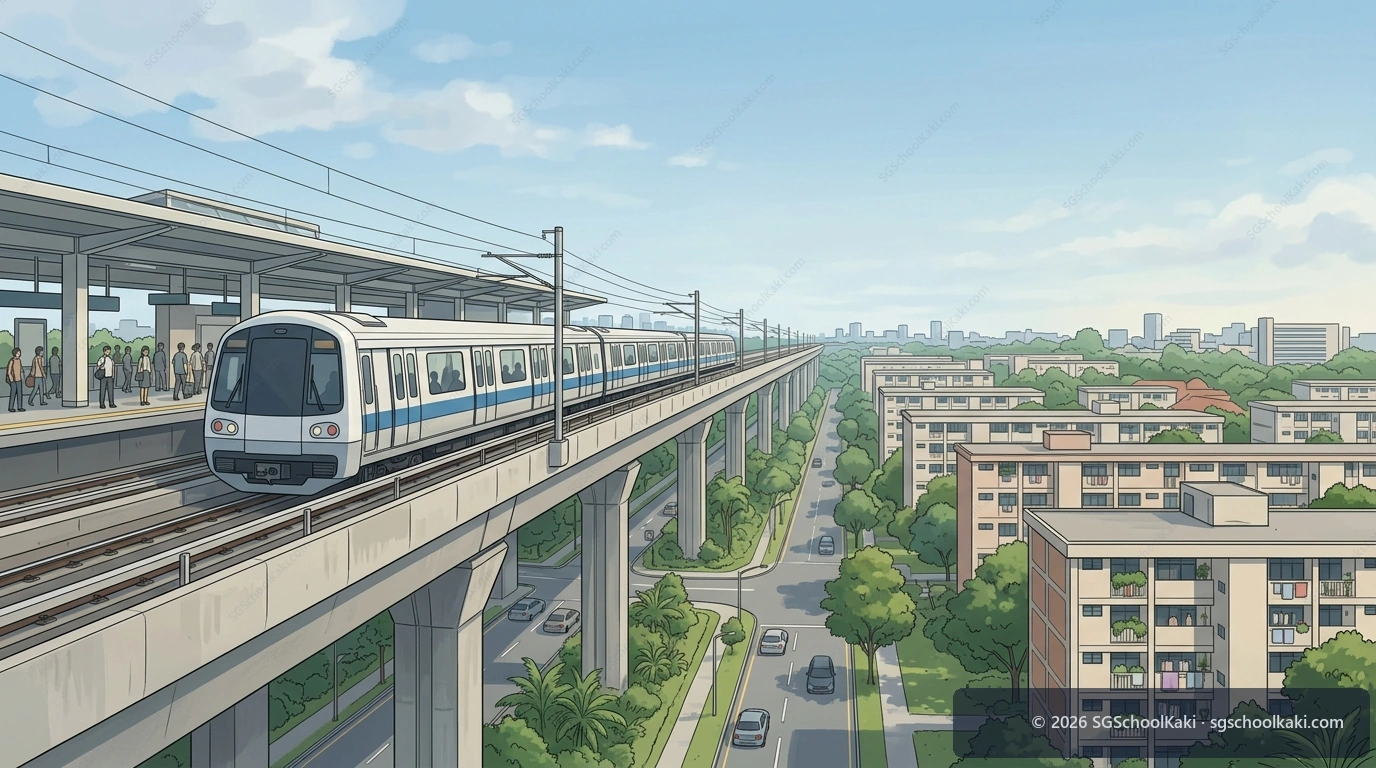
An MRT-style train leaving an elevated station with a long straight viaduct ahead, and a distance bar and a time bar drawn over the picture
Distance 1200 mTime 90 s
Maths In Real Life 1

Between two stations

A train between two stations covers a fixed distance at an almost steady speed, so rate and unit conversion do all the work.

In this question a train covers the 1.2 km between two stations in 90 seconds at a constant speed. Round any answer that is not exact to three significant figures.

  • (a)Find the speed in m/s.
  • (b)Express the speed in km/h.
  • (c)At this speed, how long does a 3 km journey take, in minutes and seconds?
Show full solutionHide solution
Colour keyround, estimate or compare
(a)
1.2 km = 1200 m
1200 ÷ 90 ≈ 13.3 m/s
(b)
1200/90 × 18/5 = 48 km/h
m/s to km/h: × 18/5 (use the exact fraction, not the rounded decimal)
(c)
3 ÷ 48 = 0.0625 h = 3 min 45 s
Final answer
(a)13.3 m/s
(b)48 km/h
(c)3 min 45 s
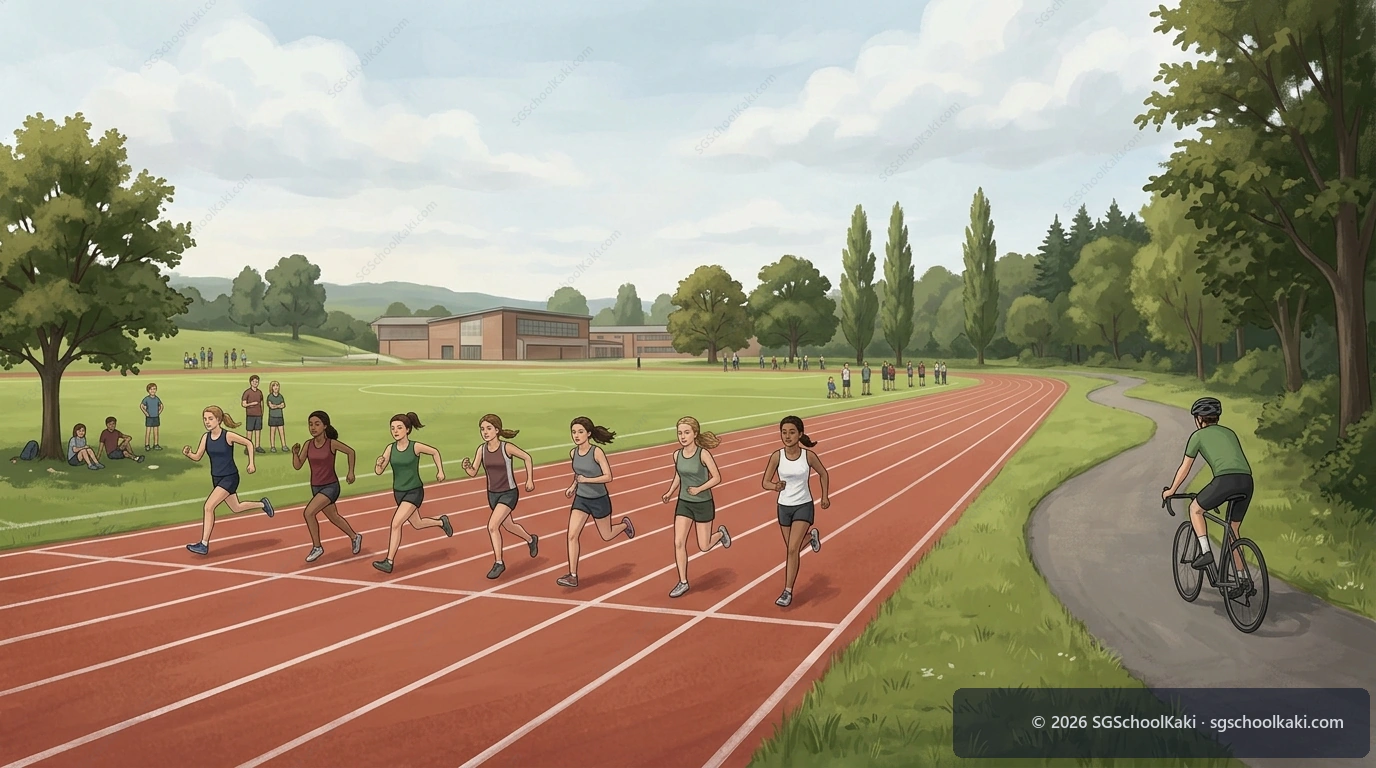
A school sports day with sprinters on a red track and a cyclist beside the field, with a stopwatch and a distance marker drawn over the picture
Sprint: 100 m in 12.5 sCycling: 20 km at 25 km/h
Maths In Real Life 2

Sports day

Athletes quote speed in m/s, cyclists in km/h; converting lets you compare them fairly.

A student runs 100 m in 12.5 seconds. A cyclist rides 20 km at 25 km/h.

  • (a)Find the student's speed in m/s and in km/h.
  • (b)Find the time the cyclist takes, in minutes.
  • (c)Who is faster, the student or the cyclist?
Show full solutionHide solution
Colour keyround, estimate or compare
(a)
100 ÷ 12.5 = 8 m/s
8 × 18/5 = 28.8 km/h
(b)
20 ÷ 25 = 0.8 h
0.8 × 60 = 48 min
(c)
28.8 km/h and 25 km/h: 28.8 is larger
compare in the same units
Final answer
(a)8 m/s = 28.8 km/h
(b)48 minutes
(c)the student (28.8 km/h against 25 km/h)
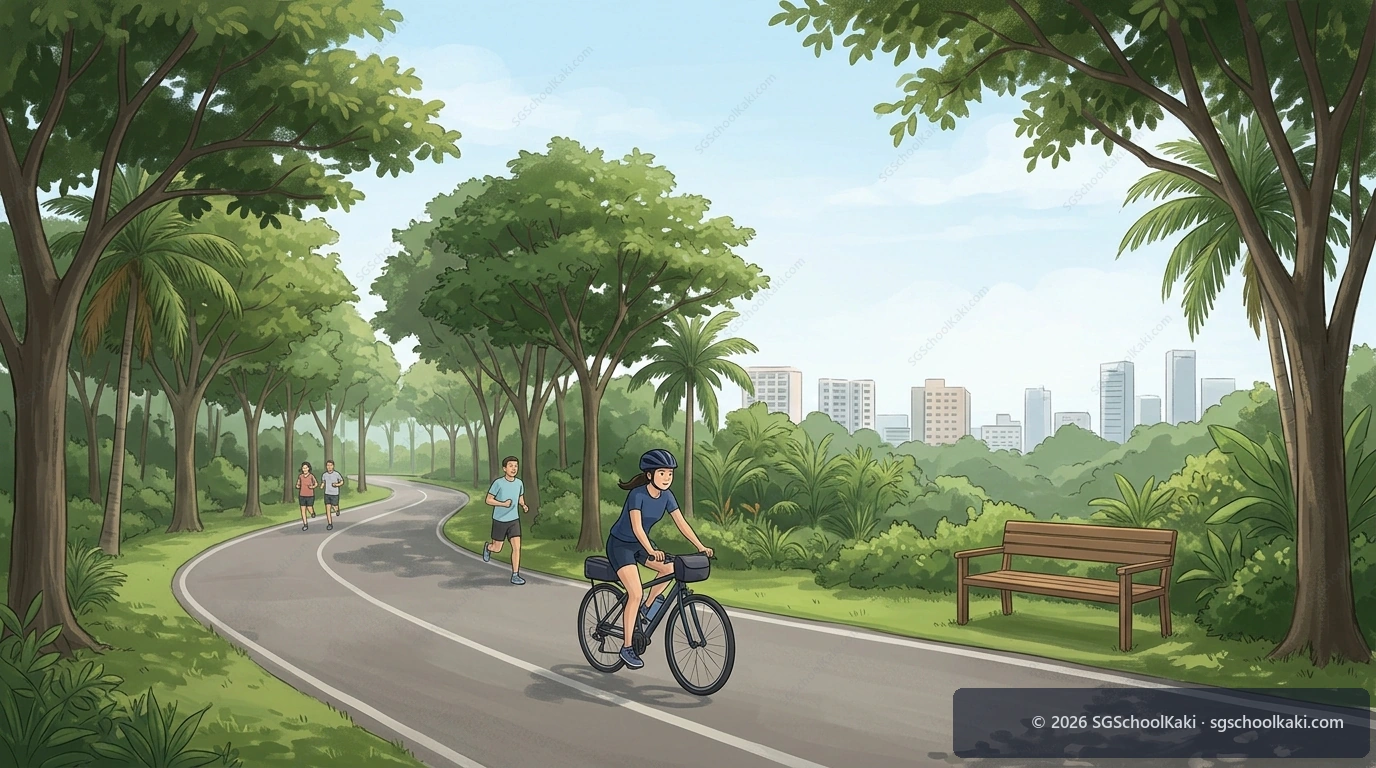
A cyclist on a tree-lined park connector with a bench for resting, and a distance-time line drawn over the picture
4050701218minkmriderestride
Maths In Real Life 3

A ride along the park connector

A ride with a rest stop has two average speeds: one including the rest, and one for the moving time only.

A cyclist rides 12 km in 40 minutes, rests for 10 minutes, then rides a further 6 km in 20 minutes. Round any answer that is not exact to three significant figures.

  • (a)Find the speed on the first part, in km/h.
  • (b)Find the average speed for the whole ride, including the rest.
  • (c)Find the average speed while riding.
Show full solutionHide solution
(a)
40 min = 40/60 h
12 ÷ (40/60) = 18 km/h
(b)
total distance = 12 + 6 = 18 km
total time = 40 + 10 + 20 = 70 min
18 ÷ (70/60) ≈ 15.4 km/h
(c)
total distance = 12 + 6 = 18 km
riding time = 40 + 20 = 60 min = 1 h
18 ÷ 1 = 18 km/h
Final answer
(a)18 km/h
(b)15.4 km/h
(c)18 km/h
Supports N4.1

Rate: one quantity per unit of another

A rate tells you how much of one quantity happens for each one unit of another quantity, such as litres per minute, dollars per kilogram or words per minute. We write a rate as one amount divided by another.

The Core Idea

rate = amount ÷ time (or amount ÷ another quantity).

Always divide so that the second quantity becomes 1. "Litres per minute" means litres ÷ minutes. The unit of the answer tells you what you did.

Example 4.1

Finding a rate

A tap fills a tank with 90 litres in 6 minutes.

  • (i)Find the rate in litres per minute.
  • (ii)At this rate, how long does it take to reach 240 litres?
Show solutionHide solution
Colour keyadd, subtract, multiply, divide or simplify
(i)
rate = 90 ÷ 6 = 15
a rate is an amount divided by a time (one unit of time)
(ii)
time = 240 ÷ 15 = 16
amount ÷ rate gives the time
Check: 15 × 16 = 240
rate × time gives the amount back
Final answer
(i)15 litres per minute
(ii)16 minutes
Example 4.2

Rate for the better buy

Pack A has 750 g for $\text{\textdollar}4.50. Pack B has 1.2 kg for $\text{\textdollar}6.60. Give money answers to the nearest cent. Find the cost of each pack per 100 g, and say which is the better buy.

Show solutionHide solution
Pack B: 1.2 kg = 1200 g
put both quantities in the same unit first
A: 4.5 ÷ 750 × 100 = $\text{\textdollar}0.60
cost per unit amount = price ÷ amount
B: 6.6 ÷ 1200 × 100 = $\text{\textdollar}0.55
$\text{\textdollar}0.55 < $\text{\textdollar}0.60
the smaller cost per unit is the better buy
Final answer
A $\text{\textdollar}0.60, B $\text{\textdollar}0.55; Pack B is the better buy
SGSchoolKaki Tip

To compare prices, first change both quantities to the same unit, then work out the cost for one standard amount (per 100 g, per litre). Compare the two rates, not the two prices.

Example 4.3

Average rate

A machine makes 480 parts in the first 3 hours and 360 parts in the next 2 hours. Find its average rate over the whole 5 hours, in parts per hour.

Show solutionHide solution
total parts = 480 + 360 = 840
average rate uses the totals
total time = 3 + 2 = 5 h
average rate = 840 ÷ 5 = 168
total amount ÷ total time
(Not the mean of the two rates: 160 and 180 give 170, which is different)
the two time periods are different lengths
Final answer
168 parts per hour
Think About It
A tap fills the first half of a tank slowly and the second half quickly. Is the average rate the mean of the two rates?
Show the worked answerHide the worked answer
say the tank holds 100 litres: the first half (50 L) takes 10 minutes and the second half takes 2 minutes
pick easy numbers
rate 1 = 50 ÷ 10 = 5 L/min; rate 2 = 50 ÷ 2 = 25 L/min
mean of the rates = (5 + 25) ÷ 2 = 15 L/min
what the wrong method gives
average rate = 100 ÷ (10 + 2) = 100 ÷ 12 ≈ 8.33 L/min
total amount ÷ total time
8.33 ≠ 15, so it is not the mean
the times are not equal
Final answerNot unless both halves take the same time. The average rate is always total amount ÷ total time.
Supports K210-N4.1 · K210-N4.3 · MOE-constant-speed · N4.2

Speed, distance and time

Quick refresher (supports K310-N4). Speed is a rate: distance travelled per unit of time. If the speed does not change, we say the object moves at constant speed, and the same distance is covered in every equal time.

The Core Idea

speed = distance ÷ time.

(MOE syllabus, supports K310-N4.1.) Rearrange it to find distance or time. Keep the units consistent: km with hours gives km/h, metres with seconds gives m/s.

Case Table 1: the three forms of the speed formula
To findFormulaUnits check
speedspeed = distance ÷ timekm ÷ h = km/h
distancedistance = speed × timekm/h × h = km
timetime = distance ÷ speedkm ÷ km/h = h
Example 4.4

Finding speed

A coach travels 150 km in 2.5 hours. Find the speed in km/h.

Show solutionHide solution
speed = distance ÷ time = 150 ÷ 2.5 = 60
the same idea as a rate: distance per one unit of time
Final answer
60 km/h
Example 4.5

Distance and time at constant speed

A vehicle travels at a constant speed.

  • (i)A car travels at 72 km/h for 2 h 15 min. Find the distance, in km.
  • (ii)A van travels 99 km at 55 km/h. How long is the journey, in hours and minutes (and seconds if needed)?
Show solutionHide solution
Colour keyexpand, rewrite, substitute or solve
(i)
2 h 15 min = 2 + 15/60 = 2.25 h
change the time to hours first
distance = speed × time = 72 × 2.25 = 162
constant speed: the same distance every hour
(ii)
time = distance ÷ speed = 99 ÷ 55 = 1.8 h
1.8 h = 1 h 48 min
turn the decimal part of an hour into minutes: × 60
Final answer
(i)162 km
(ii)1 h 48 min
SGSchoolKaki Tip

2 h 15 min is not 2.15 hours. There are 60 minutes in an hour, so 15 min is 0.25 h and the time is 2.25 h.

Example 4.6

Decimal time to hours, minutes and seconds

Change decimal times into hours, minutes and seconds.

  • (i)Write 3.7 hours in hours and minutes.
  • (ii)Write 5.35 minutes in minutes and seconds.
Show solutionHide solution
(i)
3.7 = 3 + 0.7
whole hours first
0.7 × 60 = 42 min
the decimal part × 60 gives minutes
(ii)
0.35 × 60 = 21 s
the decimal part of a minute × 60 gives seconds
Final answer
(i)3 h 42 min
(ii)5 min 21 s
Locked · Chapter 4

You've read the free 23%. Unlock the rest of Chapter 4.

Still to read in this chapter:

  • Average speed
  • Unit conversion
  • Distance-time graphs
  • Exam-style problems
  • Quick answers
  • Formula panel
  • Exercise

$9 one-time · all 19 chapters · no subscription

Worked examples, formulas and exam checks.
The whole E-Math syllabus.

Premium members get all 19 chapters included.

Notes version 1.0 · Last updated 3 Nov 2026 · Chapter 4 of 19