









SGSchoolKaki
Loading...
O-Level E-Math notes · Chapter 19

Real-World Problems and Personal Finance: O-Level E-Math Notes

The last question in Paper 2 is a real-world problem that mixes topics. This chapter gives you a method for those questions and practises the money contexts the syllabus names: interest, tax, instalments, utilities bills and money exchange, plus reading speed-time graphs and timetables.

Your outcome tracker0 / 10
Let's go! Tick an outcome once you can pass its exam check. Saved on this device.
Chapter
19
Figure 1 · The same starting sum and rate: the compound curve pulls ahead of the straight simple-interest line.
Simple and compound interest on 1000 dollars at 5 percentTwo growth curves: a straight line for simple interest and a curve for compound interest, which pulls ahead over timeYearsAmount (dollars)02468101000120014001600simplecompound
4 outcomes · 33 worked examples · every step shown ✦
Solving real-world problems

Read. Plan. Calculate. Interpret.

Taxation

Each charge multiplies the running total.

Simple interest

I = P × R × T ÷ 100

By the end of this chapter
  • Solve real-world problems from everyday life: recipes, floor plans, transport schedules, sports and games.
  • Work with simple interest, compound interest, taxation, instalments, utilities bills and money exchange.
  • Interpret data from tables and graphs, including distance-time and speed-time graphs.
  • Interpret the solution in the context of the problem.
Start here

Maths In Real Life

Three real-looking situations from this chapter. All the rates, prices and times are made-up practice data, and every part has a full worked solution.

A family at a currency counter with a stack of banknotes, a suitcase and a map, with an arrow showing S dollars changed into ringgit and back drawn over the picture
Change S$1200 at 3.4Spend RM 3100Change back at 3.5
Maths In Real Life 1

Holiday money

A family trip across the Causeway means changing money twice: once to go, and once to come home with what is left.

A family changes S$\text{\textdollar}1200 into RM at S$\text{\textdollar}1 = RM 3.4. They spend RM 3100 on the trip. On the way home they change the rest back into S$\text{\textdollar} at S$\text{\textdollar}1 = RM 3.5. Give money answers to the nearest cent.

  • (a)How many RM do they get at first?
  • (b)How many RM are left after the trip?
  • (c)How much S$\text{\textdollar} do they get back?
  • (d)What did the trip cost them in S$\text{\textdollar}?
Show full solutionHide solution
Colour keyadd, subtract, multiply, divide or simplify
(a)
1200 × 3.4 = 4080
multiply to go to the foreign currency
(b)
4080 − 3100 = 980
(c)
980 ÷ 3.5 = 280
divide at the rate for changing back
(d)
1200 − 280 = 920
S$\text{\textdollar} spent = S$\text{\textdollar} changed − S$\text{\textdollar} returned
Final answer
(a)RM 4080.00
(b)RM 980.00
(c)S$\text{\textdollar}280.00
(d)S$\text{\textdollar}920.00
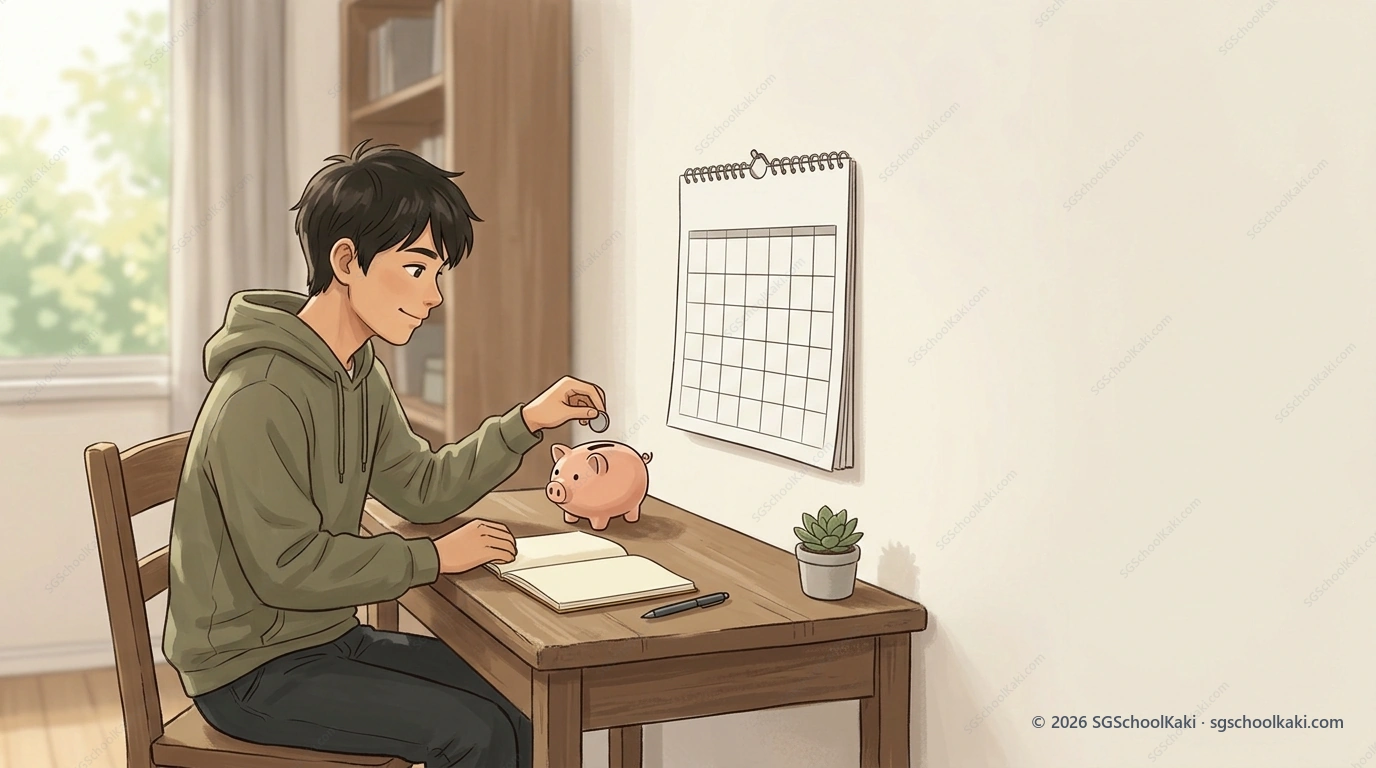
A student with a piggy bank and a notebook beside a calendar, with a rising curve of savings drawn over the picture
4820002500years$(0, 2000)3% compound
Maths In Real Life 2

A savings goal

Compound interest makes a savings plan speed up over time, so the number of years to reach a goal is found by trying values of n.

Aisha puts $\text{\textdollar}2000 into an account that pays 3% per annum compound interest. She wants at least $\text{\textdollar}2500. Give money answers to the nearest cent.

  • (a)How much is in the account after 2 years?
  • (b)What is the smallest whole number of years she must wait?
Show full solutionHide solution
(a)
2000 × 1.0321.03^{2} = 2121.8
(b)
after 7 years: 2000 × 1.0371.03^{7} = 2459.74773084974 ≈ 2459.75, which is less than 2500
try the year before
after 8 years: 2000 × 1.0381.03^{8} = 2533.5401627752322 ≈ 2533.54, which is at least 2500
the first year that reaches the goal
8 is a whole number of years, so no rounding is needed
interpret in context: you cannot wait part of a year for the interest to be added
Final answer
(a)$\text{\textdollar}2121.80
(b)8 years
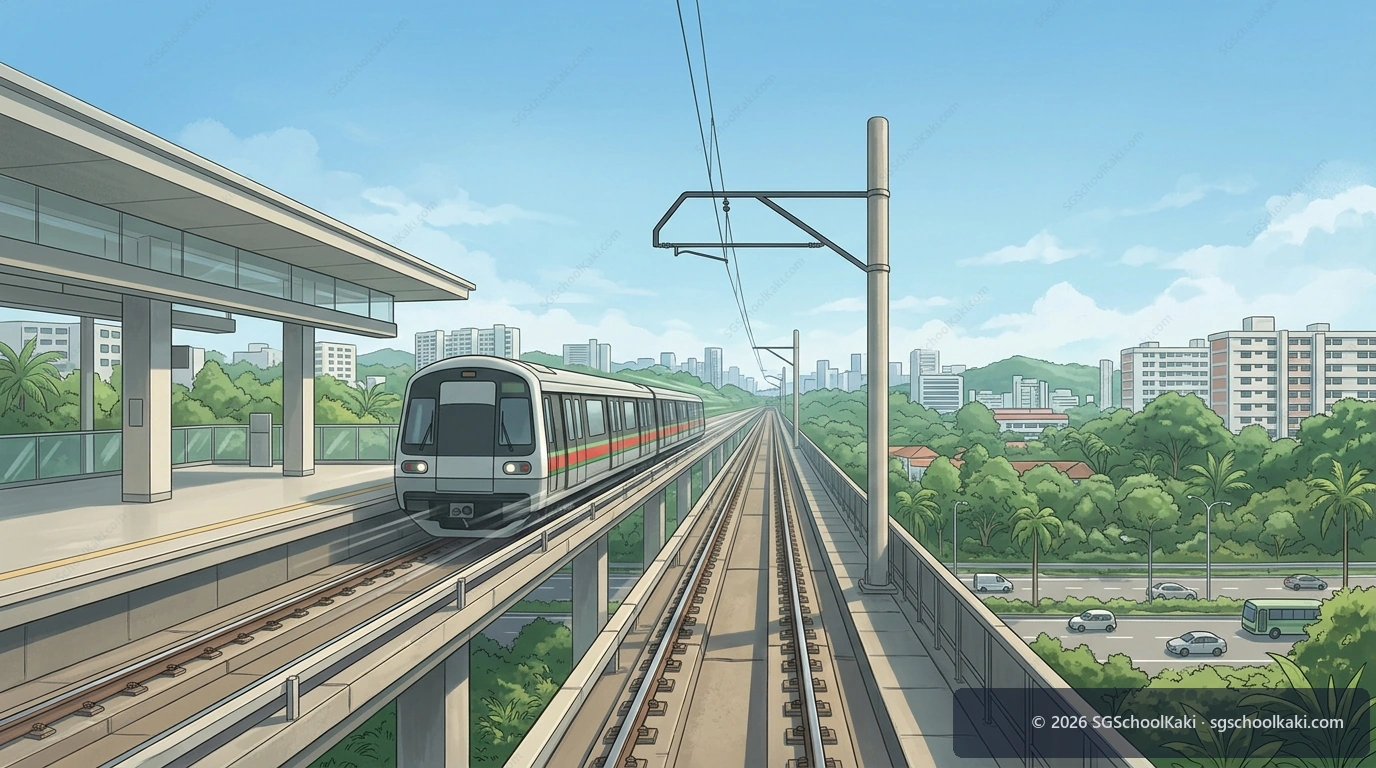
A train pulling out of a station platform with a long straight track ahead, and a speed-time graph with three straight sections drawn over the sky
2010013015time (s)speed (m/s)
Maths In Real Life 3

A train between stations

A speed-time graph tells the whole story of a train journey: how quickly it speeds up, how long it cruises and how hard it brakes.

The speed-time graph shows a train's journey between two stations. The train's speed rises steadily from 0 to 15 m/s in the first 20 s, stays at 15 m/s until t = 100 s, then falls steadily to 0 m/s at t = 130 s. Give answers to three significant figures if they are not exact.

  • (a)Find the acceleration in the first part.
  • (b)Find the gradient of the last part and say what it means.
  • (c)Find the distance between the two stations.
  • (d)Find the average speed for the whole journey.
Speed-time graph of a train between stationsSpeeding up, cruising, then braking to a stop40801201605101520OTime (s)Speed (m/s)
Show full solutionHide solution
(a)
15 ÷ 20 = 0.75 m/s²
gradient of the first line
(b)
(0 − 15) ÷ (130 − 100) = -0.5
change in speed ÷ time, with the speed falling
the gradient is negative, so the train is slowing down at 0.5 m/s²
interpret the sign
(c)
trapezium: (130 + 80) ÷ 2 × 15 = 1575 m
the distance is the area under the graph
pieces: 150 + 1200 + 225 = 1575
triangle + rectangle + triangle
(d)
1575 ÷ 130 ≈ 12.1 m/s
total distance ÷ total time
Final answer
(a)0.75 m/s²
(b)-0.5; the train is braking at 0.5 m/s²
(c)1575 m
(d)12.1 m/s
Supports RW.0 · RW.1 · RW.4

Solving a real-world problem: a method

SEAB says that some examination questions, including the extended problem at the end of Paper 2, may bring together ideas from more than one topic. This chapter gives you a method for those questions, and then practises the money contexts the syllabus names: interest, tax, instalments, utilities bills and money exchange.

The Core Idea

Read. Plan. Calculate. Interpret.

Read the story and underline what is asked. Plan which topic each part needs. Calculate with the full accuracy your calculator gives, and round once at the end to the accuracy the question states. Interpret the answer in the story: does it have the right unit, and is it a sensible whole number of buses, eggs or years?

Example 19.1

Scaling a recipe

A recipe makes 12 muffins. It uses 300 g of flour, 180 mL of milk and 3 eggs. Mei wants to make 14 muffins.

  • (i)Find the amount of each ingredient needed.
  • (ii)Eggs can only be used whole. How many eggs should she use, and why?
Show solutionHide solution
Colour keyadd, subtract, multiply, divide or simplify
(i)
flour: 300 × 14/12 = 350 g
scale factor = 14 ÷ 12
milk: 180 × 14/12 = 210 mL
scale factor = 14 ÷ 12
eggs: 3 × 14/12 = 3.5
scale factor = 14 ÷ 12
(ii)
3.5 eggs is not a whole number
check the answer makes sense in the real situation
round up to 4
using fewer would leave the mixture short; whole items cannot be split
Final answer
(i)flour 350 g; milk 210 mL; eggs 3.5
(ii)4 eggs, rounded up to a whole number
Example 19.2

A floor plan

A floor plan is drawn to a scale of 1 : 50. A room measures 8 cm by 6 cm on the plan.

  • (i)Find the actual length and width of the room, in metres.
  • (ii)Find the actual floor area, in square metres.
Show solutionHide solution
Colour keyadd, subtract, multiply, divide or simplify
(i)
actual = plan × 50: 8 × 50 = 400 cm = 4 m
1 cm on the plan is the scale number of cm in real life
6 × 50 = 300 cm = 3 m
100 cm = 1 m
(ii)
4 × 3 = 12 m²
Check: plan area 48 cm² × 50² ÷ 10000 = 12 m²
areas scale by the square of the scale: a second route
Final answer
(i)4 m by 3 m
(ii)12 m²
SGSchoolKaki Tip

In a context question, always write the unit in the answer line and check that the size is believable. A room that is 400 m wide, or a bus ride of −3 minutes, tells you something went wrong.

Example 19.3

A transport schedule

A bus leaves the interchange at 1405 and then every 15 minutes. A passenger arrives at the stop at 1432 (24-hour clock). At what time does the next bus leave, and how long does she wait?

Show solutionHide solution
Colour keyround, estimate or compare
time since first bus = 1432 − 1405 = 27 min
27 ÷ 15 = 1.8, so wait for bus number 2 after the first
round up: she cannot catch a bus that has already left
2 × 15 = 30 min after 1405 is 1435
wait = 30 − 27 = 3 min
Final answer
1435; she waits 3 minutes
Example 19.4

How many coaches?

187 students go on a trip. Each coach seats 45 students.

  • (i)How many coaches are needed?
  • (ii)How many seats are empty?
Show solutionHide solution
Colour keyadd, subtract, multiply, divide or simplifyround, estimate or compare
(i)
187 ÷ 45 ≈ 4.1556
divide
5 coaches
part of a coach cannot be hired, so round **up**
(ii)
5 × 45 = 225 seats; 225 − 187 = 38
total seats − students
Final answer
(i)5 coaches
(ii)38 seats
Think About It
A question asks for the number of coaches and your calculator shows 4.155... Why is the answer 5 and not 4?
Show the worked answerHide the worked answer
Colour keyadd, subtract, multiply, divide or simplifyround, estimate or compare
187 ÷ 45 ≈ 4.1556
divide the students by the seats
4 coaches seat 4 × 45 = 180 students
check what four coaches can carry
180 < 187, so 7 students have no seat
not enough
5 coaches seat 225 students, which is enough
so round up to five
Final answerFour coaches would leave some students without a seat. When the answer must be a whole number of items that cannot be split, round up if you need enough, and round down if you can only afford so many.
Example 19.5

Sports and games: league points

In a league a win earns 3 points, a draw 1 point and a loss no points. A team has 11 wins and 5 draws so far, and 8 matches left.

  • (i)Find its points so far.
  • (ii)The team wants at least 50 points. What is the fewest number of wins it needs in its remaining matches (assume it draws none and loses the rest)?
Show solutionHide solution
Colour keyadd, subtract, multiply, divide or simplify
(i)
3 × 11 + 1 × 5 = 38
points per result × number of results
(ii)
points needed = 50 − 38 = 12
12 ÷ 3 = 4, so 4 wins are enough
3 wins give only 9 points, which is not enough
4 ≤ 8 matches left, so it is possible
interpret the answer in context
Final answer
(i)38 points
(ii)4 wins
Supports RW.2 · RW.4

Taxation: service charge, GST and income tax

Taxes and charges are percentages applied one after another. In every question the rate is given, and so is what it is charged on, so read the wording closely: "GST on the total of the food and the service charge" is different from "GST on the food only".

The Core Idea

Each charge multiplies the running total.

A service charge of s% multiplies by (100 + s)/100. GST of g% multiplies by (100 + g)/100. Do them in the order the question says, or multiply the two multipliers together.

Example 19.6

A restaurant bill

At a restaurant the food costs $\text{\textdollar}64 before charges. A service charge of 10% is added, and then GST at 9% is charged on the total of the food and the service charge. Give the answer to the nearest cent. Find the total bill.

Show solutionHide solution
Colour keyadd, subtract, multiply, divide or simplifyround, estimate or compare
service charge = 10/100 × 64 = 6.4
a percentage of the food price
sub-total = 64 + 6.4 = 70.4
GST = 9/100 × 70.4 = 6.336
the question says GST is charged on the sub-total
total = 70.4 + 6.336 = 76.736 ≈ $\text{\textdollar}76.74
round once, at the end, to the nearest cent
Check: 64 × 1.1 × 1.09 = 76.736
the two multipliers give the same total
Final answer
$\text{\textdollar}76.74
Example 19.7

Back to the price of the food

A bill including a 10% service charge and then 9% GST on the total is $\text{\textdollar}143.88. Give the answer to the nearest cent. Find the price of the food before any charges.

Show solutionHide solution
Colour keyadd, subtract, multiply, divide or simplify
multiplier = 1.1 × 1.09 = 1.199
combine the two charges
food = 143.88 ÷ 1.199 = $\text{\textdollar}120.00
divide to undo the multiplication
Final answer
$\text{\textdollar}120.00
SGSchoolKaki Tip

Do not add the two percentages together to make one. A service charge of 10% followed by GST of 9% is a multiplier of 1.1 × 1.09 = 1.199, which is 19.9% more, not 19%.

Example 19.8

Prices with and without GST

GST is charged at 9% in this question. Shop A sells a bag for $\text{\textdollar}50 before GST. Shop B sells the same bag for $\text{\textdollar}54 including GST. Give money answers to the nearest cent.

  • (i)Find the price at Shop A including GST.
  • (ii)Which shop is cheaper, and by how much?
  • (iii)Find the price at Shop B before GST.
Show solutionHide solution
Colour keyadd, subtract, multiply, divide or simplifyround, estimate or compare
(i)
50 × 1.09 = $\text{\textdollar}54.50
(ii)
compare $\text{\textdollar}54.50 and $\text{\textdollar}54.00
compare prices that both include GST
difference = $\text{\textdollar}0.50
(iii)
54 ÷ 1.09 ≈ 49.541 ≈ $\text{\textdollar}49.54
reverse percentage: divide by the multiplier
Final answer
(i)$\text{\textdollar}54.50
(ii)Shop B, by $\text{\textdollar}0.50
(iii)$\text{\textdollar}49.54
Example 19.9

Income tax in slices

In a fictional country, income tax is charged in slices: 0% on the first $\text{\textdollar}20000, 5% on the next $\text{\textdollar}10000, 10% on the next $\text{\textdollar}20000 and 15% on any income above $\text{\textdollar}50000. A worker's income is $\text{\textdollar}42000. Give percentages to three significant figures if they are not exact.

  • (i)Find the income tax payable.
  • (ii)Express the tax as a percentage of the income.
Show solutionHide solution
Colour keyadd, subtract, multiply, divide or simplify
(i)
20000 at 0% = 0
the slice of income between 0 and 20000
10000 at 5% = 500
the slice of income between 20000 and 30000
12000 at 10% = 1200
the slice of income between 30000 and 50000
total tax = 1700
add the slices
(ii)
1700 ÷ 42000 × 100 ≈ 4.05%
Final answer
(i)$\text{\textdollar}1700
(ii)4.05%
Supports RW.2

Simple interest

Interest is money paid for the use of money. With simple interest the interest is worked out on the original sum (the principal) every year, so the same amount is added each year.

The Core Idea

I = P × R × T ÷ 100

P is the principal in dollars, R the rate in percent per annum (per year) and T the time in years. The total amount at the end is P + I. Simple interest is not on the paper's formula list, so memorise it.

Example 19.10

Interest and total amount

A sum of $\text{\textdollar}3000 is invested at 2.5% per annum simple interest for 4 years.

  • (i)Find the interest earned.
  • (ii)Find the total amount at the end.
Show solutionHide solution
Colour keyadd, subtract, multiply, divide or simplify
(i)
I = P × R × T ÷ 100 = 3000 × 2.5 × 4 ÷ 100
simple interest is the same amount every year
= 300
(ii)
3000 + 300 = 3300
principal plus interest
Final answer
(i)$\text{\textdollar}300.00
(ii)$\text{\textdollar}3300.00
Example 19.11

Finding the rate

A sum of $\text{\textdollar}1800 earns $\text{\textdollar}162 simple interest in 3 years. Find the rate of interest per annum.

Show solutionHide solution
Colour keyexpand, rewrite, substitute or solve
162 = 1800 × R × 3 ÷ 100
put the numbers into I = PRT ÷ 100
R = 162 × 100 ÷ (1800 × 3) = 3
rearrange for R
Check: interest for one year = 162 ÷ 3 = 54, and 54 ÷ 1800 × 100 = 3%
a second route
Final answer
3% per annum
Example 19.12

Finding the time

$\text{\textdollar}2400 is invested at 3.5% per annum simple interest until the interest is $\text{\textdollar}294. Find the time, in years and months.

Show solutionHide solution
Colour keyexpand, rewrite, substitute or solve
T = 294 × 100 ÷ (2400 × 3.5) = 3.5 years
rearrange I = PRT ÷ 100 for T
0.5 year = 6 months
× 12 for months
Final answer
3 years 6 months
SGSchoolKaki Tip

The time must be in years. Six months is 0.5 years and 18 months is 1.5 years. If you forget, your interest will be 12 times too big or too small.

Example 19.13

Time given in months

A loan of $\text{\textdollar}8000 is charged simple interest at 4.5% per annum for 9 months. Find the interest and the total to be repaid.

Show solutionHide solution
T = 9 ÷ 12 = 0.75 years
the rate is per year, so change months to years
I = 8000 × 4.5 × 0.75 ÷ 100 = 270
total = 8000 + 270 = 8270
Final answer
interest $\text{\textdollar}270.00; total $\text{\textdollar}8270.00
Locked · Chapter 19

You've read the free 31%. Unlock the rest of Chapter 19.

Still to read in this chapter:

  • Compound interest
  • Instalments
  • Utilities bills
  • Money exchange
  • Tables and graphs
  • Extended problems
  • Quick answers
  • Formula panel
  • Exercise

$9 one-time · all 19 chapters · no subscription

Worked examples, formulas and exam checks.
The whole E-Math syllabus.

Premium members get all 19 chapters included.

Notes version 1.0 · Last updated 3 Nov 2026 · Chapter 19 of 19