









SGSchoolKaki
Loading...
E-Math notes · Chapter 10

Angles, Triangles and Polygons: O-Level E-Math Notes

Geometry is detective work: use one fact about angles to find a new angle, write the reason, and repeat. By the end of this chapter you can find unknown angles in lines, parallels, triangles, quadrilaterals and polygons, classify the special quadrilaterals from their properties, and construct figures from given data.

Your outcome tracker0 / 7
Let's go! Tick an outcome once you can pass its exam check. Saved on this device.
Chapter
10
Figure 1 · Square
SquareA quadrilateral ABCD with its angles markedABCD
7 outcomes · 34 worked examples · every step shown ✦
Angle types and basic angle facts

Three facts about angles that sit together.

Parallel lines

Parallel lines make equal pairs and straight-line pairs.

Triangles

The angles of a triangle add up to 180°.

By the end of this chapter
  • Recognise right, acute, obtuse and reflex angles, and use angles on a straight line, angles at a point and vertically opposite angles.
  • Use the angles made by parallel lines and a transversal: corresponding, alternate and interior angles.
  • Use the properties of triangles, special quadrilaterals and regular polygons, including their symmetry, and classify quadrilaterals.
  • Find the sum of interior and exterior angles of a convex polygon, and the angles of regular polygons.
  • Construct simple figures from given data with ruler, compasses, set squares and protractor.
Start here

Maths In Real Life

Three situations where angles fit together or are shared out. The pictures are made separately and the angles are drawn on top by script, so every number matches its problem.

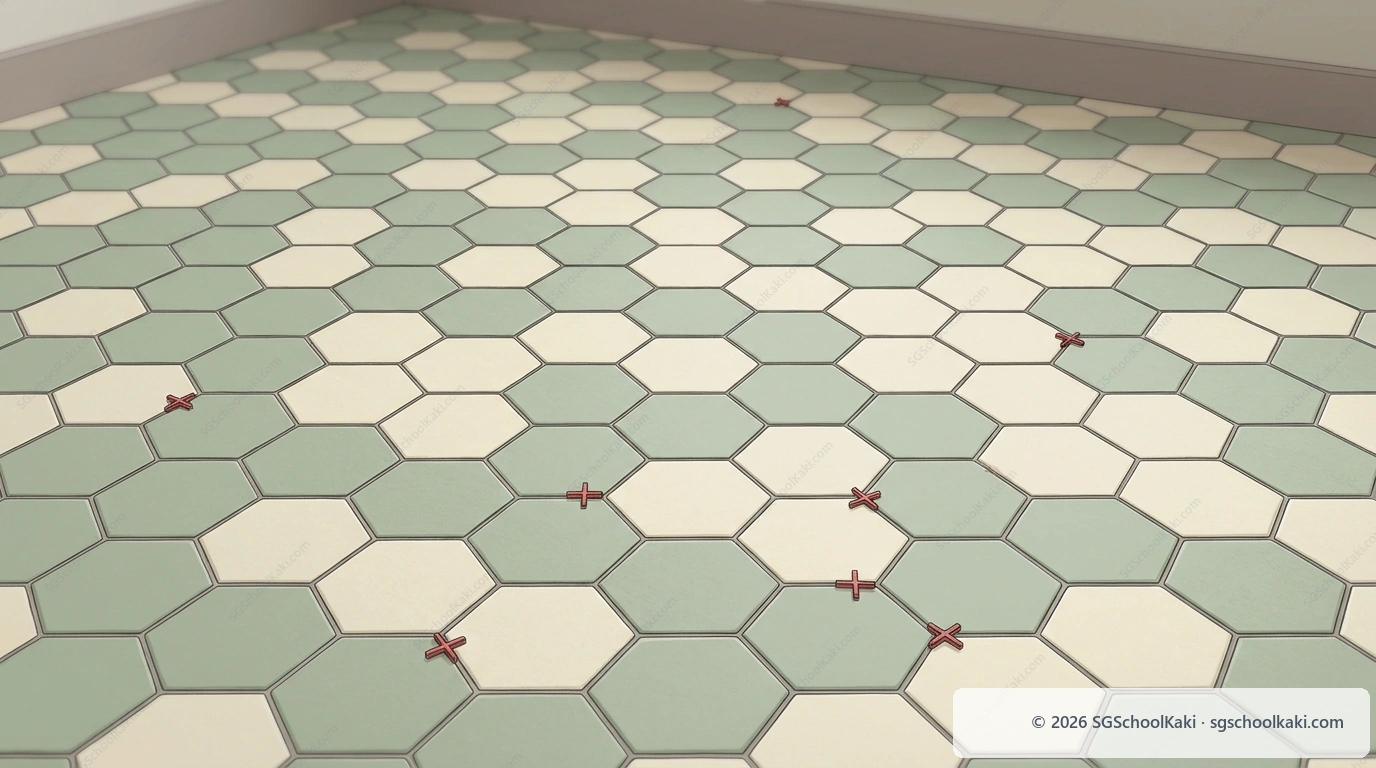
A bathroom floor tiled with regular hexagonal tiles, three tiles meeting at a point, with the three interior angles marked over the picture
Each corner 120°3 × 120° = 360°
Maths In Real Life 1

Tiling a floor with hexagons

Tiles must meet at a point without gaps or overlaps, so their angles at the point have to add up to a full turn.

A floor is tiled with identical regular polygons.

  • (a)3 regular hexagon tiles meet at one point. Show that they fit together with no gap.
  • (b)3 regular pentagon tiles meet at one point. Do they fit together with no gap? Explain.
Show full solutionHide solution
(a)
each interior angle=180−360÷6=120\displaystyle \text{each interior angle} = 180 - 360 \div 6 = 120
interior angle of a regular polygon
3×120=360\displaystyle 3 \times 120 = 360
angles at a point
(b)
each interior angle=180−360÷5=108\displaystyle \text{each interior angle} = 180 - 360 \div 5 = 108
interior angle of a regular polygon
3×108=324\displaystyle 3 \times 108 = 324
angles at a point
360−324=36\displaystyle 360 - 324 = 36
what is left of the full turn
Final answer
(a)3×120∘=360∘3 \times 120^{\circ} = 360^{\circ}, a full turn, so there is no gap and no overlap.
(b)No: 3×10⁸∘=324∘3 \times 108^{\circ} = 324^{\circ} leaves a gap of 36∘36^{\circ}.
A courtyard paved with regular octagonal tiles and square tiles, with the angles at one meeting point marked over the picture
135° + 135° + 90° = 360°
Maths In Real Life 2

Octagons and squares

Some patterns mix two shapes: regular octagons leave square gaps, which can be filled with squares.

A designer uses regular octagonal tiles and square tiles.

Two regular octagons and one square meet at a point. Do they fit with no gap?

Show full solutionHide solution
each octagon: 180−360÷8=135\displaystyle \text{each octagon: } 180 - 360 \div 8 = 135
the quadrilateral: 180−360÷4=90\displaystyle \text{the quadrilateral: } 180 - 360 \div 4 = 90
135+135+90=360\displaystyle 135 + 135 + 90 = 360
angles at a point
Final answer
Yes, they fit with no gap: 135∘+135∘+90∘=360∘.135^{\circ} + 135^{\circ} + 90^{\circ} = 360^{\circ}.
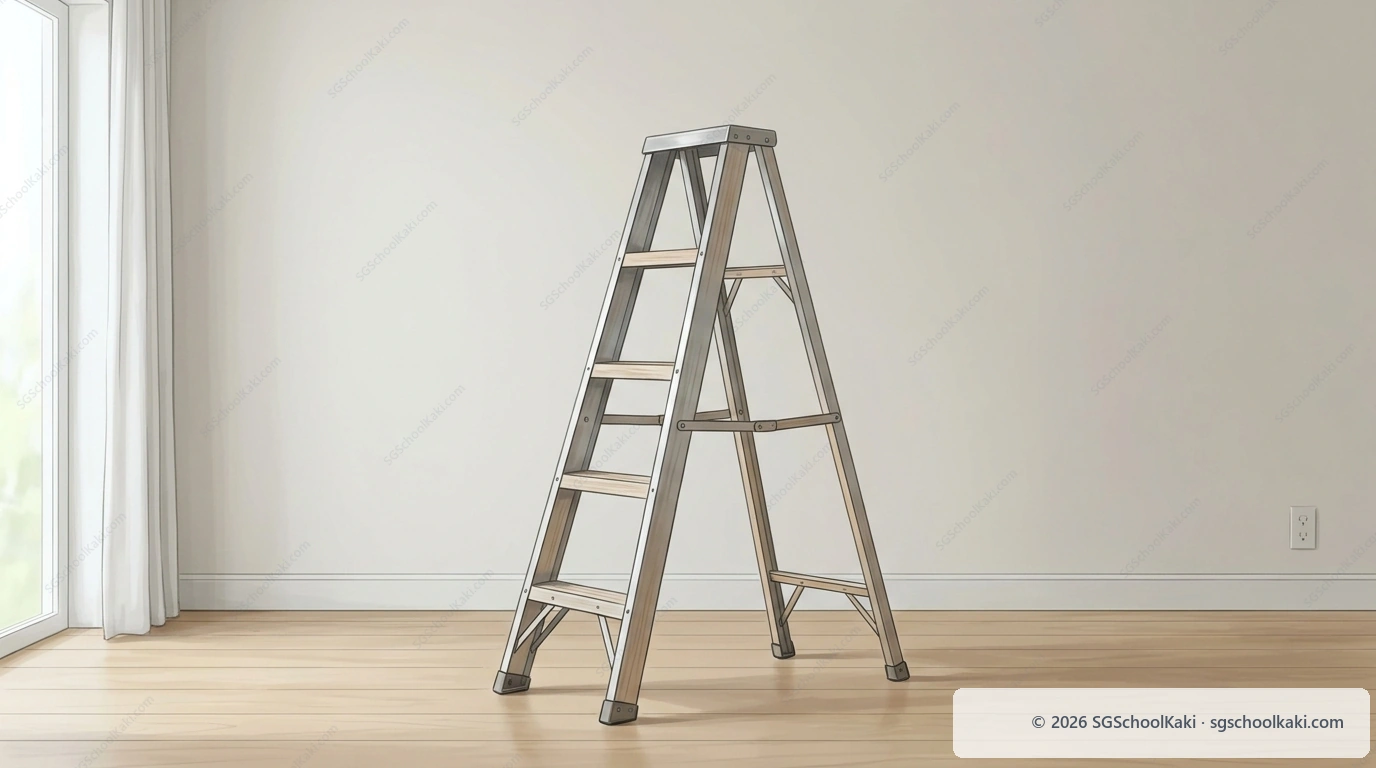
A step-ladder opened on a floor, with the two legs equal and the angle between each leg and the floor marked over the picture
Base angles 65°Apex angle x
Maths In Real Life 3

The step-ladder

A step-ladder opens into an isosceles triangle, because its two legs are the same length.

A step-ladder has two legs of equal length.

A step-ladder is opened so that each leg makes an angle of 65° with the floor. Find the angle between the two legs at the top.

Show full solutionHide solution
The two legs and the floor form an isosceles triangle, because the legs have equal length.
equal legs, equal base angles
65+65+x=180\displaystyle 65 + 65 + x = 180
angle sum of a triangle
x=180−130=50\displaystyle x = 180 - 130 = 50
Final answer
50∘50^{\circ}
Supports G1.1 · G1.2

Types of angle and the basic angle facts

An angle measures a turn, in degrees. Every angle in this chapter is described by how big it is, and by a few rules that connect angles that sit together.

Case table 1: the types of angle (right, acute, obtuse and reflex are the four named in the syllabus)
TypeSizePicture
Acutemore than 0° and less than 90°
Angle diagramAn angle of 40 degrees40°OAB
acute
Rightexactly 90°
Right angleA right angle marked with a squareOAB
right
Obtusemore than 90° and less than 180°
Angle diagramAn angle of 130 degrees130°OAB
obtuse
Straightexactly 180°a straight line
Reflexmore than 180° and less than 360°
Angle diagramAn angle of 250 degrees250°OAB
reflex
The Core Idea

Three facts about angles that sit together.

Angles on a straight line add up to 180°. Angles at a point add up to 360°. Vertically opposite angles (opposite each other where two lines cross) are equal.

Angles on a straight lineA straight line with rays from a point on it; the angles on the line are marked65°x°OBPA
angles on a straight line
Angles at a pointLines meeting at a point O; the angles around O are marked100°90°80°x°OABCD
angles at a point
Vertically opposite anglesTwo straight lines AB and CD cross at O; the four angles at O are marked70°110°70°110°OACBD
vertically opposite angles
SGSchoolKaki Tip

Write the reason beside every step, in standard words: "angles on a straight line", "angles at a point", "vertically opposite angles". A correct number with no reason loses the reasoning mark.

Think About It
Two angles on a straight line are equal. What must each one be?
Show the worked answerHide the worked answer
2x=180\displaystyle 2x = 180
angles on a straight line
x=180÷2=90\displaystyle x = 180 \div 2 = 90
Final answerEach is 90°, so they are right angles.
Example 10.1

Name the angle

Name each angle as acute, right, obtuse, straight or reflex.

  • (i)35°
  • (ii)90°
  • (iii)127°
  • (iv)200°
  • (v)180°
Show solutionHide solution
(i)
35° is more than 0° and less than 90°.
(ii)
90° is exactly 90°.
(iii)
127° is more than 90° and less than 180°.
(iv)
200° is more than 180° and less than 360°.
(v)
180° is exactly 180°.
Final answer
(i)an acute angle
(ii)a right angle
(iii)an obtuse angle
(iv)a reflex angle
(v)a straight angle
Angles on a straight lineA straight line with rays from a point on it; the angles on the line are marked47°x°68°OBPQA
Diagram for Example 10.2
Example 10.2

Angles on a straight line

The diagram shows 3 angles on a straight line. Find xx.

Show solutionHide solution
Colour keyadd, subtract, multiply, divide or simplify
47+x+68=180\displaystyle 47 + x + 68 = 180
angles on a straight line
x=180−47−68\displaystyle x = 180 - 47 - 68
subtract the known angles
x=65\displaystyle x = 65
Final answer
x=65∘x = 65^{\circ}
Angles at a pointLines meeting at a point O; the angles around O are marked105°88°x°73°OABCD
Diagram for Example 10.3
Example 10.3

Angles at a point

Four lines meet at a point, as shown. Find xx.

Show solutionHide solution
Colour keyadd, subtract, multiply, divide or simplify
105+88+x+73=360\displaystyle 105 + 88 + x + 73 = 360
angles at a point
x=360−105−88−73=94\displaystyle x = 360 - 105 - 88 - 73 = 94
subtract the known angles
Final answer
x=94∘x = 94^{\circ}
Two straight lines crossingTwo straight lines AB and CD cross at O; the four angles at O are marked(2x + 10)°40°y°OACBDNot drawn to scale
Diagram for Example 10.4
Example 10.4

Vertically opposite angles with algebra

Two straight lines AB and CD cross at O. Find xx and the angle marked yy.

  • (i)Find xx.
  • (ii)Find the angle AOD (the angle marked yy).
Show solutionHide solution
Colour keyadd, subtract, multiply, divide or simplify
(i)
2x+10=40\displaystyle 2x + 10 = 40
vertically opposite angles
2x=40−10=30\displaystyle 2x = 40 - 10 = 30
move the number across
x=30÷2=15\displaystyle x = 30 \div 2 = 15
divide by the coefficient of x
(ii)
y+40=180\displaystyle y + 40 = 180
angles on a straight line
y=180−40=140\displaystyle y = 180 - 40 = 140
Final answer
(i)x=15x = 15
(ii)y=140∘y = 140^{\circ}
Angles on a straight lineA straight line with rays from a point on it; the angles on the line are markedx°2x°(x + 20)°OBPQANot drawn to scale
Diagram for Example 10.5
Example 10.5

Algebra on a straight line

Three angles on a straight line are marked with expressions in xx. Find xx and the size of the largest of the three angles.

Show solutionHide solution
Colour keyadd, subtract, multiply, divide or simplify
x+2x+(x+20)=180\displaystyle x + 2x + (x + 20) = 180
angles on a straight line
4x+20=180\displaystyle 4x + 20 = 180
collect the x terms and the numbers
4x=180−20=160\displaystyle 4x = 180 - 20 = 160
move the number across
x=160÷4=40\displaystyle x = 160 \div 4 = 40
The largest angle is (2x)(2x) = 8080°.
put x back into each expression
Final answer
x=40x = 40; the largest angle is 80∘80^{\circ}
Supports G1.3 · G1.2

Parallel lines and a transversal

A line that crosses two other lines is a transversal. When the two lines are parallel (marked with matching arrows, written AB // CD), the eight angles it makes have only two sizes, and three named pairs tell you which are equal and which add up to a straight line.

Case table 2: the three pairs of angles when AB // CD
NamePicture (the two marked angles)Shape to spotRelationship
Corresponding angles
Parallel lines: corresponding anglesParallel lines with a pair of corresponding angles marked65°65°ABCDPQEF
in matching positions
Fequal
Alternate angles
Parallel lines: alternate anglesParallel lines with a pair of alternate angles marked65°65°ABCDPQEF
between the lines, opposite sides
Zequal
Interior angles
Parallel lines: interior anglesParallel lines with a pair of interior angles marked65°115°ABCDPQEF
between the lines, same side
Cadd up to 180°
The Core Idea

Parallel lines make equal pairs and straight-line pairs.

If AB // CD then corresponding angles are equal, alternate angles are equal, and interior angles add up to 180°. The reverse also works: equal corresponding or alternate angles show that the lines are parallel.

SGSchoolKaki Tip

Write "AB // CD" inside the reason, for example "alternate angles, AB // CD". The parallel statement is part of the reason.

SGSchoolKaki Tip

Do not use these rules unless the lines are parallel. If the question does not say so and you cannot show it, the rules do not apply.

Think About It
Two interior angles on the same side of a transversal add up to 180°. What does that tell you about the two lines?
Show the worked answerHide the worked answer
Colour keyfinal answer
If the lines were not parallel, the interior angles on one side would add up to more or less than 180°.
so the sum tells you about the direction of the lines
Final answerThe lines are parallel, because the interior angles add up to a straight line.
Parallel lines cut by a transversalTwo parallel lines cut by a straight line; some of the angles are marked72°x°y°z°ABCDPQEF
Diagram for Example 10.6
Example 10.6

Corresponding, alternate and interior angles

In the diagram AB // CD and the line EF crosses them at P and Q. Find xx, yy and zz, giving a reason for each.

  • (i)xx
  • (ii)yy
  • (iii)zz
Show solutionHide solution
(i)
x=72\displaystyle x = 72
corresponding angles, AB // CD
(ii)
y=72\displaystyle y = 72
alternate angles, AB // CD
(iii)
z+72=180\displaystyle z + 72 = 180
interior angles, AB // CD
z=180−72=108\displaystyle z = 180 - 72 = 108
Final answer
(i)72∘72^{\circ} (corresponding angles, AB // CD)
(ii)72∘72^{\circ} (alternate angles, AB // CD)
(iii)108∘108^{\circ} (interior angles, AB // CD)
Parallel lines cut by a transversalTwo parallel lines cut by a straight line; some of the angles are marked128°a°b°c°ABCDPQEF
Diagram for Example 10.7
Example 10.7

A chain of reasons

AB // CD. Use the given angle to find aa, bb and cc, with a reason at every step.

  • (i)aa (the angle QPA)
  • (ii)bb (the angle EPB)
  • (iii)cc (the angle APE)
Show solutionHide solution
(i)
a=128\displaystyle a = 128
corresponding angles, AB // CD (FQC and QPA)
(ii)
b=a=128\displaystyle b = a = 128
vertically opposite angles (QPA and EPB)
(iii)
c+128=180\displaystyle c + 128 = 180
angles on a straight line
c=180−128=52\displaystyle c = 180 - 128 = 52
Final answer
(i)128∘128^{\circ}
(ii)128∘128^{\circ}
(iii)52∘52^{\circ}
Parallel lines cut by a transversalTwo parallel lines cut by a straight line; some of the angles are marked(3x + 10)°(x + 50)°y°ABCDPQEFNot drawn to scale
Diagram for Example 10.8
Example 10.8

Parallel lines with algebra

AB // CD. The angles CQP and BPQ are marked as shown. Find xx and then the angle yy (the angle PQD).

  • (i)Find xx.
  • (ii)Find the angle PQD.
Show solutionHide solution
Colour keyadd, subtract, multiply, divide or simplifyexpand, rewrite, substitute or solve
(i)
3x+10=x+50\displaystyle 3x + 10 = x + 50
alternate angles, AB // CD
2x=40\displaystyle 2x = 40
collect the x terms on one side
x=20\displaystyle x = 20
(ii)
∠CQP=3x+10=70\displaystyle \angle\text{CQP} = 3x + 10 = 70
substitute x
∠PQD+70=180\displaystyle \angle\text{PQD} + 70 = 180
angles on a straight line (CQP and PQD on the line CD)
∠PQD=180−70=110\displaystyle \angle\text{PQD} = 180 - 70 = 110
Final answer
(i)x=20x = 20
(ii)y=110∘y =110^{\circ}
A bent line between parallel linesTwo parallel lines with a bent path XTY between them; the angles at X, Y and T are marked35°40°x°PQRSXYT
Diagram for Example 10.9
Example 10.9

A bent line between parallels

PQ // RS. X is on PQ and Y is on RS, and T lies between the two lines. Find xx, the angle XTY.

Show solutionHide solution
Draw a line through T parallel to PQ and RS. It splits xx into two parts.
an extra line often unlocks the problem
upper part=35\displaystyle \text{upper part} = 35
alternate angles, PQ // the new line
lower part=40\displaystyle \text{lower part} = 40
alternate angles, RS // the new line
x=35+40=75\displaystyle x = 35 + 40 = 75
Final answer
x=75∘x = 75^{\circ}
Two lines and a transversalTwo lines AB and CD cut by a transversal EF; a pair of corresponding angles is marked68°68°PQEFBADC
Diagram for Example 10.10
Two lines and a transversalTwo lines AB and CD cut by a transversal EF; a pair of corresponding angles is marked65°71°PQEFBADC
Diagram for Example 10.10
Example 10.10

Are the lines parallel?

For each diagram, state whether AB is parallel to CD, with a reason.

  • (i)the first diagram
  • (ii)the second diagram
Show solutionHide solution
(i)
The marked angles are corresponding angles: 68° and 68°.
look at which pair of angles is marked
Equal corresponding angles mean parallel lines; unequal ones do not.
the converse of the corresponding-angles rule
(ii)
The marked angles are corresponding angles: 65° and 71°.
Compare them: equal means parallel.
Final answer
(i)AB // CD, because the corresponding angles are equal.
(ii)AB is not parallel to CD, because the corresponding angles are not equal.
Locked · Chapter 10

You've read the free 26%. Unlock the rest of Chapter 10.

Still to read in this chapter:

  • Triangles
  • Quadrilaterals
  • Polygons
  • Constructions
  • Exam-style problems
  • Formula panel
  • Exercise

$9 one-time · all 19 chapters · no subscription

Worked examples, formulas and exam checks.
The whole E-Math syllabus.

Premium members get all 19 chapters included.

Notes version 1.0 · Last updated 3 Nov 2026 · Chapter 10 of 19